Mauritius Residential Property Market Analysis 2026
Housing prices in Mauritius remain on a strong upward trajectory, the trend supported by firm foreign demand and still-attractive mortgage rates, while record-high tourism activity sustains demand for holiday and high-end rentals.
This extended overview from Global Property Guide covers key aspects of the Mauritian housing market and takes a closer look at its most recent developments and long-term trends.
Table of Contents
- Property Prices and Price Index
- Property Demand Trends
- Property Supply Trends
- Rental Market: Rents and Rental Yields
- Mortgage Market and Interest Rates
- Economic and Social Factors
Property Prices and Price Index
Residential property prices in Mauritius remained elevated through 2025, continuing the strong upward trajectory seen in recent years, although growth moderated from the exceptional pace recorded earlier in the cycle. According to the latest available data, the Residential Property Price Index (RPPI) rose by 13.89% year-on-year in Q3 2025.
The Bank of Mauritius (BoM), in its December 2025 Financial Stability Report, observed that the sustained increase in residential property prices, despite a slowdown in mortgage credit growth, suggests that persistent demand-supply pressures have remained the main driver of the market. It further noted that the trend was likely reinforced by still-attractive housing loan rates, foreign demand, and purchases brought forward in anticipation of changes to fiscal incentives.
Mauritius house price annual change:
Propertycloud.mu, the country’s leading real estate platform, reported that the average listing price for apartments for sale in Mauritius reached MUR 20,540,541 (USD 441,270) in 2025, down by 5.20% from a year earlier, while the average listing price for houses stood at MUR 29,900,000 (USD 642,338), up by 4.73% year-on-year. These figures should be interpreted with caution, however, as portal data reflects asking prices rather than completed transactions and is therefore sensitive to changes in listing composition by location, unit size, and market segment, and are best read as a complementary indicator of market positioning and stock mix, rather than as a direct equivalent of the official transaction-based RPPI.
Geographically, the Eastern region registered the highest average listing prices, at MUR 29,800,000 (USD 640,190) for apartments and MUR 119,266,055 (USD 2,562,179) for houses, supported by a thin but ultra-prime stock of branded and resort-linked residences such as One&Only Private Homes and Four Seasons at Anahita. By contrast, the Central region remained the most affordable market, pointing to an increasingly polarized pricing structure, with the island’s coastal luxury corridors continuing to perform very differently from the broader domestic market.
Average for-sale listing price, by region:
| Region | Apartments | Houses | ||
| Average Listing Price, 2025 |
YoY, % | Average Listing Price, 2025 |
YoY, % | |
| Center | MUR 8,500,000 (USD 182,605) |
13.33% | MUR 12,000,000 (USD 257,795) |
4.35% |
| East | MUR 29,800,000 (USD 640,190) |
1.04% | MUR 119,266,055 (USD 2,562,179) |
59.76% |
| North | MUR 22,500,000 (USD 483,365) |
5.58% | MUR 25,000,000 (USD 537,072) |
-1.96% |
| South | MUR 24,000,000 (USD 515,589) |
26.81% | MUR 52,270,270 (USD 1,122,916) |
4.14% |
| West | MUR 22,889,908 (USD 491,741) |
-16.21% | MUR 39,633,028 (USD 851,432) |
-6.41% |
| Note: Exchange rate as of December 2025, USD 1 = 46.5487. | ||||
| Data Source: Propertycloud.mu. | ||||
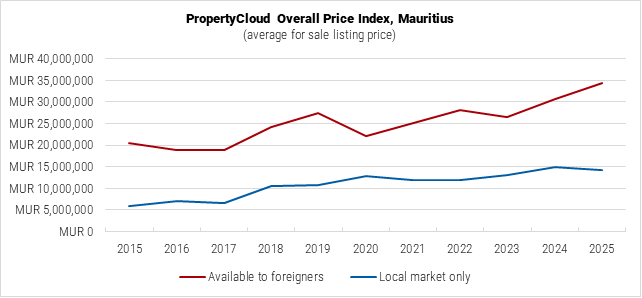
Mauritius operates as a dual residential market, with local citizens able to purchase property freely across the island while foreign buyers are largely restricted to designated schemes approved by the Economic Development Board (EDB). In that context, the gap between foreign-eligible and local-exclusive pricing remains a key feature. Data from Propertycloud.mu shows that the average listing price for properties available to foreign buyers — including apartments, houses, commercial property, and land — reached MUR 34,432,432 (USD 739,708) in 2025, up by 12.62% year-on-year. Meanwhile, properties listed exclusively for Mauritian citizens averaged MUR 14,250,000 (USD 306,131), more than twice as low and down by 5.00% year-on-year, reflecting mounting affordability constraints in the domestic segment.
Data Source: Propertycloud.mu.
Looking ahead, residential sale prices in Mauritius are likely to remain on an upward trajectory in 2026, but the market should become more selective than in 2024–25. Upward pressure should continue to come from still elevated construction costs, limited prime supply, and continued foreign interest in approved residential schemes. At the same time, the policy environment has become less supportive. For domestic buyers, the Home Ownership Scheme and Home Loan Payment Scheme were discontinued after 30 June 2025, while the Housing Loan Relief Scheme was renewed only on a phased-down basis through June 2027. For non-citizens, transaction costs will rise from 1 July 2026, when registration duty on acquisitions under EDB and other approved schemes increases from 5% to 10%, and land transfer tax on sales to non-citizens also moves to 10%.
In practice, this should not reverse the price trend, but it is likely to temper activity and reinforce differentiation across segments. As Philippe de Beer, CEO of Parklane, observed in early 2026, the Mauritian real estate market is entering “a selection cycle” — one in which pricing should remain firm overall, but performance will depend increasingly on location, product quality, and target buyer profile.
Property Demand Trends
Foreign-Buyer Schemes Continue to Support Demand Amid Rising Local Affordability Pressures
Residential demand in Mauritius remains firm, but increasingly segmented. Demand linked to approved foreign-buyer schemes and prime coastal product continues to hold up well, while affordability pressures are becoming more evident in the broader local market. The International Monetary Fund (IMF) analysis shows that residential prices have risen by about 80% between 2019 and 2024, far outpacing the roughly 20% increase in nominal wages. In its June 2025 Financial Stability Report, the BoM similarly flagged the widening gap between property prices and incomes.
Foreign demand continues to be channeled through Mauritius’ regulated acquisition framework. Non-citizens may acquire approved residential property under the IRS, RES, PDS, IHS, Smart City Scheme, and Ground +2 apartment regime, with authorization handled through EDB. Qualifying acquisitions above the prescribed threshold of USD 375,000 may also support residence-permit eligibility, which remains an important part of the market’s appeal for internationally mobile buyers.
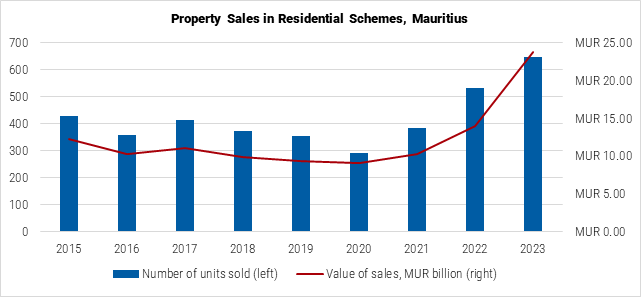
EDB-linked data confirms that this segment has expanded materially since the pandemic. The latest detailed market review shows that 5,396 residential units were sold under the approved schemes between 2005 and 2023, with cumulative transaction value reaching MUR 156.6 billion. 646 units were sold for MUR 23.8 billion in 2023 alone, representing the highest annual value in the published series. Mauritian buyers accounted for only 9% of cumulative acquisitions, underlining the extent to which this segment is driven by foreign purchasers. The same EDB review indicated that the 6,000th cumulative sale was likely to be reached during 2024.
More recently, EDB Chief Executive Mahen Abhimanu Kandasamy said that 862 authorizations for residential real estate purchases were granted in 2025, “a level that remains solid and reflects sustained appeal for Mauritius and its residential offering among investors.” These authorizations are EDB-approved purchase applications and should therefore be read as a current demand indicator rather than as completed sales.
Data Source: EDB.
Portal-based data points to similarly resilient demand, while also suggesting some broadening beyond the traditional coastal hotspots. According to PropertyCloud’s 2025/26 directory, the North accounted for 43% of total demand inquiries and the West for 21%, confirming the continued dominance of established coastal markets. At the same time, the Center generated 28% of inquiries despite representing only 15% of the listed supply, indicating rising traction in inland locations such as Moka, Curepipe, and Rose Hill–Quatre Bornes.
The near-term outlook remains positive, but more selective than during the immediate post-pandemic rebound. Amendments effective from 13 December 2024 tightened the rules governing acquisitions under the main EDB schemes, including new currency-conversion and financing requirements, while the 2025/26 budget introduced higher taxes on non-citizen transactions under these regimes. At the same time, the Bank of Mauritius continued to report “steady appetite for residential real estate,” but cautioned that the tighter fiscal stance, including the removal of certain incentives and adjustments to public spending, could ease demand in the domestic segment. This suggests that the market is likely to remain supported at the prime end, while broader housing demand becomes more restrained and price growth moderates to a more sustainable pace.
Property Supply Trends
Construction Momentum Holds, but Future Expansion Faces a More Cautious Policy Backdrop
According to the latest Housing and Population Census conducted in 2022, the total residential housing stock in Mauritius reached 410,221 dwellings, representing a 14.3% increase compared to the previous census in 2011. Of these, 86.1% were occupied, down from 92.2% in 2011, while 13.9% were recorded as vacant. Among the occupied units, 99% served as principal residences, with the remaining 1% classified as secondary residences.
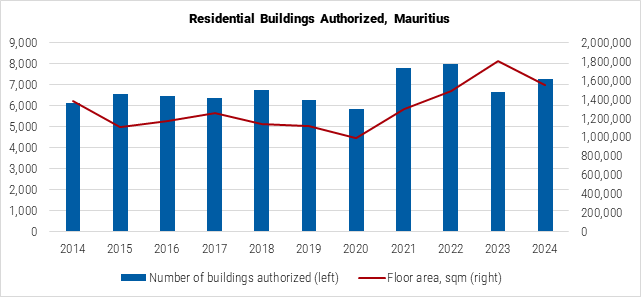
The latest data on residential construction activity from Statistics Mauritius indicates that a total of 7,264 residential building permits were issued in 2024 for both new construction and extensions, reflecting a 9.12% year-on-year increase. At the same time, the total approved residential development area fell by 14.29% to 1.55 million square meters, suggesting that the pipeline may have become more fragmented, with a shift toward smaller or more phased projects rather than a broad-based increase in large-format developments.
Investment in the sector remains strong, as evidenced by continued growth in Gross Fixed Capital Formation in residential construction. During the first three quarters of 2025, investment in residential buildings reached MUR 35.56 billion, marking a 5.36% increase compared to the corresponding period of the previous year.
Data Source: Statistics Mauritius.
An important component of Mauritius’ upper-end residential supply remains the stock of EDB-approved schemes accessible to foreign buyers. Based on the latest official data available, which still refers to end-2023, 183 projects have been approved since the inception of the program, with the total supply pool exceeding 7,800 units. This stock remains concentrated in the northern districts, especially Rivière du Rempart and Pamplemousses, with Black River also accounting for a significant share. It is worth noting, however, that these project counts exclude G+2 apartment projects and therefore do not capture the full universe of foreign-accessible residential products.
More recent evidence from PropertyCloud’s 2025/26 directory also suggests that marketed inventory remains concentrated in coastal markets, with the North clearly dominant, followed by the West, while the Center, East, and South account for smaller shares of portal listings. This points to a supply landscape that remains heavily tilted toward established coastal locations rather than being evenly distributed across the island. As this is listing-market evidence, however, it should be treated as indicative rather than as a measure of total housing stock or construction pipeline.
Looking ahead, the policy environment has become less supportive for new foreign-oriented residential developments. As Business Mauritius President Anil Currimjee observed after the 2025/26 Budget, some fiscal measures are “modifying the business model of this sector.” In practice, the curtailment of selected Smart City incentives for newer projects and the higher tax burden on promoter sales are likely to make new launches less attractive at the margin. While transitional treatment means projects already underway should not be materially disrupted, the revised framework could weigh on future pipeline expansion, especially in premium coastal and mixed-use segments.
At the same time, public-led housing is becoming more relevant to the domestic supply story. In September 2025, the Mauritian Cabinet noted that 774 social housing units had already been completed, that 2,357 additional units were expected by December 2025, and that a further 5,244 units were targeted for completion by July 2026. This implies that the most visible increase in delivered stock over the next 12 to 18 months may come from the social and affordable segment rather than from newly launched high-end schemes.
Rental Market: Rents and Rental Yields
Tourism Sustains Demand for Holiday and High-End Rentals
Record-high tourist activity in Mauritius, which attracted over 1.4 million visitors last year, continues to fuel the demand for holiday properties in the popular North, West, and East coastal regions (especially near beaches, golf courses, or nature reserves). At the same time, the domestic rental market appears to be shrinking. According to the population and housing census data published by Statistics Mauritius, as of 2022, only 6.5% of resident households were paying tenants or sub-tenants, down from nearly 8.0% reported a decade prior in 2011. In parallel, the share of homeowners increased from 88.8% in 2011 to 90.5% in 2022.
In this environment, the reporting from the real estate platform Propertycloud.mu shows continued upward movement in long-term rents, which registered a 11.1% year-on-year increase in the apartment segment and 12.5% year-on-year increase in the house segment in 2025. In nominal terms, based on properties listed on the platform, the average asking rent reached MUR 50,000 (USD 1,082) for apartments and MUR 90,000 (USD 1,947) for houses. Among the regional submarkets, the highest rents for both segments are consistently observed in the East.
Average asking rents by region:
| Region | Apartments | Houses | ||
| Average rent per sqm, MUR |
Average rent per sqm, USD |
Average rent per sqm, MUR |
Average rent per sqm, USD |
|
| Center | MUR 422 | USD 9.13 | MUR 323 | USD 6.99 |
| East | MUR 606 | USD 13.11 | MUR 450 | USD 9.74 |
| North | MUR 500 | USD 10.82 | MUR 444 | USD 9.61 |
| South | MUR 486 | USD 10.52 | MUR 342 | USD 7.40 |
| West | MUR 500 | USD 10.82 | MUR 424 | USD 9.17 |
| Note: Exchange rate as of 2025, USD 1 = MUR 46.2. | ||||
| Data Source: Propertycloud.mu. | ||||
Poor Rental Yields
Research conducted by Global Property Guide in January 2026 found the average monthly rent in Mauritius standing at USD 650 for 1-bedroom units, USD 970 for 2-bedroom units, and USD 1,620 for 3-bedroom units. The corresponding gross rental yields averaged 3.22%.
Similarly, Sotheby’s International Realty Mauritius estimates that long-term rental properties on the island typically generate returns of 3-5%, while short-term rentals offer the potential for higher returns varying between 5% and 9%.
In the short-term rental segment (STR), as of April 2026, the data from AirDNA shows the largest number of active short-term rental listings in the districts of Black River (Rivière Noire), Rivière du Rempart, and Pamplemousses. Among the more active local submarkets (with 100 or more active listings), the highest average daily rates, exceeding USD 120, are reported in Flack and Rivière du Rempart. Occupancy for short-term rentals is highly seasonal, fluctuating from 76% in March to 41% in September and averaging between 48% and 64% in the last twelve months across the popular submarkets.
Key short-term rental indicators across selected submarkets as of April 2026:
| Submarket | Total Active Listings |
Average Daily Rent (USD) |
Average Occupancy (%) |
| Black River (Rivière Noire) | 1,985 | USD 105.0 | 64% |
| Rivière du Rempart | 1,374 | USD 120.2 | 60% |
| Pamplemousses | 860 | USD 114.6 | 62% |
| Grand Port | 290 | USD 113.9 | 52% |
| Flack | 239 | USD 193.6 | 55% |
| Rodrigues | 168 | USD 76.7 | 48% |
| Plaines Wilhelms | 185 | USD 48.5 | 64% |
| Note: Submarkets with at least 100 active listings selected. Total active listings — number of listings viewable on Airbnb and/or VRBO with at least one prior booked night. Average rates in the last 12 months. | |||
| Data Source: AirDNA. | |||
Mortgage Market and Interest Rates
Loan Stock Continues to Grow Rapidly Despite Still-Elevated Interest Rates
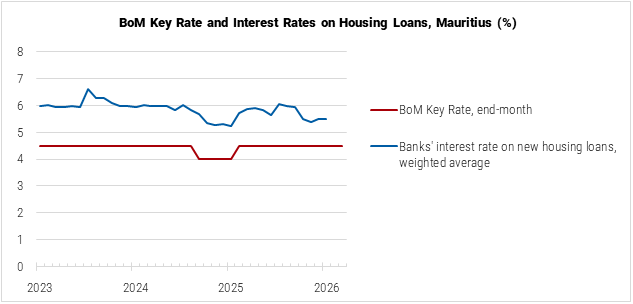
Following a re-tightening move in February 2025, prompted by evolving global financial dynamics, the BoM has maintained its key rate at 4.50%. While generally reflective of the central bank’s monetary policy trajectory, mortgage rates in Mauritius are typically more dynamic and vary substantially based on the borrower’s age, income, and loan repayment period, with banks using their own criteria to assess applicants.
As of January 2026, the BoM reported banks’ interest rates on new housing loans to households spanning from 2.00% to 13.30%. While the lower end of the range has been relatively stable in recent years, fluctuating around 2%, the upper end experienced more pronounced ups and downs, but has generally declined in the last three years from 16.60% observed in January 2023, 14.25% in January 2024, and 13.75% in January 2025. The weighted average interest rate for new housing loans to households has not exceeded 6% since mid-2025 and was most recently recorded at 5.49% in January 2026.
To assist those affected by elevated interest rates, the Government of Mauritius had previously introduced the Home Loan Relief Scheme, which offered eligible citizens a refund on the amount borrowed under a secured housing loan in the form of a monthly allowance of MUR 1,000. Although a two-year extension was announced last summer, the scheme is now being gradually phased out, with the monthly allowance reduced to MUR 667 for the period between July 2025 and June 2026 and further to MUR 333 for the period between July 2026 and June 2027.
Data Source: BoM.
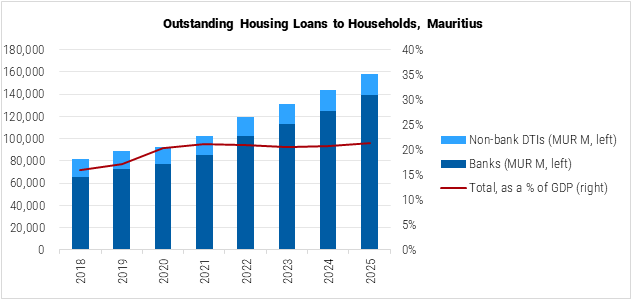
Despite elevated interest rates, the country’s mortgage market has been expanding consistently, with the total value of outstanding housing loans maintained by the deposit-taking institutions in Mauritius demonstrating an average annual growth of 11.4% in the last seven years. As of January 2026, the combined housing loan stock reported by the BoM reached MUR 159.0 billion (USD 3.4 billion), of which MUR 139.6 billion (USD 3.0 billion) was credit extended by banks and MUR 19.4 billion (USD 417 million) was credit extended by non-bank deposit-taking institutions, such as Mauritius Housing Company. Loans in domestic currency represented 99.4% of the total value, while loans in foreign currencies represented only 0.6%.
The relative size of the market, represented as a loans-to-GDP ratio, has increased from a 16.0% in 2018 to an estimated 21.3% in 2025.
Overall, Mauritius was previously estimated by the Center for Affordable Housing Finance in Africa (CAHF), an independent think tank for supporting housing markets in the region, to have the highest level of mortgage penetration among its peers in the Southern African Development Community. According to the 2022 Census data, 14.0% of privately owned housing units in the country are mortgaged, up from 12.4% previously reported in 2011.
Data Source: BoM.
Economic and Social Factors
Record-High Tourism Activity Supports Resilient Growth
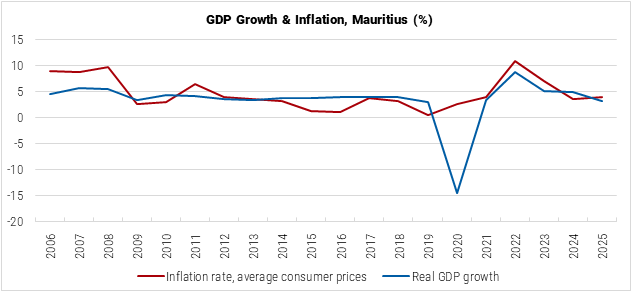
Although the completion of major infrastructure projects and a slowdown in new projects contributed to a deceleration from even higher growth rates in previous years, the Mauritian economy demonstrated solid 3.2% real GDP growth in 2025, driven by tourism, financial services, and information and communication technologies. The International Monetary Fund (IMF) forecast expects growth to remain at similar levels (3.4%) over the medium term, reflecting demographic headwinds and labor shortages, while a more recent outlook from the World Bank anticipates a slowdown to 2.5% in 2026 due to subdued external demand and heightened uncertainty from the conflict in the Middle East.
“With Middle East carriers accounting for 15% of total flights to Mauritius, the reduction in services is expected to weigh on visitor arrivals, compounded by higher oil prices and airfares,” noted the World Bank. “Nonetheless, tourism is expected to remain broadly resilient, supported by direct flight connections from other airlines to European markets.”
Consumer price index (CPI) inflation in the country rose moderately from the average annual level of 3.6% in 2024 to 3.9% in 2025, according to the IMF, and was most recently reported by Statistics Mauritius at 2.7% in March 2026. The World Bank expects price pressures to keep inflation elevated at 3.9% in 2026, before moderating to 3.7% in 2027, which should still be well within the central bank’s target range of 2-5%.
Data Source: IMF.
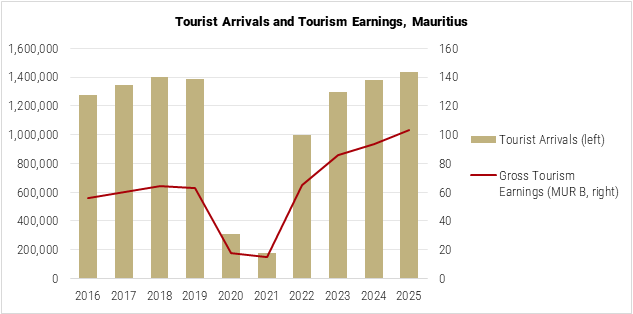
The tourism industry, which serves as one of the key drivers for the country’s economy, continues to perform strongly. The annual number of arrivals reported by Statistics Mauritius in 2025 (1.44 million) showed a 3.9% year-on-year growth and exceeded the pre-pandemic peak level of 2018 by 2.6%. The corresponding gross tourism earnings increased by 10.4% year-on-year in 2025, reaching MUR 103.4 billion (USD 2.24 billion).
Key markets of origin, together representing over 65% of all international arrivals in 2025, were France (23.5% of tourist arrivals), the UK (10.8%), Reunion Island (10.1%), Germany (8.5%), South Africa (7.7%), and India (5.3%).
Data Sources: BoM, Statistics Mauritius.
Against this background, labor market conditions in the country have improved significantly, with the unemployment rate dropping to the lowest level in over two decades: from 9.1% in 2021 to 5.9% in 2025, with the latest figures from Statistics Mauritius showing unemployment for the population aged 16 and over at 5.4% in Q4 2025.
At the same time, longstanding issues of skill mismatches, youth unemployment, and limited female participation in the domestic labor market persist, with the IMF previously estimating a nationwide shortfall of 50,000 workers.
“Reaching and sustaining high-income status will require Mauritius to reduce reliance on consumption-led growth, raise productivity, increase productive investment, and accelerate economic diversification,” noted the World Bank in a recent assessment. “To achieve this, Mauritius will have to address existing challenges, including declining export competitiveness, low female labor force participation, and high youth unemployment, all within the context of an ageing population.”
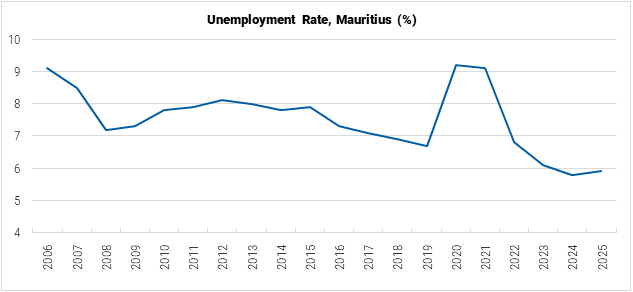
Data Source: IMF.
Overall, the Mauritian economy has recovered solidly from the pandemic, and its medium-term outlook is generally favorable, but fiscal and structural challenges persist. According to the 2025 Article IV staff report from the IMF, Mauritius is facing fiscal and structural challenges due to high public debt ( estimated at 88.9% of GDP in 2025), significant public investment needs for climate, low productivity, and an ageing society.
Both the IMF and the World Bank assess risks to the outlook as tilted to the downside, including from high global uncertainty. “If prolonged, the conflict in the Middle East could weaken external demand and dampen investor sentiment, while the accompanying rise in oil prices risks further raising airfares and production costs, eroding export competitiveness, adding to inflationary pressures, and offsetting earlier gains in poverty reduction. Additionally, lower-than-expected tax revenue and delays in pension reforms or in the ratification of the Chagos Islands agreement could slow fiscal consolidation. <…> Cyclone exposure adds further vulnerability to tourism revenues and infrastructure,” summarized the latest MPO report from the World Bank.
Sources:
- Statistics Mauritius
- Residential Property Price Index (RPPI), 3rd Quarter 2025: https://statsmauritius.govmu.org/
- Housing and Population Census 2022: https://statsmauritius.govmu.org/
- Building and Construction Statistics: https://statsmauritius.govmu.org/
- National Accounts: https://statsmauritius.govmu.org/
- Consumer Price Index: https://statsmauritius.govmu.org/
- Labor: https://statsmauritius.govmu.org/
- International Travel & Tourism: https://statsmauritius.govmu.org/
- Bank of Mauritius (BoM)
- Financial Stability Report, December 2025: https://www.bom.mu/
- Financial Stability Report, June 2025: https://www.bom.mu/
- Key Rate: https://www.bom.mu/
- The Monetary Policy Committee of the Bank of Mauritius Keeps the Key Rate Unchanged: https://www.bom.mu/
- Post MPC Meeting Press Conference: Statement by the Governor: https://www.bom.mu/
- Banks’ Credit to Private Sector: https://www.bom.mu/
- Monthly Statistical Bulletin: https://www.bom.mu/
- Prime Minister’s Office of Mauritius
- Highlights of Cabinet Meeting – Friday 26 September 2025: https://pmo.govmu.org/
- Ministry of Finance, Economic Planning and Development
- Budget 2025-2026: https://nationalbudget2025.govmu.org/
- Mauritius Revenue Authority
- Housing Loan Relief Scheme – July 2025 to June 2027: https://www.mra.mu/
- Economic Development Board of Mauritius (EDB)
- Residency: Acquire a Property in Mauritius: https://residency.mu/acquire/
- Highlights of the Property Market in Mauritius. EDB Insights – June 2024: https://edbmauritius.org/
- Interview With EDB Chief Executive Mahen Abhimanu Kandasamy: https://edbmauritius.org/
- New Mandatory Requirements for Non-Citizens Acquiring a Residential Property…: https://edbmauritius.org/
- Annex to Budget Speech 2025 – 2026: https://edbmauritius.org/
- International Monetary Fund (IMF)
- Country Overview: Mauritius: https://www.imf.org/
- 2025 Article IV Staff Report: https://www.imf.org/
- Mauritius: Selected Issues. Volume 2025: Issue 137: https://www.elibrary.imf.org/
- World Bank
- Mauritius MPO, April 2026: https://thedocs.worldbank.org/
- Center for Affordable Housing Finance in Africa (CAHF)
- 2024 Housing Finance Yearbook: Mauritius profile: https://housingfinanceafrica.org/
- Housing Investment Landscape, Mauritius: https://housingfinanceafrica.org/
- Propertycloud.mu
- Mauritius Real Estate Directory 2025/2026: https://www.calameo.com/
- Market Insights: https://www.propertycloud.mu/
- Mauritius Real Estate Index: https://www.propertycloud.mu/
- AirDNA
- Short-Term Rental Markets: Mauritius: https://app.airdna.co/
- Sotheby’s International Realty Mauritius
- Investing in Mauritius: Buy a Holiday Home and Earn Rental Income: https://www.sothebysrealty.mu/
- KPMG
- The Finance Act 2025 Mauritius: https://assets.kpmg.com/
- PWC
- National Budget 2025-2026. Taxation: https://www.pwc.com/
- Business Magazine
- Phillippe de Beer: “The Real Estate Market is Entering a Selection Cycle” (FR): https://www.business-magazine.mu/
- L’Express
- Business Mauritius is Concerned About Certain Tax Measures (FR): https://lexpress.mu/