Costa Rica’s Residential Property Market Analysis 2026
Costa Rica's housing market has split in two. Building activity is running at its strongest level since the pandemic, and the currency has never been stronger against the dollar, yet the cost of borrowing has barely moved, and rents have risen through three straight years of falling consumer prices.
This extended overview from Global Property Guide covers key aspects of the Costa Rican housing market and takes a closer look at its most recent developments and long-term trends.
- Property Prices and Price Index
- Property Demand Trends
- Property Supply Trends
- Mortgage Market and Interest Rates
- Rental Market: Rents and Rental Yields
- Economic and Social Factors
All currency figures in this article are converted at the Central Bank of Costa Rica reference rate of 20 August 2026, USD 1 = CRC 450.54, the midpoint of the published buying rate of CRC 447.75 and selling rate of CRC 453.33. That single reference pair is used throughout.
Property Prices and Price Index
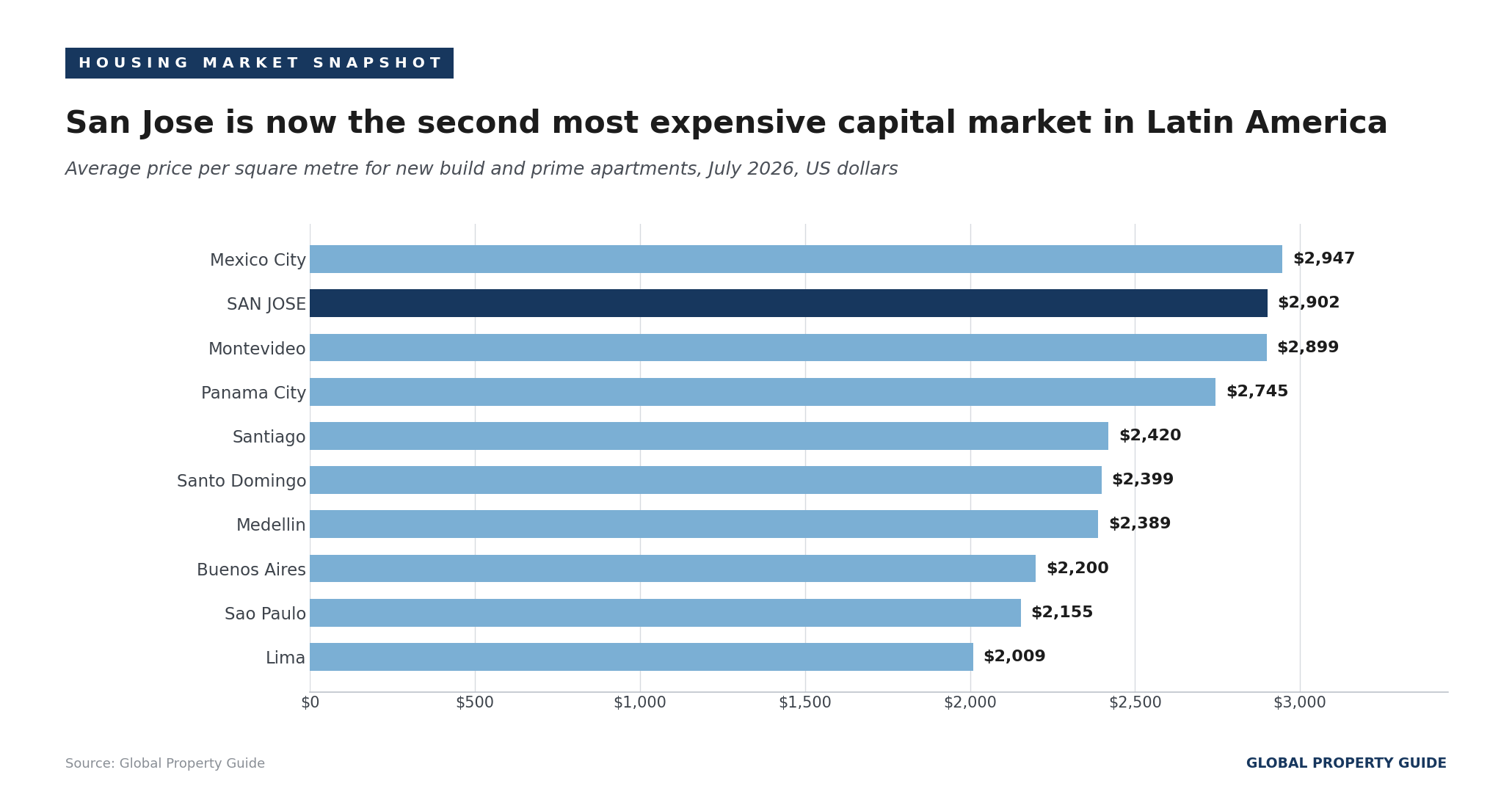
Costa Rican residential property continues to command some of the highest prices in Latin America, and the gap between the country and its regional peers has widened rather than narrowed over the past year. Global Property Guide's July 2026 survey places the average price of new build and prime apartments in the San Jose metropolitan area at USD 2,902 per square metre, second in the region only to Mexico City at USD 2,947 and ahead of Montevideo, Panama City, Santiago and Santo Domingo. For a country of five million people with a nominal income per head well below that of Uruguay or Panama, that ranking is remarkable, and it reflects the degree to which the market is priced off foreign rather than domestic purchasing power.
Costa Rica's house price annual change:
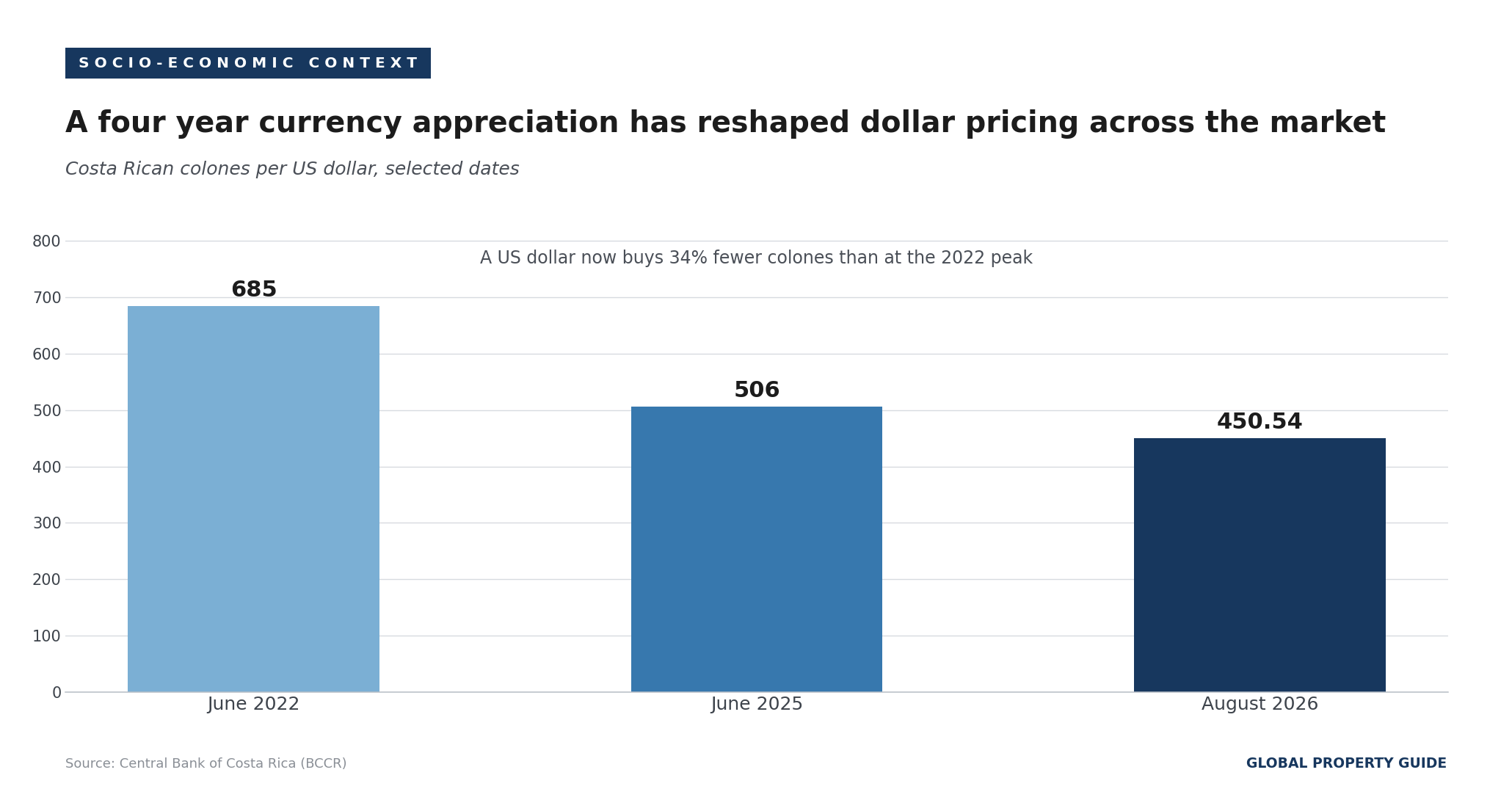
The dollar denomination of the market matters more than usual this year. The colon has appreciated almost continuously since mid 2022, and the Central Bank of Costa Rica reference rate stood at CRC 447.75 buying and CRC 453.33 selling on 20 August 2026, against roughly CRC 506 in June 2025 and a peak near CRC 685 in June 2022. A US dollar today buys about 34 percent fewer colones than it did four years ago. For a foreign buyer holding dollars, that appreciation has quietly raised the local-currency cost of everything from construction labour to closing fees, even where the headline dollar asking price has been flat.
Brokerage evidence points to a market that is busier but no longer uniformly rising. Coldwell Banker Costa Rica market data indicates that single-family home sales rose by close to 36 percent year on year to 144 closed transactions nationally, with luxury sales up by more than 37 percent, while inventory expanded across several categories at the same time. Median list prices in Guanacaste and the Nicoya Peninsula remain the highest in the country at above USD 1.4 million, against USD 1.32 million recorded in mid 2025, but the Central Valley continues to gain share among relocating buyers who want year-round accessibility, proximity to healthcare and airport convenience rather than beachfront.
The result is a two-speed market. Coastal Guanacaste and the Pacific are still set by foreign demand and constrained titled supply. The Central Valley, where the great majority of Costa Ricans actually live and transact, is set by domestic incomes and by a credit market that, as the sections below describe, has failed to pass through three years of central bank easing.
Property Demand Trends
Foreign ownership rules remain among the most open in the region
Costa Rica's legal and policy framework is generally favourable to foreign ownership, allowing non-residents to hold property outright, unlike in many other Central American countries. Foreign capital remains concentrated in the Central Valley, Guanacaste and along the Pacific Coast, with beachfront properties and homes in gated communities the most sought-after asset types.
The principal restriction is unchanged. Most beachfront land falls under the Maritime Zone Law, which prohibits direct foreign ownership within the first 200 metres from the high-tide line and instead permits leasing through concession agreements. A comprehensive reform of that statute is before the Legislative Assembly as file 22.553, and in March 2026 some 70 social organisations and more than 170 individuals publicly objected to it, arguing that the bill would open the coastline to privatisation and weaken public control over land held in the public domain. Buyers considering concession property should treat the framework as under active political review rather than settled.
New home sales in the metropolitan area went flat in 2025
Research by Gutierrez and Gallardo, the consultancy that tracks the Extended Greater Metropolitan Area, points to a clear stall in the new-build house segment. Its Market Share 2025 study found that the leading developer sold 487 new houses during the year for an 18.1 percent share of that category, which implies total new house sales of roughly 2,690 units across the metropolitan area. That is essentially unchanged against the 2,687 houses sold in 2024, and the consultancy characterised the single-family market as showing practically no growth over the year.
That flat outcome sits awkwardly beside a sharp rise in permitting, and the explanation appears to lie in product mix. Approvals for apartments and condominium dwellings rose 46.2 percent nationally in 2025 while single-family activity was subdued, which is consistent with the long-running expectation among Costa Rican analysts that limited land availability and rising land costs in the metropolitan area would gradually push the market from houses towards apartments.
Buyers have gained leverage across most price points
The transaction environment has shifted decisively towards purchasers. Inventory has risen across several categories, selling periods have lengthened, and the correction in the luxury coastal segment that began in 2024 has left a substantial stock of unsold high-end property in Guanacaste and the Nicoya Peninsula. Reports from the region describe a market that has moved past the tight inventory and elevated prices of the pandemic period toward more even progress.
Looking ahead, residential demand will continue to be shaped by Costa Rica's economic and trade ties with the United States. Prolonged uncertainty over trade policy and tariffs weighs on export-oriented sectors, particularly the free trade zones, with knock-on effects on employment and consumer confidence, while higher costs for imported construction materials limit purchasing power. The offsetting factor, a strong colon that reduces the local-currency cost of dollar-denominated purchases, cuts both ways: it helps domestic buyers who earn in colones and hurts the tourism and export earnings that support coastal demand.
Property Supply Trends
Permitting rebounded sharply in 2025
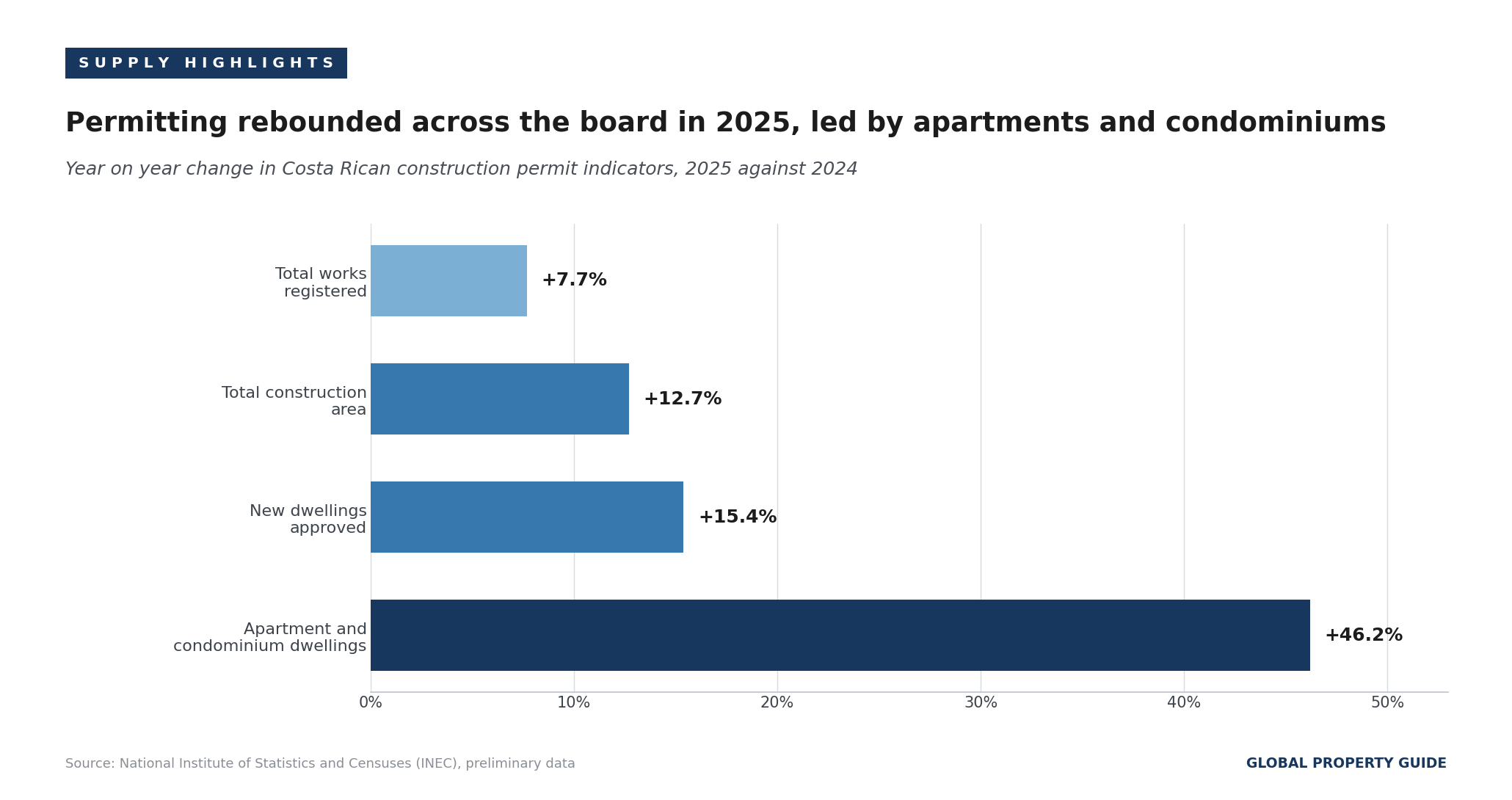
After a soft 2024, Costa Rican construction turned decisively upward. Preliminary Construction Statistics from the National Institute of Statistics and Censuses (INEC) record 44,591 works registered in 2025, an increase of 7.7 percent on the previous year, with residential works accounting for the largest absolute rise at 2,454 additional works. Total approved construction area reached 4,152,934 square metres, up 12.7 percent.
The headline residential figure is stronger still. The number of new dwellings approved rose to 26,212 units in 2025, an increase of 3,498 units or 15.4 percent, which INEC describes as the most significant such rise in recent years. Within that total, dwellings in apartments or condominiums grew 46.2 percent.
Two points of detail deserve attention. First, the 2025 figures imply a 2024 base of 22,714 approved dwellings, which is 379 units below the preliminary figure of 23,093 that circulated a year ago; readers comparing across editions should use the revised base. Second, the size distribution is shifting. Dwellings of 40 to under 70 square metres remain the most common category at 13,254 units, just over half the national total, and grew by 1,381 units, led by Alajuela. But the largest absolute increase, 1,413 units, came in the 100 to under 150 square metre band and was concentrated in San Jose, which points to a firming middle-market segment rather than purely compact construction.
By province, Alajuela and San Jose together accounted for 47.7 percent of the total approved area in 2025, at 24.2 percent and 23.5 percent respectively. San Jose recorded the largest absolute increase in area at 288,178 additional square metres, followed by Alajuela at 178,613. Alajuela showed the strongest growth in residential works at 16.7 percent, concentrated in the cantons of Naranjo, Alajuela, Orotina and Grecia.
The 2026 pipeline is running far ahead of expectations
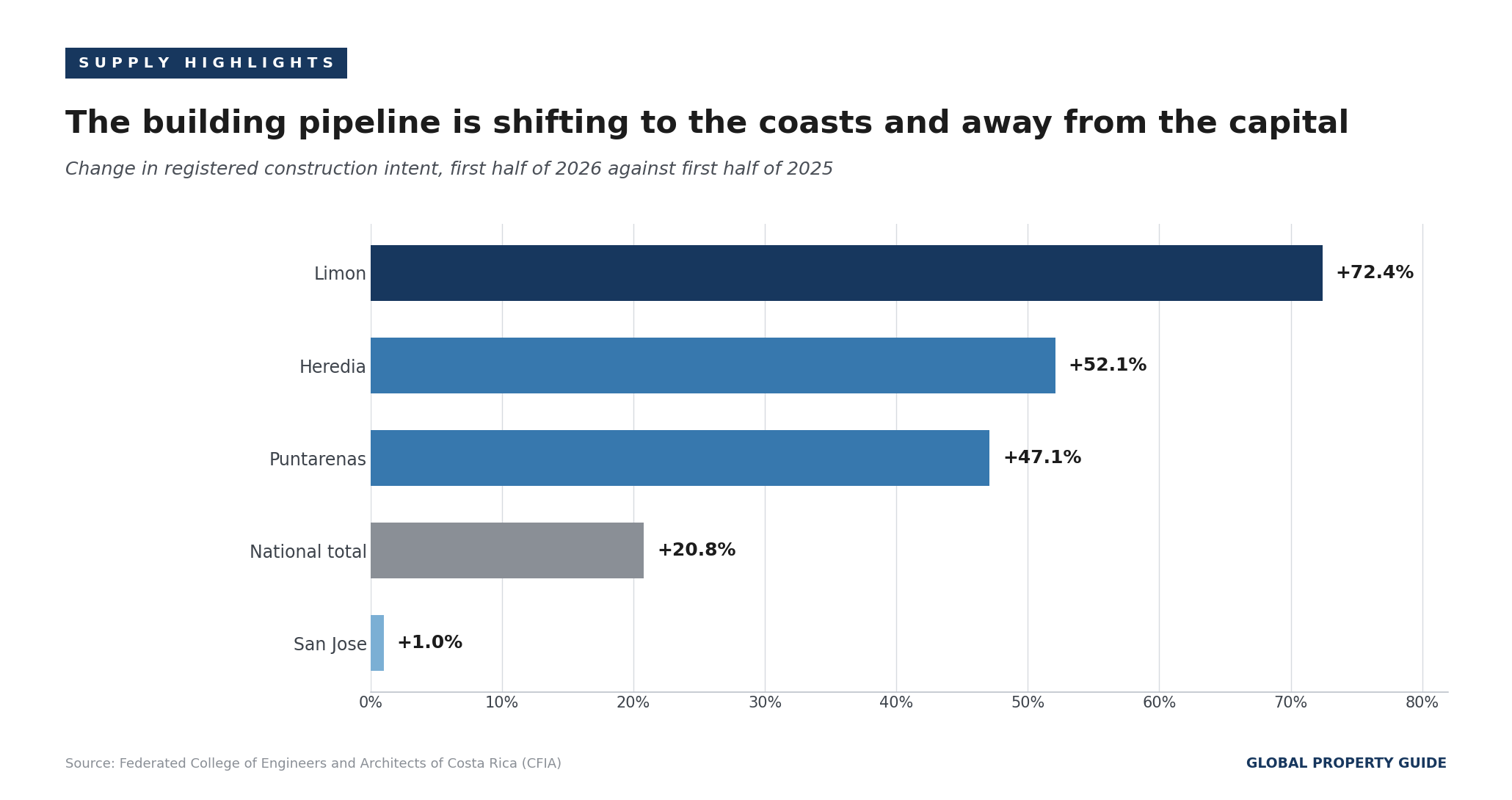
Forward indicators are stronger than the completed-permit data. The Federated College of Engineers and Architects of Costa Rica (CFIA), which registers construction intent before works begin, recorded 5,779,813 square metres in the first half of 2026 against 4,783,226 square metres in the same period of 2025, an increase of 21 percent. Growth was recorded in every province.
The geography of that pipeline has shifted decisively away from the capital. Limon posted the strongest growth at 72.4 percent, rising from 154,378 to 266,087 square metres, followed by Heredia at 52.1 percent, reaching 745,808 square metres, and Puntarenas at 47.1 percent, reaching 947,282 square metres. San Jose managed an increase of just 1 percent.
Within the housing category, the pattern again favours multi-unit and subsidised product. Individually built homes fell 1.4 percent, while social-interest housing and condominiums rose. The single largest driver of the overall increase was industrial construction, which climbed 68.8 percent to 868,467 square metres, an additional 353,892 square metres.
The CFIA now expects the full year to exceed 10.5 million square metres, against an original expectation of growth of around 1 percent. Fernando Escalante of the CFIA noted that housing, industrial and urban development works have all surpassed the projections set at the start of the year, while commercial construction remains below forecast, and that a moderation in the pace of growth is anticipated in the second half. President Laura Fernandez has said the government will continue to simplify permitting procedures to stimulate investment and employment.
The occupied housing stock grew twice as fast as the year before
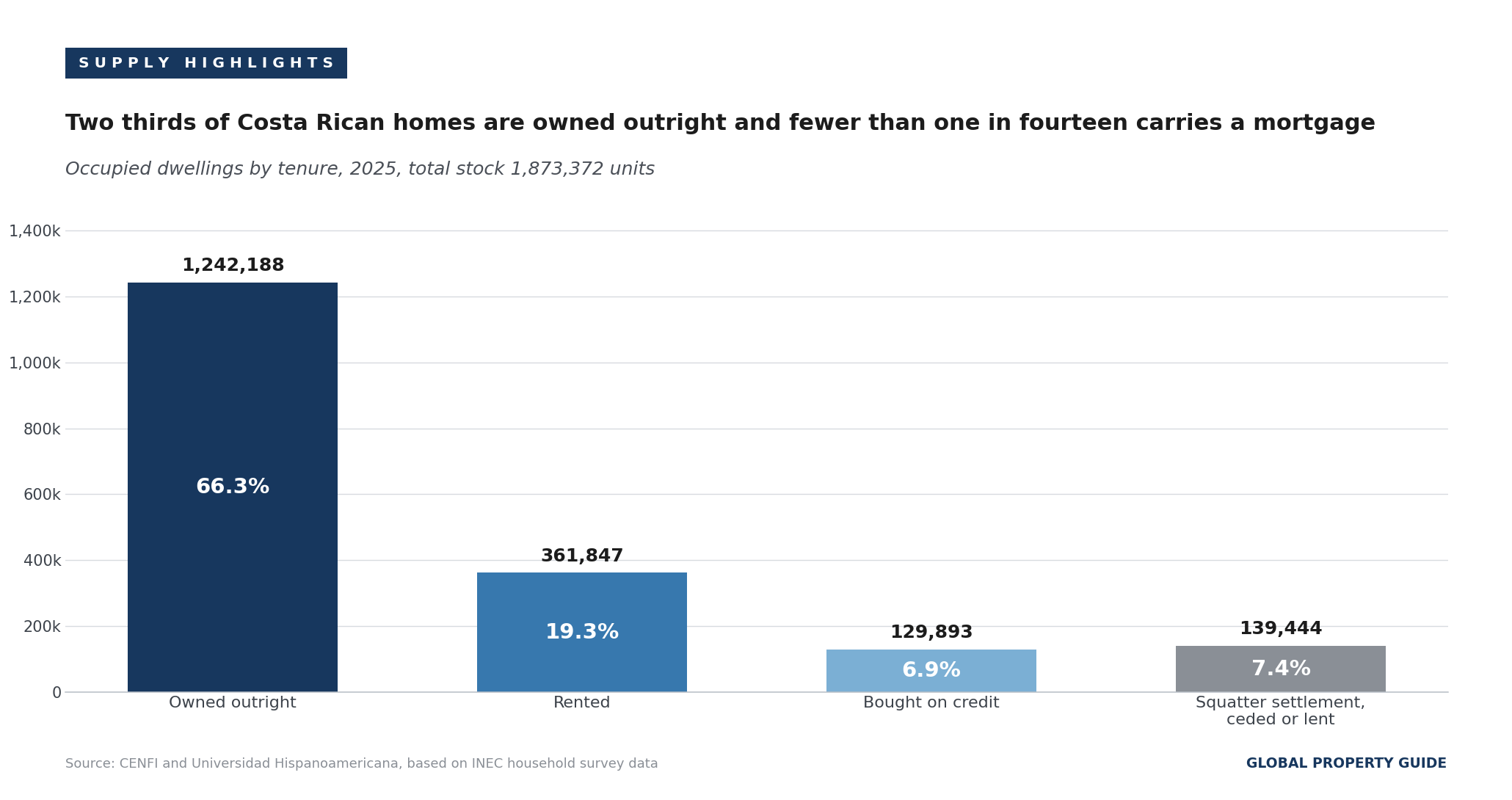
The composition of the stock tells a different story from the permit data. The Centre for Financial and Real Estate Business Studies (CENFI), working with the Universidad Hispanoamericana on household survey data from INEC, reported in August 2026 that the occupied housing stock reached 1,873,372 units in 2025 after adding 64,662 dwellings during the year. That is more than double the 30,456 units added in 2024, a growth rate of 3.6 percent against 1.7 percent the year before.
Melizandro Quiros, executive director of CENFI, was candid that the scale of the increase is not fully explained by formal construction. His working hypothesis is self-building, where a household with a large plot adds a dwelling at the back for a relative, or builds upward. He noted that the statistical agency publishes nothing that would allow the pattern to be confirmed.
Physical condition remains sharply stratified by income. Nationally, 60 percent of the stock is in good condition, 33 percent in regular condition and 7 percent in poor condition. In the lowest income quintile, 15 percent of households, some 55,357 dwellings, live in property classified as being in poor condition, around 3,000 more than in 2024, while in the fourth and fifth quintiles the shares in good condition are 70 percent and 82 percent respectively.
The subsidy programme has been cut mid-year
Costa Rica's principal housing policy instrument is the Family Housing Bond administered by the Housing Mortgage Bank (BANHVI). The bank planned to award 14,000 bonds in 2026 on a budget of CRC 186,914 million, roughly USD 415 million, drawn from the Social Development and Family Allowances Fund. In 2025, the bank financed 10,596 dwellings with investment above CRC 134,500 million, an average of 883 homes a month.
That plan has since been reduced. In July 2026, the Legislative Assembly approved the first extraordinary budget of the year in a second debate, cutting CRC 30,000 million, about USD 67 million, from the BANHVI housing subsidy transfer, along with CRC 40,000 million from the child nutrition programme, and redirecting the money to cover a deficit in the non-contributory pension regime and to poverty programmes. The cut represents roughly 16 percent of the annual housing budget. BANHVI warned that around 2,500 families would lose access to the bond as a result, and that the reduction is equivalent to the financing of about six social housing developments at the roughly CRC 5,000 million each such projects require. Deputies from Liberación Nacional and Frente Amplio voted against.
Mortgage Market and Interest Rates
The policy rate has fallen to 3.00 percent
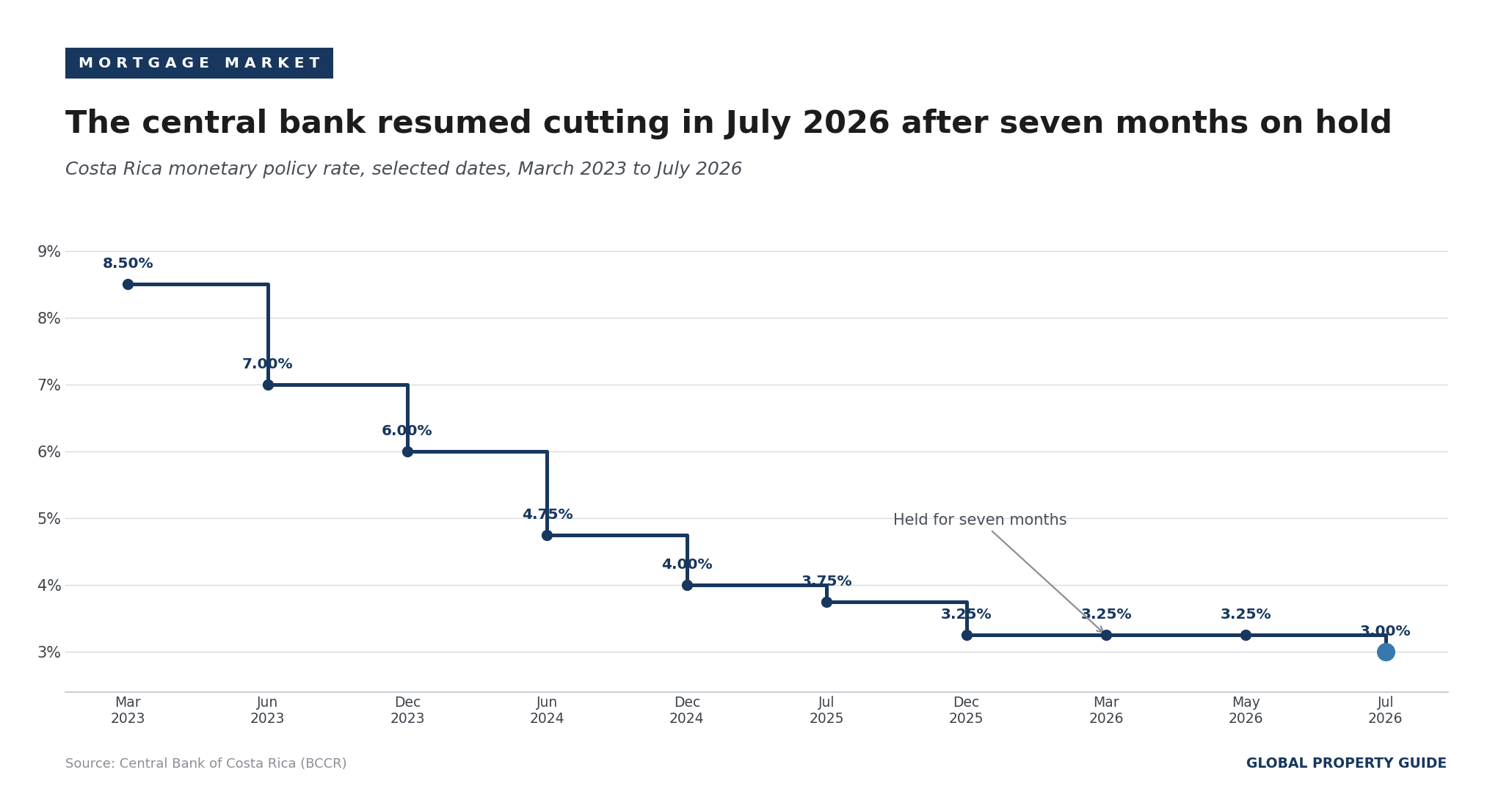
The Central Bank of Costa Rica (BCCR) cut its monetary policy rate by 25 basis points to 3.00 percent on 23 July 2026, its first reduction of the year and the end of a seven-month hold at 3.25 percent that had been in place since 19 December 2025. The board had maintained the rate through its March and May meetings, citing rising international uncertainty and a rebound in inflation expectations.
Costa Rica's mortgage loan interest rates:
The July decision was taken against a backdrop of persistent deflation and slowing output. Year-on-year inflation was negative at the close of June, core measures had sat near zero since February, and inflation expectations at both short and medium horizons remained below the 3 percent target. On the domestic side, the bank pointed to decelerating production growth in both the special and definitive regimes, broadly stable employment and a slight fall in real incomes. Governor Roger Madrigal described the context as one of elevated external uncertainty tied to geopolitical conflict, commodity prices and the possible effects of extreme weather on food and electricity costs. The policy rate has now fallen from a peak of 9.00 percent to 3.00 percent over the easing cycle that began in March 2023.
Borrowers have not received the benefit
The striking feature of the Costa Rican credit market in 2026 is how little of that easing has reached households. Between May 2025 and May 2026 the policy rate fell 0.75 percentage points, from 4.00 percent to 3.25 percent. Over exactly the same window, the weighted average negotiated lending rate in colones rose from 11.4 percent to 12.1 percent, an increase of 0.70 percentage points. Measured from the start of the easing cycle, the policy rate has fallen 5.75 percentage points while the average lending rate has come down only 2.34.
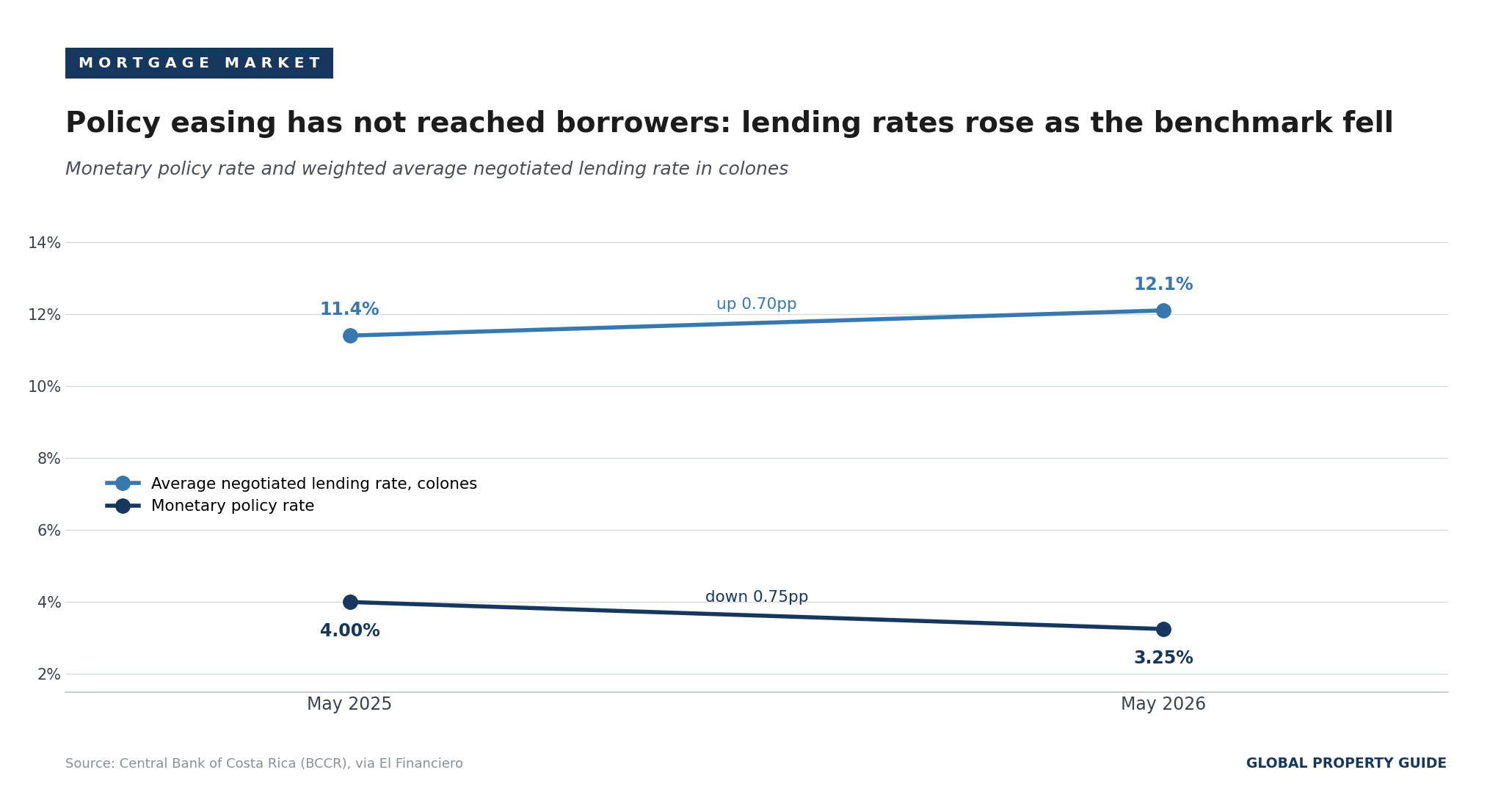
Economists at the Universidad Nacional characterise this as an incomplete and asymmetric transmission of monetary policy. Roxana Morales argued that the intention behind lower policy rates is to reduce financing costs and support consumption and investment, but that borrowing costs have instead risen, which may be discouraging private credit. Her colleague Fernando Rodriguez added that the situation limits the expected effects on credit, investment and consumption and reduces the impact of monetary policy on economic activity. Madrigal has acknowledged the problem himself, saying the effect has come through but not with the force or speed one would want, and pointing in January to entities with sufficient market power to set rates largely independently of the benchmark. The banking sector counters that transmission is necessarily gradual, passing first into deposit rates and only later into lending rates, and that active rates never rose in line with the benchmark on the way up either.
The central bank has taken at least one structural step in response: in March 2026 the board reduced the minimum operating capital required of private financial entities, a measure aimed explicitly at strengthening competition and monetary transmission.
Property lending is the cheapest and the least responsive segment
Housing borrowers occupy an unusual position within this picture. Rates on real estate activities, the category that includes housing credit, were the most stable of any segment analysed, moving just 0.1 percentage points to 7.8 percent by May 2026. Public banks at 7.7 percent and private banks at 7.5 percent offer the most competitive terms. For comparison, the corresponding figures in the prior edition were 7.66 percent for loans in national currency and 7.58 percent for loans in foreign currency in June 2025, so the level has been effectively flat for a year.
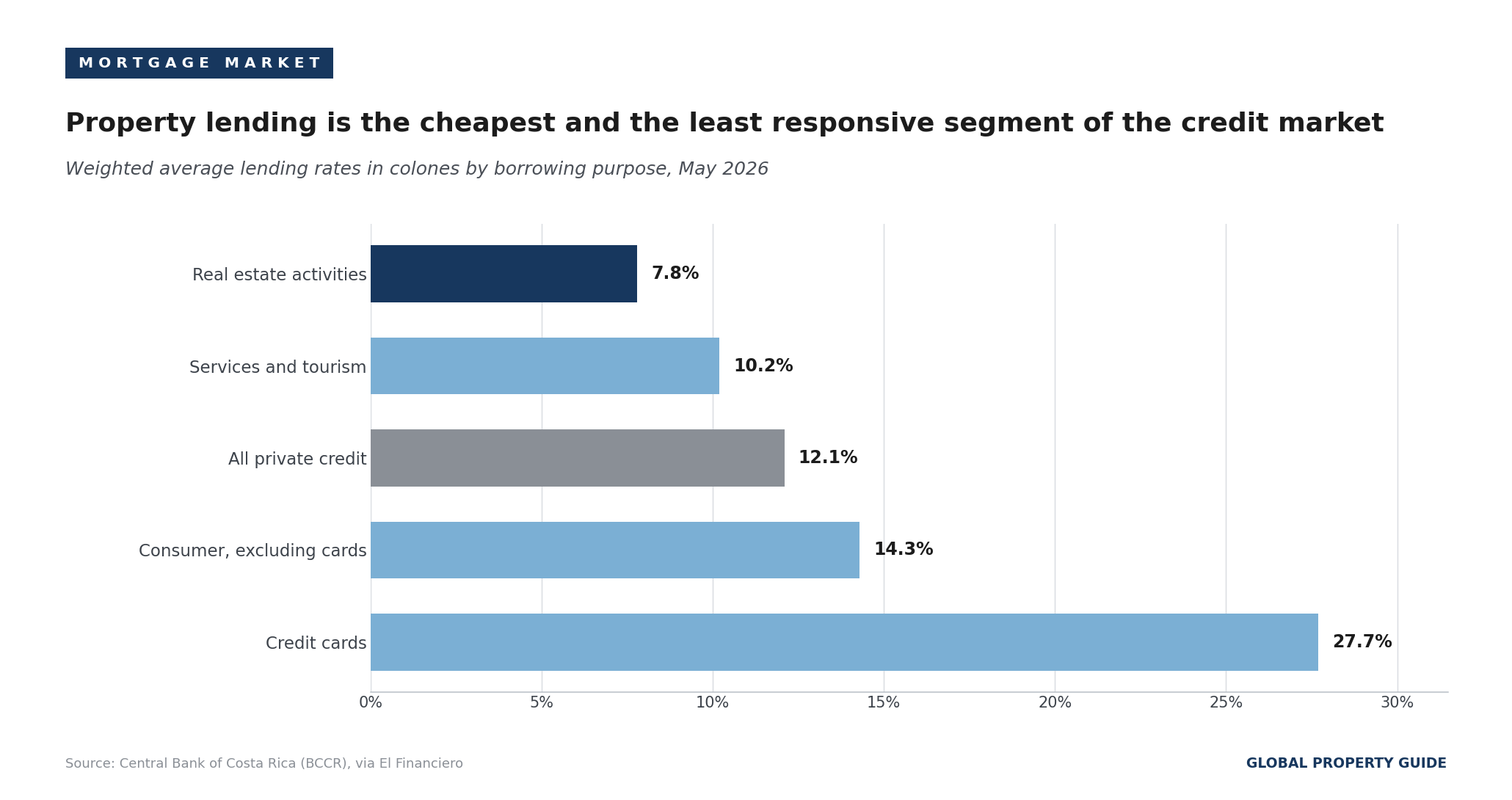
Elsewhere, the dispersion is extreme. Consumer credit excluding cards fell 0.8 percentage points to 14.3 percent, with finance companies still charging 31.5 percent. Credit card rates rose 1.8 percentage points to 27.7 percent. Services and tourism lending rose 1.3 percentage points to 10.2 percent. The legal ceiling gives a sense of the range the system tolerates: the BCCR set the maximum annual rate for ordinary credit in colones at 36.48 percent for the second half of 2026, up slightly from 36.27 percent, while the dollar ceiling fell to 30.11 percent from 30.39 percent.
Credit growth has slowed, and mortgage penetration remains low
The stock of credit to the private sector reached CRC 25.18 trillion in February 2026, an increase of CRC 327,565 million or 1.3 percent over the year, with growth decelerating steadily since March 2025. Housing accounts for 26 percent of that stock, roughly CRC 6.5 trillion or USD 14.5 billion, second only to consumption at 34 percent and ahead of services at 16 percent and commerce at 9 percent.
Mortgage use among Costa Rican households nonetheless remains limited, though it has stopped falling. CENFI counts 129,893 dwellings held on credit in 2025, 6.9 percent of the occupied stock, against 124,183 in 2024 and 124,209 in 2023. The 4.6 percent increase in 2025 breaks a period of stagnation, and the largest absolute gain came in the fourth income quintile, with an average monthly household income of CRC 1,391,136 or about USD 3,088, which added 4,632 credit-financed dwellings. Financing remains a middle- and upper-income instrument.
Rental Market: Rents and Rental Yields
The divergence between rents and general prices is now structural
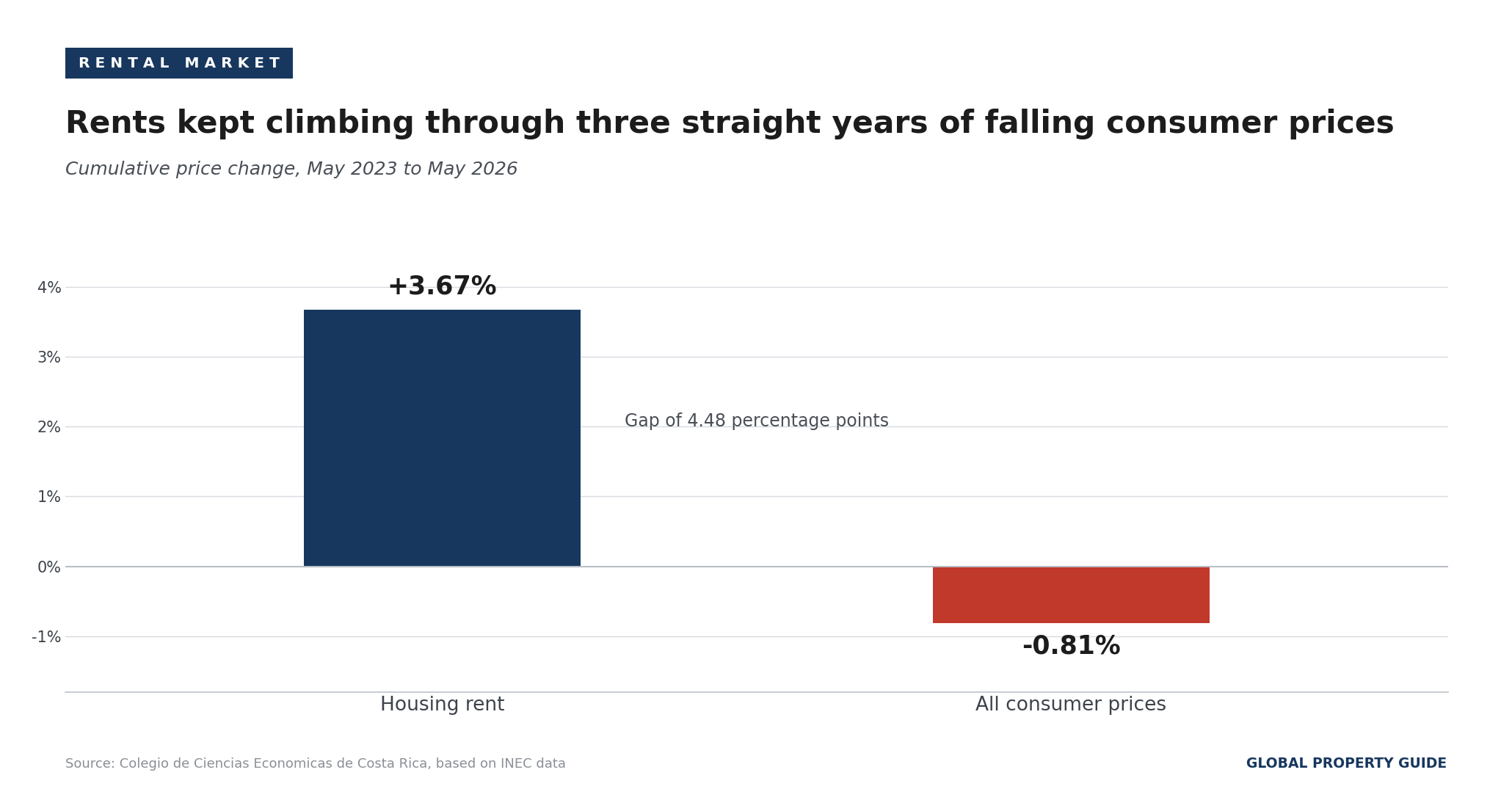
The defining feature of the Costa Rican rental market is that rents have gone on rising while almost nothing else has. The Colegio de Ciencias Económicas de Costa Rica analysed the 36 months from May 2023 to May 2026 and found that the price of housing rent rose 3.67 percent over the period while general consumer prices fell 0.81 percent, a divergence of nearly four and a half percentage points. The professional body noted that this followed a further 18 consecutive months of increases, giving 54 continuous months of rising rents.
The pattern has continued into the current data. INEC's July 2026 consumer price release, the first under an updated methodology with a June 2026 base and a basket widened from 289 to 293 items, showed annual inflation was at negative 0.28 percent, a thirty-ninth consecutive month outside the central bank's tolerance band. Within a month in which 42 percent of items fell in price, housing rent was among the small group of items pushing the index upward, alongside tomatoes and petrol.
Renting is absorbing households that cannot buy
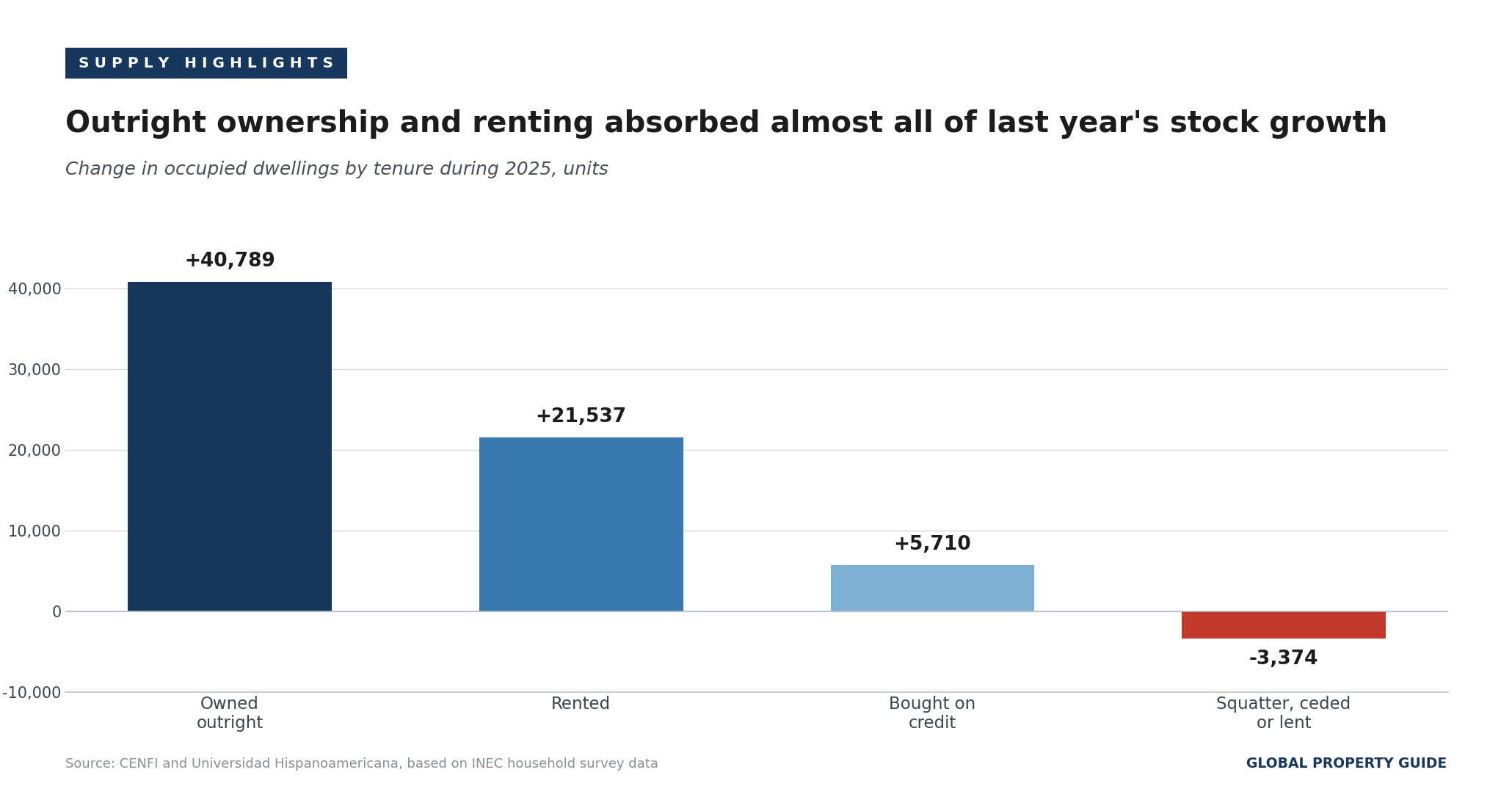
The tenure data explain why. Of the 64,662 dwellings added to the occupied stock in 2025, rented units accounted for 21,537, taking the rental stock to 361,847 units or 19.3 percent of the total, up from 340,310 units the year before. That is growth of 6.3 percent in a single year, well ahead of the 3.6 percent growth of the stock as a whole.
Costa Rica's rent price index:
The distribution of that growth is revealing. The third income quintile, with average monthly household income of CRC 925,092 or about USD 2,053, recorded the largest increase in renting at 13,042 additional units. Regionally, Chorotega, which covers Guanacaste and the north Pacific, saw the largest rise in rented dwellings at 7,636 units, consistent with a coastal market in which tourism and lifestyle migration price out local households. Quiros suggested that part of the growth reflects owners adding units, sometimes on additional storeys, on land they already hold and then letting them.
The social consequences are visible in the same dataset. The Colegio de Ciencias Economicas found that the share of the lowest-income households living in informal settlements rose by 13.66 percentage points over three years, with the sharpest deterioration among second-quintile families who are in or close to poverty, and that home ownership among the lowest-earning 60 percent of households fell by 2.68 percentage points. Economist Luis Vargas Montoya framed the challenge as one of generating adequate housing for lower-income households who have no alternative to informal settlements, and warned that the picture could worsen given falling real wages, fewer hours worked and the announced cuts to housing programmes.
Yields have compressed for a full year
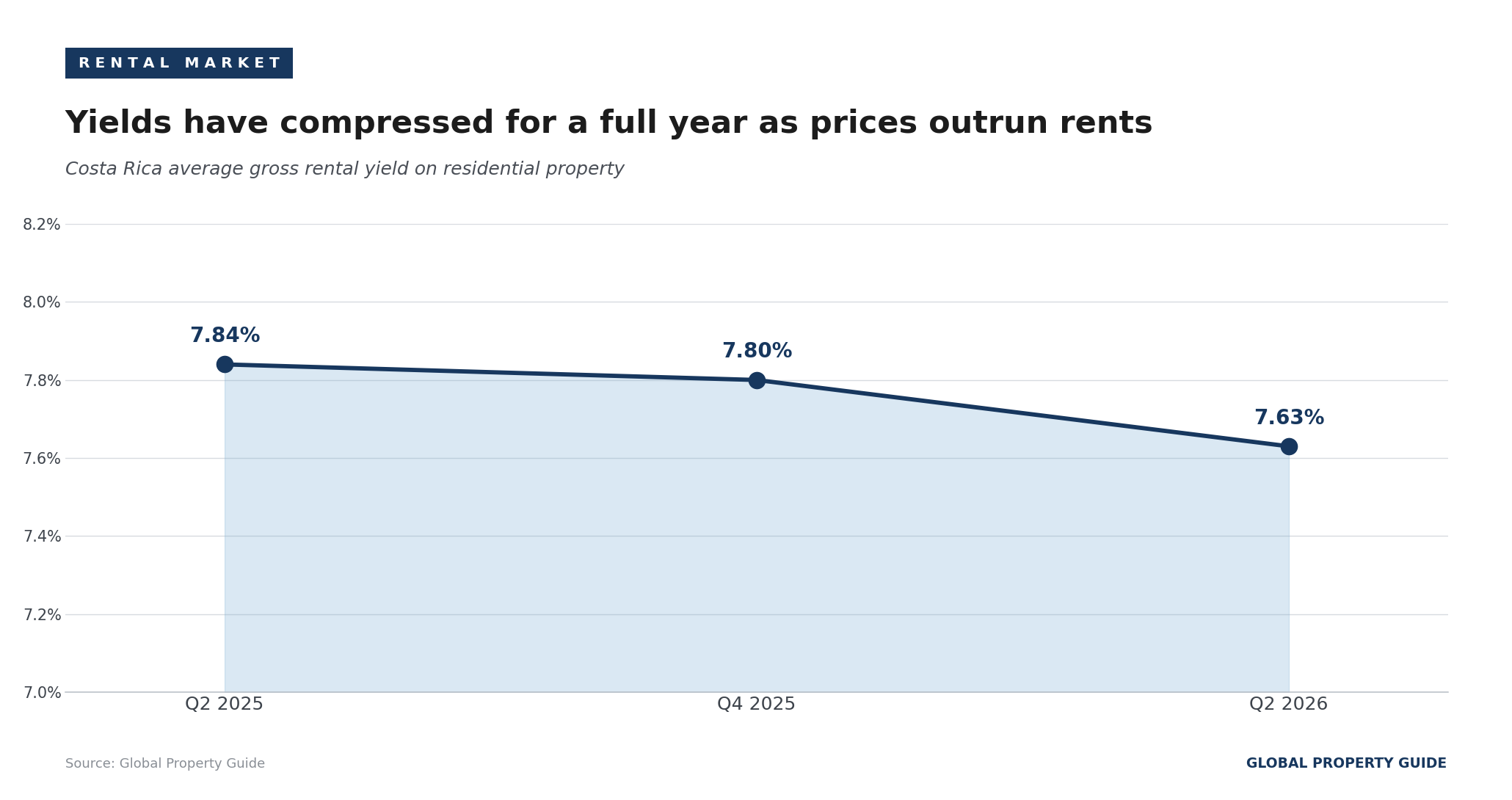
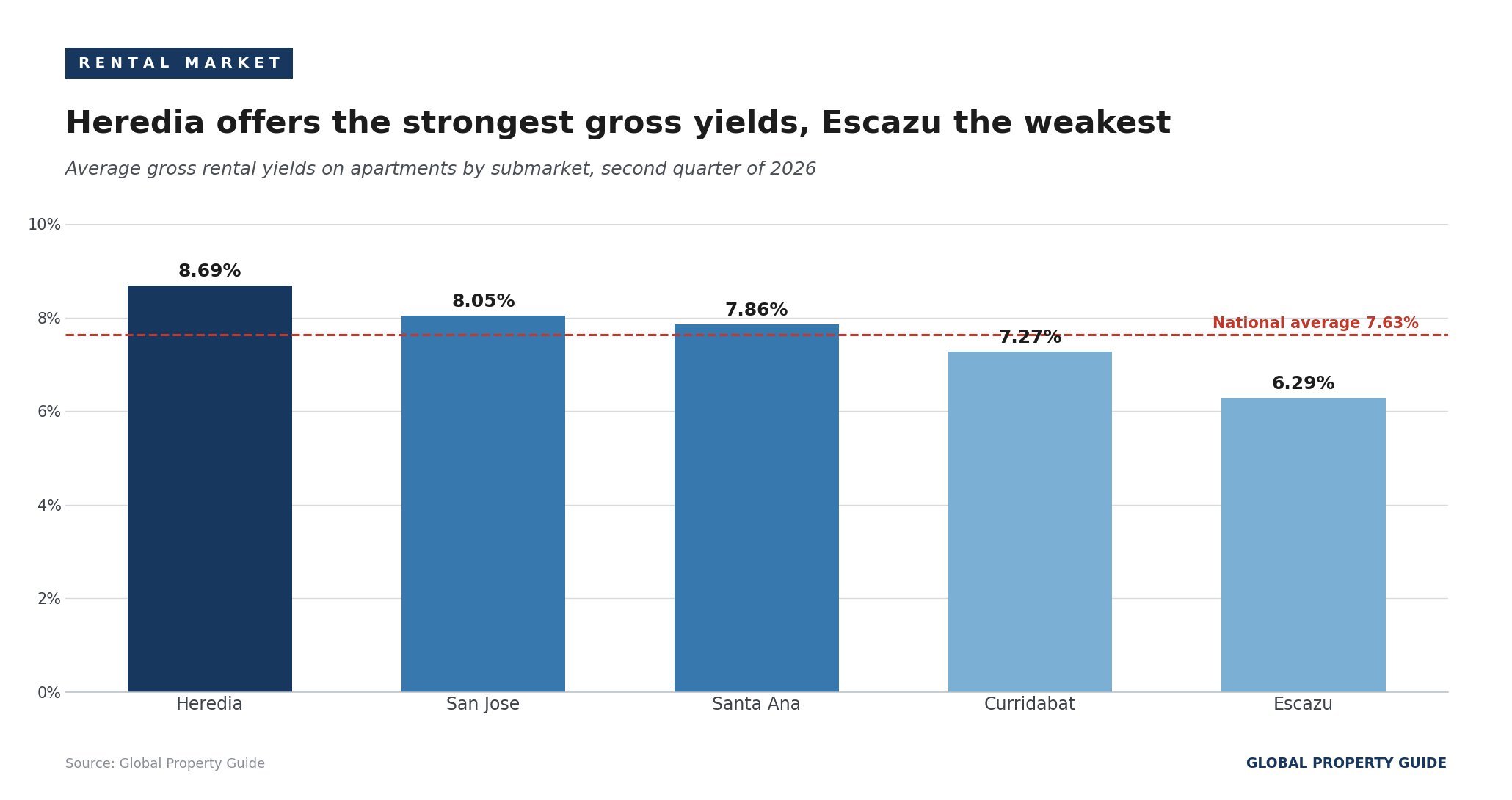
For investors, the arithmetic of that rent growth has been offset by faster growth in prices. Global Property Guide research conducted in the second quarter of 2026 puts the average gross rental yield on Costa Rican residential property at 7.63 percent, down from 7.80 percent in the fourth quarter of 2025 and from 7.84 percent recorded a year earlier.
Dispersion across submarkets is wide and has a clear logic to it. Heredia offers the strongest average yield at 8.69 percent, followed by San Jose at 8.05 percent and Santa Ana at 7.86 percent, with Curridabat at 7.27 percent and Escazu at 6.29 percent. The 2.40 percentage point spread between Heredia and Escazu reflects the premium that capital values in the wealthiest districts carry over the rents those properties can command.
At the unit level, the research found monthly asking rents of USD 950 to USD 1,200 for one-bedroom apartments, USD 1,100 to USD 1,800 for two-bedroom units and USD 1,300 to USD 2,900 for three-bedroom units, against purchase prices ranging from USD 134,000 for a one-bedroom apartment in Heredia to USD 600,000 for a four-bedroom unit in Escazu. Three-bedroom apartments in San Jose stand out, returning 8.91 percent, while the largest units in Escazu return 5.40 percent.
The legal framework is unchanged
Residential rental agreements continue to fall under the General Law of Urban and Suburban Rentals. Landlords set the initial rent freely, but increases during an existing contract are governed by statute, and the rules differ by the currency of the lease.
For leases denominated in foreign currencies, including US dollars, the rent remains fixed for the duration of the contract with no provision for increases. For leases in colones, annual adjustments may be made based on accumulated inflation over the preceding twelve months. Where inflation is 10 percent or less, the landlord may raise the rent by the corresponding percentage using the consumer price index published by INEC. Where accumulated inflation exceeds 10 percent, the Ministry of Housing and Human Settlements sets the permitted increase, which must be neither below 10 percent nor above the annual inflation rate. In a deflationary environment, this formula has an important practical consequence: colon-denominated leases have had little or no statutory scope for increase, which helps explain why the measured rise in rents has been concentrated at the point of new contracts rather than within existing ones.
Economic and Social Factors
Growth peaked in 2025
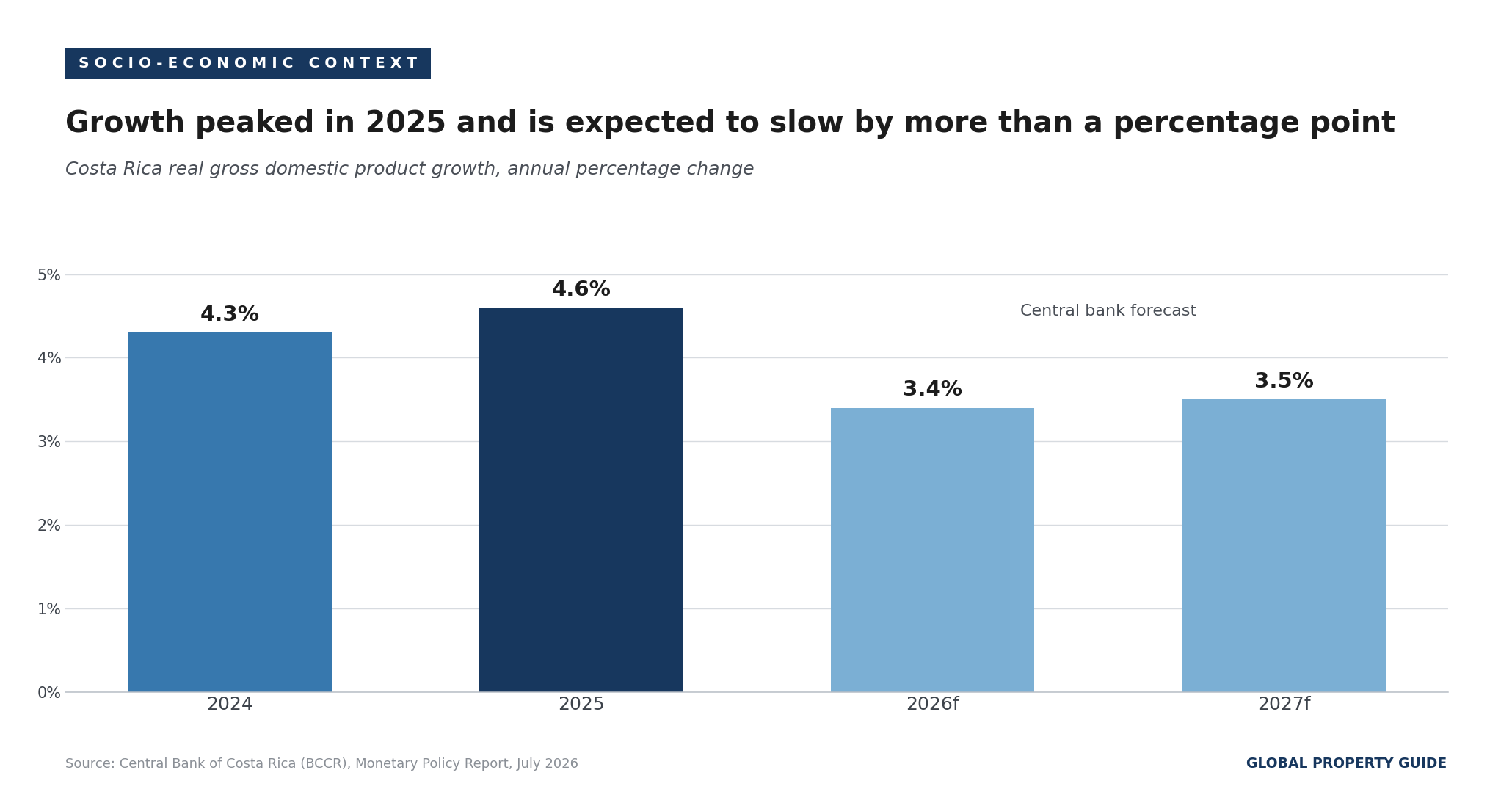
The Costa Rican economy expanded 4.6 percent in real terms in 2025, up from 4.3 percent in 2024, led by exports of medical devices and services and supported by household consumption. That was the peak. The BCCR's July 2026 Monetary Policy Report projects growth of 3.4 percent in 2026 and 3.5 percent in 2027, each revised down by 0.1 percentage points against the April report and well below the 3.8 percent the bank had forecast for 2026 in January. Domestic demand is expected to remain the principal driver.
The Institute of Economic Research at the University of Costa Rica reached a similar conclusion from a different direction, cutting its 2026 forecast to 3.4 percent from 4.5 percent estimated at the start of the year and attributing much of the downgrade to deceleration in the special regime that houses the free trade zones. Public finances have also weakened: by the end of May 2026 the primary surplus had narrowed, and the fiscal deficit widened against a year earlier.
Inflation remains the central puzzle. Consumer prices closed 2025 at negative 1.2 percent, averaged negative 0.7 percent in the fourth quarter, and have stayed negative through 2026 at negative 0.97 percent in May, negative 0.32 percent in June, and negative 0.28 percent in July. The BCCR expects headline inflation to hold near 2 percent for the remainder of 2026 and to average above 2 percent but below the 3 percent target through the second quarter of 2028. The last month in which inflation actually reached target was April 2023.
Political change without policy discontinuity
Costa Rica held general elections on 1 February 2026. Laura Fernández Delgado of the Partido Pueblo Soberano won outright in the first round with 50.87 percent of the vote against 31.63 percent for Álvaro Ramos of Liberación Nacional, becoming the country's second woman president. Her party took 31 of the 57 seats in the Legislative Assembly, the first absolute single-party majority since 1990, on turnout of 69.22 percent.
The result represents continuity with the political project of the outgoing Chávez administration rather than a change of direction, and the legislative majority gives the new government unusual latitude. Its early exercise of that latitude, in the reallocation of housing subsidy funds described above, is a signal worth watching for anyone modelling the social housing pipeline.
The colon has reshaped the tourism economy
Tourism supplies 8.2 percent of gross domestic product and close to 20 percent of employment, and its trajectory bears directly on coastal property demand. International air arrivals reached 2,689,278 in 2025, an increase of just 1.0 percent or 27,790 visitors on 2024. That was the weakest growth of the past decade, against a decade average near 8 percent, excluding the pandemic years.
Note that this series counts air arrivals only. The prior edition of this analysis cited a figure above 2.9 million for 2024 drawn from a measure that includes land and sea entry; the two are not comparable, and the air-arrivals series is used consistently here.
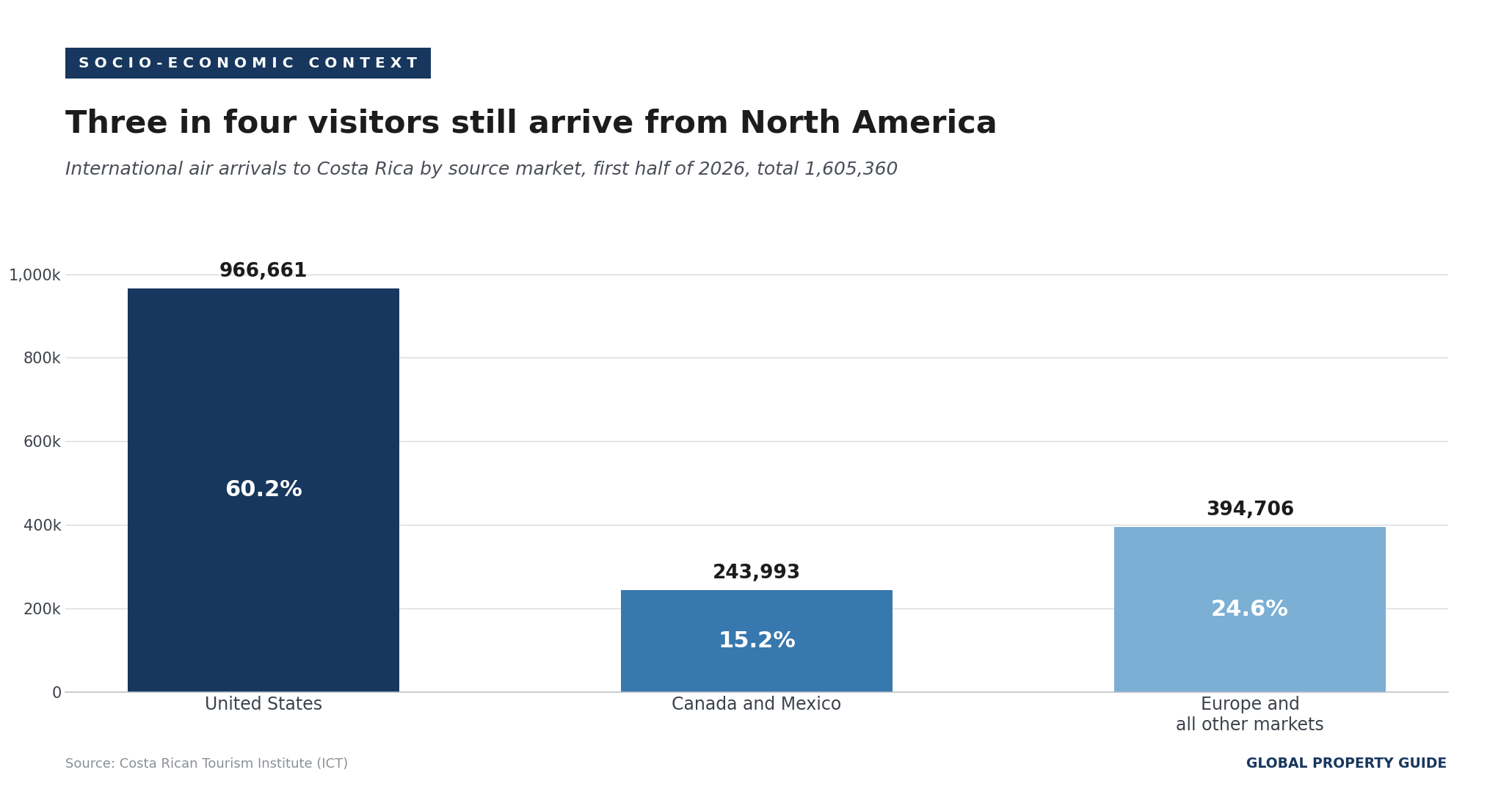
The first half of 2026 was considerably better. Arrivals totalled 1,605,360, the strongest first half on record. North America supplied 1,210,654 visitors, 75 percent of the total and 8.1 percent more than a year earlier, with the United States contributing 966,661 at growth of 4.9 percent. Canada was the fastest-growing large market and moved into second place among source countries. Among European markets, Germany remained the largest by volume at 40,916 arrivals while Spain grew fastest at 16.8 percent to 24,910.
June interrupted the run. Arrivals fell 1.2 percent to 214,518, the first negative month of the year and the end of eight consecutive months of growth. The Costa Rican Tourism Institute attributed the fall to the geopolitical environment, higher aviation fuel costs and the 2026 World Cup, which kept a portion of American and Mexican travellers at home.
Behind these figures sits the currency. The colon's appreciation from roughly CRC 685 per dollar in mid 2022 to CRC 450.54 in August 2026 has made Costa Rica materially more expensive for visitors paying in dollars, and it constitutes a structural headwind for a sector competing against regional destinations with weaker currencies.
The labour market has stopped adding jobs
INEC's Continuous Employment Survey put the unemployment rate at 7.0 percent in the second quarter of 2026, with 163,690 people out of work against 172,591 a year earlier when the rate stood at 7.4 percent. On a longer view, the improvement is substantial, from 9.6 percent in the second quarter of 2023 and 8.5 percent in 2024.
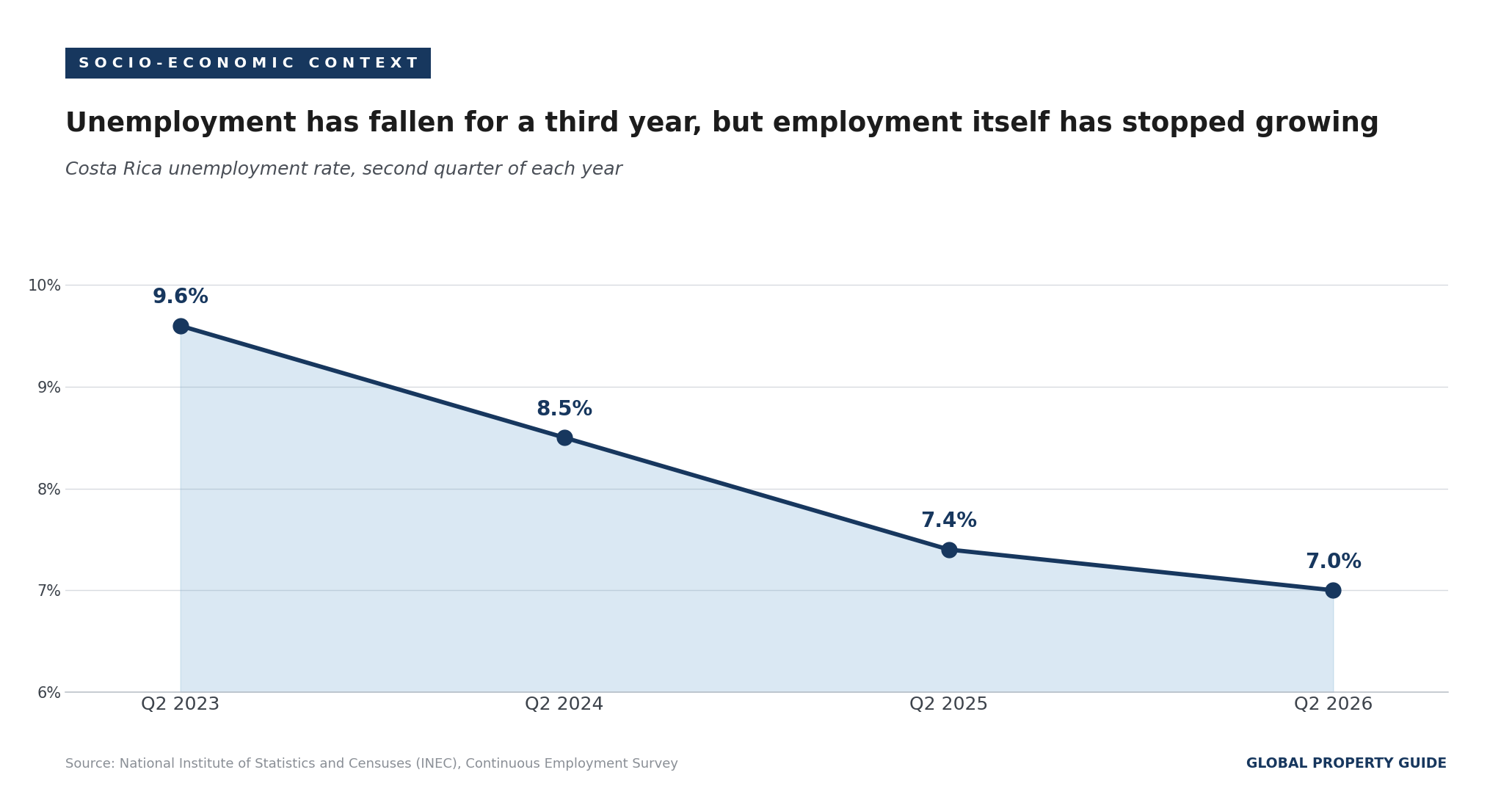
The headline rate flatters the underlying position. Employment stood at 2,182,916, an increase of 29,437 over the year that INEC does not regard as statistically significant, and the last quarter in which employment showed a representative increase ended in January 2025. The net participation rate was 54.6 percent, having drifted down through 2025 in part because of population ageing. Informal employment accounted for 785,000 workers, 36 percent of the employed. The BCCR has noted that participation and employment rates have both fallen while underemployment has risen, and that real incomes have decelerated since the second half of 2025.
For the housing market, that combination matters more than the unemployment rate itself. A labour market that is not adding jobs, in which real incomes are slipping, and a third of workers are informal and therefore largely outside the formal credit system, sets a hard ceiling on how far domestic mortgage demand can expand, regardless of where the central bank sets its policy rate.
Sources:
- National Institute of Statistics and Censuses of Costa Rica (INEC)
- Total Construction Works Rose 7.7% in 2025 (ES): https://inec.cr/
- Construction Statistics 2025, Preliminary Results (ES): https://admin.inec.cr/
- Consumer Price Index (ES): https://inec.cr/
- Consumer Price Index Update from July 2026 (ES): https://admin.inec.cr/
- Continuous Employment Survey (ES): https://admin.inec.cr/
- Census 2022: https://inec.cr/
- Central Bank of Costa Rica (BCCR)
- Economic Indicators: https://sdd.bccr.fi.cr/
- Monetary and Financial Indicators: https://sdd.bccr.fi.cr/
- Monetary Policy Communication 02-2026 (ES): https://www.bccr.fi.cr/
- Monetary Policy Report, July 2026 (ES): https://www.bccr.fi.cr/
- Monetary Policy Report, April 2026 (ES): https://www.bccr.fi.cr/
- Monetary Policy Communication 05-2025 (ES): https://www.bccr.fi.cr/
- Global Property Guide
- Costa Rica Rental Yields: https://www.globalpropertyguide.com/
- Costa Rica Square Metre Prices: https://www.globalpropertyguide.com/
- Costa Rica House Price Change: https://www.globalpropertyguide.com/
- Federated College of Engineers and Architects of Costa Rica (CFIA)
- Square Metres Registered in the First Half of the Year Exceed the Same Period of 2025 by 21% (ES): https://revista.cfia.or.cr/
- CFIA Projects Millions of Square Metres of Construction for 2026 (ES): https://revista.cfia.or.cr/
- Construction Statistics: https://cfia.or.cr/
- Costa Rican Tourism Institute (ICT)
- Statistical Reports (ES): https://www.ict.go.cr/
- Costa Rican Legal Information System
- Law on the Maritime-Terrestrial Zone No. 6043 (ES): https://pgrweb.go.cr/
- General Law on Urban and Suburban Leases No. 7527 (ES): https://pgrweb.go.cr/
- La Nacion
- Housing Market in Costa Rica Grew in 2025 Driven by Rentals and Home Ownership (ES): https://www.nacion.com/
- Construction in Costa Rica Registers Greater Dynamism Than Expected (ES): https://www.nacion.com/
- Annual Inflation Remains Negative in July at -0.28% (ES): https://www.nacion.com/
- Employed Population Records Another Quarter Without Significant Growth (ES): https://www.nacion.com/
- Election Results 2026 (ES): https://www.nacion.com/
- BANHVI to Provide 14,000 Housing Bonds in 2026 (ES): https://www.nacion.com/
- El Financiero
- The Central Bank Has Lowered Its Reference Rate, But Credit Remains Expensive (ES): https://www.elfinancierocr.com/
- Central Bank Lowers Its Monetary Policy Rate from 3.25% to 3% (ES): https://www.elfinancierocr.com/
- Delfino
- Association of Economists Reports Sustained Increases in Housing Rents (ES): https://delfino.cr/
- Usury Ceilings Get Mixed Adjustments for the Second Half (ES): https://delfino.cr/
- Organisations Reject Reform Authorising Private Uses of the Maritime-Terrestrial Zone (ES): https://delfino.cr/
- CRHoy
- Governing Party Approves Major Cut to CEN-CINAI and BANHVI (ES): https://www.crhoy.com/
- Teletica
- 2,500 Families at Risk of Losing Housing Bond After Budget Cut, BANHVI Warns (ES): https://www.teletica.com/
- La Republica
- Novogar Consolidates Its Lead in New Home Sales in 2025 (ES): https://www.larepublica.net/
- El Observador
- Tourist Arrivals to Costa Rica Recorded the Lowest Growth of the Past Decade in 2025 (ES): https://observador.cr/
- Infobae
- More Than 1.6 Million Visitors Arrived by Air in the First Half of 2026 (ES): https://www.infobae.com/
- University of Costa Rica
- The Costa Rican Economy Loses Momentum (ES): https://www.ucr.ac.cr/
- Coldwell Banker
- Costa Rica Real Estate Market Update: What Buyers Should Know in 2026: https://www.puravidaparadise.com/
- The Tico Times
- Guanacaste Leads Coastal Recovery in Costa Rica Real Estate: https://ticotimes.net/
- Gutiérrez and Gallardo
- Revista GAMA Inmobiliaria (ES): https://gyg.cr/
- Encuentra24.com
- Property Price Trends: https://www.encuentra24.com/