Sweden's Residential Property Market Analysis 2026
Sweden's housing market has turned, though not in the way most forecasters expected. Prices are rising only modestly, but transaction volumes have climbed to their highest levels since the pandemic years, and the government has delivered the deepest loosening of mortgage regulation in a decade. Working against that, mortgage rates bottomed out in February, and the Riksbank has put a rate rise back on the table.
This extended overview from Global Property Guide covers key aspects of Sweden's housing market and takes a closer look at its most recent developments and long-term trends.
Table of Contents
- Property Prices and Price Index
- Historic Perspective
- Property Demand Trends
- Property Supply Trends
- Rental Market: Rents and Rental Yields
- Mortgage Market and Interest Rates
- Economic and Social Factors
Property Prices and Price Index
Swedish house prices have been rising steadily but slowly throughout 2026. In the twelve months to July 2026, apartment prices in the tenant-owned sector rose by 4.6% while prices of single-family houses rose by 3.4%, according to Svensk Mäklarstatistik, the statistics body owned by the Swedish association of estate agents and quality-assured by Statistics Sweden. With consumer price inflation running at a preliminary 0.2% in July, those gains translate into real increases of about 4.4% and 3.2%, respectively.
Sweden's house price annual change:
Monthly movements have been choppier. Apartment prices fell 1.5% in July 2026 from the previous month, while house prices rose 0.9%. Per-Arne Sandegren, head of analysis at Svensk Mäklarstatistik, attributes the apartment decline to a familiar seasonal pattern in which sales in the most expensive inner-city districts thin out over the summer and drag the price average down with them.
The official index tells a more subdued story, partly because it measures something different. Prices according to the Real Estate Price Index for one- and two-dwelling buildings rose by slightly more than 1% at the national level in the first quarter of 2026 compared with a year earlier, and increased against the previous quarter, based on figures from Statistics Sweden. Against first-quarter consumer price inflation averaging 0.5%, that is a real gain of roughly half a percentage point.
Two points of methodology matter for anyone comparing this edition with earlier ones. First, Statistics Sweden issued a correction on 13 March 2026 that revised the Real Estate Price Index, both annual and quarterly, for the years 2023 to 2025. Growth rates for the fourth quarter of 2025 published before that date have been superseded. Second, second-quarter 2026 index figures had not been released at the time of writing, which is why the most recent official reading here is the first quarter.
Average transaction prices, first quarter 2026. At the national level, the average price for a one- or two-dwelling building was SEK 4.2 million (EUR 381,298). In the metropolitan areas, the average ranged from SEK 5.3 million (EUR 481,162) in Greater Malmö to SEK 7.2 million (EUR 653,654) in Greater Stockholm. Holiday homes averaged SEK 2.8 million (EUR 254,199).
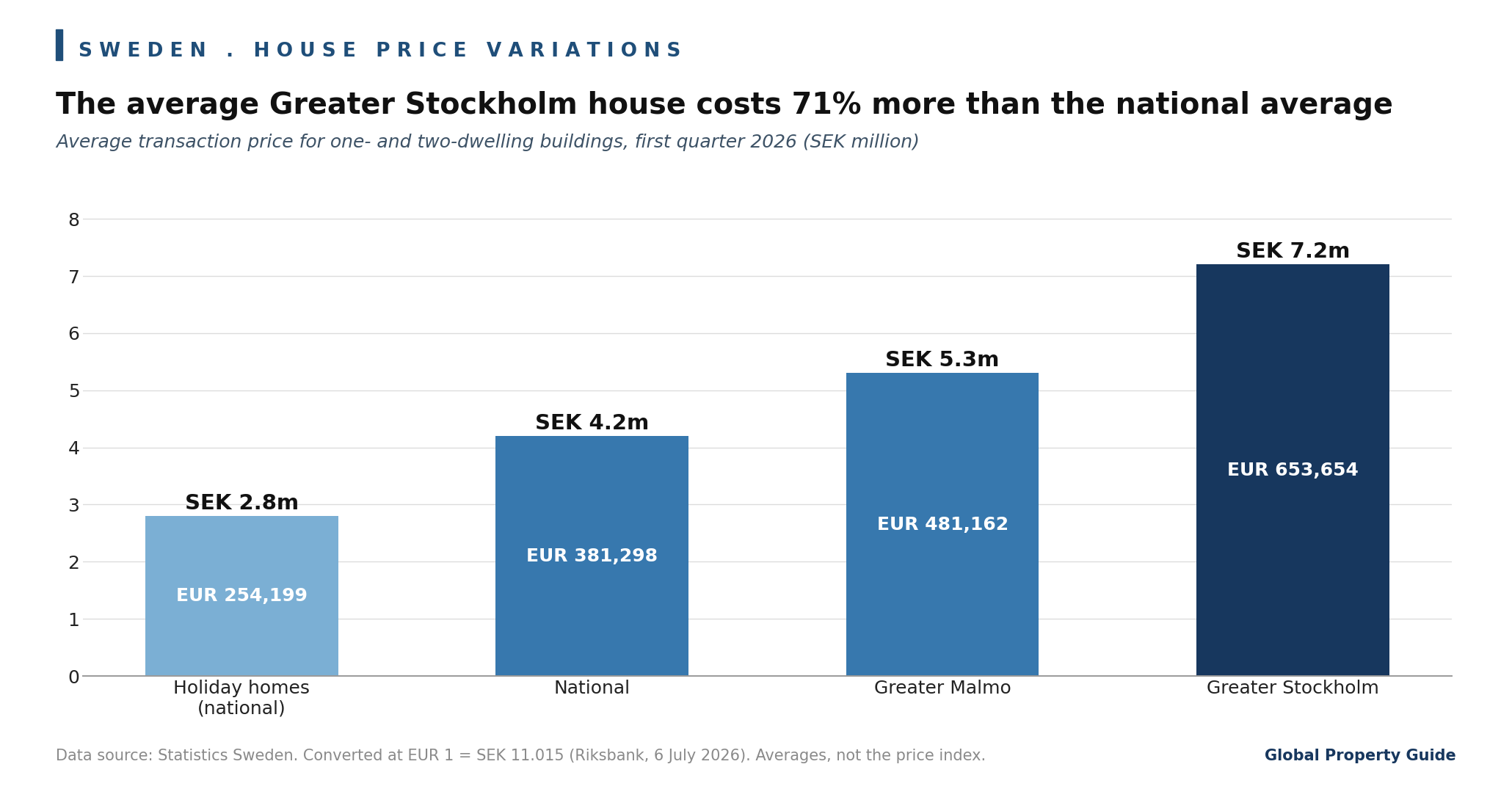
These are unadjusted averages of registered transactions, not index values, and they should not be read as price growth. The national average was SEK 3.8 million in the fourth quarter of 2025, but the 10% jump to the first quarter of 2026 reflects the changing mix and timing of sales rather than a price rise of that magnitude. The index, which is weighted by the housing stock and controls for composition, moved by roughly one percent over the year.
By metropolitan area. In July 2026, apartment prices fell 2.5% month on month in Greater Stockholm and 0.6% in Greater Gothenburg, while rising 0.4% in Greater Malmö, according to Svensk Mäklarstatistik. Every inner-city district recorded a decline, from 0.6% in Stockholm and 1.1% in Gothenburg to 1.7% in Malmö. The Greater Stockholm figure was the weakest of the three because both the number of sales in central Stockholm and prices there fell together.
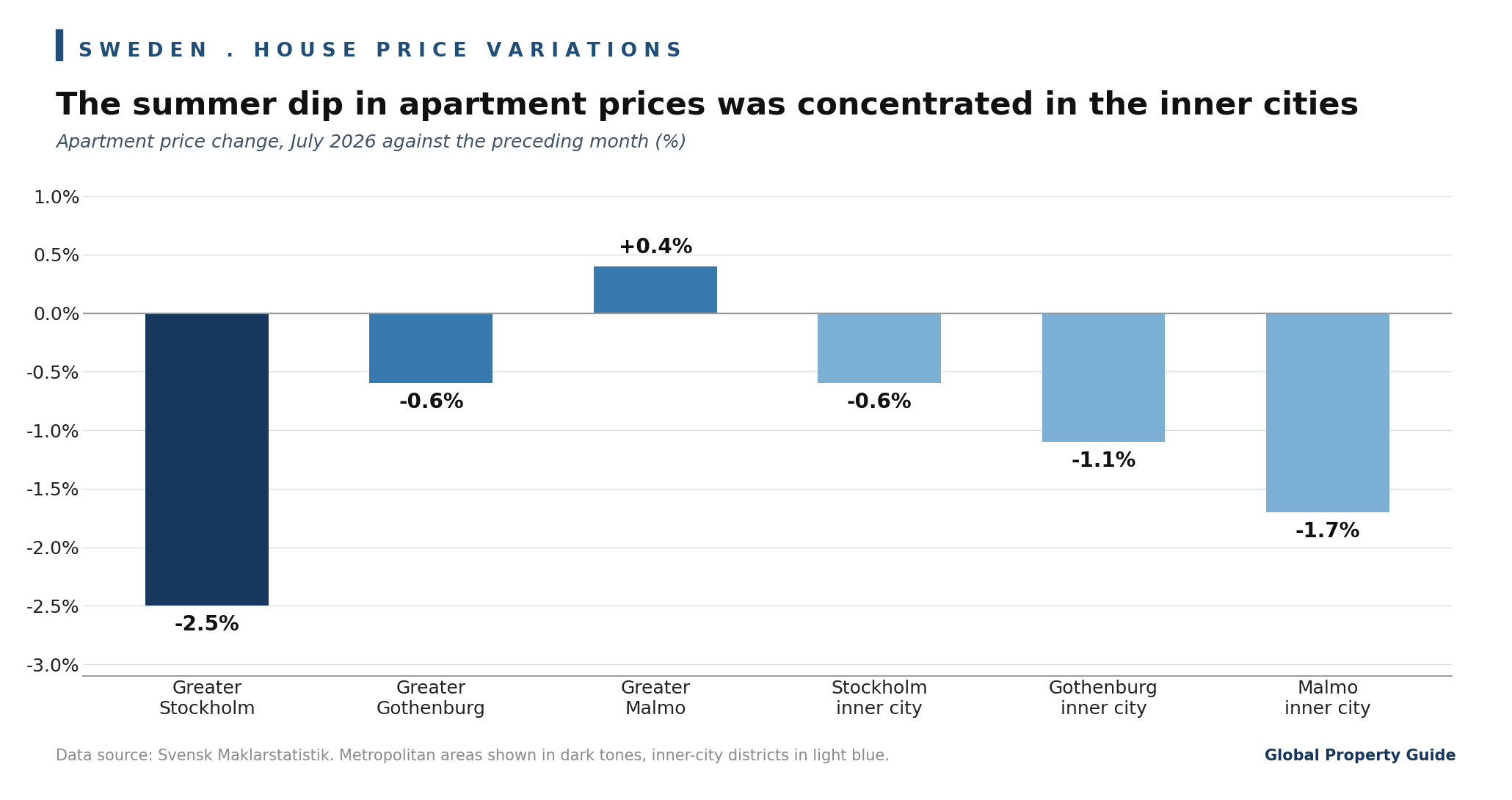
Annual rates tell a close to the opposite story. Over the twelve months to July 2026, they ranged from 0.5% in central Malmö to 8.5% in central Stockholm, which means the capital's most expensive districts are simultaneously the weakest performers month to month and the strongest over the year. House prices rose in all three metropolitan areas over the month, with the national figure of 0.9% exceeding each of them because areas outside the big cities gained 1.0%.
The holiday home market has been softer. Prices for real estate for seasonal and secondary use fell almost 4% at the national level in the first quarter of 2026 against the previous quarter and were unchanged against a year earlier, according to Statistics Sweden.
Looking ahead, Svensk Mäklarstatistik expects prices to resume rising in August and to finish 2026 between 3% and 5% higher for the year as a whole. The Länsförsäkringar housing price barometer for August 2026, based on 1,850 interviews conducted between 27 July and 5 August, found sharply divided sentiment: optimism among those under 29 jumped from 38 in July to 51 in August, while the 30 to 49 age group moved the other way, from 45 to 38, and the Stockholm reading fell from 39 to 34.
Historic Perspective
Bubble risk remains low, but household debt does not
Following the sharp correction of 2022 and 2023 and the sluggish market of 2024 and 2025, the risk of a housing bubble in Stockholm is now assessed as low. In its Global Real Estate Bubble Index, UBS notes that falling mortgage rates between 2009 and 2021 pushed real housing prices in Stockholm up by roughly 90%, outrunning local incomes and rents, and that the combination of stretched valuations, high household debt, and variable-rate mortgages proved dangerous when rates rose. Real prices then fell by almost 30% over three years. "For now, the bubble risk is low", the report concludes, adding that the correction is losing momentum. The 2025 edition remains the most recent at the time of writing.
Household indebtedness is the unresolved part of the picture. About 65% of Swedish households own their homes, and around 77% of those carry a mortgage. The home ownership rate stood at 64.6% in 2025, down slightly from 64.8% in 2024. The Swedish Financial Supervisory Authority (Finansinspektionen) has repeatedly noted that although mortgage growth slowed markedly from May 2022, total household indebtedness remains high.
The cost of carrying that debt rose steeply. Finansinspektionen found that new mortgagors who amortised spent an average of 18% of disposable income on interest and amortisation payments after interest deductions, an increase of roughly 7 percentage points on the low-rate years of 2017 to 2021. Conditions improved through 2024 and 2025 as the Riksbank cut its policy rate and incomes recovered, and the average size of a new mortgage rose in 2024 for the first time since 2021.
Sweden's housing market cycle
Sweden's long boom began in the mid-1990s, set off by falling interest rates, rapid economic growth, and a shortage of new supply. Mortgage rates fell from above 10% in 1996 to below 5% between 2004 and 2008, sharply expanding borrowing capacity.
From 1996 to 2007, the Greater Stockholm house price index rose by 217% (119% inflation-adjusted), Greater Malmö by 236% (185%), and Greater Gothenburg by 202% (156%). The trend stalled briefly in 2008 and again in 2012, then resumed: prices rose 45.1% (40.7% inflation-adjusted) between 2012 and 2017 on ultra-low rates, strong income growth, urban population increases, and persistent supply shortages. After a marginal dip in 2018, prices rose a cumulative 32.6% (25.8% inflation-adjusted) from 2019 to 2021.
The reversal was severe. Between the first quarter of 2022 and the fourth quarter of 2023, house prices fell 10.8% in nominal terms and roughly 23% in real terms, with consumer prices rising 8.4% in 2022 and 8.7% in 2023. Seven consecutive quarters of annual price falls from the fourth quarter of 2022 to the second quarter of 2024 made this the worst Swedish housing downturn since 1993.
The recovery since has been shallow. Prices rose 2.1% in 2024 and 0.9% in 2025 in nominal terms. Deflating those by annual average consumer price inflation of 2.9% and 0.7% gives a real fall of 0.8% in 2024 and a real gain of 0.2% in 2025. Readers comparing these figures with other published series should note that the choice of deflator matters at these magnitudes: using December-on-December inflation rather than the annual average produces materially different real figures for both years.
The regulatory pivot of April 2026
The single largest change to the Swedish housing market this year is regulatory rather than cyclical. After a Ministry of Finance committee appointed in April 2023 delivered its report on the regulation of household debt in November 2024, and a consultation memorandum followed in June 2025, the government presented a bill in February 2026. The Riksdag approved it in early March, and the changes took effect on 1 April 2026.
A new act on the limitation of residential credit now replaces Finansinspektionen's own regulations and general guidelines on amortisation requirements and the mortgage cap. Three substantive changes followed:
- The mortgage cap rose from 85% to 90% of a property's market value when buying a home, cutting the minimum deposit from 15% to 10%.
- The tightened amortisation requirement was abolished. Households whose housing debt exceeded 4.5 times gross annual income no longer face an additional 1% amortisation obligation.
- Top-up borrowing against an existing home, used for renovation among other purposes, is now capped at 80% of market value.
The original amortisation requirement tied to the loan-to-value ratio survives unchanged: at least 1% a year above 50% and at least 2% above 70%. Responsibility for setting the countercyclical capital buffer also passed from Finansinspektionen to the Riksbank.
Finansinspektionen itself had argued against a higher cap. Asked by the government to assess raising the limit from 85% to 90%, the authority concluded that doing so would increase household indebtedness and the risks attached to it, and said it would be appropriate to await the results of the wider inquiry before making changes. The government proceeded regardless, on the reasoning that a lower threshold would help younger buyers enter the market and reduce reliance on expensive unsecured borrowing for deposits.
Property Demand Trends
Transaction volumes at their highest since the pandemic
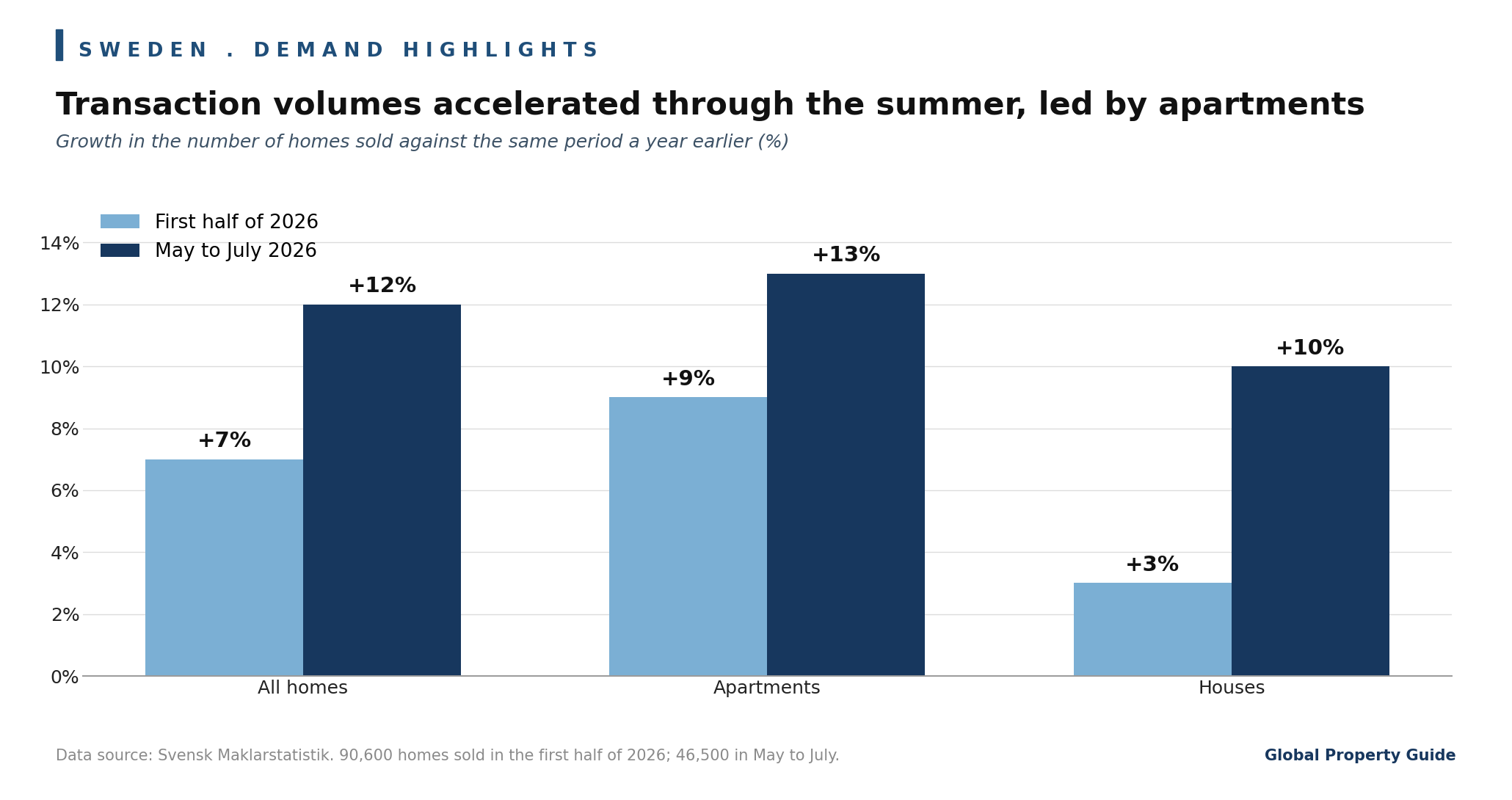
Turnover, not price, is where the Swedish recovery is visible. In the first half of 2026, 90,600 homes were sold nationwide, 7% more than in the same period of 2025, according to Svensk Mäklarstatistik. Apartment sales rose 9% to 59,700 units, and house sales rose 3% to 30,900. Per-Arne Sandegren notes that house transactions in the first half of 2026 exceeded even the corresponding period of the pandemic boom years, when the market was at its most frenetic.
Momentum built over the summer. Between May and July 2026, 46,500 homes changed hands against 41,600 in the same three months of 2025, an increase of 12%. Apartments accounted for 28,500 of those sales, up 13%, and houses for 18,000, up 10%. Oskar Öholm, chief executive of the estate agents' association Mäklarsamfundet, describes January to July volumes as the strongest for that period since the pandemic years, with prices up across a broad front on an annual basis.
Over the twelve months to July 2026, the average apartment price was SEK 45,500 (EUR 4,131) per square metre, 58,300 houses were sold, and the combined value of apartment and house sales reached SEK 550 billion (EUR 49.9 billion).
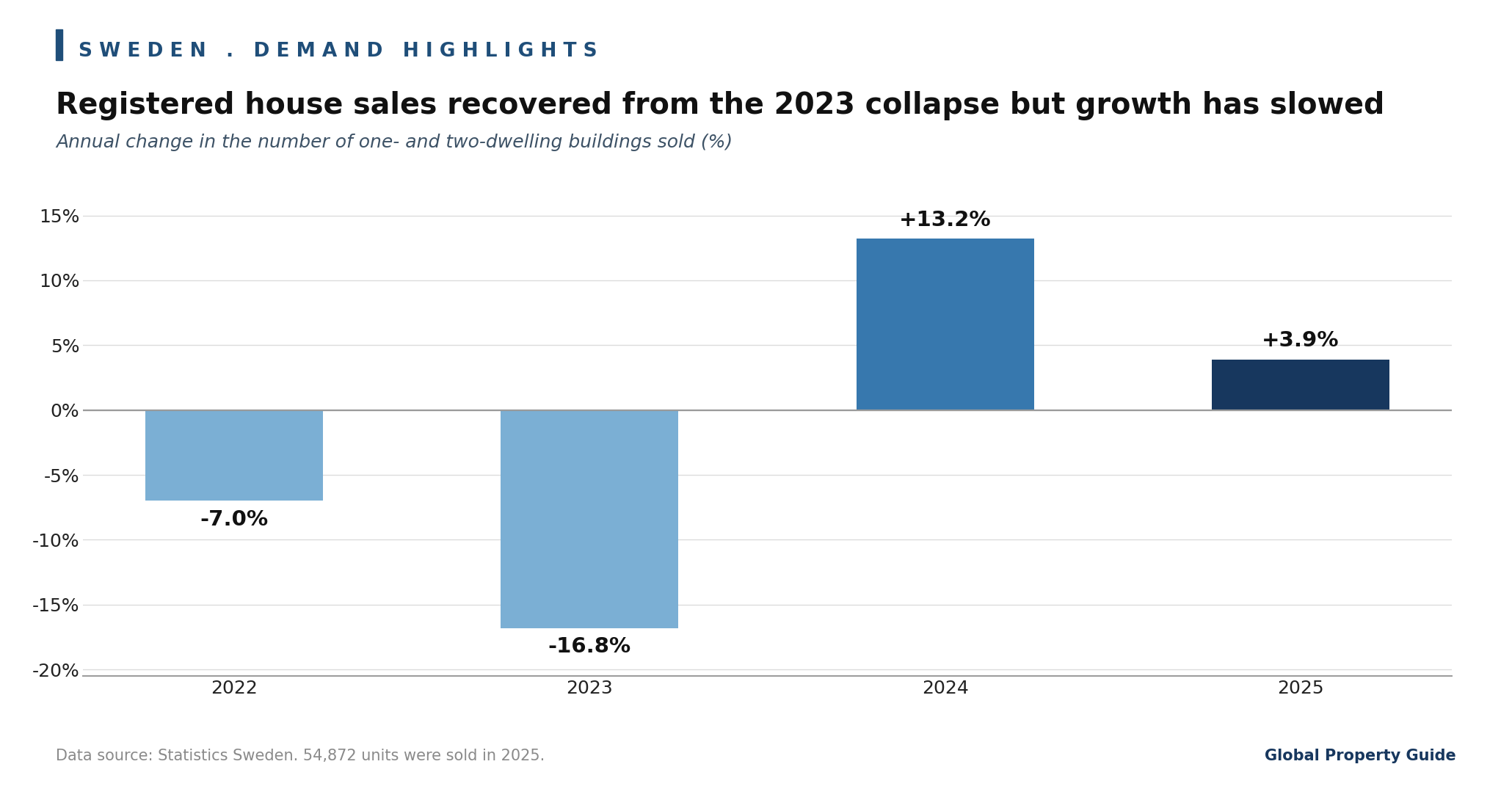
The official registration statistics, which lag and cover a narrower definition, show the same trajectory arriving earlier. Sales of one- and two-dwelling buildings rose 3.9% to 54,872 units in 2025, a slowdown from 13.2% growth in 2024 but a clear improvement on declines of 16.8% in 2023 and 7% in 2022, according to Statistics Sweden.
The tenant-owned sector was similarly steady. In 2025, 102,062 tenant-owned flats were sold for a combined SEK 295 billion, about 2% more in value than the previous year, with the average price rising 2% from SEK 2.829 million to SEK 2.888 million.
Supply on the resale market has tightened as sales have picked up. Boverket, the national board of housing, building, and planning, reports that roughly 10% more homes were sold on the second-hand market in the first five months of 2026 than in the same period of 2025, according to Booli Pro data, and that the number of homes listed for sale early in the year ran below the level of a year earlier.
Foreign demand is flat, but the currency picture has flipped
Foreign ownership of Swedish holiday homes remains stable at the margin. Foreign owners held 38,133 holiday homes at the start of 2025, a rise of about 0.4% on the previous year, equivalent to 6% of the total holiday home stock, according to figures released by Statistics Sweden in March 2026.
Three nationalities account for the overwhelming majority. Norwegian citizens held 12,095 properties, or 31.7% of the foreign-owned total, Germans 11,478 or 30.1%, and Danes 9,506 or 24.9%. Together, they represent 86.7% of foreign holdings. Norwegian owners concentrate in Västra Götaland, Danish owners in Kronoberg and Skåne, German owners in Kalmar, and Dutch owners in Värmland. Separately, Swedish citizens living abroad owned 16,030 holiday homes, with those resident in Norway holding the largest share at 3,124.
Regional variation is extreme. Kronoberg recorded the highest share of foreign ownership at 36% of its holiday home stock, followed by Värmland at 23%. In Stockholm, Uppsala, Södermanland, Gotland, and Västmanland, the share is below 1%, with Uppsala lowest at 0.3%. In absolute terms, the largest concentrations are in Västra Götaland, Värmland, Kronoberg, and Skåne.
The currency backdrop has reversed direction since the previous edition of this report. The krona strengthened by about 10.8% against the euro between September 2023, when the monthly average was SEK 11.833 to the euro, and January 2026, when it reached SEK 10.678. That appreciation made Swedish property progressively more expensive for foreign buyers. Since January, however, the krona has given back part of that ground: the Riksbank quoted SEK 11.015 to the euro on 6 July 2026, roughly 3% weaker than in January and a modest improvement in affordability for euro-area and Nordic buyers.
Property Supply Trends
Housing starts recovered in 2025, then the forecast was cut
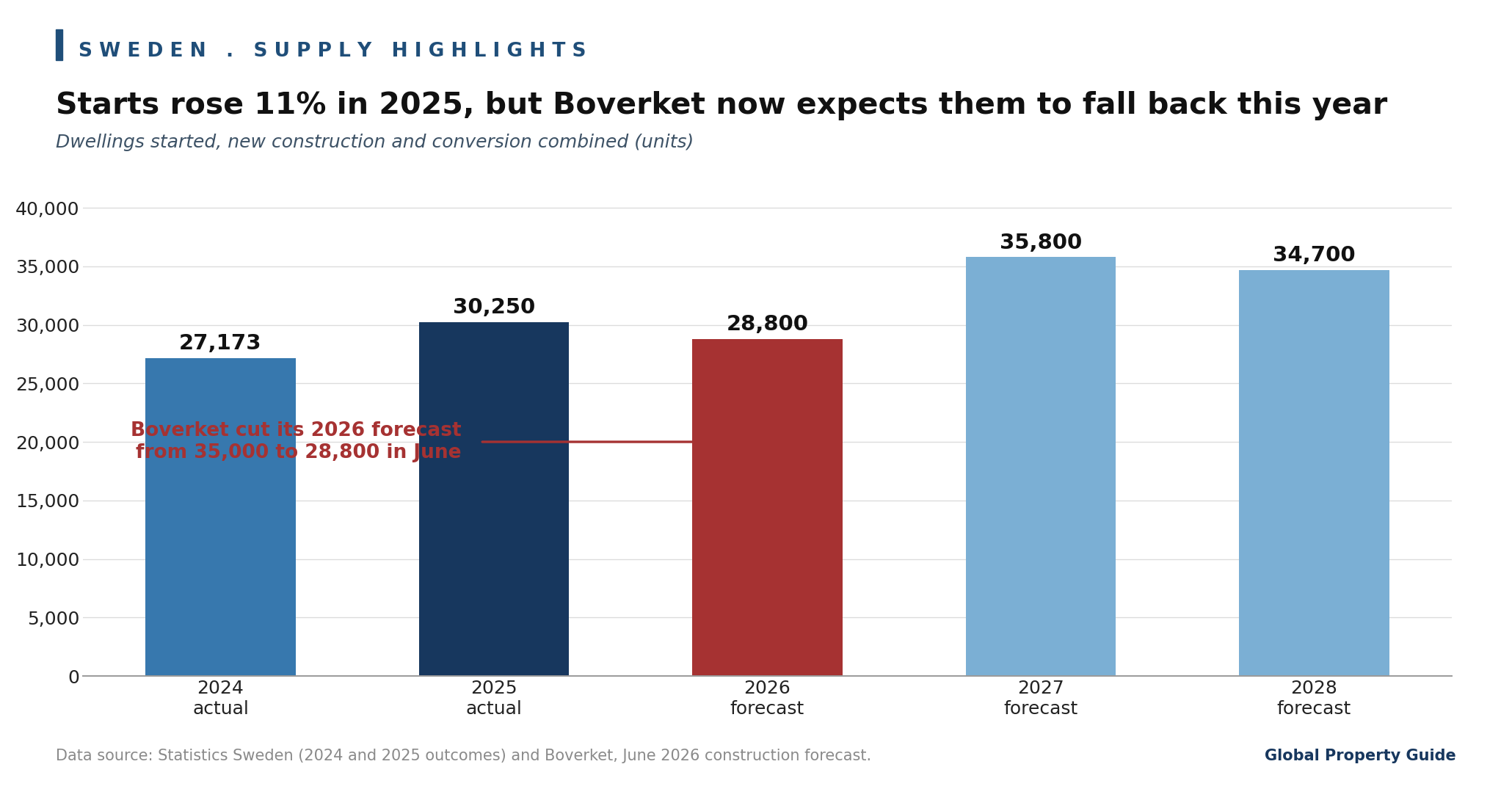
Residential construction turned a corner in 2025. According to preliminary figures from Statistics Sweden, construction of 30,250 dwellings was started in new buildings during 2025, 11% more than the 27,173 started in 2024. Starts in multi-dwelling buildings, including special housing, rose 12% to 24,350 units, and starts in one- and two-dwelling buildings rose 8% to 5,900. The tenure mix shifted: 67% of dwellings started in 2025 were rental units, against 72% in 2024.
The first quarter of 2026 continued that direction, though unevenly. Preliminary figures show roughly 6,800 dwellings started in new buildings, 4% more than in the same period of 2025. Approximately 5,200 were in multi-dwelling buildings, excluding special housing, 14% more than a year earlier, with a further 550 classified as special housing. Starts in one- and two-dwelling buildings fell about 26% to 550 units. Conversion of multi-dwelling buildings began on 250 dwellings, against 308 a year earlier. Second-quarter figures are scheduled for release on 25 August 2026.
Preliminary construction figures carry a substantial reporting lag and are revised upwards at each publication, so quarter-on-quarter comparisons between preliminary and definitive vintages are unreliable and are best avoided.
Boverket's own view has become markedly more pessimistic. Its June 2026 construction forecast expects roughly 28,800 dwellings to be started in 2026, of which 26,800 will be through new construction and 2,000 through conversion. That is a downgrade of nearly 7,000 dwellings against its March 2026 forecast, and it would place 2026 starts below the 2025 outcome. Boverket expects a recovery thereafter, to 35,800 starts in 2027 and about 34,700 in 2028, and projects completions holding at roughly 29,000 a year across 2026 to 2028.
Completions have collapsed
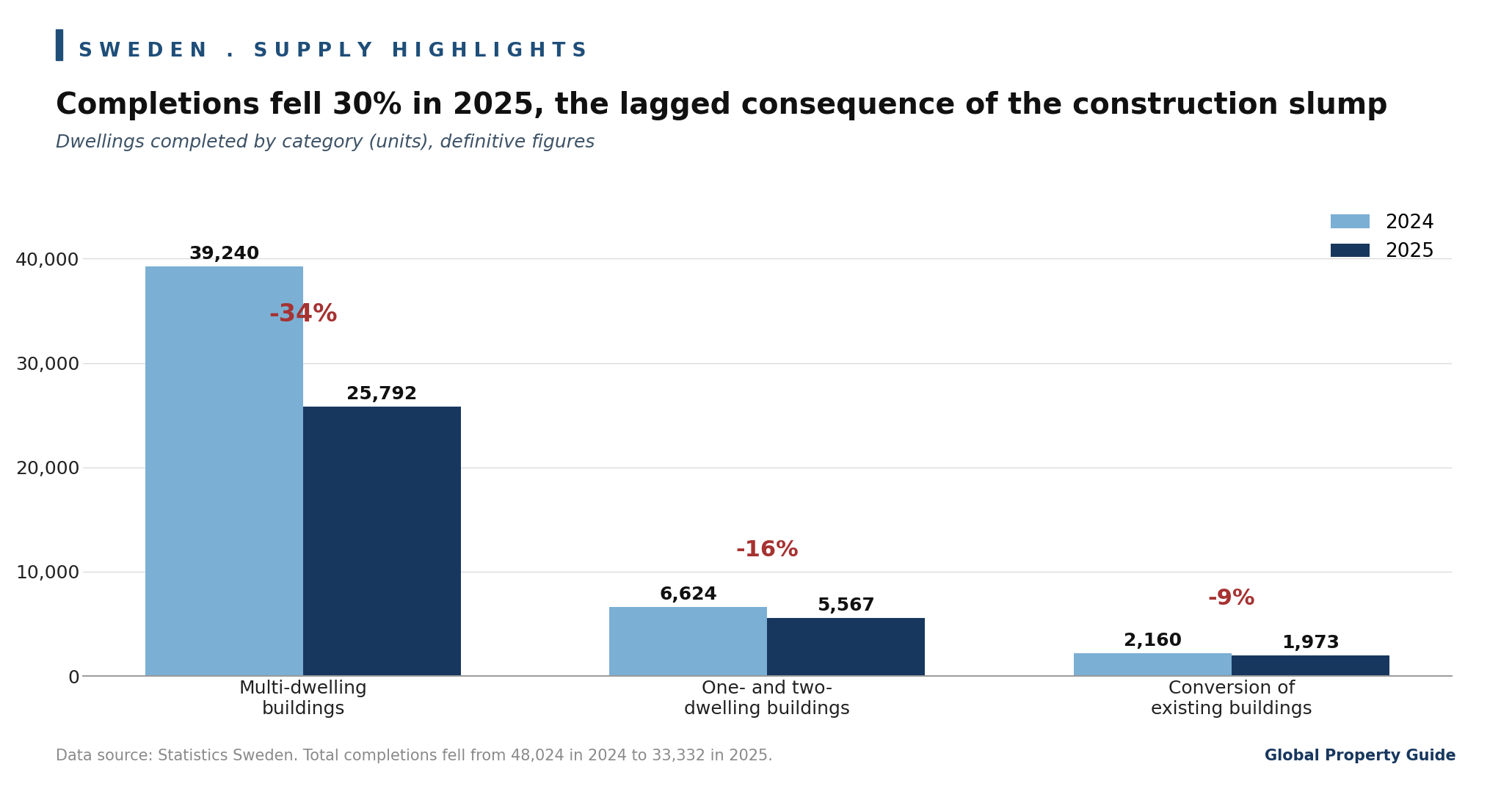
The counterpart to the 2023 and 2024 construction trough is now working through to delivery. In 2025, 25,792 dwellings were completed in newly built multi-dwelling buildings, 34% fewer than in 2024, according to definitive figures from Statistics Sweden. Completions in one- and two-dwelling buildings fell 16% to 5,567 units, and a further 1,973 dwellings were completed through conversion of existing multi-dwelling buildings, about 9% down on the previous year. New construction and conversion together produced 33,332 new dwellings in 2025, 30% fewer than the 48,024 of 2024.
Stockholm County recorded the highest number of completed dwellings in multi-dwelling buildings excluding special housing per 1,000 inhabitants, at 3.6. Among the dwellings completed in multi-dwelling buildings, 4,145 were classified as special housing. The most common size was two rooms and a kitchen, at 8,604 dwellings or more than one in three, and average useful floor space was 56 square metres in multi-dwelling buildings excluding special housing, against 149 square metres in one- and two-dwelling buildings. Around 74% of conversions involved formerly non-residential buildings, with Stockholm municipality accounting for 326 dwellings. Demolition began on 1,263 dwellings in multi-dwelling buildings during 2025, about 85% of them outside the metropolitan areas.
More municipalities now report balance than shortage
For the first time since 2001, more Swedish municipalities assess their housing market as balanced than as being in deficit. Boverket's housing market survey for 2026, published on 18 May 2026 and answered by 287 of the country's 290 municipalities, found 130 reporting a balance and 157 reporting an imbalance, of which 102 reported a deficit, and 55 reported a surplus. Marie Sand, who leads the survey at Boverket, cautions that more municipalities reporting a balanced budget does not mean the housing problem is solved, since vacancies and surpluses coexist with a shortage of affordable and accessible homes.
The reported surpluses cluster in specific segments: newly built and more expensive rental units, and homes in smaller localities. Constraints on building are consistent across municipality types. Nearly eight in ten municipalities identified high production costs as a leading factor limiting construction, alongside difficult lending conditions for both households and developers, and the absence of state support. Student housing has eased noticeably, with 17 of 38 university municipalities now reporting balance, double the number a year earlier. The public housing sector's stock grew by just under 4,100 dwellings during 2025. A shortage of housing for people with disabilities was reported by 132 municipalities.
Municipalities themselves expect around 33,400 new-construction starts in 2026 and 39,650 in 2027, an increase of roughly 19% between the two years. Boverket urges caution: across 2020 to 2024, only about 62% of the building municipalities projected in the survey actually began, and in 2024, the outcome reached just 36% of projected levels.
On the stock itself, Sweden had 5,260,876 dwellings at the end of December 2024, the most recent figure published in this series at the time of writing. Of these, 2,136,854 or 41% were in one- and two-dwelling buildings, 2,756,647 or 52% in multi-dwelling buildings, 289,047 or 5% in special housing, and 78,328 or 2% in other buildings. Rental tenure remains dominant in multi-dwelling buildings at 58% of the stock.
Rental Market: Rents and Rental Yields
Gross rental yields improved in every major city
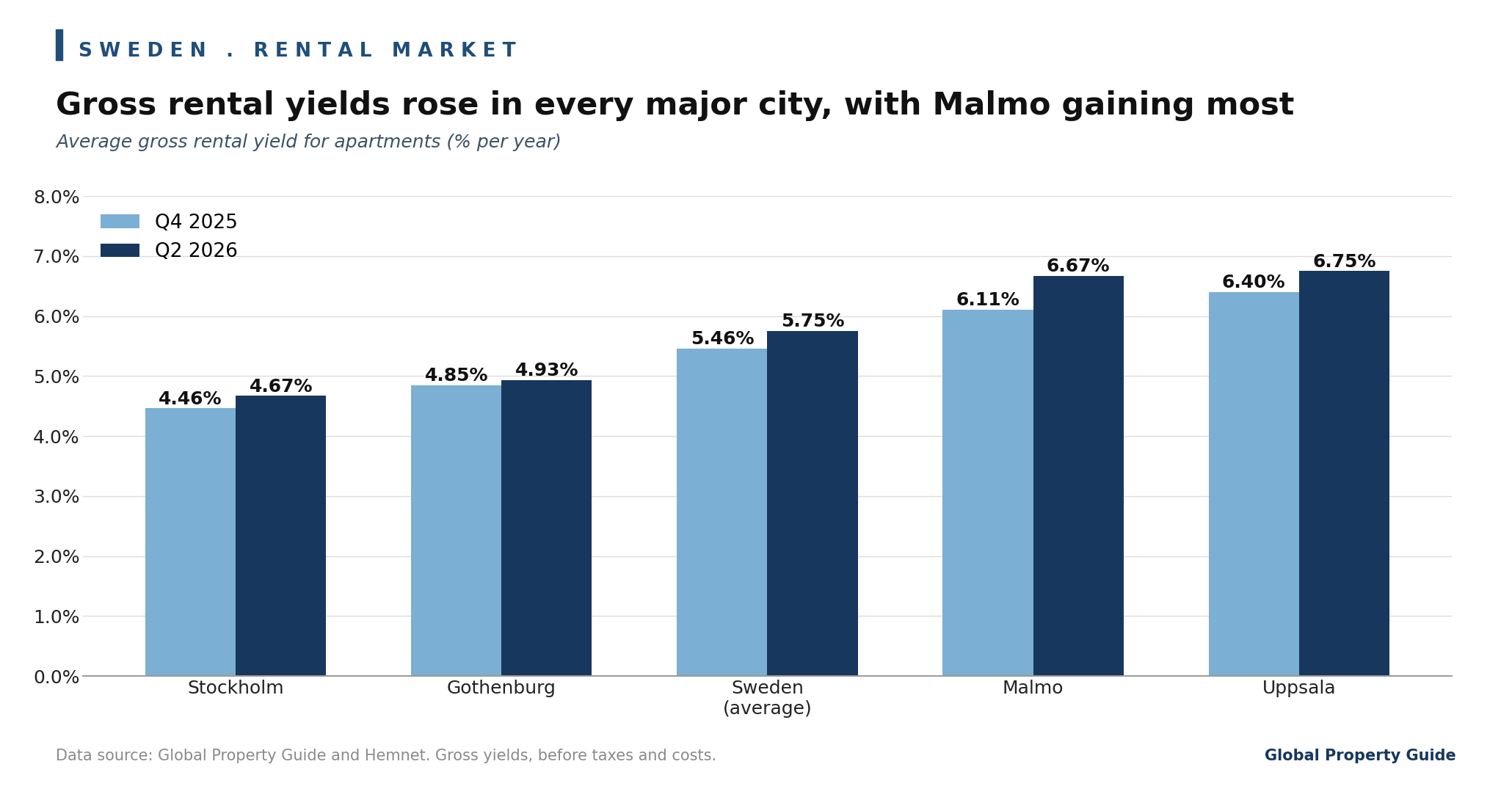
Rental returns strengthened over the first half of 2026. The average gross rental yield in Sweden stood at 5.75% in the second quarter of 2026, up from 5.46% in the fourth quarter of 2025, based on research by Global Property Guide using data from Hemnet. Every city covered gained ground.
In major cities, in the second quarter of 2026:
- In Stockholm, apartment yields range from 3.03% to 5.96%, with a city average of 4.67%, up from 4.46% in the fourth quarter of 2025. Central district studios return 5.96% while four-bedroom apartments across all locations return just 3.03%.
- Gothenburg yields range from 4.30% to 6.60%, with a city average of 4.93%, up from 4.85%.
- In Malmö, yields range from 4.56% to 7.54%, with a city average of 6.67%, a gain of more than half a percentage point from 6.11%.
- In Uppsala, apartments return between 6.00% and 7.17%, with a city average of 6.75%, up from 6.40%, and the highest of the four cities.
All figures are gross yields, before taxes, repairs, ground rents, agents' fees, and other costs. Net yields typically run 1.5 to 2 percentage points lower. The next update to this dataset is scheduled for October 2026.
Rents rose 4.6% in 2025, comfortably ahead of inflation
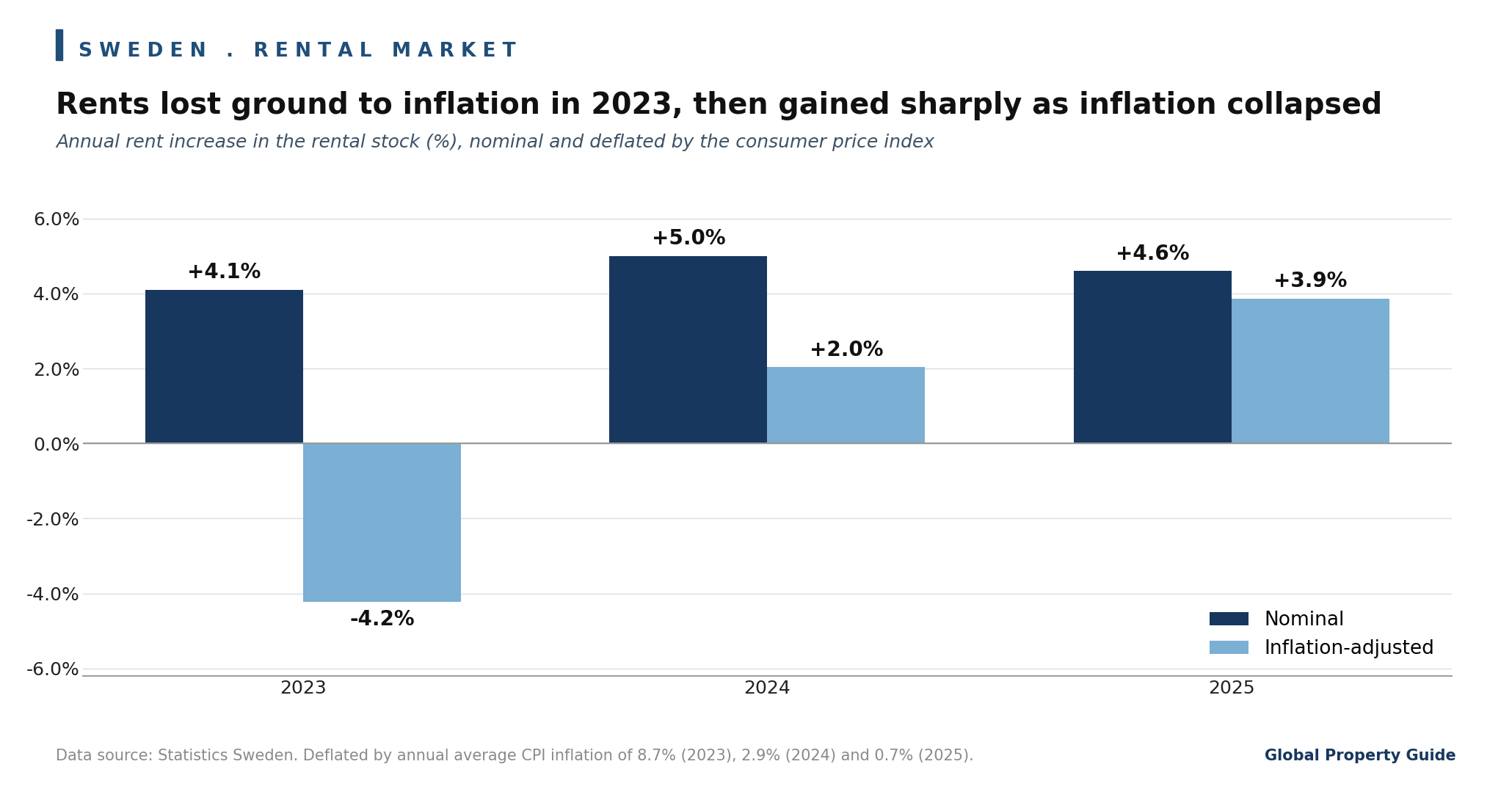
Rents in the existing rental stock rose by an average of 4.6% between 2024 and 2025, according to Statistics Sweden. That is 0.4 percentage points below the 2024 increase of 5.0%, which was the largest since 1993, and above the 4.1% recorded in 2023. Cumulatively, rents have risen by close to 14% since 2023, after annual increases of between 0.8% and 1.9% through the years 2016 to 2022. The survey samples roughly 16,000 dwellings nationwide. Figures for 2026 are due in autumn 2026.
Sweden's rent price index:
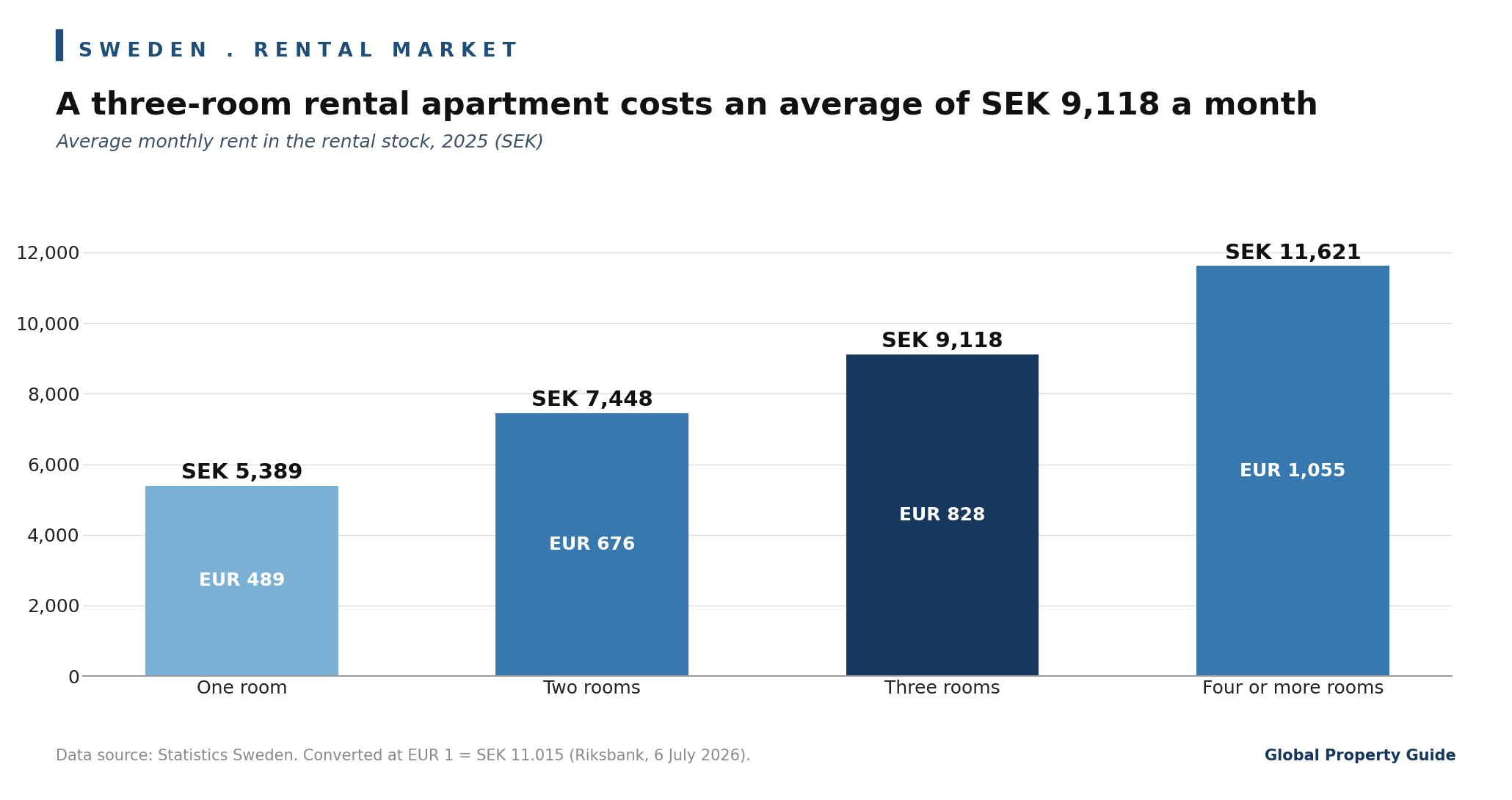
The average monthly rent for a three-room apartment reached SEK 9,118 (EUR 828). A two-room apartment averaged SEK 7,448 (EUR 676), a one-room apartment SEK 5,389 (EUR 489), and an apartment with four or more rooms SEK 11,621 (EUR 1,055). Rents run highest in the metropolitan regions and larger municipalities: a three-room apartment costs SEK 10,139 (EUR 920) in Stockholm and SEK 10,432 (EUR 947) in Malmö, against SEK 9,218 in municipalities with more than 75,000 inhabitants and below the national average in smaller municipalities.
The real picture has swung sharply as inflation has collapsed. Deflated by annual average consumer price inflation, rents fell about 4.2% in real terms in 2023, when inflation reached 8.7%, then rose roughly 2.0% in 2024 and 3.9% in 2025. Tenants who lost purchasing power during the inflation spike have since seen rent increases outpace general prices by a wide margin.
Newly built rental units have seen far steeper increases, with rents rising 13.2% between 2023 and 2024. Private landlords raised annual rents from just over SEK 131,000 to about SEK 154,000 over that period, while municipal housing companies moved from around SEK 130,500 to just under SEK 138,000. The next statistics on charges and rents for newly constructed dwellings are scheduled for 2 October 2026.
Swedish law requires rent-setting to be negotiated between tenant organisations and municipal housing companies or private landlord organisations. Private rents are compared against social housing rents under the utility value system, which produces broad rent conformity across tenures.
One consequence of rising housing association charges deserves attention in the ownership market as well. Fees levied by tenant-owner associations have increased substantially over the past five years as maintenance, utility, and interest costs have risen, while owners of single-family houses have not faced the equivalent. Market participants point to this widening gap as one explanation for why house prices and house transaction volumes have outperformed the apartment sector through 2026.
Mortgage Market and Interest Rates
Mortgage rates have bottomed and started to climb
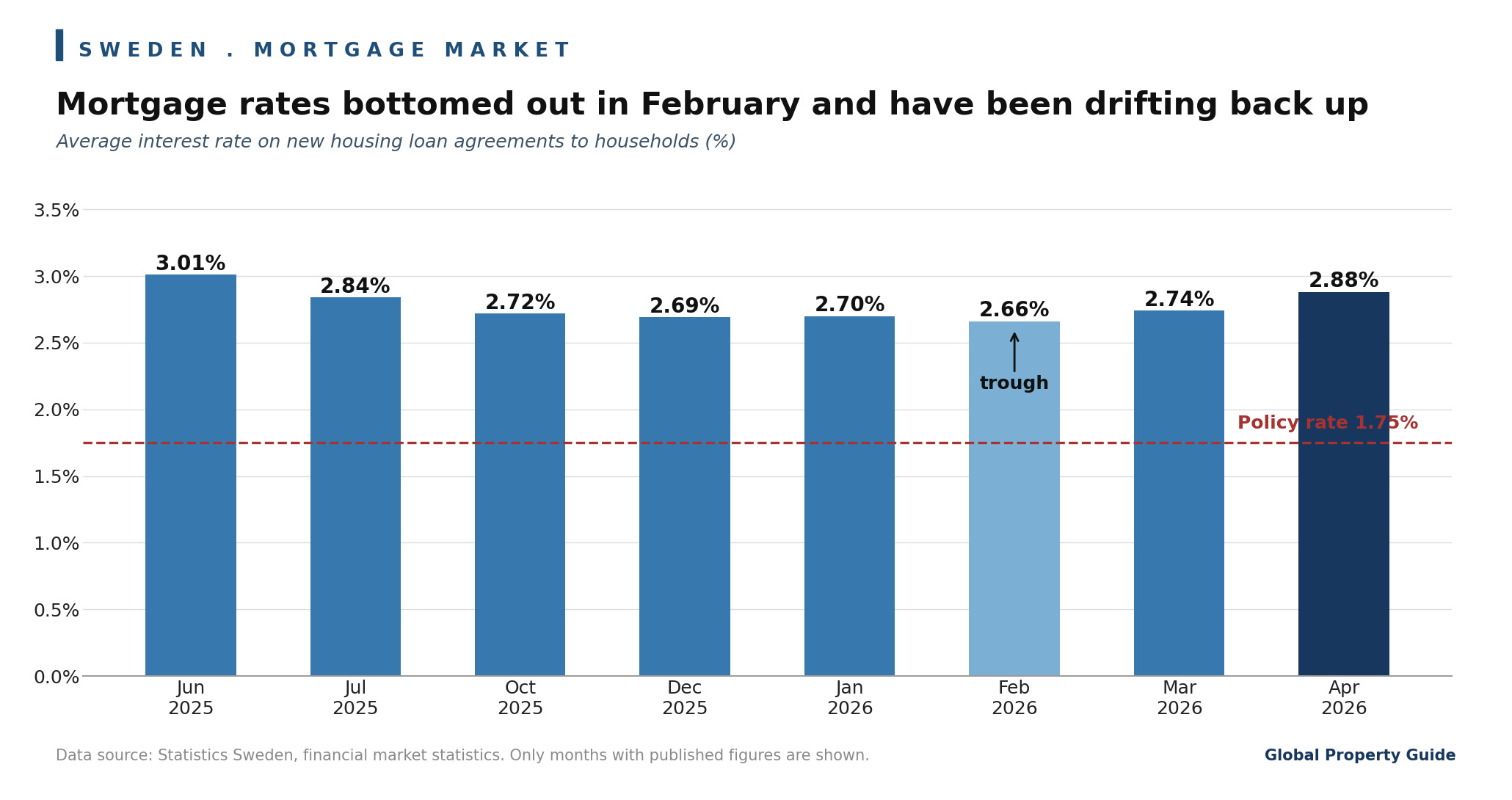
The long decline in Swedish mortgage rates ended in early 2026. The average interest rate on new housing loan agreements to households fell from 3.01% in June 2025 to a trough of 2.66% in February 2026, then rose to 2.74% in March and 2.88% in April, according to Statistics Sweden's financial market statistics.
Sweden's mortgage loan interest rates:
Fixed rates drove the reversal. The average rate on new agreements with fixed terms between one and five years rose from 2.90% in February to 3.02% in March and 3.29% in April, a movement of nearly 0.4 percentage points in two months, while rates on terms of one to two years reached 3.27%. The floating rate rose from 2.65% in March to 2.81% in April.
Since then, the picture has softened again. Average interest rates on housing loans with maturities up to and including five years declined in June 2026, and the average floating rate on new agreements fell to 2.75% in June from 2.78% in May, according to Statistics Sweden. The rate on new lending to non-financial corporations reached 3.31% in June, its lowest since September 2022.
Monetary policy has been on hold for close to a year. The Riksbank implemented eight consecutive cuts from April 2024, when the policy rate stood at 4.00%, to September 2025, when it reached 1.75%. It has been held at that level at every meeting since. At its June 2026 decision, the Executive Board again left the rate unchanged but raised its projected average for the final quarter of 2026, and stated that "the probability of the rate being raised later this year has increased" against its March assessment. Inflation is low, the bank noted, but the risks of inflation becoming too high have grown. The next decision is scheduled for 20 August 2026.
For borrowers, the practical implication is that the floating mortgage rate now sits a full percentage point above the policy rate, and that a policy tightening would feed through within one to three months to the roughly three-quarters of Swedish mortgage debt carrying a floating rate.
Lending growth remains modest despite the reform
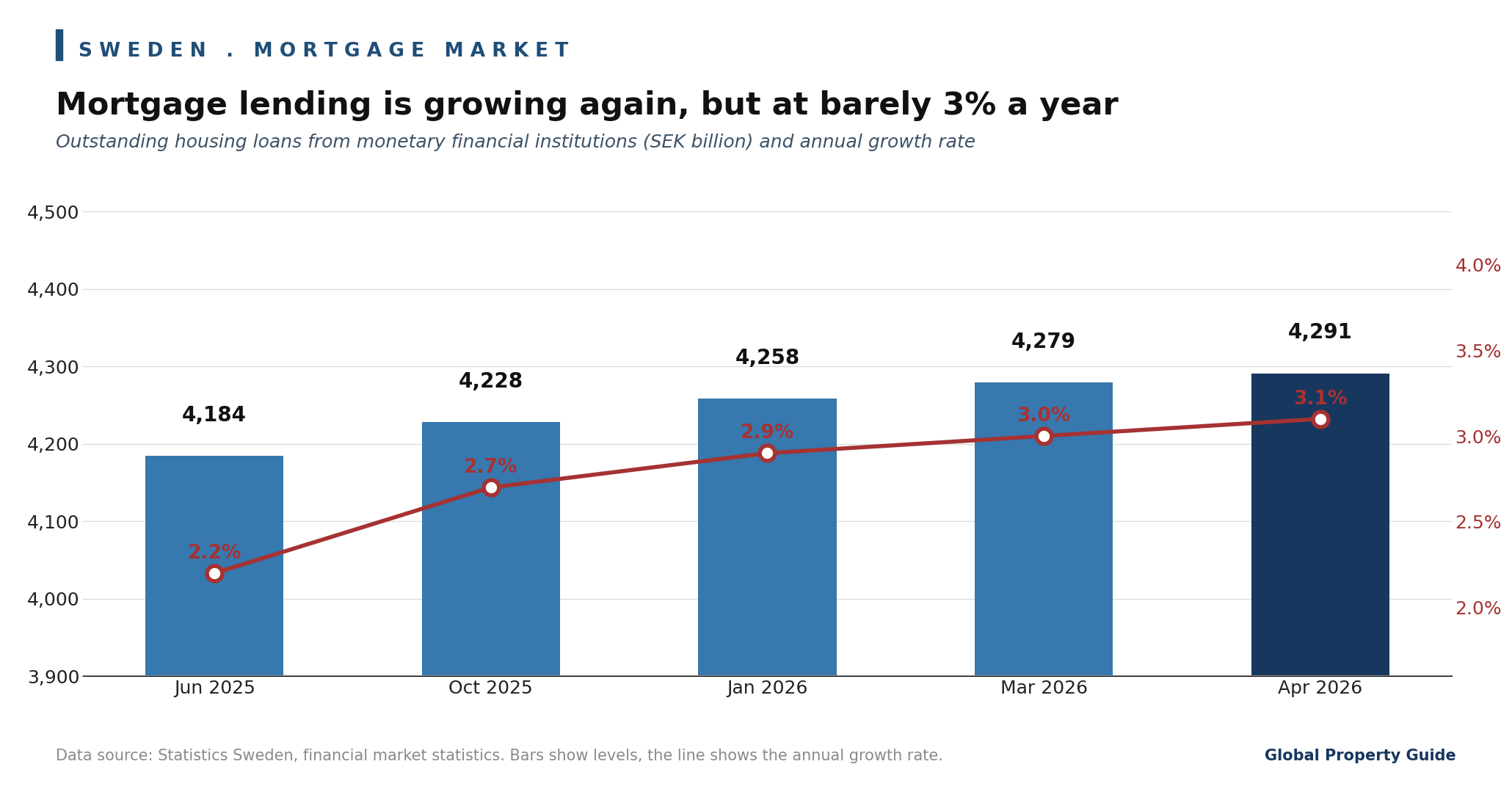
Mortgage credit is expanding again, but slowly. Outstanding housing loans from monetary financial institutions reached SEK 4,291 billion (EUR 390 billion) in April 2026, growing 3.1% year on year, up from 2.2% growth in June 2025. Of that stock, 76% or SEK 3,255 billion carried a floating interest rate, a share that has risen steadily as borrowers have chosen not to fix. Mortgage credit companies outside the monetary financial institution sector accounted for 1.0% of housing loans to households, or SEK 44 billion, and their lending contracted 0.9% over the year.
Total household loans stood at SEK 5,491 billion (EUR 499 billion) at the end of the first quarter of 2026, an annual growth rate of 2.9%, according to Statistics Sweden's savings barometer. Net household borrowing during the quarter amounted to SEK 38 billion, SEK 9 billion more than in the same quarter of 2025. Housing loans represent 83% of total lending to households.
A note of caution on international comparisons. Because the krona moved substantially against the euro over 2025 and 2026, euro-denominated measures of the Swedish mortgage stock can imply growth rates several times the underlying krona figures. The krona-denominated series above is the appropriate basis for assessing credit expansion.
Record-low borrowing costs over the preceding two decades drove housing loans from 28.6% of GDP in 2001 to 56.5% in 2010 and above 70% by 2021. Finansinspektionen attributes that expansion chiefly to rising house prices, themselves driven by stable income growth, a growing population, and historically low interest rates. Over the past four years, the mortgage market has shrunk back below 70% of GDP as higher rates compressed household purchasing power. Housing loans extended to households have grown by roughly 400% over two decades. The three largest housing finance institutions are owned by Swedbank, through Swedbank Hypotek, Handelsbanken, through Stadshypotek, and Nordea, through Nordea Hypotek.
What the new rules change for borrowers
The April 2026 reform alters household cash flow rather than the cost of credit. Under the previous framework, a household with a loan exceeding both 70% of the property value and 4.5 times gross annual income faced a combined amortisation obligation of 3%. With the tightened requirement removed, amortisation for that household is now based on the loan-to-value ratio alone, at 2%. On a worked example published by Swedbank, that reduces the monthly amortisation payment from SEK 2,500 to SEK 1,667, a saving of SEK 833 a month.
The higher mortgage cap works on a different constraint. Cutting the required deposit from 15% to 10% of market value lowers the accumulated savings needed to enter the market, which is the binding constraint for most first-time buyers, particularly in Stockholm, where the deposit on an average-priced home runs into hundreds of thousands of kronor. Whether this translates into higher prices rather than wider access is contested. Critics have argued that the principal beneficiaries of a higher cap are existing owners, whose properties become easier to sell at higher prices, rather than the young buyers the measure targets.
The evidence after four months is mixed and difficult to separate from the interest rate cycle. Transaction volumes have risen strongly, which is consistent with easier access, while price growth has remained moderate, and mortgage credit is still expanding at only about 3% a year. Boverket lists changed mortgage rules among the factors that could support the market through the autumn, alongside household finances and the interest rate environment.
Economic and Social Factors
Growth rebounded sharply in the second quarter
The Swedish economy grew 1.4% in the second quarter of 2026 against the previous quarter, rebounding from a contraction of 0.2% in the first quarter and beating market expectations of 0.7% growth, according to preliminary estimates from Statistics Sweden. That was the sharpest quarterly expansion since the first quarter of 2024. On an annual basis, GDP grew 2.8%, accelerating from 2.0% in the first quarter and marking the fastest annual expansion since the fourth quarter of 2024.
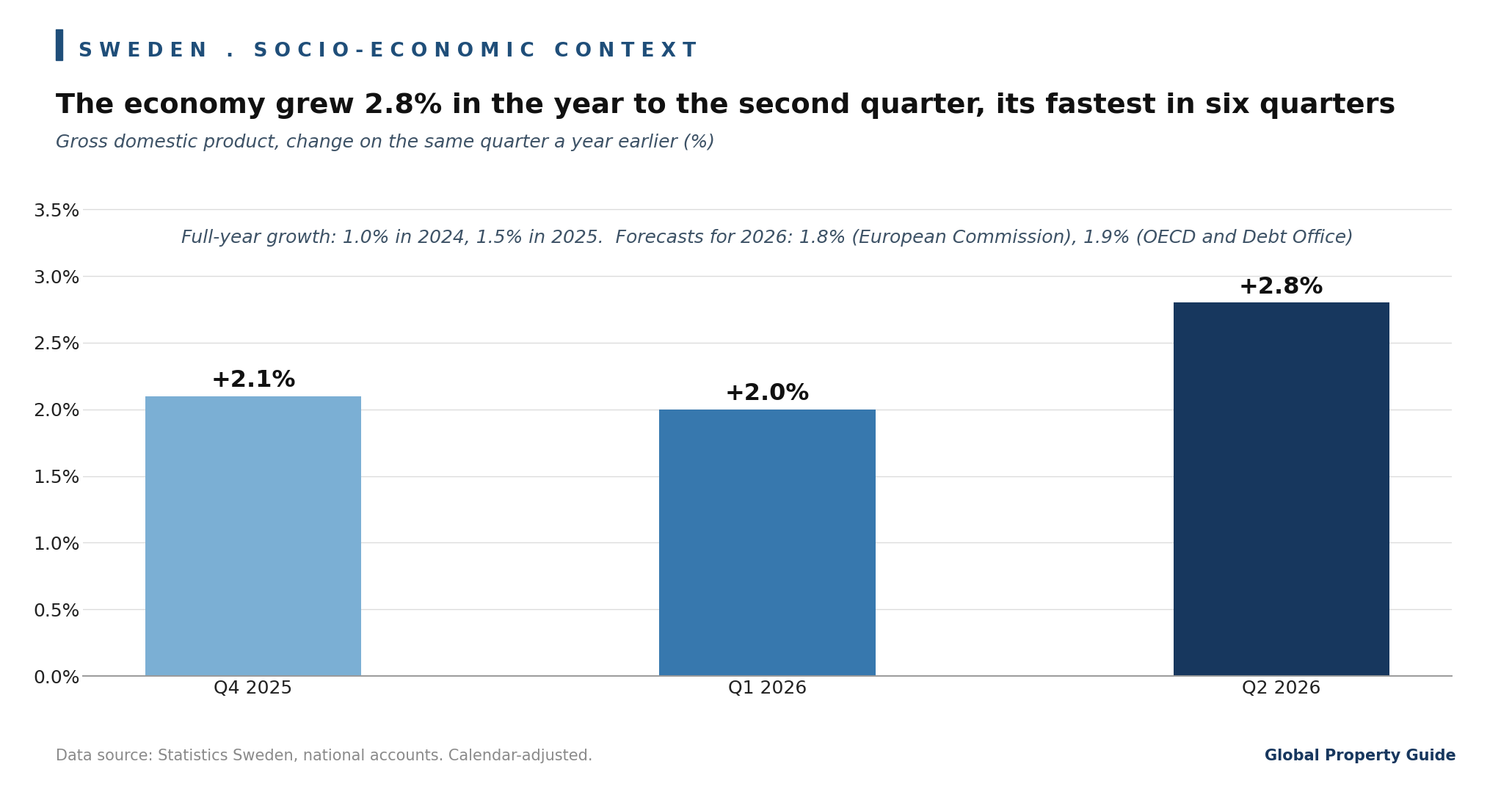
The annual figures are more sober. GDP rose 1.5% in 2025, following 1.0% growth in 2024, making 2025 the strongest year in three. In the fourth quarter of 2025, growth of 0.5% against the previous quarter was driven mainly by gross fixed capital formation and general government consumption.
Forecasts for 2026 have been cut across the board since the previous edition of this report. The European Commission now projects real GDP growth of 1.8% in 2026 and 2.2% in 2027, down from the 2.6% it had forecast for 2026. The OECD expects 1.9% this year and 2.5% next, supported by fiscal expansion, rising real incomes, and a rebound in residential and public investment, particularly defence. The Swedish National Debt Office cut its own 2026 forecast from 2.7% to 1.9%.
The reason for the downgrades is external. The conflict in the Middle East, including disruption to shipping through the Strait of Hormuz, has pushed commodity and fuel prices up sharply, while the United States trade and foreign policy has widened the range of possible outcomes. The European Commission notes that risks to the growth outlook remain tilted to the downside.
Inflation is far below target, held down by tax cuts
Inflation has spent 2026 well under the Riksbank's 2% objective. The preliminary inflation rate according to the consumer price index was 0.2% in July 2026, down from 0.7% in June, with prices falling 0.3% over the month. The CPIF, which holds mortgage rates constant and serves as the Riksbank's target variable, fell to a preliminary 0.7% in July from 1.3% in June. CPIF excluding energy moved the other way, rising from 0.4% to 0.6%.
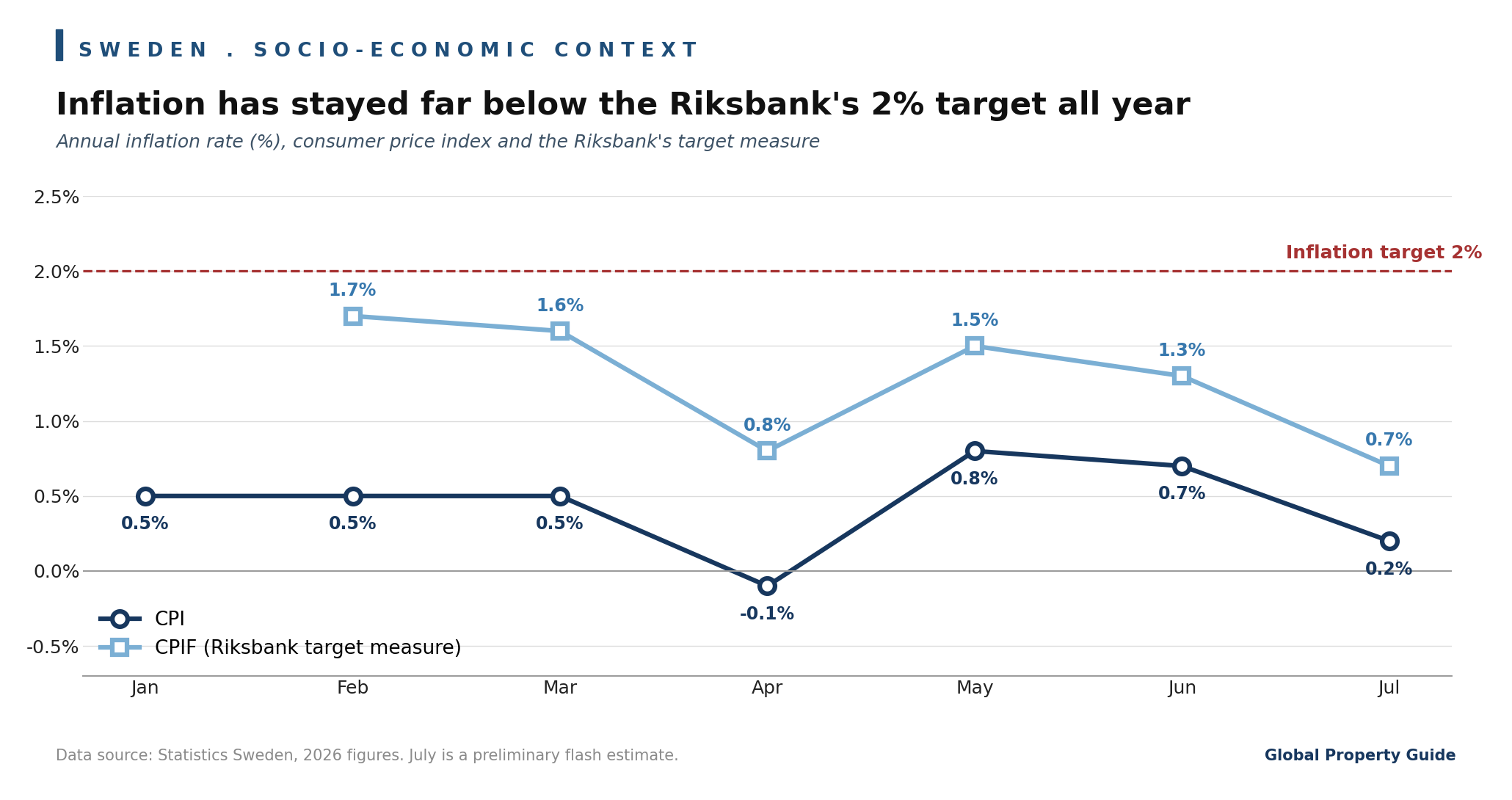
Monthly readings across the year have been volatile: 0.5% in January, February, and March, minus 0.1% in April, 0.8% in May, 0.7% in June, and a preliminary 0.2% in July. Energy has driven much of that variation. Fuel prices rose 29.3% year on year in April, the largest monthly increase since the 1990s, having been recorded in March, before falling back sharply in July.
Fiscal measures have done considerable work in suppressing the headline rate. The government cut the electricity tax in January 2026, reduced fuel taxes in May and again in July, lowered public transport costs, and temporarily halved value-added tax on food, which alone contributed to a 5.5% fall in prices for food and non-alcoholic beverages between March and April. A new dental care subsidy from 1 January 2026 reduced prices for people turning 67 or older during the year. The OECD expects CPIF inflation of 1.2% in 2026 on base effects and tax reductions, returning to 1.9% in 2027.
The labour market remains the weak point
Employment is rising, but unemployment remains elevated. In June 2026, the unadjusted unemployment rate stood at 9.9%, up from 9.4% in the same month a year earlier, while the seasonally adjusted and smoothed rate was 8.7%, according to Statistics Sweden's labour force surveys. There were 5,398,000 employed people in June, unadjusted. The gap between the two unemployment measures reflects the seasonal influx of students into the labour force each June and should not be read as a deterioration of that scale.
Earlier in the year, the unadjusted rate was 8.6% in January, when 490,000 people were unemployed, and 8.8% in February. Long-term unemployment has worsened: 194,000 people aged 15 to 74 had been unemployed for at least 27 weeks in the first quarter of 2026, an increase of 22,000 on the same quarter of 2025. Youth unemployment among 15 to 24 year olds reached 26.4% unadjusted in the first quarter, though 134,000 of those 179,000 young people were full-time students.
Sweden's position looks worse in headline terms than in substance. A Statistics Sweden analysis published in June 2026 found that for the 20 to 64 age group, the Swedish unemployment rate was 7.1%, ranking seventh in the European Union rather than near the top, and that youth unemployment of 24.3% was the second highest in the Union. High labour force participation and a high employment rate mechanically raise both employment and unemployment. Sweden also has a comparatively low proportion of long-term unemployed by international standards. The European Commission expects employment growth to turn positive in 2026 and unemployment to fall to just below 8% by 2027; the OECD sees a decline from 8.9% in 2025 to 7.6% in 2027.
The fiscal position is deteriorating quickly
Central government payments produced a deficit of SEK 101.9 billion (EUR 9.3 billion) in 2025, marginally smaller than the SEK 104.3 billion of 2024 and the second consecutive annual shortfall, according to the Swedish National Debt Office. A weak economy, tax cuts, spending increases, and higher interest payments kept the deficit at roughly the prior year's scale even after a first SEK 18.5 billion receipt from the EU Recovery and Resilience Facility.
The trajectory has since worsened. For the twelve months to the end of July 2026, central government payments resulted in a deficit of SEK 128.3 billion (EUR 11.6 billion), and central government debt stood at SEK 1,265 billion (EUR 115 billion) at the end of July, up from SEK 1,221 billion at the end of May.
The Debt Office's May 2026 forecast points to budget deficits of SEK 196 billion (EUR 17.8 billion) in 2026 and SEK 208 billion (EUR 18.9 billion) in 2027, both substantially larger than in its November forecast, driven by new fiscal measures, higher net lending by the Debt Office, and the effects of the Middle East conflict on the Swedish economy. Director General Karolina Ekholm attributes the rapid deterioration to increased defence spending, tax cuts, and measures to cushion the war's impact, adding that "we expect a temporary halt in the economic recovery".
Even at these levels, Swedish public debt remains among the lowest in the European Union. Gross public debt rose to about 34.5% of GDP in 2025 from 33.5% in 2024, 31.6% in 2023, 33.8% in 2022, 36.9% in 2021, and 40.4% in 2020. The European Commission expects debt to reach 35.3% of GDP in 2026 and just below 36% in 2027, several percentage points below the ceiling of Sweden's own debt anchor rule.
Sources:
- Real estate price index for one- and two-dwelling buildings for permanent living by region, quarterly (Statistics Sweden): https://www.statistikdatabasen.scb.se/
- Real estate prices and registrations of title, first quarter 2026 (Statistics Sweden): https://www.scb.se/
- Falling apartment prices while houses rose in July (Svensk Mäklarstatistik): https://www.maklarstatistik.se/
- New construction of dwellings, 2025 preliminary figures (Statistics Sweden): https://www.scb.se/
- Completed new construction, conversion, and demolition of multi-dwelling buildings in 2025, definitive figures (Statistics Sweden): https://www.scb.se/
- Construction forecast analysis, June 2026 (Boverket): https://www.boverket.se/
- Observations from the housing market survey 2026 (Boverket): https://www.boverket.se/
- Rents in rental dwellings 2025 (Statistics Sweden): https://www.scb.se/
- Gross rental yields in Sweden (Global Property Guide): https://www.globalpropertyguide.com/
- Financial market statistics (Statistics Sweden): https://www.scb.se/
- Monetary policy decision, June 2026 (Sveriges Riksbank): https://www.riksbank.se/
- Policy rate, deposit, and lending rate (Sveriges Riksbank): https://www.riksbank.se/
- The government proceeds with proposals for new mortgage rules (Government of Sweden): https://www.regeringen.se/
- Committee endorses proposal on new mortgage rules (Sveriges Riksdag): https://www.riksdagen.se/
- The Swedish Mortgage Market (Finansinspektionen): https://www.fi.se/
- Sweden increases borrowing to cover budget deficits (Swedish National Debt Office): https://www.riksgalden.se/
- Deficit for Swedish central government in July 2026 (Swedish National Debt Office): https://www.riksgalden.se/
- Economic forecast for Sweden (European Commission): https://economy-finance.ec.europa.eu/
- Sweden economic snapshot (OECD): https://www.oecd.org/
- Global Real Estate Bubble Index (UBS): https://www.ubs.com/