Cayman's Residential Property Market Analysis 2025
Prices in the Caymanian housing market are expected to continue rising, albeit more moderately than during the recent boom, with the high-end waterfront segment remaining the market’s key driver, while the mid-segment may experience a period of slower growth.
This extended overview from the Global Property Guide covers key aspects of the Cayman Islands’ housing market and takes a closer look at its most recent developments and long-term trends.
Table of Contents
- Housing Market Snapshot
- Demand Highlights
- Supply Highlights
- Rental Market
- Mortgage Market
- Socio-Economic Context
Housing Market Snapshot
The Cayman Islands continue to attract residential investors and expatriates seeking a secure, high-quality lifestyle in a stable, business-friendly environment. With no direct taxes on income, capital gains, or inheritance, the jurisdiction offers a compelling financial advantage supported by a strong legal framework and transparent property ownership rights. Combined with modern infrastructure, high-end amenities, and convenient global connectivity, Cayman has established itself as a premier destination for those seeking both lifestyle appeal and long-term investment stability.
In September 2025, the Cayman Islands government introduced its first Residential Property Price Index (RPPI) to enhance market transparency and improve data availability for stakeholders. Developed by the Lands and Survey Department with technical assistance from the IMF, Phase One of the RPPI focuses exclusively on condominium transactions, with houses to be included in future phases. Early data indicates continued growth, though at a moderating pace, with the nationwide RPPI increasing by 3.24% year-on-year in 2024.
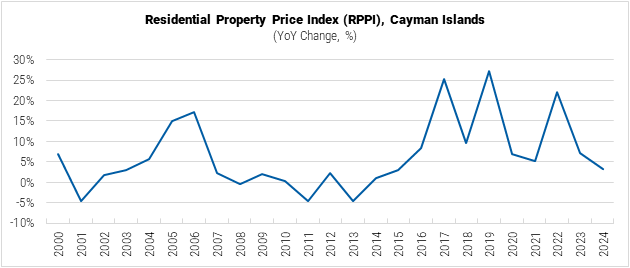
Data Source: Land and Survey Department.
The index underscores distinct performance across the country's primary residential markets. Seven Mile Beach, the benchmark for foreign investor activity, recorded a 2.70% annual increase in 2024 and a remarkable 226% rise over the past decade. This sustained long-term growth reflects the enduring appeal of high-end beachfront condominiums to overseas buyers, supported by limited supply and persistent demand for luxury second homes.
George Town, which is more representative of local housing trends, posted a 2.85% annual increase in 2024 and a 147% gain over the past ten years. Although its long-term growth has been more moderate than that of Seven Mile Beach, performance remains robust, driven by steady domestic demand, proximity to major employment hubs, and a growing pipeline of mid-range condominium developments catering to residents and local professionals.
Residential Property Price Index (RPPI) by submarket:
| RPPI 2024, YoY % | RPPI 2024, 5Y, % | RPPI 2024, 10Y, % | |
| George Town | 2.85% | 67.26% | 147.18% |
| Seven Mile Beach | 2.70% | 32.84% | 226.26% |
| West Bay | 10.47% | 91.02% | 173.94% |
| Other Cayman Islands | -3.02% | 53.55% | 111.64% |
| Total Cayman Islands | 3.24% | 51.77% | 194.96% |
| Data Source: Land and Survey Department. | |||
The Cayman Islands Real Estate Brokers Association's (CIREBA) October 2025 listings data further highlights these dynamics, illustrating the significant variation in property values between luxury-driven and locally focused districts. On Seven Mile Beach, where inventory is constrained and the market is dominated by premium offerings, active listings range from USD 738,000 to nearly USD 39 million, reinforcing its position as the island's flagship high-end market. The adjacent Seven Mile Corridor maintains similarly elevated pricing, with listings between USD 904,000 and USD 25 million.
In contrast, George Town and West Bay continue to offer more accessible entry points, with listings starting at approximately USD 369,000 and USD 320,000, respectively, while still featuring high-value properties reaching several million dollars. Mid-price areas such as South Sound and Prospect/Spotts serve as transitional zones, reflecting steady demand from both residents and long-term investors.
Residential market snapshot, as of October 2025:
| Number of Active Listings | Minimum Listed Price | Maximum Listed Price | |
| Seven Mile Beach | 97 | USD 738,095 | USD 38,800,000 |
| Seven Mile Corridor | 127 | USD 904,286 | USD 25,000,000 |
| West Bay | 181 | USD 320,238 | USD 7,500,000 |
| George Town | 136 | USD 369,048 | USD 4,500,000 |
| South Sound | 72 | USD 475,000 | USD 7,699,000 |
| Prospect/Spotts | 109 | USD 416,665 | USD 6,695,000 |
| Note: The listing includes houses, condominium units as well as, and properties within the resort developments. | |||
| Data Source: CIREBA. | |||
Looking ahead, market experts anticipate that property prices will continue to appreciate over the medium term, albeit at a more measured pace than during the recent boom period. Premium waterfront and canal-front properties are expected to remain key drivers of growth, supported by structural land scarcity, stable governance, and the Cayman Islands' enduring global appeal as both a lifestyle and investment destination. As international real-estate developer Michael Ryan observed, "Property ownership here offers not only a high quality of life but also strong long-term value," citing the jurisdiction's tax-neutral status, political stability, and limited supply of prime land as central drivers of sustained appreciation.
Nonetheless, beneath the broadly positive outlook, market conditions are beginning to soften within the mid-range segment, where higher borrowing costs and affordability constraints have started to weigh on demand. According to IRG president Jeremy Hurst, "challenges are more in the mid-market," although recent interest rate cuts are expected to provide some relief. This emerging divergence suggests that while the high-end segment will remain buoyed by overseas demand and constrained supply, the mid-market may experience a period of slower, more selective growth.
Demand Highlights:
Resilient High-End Demand and Gradual Market Rebalancing
In 2024, the Land and Survey Department of the Cayman Islands recorded a total of 2,215 freehold property transfers (including all transfers of undivided property shares for all property types and land), marking a modest 0.77% year-on-year increase. In contrast, the total value of transfers rose more notably by 6.64%, with the average transaction value up 5.82% to KYD 519,762 (USD 623,714).
During the first nine months of 2025, market activity softened, with the number of transfers declining by 7.11% year-on-year to 1,581. Despite lower transaction volumes, total and average values continued to rise, up 9.34% and 17.71%, respectively, compared to the same period in 2024, indicating sustained price growth amid moderating demand.
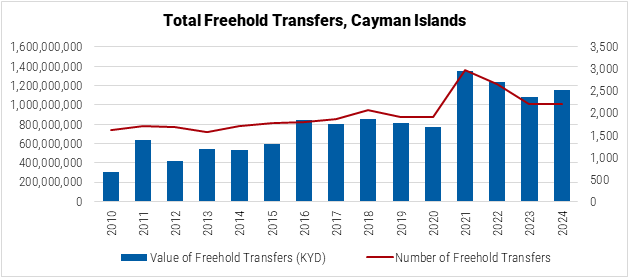
Note: Number of transfers includes transfers of undivided shares, transfers by charge, and transfers for natural love and affection.
Data Source: Land and Survey Department.
Residential sales data from the CIREBA, as reported by Property Cayman, similarly pointed to a slowdown. In the first half of 2025, 426 residential units were sold, down 5.75% year-on-year. The average sale price fell by 4.48%, while the average days on market lengthened significantly from 242 in Q2 2024 to 416 in Q2 2025.
"This isn't a slowdown <…> what we're seeing is a rebalancing," noted experts from Property Cayman in their latest market report. They emphasized that buyers have not disappeared but have become more strategic in their decision-making. With interest rates remaining elevated and global uncertainties persisting, purchasers are taking more time, conducting deeper research, and approaching transactions with greater caution. "Through it all, the market continues to move forward, perhaps not at a sprint, but at a steady, confident pace," the report added.
Residential property sales, main indicators:
| H1 2025 | H1 2024 | YoY, % | |
| Number of residential units sold | 426 | 452 | -5.75% |
| Value of units sold | USD 547,582,436 | USD 573,837,407 | -4.58% |
| Average price of units sold (as of Q2) | USD 1,200,315 | USD 1,256,556 | -4.48% |
| Days to sell (as of Q2) | 416 | 242 | 71.90% |
| Data Source: Property Cayman based on CIREBA data. | |||
The luxury segment, particularly properties priced above USD 3 million, has remained resilient. Serious cash buyers, legacy homeowners, and internationally mobile individuals continued to demonstrate strong interest. "Cayman continues to attract UHNWIs from across the globe seeking a safe, enjoyable, and high-quality lifestyle for their families. This is evident in the ongoing absorption of high-end luxury homes and condos. The luxury sector continues to face a shortage of inventory, with more families and individuals relocating to the islands than there are homes available," said Ewelina Cimring, real estate agent at Provenance Properties.
At the same time, properties priced below USD 3 million remained the main driver of market activity. "These buyers are navigating higher interest rates carefully, comparing properties more critically, and negotiating firmly. It's not hesitancy, it's prudence," commented Michael Joseph, real estate agent at Property Cayman.
Looking ahead, market dynamics are expected to be shaped by government policy, financing conditions, and affordability constraints. The new administration has indicated potential reforms, including stamp duty relief for Caymanians, incentives for community-focused developments, and revisions to immigration and residency frameworks, all of which could influence buyer sentiment and development timelines.
While interest rates have stabilized, they remain elevated enough to constrain activity in the lower-priced segment, where affordability pressures are most pronounced. Conversely, cash buyers continue to sustain momentum at the top end of the market. As affordability challenges deepen, particularly among younger Caymanians, the need for targeted housing support and proactive policy intervention is becoming increasingly urgent.
Supply Highlights:
Strong Fundamentals Propel Housing Supply, Even as Planning Reforms Create Headwinds
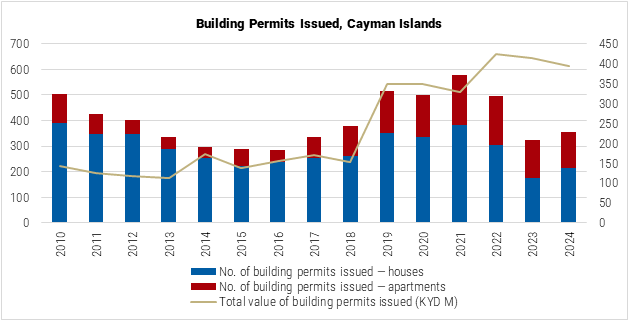
In line with earlier projections from industry professionals, construction activity in the Cayman Islands accelerated in the second half of 2024 and continued to strengthen into early 2025. According to the Economics and Statistics Office (ESO), 105 residential building permits were issued in the first quarter of the year, reflecting a robust 47.89% year-on-year increase. Houses accounted for 66% of these permits, rising by 40.82% compared to the previous year, while apartments represented 34% and recorded even stronger growth of 63.64%.
The total value of residential building permits expanded even more significantly, increasing by 111.77% year-on-year and indicating a shift toward larger and higher-value developments. The value of permitted house projects grew by 49.53%, while the value of apartment projects surged by 183.10%.
Data Source: ESO.
However, despite this surge in permitting, developers caution that the policy environment is becoming increasingly uncertain as the government advances its overhaul of the National Development Plan and considers amendments to key Planning Regulations, including building height limits, density allowances, and zoning rules. While these reforms aim to modernize the development framework, the lack of clarity regarding the final regulations has prompted a wait-and-see approach across the industry.
As the Cayman Compass reports, "Definitely there is a reluctance with developers and investors, especially some of the larger ones, to proceed with projects until there is clarity in what the new regulations will entail," leading some stakeholders to delay projects or hold land. Operational bottlenecks within the approval process are also contributing to slower and less predictable timelines. In effect, the transition to a new planning regime, though necessary, is creating uncertainty that is constraining residential development activity.
Rental Market:
Rental Inflation Slows, Market Shows Signs of Stabilization
The Cayman Islands' rental market is defined by the significant share of households leasing rather than owning their residences, a large foreign population, and seasonal tourist demand for short-term accommodation.
The islands have experienced a notable expansion of the foreign population over the past two decades. The ESO reporting shows that the share of non-Caymanians in the total resident population increased from about 41% in 2003 to nearly 54% in 2023, representing over 45,000 foreigners. According to the latest Census data, the non-Caymanian population includes expats of over 160 nationalities, their top countries of origin being Jamaica (36.7%), the Philippines (11.1%), the United Kingdom (7.7%), and the United States (5.3%).
As of 2023, 51.9% of households in the territory were paying tenants, up from 47% in 2018, according to the ESO data. More recently, the trend was likely further fueled by the elevated cost of borrowing, which made ownership less affordable.
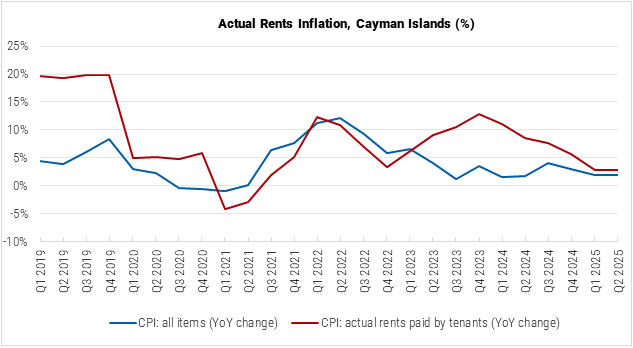
Against this background, rental inflation in the territory, while slowing in recent quarters, has been outpacing the overall price growth since 2023. In Q2 2025, the ESO reported a 2.8% year-on-year increase in the actual rents paid by tenants component of the consumer price index (down from 8.6% reported a year prior in Q2 2024 and the peak level of 12.8% in Q4 2023), while the all-item CPI registered a 1.9% increase during the same period.
Data Source: ESO.
In their Q2 2025 report Provenance Properties brokerage outlines a similar slowing dynamic, also pointing to the returned seasonality in the local rental market, which had been previously disrupted by the pandemic (like in the rest of the Caribbean region, the high season with most active demand in the Cayman Islands is typically observed from December to April, while summer is a slower period).
"The Cayman Islands rental prices have increased by 2% in Q2 2025 compared to Q1 2025 and increased by 3% compared to Q2 2024. In line with typical seasonal trends, we anticipate a continued slowdown through the summer months, followed by a more active fourth quarter. Overall, the rental market has started to show signs of stabilization as new inventory is brought to the market to meet the increased demand for accommodation," said the report.
In nominal terms, as of mid-October 2025, the CIREBA rental portal offered about 200 residential properties (condos and houses) for long-term rent ranging from USD 1,400 to USD 34,000 per month. The highest price tags are typically found in expat-preferred areas such as the West Bay district (particularly around Seven Mile Beach) and George Town.
The research conducted by Global Property Guide in June 2025 found average asking rents in the Cayman Islands at USD 3,171 for 1-bedroom units, USD 4,024 for 2-bedroom units, USD 6,463 for 3-bedroom units, and USD 7,317 for larger units with 4 or more bedrooms. The corresponding gross rental yields averaged 5.31%, marginally down from 5.36% previously reported in October 2024.
As for the short-term rental segment, the latest data from AirDNA shows the largest number of active listings and the highest daily rates, exceeding KYD 500 (USD 600), in the areas of Seven Mile Beach and North Side, both popular tourist destinations offering a variety of holiday options from secluded beaches to vibrant resorts. Occupancy for short-term rentals is highly seasonal, fluctuating from 70-80% in March to 30-40% in September.
Key short-term rental indicators across selected submarkets as of October 2025:
| Submarket | Total Active Listings | Average Daily Rent (KYD) | Average Daily Rent (USD) | Average Occupancy (%) |
| West Bay | 145 | KYD 364.9 | USD 437.9 | 55% |
| Seven Mile Beach | 372 | KYD 686.9 | USD 824.3 | 56% |
| George Town | 43 | KYD 601.9 | USD 722.3 | 54% |
| Patrick's Island | 45 | KYD 275.0 | USD 330.0 | 53% |
| Bodden Town | 73 | KYD 638.7 | USD 766.4 | 48% |
| North Side | 226 | KYD 650.8 | USD 781.0 | 58% |
| East End | 69 | KYD 449.0 | USD 538.8 | 54% |
| Note: Total active listings - number of listings viewable on Airbnb and/or VRBO with at least one prior booked night. Exchange rate KYD 1 = USD 1.20. | ||||
| Data Source: AirDNA. | ||||
Mortgage Market:
Lower Interest Rates Expected to Boost Lending Activity
With the local currency pegged to the US Dollar at KYD 1 = USD 1.20 since 1974, the monetary system of the Cayman Islands remains highly dollarized and linked to the US monetary policy, with many mortgage products priced directly off the US prime rate rather than the overall market conditions.
"The concept of Cayman setting its own interest rates, independent of the US Federal Reserve, has been dismissed as unworkable by industry experts, given that the Cayman dollar is pegged to the US dollar," the Cayman Compass previously wrote in the summer of 2023, amid the series of consecutive interest rate increases.
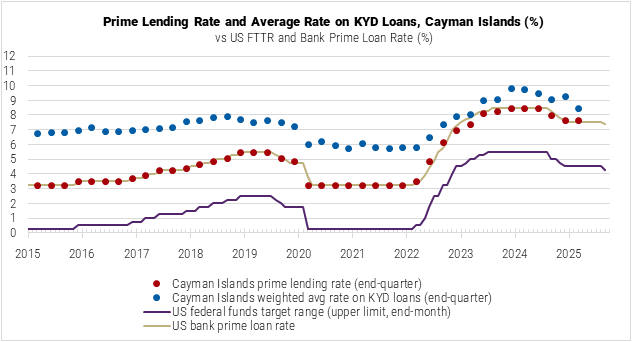
As the US Federal Reserve began its policy easing cycle in the fall of 2024, the official banking indicators reported by the ESO also shifted to a downward trajectory. As of Q1 2025, the prime lending rate collectively determined by the territory's retail banks fell to 7.67% (down from 8.50% a year prior), and the weighted average rate on KYD loans fell to 8.50% (down from 9.76% a year prior).
More recently, following another 25 bps cut to the US federal funds target range (FFTR) announced in September 2025, local retail banks in the Cayman Islands reportedly followed suit, also lowering their rates on variable mortgages, personal, and corporate loans. According to the Cayman Compass, at least two banks have already decreased their lending rates to 7.25%, and the rest are expected to follow suit soon.
With the indication of further cuts to the US policy rate possible this year, experts in the Cayman Islands expect borrowing conditions to continue improving locally as well, stimulating demand for new home credit. "The higher rate cycle has certainly had an impact on demand for local lending. With lending rates trending downward, I expect borrowing capacity will increase and there will be more activity in the market," said Amanda Bodden, president of the Cayman Islands Bankers Association.
Data Source: FRED, ESO.
Interest rates on primary residence mortgages in the Cayman Islands are typically 0.5%-1% above the prime rate and had previously doubled from around 4% up to 9% in the span of two years, raising concerns about home affordability and a potential spike in foreclosures.
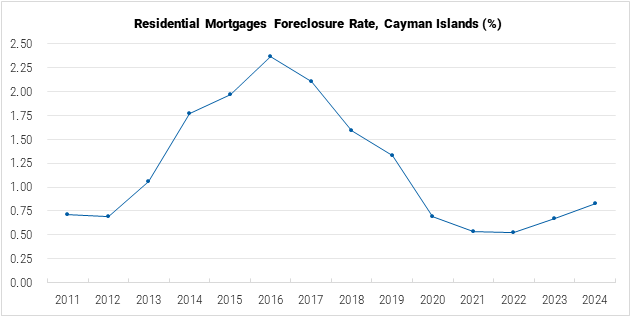
While the long-term impact of the period of high inflation and elevated interest rates on mortgage foreclosures and homeownership in the Cayman Islands remains to be seen, data from the Cayman Islands Monetary Authority (CIMA) reported by the ESO shows that both the average value of foreclosure inventory and the foreclosure rate for residential mortgages went up in the last two years.
The average foreclosure rate (representing the value of foreclosure inventory against the total value of residential mortgages) increased from 0.52% in 2022 to 0.83% in 2024, although this level is still significantly below the previous peak of 2015-2017, when the indicator spiked above 2%. More recently, at the end of Q1 2025, the average foreclosure inventory reached 77 properties valued at USD 22.8 million (compared to USD 23.9 million in Q1 2024 and USD 14.6 million in Q1 2023). "Although the number of foreclosed properties increased compared to the same period in 2024, the total value declined, implying a reduction in the average value of properties entering foreclosure," the ESO report noted.
Data Source: CIMA.
Based on the available foreclosure inventory data, the total value of outstanding residential mortgages maintained by banks in the Cayman Islands has remained relatively stable in recent years and can be estimated at USD 3.13 billion as of 2024, which equals about 41% of the territory's annual GDP at current prices during the same period.
According to the ESO data, as of 2023, 21.8% of all households in the Cayman Islands owned their residences with mortgage debt.
Socio-Economic Context:
Growth Moderates, Inflation Eases Further
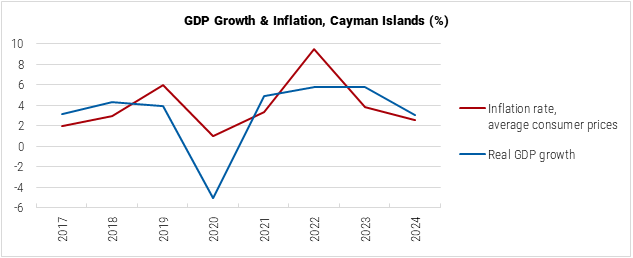
After several years of strong post-pandemic expansion, the Cayman Islands' economic activity moderated somewhat, with the real GDP growth reported by the ESO slowing from 5.8% in 2023 to an estimated 3.1% in 2024. According to the ESO, the expansion was broad-based, however, with all major sectors registering growth. Financial services and construction activities emerged as principal drivers, supported by sustained domestic demand across auxiliary industries. In 2025, the territory's GDP is projected to expand by 2.6% percent.
Owing to the delayed effects of restrictive monetary policy among major trading partners and improved global commodity supply, consumer price index (CPI) inflation for the territory has continued to ease, dropping from a 9.5% peak in 2022 to 3.1% in 2024, and was most recently reported at 1.9% in Q2 2025. The annual inflation rate for 2025 is expected to reach 2.5%, arising mainly from external pressures.
Data Source: ESO.
As of 2024, the territory's banking sector, which serves as its key economic driver, was represented by 79 licensed institutions (a decrease compared to 87 in 2023 and 94 in 2022). According to the ESO, this is the lowest number of banks and trusts observed since 2005; however, the decline is tied to a number of license revocations and cancellations for Class B institutions, as well as bankruptcies, such as that of the Silicon Valley Bank in 2023, rather than any local environment shifts.
According to the ESO data, currently active banking and trust licenses include 7 institutions from the US, 10 from Canada & Mexico, and 9 from Europe. South America remains the regional leader with 22 licenses, followed by the Caribbean & Central America with 16, and Asia & Australia with 13. At the end of 2024, international financial assets domiciled in the Cayman Islands stood at USD 317.7 billion (16.4% decline from the previous year). The international liabilities domiciled locally declined by 16.4% year-on-year to USD 319.9 billion.
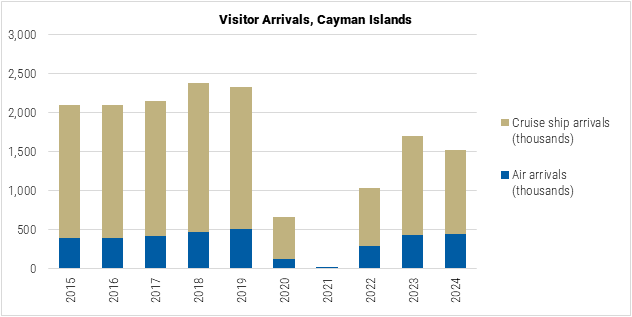
The tourism industry, which, along with the banking sector, serves as one of the main drivers of the Cayman economy, continues to recover after the pandemic-related halt in 2020 and 2021, although the dynamics observed for overnight tourists and cruise passengers vary. In 2024, the ESO reported over 1.5 million visitor arrivals, a 10.9% decrease compared to the previous year, which reflects a contraction in cruise arrivals (-15.3%) amid growth in the segment regionally. At the same time, stopover arrivals increased for the period (2.0%), inching closer to pre-pandemic levels.
Of the 437.8 thousand stopover visitors reported in 2024, the vast majority arrived from the US (82.3%); other leading geographies of origin included Canada (6.9%) and Europe (4.8%).
In line with general economic stabilization in the territory, the Cayman Islands' labor market appears to be generally balanced, according to the ESO assessment. In 2024, the rise in employment outpaced the expansion in the labor force, resulting in the overall unemployment rate falling to 2.4%, with the unemployment rate among Caymanians estimated slightly higher at 4.6%.
Data Source: ESO.
The overall outlook for the Cayman Islands' economy appears steady, with further growth expected on the back of recovering private consumption (supported by lower inflation) and the robust performance of the tourism sector. According to the latest Caribbean Tourism Report from BMI, as cited by the Cayman Compass, the territory is set to outperform many of its Caribbean peers over the next five years in terms of overnight visitor arrivals.
Following the April 2025 general election, the Cayman Islands have a new coalition government led by Premier André Ebanks. According to the Cayman Compass reporting, among key issues to be addressed by the new government in the future is immigration reform (including possible restrictions on new applications for permanent residency and Caymanian status), new infrastructure to support tourism recovery, and a new territory development plan focused on housing to meet the needs of the growing population.
Sources:
- Economics and Statistics Office (ESO)
- The Cayman Islands' First Quarter Economic Report 2025: https://www.eso.ky/
- Consumer Price Index Report: April to June 2025: https://www.eso.ky/
- 2024 Annual Economic Report: https://eso.ky/
- Housing Characteristics: https://www.eso.ky/
- Monetary and Financial Services: https://www.eso.ky/
- Population and Vital Statistics: https://eso.ky/
- 2021 Population and Housing Census Report: https://eso.ky/
- Tourism Statistics: https://eso.ky/
- Labour Force Survey Reports: https://eso.ky/
- Land and Survey Department of the Cayman Islands
- Residential Property Price Index (RPPI): https://www.caymanlandinfo.ky/
- Department Statistics: https://www.caymanlandinfo.ky/
- US Federal Reserve Board
- Federal Reserve Issues FOMC Statement: https://www.federalreserve.gov/
- Federal Reserve Economic Data (FRED)
- Bank Prime Loan Rate: https://fred.stlouisfed.org/
- Federal Funds Target Range - Upper Limit: https://fred.stlouisfed.org/
- Plan Cayman
- National Planning Framework: https://www.plancayman.ky/
- Property Cayman
- Cayman Real Estate Market: Q2 2025 Review: https://www.propertycayman.com/
- Provenance Properties
- Q2 2025 Market Report: https://www.provenanceproperties.com/
- Q3 2024 Market Report: https://www.provenanceproperties.com/
- Cayman Islands Real Estate Brokers Association (CIREBA)
- For Sale Listings by CIREBA: https://www.cireba.com/
- For Rent Listings by CIREBA: https://www.cirebarentals.com/
- PWC
- Worldwide Tax Summaries: Cayman Islands: https://taxsummaries.pwc.com/
- AirDNA
- Short-term rental markets: Cayman Islands: https://app.airdna.co/
- Cayman Compass
- Cayman Property Market Splits in Two: https://www.caymancompass.com/
- Cayman's Future Development Rests on Fragile Foundations: https://www.caymancompass.com/
- Local Mortgage and Loan Rates Fall Following US Fed Rate Cut: https://www.caymancompass.com/
- Cayman Banks Agree to 'Notice Period' Before Passing on Interest Rate Hikes: https://www.caymancompass.com/
- The in Tray: 10 Immediate Priorities for Cayman's New Government: https://www.caymancompass.com/
- Fitch: Cayman Tourism to Outpace Regional Peers Through 2029: https://www.caymancompass.com/
- Global News Wire
- Is It Worth Buying Property in the Cayman Islands?: https://www.globenewswire.com/