Vietnam’s Residential Property Market Analysis 2026
Vietnam's housing market has entered a period of adjustment. Prices are still rising, and in the primary market, they are rising fast, but the buyers have started to disappear. Mortgage rates climbed to between 12% and 13% over the first half of 2026, inflation broke through the government's ceiling in March, and transaction volumes fell even as developers launched the most new homes in six years. For the first time since 2022, resale apartment prices in Hanoi went down.
This extended overview from Global Property Guide covers key aspects of Vietnam's housing market and takes a closer look at its most recent developments and long-term trends.
Table of Contents
- Property Prices and Price Index
- Property Demand Trends
- Property Supply Trends
- Historic Perspective
- Rental Market: Rents and Rental Yields
- Mortgage Market and Interest Rates
- Economic and Social Factors
House Price Variations
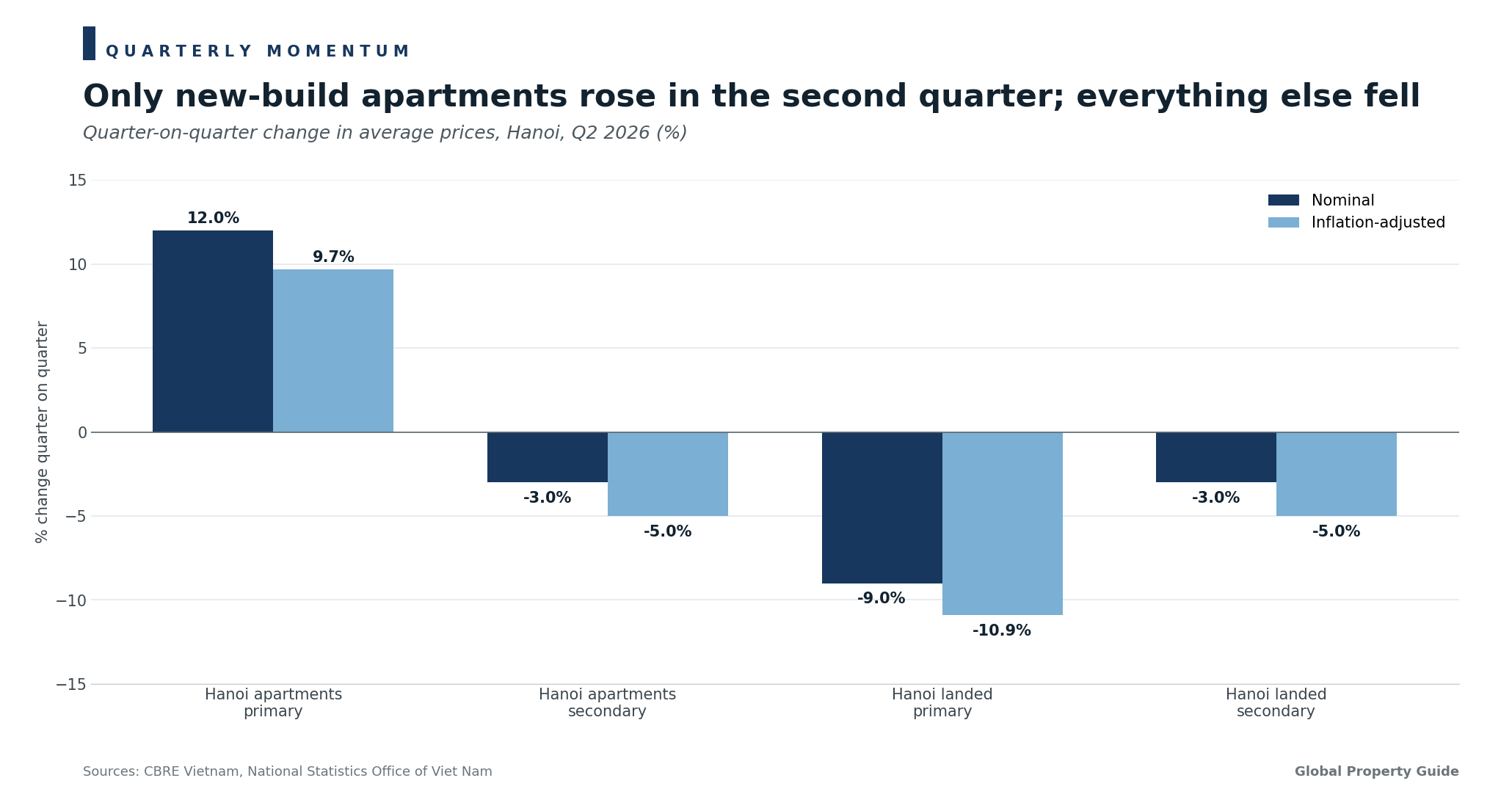
In Hanoi, the average primary selling price of apartments reached about VND95 million (US$3,612) per square metre (sqm) in Q2 2026, up 12% from the previous quarter and 21% from a year earlier, according to CBRE Vietnam. Adjusted for inflation, that is a rise of about 15% over the year and 9.7% over the quarter.
The increase says more about what is being built than about underlying demand. For a second consecutive quarter, not a single new Hanoi project was launched below VND60 million (US$2,281) per sqm. Apartments priced between VND80 million and VND110 million per sqm made up roughly 30% of new launches in the first half, and those above VND120 million (US$4,563) per sqm accounted for another 35%. In the second quarter alone, more than 3,000 units above that VND120 million threshold came to market in central and near-central wards, including Thanh Xuan, Tay Ho, and Dong Anh.
Vietnam's house price annual change:
The resale market tells the opposite story. Average secondary apartment prices in Hanoi fell close to 3% from the previous quarter to around VND60 million (US$2,281) per sqm, the first quarterly decline since late 2022. Annual growth slowed to roughly 13%, about half the pace recorded during the market's recent surge. In real terms, the quarterly fall was around 5%.
In Ho Chi Minh City, the picture is complicated by administrative reform. Following the 2025 provincial mergers, the city now incorporates the former Binh Duong and Ba Ria-Vung Tau provinces, and the consultancies report both the enlarged and the pre-merger footprints. Readers should be careful not to compare the two directly.
- Across the enlarged city, CBRE put the average primary price at about VND76 million (US$2,890) per sqm in Q2 2026, up 8% on the quarter and 16% on the year. Secondary prices averaged around VND62 million (US$2,357) per sqm, up 26% year on year, though the rate of increase has slowed.
- Within the pre-merger city, JLL recorded a primary price of roughly VND98.1 million (US$3,730) per sqm, up close to 10.5% year on year, with cumulative apartment supply reaching nearly 342,300 units.
The enlarged-city average is lower than the old-city average because most of the new supply is now built well outside the historic core. It is a compositional effect, not a price fall.
Liquidity is where the strain shows. Ministry of Construction figures show the total volume of transactions in land plots, apartments and detached houses fell 8% year on year in the first quarter of 2026, while inventory at the end of the quarter jumped 27.8% from the start of the year. The Vietnam Association of Realtors put the absorption rate on newly launched projects at around 58% in Q1 2026, and reported that secondary transactions in Hanoi and its surrounding suburbs fell 22% year on year.
Affordability is the binding constraint. At prices of VND90 million to VND100 million per sqm, Le Hoang Lan Nhu Ngoc of Cushman & Wakefield Vietnam has estimated that a typical dual-income household would need between 50 and 85 years of savings to buy a home. Data from the Ho Chi Minh City Department of Construction showed that by the end of May, close to 90% of newly launched supply in the city was in the high-end segment, with no new affordable projects introduced at all.
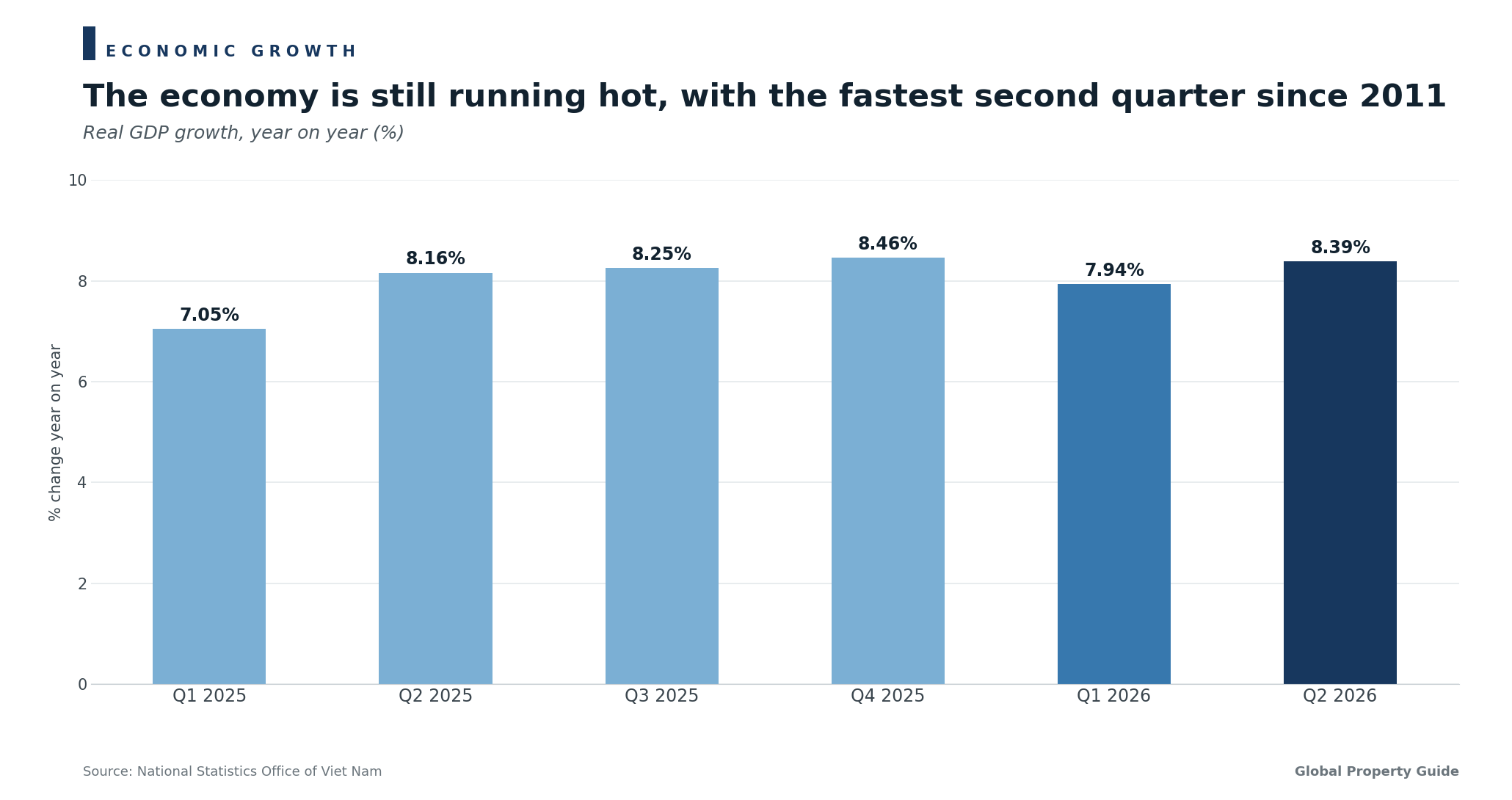
The wider economy, by contrast, remains exceptionally strong. GDP grew 8.39% year on year in the second quarter of 2026 and 8.18% over the first half, the fastest second-quarter reading since 2011. The disconnect between a booming economy and a cooling property market is the defining feature of Vietnamese real estate this year.
Note on currency: USD conversions in this article use an exchange rate of VND26,300 to US$1, approximately the market rate prevailing in mid-2026.
Property Demand Trends
Buyers have moved to a defensive stance
The demand picture has inverted since last year. In 2025, Vietnam registered approximately 580,437 successful real estate transactions nationwide, including about 138,744 in apartments and detached houses and 441,693 in land plots. That was the strongest year since before the pandemic. The first half of 2026 has not sustained it.
In Hanoi, more than 5,800 apartments changed hands in the second quarter, equivalent to roughly 68% of newly launched units. Over the preceding two years, take-up frequently exceeded 90% and at times outpaced new launches outright. Nguyen Hoai An, senior director of CBRE Hanoi, attributes the slowdown chiefly to persistently high lending rates, noting that buyers who previously relied on mortgages are now focused on cash flow.
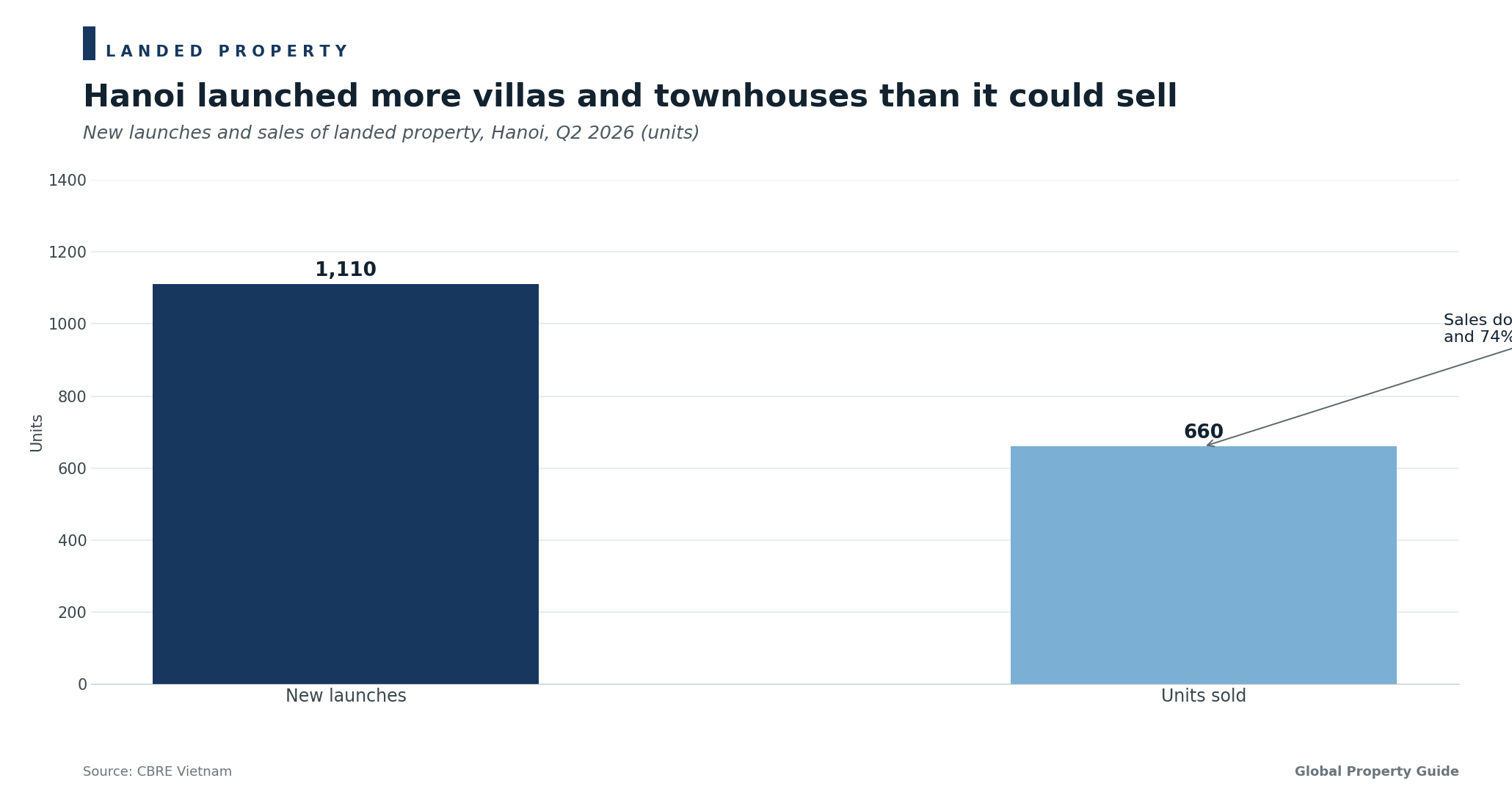
Landed property in Hanoi has weakened far more sharply, with only just over 660 villas and townhouses sold in the second quarter, down 30% from the previous quarter and 74% from a year earlier.
In Ho Chi Minh City, absorption held up better. CBRE reported an overall market absorption rate of around 90% in Q2 2026, with 73% take-up on newly launched stock. JLL recorded about 3,600 successful transactions in the pre-merger city over the first half, against a cumulative absorption rate above 99%. Inventory in the old city stands at only about 2.3% of cumulative supply, a reflection of how little product is actually available in central and near-central areas.
The composition of demand has changed as much as the volume. Duong Thuy Dung, managing director of research and consulting at CBRE Vietnam, has observed that most buyers now hold borrowing below 40% of contract value, a marked shift from the leveraged enthusiasm of the previous cycle. Buyers are prioritising projects with genuine utility, clear legal status, and sustainable growth potential over short-term price appreciation.
Some of the pressure has become visible in discounting. A survey by the Vietnam Association of Realtors found that investors who had borrowed 70% to 90% of property value began offering reductions of roughly VND100 million to VND300 million on apartments and low-rise homes. Projects priced above VND140 million per sqm have seen noticeably slower sales, and the ultra-premium segment faces mounting liquidity pressure as the pool of qualified buyers narrows.
Property Supply Trends
The strongest launch cycle in years, arriving at the worst moment
Supply is no longer the constraint it was. In Hanoi, about 16,600 new apartments were launched in the first half of 2026, the highest first-half total in five years. CBRE forecasts that new apartment launches in the capital could approach 39,000 units across the full year, which would surpass the record set in 2019. Around 6,000 new landed homes are also expected during the year.
Across the enlarged Ho Chi Minh City, 10,761 units were launched in the first half, with an unusual geographic split: only 13% came from the former Ho Chi Minh City, while 79% originated in the former Binh Duong. In the second quarter alone, 6,573 new apartments came to market across the merged city, a 20% increase on the same period last year, with roughly 95% of new Binh Duong supply positioned in the high-end segment.
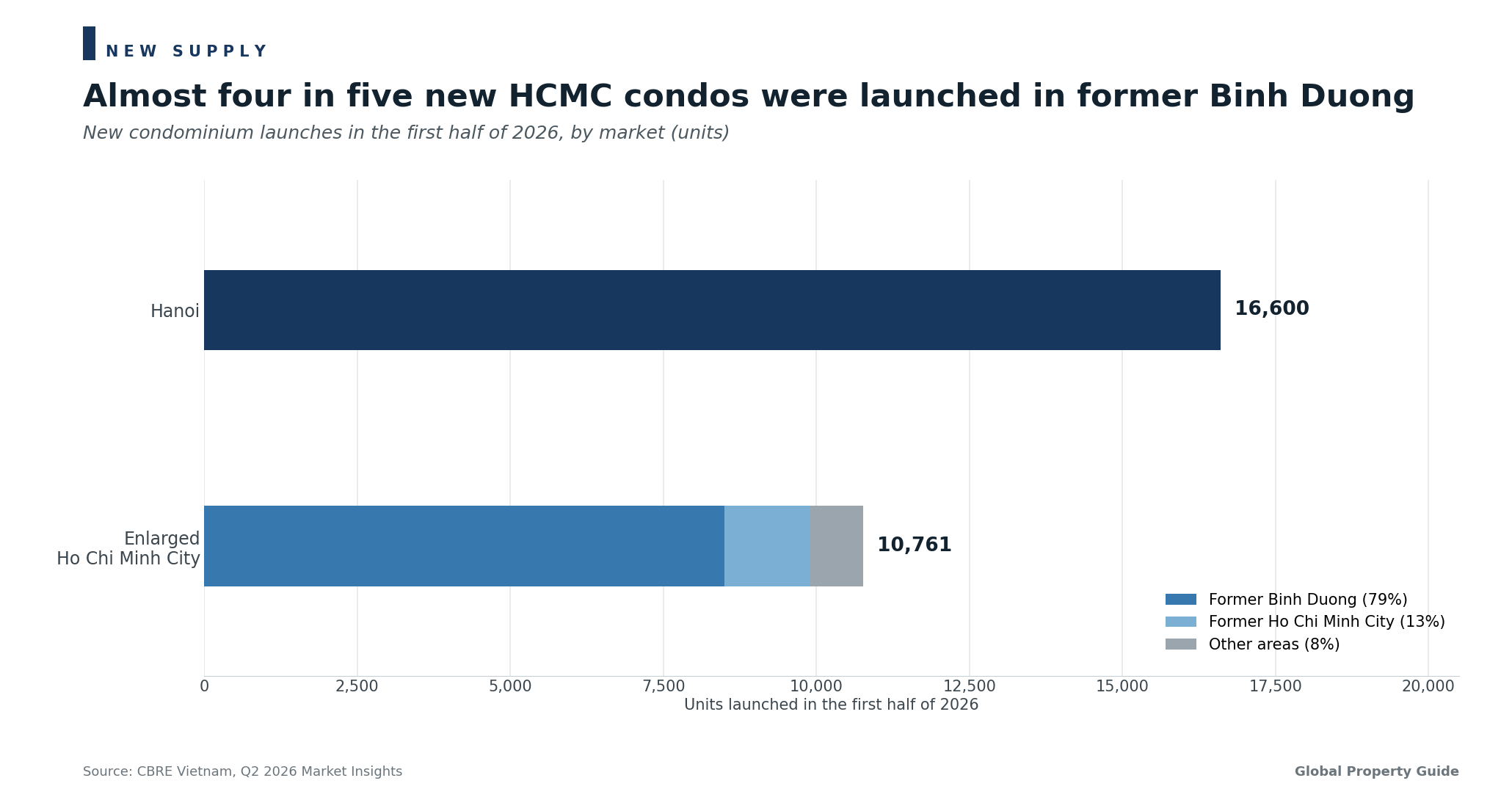
The shift towards the urban fringe is structural. Inner-city land is scarce and expensive, while the former Binh Duong offers ample land, lower entry prices, and improved connectivity. JLL recorded roughly 3,000 new units in the pre-merger city over the first half, about 70% of them in the eastern area, with 43.2% in the high-end bracket.
Landed supply is shrinking
The landed segment moved in the opposite direction. New supply of villas and townhouses in Hanoi reached nearly 2,100 units in the first half, down 17% year on year. More than 1,110 units launched in the second quarter, with close to 80% located in large township developments in Van Giang Ward of Hung Yen Province, which underlines how residential development continues to push into areas bordering the capital.
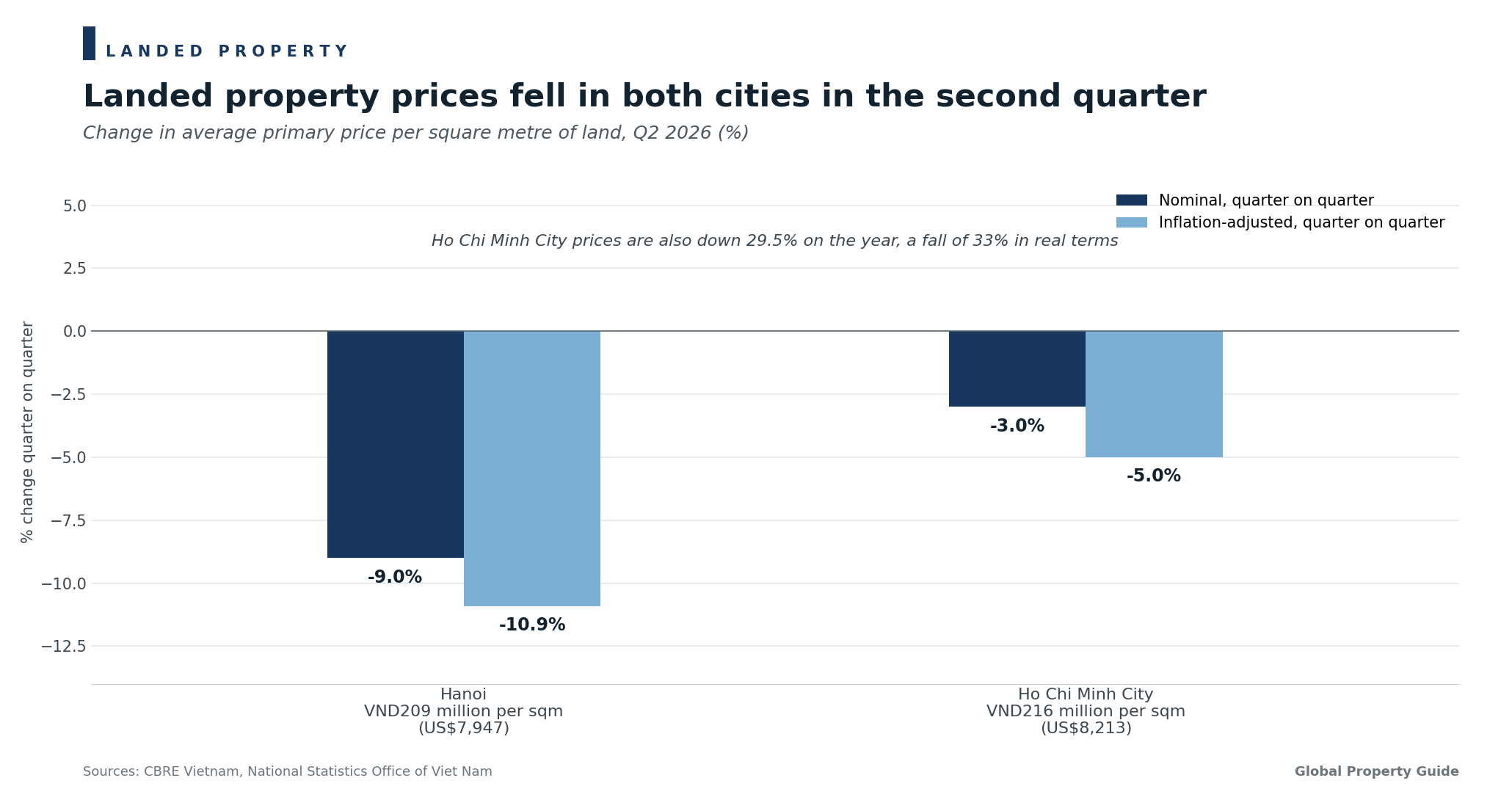
Average primary prices for Hanoi landed property fell about 9% quarter on quarter to approximately VND209 million (US$7,947) per sqm of land, a decline of nearly 11% in real terms. CBRE attributed the fall to the concentration of new supply in suburban townships, combined with elevated borrowing costs, prompting investors to delay purchases or accept lower profit expectations. Secondary prices for villas and townhouses eased around 3% on the quarter, with annual growth slowing to about 2%, which is a real-terms decline.
In Ho Chi Minh City, the same dynamic has run much further. CBRE's Q2 2026 report put the average primary price of villas and townhouses at roughly VND216 million (US$8,213) per sqm of land, down 3% on the quarter and 29.5% on the year. In real terms, that annual fall is close to 33%. The headline decline is not the result of developers cutting prices. It reflects where the new stock is: the city recorded 1,934 newly launched landed homes in the quarter, all of them within a single large urban development in Hoc Mon. Ownership remains out of reach for most genuine homebuyers despite the lower average.
The secondary market has begun to soften alongside it. Villa prices in Ho Chi Minh City fell about 6.3%, from VND160 million to VND150 million per sqm, land plots declined close to 3% to VND66 million per sqm, townhouses eased about 1%, and prices for private houses were largely unchanged.
Social housing is the policy answer, and it is running behind
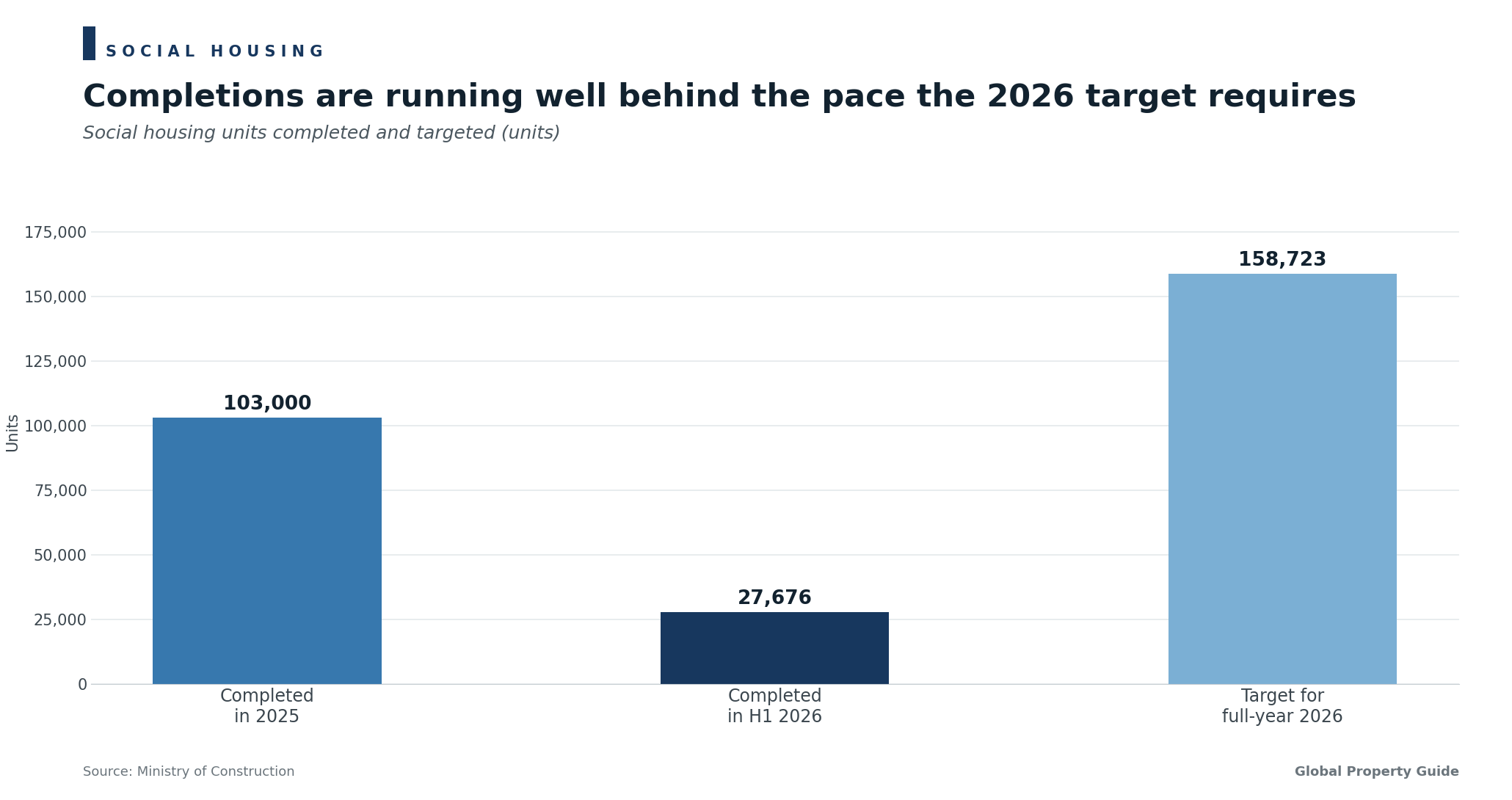
The government's response to the affordability gap runs through the one million social housing units programme. In the first half of 2026, the country completed 96 projects comprising 27,676 units and broke ground on 62 new social and rental housing projects totalling 65,605 units, of which 17 rental projects account for 9,064 units. Cumulatively, 875 projects covering 771,971 units are under implementation, roughly 77% of the 2030 target.
That first-half output sits well short of the pace required. Vietnam completed more than 103,000 units in 2025, about 103% of that year's plan, but the Prime Minister has assigned a target of 158,723 units for 2026 alone, within a 2026 to 2030 programme of 973,471 units.
Developers themselves are under strain. According to the Ministry of Construction statistics, more than 1,460 real estate businesses completed dissolution procedures in the first half of 2026, an increase of over 16% year on year, while the number of resuming operations fell sharply. Many of the survivors are restructuring cash flow rather than competing on headline price, offering extended grace periods and subsidised introductory rates instead of discounts.
Historic Perspective
The memory of a housing bust (2009 to 2013)
Vietnam experienced a prolonged housing crisis in the aftermath of the 2008 to 2009 global financial crisis. Property prices plunged by double-digit figures, banks failed, and the economy slowed sharply. At the height of the crisis, roughly one in every ten loans in the banking system was non-performing, crippling credit activity and undermining confidence in the financial sector.
To restore demand, the government provided the real estate market with a US$1.4 billion stimulus package in 2013, imposed stricter financial requirements on developers, and bought US$8 billion of non-performing loans. The central bank cut the refinance and discount rates several times and extended about US$197 million in credit to homebuyers through Vietinbank. These measures were, over time, successful.
Pre-pandemic growth and the post-pandemic surge
By the late 2010s, the market had entered a strong recovery. Apartment prices in Ho Chi Minh City rose roughly 75% between 2017 and 2019, about 63% in inflation-adjusted terms.
After a decline of 14.3% in 2020 (down 14.5% in real terms), the Ho Chi Minh City market rebounded quickly, with new apartment prices up 10.4% in 2021 (8.4% real) and a further 15.1% in 2022 (10.1% real). Momentum then stalled: prices rose 2.4% during 2023 but fell 1.2% once adjusted for inflation.
The turnaround came in 2024, when Ho Chi Minh City apartment prices rose 20.1% (16.7% real) on JLL estimates, with Savills suggesting an increase of as much as 33%. In 2025, apartment prices in the city averaged about VND111 million per sqm on Cushman & Wakefield data, an annual increase of roughly 23%, while Hanoi climbed to around VND100 million per sqm, a sharper rise of about 40% according to Savills.
That two-year surge is precisely what has made 2026 difficult. Prices reset to a level that outran incomes, and when borrowing costs rose the market lost its marginal buyer. Nguyen Tien Thoa, chairman of the Vietnam Valuation Association, has suggested the period of irrational price increases may be ending, while cautioning that prices are unlikely to fall sharply.
Rental Market: Rents and Rental Yields
Renting is absorbing the demand that buying cannot
With a typical big-city apartment now far beyond the reach of median incomes, rental housing has become the default option for a growing share of urban households. Pham Thi Mien, deputy director of the Vietnam Real Estate Research Institute, has pointed to rising rental demand and continuously increasing apartment prices as the twin drivers pushing rents higher, alongside cost pressures from construction materials, maintenance, and management charges. Younger professionals increasingly prioritise flexibility and choose to rent rather than buy.
The policy framework is as follows. Avison Young Vietnam forecasts that the residential rental market will become increasingly specialised, particularly given that Vietnam's leadership has identified rental housing as a strategic pillar of housing policy through 2030. Of the 62 social and rental housing projects started in the first half of 2026, 17 were rental projects. From May 2026, the State Bank of Vietnam also stopped counting additional social housing lending against banks' real estate credit limits, which frees capital to flow towards this segment.
Gross rental yields remain among Asia's thinnest
The average gross rental yield in Vietnam, meaning the return earned on the purchase price of a rental property before taxation, vacancy costs, and other costs, stood at 3.85% in Q3 2025, up from 3.36% in Q1 2025, according to the Global Property Guide. That compares with 3.83% in Q1 2024 and 4.02% in Q3 2023.
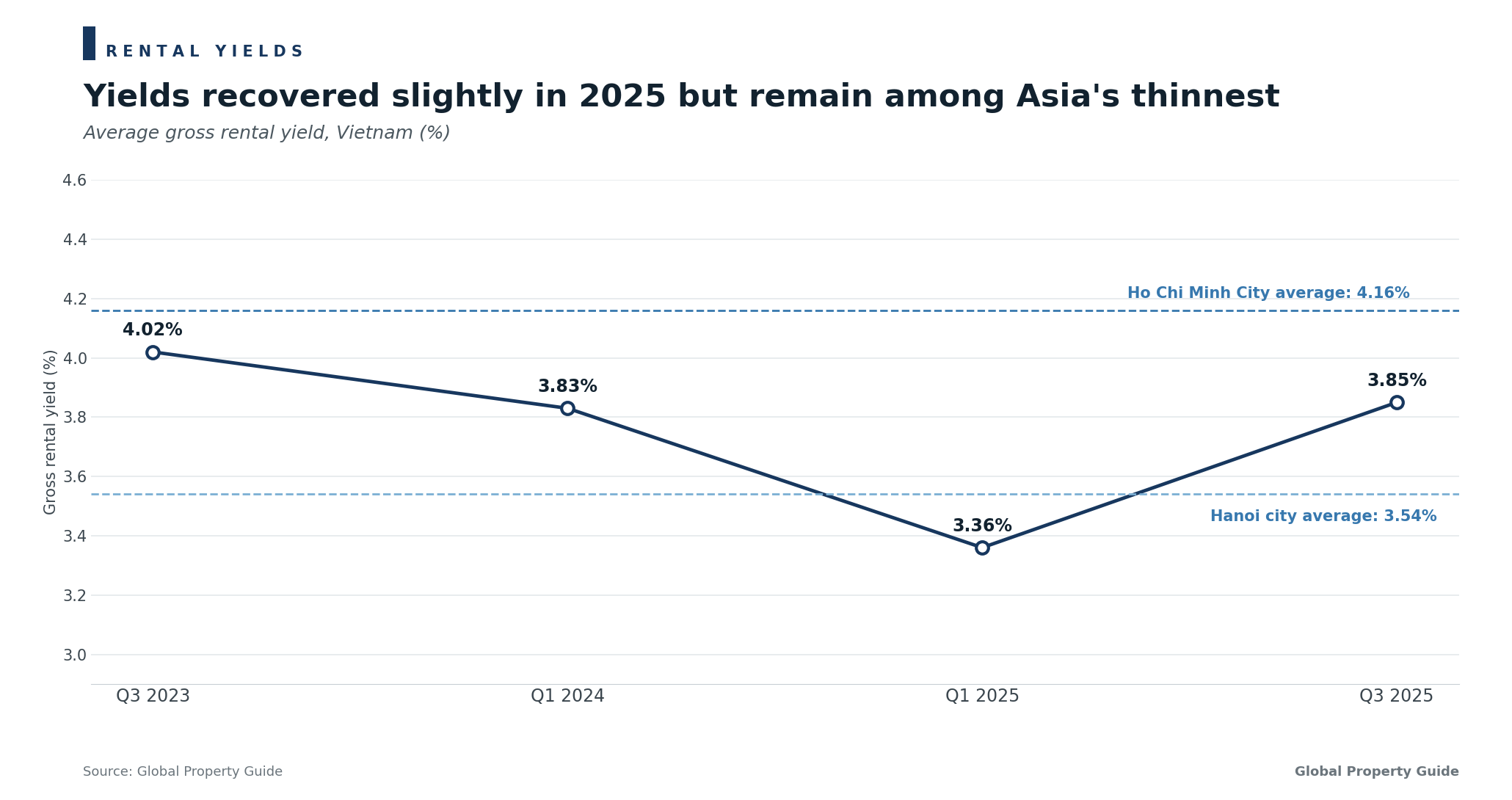
The recovery in the headline figure masks continued compression at the top end of the market. Yields have fallen to roughly 3% to 4% from 8% to 10% a decade ago, a consequence of prices rising far faster than rents.
In Hanoi, gross yields range from about 2.1% to 5.3% depending on the district, with a city average of 3.54%.
- In Cau Giay, yields on apartments range from 3% to 4.4%.
- Dong Da offers some of the strongest returns in the capital, from 3% to 5.31%.
- In Nam Tu Liem, yields range from 2.67% to 3.58%.
- Ha Dong apartments offer yields ranging from 2.77% to 3.75%.
- In Gia Lam, yields range from 2.83% to 4.21%.
- Tay Ho apartments offer yields from 2.58% to 3.5%.
- In Hai Ba Trung, yields range from 2.62% to 3.38%.
- Hoang Mai yields range from 2.58% to 3.1%.
- In Thanh Xuan, yields range from 2.58% to 2.79%.
- In Bac Tu Liem, apartments have low yields ranging from 2.49% to 2.64%.
- In Long Bien, yields range from 2.38% to 2.85%.
- In Ba Dinh, yields range from 2.08% to 3.22%.
In Ho Chi Minh City, yields are higher than in the capital, averaging 4.16% across the city.
- In District 10, yields vary from 3.22% to 5.9%.
- In Thu Duc, yields range from 3.42% to 5.83%.
- Tan Binh yields vary from 3.12% to 5.67%.
- In District 4, yields range from 3.81% to 5.36%.
- In District 8, yields range from 4.54% to 5.16%.
- Binh Thanh apartments offer yields from 2.99% to 4.82%.
- In Binh Chanh, yields vary from 3.05% to 4.98%.
- Nha Be yields range from 2.31% to 4.24%.
- In District 7, yields range from 3.57% to 4.21%.
- In Phu Nhuan, yields range from 3% to 4.01%.
- In District 12, yields vary from 2.79% to 3.8%.
- In District 6, yields range from 3.26% to 3.71%.
- In Go Vap, yields range from 3.29% to 3.67%.
- In District 2, yields range from 3.16% to 3.53%.
- Tan Phu apartments offer yields from 2.03% to 3.47%.
Expatriate demand remains a meaningful support in the prime segments of both cities, particularly around industrial parks in the north and the established international districts in the south.
Mortgage Market and Interest Rates
Policy rates have not moved, but mortgages have become much more expensive
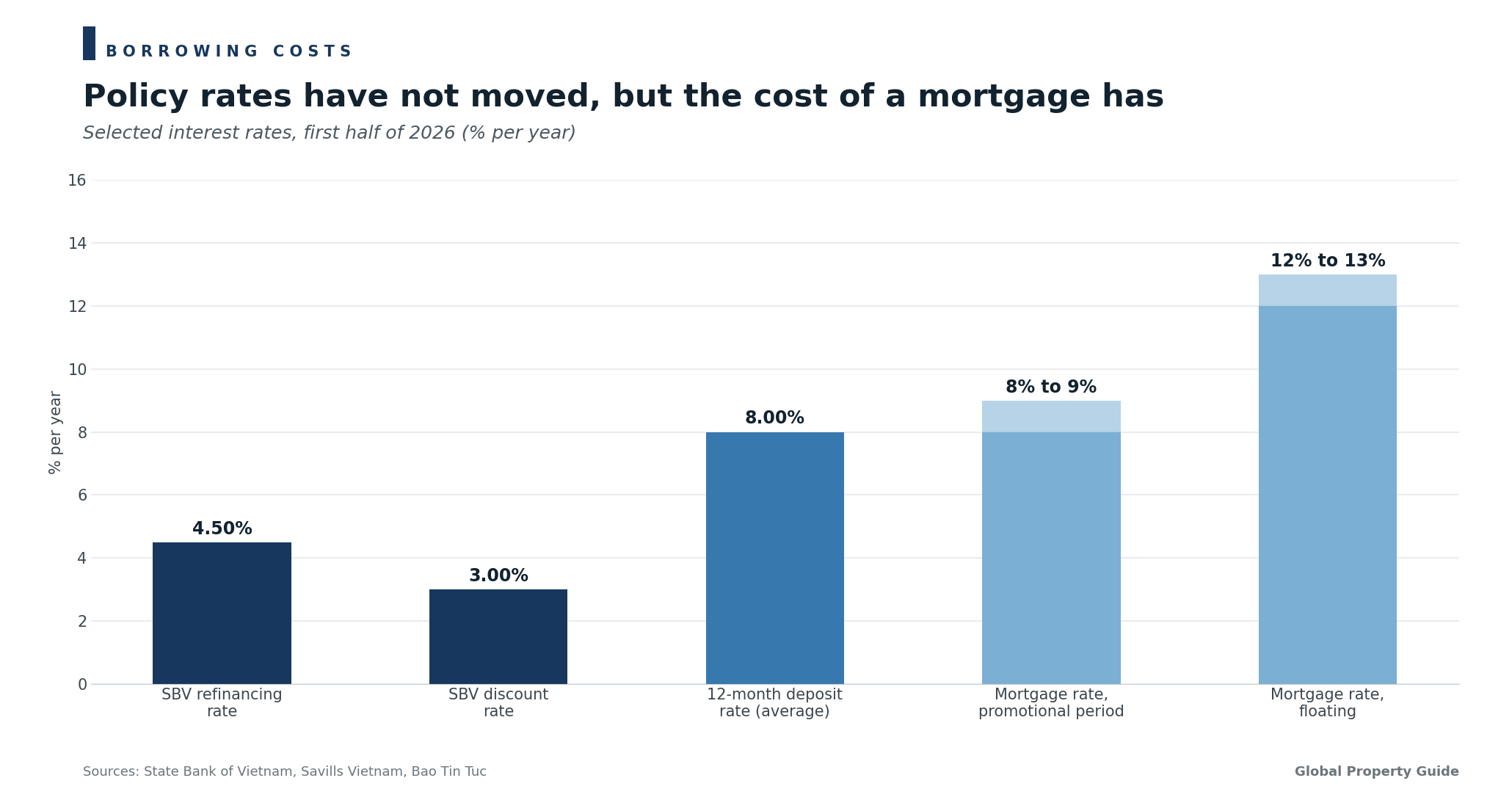
The State Bank of Vietnam (SBV) held its benchmark refinancing rate at 4.50% throughout the first half of 2026, with the discount rate unchanged at 3.00%. The policy rate has now been steady since June 2023. DBS Group Research expects this stance to hold through the end of 2026, citing easing inflation risks and a broadly stable currency.
Borrowers have not been spared, because the pressure came from funding costs rather than policy. By the end of June 2026, system credit growth had reached 7.41% while deposit mobilisation grew only about 5%. That gap pushed average 12-month deposit rates to around 8% per year, roughly 2 percentage points higher than a year earlier, with competition fiercest among small and medium-sized private banks, some of which pushed effective rates towards 9%.
Those funding costs fed straight through. Conventional mortgage rates rose to 12% to 13% per year over the first half of 2026, between 1 and 1.5 percentage points above the 2024 to 2025 range. Troy Griffiths, senior advisor at Savills Vietnam, notes that preferential loan rates now sit at around 8% to 9%, but can exceed 12% once loans reset to floating terms. Many buyers experience a financial shock the moment the fixed introductory period ends.
Developers have responded with financing packages rather than price cuts. The Masterise Nguyen Trai project in Hanoi offers a maximum 70% loan at a fixed 7.5% with a two-year principal grace period, while Imperial Sky Park has offered 0% interest for 24 months. In the south, Vinhomes Can Gio has offered 0% for the first 18 months, followed by tiered rates of 3.5%, 7%, and 11.5% over subsequent periods.
Credit is being deliberately restrained
Real estate lending expanded roughly 36% in 2025, and the SBV moved early in 2026 to slow it. The central bank instructed credit institutions to control growth from the start of the year, capping first-quarter lending at 25% of the annual target and requiring that real estate loan books at each bank grow no faster than overall credit. The system-wide credit growth target for 2026 is approximately 15%, calculated using a coefficient of 2.6%, down from 3.5% in 2024 and 2025.
The restraint is selective rather than blanket. From January 2026, additional lending for social housing projects and for industrial parks and export processing zones is excluded from the real estate credit growth calculation, and from 29 May, the SBV extended that carve-out further. Loans for large projects with significant economic spillovers are also excluded from the annual limit.
As of 26 June 2026, total outstanding credit across the system reached over VND19.97 quadrillion (US$759 billion), up 7.41% from the end of 2025 and 18.1% year on year.
The SBV's own first-half banking report puts the property exposure more precisely. At the end of May 2026, real estate credit accounted for 25.73% of total outstanding credit in the economy, with owner-occupier lending making up 51.97% of that and the sector's non-performing loan ratio at 2.3%. For context, the system-wide on-balance-sheet non-performing loan ratio stood at 3.43%, falling to 1.55% once five banks under special handling are excluded.
Lending to developers is the faster-growing half. Ministry of Construction data shows outstanding real estate business credit exceeded VND2.2 quadrillion (US$84 billion) at the end of February 2026, an increase of 43% year on year, with urban area and housing development projects accounting for close to VND784 trillion, or roughly 35% of the total. That is a far faster expansion than the system average, and it indicates that developers remain heavily reliant on bank leverage despite the increased cost of capital.
One further easing measure took effect on 1 July 2026: the maximum share of short-term funds that banks may use for medium and long-term lending was raised from 30% to 40%, which should relieve some of the funding mismatch that pushed deposit rates higher, while leaving the real estate credit ceilings in place.
Subsidised lending for younger buyers
Homebuyers aged 35 and under continue to benefit from a subsidised loan programme, which from 2026 provides a rate one percentage point below the market average. These loans form part of a VND120 trillion package launched in April 2023 to support social housing, under which rates have been cut repeatedly from an original 8.2% for buyers and 8.7% for developers. Take-up has been modest: by 31 May 2026, disbursements under the under-35 social housing scheme had reached approximately VND383 billion, with outstanding balances of around VND353 billion.
The market remains structurally underdeveloped. Most homebuyers still pay in cash, loan-to-value ratios rarely exceed 50% of property value, and typical loan terms run to around 15 years.
Economic and Social Factors
Spectacular growth, uncomfortable inflation
Vietnam's economy grew an estimated 8.39% year on year in the second quarter of 2026, following an upwardly revised 7.94% in the first quarter, for first-half growth of 8.18% against 7.63% a year earlier. It was the strongest second quarter since 2011.
Industry and construction led, expanding 10.51% and contributing just over half of total value-added growth, while services rose 7.87% and agriculture, forestry, and fisheries grew 4.06%. On the demand side, final consumption rose 8.15%, gross capital formation jumped 15.2%, exports of goods and services increased 20.18%, and imports grew 26.44%.
The government is targeting an average annual growth of 10% or higher during the 2026 to 2030 period. External forecasters remain more cautious, though several have revised upwards through the year: DBS Group Research raised its 2026 forecast to 8.0%.
Inflation is the counterweight. Consumer prices accelerated sharply through the spring as the conflict in the Middle East pushed energy costs higher, reaching 5.46% year on year in April and 5.6% in May, well above the government's 4.5% ceiling. The pressure has since eased: June came in at 4.69%, and July at 4.45%, with the index falling 0.12% on the month as domestic fuel prices tracked global markets lower. Average inflation over the first seven months was 4.39%, with core inflation at 4.19%.
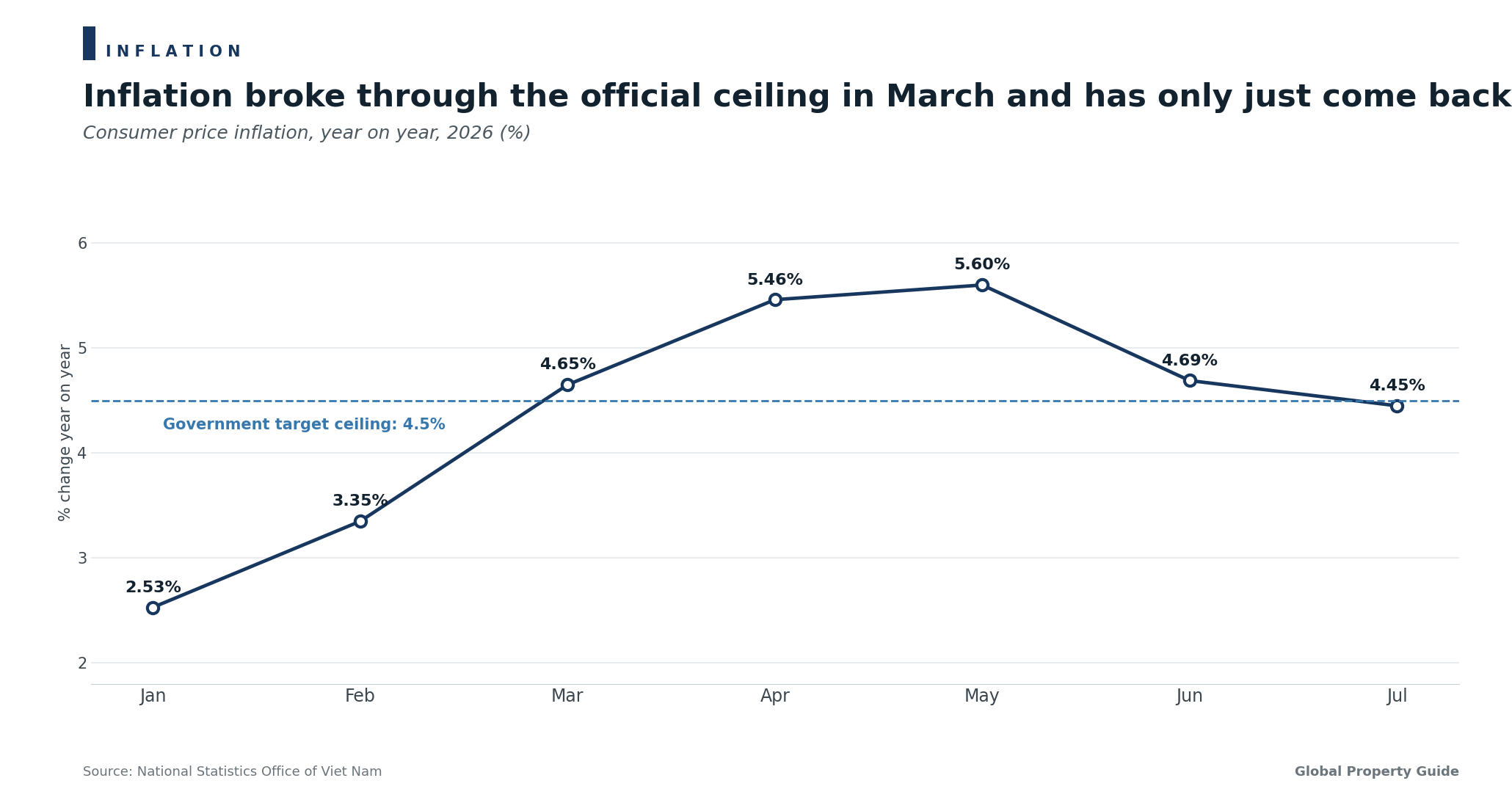
For property, the significance of that inflation path is twofold. It ate into real price growth, and it drove the deposit competition that raised mortgage rates.
The labour market remains tight. The unemployment rate among the working-age population was 2.22% over the first half of 2026, unchanged from a year earlier, at 2.47% in urban areas and 2.05% in rural areas. Employment reached 52.7 million in the second quarter, and average monthly worker income stood at VND9 million (about US$342), up VND717,000 year on year. Set against apartment prices approaching VND95 million per sqm, that income figure explains the affordability squeeze more clearly than any index.
Foreign investment at record levels
Foreign capital continues to arrive in volume. Total registered foreign direct investment reached US$34.65 billion in the first half of 2026, up 61% year on year, with 2,013 newly licensed projects carrying US$17.39 billion of registered capital, an 87.2% increase in value.
Disbursed FDI reached US$13.03 billion, up 11.2% and the highest first-half figure in five years. Manufacturing and processing took US$10.76 billion of that, or 82.6%, while real estate activities accounted for US$965.2 million, or 7.4%. On registered capital, real estate ranked second among all sectors with US$5.1 billion, a 17.9% share. Singapore was the largest single investor with US$7.31 billion, or 42.1% of newly registered capital, followed by South Korea with US$5.45 billion.
JLL Vietnam reports that foreign investors in real estate are increasingly selective, favouring assets with clear legal status, stable cash flow and strong operational performance, with data centres emerging as a growth segment. Ta My Bach of JLL Vietnam notes that foreign investors are now prepared to commit to projects of US$200 million or more.
Foreign ownership rules
Vietnam opened to foreign buyers a decade ago. Under the Housing Law (Law on Housing No. 65/2014/QH13), effective 1 July 2015, foreigners holding a Vietnamese visa, along with foreign investment funds, banks, Vietnamese branches and representative offices of overseas companies, may purchase residential property, including condominiums and landed property such as villas and townhouses. Properties owned by foreigners can be sub-leased, inherited, and used as collateral.
Overseas Vietnamese who have retained their citizenship are treated as locals and may own property without limit in their own names. For foreign individuals, the ownership period is 30 years, extendable. The law limits foreigners to no more than 30% of a single apartment building, or 350 houses and apartments in a ward. Under Circular 19/2016/TT-BXD, foreigners may own 10% of the individual houses within a given commercial housing project.
The amended Land Law and Housing Law, approved in November 2023, took effect on 1 January 2025. JLL notes that 2026 marks the first full year of the market operating under the new legal framework for land, housing, and real estate business, with guiding decrees still being finalised and Ho Chi Minh City issuing a new land price list. These changes are expected to standardise financial obligations, shorten project implementation times, and improve supply over the coming years.
From 2014 to 2023, a total of 3,035 foreign individuals purchased homes in Vietnam according to Ministry of Construction figures, concentrated in Hanoi (1,765), Ho Chi Minh City (850), Binh Duong (210), Bac Ninh (110), and Ba Ria-Vung Tau (50). More recent activity has been considerably stronger: foreigners bought more than 2,800 apartments in Hanoi during 2024 alone, more than double the total recorded across the five years from 2018 to 2022.
Trade agreements and tourism
Vietnam's network of free trade agreements continues to underpin foreign business presence and, indirectly, housing demand. The EU-Vietnam Free Trade Agreement took effect in August 2020, eliminating 99% of tariffs between the two parties. The Comprehensive and Progressive Agreement for Trans-Pacific Partnership entered into force for Vietnam in January 2019, offering investor protection through the Investor-State Dispute Settlement mechanism and expanding foreign participation in real estate services. The Regional Comprehensive Economic Partnership followed in 2022, and the UK-Vietnam Free Trade Agreement in 2021.
Tourism is running at record levels. Vietnam welcomed 13.9 million international visitors in the first seven months of 2026, up 13.8% year on year, or about 56% of the full-year target of 25 million. July alone brought 1.67 million arrivals, a 6.6% increase on the same month last year, achieved during what is traditionally the low season.
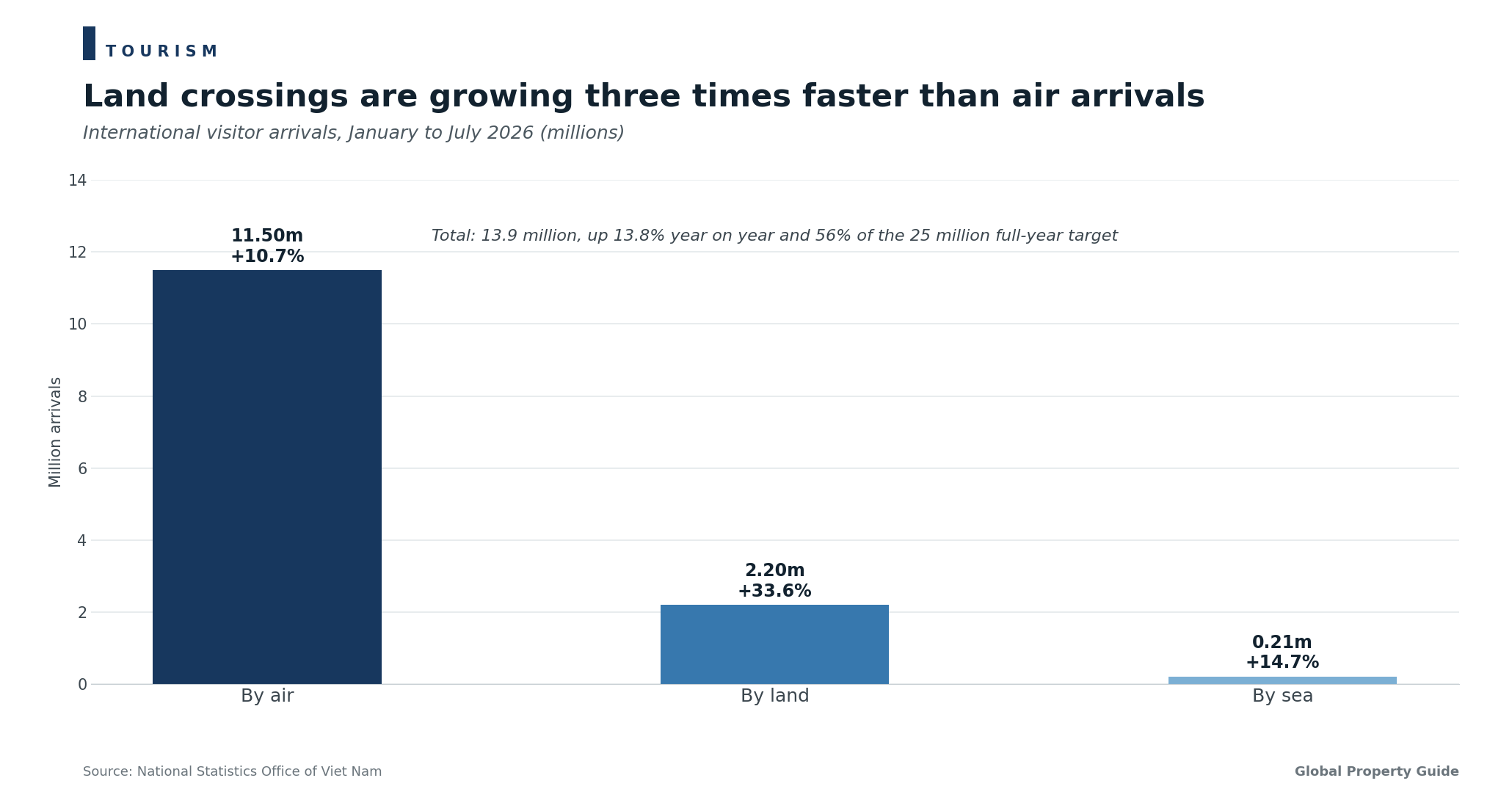
Of the seven-month total, 11.5 million visitors arrived by air, accounting for 82.8% and up 10.7%, while land arrivals reached 2.2 million, up 33.6%, and sea arrivals totalled 210,900, up 14.7%. China remained the largest source market with about 3.1 million visitors, or 22.2% of the total, followed by South Korea with 2.4 million. Russia was the third-largest market and Europe's biggest contributor, with 864,000 visitors, a rise of 174%. European arrivals overall surged 53.4% to more than 2.35 million.
Outlook
The second half of 2026 is unlikely to bring either a boom or a bust. Interest rates are the swing factor, and few expect a return to the era of cheap capital. Investment strategies dependent on heavy leverage have become distinctly riskier, while genuine housing demand, infrastructure delivery, and urbanisation continue to support the segments that serve owner-occupiers.
Infrastructure remains the strongest structural argument. Hanoi's 2045 master plan will drive expansion into Gia Lam, Dong Anh, Hoai Duc, and Van Giang, supported by five new urban railway lines. In the south, Long Thanh International Airport, new ring roads, and Metro Line 1 are reshaping the Ho Chi Minh City and Dong Nai corridor. Transit-oriented development is moving from concept to policy in both cities.
What has changed is the basis on which property is valued. As Ngo Tri Long has argued, real estate should now be treated as a conditional investment whose worth depends on legal status, cash flow, pricing, and liquidity rather than on the assumption of perpetual appreciation. On that measure, 2026 is less a downturn than a repricing of expectations.
Sources:
- Ha Noi sees rising housing supply as property transactions ease (Viet Nam News / CBRE Vietnam): https://vietnamnews.vn/
- With high interest rates, what are apartment prices like in Ho Chi Minh City now? (VietNamNet): https://www.vietnam.vn/
- Vietnam Real Estate Market 2026: Q2 Outlook (Realtique, citing CBRE Vietnam Q2 2026 Market Insights): https://www.realtique.net/
- Looking Back at the First Half of 2026 (Metrohouse Vietnam): https://metrohousevietnam.com/
- Residential Real Estate 2026, Part 1: A Fierce Liquidity Screening (Bao Tin Tuc): https://www.vietnam.vn/
- Residential Real Estate 2026, Part 2: Pressure from the Interest Rate Whirlwind (Bao Tin Tuc): https://www.vietnam.vn/
- Real estate in 2026: Overcoming project obstacles, increasing affordable housing (Ministry of Construction): https://www.vietnam.vn/
- Gross rental yields in Vietnam: Hanoi and Ho Chi Minh (Global Property Guide): https://www.globalpropertyguide.com/asia/vietnam/rental-yields
- Ha Noi sees rise in apartment rental prices amid growing demand (Viet Nam News): https://vietnamnews.vn/
- Consumer Price Index releases (National Statistics Office of Viet Nam): https://www.nso.gov.vn/en/cpi/
- Lower fuel, food prices push July CPI down 0.12% (Vietnam News Agency): https://en.vietnamplus.vn/
- Vietnam's Q2 GDP rises 8.39% amid broad-based economic growth (Vietnam News Agency / NSO): https://en.vietnamplus.vn/
- Viet Nam's labour market remains on solid footing in H1 (Vietnam News Agency / NSO): https://en.vietnamplus.vn/
- Open the credit tap and redirect capital into growth and welfare drivers (State Bank of Vietnam press conference): https://www.vietnam.vn/
- Vietnam's central bank tightens real estate credit as lending surges (Saigon Giai Phong): https://en.sggp.org.vn/
- Vietnam relaxes credit limits for priority real estate sectors (VietNamNet): https://vietnamnet.vn/
- Real estate credit accounts for 25.73% of economy-wide lending (VnEconomy / State Bank of Vietnam): https://vneconomy.vn/
- Banks tighten real estate credit, prioritising genuine housing need (Vietnam News Agency / Ministry of Construction): https://www.vietnamplus.vn/
- Redirecting real estate credit away from speculative segments (Thoi Bao Tai Chinh Viet Nam): https://thoibaotaichinhvietnam.vn/
- Ho Chi Minh City landed house prices down nearly 30% (VietNamNet / CBRE Vietnam): https://www.vietnam.vn/
- Secondary market price levels begin to cool (Lao Dong / CBRE Vietnam): https://news.laodong.vn/
- Vietnam: Refinancing rate to hold firm to support growth (DBS Group Research via FXStreet): https://www.fxstreet.com/
- Vietnam's realised FDI reaches five-year high in first half (Vietnam Investment Review / NSO): https://vir.com.vn/
- FDI disbursement hits five-year high in H1 (Nhan Dan / NSO): https://en.nhandan.vn/
- Vietnam real estate M&A favors quality, clear legal status assets (The Investor / JLL Vietnam): https://theinvestor.vn/
- Vietnam welcomes nearly 13.9 million foreign visitors in seven months (Vietnam News Agency): https://en.vietnamplus.vn/
- European arrivals surge as Vietnam welcomes nearly 14 million foreign visitors (The Star / NSO): https://www.thestar.com.my/
- Special mechanisms pave the way for social housing to accelerate (Lao Dong / Ministry of Construction): https://news.laodong.vn/
- Nearly 159,000 social housing units to be developed in 2026 (Viet Nam News): https://vietnamnews.vn/
- Vietnam advances social housing development (VnEconomy / Ministry of Construction): https://en.vneconomy.vn/
- USD exchange rate, 22 July 2026 (State Bank of Vietnam central rate): https://www.vietnam.vn/
- Vietnam Housing Law 2024 (Viet An Law): https://vietanlaw.com/vietnam-housing-law-2024/
- Guidelines on implementation of housing law (Indochine Counsel): https://indochinecounsel.com/
- Foreign buyers not lifesavers for Vietnam's struggling property market (The Investor): https://theinvestor.vn/
- More foreigners buy homes in Hanoi (VnExpress): https://e.vnexpress.net/
- EU-Vietnam Free Trade Agreement (European Commission): https://trade.ec.europa.eu/
- Comprehensive and Progressive Agreement for Trans-Pacific Partnership (Australian Department of Foreign Affairs and Trade): https://www.dfat.gov.au/
- Regional Comprehensive Economic Partnership (ASEAN): https://asean.org/
- Vietnam and the UK (UKVFTA) (WTO Center): https://wtocenter.vn/
- Vietnam Property Market Outlook 2026 (IQI): https://iqiglobal.com/