Apartment price falls expected in Dubai
Build a vast city on a desert island. People it with the world’s tallest skyscrapers, the word’s biggest malls, the world’s lowest taxes. Drench the world with publicity. Will people come?
The answer is – yes. And come with enthusiasm.
It all began modestly, in 1997, with the foundation of two publicly quoted Dubai construction companies, Emaar Properties and Al Nakheel Properties. Within a year, work had begun on the Dubai Marina and on the Emirates Living Community Developments (The Springs, The Meadows, Emirates Hills, The Views).
Initially, these developments had a poor take-up.
Then in May 2002 the Dubai government announced that foreigners of any nationality would shortly be able to own freehold residential titles to these properties, instead of the originally-proposed leasehold titles. The same month Nakheel’s man-made island The Palm Jumeirah was announced, followed a year later by The Palm Jebel Ali, and then by a third island, Deira. Many other developers entered the market.
This set off an enormous wave of buying.
On 14th March 2006 came the long-awaited law legalizing foreign ownership in designated areas of Dubai. The law allowed foreign owners to register a freehold title with the Dubai Lands department, and to sell or lease the properties without restriction. The new law doesn’t assure owners the right of permanent residence, nor the right to work in Dubai.
Europeans, including Russians, account for 20% of the buyers of all property categories (including offices). GCC, Arab nationals and UAE nationals make up 28%, Asians 40%, and Iranians 12%, according to figures from Global Realty Partners.
Look on my works, ye mighty, and despair
A few highlights. The first Palm Jumeirah residents took possession in mid-2007. The ultimate luxury address for 120,000 residents, it will be connected by a 1.4km sub-sea tunnel to the mainland. There will be 20 hotels, including the US$600 million Trump International Hotel & Tower.
Then there’s Dubai Waterfront, a giant crescent arching around The Palm. When it is finished, it will be larger than Manhattan, house 700,000 people, and have 12 kilometres, or 7.5 miles, of beachfront, 10 kilometres of canals, 200 hotels, and a harbour two kilometres wide. The city will have five major sections, the centrepiece being the Madinat Al Arab, a city centre with businesses, shopping and the elegant Al Burj, which in September 2007 became the world’s tallest structure, due for completion in 2008. Nakheel has spent about $4 billion on the infrastructure of the new city. The value of the land alone, before any improvements, was estimated to be around $30 billion.
Another project is The Dubai Creek. This was the first city district of to be upgraded by Sheikh Rashid, the founder of modern Dubai. Now it will host the 70 million square feet The Lagoons, comprising seven landscaped islands linked by bridges, with residential buildings, shopping centres, office buildings and marinas. There will also be a central business district, 5-star hotels, an opera house, theatre, a planetarium, art gallery and a museum. Half of The Lagoons will be sold to developers. The rest will be developed by Sama Dubai, the realty arm of the government-owned Dubai Holding.
Traffic
Not everything is as well-planned as the publicity suggests. In the midst of all this potential, there is a severe housing shortage. Workers are squashed into tightly crowded conditions, and even high-end expatriates are being forced to move to multi-family accommodation or sub-divide residential units.
Traffic congestion has become a part of the city’s daily routine. Lines of car queues, often several kilometres long, are now a common sight at key junctions and roads, especially in Sheikh Zayed road, the main thoroughfare, a 10-lane superhighway which stretches 55 kilometres through Dubai. Dubai has more than a million cars on its roads. A system of tolls on Sheikh Zayed road, Salik, has decreased the congestion – or rather shifted it to the smaller roads.
Soon Dubai Metro, an ambitious light rail project due to start running in 2008, will cross the city. It is constantly being added to as more problems emerge, and by 2020 it will handle 1.85 million travellers a day.
New apartment prices have peaked
Speculators who entered the market early made excellent profits. New villa prices have increased by an average of 226% over the past four years, according to Colliers – i.e., from AED 3,563 per square metre (US$970), to AED 8,224 per square metre (US$2,238).
New apartment prices have risen less - by an average of 100% over four years, according to Colliers, i.e., from AED 5,737 (US$1,561)/ per square. metre., to AED 10,128 (US$2,756)/per square. metre.
During 2006 price rises continued, with dwelling prices rising 18.8% in the 10 months to December 2006, according to EFG-Hermes, which tracks both villa and apartment prices. Villas rose 30.1%, while apartments rose 10%.
Primary market demand continues strong. Prices for undelivered units are still rising, with an annual increase of around 15%. Emaar’s Old Town Tajer island development sold out within two weeks. Nakheel’s Jumeira Golf Estates sold within two days.
“Much of the demand comes from people actually seeking homes and not simply from speculators,” notes EFG-Hermes.
The mood of self-confidence is obvious from banks’ attitudes to mortgage loans. 18 months ago, mortgage loan-to-value maximums were 75% to 80%. Now, 97% LTV mortgages are being offered at 6.5% - 7.75% interest rates, with 15-25 year loan maturity periods. Amlak and Tamweel entered the mortgage market in 2004, and Lloyds TSB plans a fixed-rate product linked to US rates.
However, only 25% of residential property is bought on mortgage.
Secondary market apartment prices have begun to fall
Yet prices in the secondary market have begun to fall, according to a recently-created EFG-Hermes price index that tracks 2,500 apartments and villas in the secondary market.
The high-end segment has experienced the sharpest price falls, though average prices are still at 60% premium to launch. Some apartments in the luxurious Dubai Marina and Burj Dubai areas have declined around 50% from highest observed prices.
Prices in the middle income segments have fallen by around 20% from the highest observed prices since launch.
Villa prices have only dropped slightly. Villa prices are now at a discount of around 10% on the highest observed prices since project launch.
‘Price declines on highest observed prices’ tracked by EFG-Hermes should not be confused with average price falls – they represent the very highest price ever seen within a specific category, compared with the very lowest price within that category. In reality prices are perhaps stable rather than declining – but the warning signs are obvious.
Rents are still rising
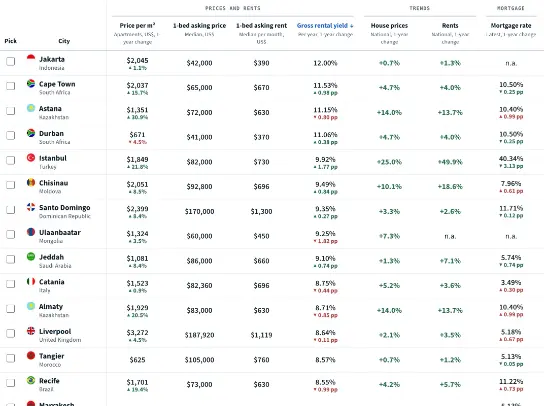
Rents have risen 25% in 2006, after rises of 30% in 2003, and 40% in 2004, according to EFG-Hermes. Rental yields range from 8.5% on the smallest units, to 6.5% on the largest units, according to Global Property Guide figures (September 2007).
These rent increases are largely related to the construction boom, which has drawn a large number of expatriates to Dubai. In April 2005 the government was forced to raise the pay of its national employees by 25%, and the pay of expats by 15%, because of the rent increases, and at end-2005 announced an annual 15% rent increase cap, largely ignored to date.
In mid-2007 a new Real Estate Regulatory Agency (Rera) was formed, and has suggested a standard model tenancy agreements, lasting 3-5 years, to fix rents for the duration of the contract. Rera also intends to set up a property arbitration centre.
The coming crash
A large number of new properties are expected on-stream within the next two years. Apartment deliveries bunched into 2007 and 2008 (90% of all new housing unit completions will be apartments). Villa deliveries are expected to be bunched in 2008 and 2009. The total supply of housing in Dubai will double by 2010.
This large new supply raises the prospect of a drop in prices. “The Singapore property market went through a boom that began at the end of 1998, with property selling prices increasing a cumulative 37% over two years,” says EFG-Hermes. “This boom was followed by a very short period of stability, after which property prices dropped sharply. During the downturn property prices fell by about 30% from their peaks. We believe the supply-demand forces of Singapore of 2000 to be similar to those of Dubai now.
“The magnitude of the price drop will differ in various market segments. We expect prices of villas will fall the least.
However, the fact that many projects are facing substantial delays, due to labour shortages, and increases in construction costs, has altered the situation.
EFG-Hermes propose two alternative scenarios:
- Substantial delays and cancellations, leading to price falls of around 25%-30% within 2 years
- No delays, so that the bulk of deliveries actually arrive in 2008.
“This scenario sees prices falling by significantly more than the 25-30% in Scenario One,” notes EFG-Hermes in a December 2006 report.
Rental falls will lag prices. “We expect rents to increase at a moderate rate in 2007 despite the arrival of new units onto the market in 2007,’ they say.
“In 2008, however, rents are likely to begin falling, provided the bulk of new units are delivered as expected. The continuous supply inflow in several residential communities and towers will relieve rent pressures in 2007, and actually push down rates in 2008”.
However these projections are subject to substantial uncertainty – not least, the fact that the supply and the land bank is dominated by three developers. They could well co-operate to restrict supply.
Only if Dubai’s population continues to grow at its present rapid rate of approximately 5%, analysts believe, might there be enough demand to meet supply. However this rate is exceptional, and places it in the top 1% of all countries – and depends on massive immigration. If Dubai’s population growth slows to a more reasonable 3%, it appears certain there will be an oversupply of housing units.
Has Dubai overreached itself?
Dubai has had enormous success in attracting investors. But has the principality overreached itself?
Dubai is very attractive to wealthy people from India, Pakistan, Iran, Egypt, Iraq and Syria, given its zero tax regime. The principality has been an excellent forward-thinker and planner. It has taken the city-state model of Singapore to heart, and learnt well.
Initiatives such as Dubai Internet City (DIC), the information and communications technology (ICT) hub, have been very successful. DIC already has over 1,000 establishments, including international ICT firms such as LexMark, General Electric (GE). Intel, and others. This makes it one of the world’s largest ‘managed clusters’ of ICT companies. Another important initiative is the Dubai International Financial Centre, which will have generous benefits and first-world regulation.
Yet the social issues are alarming. Dubai's population has almost doubled from 1993 to 2005. It has grown from 610,926 to 1,200,309 inhabitants. There’s a thin upper crust – about 7% – of locals, or “Emiratis.” The rest are labourers and expatriate experts. By 2020, it is projected that the population will reach four million, with a much higher proportion of settled skilled or upper-income foreigners. Will this generate tension?
The real answer is – nobody knows. Dubai is a unique experiment. The scale of what’s being attempted is probably unmatched in human history.
Copy cats
All the other emirates are following Dubai and intend to allow freehold sales to foreigners (see the excellent article on these issues on the portal Ten Real Estate.)
The United Arab Emirates doesn't, at present, have a federal law relating to freehold ownership. It is believed there will eventually be such a law, and all property purchased by a foreigner will be put in his/her name for life, and registered in the Lands Department. The owner will then have full rights to sell, lease or rent.
Abu Dhabi and Al Ain
Abu Dhabi's property law came into effect in August 2005. For the first time, Abu Dhabi nationals can purchase freehold real estate. Previously even locals could not buy in Abu Dhabi, where property was on a not-for-sale, gifted-land basis. GCC nationals may now buy and sell real estate, but only within designated areas. Non-GCC foreigners, unlike in Dubai, cannot buy real estate freehold, but only 99-year land ownership and 50-year surface ownership, renewable, in specified areas.
In some ways Abu Dhabi’s development pattern has mirrored Dubai’s. First there was the formation of new development companies, then a small number of initial projects which attracted headline-grabbing sell-outs, wetting the public’s appetite. Then the marketing of much larger schemes began, with attractive financing for investors.
However, there are important differences. Dubai under-priced initial developments to create a market. Abu Dhabi has not needed to follow this pattern. Abu Dhabi is much richer than Dubai – it is the world’s richest city, with a per capita income of $46,185 in 2005, and sits on 10 per cent of the world's oil reserves. When offered their first-ever opportunity to buy real estate instead of paying sky-high rentals, locals have jumped at the chance.
Foreign nationals can buy in several designated investment zones:
- Al Reem Island, 400 metres offshore Abu Dhabi’s downtown opposite Beach Rotana Hotel and the Abu Dhabi Mall. This is being developed by Sorouh, Tamouh and Reem Investments. The main projects are Reem Investments’ US$8 billion Najmat Abu Dhabi, which will host more than 80,000 people when ready in 2012. Them there’s Sorouh's US$3 billion Shams Abu Dhabi flagship project with its 83-storey Sky Tower, and one million square foot Central Park, which will include 12 mixed-use towers, restaurants, water canals, lakes, recreational and sports complexes.
- Al Raha Beach. At the entrance to the city, this is only 10 minutes from Abu Dhabi International Airport. Aldar Properties is the master developer of this $15 billion project, an entire city which will house more than 120,000 residents.
- Immediately opposite it, the $40 billion Yas Island project, which will take a decade to complete.
- The $27bn Saadiyat Island tourism project, by the Abu Dhabi Tourism Authority.
Not for expatriates is the $9 billion Danet Abu Dhabi project launched by Al Qudra Real Estate on the airport road, and the $2 billion Capital Centre.
The investment response from the local population has driven the expansion. Rents in Abu Dhabi have nearly doubled, by some estimates, since the launch of the new property law. In late 2006 the Abu Dhabi Government announced a rent cap of 7% per annum.
Abu Dhabi, like Dubai, faces a severe shortage of housing, Only 1,100 high-end units will hit the market in 2007. However a staggering 22,000 units will be in demand, mostly from the middle class, according to recent report by Colliers International and Shuaa Capital.
“There is an element of catch up,” says Steve Brice, regional head of research for Standard Chartered. “Dubai started building two years before Abu Dhabi and the supply and demand imbalance is if anything greater than in Dubai. Thus we see prices rising strongly until perhaps early 2009, while Doha is set to peak in 2008, and Dubai probably early next year.”
Ras Al Khaimah
Ras Al Khaimah was the first ‘copy cat’ emirate to follow Dubai’s model by offering freehold foreign ownership, initially through its 1,300 residential unit development at Al Hamra Village. Now there is a second freehold development, on the 50 beachfront acres of the five-star resort facility The Cove. As with Dubai and Abu Dhabi, the recent formation of a development company, Ras Al Khaimah Properties (RAK Properties), seems to promise more substantial moves to attract foreign developers. RAK Properties is developing a resort community, Mina El Arab, which includes a Hilton Hotel, and also the mixed-use Julfar Towers.
Ajman
Ajman already has 15 freehold residential apartment buildings (Al Naeemiya Towers), which are being followed by Al Khor Towers. Tameer Real Estate is also developing a US$300 million freehold residential and commercial project in Ajman, Al Ameera Village.
Sharjah
Sharjah is the third largest Emirate. It covers 2,600 square kilometres and is located 10 kilometres north-east of Dubai. It has a large industrial sector.
Sharjah’s ownership situation is unclear. It is believed to be intending to offer foreign ownership, but has presently stuck with leasehold.
Nujoom Islands, also known as Stars Islands, is Sharjah’s largest projected development. Costing US$4.9 billion, it is expected to cover 5.6 million square metres on the northeastern coast, 15 kilometres from the centre of Sharjah, by the time of completion in 2010. It consists of 13 sectors, the first three on the mainland, the remaining ten on artificial islands separated by water channels, connected by bridges, containing 40,000 residents in 40 high-rise residential and commercial towers, 145 apartment buildings, four hotels, two resorts, and 1,400 water-front and park-side villas, five marine clubs, and a large commercial centre. The developer is Saudi-based Al Hanoo Holding Company.
Mortgage finance is being offered by Tamweel, with up to 70% property value financed over 25 years, starting at a fixed rate of 4.99%.
Umm Al Quwain
Umm Al Quwain is a tiny place whose big draw is the rather shabby Aqua Water Park. Non-GCC nationals can own property, but not land. Tameer will be developing the AED30 billion Al Salam City, which will be completed by 2010.
Fujairah
Fujairah's freehold development consists, so far, of only one building – the 43-storey 170-meter Al Jabar Tower. Developed by Al Jabel Contracting, this will contain 270 residential apartments and also shops and showrooms.