Philippines' Residential Property Market Analysis 2026
The Philippine housing market continues to struggle, weighed down by weak demand, rising unsold inventory, and an economy battered by a deepening corruption scandal, devastating typhoons, and a sharp inflation shock triggered by the Middle East war.
This extended overview from the Global Property Guide provides a comprehensive review of the Philippine housing market, highlighting its key characteristics while offering deeper insight into recent developments, underlying market dynamics, and longer-term structural trends.
Table of Contents
- Housing Market Snapshot
- House Price Variations
- Historic Perspective
- Demand Highlights
- Supply Highlights
- Rental Market
- Mortgage Market
- Socio-Economic Context
Housing Market Snapshot
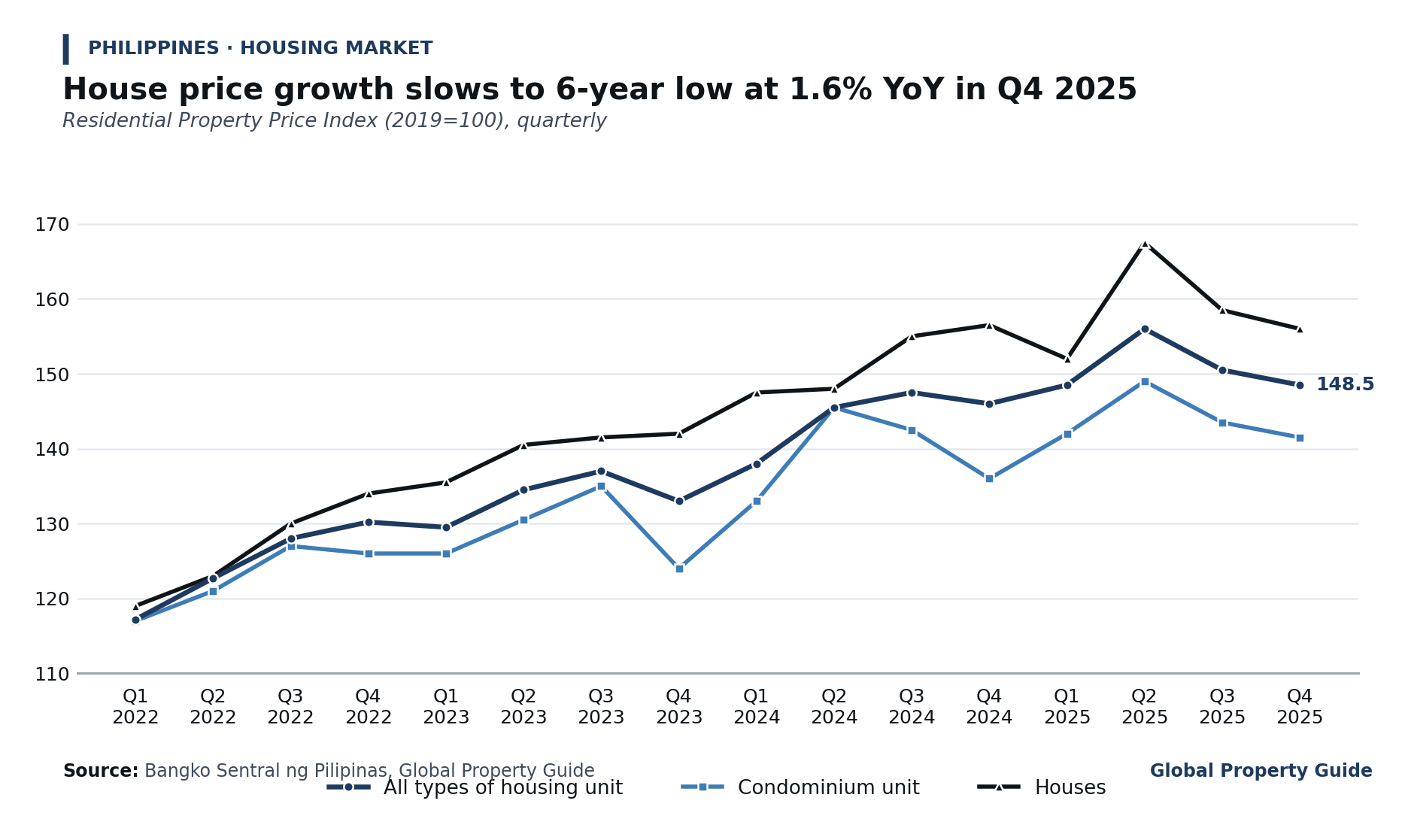
Nationwide, house price growth has slowed to a six-year low. In the fourth quarter of 2025, the nationwide Residential Property Price Index (RPPI) increased by just 1.6% from a year earlier, according to figures released by the Bangko Sentral ng Pilipinas (BSP), the slowest pace of increase since Q1 2019. This is a further deceleration from year-on-year price growth of 1.9% in Q3 2025, 7.55% in Q2 2025, 7.56% in Q1 2025, and 9.77% in Q4 2024.
When adjusted for inflation, nationwide residential property prices in Q4 2025 actually declined by 0.2% year-on-year, slipping into negative territory for the first time in several years.
Quarterly, the price index continued to fall in Q4 2025, declining by 1.3% (a narrower drop than the 3.83% decrease in Q3 2025), suggesting the price correction may be moderating, even as the annual growth rate continues to slow.
Philippines' house price annual change:
The Residential Property Price Index, published every quarter, is based on bank reports on residential real estate loans. From Q1 2025, the BSP has been using a new hedonic regression methodology that more accurately captures market trends by incorporating property-specific characteristics such as location, size, and type.
This is supported by Colliers International's latest report, which showed that the average price of a luxury three-bedroom condominium unit in Metro Manila's central business districts (CBDs) continued to fall in late 2025 and into early 2026. As of Q1 2026, the average luxury price reached approximately PHP197,500 (US$3,359) per square meter, a further deceleration from the price of PHP202,590/sqm recorded in Q3 2025.
The Philippines experienced a house price boom from 2010 to 2018, with house prices in CBDs rising by 125% (77% inflation-adjusted). But with a slowing domestic economy, coupled with the US-China trade war, the housing market slowed sharply in 2019, with house prices rising by a meager 0.9% and falling by 1% when adjusted for inflation. In 2020, the Covid-19 pandemic aggravated the situation, sending the housing market to its knees. Philippine house prices fell by 14.55% (inflation-adjusted) in the third quarter of 2020, and by the end of the year was ranked among the worst-performing housing markets in our Global Residential Real Estate Market Report 2020. Metro Manila CBD house prices plunged by 20.16% (inflation-adjusted).
The housing market started to recover in 2022, with prices increasing by 3.93%, but still declined by 3.82% in real terms due to high inflation. During 2023, prices in the CBDs were up by another 3.98% but remained more or less steady when adjusted for inflation.
However, Metro Manila CBD housing markets noticeably cooled again by the end of 2024, with prices edging up by a negligible 0.12% in nominal terms and falling by 2.7% in real terms. The slowdown has now extended through all of 2025 and into Q1 2026, with the cumulative effect of weak demand, persistent oversupply, and rising mortgage rates dragging the market deeper into correction territory.
The Metro Manila residential sector showed early signs of recovery in Q1 2026, with Colliers data showing remaining inventory life falling to 6.8 years from a peak of 13.4 years in mid-2025, while preselling take-up surged by 765% year-on-year, driven by economic and affordable housing segments. However, the broader market remains fragile. "The Philippine property market is cyclical. Periods of economic uncertainty and turbulence usually affect the condominium demand and put downward pressure on prices," noted Joey Roi Bondoc, Colliers Philippines Director and Head of Research, in May 2026. Colliers projects residential vacancy to peak at 25.6% by end-2026 as nearly 13,000 condominium units come online, almost double the 7,400 turned over in 2025, with the Bay Area facing vacancy approaching 60%.
The housing market's muted activity is largely underpinned by the broader economic slowdown, which has now turned into a deeper and more prolonged downturn than analysts initially anticipated.
In the first quarter of 2026, the Philippines posted an economic growth of just 2.8% year-on-year, the weakest quarterly performance since the contraction in Q1 2021, excluding the pandemic period. This marks a further slowdown from the 3.0% growth in Q4 2025 (revised) and the 5.4% expansion in the same quarter last year. Growth was weighed by the ongoing fallout from the flood control corruption scandal, contracting fixed investment (-2.7% YoY), and the inflationary shock from the Middle East war that began impacting energy and food prices from March 2026 onwards.
For the full year 2025, the Philippine economy expanded by 4.4%, the slowest post-pandemic growth rate, falling well below the government's target band of 5.5% to 6.5%. Both the International Monetary Fund (IMF) and the World Bank have further downgraded their 2026 forecasts, with the Asian Development Bank now projecting only 4.4% growth this year.
House Price Changes
Sharp variations in prices across property types
Residential market trends show notable variation not only by property type but also across different locations, reflecting the diverse demand patterns, supply dynamics, and price movements within the housing sector.
Nationwide:
- For condominium units, prices rose by 3.3% y-o-y in Q4 2025, accelerating from 0.8% in Q3 2025. Quarter-on-quarter, however, condo prices fell by 1.8% during the latest quarter.
- For houses, prices rose by just 0.1% y-o-y in Q4 2025, a sharp deceleration from 1.9% growth in Q3 2025, the smallest increase since Q1 2019. Quarterly, prices were down by 2.5% in Q4 2025.
In the National Capital Region:
- NCR prices rose by 2.3% year-on-year in Q4 2025, unchanged from the previous quarter.
In areas outside the National Capital Region:
- AONCR prices increased by just 1.0% in Q4 2025, the lowest growth on record. Condominium prices led annual growth at 4.1%, while house prices rose marginally by 0.2%.
Historic Perspective
Real house prices still lag pre-Asian Financial Crisis peaks
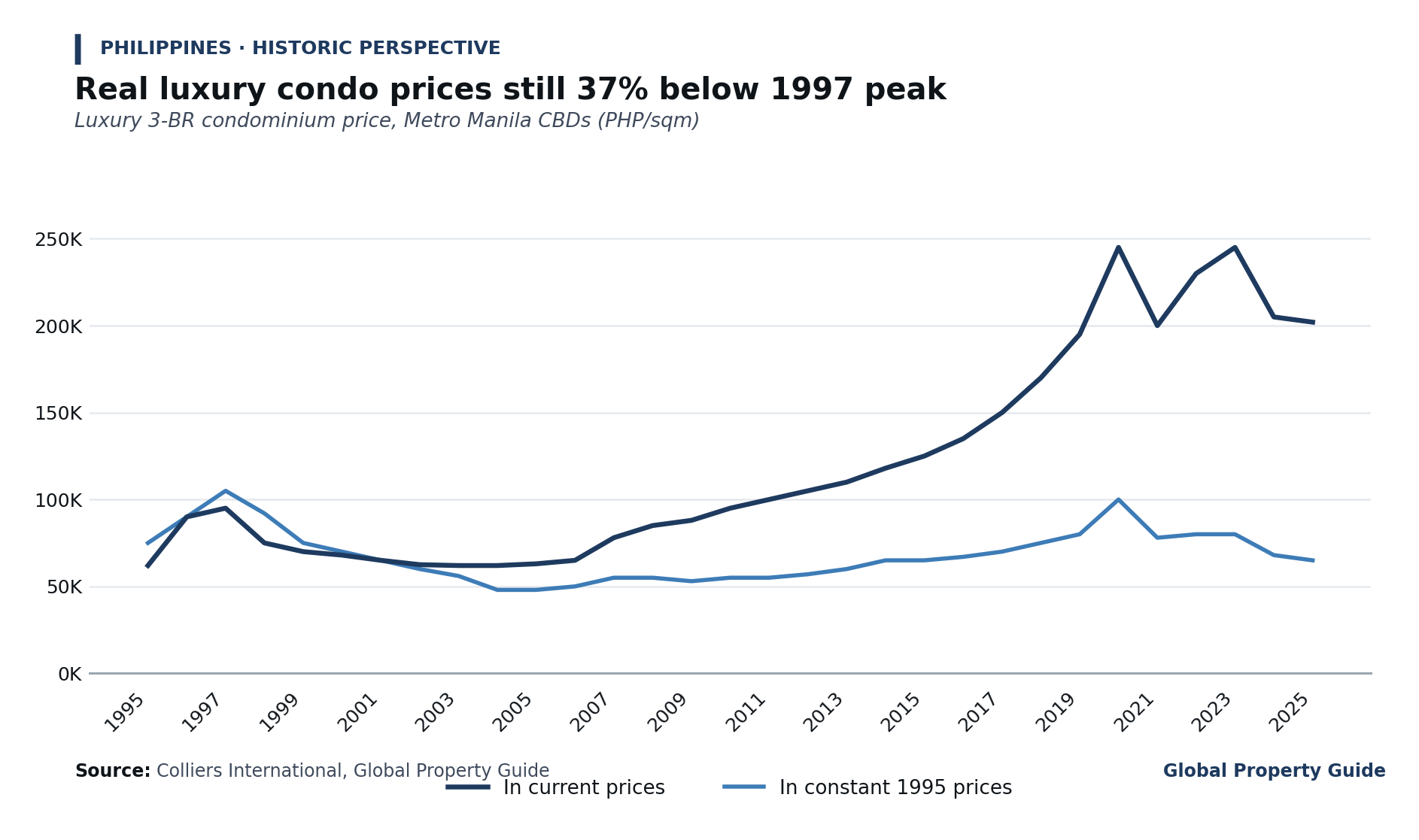
Surprisingly, despite so much price appreciation for a decade, the Philippine housing market has still not recovered from the crash after the 1997 Asian Financial Crisis. Between 1997 and 2004, luxury condominium prices dropped 28% (52% inflation-adjusted), in the biggest property crash of all countries affected by the Asian Financial Crisis.
In current price terms, both rental rates and property values are already far above 1997 levels. Yet in 2019, before the new coronavirus outbreak, residential property prices were still about 10% below pre-Asian Financial Crisis levels in real, inflation-adjusted terms.
Worse, the pandemic quickly offset most of the gains in recent years. Combined with the renewed inflation surge in 2026, real prices in Q4 2025 fell back to about 37% below pre-Asian Crisis values, and the gap is expected to widen further as inflation accelerates through 2026.
Property Demand Trends
Preselling rebounds sharply in Q1 2026 after mid-2025 trough
After a punishing 2024 and most of 2025, Metro Manila's residential demand metrics turned sharply higher in Q1 2026. According to Colliers Philippines, net condominium preselling take-up surged by 765% year-on-year in the first quarter, climbing to roughly 2,000 units from just 200 units in Q1 2025. The rebound was concentrated in the economic and affordable segments, with units priced between PHP1.8 million and PHP3.6 million driving the bulk of activity, a shift away from the luxury and lower mid-income segments that had dominated take-up through late 2025.
The clearest signal of improving absorption is the remaining inventory life (RIL) metric, which measures how long it would take to clear current unsold stock at the prevailing pace of take-up. RIL fell to 6.8 years in Q1 2026 from a peak of 13.4 years in mid-2025, the lowest reading in six quarters. Still, the level remains elevated by historical standards, and roughly 78,600 condominium units remain unsold across Metro Manila, with concentrations in Cubao-New Manila, Quezon City, the Bay Area, Pasig, and the Alabang-Las Piñas corridor.
"The Philippine property market is cyclical. Periods of economic uncertainty and turbulence usually affect the condominium demand and put downward pressure on prices," noted Joey Roi Bondoc, Director and Head of Research at Colliers Philippines, in May 2026. The recovery in preselling was driven largely by aggressive developer promos, particularly on ready-for-occupancy (RFO) units, alongside flexible payment schemes that lowered effective entry costs for first-time buyers.
OFW remittances anchor the affordable segment
Overseas Filipino Workers (OFWs) remain the structural backbone of demand in the affordable and mid-income segments. The World Bank estimates that approximately 60% of OFW remittances flow directly or indirectly into the real estate sector, primarily into housing projects and mid-scale subdivisions in regions near Metro Manila, such as Cavite, Batangas, and Laguna.
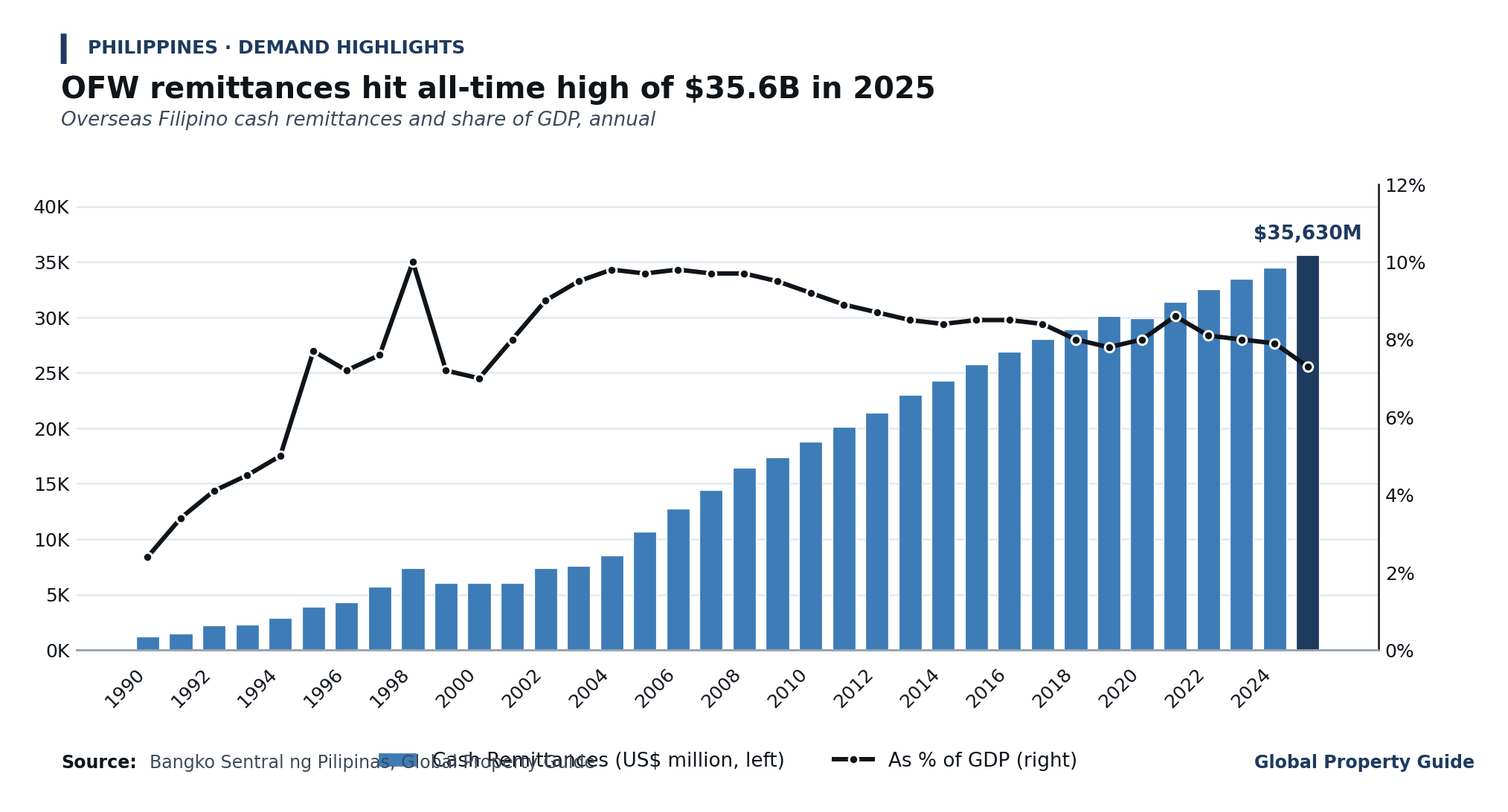
In 2025, total cash remittances reached an all-time high of US$35.63 billion, up 3.3% from US$34.49 billion in 2024, based on figures released by the BSP. Remittances accounted for about 7.3% of GDP in 2025. December alone saw a record monthly inflow of US$3.52 billion, partly driven by OFWs accelerating transfers ahead of the 1% US tax on OFW remittances that took effect in January 2026.
"Some OFWs also increased remittances and conversion to pesos in December 2025 before the 1 percent tax on OFW remittances from the US took effect in 2026," noted Rizal Commercial Banking Corporation Chief Economist Michael Ricafort.
Personal remittances, which include in-kind transfers and informal channel inflows, also hit a record US$39.62 billion in 2025. The United States remained the largest source at 39.7% of total inflows, followed by Singapore (7.3%), Saudi Arabia (6.6%), Japan (5.0%), and the UK and UAE (4.6% each).
Demand segments diverge sharply
Three distinct demand pools shape the Philippine residential market, each with very different dynamics in the current cycle:
- The high end: Local high-income earners and expatriates. Demand remains thin, with luxury 3-bedroom condo prices in CBDs falling for three consecutive quarters through Q3 2025. Premium and ultra-luxury projects scheduled for turnover from 2026 in Makati CBD, Fort Bonifacio, and Alabang are expected to redefine the high-end inventory mix.
- The middle tier: Mid-end condominium buyers, with monthly amortizations around PHP10,500 (US$179) on a PHP2 million (US$34,000) loan, requiring disposable income of at least PHP34,962 (US$596). This is the segment where OFW demand concentrates and where developer RFO promos have been most aggressive. The Q1 2026 surge in preselling take-up was disproportionately driven by units priced PHP1.8 to PHP3.6 million, sitting at the lower edge of this tier.
- The low end: Socialized housing, where the demand vastly exceeds supply. The national housing backlog is estimated at 4 million units by the Subdivision and Housing Developers Association, while other estimates put the shortfall at 6.5 million units. Most of this would need to be priced under PHP450,000 (US$7,650).
The mid-tier remains structurally oversupplied relative to absorbable demand: Metro Manila secondary-market vacancy ended 2025 at 24.7%, with Colliers projecting it to climb to 25.6% by end-2026 before easing modestly to 23.9% in 2027. Vacancy in the Bay Area submarket remains above 50%, reflecting the lingering impact of the POGO exit alongside a sizable volume of units completed before and during the pandemic.
Property Supply Trends
Condominium supply continues to expand
The total condominium stock in Metro Manila's CBDs rose by 5% to reach 162,510 units in 2024 from a year earlier, following annual increases of 2.3% in 2023, 6.3% in 2022, 6.5% in 2021, and 2.6% in 2020, based on figures published by Colliers International.
During 2024, completions in the CBDs totaled 7,810 units, equivalent to a strong growth of 120.6% from 3,540 completed units in the prior year. Among the projects completed by end-2024 included Filinvest Land's Belize Oasis in Alabang, Megaworld's Gentry Manor (4 towers), Jinxi Group's Jinxi Seaview City in the Bay Area, and Robinsons Land's Sapphire Bloc East in Ortigas Center.
For the full year 2025, approximately 7,400 new condominium units were delivered in the Metro Manila CBD market, slightly below the original Colliers forecast of 8,600 units. For 2026, Colliers projects a sharp jump to nearly 13,000 new condominium units, with the C5 Corridor accounting for roughly one-third of the upcoming supply, followed by the Bay Area (32%) and Ortigas Center (24%).
"The Bay Area is now the largest residential hub in Metro Manila, accounting for nearly 30% of the condominium stock in the capital region," noted the Colliers report.
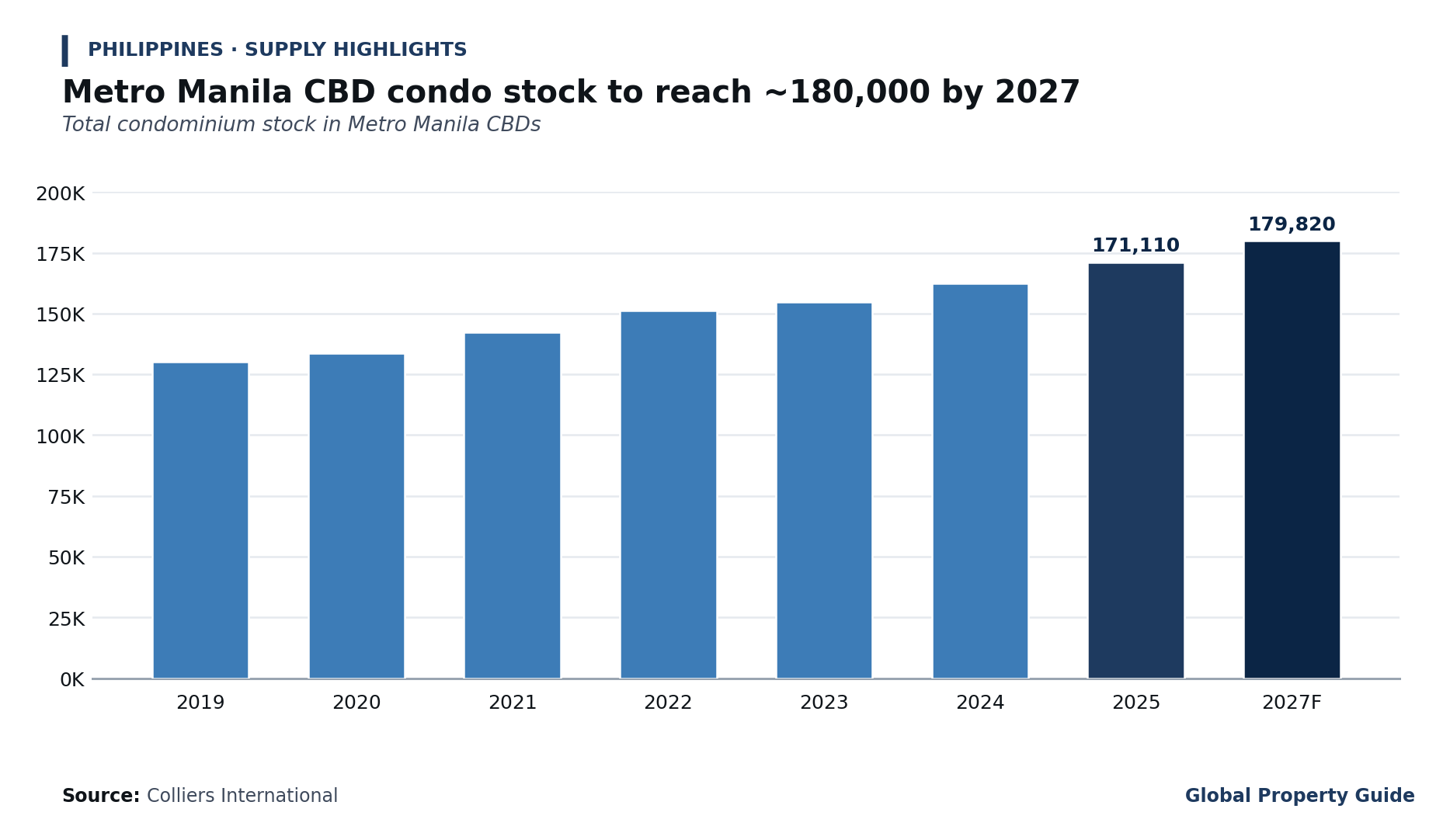
Completions averaged around 8,000 units in the past 15 years.
Beyond 2026, Colliers projects a sharp slowdown in project completions, partly reflecting the more subdued pace of condominium launches in major Metro Manila CBDs over the past three to four years. From 2027 to 2029, average annual deliveries are expected to total around 2,000 units, sharply lower than the roughly 13,000 units delivered each year from 2017 to 2019, when developers accelerated completions to capitalize on strong demand from POGO-related tenants.
Overall, Metro Manila's condominium stock is projected to reach around 179,820 units by end-2027, an increase of 10.7% from 2024.
| METRO MANILA RESIDENTIAL STOCK | |||||
| Location | 2022 | 2023 | 2024 | 2025 | Change, % |
| Bay Area | 36,070 | 36,860 | 40,730 | 46,590 | 14.4 |
| Alabang | 5,390 | 5,660 | 6,220 | 9,010 | 44.9 |
| Fort Bonifacio | 41,740 | 42,550 | 43,840 | 46,440 | 5.9 |
| Rockwell Center | 5,830 | 5,830 | 5,880 | 5,880 | 0.0 |
| Ortigas Center | 19,200 | 19,830 | 21,860 | 25,350 | 16.0 |
| Makati CBD | 28,760 | 29,210 | 29,210 | 31,790 | 8.8 |
| Araneta City | 4,550 | 5,140 | 5,140 | 5,140 | 0.0 |
| Others | 9,630 | 9,630 | 9,630 | 9,630 | 0.0 |
| Total | 151,160 | 154,700 | 162,510 | 179,820 | 10.7 |
| Source: Colliers International | |||||
Residential construction activity strengthens
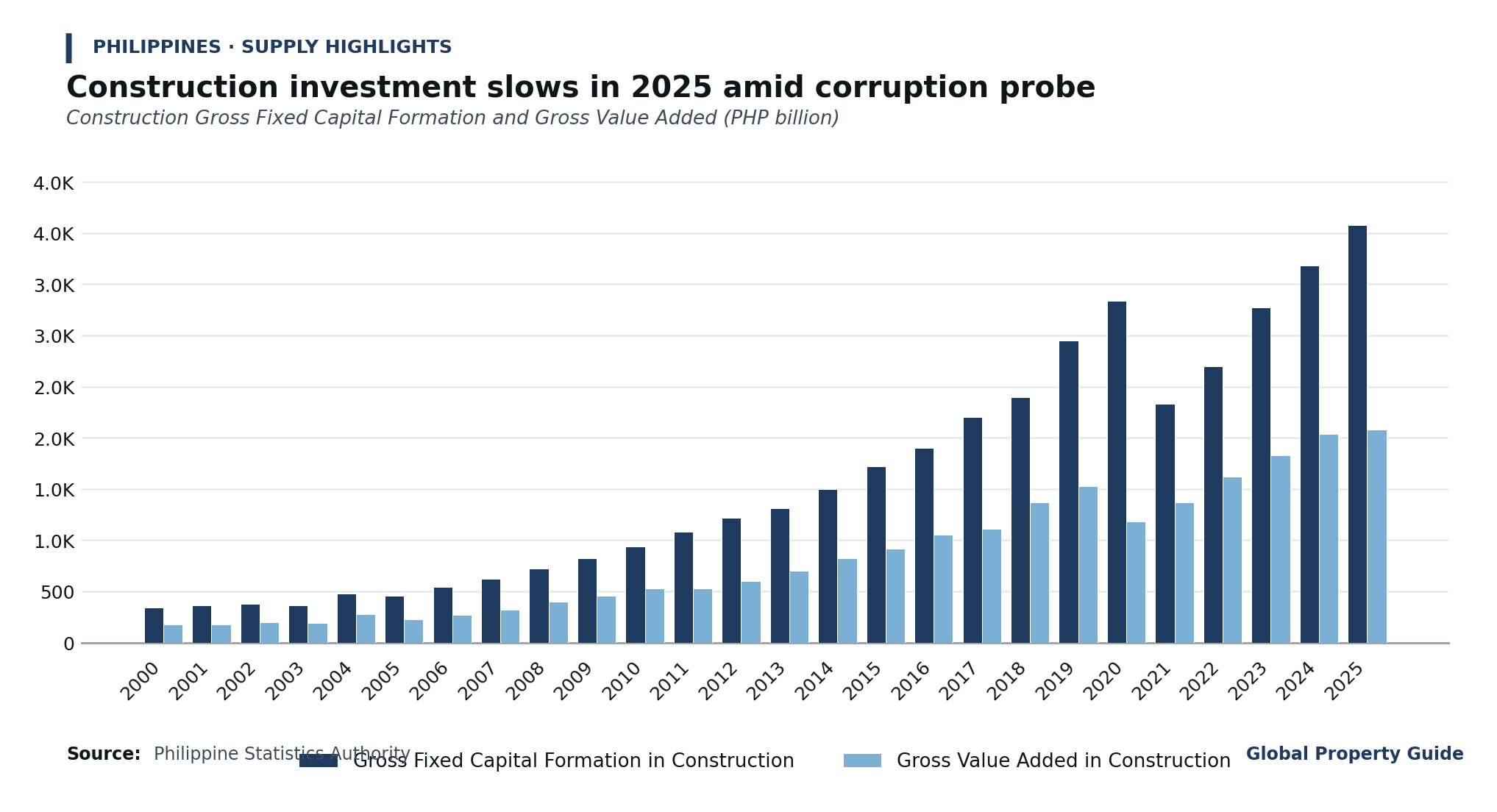
Residential construction activity continued to improve through 2025, although early 2026 data show signs of weakening as the broader economy slows.
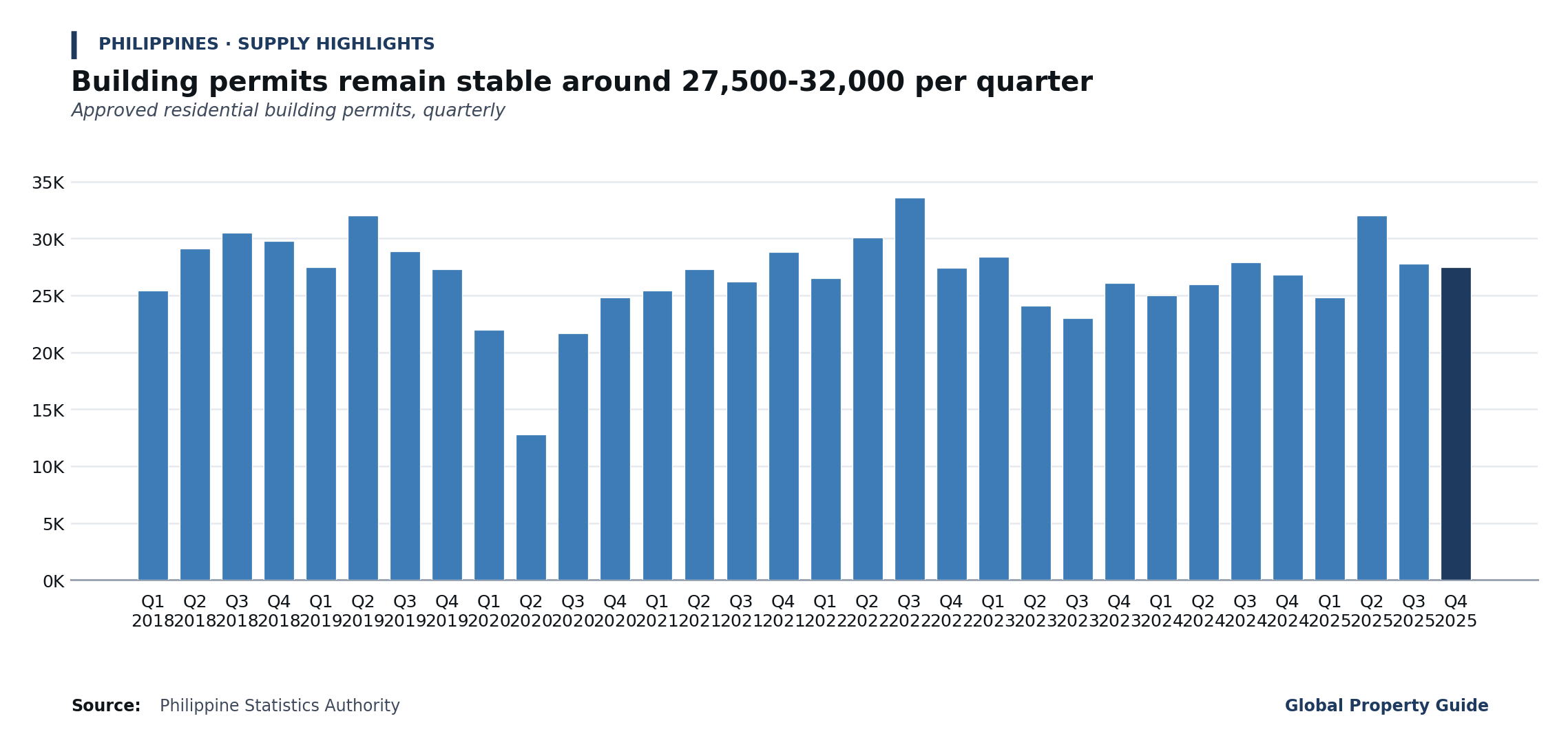
During 2024, the total number of residential building permits issued increased by a modest 3.6% y-o-y to 116,427, following an annual decline of 7.2% in 2023, according to figures released by the Philippine Statistics Authority (PSA).
Similarly, the floor area of residential building permits was up by 8.9% y-o-y to 19.75 million square meters in 2024, in contrast to the annual contraction of 6% in 2023. Total value also rose strongly by 15.8% to PHP248.65 billion (US$4.23 billion) in 2024, a sharp acceleration from a meager growth of 1.9% in the preceding year.
The upward trend continued through most of 2025:
- The number of residential building permits rose by 9.7% to 86,919 in the first three quarters of 2025, compared to the previous year. This is far higher than the minuscule year-over-year growth of 0.7% registered in the same period last year.
- The floor area of residential building permits increased strongly by 18.1% y-o-y to 15.11 million sqm in the first three quarters of 2025, an acceleration from the 2% growth seen in Q1-Q3 2024.
- The total value of residential building permits was up by 18.5% to PHP189.76 billion (US$3.23 billion) in the first three quarters of 2025. This compares to a year-over-year growth of 12.9% in Q1-Q3 2024.
However, fixed investment contracted by 2.7% year-on-year in Q1 2026 according to the PSA, suggesting that construction activity is now slowing under the weight of the corruption scandal, weather-related disruptions, and rising borrowing costs.
In September 2025, about 85% of residential constructions in the country were single-type houses.
The average construction cost for a residential unit was PHP15,562 (US$265) per sqm in September 2025. Residential condominium units registered the highest average cost at PHP24,100 (US$410) per sqm. It was followed by single houses, with an average cost of PHP15,060 (US$257) per sqm; apartments with PHP11,805 (US$201) per sqm; duplex/quadruplex with PHP11,269 (US$192) per sqm; and other residential types with PHP8,215 (US$140) per sqm.
4PH housing program faces headwinds amid economic slowdown
The Philippines has a huge housing need at the low end. Nationwide, the country has a housing shortage of approximately 4 million units, according to the Subdivision and Housing Developers Association (SHDA). But other estimates put the housing backlog at a huge 6.5 million units.
Most of this would need to be socialized housing units with a selling price of under PHP450,000 (US$7,650). In Metro Manila, as many as 300,000 households reside in informal and semi-uninhabitable housing units, comprising 8.7% of Metro Manila's total population.
To meet the needs of these families, Philippine President Ferdinand Marcos, Jr. launched in September 2022 the current administration's flagship housing program, "Pambansang Pabahay Para sa Pilipino Program" or 4PH, which aims to build a total of 6 million housing units or about 1 million housing units every year until the end of his term in 2028.
Aside from its main goal of providing the Filipino people with decent and affordable housing, the project also aims to generate around 1.7 million jobs every year until 2028.
Construction is now ongoing for 4PH projects in San Fernando City, Pampanga, Davao City, Tagoloan, Misamis Oriental, Tondo and San Miguel districts in Manila, and Puerto Princesa, Palawan, among others. Additionally, there are over 100 projects in the pipeline, projected to build around 415,000 units.
Despite this, the annual target has been missed every year since 2023 due to several challenges, including typhoons, procedural delays, the ongoing infrastructure corruption probes, and tighter public spending in early 2026.
Recently, DHSUD Secretary Jose Ramon Aliling has pledged to enhance and expand the 4PH Program, shifting its focus toward horizontal housing developments such as townhouses and single-detached units. This move signals a strategic shift away from the vertical, condominium-style housing favored by his predecessor, Jose Rizalino Acuzar.
Socialized housing units (under PHP450,000 / US$7,650) can be purchased with a monthly amortization of PHP2,302 (US$39). The Pag-IBIG Fund, the country's state-owned housing loan provider, offers a fixed rate of 3% for 30 years for socialized housing units. The problem is that these low-end housing units are usually far from work.
Rental Market: Rents and Rental Yields
Residential rental market still weak, vacancy rates remain high
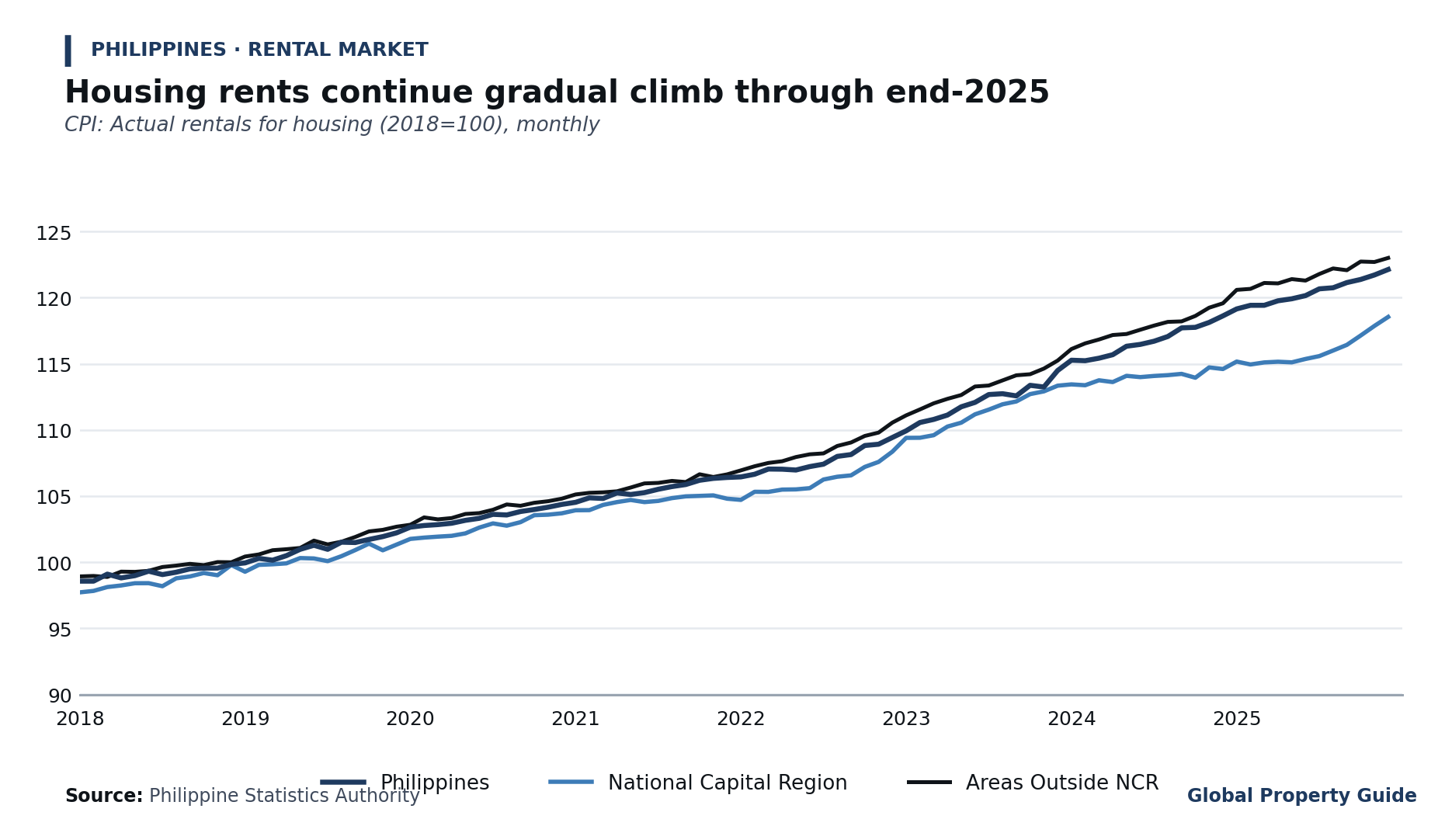
Philippines' rent price index:
Based on the Consumer Price Index (CPI) published by the PSA, the actual rentals for housing in the Philippines increased by 2.7% in March 2026 from a year earlier, broadly in line with the 2.61% recorded in November 2025. However, with overall inflation accelerating sharply through Q1 2026, real rents are now in negative territory.
- In the National Capital Region (NCR), housing rentals were up by approximately 3.3% in March 2026 from the previous year.
- In areas outside the NCR, housing rentals increased by approximately 2.4% y-o-y over the same period.
However, data from Colliers International paint a less optimistic picture, with residential rents across Metro Manila slipping further in Q4 2025 and early 2026. This followed a meager rent growth of 0.5% in 2024, modest increases of 3.5% in 2023 and 3.9% in 2022, and a cumulative 12% decline in 2020-21.
"We expect a marginal rental correction in 2026, given the elevated vacancy, still substantial number of unsold ready-for-occupancy (RFO) units, and weaker household budgets amid the renewed inflation shock," said Colliers.
The lackluster performance of the residential rental market is not surprising given the elevated vacancy registered in Metro Manila CBDs. By end-2025, the overall vacancy rate in Metro Manila's secondary market reached an all-time high of approximately 24.7%, up from 23.9% a year earlier, with Colliers projecting it to peak at 25.6% by end-2026.
"Vacancy in the Bay Area remains above 50% due to a sizable number of units completed before and during the pandemic. The exit of POGO-related tenants continues to weigh heavily on this submarket," noted the Colliers report.
Gross rental yields remain moderately good, but beware of taxes
Rental yield returns in the Philippines are moderately good, at an average of 5.57% in Q3 2025, an increase from 5.12% in Q1 2025, 5.36% in Q3 2024, and 5.19% in Q1 2024, according to a recent research conducted by the Global Property Guide. Usually, smaller properties tend to have higher rental yields, but this is not the case in Manila. Return rates are mostly similar for all apartment sizes.
In Metro Manila, apartments offer gross rental yields ranging from 4.16% to 7.6%, with an average of 5.77%. In Cebu City, rental yields currently range from 4.06% to 6.53%, with a city average of 5.38%.
These yields are before taxes and other expenses. They are for the high-end areas: Taguig City, Pasay City, Pasig City, Makati CBD, Ortigas CBD, Rockwell, The Fort, and Eastwood City.
This does not mean that foreign investors should necessarily rush to invest in Manila, because transaction taxes (known as 'capital gains taxes', but not actually such), and (if observed) official income tax rates applicable to non-resident investors are high.
Mortgage Market and Interest Rates
BSP pivots to hiking as Middle East war shocks inflation
In a dramatic reversal of policy, the BSP Monetary Board raised its policy rate, the Target Reverse Repurchase (RRP) Rate, by 25 basis points to 4.50% on April 23, 2026, ending an easing cycle that had delivered 225 basis points of cuts since August 2024. The interest rates on the overnight deposit and lending facilities were also adjusted to 4.0% and 5.0%, respectively. It marked the first rate hike in more than two years.
The move came as headline inflation surged to 7.2% in April 2026, the highest level since March 2023, from 4.1% in March, after running at just 2.4% in February. The acceleration was driven by the Middle East conflict that began in March 2026, which pushed transport inflation up to 21.4% in April and food prices to 6.0%, according to the PSA.
"After considering its options, the Monetary Board deemed it necessary to take timely and preemptive policy action to safeguard price stability," the central bank said in its April 2026 statement.
"Once we start raising the policy rate, we're likely to raise it again," said BSP Governor Eli Remolona Jr. The BSP has raised its 2026 inflation forecast to 6.3% (from 3.6% previously) and its 2027 forecast to 4.3% (from 3.2%), both well above the central bank's 2% to 4% target range.
Aris Dacanay, senior economist at HSBC Global Investment Research, warned that the BSP may need to raise the policy rate as high as 6% if the war in the Middle East extends beyond May 2026, with inflation potentially climbing as high as 8.1% in Q4 2026.
This sharp pivot has fundamentally changed the outlook for the housing market. Just months earlier, in December 2025, the BSP had cut rates to 4.50% in what it called the eighth consecutive cut since July 2024, with then-Governor Remolona signaling the easing cycle was nearing its end. The February 2026 cut to 4.25% was widely expected to be the last in the cycle. Few analysts anticipated that the BSP would reverse course so quickly.
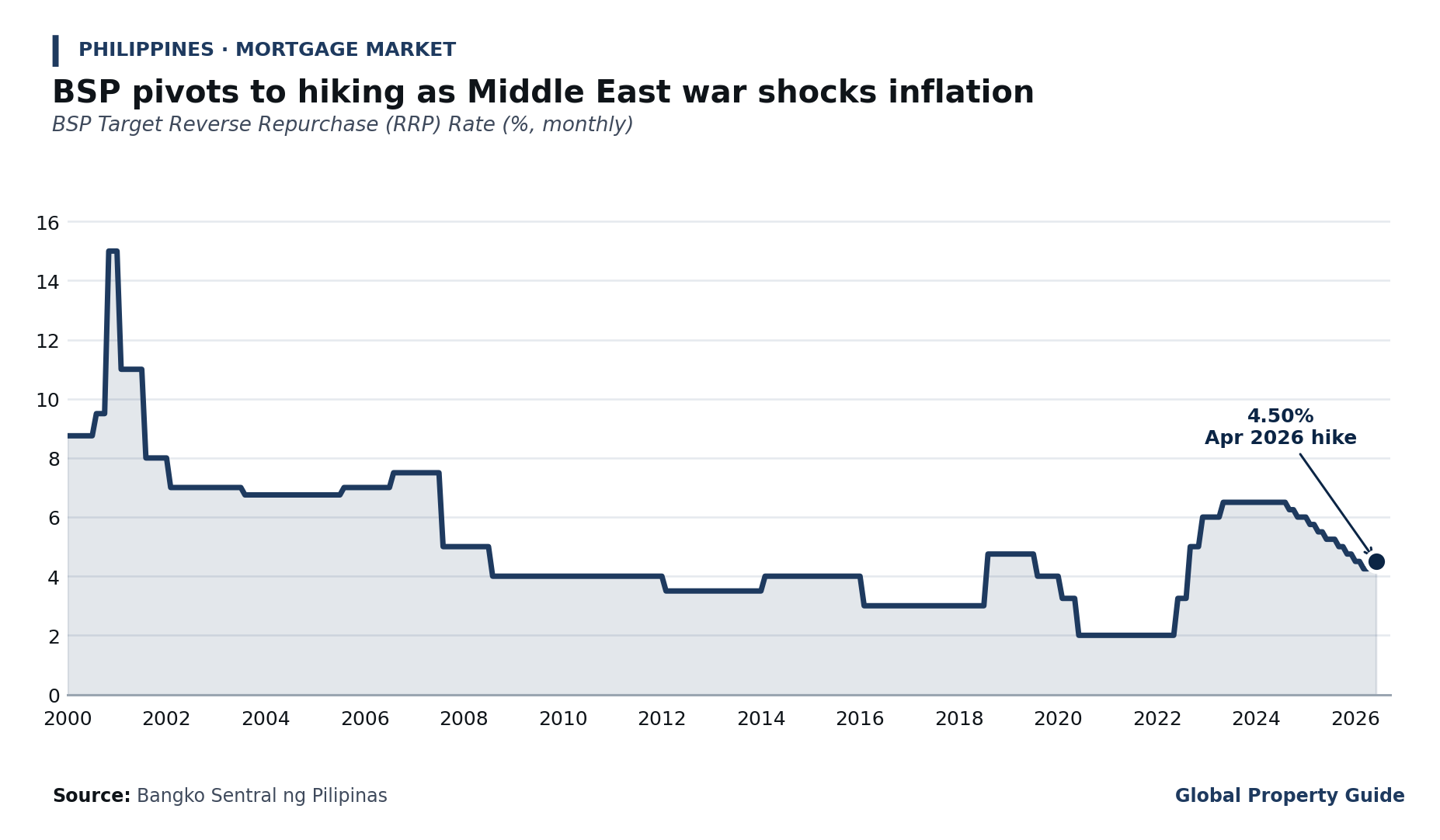
Prior to the December 2025 cut, the policy rate had been raised thirteen times from May 2022 to October 2023, amidst stubbornly high inflation.
The mortgage market remains underdeveloped
A few major banks in the Philippines offer housing loans. And although loan-to-value ratios of 90% are now in theory being offered and loan tenors can be as long as 30 years, in fact, most loans are short-term. Banks are wary because land titling and registration problems are prevalent, as are lengthy delays in the foreclosure process due to the country's very weak court system.
Therefore, approval of loan applications takes a long time. In addition, interbank collusion prevails: different banks' loans have strangely similar terms and conditions.
Property buyers also face high transaction costs, corruption and red tape, fake land titles, and substandard building practices. Plus, the large informal housing sector and its incentives make it less attractive for low to middle-income families to buy or rent properties.
Because of these factors, the ratio of residential mortgage loans to GDP remains small, at less than 5% of GDP in 2025, a slight increase from 2.4% of GDP in 2012. Most houses in the Philippines are sold for cash or pre-sold, with the developers offering financing.
The size of the residential mortgage market is expected to remain between 4% and 5% of GDP this year, with the BSP's policy reversal likely to weigh on new originations.
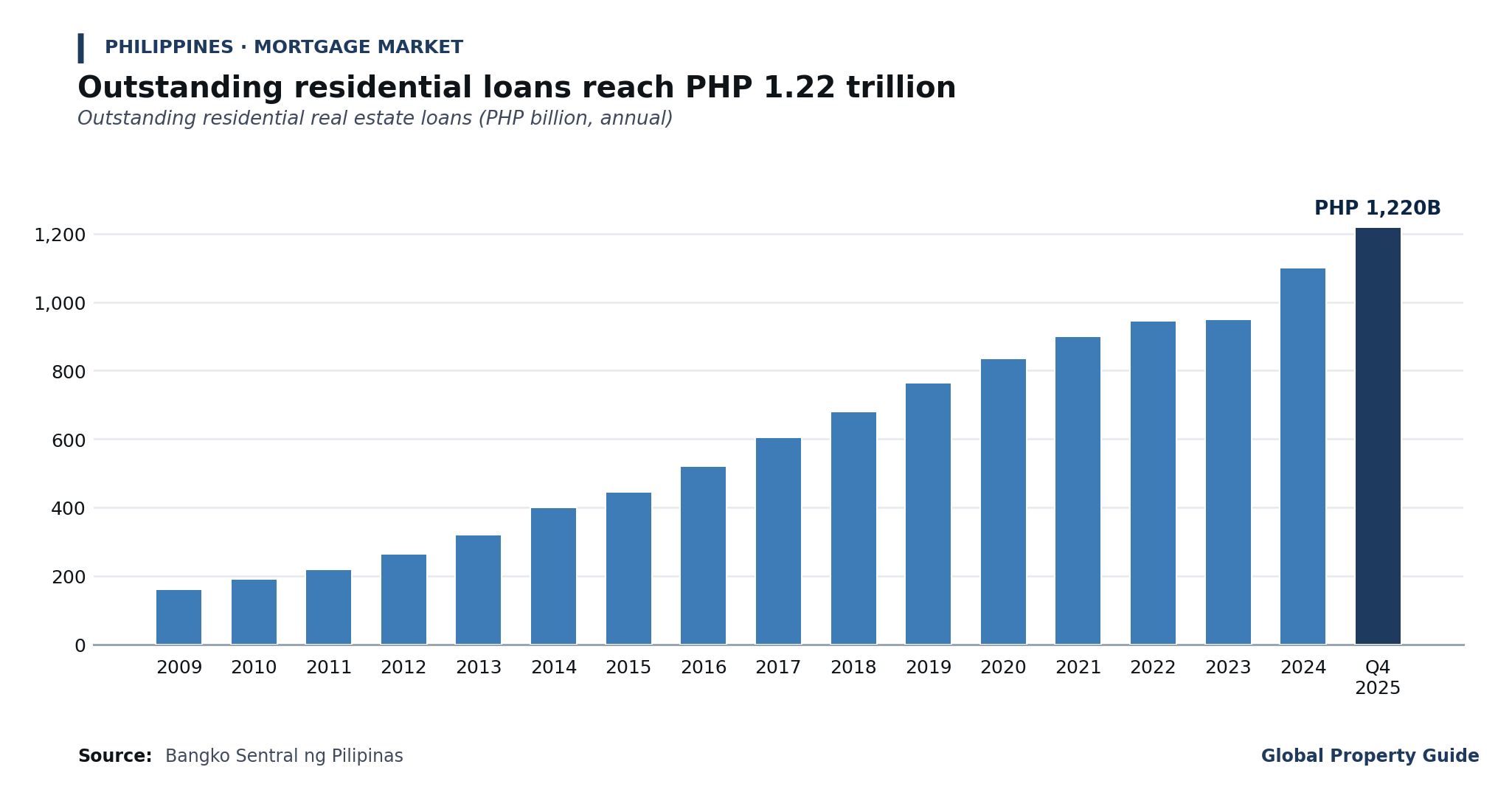
As of Q4 2025, the total outstanding residential real estate loans in the country amounted to approximately PHP1.22 trillion (US$20.7 billion), up by around 10% from the same period last year, according to figures from the BSP.
From an annual average growth of about 17% from 2010 to 2019, the growth in residential real estate loans decelerated sharply to less than 6% annually from 2020 to 2023. The annual growth of residential real estate loans accelerated again to 16.3% during 2024, before moderating in 2025 amid the broader market slowdown.
Economic and Social Factors
Growth slows sharply amid corruption scandal and oil shock, Philippine peso under pressure as inflation flares back up
After appreciating by 5.6% in 2020, the Philippine peso depreciated for the second straight year in 2022, reaching PHP58.681 = US$1 in October 2022, amidst aggressive rate hikes delivered by the U.S. Federal Reserve to rein in inflation during the said year.
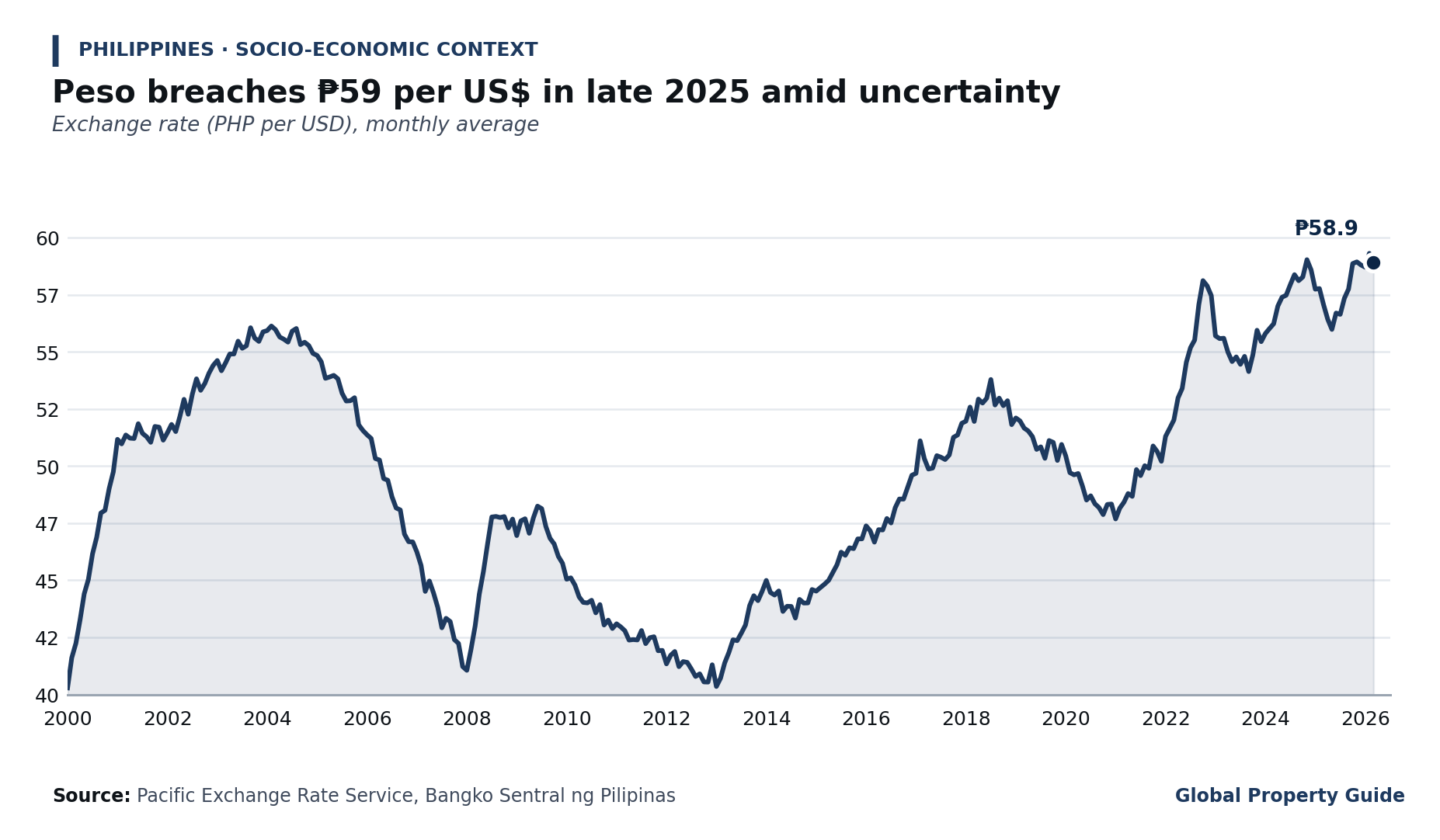
After regaining some value in early 2023, the local currency depreciated again in the succeeding months. The peso closed 2025 at PHP58.79 per US dollar, down 1.61% from PHP57.845 at the end of December 2024. In October 2025, the exchange rate breached PHP59 per US dollar for the first time on record.
The peso has remained under pressure in early 2026 amid the renewed inflation shock, the BSP's hawkish pivot, and continued domestic challenges, with the ongoing corruption probes and infrastructure spending controversy continuing to erode investor and consumer confidence.
In April 2026, headline inflation surged to 7.2%, the highest level since March 2023, up sharply from 4.1% in March and just 2.4% in February, according to the PSA. The acceleration brought the January-April 2026 average to 3.9%, already at the upper end of the BSP's target band of 2% to 4%.
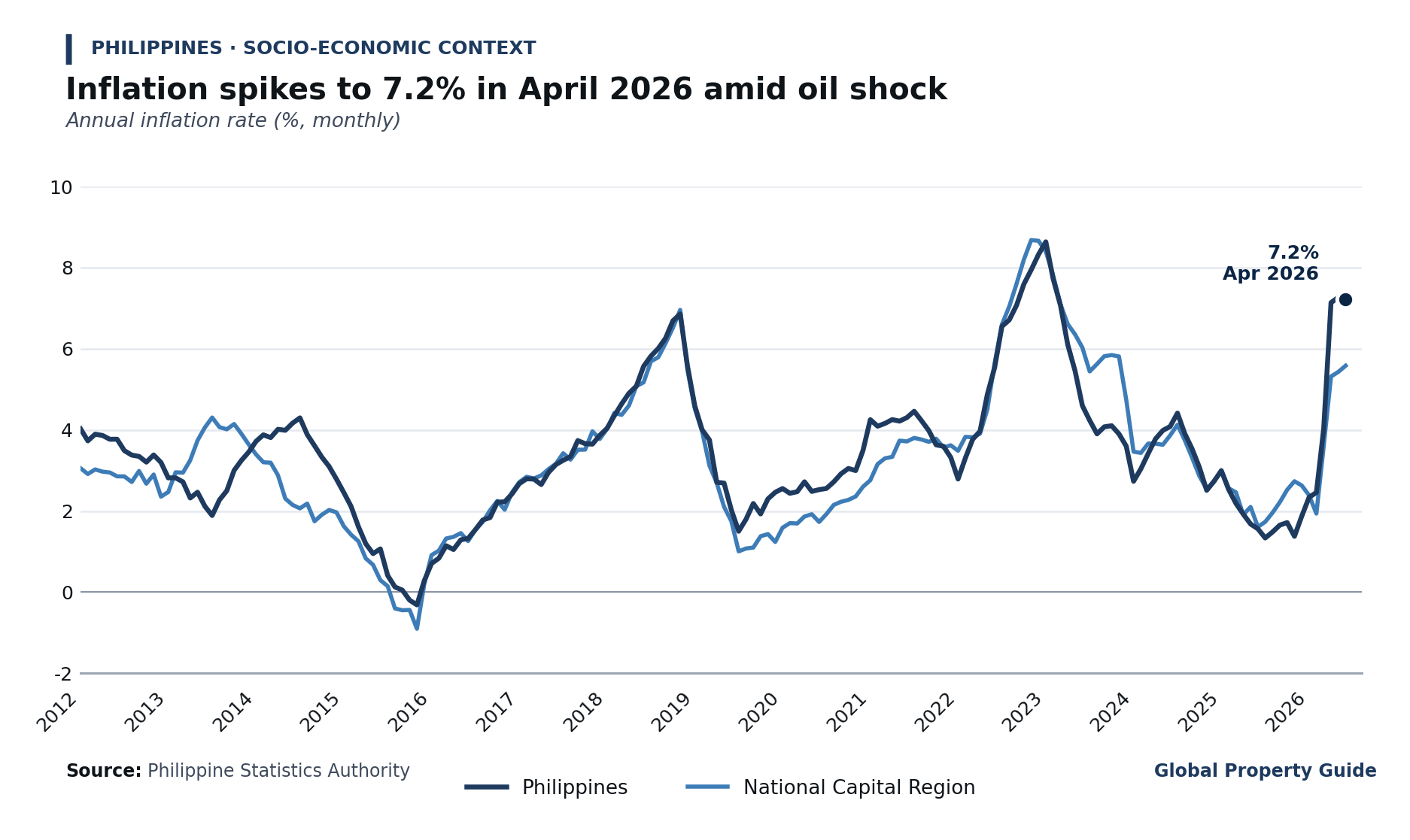
"The uptrend in the overall inflation rate in April 2026 was primarily influenced by the faster annual increment in the heavily-weighted food and non-alcoholic beverages index at 6.0 percent during the month from 2.9 percent in March 2026," noted the PSA. "Also contributing to the uptrend were the faster annual increases observed in transport (21.4% from 9.9%) and housing, water, electricity, gas, and other fuels (8.2% from 4.7%)."
Core inflation, which excludes selected food and energy items, also accelerated to 3.9% in April 2026 from 3.2% in March, indicating that price pressures are broadening beyond just oil-related items.
Trade gap continues to widen amid global uncertainties
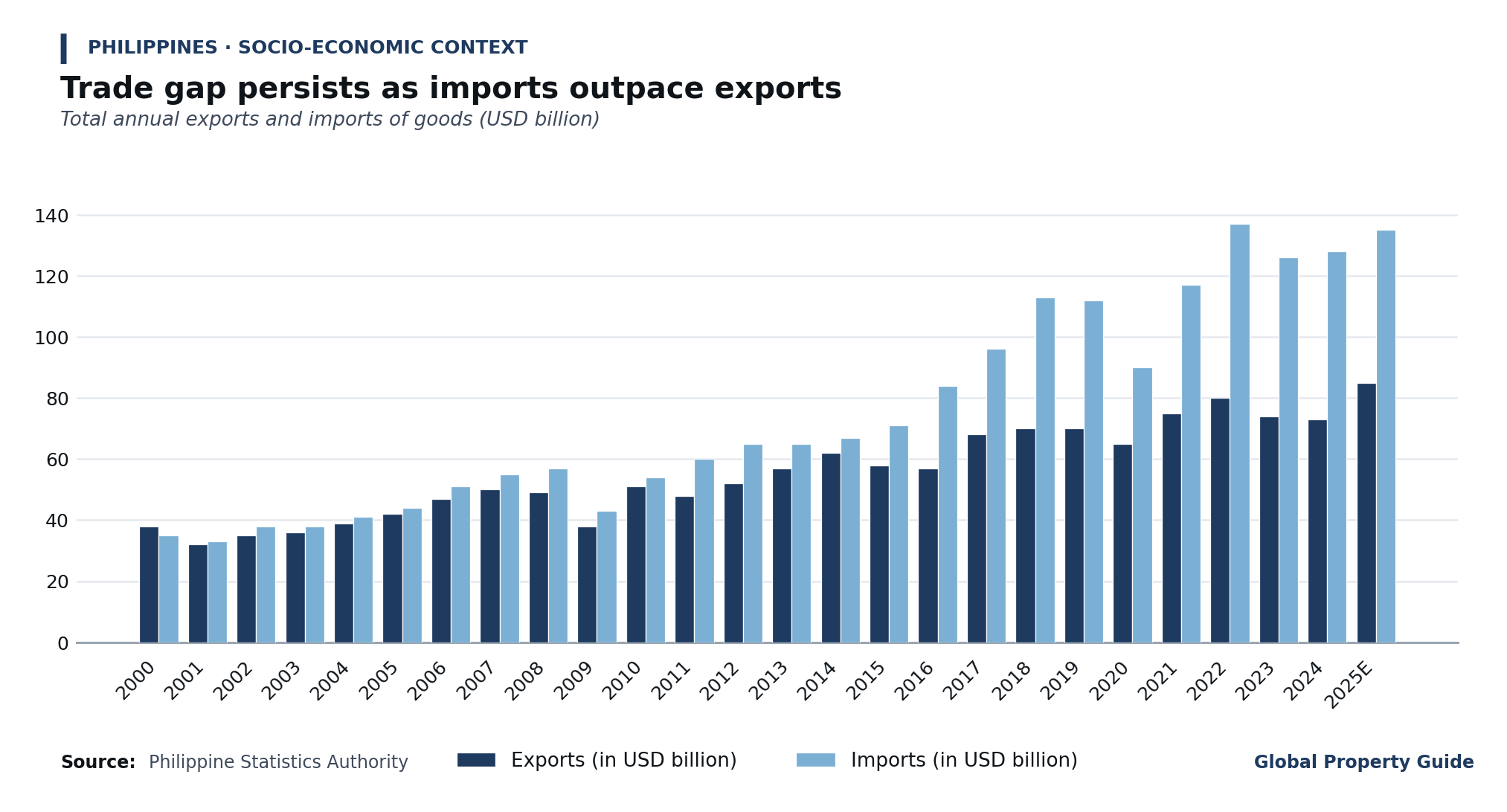
During 2024, the total value of exports fell slightly by 0.5% y-o-y to US$73.29 billion while imports increased by 1.1% to US$127.6 billion, resulting in a trade deficit of US$54.33 billion, according to PSA figures.
For the first eleven months of 2025, Philippine exports reached US$77.39 billion, marking a 14.5% growth from the US$67.6 billion in the previous year. Imports, on the other hand, increased by a modest 4.1% y-o-y to US$122.59 billion in Jan-Nov 2025. This resulted in a cumulative trade gap of US$45.2 billion in the first eleven months of the year.
China continued to be the leading source of imports for the Philippines in Jan-Nov 2025, accounting for US$35.13 billion (28.7% share of total imports). Other major suppliers included Japan with US$9.77 billion (8% share), South Korea with US$9.53 billion (7.8% share), Indonesia with US$9.42 billion (7.7% share), the United States with US$7.41 billion (6% share), and Thailand with US$7 billion (5.7% share).
The United States emerged as the country's top export destination, receiving US$12.33 billion worth of Filipino export products (15.9% share of total exports) in the first eleven months of 2025. Hong Kong followed closely with US$11.27 billion (14.6% share). Other top export markets included Japan with US$10.59 billion (13.7% share), China with US$8.51 billion (11% share), the Netherlands with US$3.27 billion (4.2% share), and Singapore with US$3.2 billion (4.1% share).
Electronic products remained the Philippines' leading export category, valued at US$4.19 billion in November 2025, accounting for about 60.7% of total export receipts.
For 2025, the BSP estimated the balance of payments (BOP) deficit narrowed to about US$5.7 billion. However, the BSP now expects the BOP deficit to widen to US$5.9 billion in 2026 (1.2% of GDP), wider than its previous projection of US$3.4 billion, as external challenges persist and the Middle East war pushes import bills higher.
Corruption scandal and oil shock weigh on growth
In the first quarter of 2026, the Philippines posted an economic growth of just 2.8% from a year earlier, the weakest quarterly performance since the Q1 2021 contraction. This was a further slowdown from 3.0% in Q4 2025 (revised) and 5.4% in the same quarter last year.
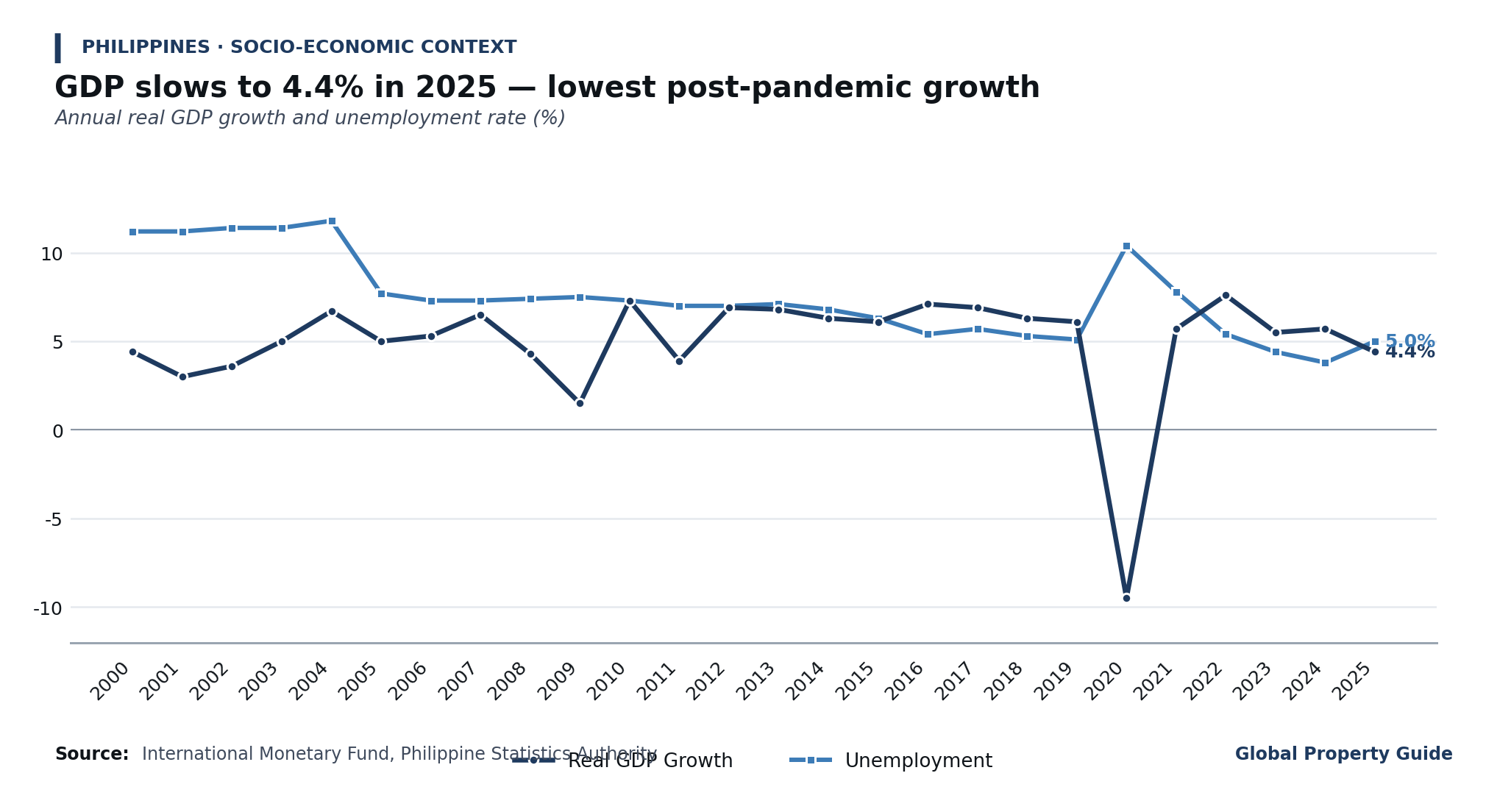
For full-year 2025, the economy expanded by 4.4%, the slowest post-pandemic growth rate. This came in well below the government's 5.5% to 6.5% target band and below the 5.7% recorded in 2024.
In Q1 2026:
- Household consumption growth eased to 3.0% from 3.8% in Q4 2025.
- Fixed investment continued to contract by 2.7% y-o-y, though less sharply than the 6.4% contraction in Q4 2025.
- Government spending accelerated to 4.8%, up from 0.7% in Q4 2025.
- Net trade contributed positively, with exports rising 7.8% and imports increasing at a slower 6.1% pace.
- On the production side, agriculture, forestry, and fishing (-0.2%) and industry (-0.1%) contracted, while services growth slowed to 4.5% from 4.9% in Q4 2025.
"This marked the softest growth since the contraction in Q1 2021, as the Middle East war-driven oil shock compounded pressures from a major infrastructure graft scandal, pushing the Philippine economy into one of its weakest stretches in 16 years outside the pandemic period," noted Trading Economics in its analysis of the PSA release.
The government's 5% to 6% growth target for 2026 now looks increasingly out of reach. The Asian Development Bank projected Philippine GDP growth of 4.4% for 2026, while private firms' analysis initially expected the economy to expand by about 5.2% this year, though these projections were made before the global oil shock that followed the escalation of the Middle East conflict.
"Growth decelerated in the Philippines, weighed by domestic shocks. Growth in the first three quarters (Q1-Q3) of 2025 averaged 5 percent, 0.9 percentage points lower than Q1-Q3 2024," said the World Bank in its Philippines Economic Update December 2025 Edition. "Private consumption growth was robust in Q1-Q2 but decelerated in the face of typhoons and flooding in Q3. Private and public investment weakened as construction was disrupted by severe weather events, the public works ban preceding mid-term elections, and stronger oversight of infrastructure projects in Q3 amid controversy over governance risks."
In its December 2025 Article IV consultation, the IMF noted that "the balance of risks to the growth outlook is tilted to the downside amid uncertainty from global trade policies, corruption allegations related to flood control projects, and extreme climate events." Those downside risks have now largely materialised.
In 2024, the country's budget deficit narrowed slightly to PHP1.506 trillion (US$25.6 billion). As a percent of GDP, the deficit fell to about 5.7% in 2024, down from 6.1% in 2023. The IMF expects the Philippines' shortfall to remain elevated at around 5.4% of GDP in 2025 and 5.2% of GDP in 2026.
The country's national debt ballooned to PHP16.05 trillion (US$273 billion) at end-2024, up by 9.8% from the preceding year, according to the Bureau of Treasury. As a percentage of GDP, government debt stood at 60.7% in 2024, far higher than the pre-pandemic level of below 40%. The national government's gross debt is projected to increase to about 62.2% of GDP this year and continue rising in 2026, based on IMF projections.
Labor market deteriorating
The labor market has weakened considerably through late 2025 and into early 2026. In March 2026, the nationwide unemployment rate eased slightly to 5.0% from 5.1% in February, but remained well above the 3.9% recorded in March 2025, based on figures from the PSA. The year-to-date unemployment rate clocked in at 5.3%, exceeding the government's ceiling of 4% to 5% for 2026 to 2028.
The underemployment rate rose to 12.3% in March 2026 from 11.8% in February, with 6.03 million Filipinos reporting they wanted additional hours of work or another job. The manufacturing sector shed 149,000 jobs in March amid losses in semiconductors and other electronic components.
Overall unemployment averaged 6.3% from 2010 to 2019, before spiking to 10.4% in 2020 amid the pandemic. The jobless rate fell to 7.8% in 2021, 5.4% in 2022, 4.4% in 2023, and a then-record low of 3.8% in 2024, before edging back up in 2025 and 2026.
Tourism modestly recovering but missing targets
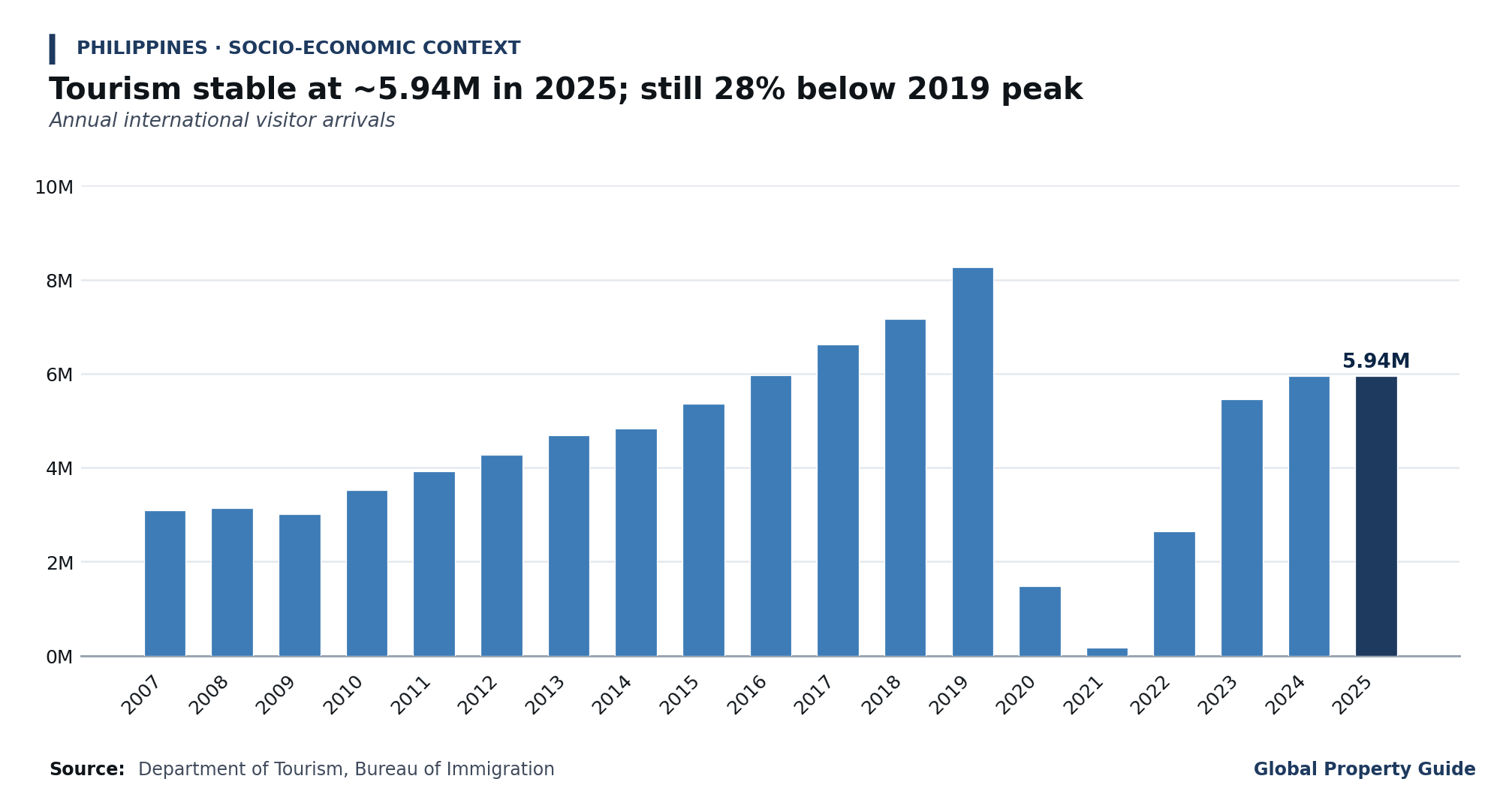
One of the drivers of the country's economy is tourism. During 2025, the total number of international visitor arrivals reached approximately 5.94 million (per Bureau of Immigration), with an additional 543,085 returning Overseas Filipinos, bringing total foreign arrivals to 6.48 million. This represented just a 0.76% increase from 2024's 5.93 million and remained far below the Department of Tourism's target of 8.4 million for the year.
Inbound visitor spending reached an estimated PHP694 billion (US$11.8 billion) in 2025, with the tourism sector contributing nearly 9% to GDP. The Philippines topped other ASEAN members in tourism revenue per arrival at approximately US$1,631 per visitor.
"The foundations of Philippine tourism are firm, and the demand for it is real. Therefore, the opportunity to invest is open. We invite you to partner with us in seeing the Philippines through to its rise to its rightful place as a tourist powerhouse," said DOT Secretary Christina Garcia Frasco.
The recovery has continued in early 2026. In Q1 2026, total foreign visitor arrivals reached 1.76 million, up 2.64% year-on-year, according to the DOT. The United States overtook South Korea as the country's top source market, with US arrivals up 5.9% to 393,137. South Korea slipped to second place at 385,569 arrivals (-10.2% YoY), while Chinese arrivals continued to decline sharply, falling 19.8% to just 46,553.
The DOT has set a more measured target of 6.7 million international arrivals for 2026, down from the 8.4 million target for 2025. The Philippines is also hosting the ASEAN Tourism Forum in Cebu from January 26-29, 2026, alongside the meeting of ASEAN tourism ministers.
Sources:
- Residential Property Price Index Q4 2025 Report (Bangko Sentral ng Pilipinas): https://www.bsp.gov.ph/Media_And_Research/RPPI/RPPI-Report-2025-Q4.pdf
- Philippines property price growth slows in Q4 (Philippine Star): https://www.philstar.com/business/2026/03/28/2517270/philippines-property-price-growth-slows-q4
- BSP records slower increase in real property prices in Q1 2025 (Philippine News Agency): https://www.pna.gov.ph/articles/1253064
- Property Market Report – Residential Q1 2026 (Colliers Philippines): https://www.colliers.com/en-ph/research/property-market-report-residential-q1-2026-philippines
- Property Market Report – Residential Q4 2025 (Colliers Philippines): https://www.colliers.com/en-ph/research/colliers-property-market-report-residential-q4-2025-philippines
- Metro Manila residential market shows early recovery in Q1, Colliers (Manila Bulletin): https://mb.com.ph/2026/05/18/metro-manila-residential-market-shows-early-recovery-in-q1colliers
- Philippine residential condo market faces challenges amid Middle East crisis, inflation concerns (Manila Times): https://www.manilatimes.net/2026/05/26/business/real-estate-and-property/philippine-residential-condo-market-faces-challenges-amid-middle-east-crisis-inflation-concerns/2350978
- OFW remittances soar to an all-time high of $35.63 billion in 2025 (BusinessWorld): https://www.bworldonline.com/top-stories/2026/02/16/730762/ofw-remittances-soar-to-all-time-high-35-63-billion-in-2025/
- OFW remittances hit record $35.6B (BusinessWorld): https://www.bworldonline.com/top-stories/2026/02/17/730931/ofw-remittances-hit-record-35-6b/
- OFW remittances reach record-high level in Dec 2025 (Philippine News Agency): https://www.pna.gov.ph/articles/1269149
- Commission on Filipino Overseas: https://cfo.gov.ph/
- Habitat for Humanity Philippines: https://www.habitat.org/where-we-build/philippines
- Department of Human Settlements and Urban Development (4PH): https://dhsud.gov.ph/
- Gross rental yields in the Philippines: Manila and Cebu (Global Property Guide): https://www.globalpropertyguide.com/asia/philippines/rental-yields
- BSP hikes policy rate to 4.5% as Middle East crisis deteriorates inflation outlook (Rappler): https://www.rappler.com/business/bangko-sentral-pilipinas-monetary-policy-interest-rates-april-2026/
- BSP raises rates, signals more hikes (BusinessWorld): https://www.bworldonline.com/top-stories/2026/04/24/745239/bsp-raises-rates-signals-more-hikes/
- BSP seen to hike policy rate to 6% (Philippine Daily Inquirer): https://business.inquirer.net/587698/bsp-seen-to-hike-policy-rate-to-6
- Consumer Price Index and Inflation Rate (Philippine Statistics Authority): https://psa.gov.ph/price-indices/cpi-ir
- Summary Inflation Report Consumer Price Index April 2026 (PSA): https://psa.gov.ph/content/summary-inflation-report-consumer-price-index-2018100-april-2026
- Philippines Inflation Rate (Trading Economics): https://tradingeconomics.com/philippines/inflation-cpi
- BSP warns of wider BOP deficit in 2026 (Philippine Star): https://www.philstar.com/business/2025/12/28/2497104/bsp-warns-wider-bop-deficit-2026
- GDP Grows by 2.8 Percent in the First Quarter of 2026 (PSA): https://psa.gov.ph/content/gdp-grows-28-percent-first-quarter-2026
- Philippine GDP growth slows to 2.8% in Q1 2026 (Philippine Daily Inquirer): https://business.inquirer.net/589015/philippine-gdp-growth-slows-to-2-8-in-first-quarter
- PH Economy Grew at 4.4% in 2025 (Makati Business Club): https://mbc.com.ph/2026/01/29/economy-insights-gdp-report-q4-2025-yoy/
- Philippines GDP Annual Growth Rate (Trading Economics): https://tradingeconomics.com/philippines/gdp-growth-annual
- IMF Executive Board Concludes 2025 Article IV Consultation with the Philippines: https://www.imf.org/en/news/articles/2025/12/12/pr-25418-philippines-imf-executive-board-concludes-2025-article-iv-consultation
- Philippines Economic Updates (World Bank): https://www.worldbank.org/en/country/philippines/publication/philippine-economic-updates
- Unemployment Rate Eased to 5.0 Percent in March 2026 (PSA): https://psa.gov.ph/content/unemployment-rate-eased-50-percent-march-2026
- Jobless Pinoys decline to 2.58M in March 2026 (GMA News): https://www.gmanetwork.com/news/money/economy/986581/jobless-pinoys-decline-to-2-58m-in-march-2026/story/
- Unemployment eases to 5%, but underemployment rises to 12.3% in March 2026 (Rappler): https://www.rappler.com/business/unemployment-rate-philippines-march-2026/
- Tourism offers high investment returns amid growing demand (PIA): https://pia.gov.ph/news/tourism-offers-high-investment-returns-amid-growing-demand-dot-chief/
- Foreign visitor arrivals to the Philippines up 2.6% in Q1 2026 (IAG): https://asgam.com/2026/04/14/foreign-visitor-arrivals-to-the-philippines-up-2-6-in-1q26-despite-ongoing-decline-in-visitation-from-south-korea-and-china/
- Tourism misses target, but Philippines plays the long game (Travel Weekly Asia): https://www.travelweekly-asia.com/Destination-Travel/Tourism-misses-target-but-Philippines-plays-the-long-game