Kazakhstan's Residential Property Market Analysis 2026
After a period of strong price growth across all segments, which outpaced consumer inflation last year, the housing market in Kazakhstan is expected to start cooling, with price resilience concentrated in larger urban markets and higher-quality properties.
This extended overview from Global Property Guide covers key aspects of Kazakhstan’s housing market and takes a closer look at its most recent developments and long-term trends.
Table of Contents
- Property Prices and Price Index
- Historic Perspective
- Property Demand Trends
- Property Supply Trends
- Rental Market: Rents and Rental Yields
- Mortgage Market and Interest Rates
- Economic and Social Factors
Property Prices and Price Index
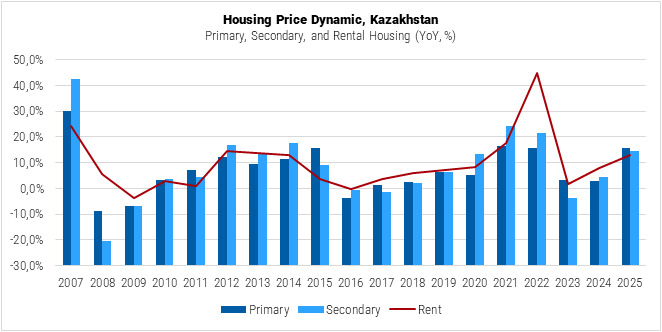
In 2025, Kazakhstan’s housing market entered a substantially stronger price-growth phase with momentum broadening across segments and increasingly outpacing consumer inflation. According to the Bureau of National Statistics of Kazakhstan (BNS), in December 2025, the Nationwide Primary House Price Index recorded a year-on-year growth of 15.74% (3.06% when adjusted for inflation). Similarly, the Secondary House Price Index rose by 14.56% year-on-year (2.01% increase inflation-adjusted).
In terms of drivers, the 2025 price acceleration was largely policy- and cost-anchored rather than speculative. Halyk Financeattributes the upswing to a mix of policy and cost-side factors, noting that the growth was “driven by changes in market regulation, the expected VAT increase <…> and rising inflation.” A key structural shift was tighter supervision of the development pipeline (notably, stricter shared-construction rules), which likely pushed up compliance costs and reduced “informal” supply, supporting pricing power in new build stock. VAT expectations also influenced late-2025 market sentiment, encouraging some demand to be brought forward; however, given transitional arrangements for projects already underway, the real pricing impact is likely to be gradual rather than immediate.
Kazakhstan's house price annual change:
In nominal terms, the BNS reported that the average price per square meter in the primary housing segment reached KZT 571,220 (USD 1,117) nationwide in December 2025. In the secondary segment, prices averaged KZT 594,701 (USD 1,163). Regionally, momentum remained uneven, reinforcing a two-speed market where major urban centers continue to lead. Among major cities, Almaty registered the highest average sales prices, with secondary properties priced at KZT 738,300 (USD 1,444) per square meter and primary properties at KZT 690,668 (USD 1,350) per square meter. The capital city, Astana, followed closely in terms of pricing dynamics.
Average house prices per square meter in the five largest cities:
| Primary Sales, KZT/sqm |
Primary Sales, USD/sqm |
YoY, % | Secondary Sales, KZT/sqm |
Secondary Sales, USD/sqm |
YoY, % | |
| Astana | KZT 671,200 | USD 1,312 | 12.72% | KZT 720,425 | USD 1,409 | 10.88% |
| Almaty | KZT 690,668 | USD 1,350 | 18.57% | KZT 738,300 | USD 1,444 | 25.43% |
| Shymkent | KZT 527,967 | USD 1,032 | 18.89% | KZT 466,879 | USD 913 | 10.86% |
| Aktobe | KZT 327,514 | USD 640 | 14.49% | KZT 363,052 | USD 710 | 18.25% |
| Karaganda | KZT 375,908 | USD 735 | 1.85% | KZT 394,930 | USD 772 | 2.41% |
| Kazakhstan | KZT 571,220 | USD 1,117 | 14.20% | KZT 594,701 | USD 1,163 | 15.21% |
| Note: Exchange rate as of December 2025, USD 1 = KZT 511.46. | ||||||
| Data Source: BNS. | ||||||
Looking ahead, forecasts point to slower, but still positive, growth, as the market shifts from broad-based acceleration toward more selective, affordability-driven dynamics. Halyk Finance expects the market to remain “in a growth zone,” but with “more moderate momentum,” as demand cools due to stricter mortgage conditions, higher ENPF sufficiency thresholds (i.e., higher minimum pension balances required before households can withdraw savings for housing purposes), and further regulatory tightening. In this environment, price resilience is expected to concentrate in the most liquid urban markets and higher-quality projects, while weaker locations and less competitive secondary stock may face greater bargaining pressure.
A similar baseline is echoed by market practitioners: Krisha.kz expects 2026 price growth of around 8-10% on average, with stronger performance in Astana and Almaty and a more selective buyer profile, implying continued nominal growth but with a clearer differentiation across cities and product segments.
Historic Perspective:
The Interplay Between Economic Forces and Government Policies
Kazakhstan’s housing market has moved through several distinct cycles over the past two decades, shaped primarily by shifts in liquidity, affordability, and policy support. In the mid-2000s, the sector experienced a clear boom as rapid economic expansion, abundant bank funding, and easy credit conditions drove a surge in housing demand. With supply unable to adjust quickly in the largest cities, both sales prices and rents rose steeply, reflecting a classic credit-led upswing.
That momentum broke during the 2008–2009 global financial crisis. External funding conditions tightened, domestic lending contracted, and transaction activity weakened, leading to a broad market correction. The rental segment softened as well once the downturn fed through to household confidence and purchasing power.
The early 2010s brought a recovery supported by stronger macro conditions, improving incomes, and ongoing urbanization, restoring demand and gradually rebuilding price momentum. However, the post-2014 oil shock and currency depreciation tightened affordability and introduced a more volatile inflation backdrop, pushing the market into a slower and more cautious phase. Growth became more uneven, with activity concentrating in the most liquid urban centers, while weaker regions relied more on gradual, phased expansion.
From the late 2010s onward, government-backed mortgage initiatives helped stabilize demand and support a more sustained market trajectory. Even the pandemic shock did not fully reverse the cycle: while transactions temporarily slowed, supply-side constraints and rising replacement costs continued to underpin prices.
The strongest re-acceleration came in 2021–2022, when policy-driven demand stimulus materially increased purchasing capacity, most notably through the ability to use pension savings for housing purchases. At the same time, the rental market experienced an extraordinary and rapid repricing in 2022, triggered by the war in Ukraine and the related inflow of migrants from Russia, which sharply tightened rental availability in the most affected cities.
After this surge, the market moved into a more mature phase in 2023–2024. Demand became more sensitive to affordability and financing constraints, and price growth moderated, particularly in the resale segment, while rents normalized but stayed relatively firm as some households postponed buying decisions. In 2025, momentum strengthened again across both sales and rentals, but the drivers were largely structural rather than speculative. Inflation and higher replacement costs raised the pricing baseline, regulatory tightening increased compliance burdens and reinforced cost pass-through, especially in the primary market, and demand remained supported by housing-related withdrawals from the Unified Accumulative Pension Fund (ENPF). Expectations around upcoming tax changes also influenced timing, contributing to stronger late-year activity and a renewed, inflation-led upswing.
Data Source: BNS.
Property Demand Trends
Activity Held Up Through 2025, Momentum is Expected to Cool as Policy and Credit Tighten
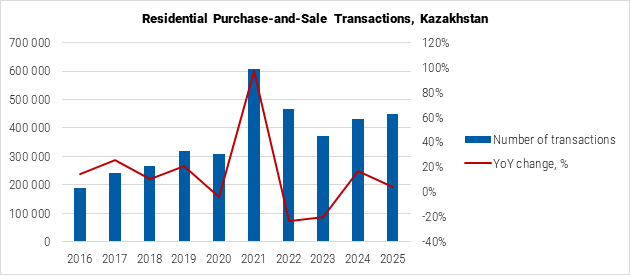
Transactional momentum in 2025 remained strong, even as the cycle moved into a more mature pricing phase and buyer behavior became more selective. According to the BNS, residential purchase-and-sale transactions increased by 3.6% year-on-year over January to December 2025, indicating that demand remained resilient, though without the rapid, broad-based expansion seen in 2024.
Data Source: BNS.
Performance across regions was mixed: the strongest growth was recorded in Astana (+21.6%), Zhambyl Region (+10.1%), and Zhetysu Region (+10.1%), while the sharpest declines were observed in Atyrau Region (-13.2%), Ulytau Region (-12.5%), and West Kazakhstan Region (-12.3%). Throughout the year, Almaty and Astana continued to account for the largest share of residential demand, underscoring the ongoing concentration of market liquidity in the country’s two principal urban centers.
Number of residential sales transactions by region:
| Region | No. of Transactions | YoY (%) | Region | No. of Transactions | YoY (%) | |
| Abay | 10,542 | 1.9% | Kyzylorda | 7,359 | -7.6% | |
| Akmola (excl. Astana) | 16,701 | 2.5% | Mangystau | 20,564 | -4.8% | |
| Aktobe | 16,724 | -11.0% | Pavlodar | 12,673 | -3.0% | |
| Almaty (excl. Almaty city) | 24,760 | 7.2% | North Kazakhstan | 8,344 | -8.7% | |
| Atyrau | 11,797 | -13.2% | Turkistan (excl. Shymkent) | 12,260 | -11.6% | |
| West Kazakhstan | 14,214 | -12.3% | Ulytau | 4,078 | -12.5% | |
| Zhambyl | 13,748 | 10.1% | East Kazakhstan | 13,449 | 2.1% | |
| Zhetisu | 10,458 | 10.1% | Astana city | 93,548 | 21.6% | |
| Karaganda | 33,017 | -2.1% | Almaty city | 87,592 | 4.6% | |
| Kostanay | 15,716 | 2.0% | Shymkent city | 21,027 | 8.3% | |
| Data Source: BNS. | ||||||
Looking ahead to 2026, local market commentary increasingly points to a cooler, more selective demand environment, with transaction volumes expected to ease from the 2025 level as several temporary demand accelerators fade. Halyk Finance expects the market to move into a more moderate growth phase, while warning that a decline in the number of transactions could lead to slower price growth. A key channel is the weakening of liquidity-driven demand: from January 1, 2026, a higher minimum sufficiency threshold is expected to restrict pension-fund withdrawals, reducing one of the most important sources of down payments and cash-backed purchasing power that supported activity in 2025.
Mortgage affordability is also seen to remain the main constraint on demand in 2026, especially for secondary-market purchases and more discretionary, investment-led transactions. Lyazzat Ibragimova, Head of Otbasy Bank, has described the market as broadly calm, but emphasized that mortgages are expensive and that most deals are now concluded with meaningful negotiation and discounts, with signs of stagnation most evident in the secondary segment. This suggests that while transactions will continue, the market is likely to shift toward longer decision cycles, stronger price discipline, and a clear preference for more liquid product types, such as smaller units, better locations, and newer stock, while older and less competitive properties face greater pressure.
At the same time, demand is expected to become increasingly reliant on state-backed and savings-based financing mechanisms, reinforcing the central role of preferential programs in sustaining market activity. Eldar Shamsutdinov, an economist at property portal Krisha.kz, notes that the market is likely to continue cooling, while projects supported by preferential and savings-based mortgages should remain comparatively resilient, with Otbasy Bank retaining a key role in the financing landscape.
Property Supply Trends
High Commissioning Volumes Persist, Reflecting a Continued Catch-Up Cycle
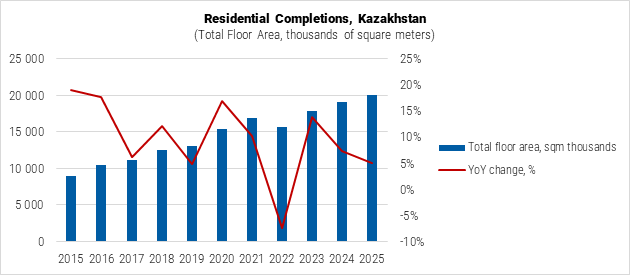
In 2025, residential construction in Kazakhstan remained strong and continued to act as a key driver of the broader construction sector. According to the BNS, total housing commissioned reached 20.1 million square meters, representing a 5.1% year-on-year increase. This performance confirms both sustained developer activity and the market’s ongoing capacity to absorb sizeable volumes of new supply.
Supply delivery remained highly concentrated in the country’s two largest urban markets. Nearly 37% of newly commissioned housing area was accounted for by Astana (23.9%) and Almaty (13.0%), underscoring the continued dominance of these cities within the national development pipeline and the broader direction of investment flows. Among other regional centers, Shymkent stood out with over 1.38 million square meters commissioned (6.9%), reinforcing its position as one of the most active growth markets outside the two main hubs.
Data Source: BNS.
Residential completions by region:
| Region | Residential completions, sqm ‘000 |
YoY (%) | Region | Residential completions, sqm ‘000 |
YoY (%) | |
| Abay | 338 | 5.80% | Kyzylorda | 939 | 8.40% | |
| Akmola (excl. Astana) | 694 | 3.70% | Mangystau | 859 | 3.20% | |
| Aktobe | 1,021 | 5.90% | Pavlodar | 578 | 2.40% | |
| Almaty (excl. Almaty city) | 1,069 | 10.20% | North Kazakhstan | 338 | 2.40% | |
| Atyrau | 769 | 1.30% | Turkistan (excl. Shymkent) | 1,236 | 6.60% | |
| West Kazakhstan | 642 | 0.80% | Ulytau | 110 | 1.40% | |
| Zhambyl | 769 | 1.30% | East Kazakhstan | 407 | 1.40% | |
| Zhetisu | 413 | 11.00% | Astana city | 4,813 | 8.50% | |
| Karaganda | 597 | 9.00% | Almaty city | 2,608 | 2.00% | |
| Kostanay | 517 | 3.90% | Shymkent city | 1,382 | 0.60% | |
| Data Source: BNS. | ||||||
Nevertheless, even record commissioning volumes have not eliminated Kazakhstan’s underlying structural supply gap. The market continues to evolve in a “catch-up” cycle, shaped by persistent demand concentration in major cities and economically active regions. Industry experts note that “record housing commissioning does not close the deficit,” and that per-capita housing provision remains below policy benchmarks. In practice, this suggests the current construction wave is better interpreted as a response to accumulated unmet needs, particularly in high-mobility urban markets, rather than a sign of systemic oversupply.
The 2026 outlook for residential construction increasingly points to a transition toward a more regulated and disciplined cycle, with higher compliance thresholds influencing both project economics and the pace of new starts. Industry participants expect developers to face multiple regulatory shifts at once. Timur Nurtaev, a branch director at the Union of Builders of Kazakhstan, notes that the sector in 2026 will be influenced by the “Shared Construction Law,” amendments to the Tax Code (effective from January 1, 2026), and the Construction Code (expected from July 2026). In parallel, the government is strengthening oversight and market transparency through the launch of the Unified Construction Portal from January 1, 2026, enabling buyers to verify developers and project documentation before purchasing. Together, these measures are likely to raise compliance costs and tighten operational requirements, creating near-term friction and potentially accelerating consolidation by pushing smaller players out, while supporting stronger long-run quality standards and consumer protection.
Against this backdrop, and with demand expected to soften, the baseline supply scenario for 2026 is best described as continued construction activity, but with more selective and risk-aware development decisions. Market commentary suggests project strategies will shift further toward solvent end-user demand through mass-market positioning, smaller and more affordable unit sizes, and greater reliance on phased delivery. At the same time, a portion of new project launches may be deferred as developers recalibrate underwriting assumptions amid tighter regulatory requirements and more constrained financing conditions.
Rental Market: Rents and Rental Yields
Growth in Rents Outpaces Overall Inflation, Moderation Anticipated in 2026
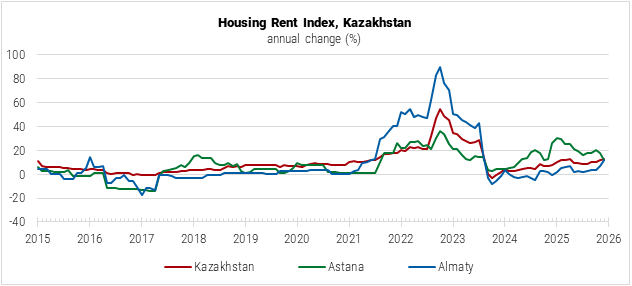
Contrary to some experts’ earlier projections of moderate growth, rental inflation in Kazakhstan remained high throughout 2025, exhibiting an accelerating trend in recent months and even outpacing the overall price growth in the country by year’s end.
Kazakhstan's rent price index:
In December 2025, the nationwide rent index published by the BNS registered a 13.1% annual increase, up from 8.2% in July and 7.9% a year prior. This dynamic appears to be primarily driven by regional centers such as Aktobe, Petropavlovsk, and Pavlodar, where the annual growth in rents exceeded 30%, while in the largest city of Almaty and the capital city of Astana, it was less pronounced, reaching 11.6% and 11.9%, respectively. The overall consumer price index (CPI) inflation during the same period was reported at 12.3%.
Commenting on the state of the market in an interview with DigitalBusiness, Yermek Musrepov, President of the Kazakhstan Federation of Real Estate, named structural supply shortage, declining affordability of mortgage, and overall inflation pushing up operational costs for landlords as key drivers behind growing rental rates nationwide. Locally, in regional centers like Pavlodar and Aktobe, the surge was supported by a lower base effect and fueled by ongoing industrial projects with an influx of temporary and rotational workers, which increased demand.
Data Source: BNS.
In nominal terms, the property platform Krisha.kz reported the following median advertised apartment rents in the largest Kazakhstani cities in January 2026:
- 1-room apartments: KZT 220,000 (USD 431) in Almaty, KZT 200,000 (USD 391) in Astana, KZT 150,000 (USD 293) in Shymkent, and KZT 145,000 (USD 284) in Karaganda, and KZT 140,000 (USD 274) in Aktobe;
- 2-room apartments: KZT 320,000 (USD 626) in Almaty, KZT 280,000 (USD 547) in Astana, KZT 200,000 (USD 391) in Shymkent, KZT 180,000 (USD 352) in Karaganda, and KZT 160,000 (USD 313) in Aktobe;
- 3-room apartments: KZT 450,000 (USD 880) in Almaty, KZT 400,000 (USD 782) in Astana, KZT 240,000 (USD 469) in Shymkent, KZT 230,000 (USD 450) in Karaganda, and KZT 200,000 (USD 391) in Aktobe.
According to the BNS reporting, the average rent per square meter reached KZT 5,024 (USD 9.82) nationwide in December 2025. Among major cities, the highest average rent per sqm was reported in Almaty at KZT 5,965 (USD 11.66) and the lowest in Aktobe at KZT 3,234 (USD 6.32). In smaller regional centers, the indicator stood between KZT 2,400 and KZT 4,500 (USD 4.69-8.80).
Very Good Rental Yields
Research carried out by Global Property Guide in January 2026 found gross rental yields for residential units in Kazakhstan at the average level of 10.50%, with the strongest potential performance among the surveyed submarkets demonstrated by Karaganda (11.42%), while Astana and Almaty demonstrated somewhat lower yields at 10.75% and 8.99%, respectively.
Average rent per square meter in the five largest cities:
| December 2025, KZT per sqm |
December 2025, USD per sqm |
YoY, Dec 2025 vs Dec 2024 |
|
| Almaty | KZT 5,965 | USD 11.66 | 11.6% |
| Astana | KZT 5,551 | USD 10.85 | 11.9% |
| Shymkent | KZT 4,252 | USD 8.31 | 12.9% |
| Aktobe | KZT 3,234 | USD 6.32 | 30.4% |
| Karaganda | KZT 4,638 | USD 9.07 | 9.5% |
| Kazakhstan | KZT5,024 | USD9.82 | 10.1% |
| Data Source: Exchange rate as of December 2025, USD 1 = KZT 511.46. | |||
| Data Source: BNS. | |||
Looking ahead, after strong gains last year, Halyk Research expects the real estate market in Kazakhstan, including the rental sector, to “remain in the growth zone, but demonstrating more moderate dynamics” in 2026.
Yermek Musrepov from the Kazakhstan Federation of Real Estate generally agrees with this assessment.“In the absence of large-scale incentive programs and with inflation slowing, the market will enter a stabilization phase. Growth is possible, but it will be uneven and dependent on the quality of the property,” he told DigitalBusiness.
Mortgage Market and Interest Rates
Growth in Lending Activity Sustained by Subsidized Programs
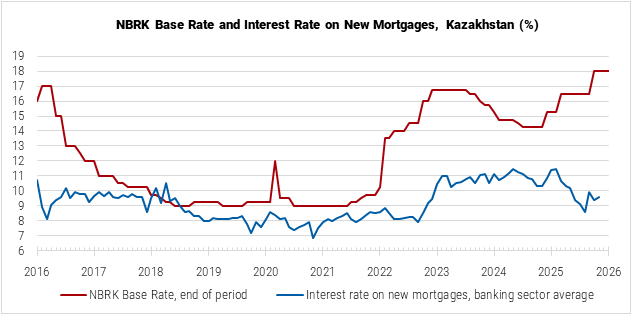
Responding to persistent inflationary pressures, the National Bank of the Republic of Kazakhstan (NBRK) pursued a tight monetary policy last year, raising its base rate by a cumulative 375 bps between December 2024 and October 2025 to a decade-high of 18.00%. At the latest policy meeting in January 2026, the regulator decided to maintain the rate at its current level, indicating that the stance will likely be held over the next six months.
Kazakhstan's mortgage loan interest rates:
“The dynamics of inflation and the balance of risks are in line with the National Bank’s forecasts and assessments. At the same time, external challenges, uncertainty regarding the scale of the impact of changes to the tax system, and the parameters of the resumption of growth in utility tariffs and fuel prices from the second quarter of this year warrant a balanced and cautious approach to setting the base rate. Accordingly, the base rate is highly likely to be maintained at its current level until the end of the first half of 2026,” said the NBRK press release on the matter.
At the same time, the maximum effective annual rate for mortgage loans in Kazakhstan’s commercial banks has been capped at 25% since August 2024 (with the planned lowering of the ceiling to 20% recently postponed until July 2026), limiting the banks’ potential margins against the background of heightened risks. As a result, mortgage products for secondary properties are losing their appeal to lenders, many reportedly halting credit issuance after the most recent base rate hike, revising their terms, or reorienting towards government-backed subsidized programs for the primary market.
“The main focus is now shifting toward new builds and preferential programs through Otbasy Bank [state-owned bank focused on housing finance], which could actually become the main player in the mortgage market,” property website kn.kz wrote in October 2025.
Data Source: NBRK.
In this environment, the average nominal interest rates on new mortgage loans (including preferential programs) reported by the NBRK generally trended downwards throughout the year, as the share of subsidized credit in new disbursements continued to grow. In November 2025, the average interest rate on new loans of all term lengths stood at 9.6%, down from 10.4% in November 2024 and 11.1% in November 2023.
Interest rates on new mortgages in the banking sector:
| November 2025 | YoY | November 2024 | YoY | November 2023 | |
| New mortgages: all terms | 9.6% | ↓ | 10.4% | ↓ | 11.1% |
| New mortgages: short-term | 4.5% | ↓ | 11.3% | ↑ | 9.0% |
| New mortgages: long-term | 9.6% | ↓ | 10.4% | ↓ | 11.1% |
| Data Source: NBRK. | |||||
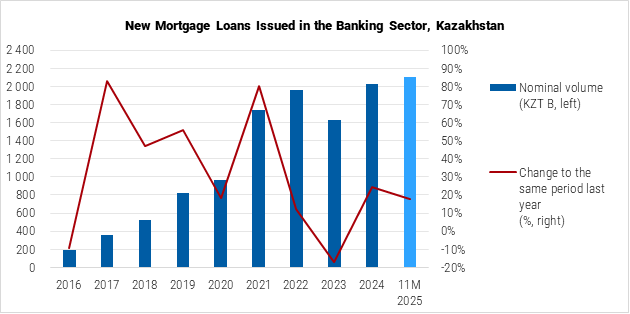
Supported by state-backed preferential programs, which represented 67% of all disbursements in the nine months of 2025 (up from 61% during the same period the previous year), new lending volumes in Kazakhstan continued to grow. Based on the data reported by the NBRK, between January and November 2025, the Kazakhstani banks issued KZT 2.1 trillion (USD 4.03 billion) in new mortgages, which was 18.0% above the comparable period in 2024.
“The easing of pricing conditions through the prevalence of preferential programs could be a key factor supporting demand despite the overall tightening of financial conditions in the system. <…> Thus, the sector's development is becoming increasingly dependent on government policy, and the role of the commercial segment is shrinking,” the Association of Financiers of Kazakhstan commented on the developments in their recent market overview.
The association’s report also points out the impact this shift in the market has on the overall use of bank financing in Kazakhstan, the share of mortgage transactions in total purchases sharply falling to 62% from 91% a year earlier.
Data Source: NBRK.
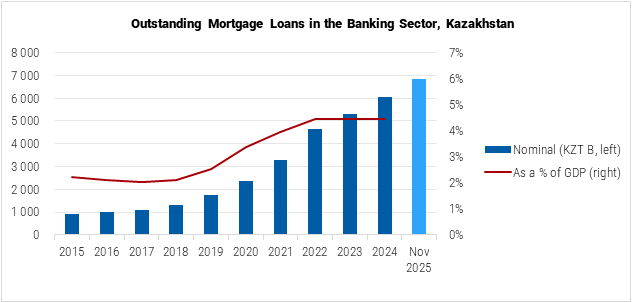
In general, in the last five years, the mortgage market in Kazakhstan more than tripled. As of November 2025, the total value of outstanding mortgage loans in the banking sector reported by the NBRK reached KZT 6.84 trillion (USD 13.1 billion), a 12.9% increase since the end of the previous year. In addition, KZT 260.3 billion (USD 497.9 million) of housing loans were maintained by non-bank mortgage institutions. In relative terms, however, the market remains limited. Sized against the national economy, it amounted to an estimated 4.4% of the GDP at current prices in 2024.
Data Sources: NBRK, BNS.
Economic and Social Factors
Signs of Economic Overheating and Accelerating Inflation
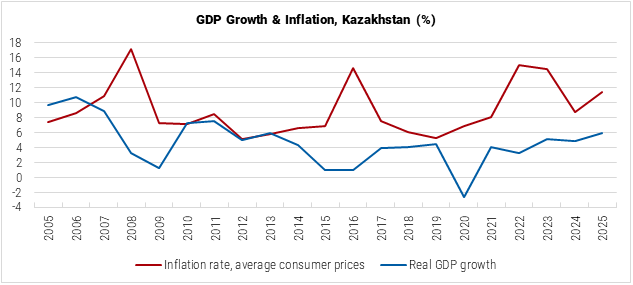
Boosted by rising oil output and robust activity in non-oil sectors, Kazakhstan’s economy continues to expand at a rapid pace, with the real GDP growth accelerating from 4.8% in 2024 to an estimated 5.9% in 2025. The 2025 Article IV staff report from the International Monetary Fund (IMF) points out that the “economy is showing clear signs of overheating” now and that the outlook “faces elevated risks from persistent inflation, an uncertain external environment, and weaker oil prices”. Over the next two years, growth is projected to begin moderating to more sustainable levels, reaching 4.8% in 2026 and 4.2% in 2027.
Strong domestic demand, underpinned by an expansionary public sector stance, alongside imported price pressures, led to a sharp acceleration in consumer price index (CPI) inflation in the country, which rose from the average annual level of 8.7% in 2024 to 11.4% in 2025 and was most recently reported by the BNS at 12.3% in December 2025. In the upcoming periods, the IMF expects inflation to slow only slightly, remaining well above target at 11.2% in 2026 and 10.5% in 2027. The macroeconomic survey conducted by the NBRK in January 2026, however, shows more optimistic inflationary expectations among experts, estimating the CPI to increase by 10.8% by the end of the current year and by 6.8% by the end of 2027.
Data Source: IMF.
In this environment, the labor market in the country remains tight, with the unemployment rate decreasing from 4.9% in 2022 to 4.7% in 2024 and further to 4.6% as of Q3 2025, according to the BNS reporting. The nominal wage growth reached 10.0% year-on-year in Q3 2025, while in real terms, wages declined by 2.0% over the same period due to high inflation.
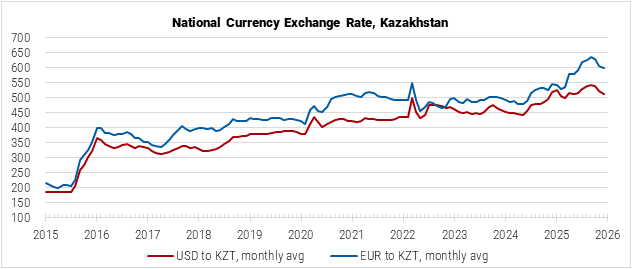
The national currency exchange rate continued to demonstrate volatility and overall depreciation of the tenge (KZT), the average exchange rate reaching KZT 521.59 per USD 1 and KZT 590.15 per EUR 1 in 2025. The latest macroeconomic assessment and forecast from Halyk Research anticipates further weakening of the national currency. “In 2026, a further weakening of the national currency to 600-610 tenge per dollar is expected <…>. The key factors will be lower global oil prices, reduced export revenues, and a decline in foreign exchange sales from the National Fund, which will exacerbate the imbalance between supply and demand in the domestic foreign exchange market,” said the report.
Data Source: NBRK.
Overall, Kazakhstan’s economic outlook is strong, although the economy continues to face persistently elevated inflation, as well as internal and external uncertainties. The country’s high dependence on oil, which accounts for more than half of its exports, presents considerable risks. As outlined in the IMF assessment, despite initiatives to diversify the economy and encourage private participation in productivity-driven sectors, the role of the state in Kazakhstan’s economy remains significant. State interventions and external restrictions remain substantial, constraining competition and private sector development.
“External risks include a growth slowdown or renewed inflation pressures in major trading partners, trade fragmentation and global policy uncertainty, lower oil prices, and disruptions to oil exports through the Caspian Pipeline Consortium (CPC) pipeline,” summarized the IMF staff report. “Domestic risks relate to revenue underperformance from widespread exemptions, potential delays in implementing infrastructure projects, continued liquidity injections into the economy via large transfers from the oil fund, which could further de-anchor inflation expectations, and higher-than-expected inflation that could undermine monetary policy credibility and prompt additional monetary policy tightening.”
At the same time, S&P revised its outlook for Kazakhstan from stable to positive in August 2025 (while maintaining the ‘BBB-’ rating), noting favorable progress in measures to liberalize and diversify the country's economy, enhance the efficiency of public administration, and reduce the budget deficit. Fitch Ratings affirmed Kazakhstan’s ‘BBB’ standing with a stable outlook earlier in 2025.
Sources:
- Bureau of National Statistics (BNS)
- Statistics of National Accounts: https://stat.gov.kz/
- Statistics of Prices: https://stat.gov.kz/
- The Number of Residential Purchase-Sales Transactions Increased… Press release (RU): https://stat.gov.kz/
- Construction Statistics: https://stat.gov.kz/
- Employment and Unemployment: https://stat.gov.kz/
- Wages and Working Conditions: https://stat.gov.kz/
- National Bank of the Republic of Kazakhstan (NBRK)
- Base Rate 2015-2026: https://nationalbank.kz/
- Press-release: On Maintaining the Base Rate at 18.0%: https://nationalbank.kz/
- Loans from Banking Sector to Economy (Analytical Presentation): https://nationalbank.kz/
- Loans to the Economy in an Expanded Format: https://nationalbank.kz/en/
- Official Foreign Exchange Rates on Average for the Period: https://nationalbank.kz/
- Kazakhstan Macro & Market Overview: https://nationalbank.kz/
- Macroeconomic Survey of the National Bank: https://nationalbank.kz/
- Agency for Regulation and Development of the Financial Market
- Joint Decree of the Board of the Agency of the Republic of Kazakhstan for Regulation and Development of the Financial Market (August 16, 2024 No. 62) and the Board of the National Bank of the Republic of Kazakhstan (August 19, 2024 No. 45) "On determining the maximum amounts of the annual effective interest rate" (RU): https://www.gov.kz/
- International Monetary Fund (IMF)
- Country Overview: Kazakhstan: https://www.imf.org/
- 2025 Article IV Staff Report: https://www.imf.org/
- Fitch Ratings
- Fitch Affirms Kazakhstan at 'BBB'; Outlook Stable: https://www.fitchratings.com/
- S&P Global
- Research Update: Kazakhstan Outlook Revised To Positive On Sustained Reform Momentum; 'BBB-/A-3' Ratings Affirmed: https://www.spglobal.com/
- Association of Financiers of Kazakhstan
- Mortgage Market Overview, Jan-Sep, 2025 (RU): https://afk.kz/
- Halyk Finance
- Kazakhstan’s Housing Market in 2025… (RU): https://halykfinance.kz/
- Macroeconomic Report H1 2025 (RU): https://halykfinance.kz/
- Macroeconomic Report Q3 and Forecast for 2026 (RU): https://halykfinance.kz/
- Krisha.kz
- What Will Happen to the Housing Market in Kazakhstan in 2026? (RU): https://krisha.kz/
- What's Happening With Rent Prices in Kazakhstan in January 2026? (RU): https://krisha.kz/
- What's Happening in the Rental Market in Kazakhstan? (RU): https://krisha.kz/
- Forbes Kazakhstan
- Kazakhstan Officially Postponed the Reduction of Maximum Mortgage Rates (RU): https://forbes.kz/
- Tengri News
- Mortgage Issuance Halted in Kazakhstan: What’s Happening and What’s Next: https://en.tengrinews.kz/
- What Will Happen to Housing Prices in Kazakhstan in 2026: Forecast… (RU): https://tengrinews.kz/
- How to Check a Developer and Who is Responsible for Building Safety in Kazakhstan (RU): https://tengrinews.kz/
- DigitalBusiness
- An Expert Explained What Will Happen to Rental Prices in 2026 (RU): https://digitalbusiness.kz/
- Kn.kz
- Mortgages in Kazakhstan: The Market Prepares for New Rules (RU): https://www.kn.kz/
- Kapital.kz
- Will House Price Growth Continue in 2026? (RU): https://kapital.kz/
- Zakon.kz
- Record Housing Construction Fails to Address the Housing Shortage… (RU): https://www.zakon.kz/
- Inform.kz
- Construction Market, What to Await in 2026… (RU): https://www.inform.kz/