CLOSE X

Register - if you don't have an account

Yes! Sign me up for Global Property Guide's fortnightly email newsletter.


Login - for registered users

Forgot Password?
Explore destinations
continent map couldn't be loaded Pacific Europe & Russia North America Latin America Asia Africa Middle East Caribbean


Mark Stucklin
Journalist

Mark Stucklin is author of the Spanish Property Doctor Column in The Sunday Times, and the book ‘Need to Know: Buying Property in Spain’, published by Collins. He also runs Spanish Property Insight - a property information website for anyone with an interest in buying,...more

My company
Spanish Property Insight

ON GPG


Official Spanish house price index invites ridicule

Mar 19, 2010 | 4 Comment(s)


Official house price index

                                            Official house price index

Spanish property prices fell by an average of just 4.3% last year, according to the official house price index prepared by the National Institute of Statistics (INE). Everyone in the business knows that average prices fell much more than that, so why is the INE publishing figures that invite ridicule and risk making foreign observers suspect that the official figures in Spain can’t be trusted?

It’s an important question, but one I can’t confidently answer. The INE gets its data from the Notaries, so either the data is flawed, or someone is manipulating it, or I’m completely wrong, along with everyone else in the business I have talked to.

According to the admittedly anecdotal information I get from talking to lots of different people in the property business all over Spain, average prices are down something in the region of 40% since the peak around 2006 to 2007, and fell at least 10% last year, perhaps as much as 20%, which would be hardly surprising in a year marked by a massive property crisis and credit drought.

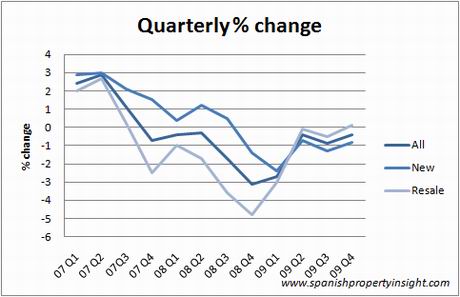
So how come the Notaries are saying prices fell just 4.3% last year, and by just 10% since the peak? Even more difficult to believe, they say resale property prices fell just 3.5% last year, and actually rose by 0.1% on a quarterly basis in the last 3 months of the year, all this at a time when mortgages were hard to get and credit conditions tightened dramatically. It doesn’t make any sense.

If the data is to be believed, 2009 was a much better year on a quarterly basis than 2008, as you can see from the next chart. The data would have us believe that prices fell by less than 1% in 3 out of 4 quarters last year, and by just 0.4% in 2 of them. How likely is that during a credit crunch, with a monumental property glut, dramatically falling property sales, 20% unemployment, and a shrinking economy?
ine-index-quarterly-q409

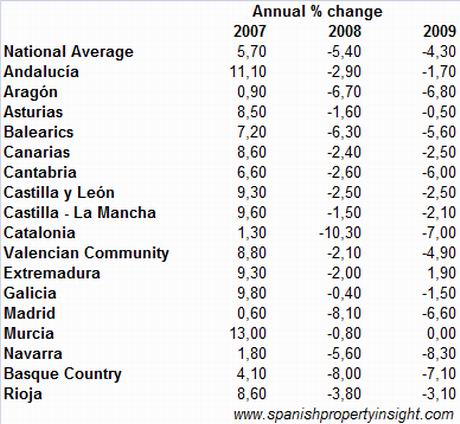
If you are still not convinced then have a look at Murcia, a region devastated by the property crash. According to the INE’s index, prices didn’t fall at all in Murcia last year, having fallen a paltry 0.8% the previous year. But you try selling a new property on one of Murcia’s many golf developments and see how far you have to drop your pants to find a buyer. In the following table you can see how prices are said to have changed by region in the last 3 years.
ine-index-regional-q409

To make matters worse, leading papers like El Pais accept the INE’s figures without doubt, despite the obvious questions they raise. Having first warned everyone waiting for prices to drop that they will be disappointed today’s El Pais goes on to say “It is true that, according to the INE, prices fell 4.3% last year. It is also true that quarterly price falls are getting smaller (-0.4% between October and December). And it’s now possible to find the first positive change: resales increased in price by 0.1% in the last quarter. That’s the first rise in 2 years.” The article does not at any point question the figures.

With figures like these I wouldn’t blame foreign observers from wondering if Spain is doing a bit of a Greece with its figures. In my opinion, these figures won’t fool anyone who counts.
Comments

#1 MANUEL | March 22, 2010

It's all about banks, loans and defaults. Homes' value must "resist" at such levels, despite the evidences, because a further crash of the prices will instantly and without doubt led to a crash of the banking system. This will make unemployment go to 30% and euro currency will become as volatile as the US dollar 2 years ago. The prices are officially "frozen" at such levels, the banks can state that all is under control and the government that "economy is slowly but steadily recovering".
The same s*** can be observed in Romania. Economy depends now all over Europe on mystified numbers...

#2 CLAUDIO | March 22, 2010

Recently I spent a few days in Torremolinos and I noticed how many home units are for sale.....if british buyers are still licking their wounds for the crisis, I think that real estate market in Spain will never recover because there's too much offer (Costa del sol, costa brava, costa blanca, Murcia, Baleares, Canarias) anpprices

#3 ROLAND | April 02, 2010

One explanation for the information coming from the Notaries in Spain could be that during the boom years in Spain, almost everybody paid for a substantial part of the properties they bought in "black" money to reduce the tax bill. The laws regarding proving to Notaries how properties are being funded have changed since then so this "black" money (which often reached 20% of sale price) is more difficult to use. Whatever percentage this "black" money represented has been absorbed by falling prices over the last years so on paper the price change doesn´t appear as real as it is.

#4 SIMON | August 02, 2010

Roland makes a good point, the majority of black money transactions have certainly reduced, which has a roll on effect as buyers don't want to be left with a high tax bill if they sell on again in the future and have to declare a substantial capital gain if the next buyer pays no black money. the real drop in value is likely to be much higher as official figures obviously can't take this into consideration ... even so this report http://prices.kyero.com/2010/07/11/spanish-property-market-summary/ shows an asking price drop of over 20% in two years, while adding to the doubts over official data.

Login or Register to submit a comment!

In order to promote open and spam-free conversations, Global Property Guide moderates commetns on all articles. You can expect that your comment will be published within 24 hours.


Market Analysis - Spain
Time series for residential property
 
House price index, appraised housing, Spain
Price/Rent Ratio: 29 yrs

Intasure - insurance that speaks your language

PROPERTY RECOMMENDATIONS

 
Download free Global Property Guide reports Sponsor a property investment report

Our Newsletter

 
Fortnightly updates from the global property arena directly to your inbox.

Manage subscriptions
Featured on Lead Galaxy, along with A Place in the Sun, Medhead, Eurobrix, Alternative Outlook, Move Worldwide and more...

Which parts of the world are most attractive for property investment today?

Click here to download our FREE Property Recommendations Reports!

Close Me