Tunisia's Residential Property Market Analysis 2025
Tunisia’s housing market is gradually strengthening, driven by improving economic conditions and a steady resurgence in the tourism sector.
This article provides a comprehensive overview of Tunisia’s housing market, beginning with a general market overview that highlights recent trends and key indicators. It also covers demand and supply dynamics, rental conditions, mortgage developments, and the broader socio-economic context shaping the country’s housing landscape.
Table of Contents
- Housing Market Snapshot
- Demand Highlights
- Supply Highlights
- Rental Market
- Mortgage Market
- Socio-Economic Context
Housing Market Snapshot
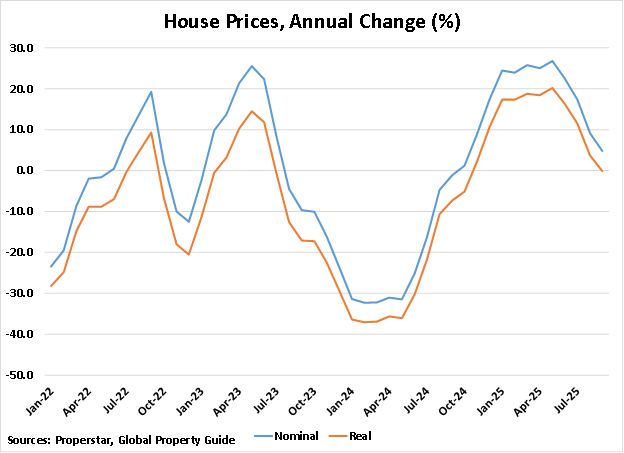
For apartments, nationwide prices rose by 6.82% to an average of TND329 (US$112) per square foot (sq. ft) in Q3 2025 from a year earlier, based on figures from real estate platform Properstar. It followed year-on-year growth of 5.98% in Q2 2025, 9.09% in Q1 2025, 12.95% in Q4 2024, and 5.12% in Q3 2024.
Though when adjusted for inflation, apartment prices were up by just 1.71% year-on-year in Q3 2025.
Quarter-on-quarter, apartment prices in Tunisia increased by 3.13% (1.93% inflation-adjusted) during the latest quarter.
Tunisia's house price annual change:
Note: Tunisia House Price Index: Apartment price per sq/ft, in TND
Data Source: Properstar.
For houses, the average price increased by a modest 4.82% year-on-year to TND261 (US$89) per sq. ft in Q3 2025, following annual growth of 22.54% in Q2 2025, 25.74% in Q1 2025, and 17.35% in Q4 2024 and a decline of 1.19% in Q3 2024. When adjusted for inflation, house prices were down slightly by 0.19% over the same period.
Yet quarter-on-quarter, nationwide house prices were actually unchanged in Q3 2025 (but declined by 1.17% in real terms).
By major location:
- In Tunis, the median price of apartments increased strongly by 16% y-o-y to TND377 (US$129) per sq. ft in Q3 2025, according to Properstar, while house prices also surged by 19% to TND308 (US$105) per sq. ft over the same period.
- In Sousse, the median price of apartments rose by 12% to TND317 (US$108) per sq. ft in Q3 2025 as compared to a year earlier. House prices also increased by 6% y-o-y to TND260 (US$89) per sq. ft.
- In Nabeul, apartment prices increased slightly by 1% y-o-y to TND334 (US$114) per sq. ft in Q3 2025, but house prices fell by 5% to TND285 (US$97) per sq. ft.
- In Ariana, the median price of apartments dropped 17% y-o-y to TND250 (US$85) per sq. ft, but house prices soared by 30% to TND203 (US$69) per sq. ft.
- In Jendouba, apartment prices were down slightly by 1% y-o-y to a median value of TND 370 (US$126) per sq. ft in Q3 2025, while house prices fell by 2%, also to reach a median of TND 370 (US$126) per sq. ft.
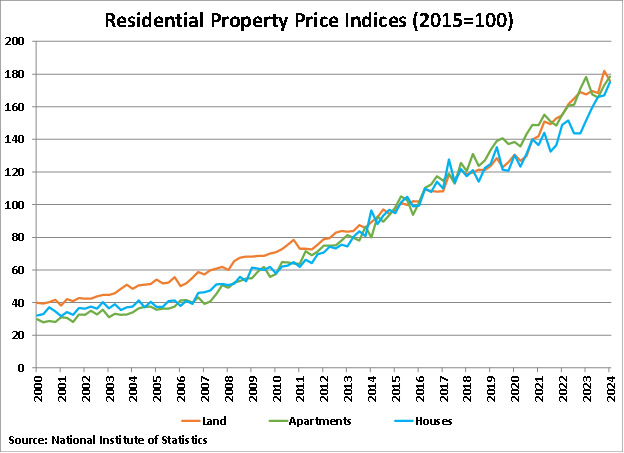
From 2011 to 2021, residential property prices in Tunisia surged by more than 100%, based on the nationwide real estate price index published by the National Institute of Statistics (INS). However, when adjusted for inflation, prices were actually up by just less than 20% over the said period. Apartment prices soared by a cumulative 110% (21% inflation-adjusted) while house and villa prices increased by 102% (16% inflation-adjusted).
Then in the succeeding two years, INS figures showed that apartment prices in Tunisia increased by another 16.6% (-2% inflation-adjusted) while house prices were up by 22.4% (2.8% inflation-adjusted).
In early 2024, the average price of residential land increased by 4.95% from a year earlier but declined by 2.37% in real terms, based on the latest figures released by the INS. Land prices were up by a cumulative 112% (16% inflation-adjusted) from 2013 to 2023.
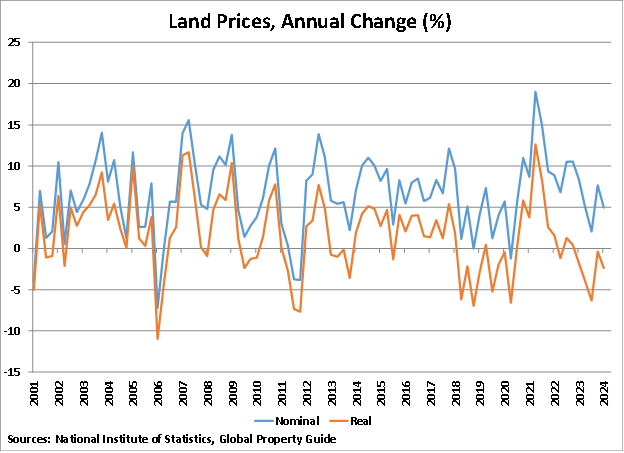
Overall, residential property price movements in the past decade have been erratic, as the country suffered from an ailing economy, struggling tourism, and political crisis, then exacerbated by the adverse impact of the Covid-19 pandemic.
Tunisia's post-pandemic housing market continues to improve, supported by the growth of the tourism sector and renewed confidence from foreign investors. In the first half of 2025, international visitor arrivals climbed by 11%, while tourism revenues rose by more than 8%, further stimulating property demand in coastal and resort zones.
Foreign homebuyers, mainly European retirees from France and Italy, are gradually returning, attracted by Tunisia's affordable property prices, Mediterranean climate, and expanding tourism infrastructure.
Several developers have also announced new projects, signaling renewed investor optimism. Notably, the UAE-based Bukhatir Group has revived its US$5 billion "Tunis Sports City" project in the northern suburbs of the capital. Spanning around 250 hectares, the project will feature luxury villas, a golf course, sports academies, hotels, and other amenities, with the first phase expected to begin construction in 2026.
Bukhatir Group Chairman Salah Bukhatir expressed strong optimism about Tunisia's development prospects, saying: "This project will change the face of the capital Tunis and mark a new era of growth for Tunisia's real estate and tourism sectors."
Overall, Tunisia's housing market outlook remains cautiously positive, buoyed by foreign investment and tourism recovery. However, lingering challenges such as high public debt and limited access to financing continue to temper growth.
Tunisia's broader economy is now slowly gaining momentum. During 2024, the economy grew by 1.4% from a year earlier, an improvement from a nearly zero growth in 2023 but still far lower than the annual expansions of 2.7% in 2022 and 4.7% in 2021, according to the International Monetary Fund (IMF). Prior to this, the country suffered a pandemic-induced economic contraction of 9% in 2020 - its worst economic performance in recent history.
In Q2 2025, the country posted a real GDP growth rate of 3.2% from the prior year, up from a year-on-year expansion of 1.6% in the previous quarter and 1.4% in the same period last year. This marks the country's strongest growth since the third quarter of 2022, driven by improved performance across several key sectors. Quarter-on-quarter, GDP grew by 1.8% in Q2 2025, rebounding from a 0.1% decline in Q1 and marking the strongest quarterly expansion since Q4 2021.
With this, the World Bank expects Tunisia to grow by a modest 2.6% this year. This is not significantly different from the IMF's projection of a 2.5% growth.
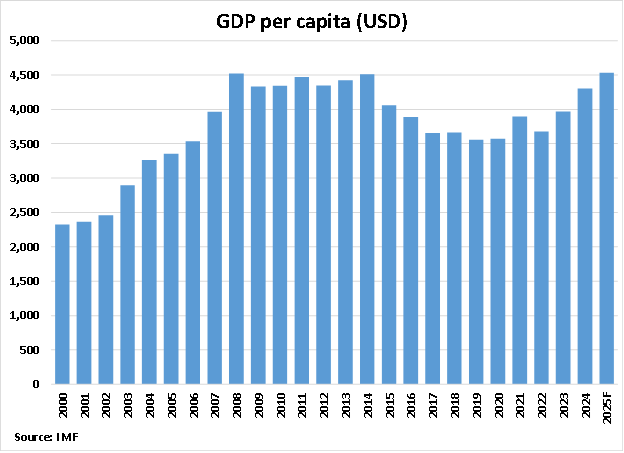
The country's GDP per capita reached approximately US$4,300 in 2024, up from US$4,000 in the prior year and US$3,700 two years ago, based on IMF figures.
Demand Highlights:
Property hotspots in Tunisia
Tunis, the capital, remains the country's main real estate hub - a blend of historic charm and modern living. The northern suburbs, city center, and the business district of Les Berges du Lac continue to attract Tunisia's political and business elite. These areas have seen strong price appreciation, with average apartment prices now ranging from TND 3,000 (US$1,023) to over TND 5,000 (US$1,706) per sq. m, and luxury units in La Marsa, Carthage, and Gammarth reaching up to TND 12,000 (US$4,093) per sq. m in prime locations.
Berges du Lac remains among the most desirable neighborhoods, home to embassies, major firms, and upscale apartments. Well-located and with good infrastructure, this affluent neighborhood has been developed since the 1980s after building polders in Tunis Lake. While Lac I is more established and offers better amenities, Lac II still attracts developers due to its newer buildings and available space. Typical apartments in these districts range from 110 sq. m to 150 sq. m and are mostly two- or three-bedroom units.
Other popular locations for expats are the northern suburbs of Greater Tunis, such as Carthage and La Marsa. There is a relatively strong market for residential units to lease and for sale. Tunis Ennasr, a small posh neighborhood in the farthest northern corner of the urban sprawl of Tunis, is also a growing real estate hotspot. Prices in these areas often exceed TND 4,000 (US$1,364) per sq. m and continue to rise due to high-end demand and limited supply.
Meanwhile, more affordable districts such as Ain Zaghouan and the southern suburbs of Tunis offer lower prices, averaging TND 700 (US$239) to TND 1,500 (US$512) per sq. m, making them attractive to local buyers seeking value or long-term investment potential.
Another area of interest to property buyers includes Jardins de Carthage. South of the historic site of Carthage, this new neighborhood has become a hotspot for luxury real estate. With a popular tourist site in close proximity, Jardins de Carthage is an attractive option for luxury real estate developers and house hunters looking to invest in upscale property. Asking prices for apartments in Carthage range between TND 4,100 (US$1,399) to TND 5,200 (US$1,774) per sq. m.
Overall, Tunisia's housing market continues to grow steadily, with the average national price for apartments reaching about TND 3,345 (US$1,141) per sq. m in 2024, up 6.4% year-on-year. The sharp divide between luxury and mid-market housing persists, reflecting both rising construction costs and sustained demand for premium coastal properties.
Coastal towns along the Mediterranean
Hammamet, about 65 km southeast of Tunis, is a popular destination for swimming and water sports due to its exceptional white beaches. It is among the tourist zones in Tunisia with the most expensive houses. Residential units cost TND2,000 (US$682) to TND5,000 (US$1,706) per sq. m.
Sousse, approximately 140 km south of Tunis, has world-class resorts and sandy beaches, adjoining orchards, and olive groves. The Medina (Old City) of Sousse is listed as a UNESCO Heritage Site. House prices range between TND2,700 (US$921) and TND4,000 (US$1,364) per sq. m.
Monastir, a traditional town 165 km south of Tunis, is famous for its well-preserved Ribat, a fortified Muslim monastery overlooking the Mediterranean Sea. Houses are priced from TND 1,800 (US$614) per sq. m. to TND 2,800 (US$955) per sq. m. In Djerba, a Mediterranean island in the southern coast of Tunisia, houses are fairly priced at TND1,400 (US$478) per sq. m. to TND2,700 (€804) per sq. m.
Sfax, an industrial city located 270 km southeast of Tunis, is, however, very modern and pleasant. It is also one of the towns in Tunisia with the cheapest housing units. In Sfax, house prices range from around TND1,000 (US$341) to TND1,500 (US$512) per sq. m.
Foreign ownership of Tunisian property
In 2005, the government passed a law permitting foreign ownership of properties for economic and tourism purposes. Since it became effective in 2006, the government has continuously encouraged foreign companies and tourists to invest in the country and buy properties in its prime cities.
A foreigner can buy a property in Tunisia, a villa, or an apartment, but cannot own agricultural land. In fact, agricultural land cannot be sold to foreigners, whatever the reason for the purchase.
According to Giambrone Law, if the land is included in the national development plan, it must be considered as "residential"; but if not covered by the plan, it should be considered as agricultural and, therefore, not available for acquisition by a foreigner.
Purchase of property in Tunisia by a foreigner is subject to prior authorization, to be given by the governor of the region where the property is located. Despite this, in recent years, more favorable legal provisions have been recognized as regards to certain land and real estate operations carried out by foreigners. All purchases of real estate by non-resident foreigners are also necessarily subject to authorization by the Central Bank of Tunisia, according to the actual legislation on monetary exchange.
According to the World Bank's Doing Business report, registering property in Tunisia requires 5 procedures, takes 35 days, and costs 6.1% of the property value. Globally, Tunisia stands at 94th in the ranking of 190 economies on the ease of registering property (with first place representing the greatest ease of doing business). Tunisia is 13 notches down from Morocco (81) but higher than the Middle East and North Africa average.
| Summary of time, cost, and procedures for registering property in Tunisia | |||
| No. | Procedure | Time to Complete | Cost to Complete |
| 1 | Consultation of pending encumbrances on the property at the Regional Land Registry Agency: The parties generally conduct a search for pending encumbrances of the property prior to the notarization of the contract. They can do this by going to the property registry and looking up the property on the computers there, where titles are kept electronically. The property registry delivers to the parties (requesting it) a certificate showing the legal situation of the land (or the building). | 1 day | TND 20 |
| 2 | Preparation and notarization of the contract: The contract agreement is prepared by a lawyer, notary public, or local council clerk (redacteur CPF employee) at the Land Registry (Conservation de la Propriété Foncière) after consultation with the property registry services. Both parties are summoned to sign it. Then the contract is notarized by a public notary or local council clerk (redacteur). Costs for this procedure vary according to who prepares the contract agreement. Businesses considered in the Doing Business case are likely to consult a lawyer even if fees are slightly higher. The lawyer fees are set freely between the parties, while the notary fees vary from 1% to 5% of the property value. It is useful to note that local council clerks charge a minimum of TND 30 and a maximum of TND 300 for their service, depending on the property and type of contract. In the case study, TND 300 would be the applicable fee for the preparation. The fees charged by the local council clerks are based on Decree No. 92-2114 of November 30, 1992. | 7 days | TND 300.75; (TND 300 (contract) + TND 0.750 per signature (notarization)) |
| 3 | Pay the transfer tax and the registration fee at the Local Tax Office: Fees and taxes should be paid during the application for registration at the local tax office. | 1 day | TND26,408.72; (5% of property value (transfer tax) + 1% of property value (registration fee) |
| 4 | The buyer files for a title deed at the Land Property Administration: The Land Registry studies the application. If accepted, the operation is deposited and transcribed onto the Regional Land Registry. The documentation shall include:-Power of attorneys-Identification of representatives to the parties-Certificate of Company Registration-Topographic plans of the property provided by the seller-Notarized contract (obtained in Procedure 2)-Payment receipts for transfer tax and registration fees (obtained in Procedure 3) | 25 days | TND 45 |
| 5 | The seller must inform the Municipality of the change of ownership: By law (article 17 of the Code de la Fiscalité locale), Law 97-11 of February 3, 1997, the former owner must inform the local municipality that the building has been sold and provide the proof of sale. Both the seller and buyer are jointly responsible for paying any outstanding taxes. | 1 day | No charge |
| Source: World Bank Doing Business report | |||
A buying guide is published by the Global Property Guide.
Supply Highlights:
Housing is a key national priority
Tunisia has successfully reduced its housing shortage and cut the number of substandard dwellings in recent decades. The ratio of statistically defined 'rudimentary dwellings' has declined from almost 24% in 1975 to 4.9% in 1989, and to 0.4% in 2014. According to the 2024 Population and Housing Census, rudimentary dwellings remained low at 0.67% of all housing units.
This underscores a major shift in housing conditions across the country, reflecting decades of housing policy, urban upgrading, and improved connectivity to basic services.
Tunisia has also eliminated its 'housing deficit' (i.e., the number of un-housed households) and now has about 794,000 more housing units than households, hence a 19.3% national vacancy rate. According to the 2024 census, total housing stock stood at 4,265,636 units, increasing by 975,728 units since the last census in 2014. The number is now well above the number of households, which is 3,472,000.
Of formal units, about 80% are built by individual households, 2% by public developers, and 18% by registered developers, catering to middle to high-income groups.
Acquiring permits to build houses is relatively easy and cheap by international standards. Tunisia ranked 42nd out of the 190 economies in the "dealing with construction permits" category in the World Bank's 2020 Doing Business report (the latest available), sharply up from 77th in the previous year.
Though obtaining a building permit requires 14 separate administrative procedures, the process is quite fast, taking an average of 133 days, higher than the 123.6 days across the region as a whole but lower than the 152.3 days for wealthier OECD countries. The costs involved represent 3.4% of the value of a standard warehouse, as compared to 4.4% and 1.5% for MENA and high-income OECD countries, respectively.
Rental Market:
Moderate rental yields
Gross rental yields are moderately good in Tunisia, averaging 5.43% in Q2 2025, slightly up from 5.24% in Q3 2024 and 5.2% in Q2 2024, according to a recent research conducted by the Global Property Guide.
By major location, in Q2 2025:
- In Tunis, rental yields currently range from 5.77% to 8.21%, with a city average of 7.24%.
- In Ariana, one can expect the rental yields to be between 4.95% and 5.99%, with an average of 5.4%.
- In Nabeul, rental yields are relatively lower, ranging from 3.17% to 4.46%, with an average of 3.91%.
- In Ben Arous, gross rental yields fall between 5.14% and 5.16%, with an average of 5.15%.
In Q2 2025, average monthly rents in Tunis were around US$358 for a studio apartment, US$423 for a one-bedroom apartment, US$488 for a two-bedroom apartment, US$716 for a three-bedroom apartment, and US$814 for apartments with four or more bedrooms.
Home in Tunisia provides a property management service for owners wishing to rent properties either long-term or short-term.
Taxes are much lower than in comparable developed countries. There's no taxation on unfurnished property rentals, and the taxes on furnished properties are low.
Overall, round-trip transaction costs are low for buyers of residential property.
Mortgage Market:
The mortgage market still underdeveloped
Tunisia's mortgage market remains underdeveloped. More than 70% of housing projects in the country are self-financed. In fact, only around 4% of households take out a mortgage to build a house, as most of them do not meet bank credit conditions. Currently, about 37% of adults in Tunisia have a bank account.
The total value of residential mortgages outstanding in Tunisia amounted to TND 12.93 billion (US$4.41 billion), according to the Africa Housing Finance Yearbook 2024. This was equivalent to about 9.9% of GDP, only slightly up from 6.5% of GDP in 2003.
However, non-performing loans accounted for nearly 10% of the total mortgage loans.
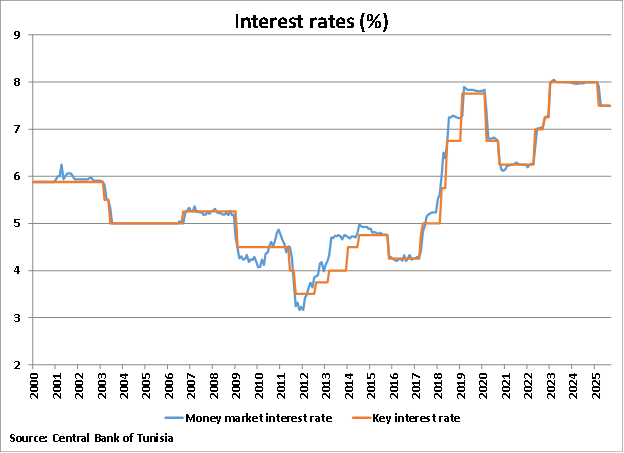
The money market interest rate, on which housing loans are based, has been gradually declining recently. In September 2025, the money market interest rate stood at 7.49%, down from 7.99% in September 2024 and 8% in September 2023, according to figures from the Central Bank of Tunisia.
The prevailing residential mortgage interest rate ranges from 5% to 13%.
Of the 46 banks and financial institutions operating in Tunisia, roughly 30 banks offer housing loan programs for individuals, mainly targeting middle and upper-income families. Mortgage loans are granted for a period of 10 to 25 years.
While banks are permitted to issue mortgages of up to 25 years, they are required to fix interest rates for loans exceeding 15 years, making such financing difficult to sustain. Consequently, shorter-term mortgages have become the norm. Loan amounts are generally capped at 80% of the property's value, rising to 90% for subsidized loans granted to low-income households. Monthly repayments usually account for about one-third of the borrower's income.
In April 2025, private banks in Tunisia halted the issuance of new loans with terms exceeding 15 years, following the enactment of a new law aimed at lowering borrowing costs.
The present competitive mortgage market is a great improvement from the situation up till 2001, when the Banque de l'Habitat (BH), in which the Tunisian state owns a 57% controlling stake, was the only mortgage lender, offering loans for house purchases, home improvement, and residential land acquisition. It now only accounts for about one-fourth of real estate lending, according to figures cited in the local press.
In February 2017, the government launched the "Programme Premier Logement," which benefits middle-class families with incomes between 4.5 and 10 times the minimum wage who want to purchase their first home. The program helps those families to finance their down payment up to 20% of the total house price. The loan can finance houses priced at TND 200,000 (US$68,225) or less over a period of 12 years with no repayment during the first 5 years.
Recent policy updates show that the eligibility thresholds and scope of the Programme Premier Logement are being expanded. According to the 2025 Finance Bill's draft, the programme will now include the construction of a first home, not just home purchase, especially for owners of buildable land in interior regions. The programme's home-price ceiling has also reportedly been raised to about TND 220,000 (US$75,047) to TND 234,400 (US$79,959).
Other institutions and funds helping the poor include:
- The Housing Promotion Fund for Salaried Persons (FOPROLOS, Fonds de Promotion des Logements pour les Salariés) is managed by BH. Loan rates for mortgages range from 2.5% to 5.75% for three different income eligibility brackets, targeted at households earning a regular salary between minimum wage and up to 4.5 times minimum wage (set at US$152 a month - from May 2015 onwards);
- The National Fund for House Improvement and Rehabilitation (FNAH, Fond National pour l'Amélioration de l'Habitat) disburses loans for home improvement to those whose salaries are below a set minimum; and,
- The National Solidarity Fund 26-26 (Fonds de Solidarité Nationale 26-26) supports the poorest of the poor, mainly through funding housing improvements for the very poor who live in upgrading and rehabilitation areas in Greater Tunis and other large towns.
In January 2022, decree-law n° 2022 was promulgated, which provides for a legal framework to govern the activity of credit bureaus in an effort to support better tracking of the credit behavior of consumers. Accordingly, these credit bureaus collect information from banks, financial institutions, and other credit companies.
Some financial institutions offer products that allow you to save, especially for the purpose of purchasing a house.
Al Jadid Savings
The Banque de l'Habitat (BH) introduced a range of three supplemental loan schemes - Al Jadid 1, Al Jadid 2, and Al Jadid 3 - designed for families with incomes higher than those eligible for FOPROLOS programs. These loans are based on prior family savings and carry a fixed interest rate of 7% per year with a maximum repayment term of 15 years.
Essentially, the Al Jadid Savings schemes operate at or near money market rates. They do not impose maximum income requirements, nor do they set a fixed downpayment amount - an approach that encourages greater equity participation from beneficiaries. As such, Al Jadid Savings represents a more flexible and market-oriented housing loan system.
Recently, BH aims to raise the ceilings of its subsidised housing loans to around US$100,000 by late 2025 or early 2026, reflecting the bank's continuing efforts to expand access to home financing and support middle-income families.
| Main Individual Housing Loan Scheme, Managed by BH | ||||||
| Loan Scheme | FOPRO LOS 1 | FOPRO LOS 2 | FOPRO LOS 3 | Al Jadid (HP1) | Al Jadid (HP2) | Al Jadid (HP3) |
| Income | 1 to 2 times SMIG | 2 to 3 times SMIG | 3 to 4.5 times SMIG | variable | variable | variable |
| Unit Area | Individual 50 sqm; Family 65 sqm | 75 sqm | 80-100 sqm | variable | variable | Variable |
| Nominal Cost of Unit | TND39,000 | TND50,000 | TND54,000-TND67,500 | variable | variable | variable |
| Down payment | 10% of cost | 10% of cost | 15% of cost | 4 years prior saving | 5 years prior saving | 6 years prior saving |
| Term | 25 years plus 3 years grace | 25 years plus 3 years grace | 20 years plus 1 year grace | 15 years | 15 years | 15 years |
| Interest Rate | 3.5% | 5.0% | 5.75% | 7.0% | 7.0% | 7.0% |
| Maximum Loan Amount | 90% of cost to maximum of 130 times SMIG | 90% of cost to maximum of 179 times SMIG | 90% of the to maximum of 210 times SMIG | TND 53,000 | TND 67,000 | TND 83,000 |
| Source: UN-HABITAT | ||||||
Socio-Economic Context:
Tunisia's economic conditions gradually improving, unemployment also declining
Tunisia's economy grew by a meager 1.4% during 2024, an improvement from a nearly zero growth in 2023 but still far lower than the annual expansions of 2.7% in 2022 and 4.7% in 2021, according to the International Monetary Fund (IMF). Prior to this, the country suffered a pandemic-induced economic contraction of 9% in 2020 - its worst economic performance in recent history.
In Q2 2025, the country posted a real GDP growth rate of 3.2% from the prior year, up from a year-on-year expansion of 1.6% in the previous quarter and 1.4% in the same period last year. This marks the country's strongest growth since the third quarter of 2022, driven by improved performance across several key sectors.
By sector:
- The mining sector grew by a whopping 39.5% y-o-y in Q2 2025, an acceleration from the prior quarter's 17.6% growth.
- Construction expanded by 9.6% in Q2 2025 from a year ago, an improvement from the previous quarter's 3% growth.
- Agriculture, forestry, and fishing rose by 9.8% y-o-y in Q2 2025, following a 7.3% growth in the previous quarter.
- Accommodation and catering grew by 7%, following a 5.7% expansion in the previous quarter.
- Trade and repair services increased by 2.8% y-o-y in Q2 2025, following a 1.9% growth in Q1.
- Information and communication expanded by 1.5%, an improvement from the prior quarter's minuscule growth of 0.1%.
- Chemical industries saw a notable rebound, expanding by 10.1% y-o-y in Q2 2025, in contrast to a decline of 3.9% in Q1.
- Transport and storage also rose by 3%, in contrast to a 0.7% contraction in Q1.
- Production and distribution of gas increased by 3.4%, following a slight decline of 0.1% in the previous quarter.
Quarter-on-quarter, GDP grew by 1.8% in Q2 2025, rebounding from a 0.1% decline in Q1 and marking the strongest quarterly expansion since Q4 2021.
With this, the World Bank expects Tunisia to grow by a modest 2.6% this year. This is not significantly different from the IMF's projection of a 2.5% growth.
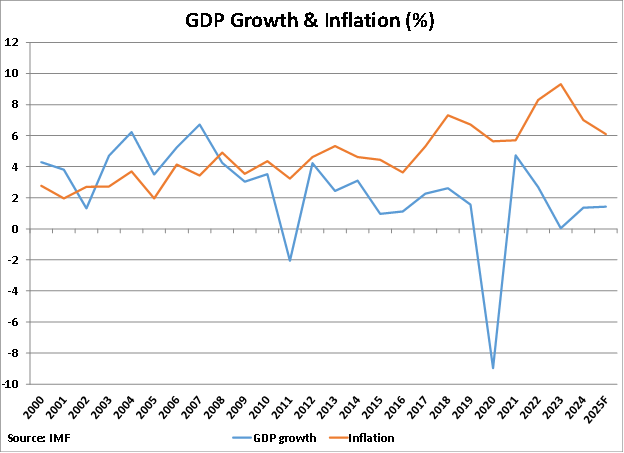
Inflationary pressures continue to ease. In September 2025, overall inflation stood at 5%, down from 5.2% in the previous month and 6.7% in the preceding year, primarily due to softer price increases in food and non-alcoholic beverages. In fact, it was the lowest level seen since May 2021.
Inflation averaged just 4.2% annually from 2000 to 2021, before accelerating to 8.3% in 2022, 9.3% in 2023, and 7% in 2024.
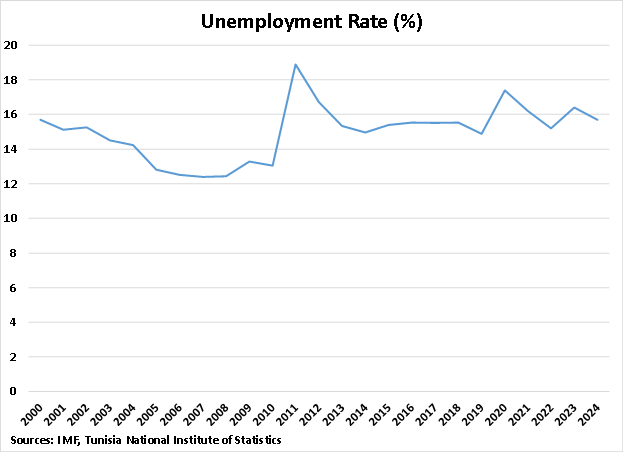
The labour market seems to be improving. In Q2 2025, the nationwide unemployment rate stood at 15.3%, down from 15.7% in the previous quarter and 16% in the same period last year, according to the National Institute of Statistics. Unemployment averaged 15.7% annually from 2014 to 2024.
Public finances remain under strain
Tunisia continues to face pressure on its public finances despite gradual improvements in its fiscal position. The budget deficit narrowed to around 6.6% of GDP in 2024, down from 7.4% in 2023, 7.9% in 2022, 7.6% in 2021, and 9% in 2020.
However, the country's public debt remains high, projected to reach about 80.5% of GDP in 2025. The government has introduced measures such as higher taxes on corporations and high-income earners to reduce the deficit, but financing needs remain substantial.
Tunisia's stalled negotiations with the IMF since 2023 continue to weigh heavily on its access to external funding, further challenging the government's efforts to stabilize its finances.
According to the 2026 draft budget, the Tunisian government plans to once again seek exceptional direct financing of up to US$3.7 billion from the central bank to help cover its fiscal deficit amid limited access to external funding.
Trade deficit widens as imports outpace exports
During the first nine months of 2025, Tunisia's external trade figures showed exports totaling TND 46.42 billion (US$15.83 billion), virtually unchanged from the same period last year, based on figures from INS. In contrast, imports climbed to TND 63.15 billion (US$21.54 billion), up by 5.4% from the corresponding period last year.
As a result, the trade deficit widened to TND 16.73 billion (US$5.71 billion, up by 23.9% from a deficit of TND 13.5 million (US$4.6 billion) in the same period of 2024.
Breaking down by product groups, the largest portion of the deficit comes from energy, which contributed a shortfall of TND 8.11 billion (US$2.77 billion). Other major contributors included raw materials and semi-finished goods, and capital goods. On the positive side, the food and agricultural group posted a surplus.
Tunisia's trade deficit was mainly driven by steep import growth from China (29.4 %) and Turkey (17.7 %). Major contributors to the deficit include Algeria, Russia, Turkey, and China. On the other hand, Tunisia posted trade surpluses with France, Germany, Italy, Libya, and Morocco.
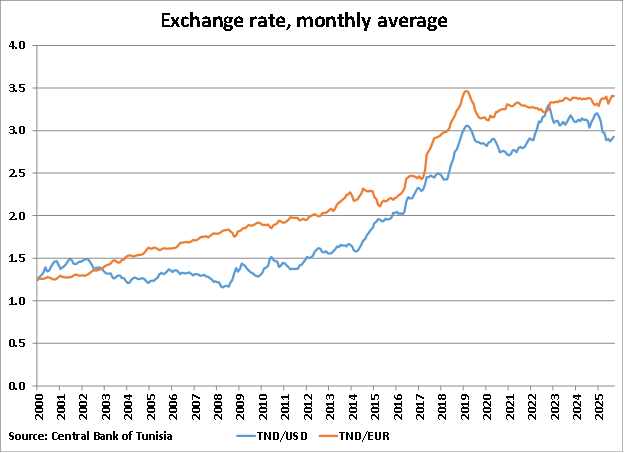
The dinar, whose exchange rate is controlled by the Central Bank of Tunisia, has appreciated in relation to the dollar but depreciated in relation to the euro. In September 2025, the dinar gained about 11% of its value against the US dollar from three years ago, to reach an average exchange rate of TND 2.9258 = USD 1. On the other hand, the dinar depreciated against the euro by about 5.5% from three years ago, at an average exchange rate of TND 3.4047 = EUR 1 in September 2025.
Tourist arrivals continue to increase
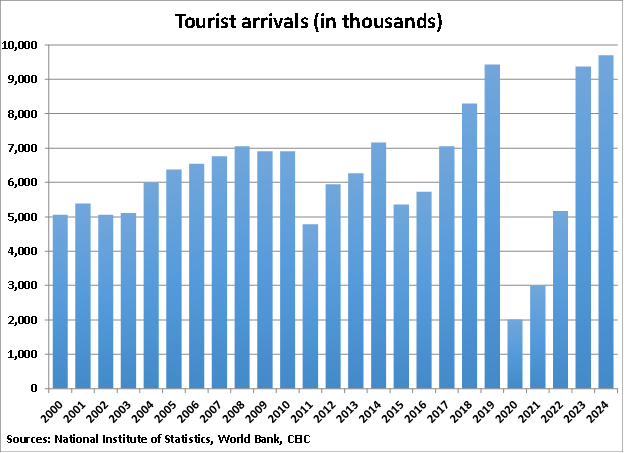
Tunisia's tourism industry remains on a strong upward trajectory. During 2024, the total number of visitor arrivals in Tunisia rose by 3.5% to around 9.7 million tourists, following strong growth of 81.3% in 2023, 72.5% in 2022, and 49.1% in 2021, and a pandemic-induced decline of 78.7% in 2020. It is now higher than the previous record of 9.43 million arrivals registered during the pre-pandemic year of 2019.
Tourism revenues mirrored this positive trend, reaching TND 7.05 billion (US$2.4 billion) in 2024, an increase of 7.8% over the prior year.
The momentum continues in 2025. According to data from the Central Bank of Tunisia, tourism revenues had already reached nearly TND4 billion (US$1.36 billion) by mid-July, up 8.2% year-on-year. Hotel performance has also strengthened, with 12.36 million overnight stays, representing a 7.1% annual increase, and an average occupancy rate of 35.3%, up by 2.1 percentage points from the previous year.
European travelers remain Tunisia's largest group of visitors, with arrivals rising by 10.7% to 1.59 million. France continues to lead the market with a 9.6% increase. Strong growth was also seen from the United Kingdom, Italy, Switzerland, and Ireland, showing renewed interest from Western Europe.
Other international markets are also showing healthy momentum. Tourist arrivals from the United States rose by 4.9%, Canada by 7.5%, and China by 15%.
The Maghreb region also plays a key role in sustaining growth, bringing in 2.75 million tourists, up by 9.8% from the previous year. Of which, Algeria contributed 1.46 million visitors, while Libya followed closely with 1.25 million, reflecting the strong cultural and geographic ties between Tunisia and its neighbors.
Domestic tourism now accounts for about 30% of all travel in Tunisia, showing how local travelers help drive the industry's growth. To support this, the government plans to launch a digital hotel booking platform for citizens to make travel easier during busy seasons.
Tourism investments are also picking up strongly, reaching TND 943 million (US$322 million) by July 2025-already higher than the total for 2024. This reflects strong investor confidence and ongoing efforts to improve infrastructure, services, and tourism options beyond beach destinations.
A sizeable portion of tourists choose to rent while vacationing in Tunisia. Foreign rental demand, mostly from Europe and neighboring countries such as Libya and Algeria, therefore complements strong domestic rental demand.
Tourism is of vital importance to the Tunisian economy, representing about 9% to 14% of the country's GDP annually and accounting for nearly 400,000 direct and indirect job opportunities.
However, Tunisia's tourism sector has experienced the worst crisis in the past decade, mainly due to the Arab Spring uprising in 2011 and two militant attacks on tourists in 2015. The tourism sector had a short-lived recovery in 2017-19 because of the Covid-19 pandemic. Fortunately, tourist arrivals are rising rapidly again despite the continued weakness of the Tunisian economy.
If current trends continue, Tunisia could welcome up to 11 million tourists by the end of 2025 - a new record that highlights its steady recovery and growing appeal as a Mediterranean destination.
Saied's dictatorial regime
Tunisia, the first Arab country to rebel against dictatorship, inspired similar revolts across other Arab countries - giving birth to what is now known as the Arab Spring Revolution.
The 2011 revolution ousted President Zine al-Abidine Ben Ali, and a new legislative body, the National Constituent Assembly, was elected to navigate Tunisia's political transition. In October 2014, successful parliamentary elections went smoothly, and Habib Essid of the anti-Islamist Nidaa Tounes (Tunisia's Call) party, which won the most seats in October 2014's parliamentary election, was nominated prime minister. This was followed by the victory of the 87-year-old Beji Caid Essebsi, also of Nidaa Tounes, in the November and December 2014 presidential elections. Mr Essebsi also served in the governments of post-independence leaders Habib Bourguiba and Ben Ali.
The Islamist party Ennahda, which led Tunisia's last government but was beaten by Nidaa Tounes in October's parliamentary election, did not field a candidate. Essebsi's main opposition came from Moncef Marzouki, the interim president and a human rights campaigner who has cast himself as a guardian of the spirit of the revolution.
However, security risks remained as terrorist operations have been staged by jihadi groups affiliated with al-Qaeda, such as Uqba Bin Nafi Battalion, and others by groups pledging allegiance to the Islamic State.
Since the terrorist attack of June 2015, there has been just one significant terror attack in Tunisia. Terrorist attacks have killed over 70 civilians, including foreign tourists. Tourism, one of the biggest contributors to Tunisia's economy, took a major hit. It was only in 2018 that tourism made a major comeback.
The 2019 presidential and parliamentary elections represented the country's first peaceful transfer of power. Retired law professor Kais Saied won a landslide victory over media mogul Nabil Karoui during the October 2019 presidential election run-off. Saied promised to fight corruption. Ironically, in 2021, he carried out a series of measures to enhance the power of the presidency, resulting in a political crisis. These exceptional measures included the freezing of the powers of parliament, the dismissal of the prime minister, and the issuance of legislation by presidential decree.
Opposition parties shunned the 2022 parliamentary elections, accusing the president of staging a coup after shutting the parliament in the prior year and giving himself almost unlimited powers. Some asserted that Tunisia's dictatorial regime has reached a new low, amidst the unprecedented crackdown on the critics of Saied. Dozens of public figures, including politicians, judges, lawyers, protesters, union leaders, business leaders, and the head of a leading independent radio station, have been arrested in violent night raids.
On October 6, 2024, Tunisia held its first presidential elections since adopting a new constitution in 2022. Saied won a second term with more than 90% of the votes. However, only two candidates were allowed to contend against him. Saied's closest rival, businessman Ayachi Zammel, won 7% of votes despite being sentenced to 12 years in prison for falsifying documents, just five days before the election. Accordingly, nearly all campaign posters in the streets were backing the president, and there were no campaign rallies or public debates conducted.
In July 2025, a Tunis court sentenced opposition leader Rached Ghannouchi and 20 others to long prison terms, further silencing President Kais Saied's top critics. The verdict sparked protests across the capital, as hundreds of Tunisians denounced his authoritarian rule and demanded the release of jailed opposition figures, journalists, and activists.
Sources:
- Tunisia: housing price and price/sq ft (Properstar): https://www.properstar.co.uk/
- Real estate prices by property type (National Institute of Statistics): https://www.ins.tn/
- Housing Finance in Africa 2024 Yearbook (Centre for Affordable Housing Finance in Africa): https://housingfinanceafrica.org/
- Population and Housing Census 2024 (National Institute of Statistics): https://www.ins.tn/
- Tunisia Doing Business 2020 (World Bank): https://www.doingbusiness.org/
- Guidelines For Foreigners When Buying Property In Tunisia (Mondaq): https://www.mondaq.com/
- Gross rental yields in Tunisia: Tunis and 3 other cities (Global Property Guide): https://www.globalpropertyguide.com/
- Tunisia Interest Rate (Trading Economics): https://tradingeconomics.com/
- Exclusive: Tunisian banks halt long-term loans after new law threatens profits, sources say (Reuters): https://www.reuters.com/
- Tunisia - Finance Bill 2025: Expansion of the first housing program (Webdo): https://www.webdo.tn/
- Banque de l'Habitat aims to increase ceilings of subsidized housing loans to $100,000 (Lorient Today): https://today.lorientlejour.com/
- Tunisia country profile (BBC News): https://www.bbc.com/
- New Tunisian electoral law raises issue of military's role in politics (Al Monitor): https://www.al-monitor.com/
- Sousse terror attack: The 30 British victims of Isis gunman's Tunisia beach massacre (Independent): https://www.independent.co.uk/
- Tunisian president wins second term with landslide (BBC News): https://www.bbc.com/
- Tunisians protest against President Saied, call country an 'open-air prison' (Reuters): https://www.reuters.com/
- Tunisia president's far-reaching clampdown targets opponents (DW): https://www.dw.com/
- Tunisia Sees Over Five Million Arrivals By July Marking Double-digit Growth From 2024 And Positioning The Country For A Record-breaking Tourism Year (Travel and Tour World): https://www.travelandtourworld.com/
- Tunisia (International Monetary Fund): https://www.imf.org/
- Tunisia Overview (World Bank): https://www.worldbank.org/
- Tunisia GDP Annual Growth Rate (Trading Economics): https://tradingeconomics.com/
- World Bank Forecasts Tunisia's Growth at 2.6% in 2025 (Ecofin Agency): https://www.ecofinagency.com/
- Tunis cuts ties with IMF (Africa Intelligence): https://www.africaintelligence.com/
- Unemployment (National Institute of Statistics): https://www.ins.tn/
- Gross Domestic Product (GDP), second quarter 2025 (National Institute of Statistics): https://www.ins.tn/
- Commerce Extérieur aux prix courants, Septembre 2025 (National Institute of Statistics): https://www.ins.tn/
- Tunisia seeks new direct financing to the treasury of $3.7 billion from the central bank (Reuters): https://www.reuters.com/