El Salvador’s housing market has many problems
World's highest murder rate. High poverty levels. Unstable political landscape. Frequent natural disasters. Weak economic growth. No wonder, El Salvador's housing market has been depressed for several years.
"In some areas, sales contracts are signed for US$12,000, then dropped to US$10,000 and ends up selling at US$7,000," said to Estela de Dubon of Inmobiliaria Las Américas. said Dubon. House price falls are especially pronounced in gang-controlled areas such as La Libertad, Soyapango, Ilopango, and Apopa, added Dubon.
This was supported by Sara de Vasquez of property management firm Lotiversa El Salvador who said that in some parts of the country, land prices have fallen by as much as 40% in just a few months. For instance, a lot that was originally priced at US$5,000 is now selling for just US$3,000.
Vasquez noted that while violence has been a part of El Salvador's life, it has increased dramatically in the last four years, frightening investors and property developers.
There are areas in El Salvador that clients and employees are afraid to enter because of the presence of criminal groups, added Vasquez. "Sometimes customers may be interested in a property, but they lose interest in seeing the area."
As gang violence worsens, the demand for gated communities is rising and homebuyers are requiring more security. Property demand has also shifted to areas with relatively low crime rates. "In areas such as Santa Tecla and Santa Elena, houses are in greater demand and values are increasing due to their better location," according to a local real estate expert.
Some construction projects have been either halted or abandoned. "Definitely, there is no execution of new housing projects in some areas because of extortion from gangs, exacerbated by customers' demand for closed buildings and better security measures," said Antonio Velasquez of El Salvador's Chamber of Construction (CASALCO).
Many overseas Salvadorians buy property in their home town, but few foreigners have been attracted to buy here. Foreigners prefer to live in San Salvador, the capital, and its surrounding suburbs, protected by gated villages.
Other than violence and crime, foreigners are discouraged by frequent natural disasters such as hurricanes, earthquakes, and volcanic activity. The country is also haunted by memories of the bloody civil war from the 1980s to 1992 which left more than 75,000 people dead.
El Salvador's small economy is extremely dependent on the US. The US dollar is the official currency. According to a UNDP study, without remittances, the proportion of households living in extreme poverty would jump from 6%, to 37%. More than 50% of all exports from El Salvador go to the US.
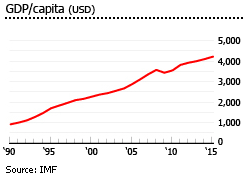
El Salvador's economic growth has historically been sluggish. Massive reconstruction efforts after the end of the civil war pushed GDP up by an average of 6.6% from 1993 to 1995. But average annual GDP growth from 1996 to 2004 was only 2.6%.
From 2005 to 2007El Salvador's economy grew by 3.8% per annum. But in 2008, GDP growth slowed to 1.3%, due to the financial meltdown and economic recession in the US.
The economy contracted by 3.1% in 2009. The economy has remained weak since then, with average GDP growth of just 1.9% from 2010 to 2015.
Gang violence continues to worsen
It is estimated that between 70,000 and 80,000 people in the country are members of gangs and another half a million more, including relatives, business partners, police, and corrupt politicians, are financially dependent on them. These gangs are vast, meticulously organized and control many parts of the country, including the city centre.Mara Salvatrucha and Barrio 18, two of the country's largest maras (gangs), have already a combined membership of 72,000. Violence between these two marasis so severe that the government had to create two separate prisons for them.
The gangs extort protection money from businesses, ranging from bus drivers to multinationals. Salvadorans pay about US$756 million every year to gangs, equivalent to 3% of the country's GDP, according to a study conducted by Banco Central de Reserva de El Salvador and the UN Development Programme. Those who refuse to pay get no mercy. In the past decade, gangs have murdered more than 1,000 transport workers in El Salvador, according to an article by The Economist. The country's persistently high murder rate is largely attributed to wars between them for control of territory.
The total cost of gang-related violence, including lost income, and the amount that households spend on extra security, is equivalent to 16% of El Salvador's GDP, the highest level in Central America. Gang extortion forces 7 to 10 shops to shut down every week, according to the National Council of Small Businesses.
In an effort to abate the situation, former president Mauricio Funes of the left-wing FMLN (FrenteMartipara la Liberacion) Party entered into a truce with the gangs. The country's murder rate dropped from 70 per 100,000 in 2011 to almost half that number in 2012 and 2013, at the price of tolerating continued extortion and other crimes. Some critics said that the truce just gave gangs legitimacy.
The government reversed gear in 2014, when presidentSalvador Sánchez Cerén assumed office. Cerén waged an all-out war with the gangs. Stronger police tactics were used against criminals, causing killings to soar. In 2015, around 6,657 people were killed, a 70% rise from the previous year. According to the World Bank, El Salvador's current homicide rate of 104 people per 100,000 is the highest for any country for nearly two decades, causing the country to be known as the murder capital of the world.
Substandard housing, many problems
About 2 million Salvadorans, which is a third of the country's total population, live in substandard housing in around 2,500 informal communities.
Calamities, which routinely hit the country, also exacerbate the bad living conditions of the residents. According to the 2015 World Risk Report compiled by the UnitedNationsUniversity for Environment and Human Security, El Salvador is ranked as among the most vulnerable countries in the world in terms of natural disasters.
- Hurricane Mitch caused devastation in 1998, leaving 300,000 people homeless.
- Two earthquakes in 2001 damaged a further 20% to 25% of the housing stock, with 174,000 houses wrecked, and about 1.5 million people left homeless.
- Hurricane Stan, in 2005, caused damage to infrastructure and agriculture, which was estimated at about US$356 million.
- In 2009, Hurricane Ida caused heavy rains and mudslides, killing hundreds and damaging thousands of homes and buildings.
- In 2010, tropical storm Alex, which had an economic cost of over US$150 million, damaged hundreds of homes, schools, bridges and highways.
- In 2015, Hurricane Patricia caused numerous landslides, severe flooding and extensive damage to homes and crops.
Families displaced by natural disasters typically move to abandoned land or alongside roads and polluted streams, live in shacks constructed of tin, mud, discarded construction materials, and sometimes building materials salvaged from their previous homes.
Lack of clear titles is another problem hindering the reconstruction process and the real estate market in general. The problem is exacerbated by inequality, criminality, and by an inefficient and corrupt bureaucracy.
El Salvador is the smallest country in Central America with a land area of 20,720 sq. km. With a population of 6.13 million people in 2015, it is also the most densely populated country in the region.
Housing unaffordable for ordinary Salvadorans
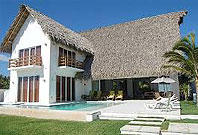
Despite the decline in house prices in recent years, housing remains unaffordable to ordinary Salvadorans.
Property prices in new developments in areas such as La Paz, Sonsonate, La Libertad, San Miguel, and San Salvador range from US$16,500 for vacant lots in Sonsonate, to more than US$250,000 for luxurious villas in San Miguel. In Altura de Tenerife (Tenerife Heights) in La Libertad, prices can exceed US$500,000 for a 2,220 sq. m. vacant lot with a good view.
While El Salvador's property prices are lower than in Costa Rica or Panama, they are way beyond the means of ordinary people. The GDP per capita of the average Salvadorian was around US$4,200 in 2015, according to the IMF.
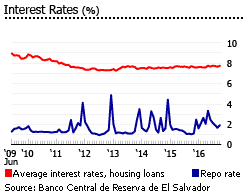
Moreover, banks' reluctance to lend and high interest rates also constrain housing demand. In October 2016, the average interest rate for housing loans stood at 7.74%, almost unchanged from the same period last year.
Modest growth in remittances not enough to buoy housing demand
Remittances are the single most important source of household income in the country. About 22% of all households in El Salvador receive remittances. Currently, there are around 2 million El Salvador-born US immigrants, including illegal immigrants.
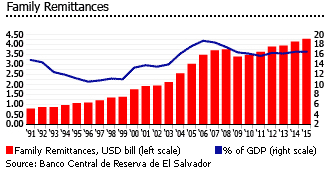
Remittances grew by a staggering 260% from just US$962.5 million in 1994 to US$3.47 billion in 2006, according to the Banco Central de Reserva de El Salvador, the country's central bank. This was equivalent to an average annual growth of 12%. El Salvador experienced a property boom from early-2000s to mid-2008, benefitting from billions of dollars of remittances from US-based Salvadorians.
However the government estimates that only a small portion of these remittances is spent on housing. The money mostly goes to consumption - food, clothing, and household maintenance costs like fuel, electricity and water.
To entice US-based Salvadorians to buy housing back in the home country, the government sets up housing fairs in the US, and offers low-interest mortgages.
Even illegal immigrants can benefit from low-cost mortgages of up to US$50,000, as long as they can prove that they have sent money home for six months or more. These efforts caused a construction boom in coastal areas and major cities during the early 2000s.
But the US recession and credit crunch caused El Salvador's real estate market to plunge. Thirty per cent of construction firms' activities were paralyzed during the crisis, due to limited bank loans for housing and other infrastructure projects, according to CASALCO (CamaraSalvadoreña de la Industria de la Construccion or Salvadorian Construction Industry Chamber). Remittances declined substantially.
It was only in 2011 that remittances were back to pre-crisis levels.
In 2015, remittances grew by a modest 3.3% to US$4.27 billion from a year earlier, slightly down from an average growth of 4.6% in the past four years. From January to October 2016, total family remittances amounted to US$3.73 billion, up 6.23% from the same period last year, according to the central bank. Evidently, the modest growth in remittances is not enough to offset the adverse effects of security problems in the housing market.
Weak economic growth, low inflation
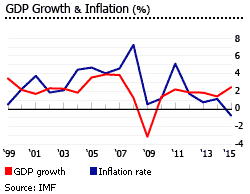
During the second quarter of 2016, the economy grew by 2.52% from a year earlier, slightly up from a growth rate of 2.34% in Q2 2015, according to the Banco Central de Reserva de El Salvador. The economy is expected to expand by 2.4% this year, according to the International Monetary Fund (IMF).
In October 2016, consumer prices actually fell by 0.88%, from annual inflation of 1.01% in September, 0.95% in August, and 0.88% in July 2016, according to the central bank.