Ukraine's Residential Property Market Analysis 2026
Ukraine’s residential market remains highly uneven, with house prices and rents still rising in relatively safer regions, where constrained supply, population displacement, and ongoing wartime disruption continue to shape market dynamics.
This extended overview from Global Property Guide covers key aspects of the Ukrainian housing market and takes a closer look at its most recent developments and long-term trends.
Table of Contents
- Property Prices and Price Index
- Property Demand Trends
- Property Supply Trends
- Rental Market: Rents and Rental Yields
- Mortgage Market and Interest Rates
- Economic and Social Factors
Property Prices and Price Index
House prices in Ukraine continued to rise through late 2025, supported by elevated construction costs, still-selective demand recovery, and constrained new supply. According to the State Statistics Service of Ukraine (Derzhstat), the House Price Index increased by 13.2% year-on-year in Q4 2025. The primary segment rose by 13.1% annually, while the secondary segment grew slightly faster at 13.3%.
Ukraine's house price annual change:
At the same time, regional pricing remained highly differentiated. Realtor Oleksandr Boyko noted that in cities under regular shelling, some owners still sell at discounts below pre-war benchmarks, while the highest purchase prices are seen in Kyiv and in large western cities such as Lviv, Uzhhorod, and Ivano-Frankivsk, supported by the concentration of jobs and businesses, inward migration, and a limited stock of safer, higher-quality housing.
Data from selected markets monitored by the property platform LUN as of March 2026 shows that Lviv recorded the highest average advertised price in the primary housing market at USD 1,360 per square meter, marking a 2.26% year-on-year increase. Kyiv followed at USD 1,340 per square meter (+4.69% year-on-year). When compared with pre-war levels, since March 2021, the strongest growth in primary-market prices has been concentrated in Ukraine’s western regions. Ivano-Frankivsk led with a 113.95% increase, followed by Lviv (+70.00%) and Uzhhorod (+50.68%). This pattern is consistent with broader local-market commentary pointing to a wartime repricing toward relatively safer regional centers.
Average price per square meter for primary market apartments in selected submarkets:
| City | Average price, USD/sqm, Mar 2026 |
YoY change, % Mar 2026 vs Mar 2025 |
4Y change, % Mar 2026 vs Mar 2021 |
| Kyiv | USD 1,340 | 4.69% | 35.35% |
| Lviv | USD 1,360 | 2.26% | 70.00% |
| Ivano-Frankivsk | USD 920 | 8.24% | 113.95% |
| Uzhhorod | USD 1,100 | -4.35% | 50.68% |
| Odesa | USD 1,170 | 15.84% | 34.48% |
| Dnipro | USD 1,080 | -0.92% | 40.26% |
| Data Source: LUN. | |||
Kyiv, Lviv, and Uzhhorod also registered the highest prices in the secondary housing market, similarly pointing to a geographically selective market, with the strongest secondary-market pricing concentrated in relatively safer urban centers. Notably, average advertised prices for one-bedroom apartments in Lviv surpassed those in Kyiv, reaching USD 72,000 (+10.77% year-on-year), while in Kyiv the same segment increased by 11.11% year-on-year to USD 70,000.
Average price per unit for secondary market apartments in selected submarkets:
| City | 1-bedroom apartment, Mar 2026 |
YoY change, % | 2-bedroom apartment, Mar 2026 |
YoY change, % | 3-bedroom apartment, Mar 2026 |
YoY change, % |
| Kyiv | USD 70,000 | 11.11% | USD 110,000 | 10.00% | USD 160,000 | 8.11% |
| Lviv | USD 72,000 | 10.77% | USD 100,000 | 8.11% | USD 125,000 | 10.62% |
| Ivano-Frankivsk | USD 42,000 | 10.53% | USD 60,800 | 12.59% | USD 80,000 | 14.29% |
| Uzhhorod | USD 69,000 | 7.81% | USD 95,000 | 6.74% | USD 110,000 | 4.76% |
| Odesa | USD 48,700 | 23.29% | USD 67,500 | 14.41% | USD 85,000 | 6.25% |
| Dnipro | USD 34,000 | 3.03% | USD 45,000 | 0.00% | USD 60,000 | 0.00% |
| Data Source: LUN. | ||||||
The 2026 outlook points to sustained but moderate price growth. OLX Real Estate expects the market to maintain its current dynamics, with limited supply continuing to support prices; in the secondary segment, this is reinforced by a still-tight stock of listings and demand concentrated on better-located, more resilient homes. In the primary segment, developers surveyed by Interfax-Ukraine likewise expect prices to rise by roughly 10%–15% in 2026, as higher construction, labor, logistics, energy, and financing costs continue to feed through to selling prices.
Property Demand Trends
Demand Recovers Gradually, but Pre-War Market Depth Has Yet to Return
Housing demand in Ukraine continued to show signs of gradual recovery in 2025. According to the latest annual report on the work of state and private notaries, 205,296 purchase-and-sale agreements for apartments and detached houses were registered during the year, up 15.05% compared to 2024, although still 36.87% below the pre-war level of 2021.
The broader market backdrop, nevertheless, remained cautious. In its December 2025 Financial Stability Report, the National Bank of Ukraine (NBU) noted that the market had been “almost static for the past year and a half” and that there were “currently no signs that demand is recovering to pre-war levels.” The central bank attributed this to persistently high security risks, damage to energy infrastructure, and interruptions to electricity and heat supply, all of which continued to weigh on purchase decisions, particularly in urban markets and among investment-oriented buyers. Demand also remained regionally uneven, with relatively stronger activity concentrated in Kyiv and several large regional markets.
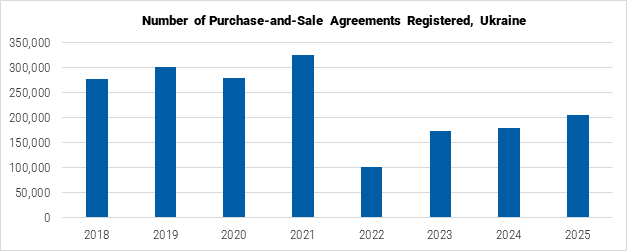
Note: Purchase-and-sale agreements are notarized, completed residential sale transactions recorded through the notarial system, regarded as a general measure of for-sale housing market activity.
Data Source: Ministry of Justice of Ukraine.
Number of residential sales contracts registered in selected regions:
| Number of Residential Sales Contracts Registered, 2025 |
YoY | |
| Kyiv | 34,836 | 2.04% |
| Kyivska region | 17,362 | 24.22% |
| Ukraine | 205,296 | 15.05% |
| Data Source: Ministry of Justice, Ukraine. | ||
That said, market participants generally agree that 2025 was more active than 2024 in relatively safer regions. Yuriy Pita, former president of the Association of Real Estate Specialists of Ukraine, said that “in safer regions, the market was more active” and that it was “more dynamic than in 2024,” pointing to pent-up demand and a gradual shift by some internally displaced households from renting to buying in places where they now expect to stay longer. Oleksandr Boyko likewise described 2025 as a period of final adaptation to wartime conditions, arguing that buyer behavior had become more deliberate and less emotionally driven than in 2022–2023. Together, these views suggest that the market did not normalize in 2025, but it did become more functional, selective, and better adapted to wartime realities.
Housing demand remained strongly focused on affordability, liquidity, and practical resilience. NBU data shows that buyers continue to gravitate toward cheaper homes, typically with smaller floor areas and in older buildings, while the stock most commonly advertised for sale tends to be larger, newer, and therefore more expensive. This mismatch between what is offered and what households are actually willing or able to buy continues to restrain market turnover. At the same time, war-related infrastructure risk has become a more visible part of buyer decision-making. Local market commentary indicates that energy independence is increasingly treated as a new housing standard, with households paying closer attention to autonomous power solutions, gas supply, and the overall operational resilience of a building.
State support measures also remained an important supporting factor for demand in 2025, although they should be seen as supportive rather than transformational. The eOselya program continued to improve financing access for eligible buyers, while eVidnovlennia supported housing purchases by households whose homes had been damaged or destroyed by the war. Together, these programs helped sustain effective demand at the margin, even though they did not fundamentally alter the still-cautious tone of the market.
Looking ahead, the most likely scenario for 2026 is further stabilization, with only gradual improvement in transaction activity, still depending primarily on security conditions, household confidence, and financing availability. Pita argues that housing is a costly and illiquid asset and that even a truce would not trigger an immediate rush to buy. A similarly cautious view is offered by DIM.RIA’s Vitaliy Poberezkyi, who says that in 2026 buyers are likely to remain rational and careful, with only gradual improvement in purchase activity and no sharp jump in transactions under the base-case scenario.
Property Supply Trends
Starts Rebound as Delivery Conditions Remain Uneven
Residential supply in Ukraine showed further signs of stabilization in 2025, although the recovery remained uneven and continued to be shaped by wartime conditions. According to data from Derzhstat, a total of 117,578 new dwellings were completed during the year, marginally down 0.74% year-on-year. The decline was concentrated in apartment buildings, where completions fell by 2.79%, while the detached housing segment remained more resilient, with completions rising by 4.04%.
Apartment buildings still accounted for the majority of completed dwellings, but their share in the delivery mix continued to edge lower as one-dwelling houses gained further weight. Commenting on this shift, Lyudmyla Kiryukhina, Head of LUN Statistics, said the growing share of private houses in completions was “not a coincidence, but a trend dictated by the war,” reflecting households’ stronger preference for the autonomy and perceived security of individual homes under current conditions.
Regionally, supply remained heavily concentrated in the capital region and in a relatively narrow group of western and southern regions. Kyivska region led in the number of completed dwellings with 22,593 units, followed by the city of Kyiv with 18,318 units, and Odeska region with 12,993 units.
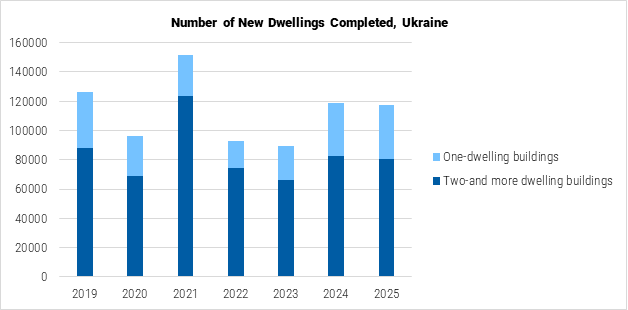
Data Source: Derzhstat.
Top 10 regions with the highest number of dwellings completed:
| Region | Number of New Dwellings Completed, 2025 |
YoY |
| Kyivska | 22,593 | 7.04% |
| Kyiv | 18,318 | -17.05% |
| Odeska | 12,993 | 63.43% |
| Lvivska | 12,594 | -0.26% |
| Vinnytska | 7,142 | -10.74% |
| Ivano-Frankivska | 6,863 | -11.33% |
| Zakarpatska | 5,550 | 43.52% |
| Volynska | 4,588 | -9.35% |
| Khmelnytska | 3,553 | -22.27% |
| Rivnenska | 3,503 | -26.02% |
| Data Source: Derzhstat. | ||
Forward-looking indicators, on the other hand, were considerably stronger. By the end of 2025, the number of dwellings started had risen to 97,078 units, up 40.10% year-on-year and extending the rebound from the 2023 low point. Starts in detached housing increased by 21.08% to 34,330 units, while starts in apartment buildings reached 62,748 units, up 53.27%. Regionally, the largest number of starts was recorded in Kyivska region (24,939 units, +57.98%), followed by Lvivska region (15,454 units, +47.83%) and Ivano-Frankivska region (8,139 units, +32.79%), while the city of Kyiv registered 8,135 dwellings started, up 178.60% year-on-year.
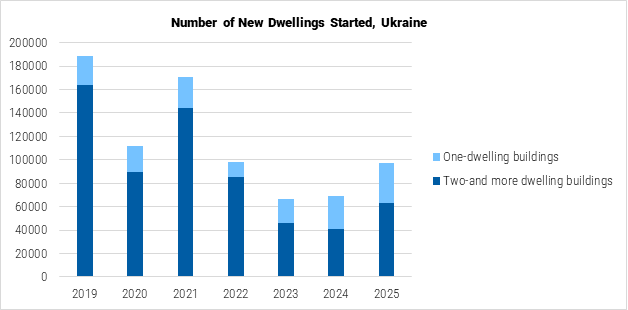
Data Source: Derzhstat.
Even so, the sharp increase in dwelling starts should be interpreted with caution. Although the pipeline improved markedly in 2025, the translation of this activity into completed, market-ready supply is likely to remain gradual. Yevhen Favorov, head of the Ukrainian Association of Developers, noted that bringing new housing to market still takes “at least 2-4 years,” while the Association’s industry survey shows that administrative preparation alone takes, on average, about 14.4 months. Combined with cost pressures, labor shortages, still-subdued demand, and persistent caution toward early-stage purchases in the primary market, this suggests that the rebound in starts is best read as a positive medium-term signal, rather than as evidence of any immediate easing in supply constraints.
Overall, the near-term supply outlook remains one of gradual improvement first in Kyiv and the western regions, where construction activity has proved relatively more resilient. A broader nationwide rebound, however, will still depend primarily on the security situation, the pace and scale of reconstruction funding, and a more predictable regulatory framework for residential development. This remains especially important given the scale of the structural housing deficit, according to the World Bank’s Rapid Damage and Needs Assessment (RDNA5), 14% of Ukraine’s housing stock had been damaged or destroyed by the end of 2025, affecting more than three million households. As a result, even with a stronger starts pipeline, effective housing supply is likely to remain constrained in the near term, while reconstruction needs will continue to shape the market’s medium-term direction.
Rental Market: Rents and Rental Yields
Growth Slows as Regional Divergence Persists
Rental inflation in Ukraine (as measured by the annual change in the actual rentals for the housing component of the consumer price index) slowed, with Derzhstat reporting the indicator at 6.6% in December 2025, below the 8.0% growth in the all-item CPI.
The moderation appears to reflect a fading displacement-driven shock and a more regionally concentrated rental market. As the NBU noted in mid-2025, “Active internal migration’s ad-hoc stimulating effect on the market has faded significantly,” while by year-end internal migration was “providing increasingly less stimulus to demand.” At the same time, rental pressures remained stronger in parts of western Ukraine, while Kyiv saw some correction, and landlords in larger cities became more willing to make price concessions amid wartime disruptions to energy infrastructure.
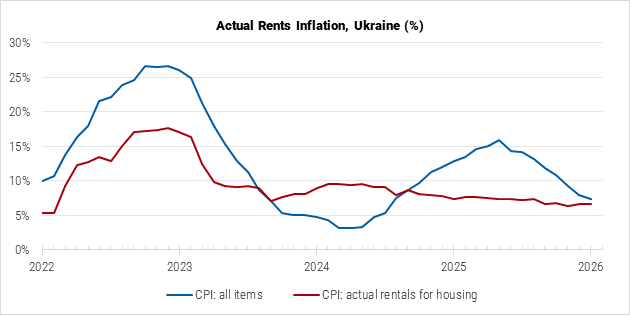
Data Source: Derzhstat.
LUN data likewise points to a more differentiated rental market as of March 2026. In Kyiv, average advertised rents fell by 8.33% year-on-year for one-bedroom apartments and by 7.41% for two-bedroom units, while three-bedroom rents were broadly stable, edging up by 0.72%. By contrast, rent growth remained much stronger in several western markets, including Lviv, Ivano-Frankivsk, and especially Uzhhorod. Among the selected cities, Uzhhorod recorded the highest advertised rents, at UAH 22,200 (USD 506) for a one-bedroom apartment and UAH 31,100 (USD 710) for a two-bedroom unit. Lyudmyla Kiryukhina, Head of LUN Statistics, linked this to wartime location advantages, citing “no curfew” and “proximity to the border” as factors supporting sustained demand.
Average apartment rents in selected submarkets:
| 1-bedroom apt, Mar 2026 |
YoY | 2-bedroom apt, Mar 2026 |
YoY | 3-bedroom apt, Mar 2026 |
YoY | |
| Kyiv | UAH 16,500 (USD 376) |
-8.33% | UAH 25,000 (USD 570) |
-7.41% | UAH 42,200 (USD 963) |
0.72% |
| Lviv | UAH 17,800 (USD 406) |
6.59% | UAH 21,000 (USD 479) |
11.70% | UAH 26,600 (USD 607) |
20.91% |
| Ivano-Frankivsk | UAH 17,800 (USD 406) |
30.88% | UAH 19,900 (USD 454) |
24.38% | UAH 20,000 (USD 456) |
19.76% |
| Uzhhorod | UAH 22,200 (USD 506) |
21.98% | UAH 31,100 (USD 710) |
48.80% | - | - |
| Odesa | UAH 10,000 (USD 228) |
25.00% | UAH 14,000 (USD 319) |
23.89% | UAH 20,000 (USD 456) |
0.00% |
| Dnipro | UAH 11,000 (USD 251) |
4.76% | UAH 15,000 (USD 342) |
0.00% | UAH 18,000 (USD 411) |
12.50% |
| Note: Exchange rate as of March 2026, USD 1= UAH 43.8314. | ||||||
| Data Source: LUN. | ||||||
Affordability remains an important part of the picture. LUN’s salary-to-rent indicators suggest that rental burdens have eased somewhat in Kyiv, where rent absorbs about half of the average salary, but remain materially heavier in western markets, including about 59% in Lviv and 68% in Ivano-Frankivsk. In Uzhhorod, the burden is much higher still, at 79%, underlining how far rents in the safest western border markets have moved relative to local earning capacity. Even so, market liquidity has remained fairly healthy, with listings in Kyiv and Lviv still being rented out within roughly one to one-and-a-half weeks, suggesting moderation rather than outright weakness in tenant demand.
Good Rental Yields
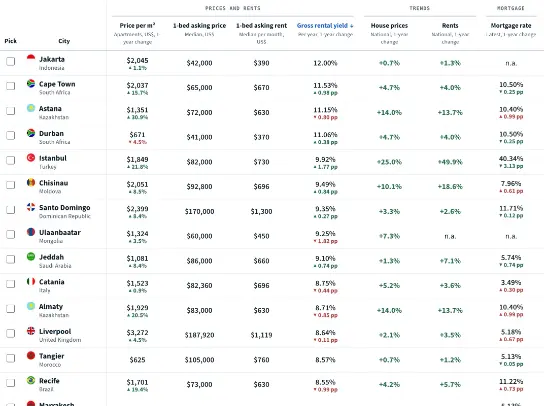
From an investment perspective, gross rental yields averaged 7.55% across Ukraine in March 2026, according to Global Property Guide research, slightly down from 7.77% in July 2025. Among the regional markets tracked, Dnipro led with a yield of 9.76%, followed by Ivano-Frankivsk at 8.15%, Kyiv at 7.27%, and Lviv at 7.17%. In contrast, yields in Kharkiv and Odesa were lower, at 6.97% and 5.99%, respectively.
Looking ahead, Ukraine’s rental market is expected to remain active but uneven in 2026. According to OLX Real Estate, the market is likely to preserve its current dynamics, with further rent growth depending mainly on whether supply continues to tighten. The platform also expects demand to remain concentrated in dwellings with stronger wartime resilience, particularly units with autonomous heating and backup power. As a result, the next phase is likely to bring a continued segmentation between resilient and non-resilient stocks, as well as between cities where relocation-driven demand remains supportive and those where affordability constraints are becoming more binding.
Mortgage Market and Interest Rates
State Support Drives Activity Amid Gradual Rate Normalization
Ukraine's mortgage loan interest rates:
The NBU’s key policy rate was gradually reduced to 13.0% by June 2024, but renewed inflationary pressure prompted the central bank to reverse part of that easing with a sequence of increases, bringing the rate to 15.5% by March 2025. In January 2026, the NBU resumed the monetary easing cycle, cutting the key policy rate by 50 basis points to 15.0%. As the policy meeting stated, “Lower price pressures, driven by NBU monetary policy measures, coupled with weaker risks of insufficient external financing, create room for a justified reduction.” At its March 2026 meeting, however, the NBU left the rate unchanged at 15.0%, postponing further reductions in view of rising inflationary risks and a deterioration in inflation expectations.
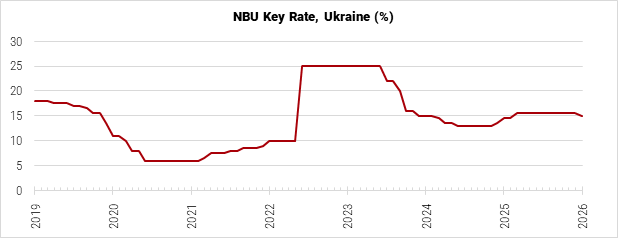
Data Source: NBU.
The earlier cycle of key rate cuts, together with continued state support under the eOselia program, was reflected in lower pricing on new real estate loans. According to NBU survey data, the weighted average effective interest rate on newly issued mortgages in the primary housing segment fell to 7.20% in May 2024, while the secondary-segment rate stood at 7.54%. By January 2026, mortgage pricing had moved modestly above these lows, with the weighted average effective rate reaching 8.15% in the primary segment and 8.97% in the secondary segment. Even so, rates remained well below the post-invasion highs recorded in late 2022.
Effective interest rates on the new mortgage loans to individuals, monthly weighted average:
| January 2026 | YoY | January 2025 | YoY | January 2024 | |
| Primary segment | 8.15% | ↓ | 8.23% | ↑ | 7.25% |
| Secondary segment | 8.97% | ↑ | 8.55% | ↑ | 7.57% |
| Data Source: NBU. | |||||
Decline in mortgage rates helped support a further recovery in lending activity in 2025, even though mortgages remain of limited significance for the broader housing market, with the NBU estimating that less than 3% of housing is purchased on credit overall. New loans for the purchase, construction, and reconstruction of real estate totaled UAH 15.69 billion (USD 371.8 million) between January and December 2025, up 4.26% year on year. Unlike in 2024, when mortgage issuance was still concentrated in the secondary segment, 2025 saw a clear shift toward the primary market, which accounted for about 58% of total new lending volume.
This shift likely reflects the increasing role and refocusing of the state-backed eOselia program toward first-sale and newer housing, including housing under construction and homes commissioned within the previous three years. Launched in October 2022, the scheme has effectively become the main driver of the country’s mortgage market, with 7,769 new loans worth nearly UAH 15 billion (USD 355.5 million) issued in 2025. The program operates with a base interest rate of 7% for eligible groups, which is reduced to 3% for priority categories such as military personnel and certain public-sector professionals. Looking ahead, the NBU expects the state support model for mortgage lending to shift in 2026 toward a compensation-based format, which could make subsidized lending more scalable and leave greater room for the development of market-based mortgage products.
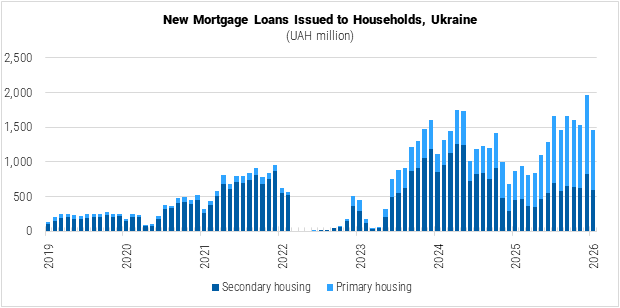
Data Source: NBU.
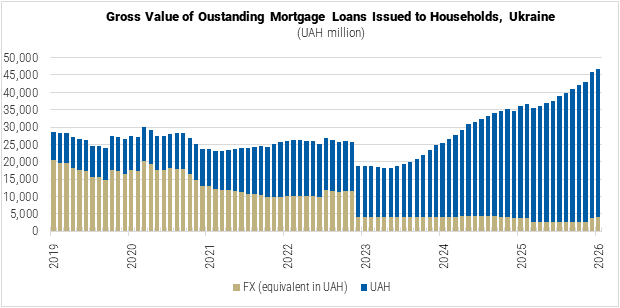
As of January 2026, the gross value of outstanding mortgage loans issued to individuals reached UAH 46.81 billion (USD 1.09 billion), reflecting a 29.98% year-on-year increase. Driven by macroeconomic conditions, geopolitical factors, and the hryvnia-only nature of the eOselia program, the share of loans denominated in local currency rose significantly, to 92% as of January 2026, compared to 61% in January 2022 and 45% in January 2021.
Data Source: NBU.
Economic and Social Factors
Growth and Structural Strains Shape the Recovery Path
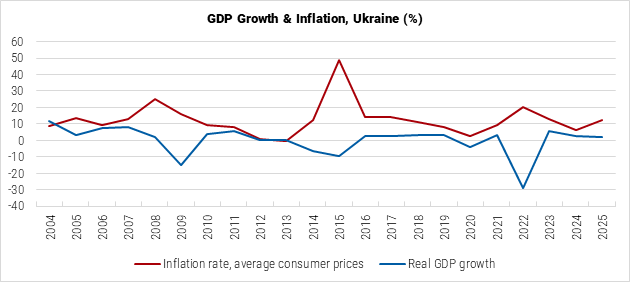
Ukraine’s macroeconomic environment remained relatively resilient in 2025, although the growth trajectory weakened as renewed attacks on energy and other critical infrastructure disrupted economic activity. The International Monetary Fund (IMF) estimates real GDP growth at 1.8%–2.2% in 2025, down from 2.9% in 2024, reflecting the impact of damage to energy facilities, gas production disruptions, blackouts, and record electricity imports. For 2026, growth is projected at 1.8%–2.5%, as the war is expected to continue and labor shortages remain a key constraint on the non-defense private sector, despite some recovery in sectors affected by earlier disruptions. In 2027, assuming the war has largely wound down, growth is expected to strengthen to 3.5%, supported by the return of refugees, the start of reconstruction, easing productivity bottlenecks, and firmer private and public demand.
Inflation, while still elevated, moderated over the course of 2025. Headline CPI growth slowed to 8.0% year-on-year in December, from a peak of 15.9% in May, helped by favorable base effects related to earlier administrative and food price increases, as well as softer growth in some non-food core components. Even so, price pressures remain significant, with inflation still shaped by tight labor market conditions, modest exchange-rate pass-through, and ongoing supply-side disruptions. The IMF expects year-end inflation to remain elevated at 7.5% in 2026 before easing further to 7.0% in 2027, assuming the war begins to wind down and supply constraints, including labor shortages, gradually soften.
Data Source: IMF.
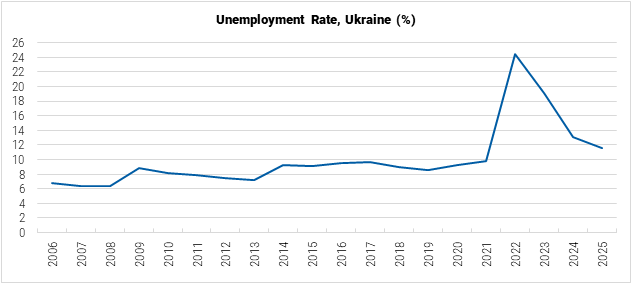
According to the IMF, Ukraine’s unemployment rate declined to 11.6% in 2025, from 13.1% in 2024 and 19.1% in 2023, and is projected to ease further to 10.2% in 2026. The labor market remains structurally tight, with the Fund noting that “labor shortages remain a key constraint on Ukraine’s recovery.” The IMF adds that labor force participation is gradually increasing, but overall employment remains well below pre-invasion levels, while worker scarcity continues to support real wage growth as firms compete to attract and retain labor.
Data Source: IMF.
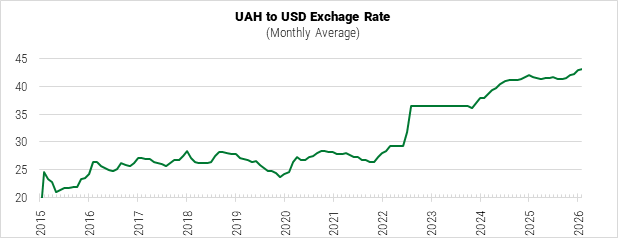
Following the NBU’s move from a fixed exchange rate to a regime of managed flexibility in October 2023, the hryvnia continued its gradual depreciation against the US dollar through 2025. Based on the NBU’s official period-average data, the exchange rate stood at an average of UAH 42.20 per USD in December 2025. As the Centre for Economic Strategy observed, the weakening has remained controlled, as the NBU continues to intervene in the foreign-exchange market to contain excessive fluctuations. With international reserves still at an adequate level, sharp exchange-rate movements appear unlikely in the near term.
Data Source: NBU.
Ukraine continued to depend heavily on external financing to preserve macroeconomic stability and meet wartime budget needs. According to the Ministry of Finance, external budget financing received since the start of the full-scale invasion had reached about USD 173 billion as of 25 March 2026. The Centre for Economic Strategy estimates that foreign aid covered 56% of Ukraine’s additional state budget needs in 2025, down from 73% in 2024, with the ERA program, funded from proceeds on immobilized Russian assets, serving as the main source of financing during the year. In 2026, support from the European Union under the agreed EUR 90 billion loan for 2026–2027 is expected to remain a key pillar of fiscal financing.
Overall, Ukraine’s macroeconomic outlook remains highly uncertain despite continued resilience in a number of key indicators. Large-scale external support and prudent policymaking have helped preserve macroeconomic and financial stability, but the conflict continues to weigh on growth, inflation dynamics, labor supply, and the pace of recovery. As IMF Managing Director Kristalina Georgieva noted following the latest Executive Board discussion, “the war has taken a toll on economic and social conditions, with slowing growth and the outlook remaining subject to exceptionally high uncertainty.”
Sources:
- Government of Ukraine
- Affordable Mortgage Program eOselia…: https://www.kmu.gov.ua/
- The Sources of Ukraine’s State Budget Financing in 2026…: https://mof.gov.ua/
- State Statistics Service of Ukraine (Derzhstat)
- Changes in Housing Market Prices: https://stat.gov.ua/
- Start and Completion of Construction Indicators: https://stat.gov.ua/
- Changes in Prices (Tariffs) for Consumer Goods (Services): https://stat.gov.ua/
- National Bank of Ukraine (NBU)
- Key Policy Rate: https://bank.gov.ua/
- Macroeconomic Indicators: https://bank.gov.ua/
- Official Exchange Rates: https://bank.gov.ua/
- Survey Of Banks On The Volume Of Mortgage Lending: https://bank.gov.ua/
- Financial Stability Report, December 2025: https://bank.gov.ua/
- Financial Stability Report, June 2025: https://bank.gov.ua/
- NBU Cuts Key Policy Rate to 15%. Press Release: https://bank.gov.ua/
- NBU Leaves Its Key Policy Rate Unchanged at 15%. Press Release: https://bank.gov.ua/
- Ministry of Justice of Ukraine
- Report on the Work of State and Private Notaries, the Ministry of Justice of Ukraine, and its Territorial Bodies in the Field of Notaries 2025 (UK): https://minjust.gov.ua/
- International Monetary Fund (IMF)
- Country Overview: Ukraine: https://www.imf.org/
- IMF Country Report No. 26/58. Ukraine: https://www.imf.org/
- World Bank
- Updated Ukraine Recovery and Reconstruction Needs Assessment Released: https://www.worldbank.org/
- European Council
- EU Financial Assistance to Ukraine: https://www.consilium.europa.eu/
- Ukrainian Financial Housing Company
- 7,769 Ukrainians Purchased Their Own Housing Under the e-Housing Program in 2025 (UK): https://ukrfinzhytlo.in.ua/
- eOselia Program
- Program Overview (UK): https://eoselia.diia.gov.ua/
- Centre for Economic Strategy
- Ukraine War Economy Tracker: https://ces.org.ua/
- Ukrainian Association of Developers
- The Government is Driving Demand, but the Market Lacks Supply…(UK): https://www.ua-developers.com.ua/
- LUN
- Primary Market Statistics (UK): https://lun.ua/
- Secondary Market Statistics (UK): https://lun.ua/
- Rental Market Statistics (UK): https://lun.ua/
- The Pace of Housing Commissioning Stabilized at Pre-Covid Levels (UK): https://lun.ua/
- OLX Real Estate
- What Was 2025 Like in the Real Estate Market? Main Results. (UK): https://business.olx.ua/
- Interfax-Ukraine
- The Cost of Housing Construction in Ukraine Will Grow Moderately in 2026… (UK): https://interfax.com.ua/
- Unian
- Square Meters Under Rockets. What 2026 Will Bring to Home Buyers and Renters (UK): https://www.unian.ua/
- LIGA.net
- Uzhhorod's Prices are Higher Than Kyiv's…: https://biz.liga.net/