Aruba's Residential Property Market Analysis 2025
Aruba’s housing market continues to attract foreign investors, driven by a strong tourism economy, consistently rising demand for short-term rentals and vacation homes, as well as competitive property prices.
This extended overview from the Global Property Guide covers key aspects of the Aruban housing market and takes a closer look at its most recent developments and long-term trends.
Table of Contents
- Market Defining Features and Trends
- Real Estate Hotspots
- Rental Market
- Mortgage Market
- Socio-Economic Context
Market Defining Features and Trends
Aruba's residential real estate market is defined by stability, relative affordability, and an enduring investor-friendly climate, making it an attractive destination for international buyers. Its strategic location outside the hurricane belt minimizes natural disaster risks, while political stability as part of the Kingdom of the Netherlands further strengthens investor confidence. Combined with housing that remains competitively priced compared to other Caribbean markets, Aruba continues to draw those seeking vacation homes, retirement properties, or long-term investment opportunities.
Tourism remains the cornerstone of both Aruba's economy and its housing market. The island's robust tourism sector continues to drive demand for accommodation across a variety of segments, from short-term vacation rentals to second homes and investment properties, supporting healthy rental yields and steady capital appreciation. According to research by the Amsterdam Bureau for Economics, as of 2023, at least 11% of vacation rental properties in the country were owned by non-residents, underscoring the growing participation of foreign investors in the housing market.
Aruba maintains one of the most transparent and accessible real estate frameworks in the region. Foreign buyers face no restrictions on property ownership, whether on a freehold or leasehold basis. Leasehold arrangements typically extend up to 60 years and may be renewed or transferred, providing long-term tenure security. Property ownership is not contingent on residency, further enhancing the island's appeal among global investors seeking a straightforward acquisition process.
According to the latest data from Global Property Guide, as of June 2025, average residential prices in Aruba stood at approximately USD 355,000 for a one-bedroom unit, USD 475,777 for a two-bedroom, USD 545,000 for a three-bedroom, and USD 589,446 for properties with four or more bedrooms.
Market analysts note that continued price appreciation is primarily driven by constrained supply in prime coastal areas. "Aruba's real estate market thrives on scarcity," noted AIInvest. "The island's limited stock of premium waterfront properties, particularly in Palm Beach and Oranjestad, has supported consistent value growth. San Nicolas, once a hidden gem, is now emerging as a preferred destination for retirees and families seeking a balance of luxury and affordability. Meanwhile, Oranjestad's cultural vibrancy and accessibility make it an attractive choice for investors focused on both rental income and long-term appreciation."
Following a brief slowdown in 2024, residential construction activity rebounded strongly in early 2025. Data from the Central Bank of Aruba (CBA) show that the number of residential building permits issued rose by 51.95% year-on-year in the first half of 2025. House permits increased 57.98%, while apartment permits were up 25.58%. The total value of approved projects nearly doubled, surging 99.82% year-on-year to AWG 127.5 million, signaling renewed developer confidence and sustained investment momentum in the sector.
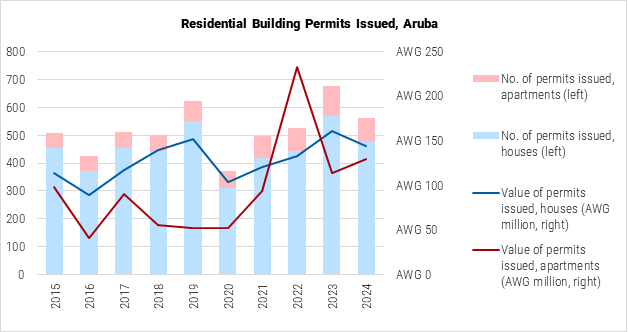
Data Source: CBA.
Real Estate Hotspots:
Diverse Residential Landscape in Key Markets
Aruba's residential landscape comprises a wide range of housing options that reflect the island's geographical diversity and distinct regional dynamics. From the luxury communities of Noord and the urban setting of Oranjestad to the coastal tranquility of Savaneta and the transforming environment of San Nicolas, each area caters to specific resident and investor profiles.
Due to the absence of a centralized Multiple Listing Service (MLS) or publicly accessible database of real estate transactions, submarket assessments in Aruba rely on the aggregation of available listing data and qualitative insights from local real estate agencies and professionals. Consequently, reported prices and trends should be interpreted as indicative rather than definitive measures of market conditions.
Noord
Noord, located just north of the capital, Oranjestad, is widely regarded as one of the island's most desirable residential districts. Its coastal position, extending across the northern shoreline, encompasses several of Aruba's most sought-after locations, including Palm Beach, an area closely tied to the tourism sector, and Malmok, noted for its oceanfront villas and proximity to major golf facilities.
The district's housing stock consists primarily of higher-end properties, combining vacation homes and permanent residences. Modern gated developments are common and typically targeted at upper-income households and foreign investors. Notable residential communities include Gold Coast Aruba, Tierra del Sol, Opal Villas, and Esmeralda Residences. Continued expansion in the district is evident through ongoing projects such as Orquidea Residences and The Moon, reflecting sustained developer confidence and demand for premium housing.
As of October 2025, according to listings from the Association of Aruban Realtors (AAR), condominium and apartment prices in Noord ranged from USD 249,000 for a one-bedroom ground-floor unit at Villas del Mar in Matadera to USD 7,500,000 for an exclusive six-bedroom beachfront condominium at Oceania Residences. Detached houses, cottages, and villas were listed from USD 330,000, with top-tier properties reaching USD 5,500,000, reflecting the area's position at the upper end of the island's residential market oriented towards international investors.
Housing market snapshot, Noord:
| Min Price | Max Price | Number of listings | |
| Apartments and condominiums | |||
| 1-bedroom | USD 249,000 | USD 385,000 | 15 |
| 2-bedroom | USD 210,000 | USD 1,175,000 | 46 |
| 3-bedroom | USD 440,000 | USD 1,650,000 | 29 |
| 4+ bedroom | USD 799,000 | USD 7,500,000 | 5 |
| Single-family houses | |||
| 1-bedroom | - | - | 0 |
| 2-bedroom | USD 330,000 | USD 1,750,000 | 14 |
| 3-bedroom | USD 405,000 | USD 2,000,000 | 49 |
| 4+ bedroom | USD 420,000 | USD 5,500,000 | 92 |
| Data Source: Association of Aruban Realtors. | |||
Oranjestad
Oranjestad, the island's capital and largest urban area, functions as the administrative, economic, and cultural center of Aruba. The city extends along the western coast, combining heritage architecture in the historic core with newer residential developments closer to the waterfront. Housing options in and around Oranjestad are highly diverse, ranging from restored colonial properties to modern condominiums and apartment buildings near the harbor. This variety accommodates both local residents and expatriates seeking proximity to employment, amenities, and transport connections.
Property values in Oranjestad are influenced by its central location, developed infrastructure, and concentration of public services, including schools, healthcare facilities, and retail centers. The city's role as the island's administrative hub underpins steady demand and stable price growth. Recent urban redevelopment projects have further altered its residential landscape. The City Place Development is transforming the former La Linda District into a mixed-use complex integrating luxury housing with retail and office components, while Caribbean Town, located near Eagle Beach, incorporates sustainable design features and contemporary architecture in a mix of apartments, townhouses, and villas.
As of October 2025, AAR listings indicated condominium and apartment prices in Oranjestad between USD 230,000 and USD 5,500,000. Detached houses, cottages, and villas were priced from USD 135,955 to USD 1,999,500. This wide range reflects both the diversity of the housing stock and the city's dual role as a local residential center and an area of interest to international investors.
Housing market snapshot, Oranjestad:
| Min Price | Max Price | Number of listings | |
| Apartments and condominiums | |||
| 1-bedroom | USD 230,000 | USD 669,000 | 12 |
| 2-bedroom | USD 299,500 | USD 1,700,000 | 27 |
| 3-bedroom | USD 365,000 | USD 2,336,098 | 14 |
| 4+ bedroom | USD 1,700,000 | USD 5,500,000 | 5 |
| Single-family houses | |||
| 1-bedroom | - | - | 0 |
| 2-bedroom | USD 135,955 | USD 450,000 | 8 |
| 3-bedroom | USD 210,000 | USD 1,450,000 | 28 |
| 4+ bedroom | USD 241,000 | USD 1,999,500 | 68 |
| Data Source: Association of Aruban Realtors. | |||
Savaneta
Savaneta, situated on Aruba's southeastern coast, is one of the island's oldest settlements and retains a predominantly traditional, low-density character. Known for its fishing heritage, calm coastal areas, and limited tourist infrastructure, Savaneta appeals to residents seeking a quieter environment, including retirees and long-term locals. The area's housing market is more moderately priced compared with Noord and Oranjestad, although certain properties benefit from direct beach access and sea views. The district contains a mix of older, locally built homes and more recent coastal developments, with growing demand for land parcels suited to custom housing.
As of October 2025, AAR listings showed detached houses, cottages, and villas in Savaneta priced between USD 224,157 and USD 5,200,000, indicating an increasingly diverse buyer profile and rising interest in this part of the island.
Housing market snapshot, Savaneta:
| Min Price | Max Price | Number of listings | |
| Single-family houses | |||
| 1-bedroom | - | - | 0 |
| 2-bedroom | USD 224,157 | USD 595,000 | 6 |
| 3-bedroom | USD 238,764 | USD 678,486 | 14 |
| 4+ bedroom | USD 260,155 | USD 5,200,000 | 25 |
| Data Source: Association of Aruban Realtors. | |||
Paradera
Paradera, located inland to the northeast of Oranjestad, has developed into a stable suburban area characterized by lower density and a more residential focus. It is particularly popular among local families and residents seeking a quiet environment while maintaining reasonable access to the capital and the coast. The area offers ample land availability, making it suitable for larger plots and single-family housing. Compared with the coastal markets, Paradera remains more affordable and oriented toward middle-income households. New residential projects such as Reina Sophia Residences are expanding the housing supply and contributing to gradual growth in this submarket.
As of October 2025, detached houses, cottages, and villas in Paradera were priced between USD 285,000 and USD 1,275,000, confirming its role as a mid-range residential area offering stable long-term value.
Housing market snapshot, Paradera:
| Min Price | Max Price | Number of listings | |
| Single-family houses | |||
| 1-bedroom | - | - | 0 |
| 2-bedroom | USD 285,000 | USD 355,000 | 2 |
| 3-bedroom | USD 447,000 | USD 640,000 | 6 |
| 4+ bedroom | USD 499,000 | USD 1,275,000 | 18 |
| Data Source: Association of Aruban Realtors. | |||
Santa Cruz
Santa Cruz, located in the island's central region, is largely residential and agricultural in character. Its proximity to Arikok National Park gives the area a distinct natural appeal, attracting residents who prefer a rural lifestyle within an accessible distance of Oranjestad. The housing stock comprises a combination of traditional Aruban dwellings, newer family homes, and agricultural plots. Property prices in Santa Cruz are among the lowest on the island, though demand has been increasing due to the availability of larger plots and relative affordability.
As of October 2025, AAR data indicated detached houses, cottages, and villas priced from USD 185,393 to USD 1,300,000, with most listings concentrated in the mid-range segment.
Housing market snapshot, Santa Cruz:
| Min Price | Max Price | Number of listings | |
| Single-family houses | |||
| 1-bedroom | - | - | 0 |
| 2-bedroom | USD 185,393 | USD 515,000 | 3 |
| 3-bedroom | USD 317,715 | USD 1,573,033 | 11 |
| 4+ bedroom | USD 351,123 | USD 1,300,000 | 19 |
| Data Source: Association of Aruban Realtors. | |||
San Nicolas
San Nicolas, situated at the southern end of the island, is Aruba's second-largest city and historically served as the industrial center due to the presence of the oil refinery. In recent years, the district has undergone gradual revitalization efforts supported by both public and private initiatives. Key projects include the Aruba Cultural Mall, designed to accommodate retail, educational, and community spaces, and the new Secrets Baby Beach Aruba by Hyatt, whose first phase was completed in 2025. Improvements to utilities and local infrastructure are also underway, contributing to enhanced residential conditions.
San Nicolas remains one of the most affordable housing markets in Aruba. The area features a mix of older housing stock and new infill construction, attracting first-time buyers and households seeking competitively priced properties. With redevelopment initiatives continuing, moderate price appreciation is anticipated over the medium term.
As of October 2025, AAR listings recorded detached houses, cottages, and villas priced between USD 98,315 and USD 850,000, confirming San Nicolas's position as the island's most accessible residential submarket.
Housing market snapshot, San Nicolas:
| Min Price | Max Price | Number of listings | |
| Single-family houses | |||
| 1-bedroom | - | - | 0 |
| 2-bedroom | USD 98,315 | USD 395,000 | 3 |
| 3-bedroom | USD 140,499 | USD 385,715 | 6 |
| 4+ bedroom | USD 174,160 | USD 850,000 | 7 |
| Data Source: Association of Aruban Realtors. | |||
Rental Market:
STR Segment Expansion Continues
Similar to other tourism-focused destinations in the region, Aruba's rental market is notably tilted towards timeshares, vacation homes, and short-term holiday rentals. A 2023 analysis by the Amsterdam Bureau for Economics pointed out that vacation home rentals have over 4,200 units that make up 11% of the housing stock on the island and provide more rooms than hotels and timeshares.
Aruba's rent price index:
Note: Aruba Rent Price Index, % change 1 year, nominal.
Data Source: CBS.
The growing popularity of alternative means of accommodation, including short-term rentals (STR), is also evident in the Aruba Tourism Authority (ATA) reporting, which shows the market share of visitors staying outside of traditional hotels, resorts, or timeshares growing from 13% in 2009 to 33% in 2024. In the first eight months of 2025, the share of tourists staying in 'other' accommodations exceeded 35%. The average occupancy of vacation rentals increased from 49% in 2019 to 58% in 2024.
As of October 2025, data from AirDNA shows the largest number of active short-term rental listings concentrated in Noord. Among the more active local submarkets (with 50 or more active listings), the highest average daily rates, exceeding AWG 500 (USD 278), are reported in Eagle Beach and Noord. Seasonal occupancy levels fluctuate between 80-90% in February and 50-60% in October.
Key short-term rental indicators across selected submarkets as of October 2025:
| Submarket | Total Active Listings | Average Daily Rent (AWG) | Average Daily Rent (USD) | Average Occupancy (%) |
| Noord | 2,605 | AWG 597.3 | USD 331.8 | 69% |
| Oranjestad | 721 | AWG 280.1 | USD 155.6 | 65% |
| Eagle Beach | 388 | AWG 670.3 | USD 372.4 | 77% |
| Savaneta | 190 | AWG 490.7 | USD 272.6 | 62% |
| Santa Cruz | 110 | AWG 309.6 | USD 172.0 | 62% |
| Paradera | 109 | AWG 307.4 | USD 170.8 | 68% |
| Exchange rate USD 1 = AWG 1.8. | ||||
| Note: Submarkets with at least 50 active listings selected. Total active listings - number of listings viewable on Airbnb and/or VRBO with at least one prior booked night. | ||||
| Data Source: AirDNA. | ||||
The active development of the short-term rental segment raises concerns regarding its possible contribution to the housing shortage on the island and exacerbation of housing affordability issues for the local population, as entire homes are withdrawn from the regular residential stock and turned into commercial operations, often held by sizable market players rather than individual homeowners.
The authorities in Aruba have also been increasingly focusing on the issue of regulation and improved management for the sector, acknowledging the need to ensure international STR investors pay all taxes and revenues correctly. As part of their mid-year review in July 2025, the Department of Tax (DIMP) emphasized that offering property for rent, especially for short-term stays, constitutes economic activity and must be reported; depending on the setup, rental income could be subject to turnover tax, corporate tax, or income tax. In collaboration with the ATA, DIMP is now using specialized software to identify unregistered listings and enforce compliance.
At the same time, long-term rent remains highly relevant for the Aruban population. The 2020 Census data showed that 22.3% of the country's housing units were occupied by paying tenants.
According to research conducted by Global Property Guide in June 2025, average asking rent in Aruba stood at USD 925 for 1-bedroom units, USD 2,100 for 2-bedroom units, USD 2,750 for 3-bedroom units, and USD 3,650 for larger units with 4 or more bedrooms. The corresponding gross rental yields averaged 5.48%, slightly down from 5.79% previously reported in October 2024.
A brief summary of the regulations in the rental sector published by the Government Information Agency stipulates that rental prices in Aruba's housing market are free and primarily determined by the property's location, size, and state of maintenance. At the same time, the country's Civil Code provides for a certain level of government involvement in rental matters, including rent-setting and rent increases in specific cases. For example, a government-appointed rent assessment committee is authorized to establish the maximum rent for premises with a market value of AWG 150,000 (about USD 83,300) or less. A more detailed overview of the recent amendments to the civil code relating to rents is available from HBN Law & Tax, a legal firm specializing in the Dutch Caribbean.
Mortgage Market: Interest Rates Steady, Loan Stock Grows Gradually
Mortgage Market:
Interest Rates Steady, Loan Stock Grows Gradually
Aruba has a sizeable financial sector, dominated by four commercial banks, the largest of which is local, and the rest are foreign subsidiaries of banks from Canada and Curacao. There is also a specialized mortgage bank, as well as several credit unions, insurance companies, and pension funds that provide lending services to the population.
The weighted average interest rate on housing mortgages issued by commercial banks in Aruba has gradually declined from the 6-7% level a decade ago and has been relatively stable between 5.0% and 5.5% over the last three years. Most recently, the Central Bank of Aruba (CBA) reported the indicator at 5.3% in Q2 2025.
As outlined in the 2023 technical assistance report from the International Monetary Fund (IMF), over the last 10-15 years, lending rates in Aruba have generally declined, in part due to the increasing competition between lenders, the relatively weak loan demand, and the excess liquidity in the system. According to the IMF assessment, mortgage interest rates are now considered stable, and a significant rise is unlikely in the upcoming periods.
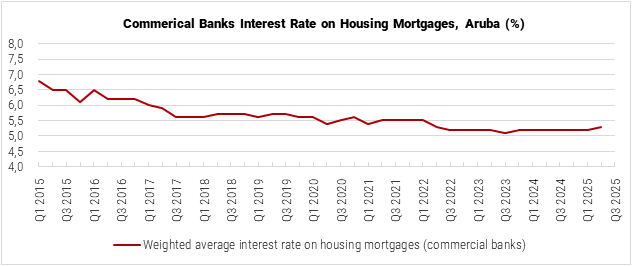
Data Source: CBA.
Despite the dominance of fixed-term contracts and stable interest rates, domestic demand for housing loans is moderate. The results of a recent consumer confidence survey published by the CBA showed that only 15.5% of respondents see taking a mortgage as suitable. The total value of new housing mortgages taken out in 2024 showed a 6.3% year-on-year increase, while the number of these loans increased by 1.0% according to the central bank's reporting. A more pronounced growth in value compared to volume of new credit indicates larger individual loans due to growing prices for materials and services related to housing construction, rather than a substantial pick-up in demand.
Overall, based on August 2025 figures from the CBA, mortgage loans in Aruba are primarily used by the resident population and businesses, with only 6.6% of the total mortgage assets of the commercial banks (combining housing and commercial mortgages) attributed to non-resident borrowers. The IMF assessment also notes that a large part of the non-resident investors on the island continue to settle their purchases with cash.
Against this background, the overall size of the housing mortgage portfolio maintained by the country's financial system has been growing steadily, annually expanding by 3.6%, on average, in the last decade and reaching AWG 2.31 billion (USD 1.28 billion) at the end of 2024, according to the CBA data from the Central Bank of Aruba (CBA). The largest share of outstanding housing credit (73%) is held by commercial banks, and the remainder is split between the mortgage bank (9%) and other financial institutions (18%).
Outside of the 2020 spike (when the tourism-dependent economy of Aruba contracted sharply), the total value of housing credit has remained relatively stable in relation to the country's GDP and was estimated to equal 30.8% of GDP at current prices in 2024. At the same time, in the concluding statement for the 2025 Article IV Mission the IMF staff noted that Aruba needs to remain vigilant to financial system vulnerabilities related to the growing exposure of commercial banks to residential real estate: "While overall financial stability risks are low, rising real estate and mortgage lending warrant close monitoring of underwriting standards and household debt and income."
While the CBA has yet to introduce borrower-based macro-prudential measures, individual banks already apply conservative standards to manage exposure risks, allowing an LTV of 60% for non-residents purchasing a property on the island and an LTV of 70-80% of execution value for local mortgage buyers.
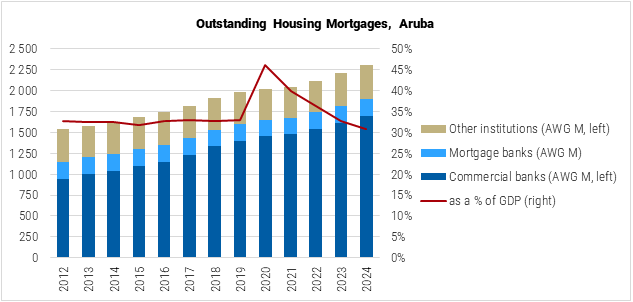
Data Source: CBA.
Socio-Economic Context:
Strong Post-Pandemic Economic Performance Continues, Expected to Moderate
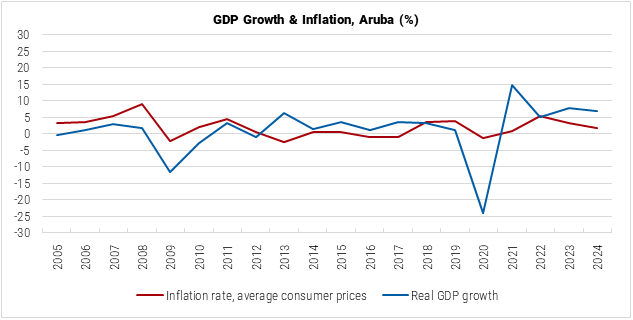
Driven by a strong post-pandemic tourism rebound, Aruba's economy continues to expand. The country's real GDP growth reached 7.7% in 2023 and 6.8% in 2024, according to the IMF data. The pace of growth, however, is expected to moderate in the upcoming periods, as the impact of tourism rebound fades, gradually converging toward its estimated potential. In the near term, the latest economic outlook from the CBA anticipates the indicator to reach 2.1% in 2025 and 2.9% in 2026. Over the medium term, the IMF forecasts the economy to slow to an annual growth rate of 1.3%.
The consumer price index (CPI) inflation in Aruba slowed from 5.1% in 2022 to 1.7% in 2024 and continued to decelerate this year, most recently reported in negative territory at -0.8% in August 2025. The CBA projects a twelve-month average inflation rate of 0.9% in 2025, driven by the core component; in 2026, inflation is forecast to reach 2.0%, consistent with the long-term average. These projections are in line with the IMF forecast of respective 0.8% and 2.1% inflation levels.
Data Source: IMF.
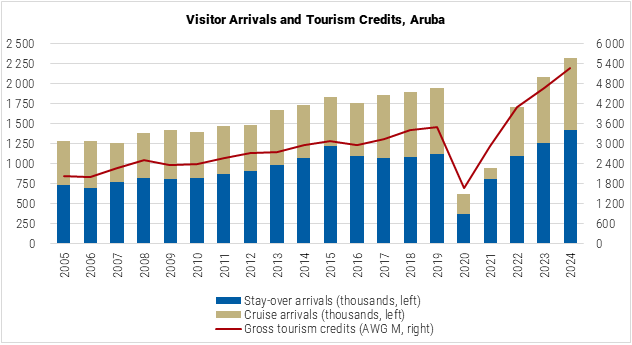
The economy of Aruba continues to rely on tourism as its main source of income and a driver supporting the development of construction and other related sectors. After a sharp decline in both stay-over and cruise segments in 2020 and 2021, the industry recovered rapidly, exceeding its pre-pandemic benchmarks by 2023.
According to the CBA reporting based on data from the Aruba Tourism Authority and the Cruise Tourism Authority, in 2024 the country welcomed over 2.3 million visitors (of which about 61% were stay-over tourists and about 39% were cruise passengers). A corresponding strong growth was also observed in the gross tourism credits indicator (compiled from transactions in foreign currency, traveler's checks, and credit cards, as reported by foreign exchange banks), which reached AWG 5.3 billion (USD 2.9 billion).
The early 2025 figures, however, indicate a potential moderation of the trend this year. While the stay-over arrivals in H1 2025 continued to grow and exceeded the comparable period last year by 3.3%, cruise ship arrivals dropped by 5.3% year-on-year during the same period, leading to the overall 0.3% year-on-year decline in arrivals.
Most stay-over tourists arrive on the island from the US (74.4%, as of H1 2025); the rest of the demand is represented by Latin America (13.6%), Europe (4.3%), including the Netherlands (2.3%), and the rest of the world (2.3%).
Data Sources: CBA, Aruba Tourism Authority, Cruise Tourism Authority.
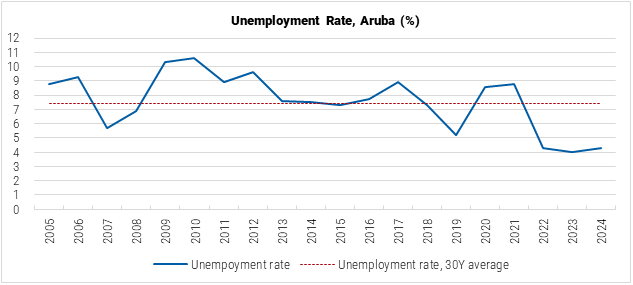
In the Aruban labor market, due to strong labor demand supported by higher labor force participation, nationwide unemployment dropped from 8.8% in 2021 to 4.3% in 2024, moving safely below the 30-year average, according to the IMF figures. The CBA economic outlook also notes that in 2024, nominal wages likely grew stronger than inflation, as public sector employees in Aruba received a 6.0% wage indexation, and private sector employees benefited from a tight labor market. At the same time, continuously tight labor market conditions could potentially constrain tourism-driven growth unless the assumed by the authorities volume of labor imports meets the growing industry needs.
Data Source: IMF.
The overall economic outlook for Aruba is favorable, with moderate growth expected in the medium term. In March 2025, Fitch Ratings upgraded it to a 'BBB-' standing with a positive outlook, citing the considerable progress Aruba has made in reducing its general government debt ratio (supported by recent high fiscal surpluses), as well as the ongoing institutionalization of the country's fiscal framework and demonstrated institutional and financial support of the Netherlands.
Sources:
- Central Bank of Aruba (CBA)
- Exchange Rates: https://www.cbaruba.org/
- Monthly Tables: https://www.cbaruba.org/
- Quarterly Tables by Sector: https://www.cbaruba.org/
- Annual Statistical Digest: https://www.cbaruba.org/
- State of the Economy: https://www.cbaruba.org/
- Economic Outlook: https://www.cbaruba.org/
- List of Financial Institutions Under Supervision of the CBA: https://www.cbaruba.org/
- Central Bureau of Statistics (CBS)
- Census 2020, Housing Tables: https://cbs.aw/
- Aruba Tourism Authority
- 2024 Annual Report: https://aruba.bynder.com/
- August 2025 Monthly Report: https://aruba.bynder.com/
- Government Information Agency
- Civil Code of Aruba (Second Edition) (NL): https://cuatro.sim-cdn.nl/
- Renting a Home (NL): https://www.gobierno.aw/
- A.T.A.: Hotels and STVRs are an Integral Part of the Offering: https://www.gobierno.aw/
- Amsterdam Bureau for Economics
- Vacation Home Rentals and Carrying Capacity: https://publico.aw/
- International Monetary Fund (IMF)
- Country Overview: Kingdom of the Netherlands-Aruba: https://www.imf.org/
- Kingdom of the Netherlands-Aruba: Staff Concluding Statement of the 2025 Article IV Mission: https://www.imf.org/
- Kingdom of the Netherlands-Aruba: Technical Assistance Report-Financial Stability Diagnostic and Scoping Mission: https://www.imf.org/
- Association of Aruban Realtors (AAR)
- Real Estate Listings: https://arubalistings.com/
- AirDNA
- Short-Term Rental Markets: Aruba: https://app.airdna.co/
- Fitch Ratings
- Fitch Upgrades Aruba to 'BBB-'; Outlook Remains Positive: https://www.fitchratings.com/
- HBN Law & Tax
- Recent Changes To Aruba Lease Law: https://hbnlawtax.com/
- Invest In Aruba
- Revitalizing San Nicolas: A New Era of Investment and Growth in Aruba's Sunrise City: https://www.investinaruba.com/
- AInvest
- Aruba's Tourism-Driven Economy: A Strategic Investment in Caribbean Real Estate and Hospitality: https://www.ainvest.com/
- Aruba News
- Property Owners Renting to Tourists or Locals Will Be Taxed: https://arubanews.ca/