Property Investment in Vietnam: Foreigner’s Guide (2025)
Vietnam has one of the fastest-growing economies in Southeast Asia, with increasing industrial, retail, and tourism industries.
The rising middle class is also keeping the housing demand strong. These factors, combined with recent infrastructure investments, are enticing foreign buyers to invest in Vietnamese real estate.
This updated 2025 edition guide will take you through the basic steps and important things to consider when buying property in Vietnam as a foreign first-time buyer.
12 Things to Know Before Buying a Property in Vietnam
- Can Foreigners Buy Property in Vietnam
- Best Cities and Regions to Invest
- Square Meter / Square Foot Prices
- Median Asking Prices
- Rental Yields and Rents
- Historical Market Performance
- Landlord and Tenant Laws
- Property Related Taxes
- Buying (and Selling) Costs
- Short-Term Rental Regulations
- Mortgage and Financing Options
- Buying Property in Vietnam: Step-by-Step
1) Can Foreigners Buy Property in Vietnam?
Yes, foreigners are allowed to buy property in Vietnam, but with important limitations.
While foreign investors can own a structure, like a condo or house, they cannot buy the land the structure sits on. Instead, property usually requires a long-term leasehold agreement, often lasting 50 years or more, with the possibility of renewal. However, these renewal laws could change.
Another important note, Vietnam’s Housing Law 2023, which went into effect in August 2024, puts caps on how much property in various locations can be owned by foreigners.
2) Best Regions and Cities to Invest
The following cities provide a variety of real estate opportunities, from vibrant urban living and high-end properties to tech-driven hubs and government-focused districts, each suited to different investor goals and lifestyle preferences.
The following cities in Vietnam offer a broad spectrum of real estate opportunities, from booming metropolitan areas and luxury beachfront developments to emerging tech zones and culturally rich urban centers, each appealing to different investment strategies and lifestyle needs.
1. Ho Chi Minh City
As Vietnam’s economic powerhouse, Ho Chi Minh City is a top destination for both residential and commercial real estate. Districts like District 1, Thao Dien (District 2), and District 7 are especially popular among investors for their vibrant lifestyles, international schools, upscale apartments, and proximity to business hubs.
The city's rapid urbanization, strong rental demand, and ongoing infrastructure projects make it a compelling choice for long-term growth.
2. Hanoi
The political and cultural capital of Vietnam, Hanoi, blends historical charm with modern development. Areas such as Tay Ho (West Lake), Ba Dinh, and Cau Giay are highly sought after for their mix of diplomatic missions, high-end residences, and commercial centers.
With a growing expat population and expanding transport network, Hanoi’s property market continues to offer solid returns, especially for those seeking stable and diversified real estate assets.
3. Da Nang
This central coastal city is quickly becoming a hotspot for both tourism and investment. Known for its clean environment, beaches, and friendly business climate, Da Nang offers a mix of beachfront villas, modern condominiums, and commercial properties. Districts like Ngu Hanh Son and Hai Chau are in high demand.
The city’s strategic location between Hanoi and Ho Chi Minh City, along with its growing tech sector, enhances its appeal for mid- to long-term investors.
4. Nha Trang
Famous for its tourism-driven economy and scenic coastline, Nha Trang is ideal for investors interested in hospitality and vacation real estate. With increasing international arrivals and a flourishing domestic tourism market, beachfront developments, resorts, and short-term rental properties remain strong investment options. The city also benefits from ongoing infrastructure upgrades and improved connectivity via Cam Ranh International Airport.
5. Binh Duong
Located just north of Ho Chi Minh City, Binh Duong is an emerging industrial and residential hub. With numerous industrial parks, foreign manufacturing firms, and a rapidly growing workforce, the area is seeing increasing demand for affordable housing and commercial real estate. Urban zones like Thu Dau Mot and Di An are transforming quickly, offering promising returns for early-stage investors in Vietnam’s expanding secondary cities.
3) Square Meter / Square Foot Prices
Vietnam’s square meter prices are some of the lowest in Asia. Below is the average price for luxury apartments as of July 2025:
- Hanoi: $3,019
4) Median Asking Prices
Property prices in Vietnam are in the moderate range compared to other Asian countries.
One-bedroom prices average as follows:
- Hanoi: $177,000
- Ho Chi Minh City: $153,000
While these are averages, prices range widely depending on the part of the city. For example, Hanoi’s Gia Lâm neighborhood’s one-bedroom apartments average $127,526 and have slightly higher yields than the city’s most expensive area, Ba Đình, where the median price is almost three times that amount ($384,539).
5) Rental Yields and Rents
Vietnam’s median rental yields are poor compared to other Asian countries, averaging 3.26% as of February 2025.
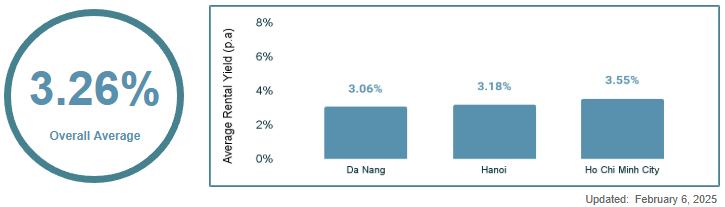
The following are median rental yields for one-bedroom apartments across key Vietnamese cities:
- Hanoi: 3.11%
- Ho Chi Minh City: 3.34%
- Da Nang: 2.34%
While parts of Ho Chi Minh City had the highest yields on one-bedroom apartments, with District 4 (4.56%) and Nhà Bè (4.18%) topping the list, the city has recently outlawed most short-term rentals.
6) Market Performance (Past and Present)
During the 2008 financial crisis, Vietnam’s property prices sharply fell, and several banks went bankrupt. In 2013, the Vietnamese government stepped in with a $1.4 billion stimulus package, which helped the real estate market get back on its feet.
Since that time, Vietnam’s luxury property market has grown, drawing foreign investors from across the globe, especially as the country has recently invested in improving infrastructure and more citizens are moving financially upward.
Vietnam is experiencing a strong economy thanks to major growth in tourism, manufacturing, and retail industries, and home ownership. These factors — combined with fewer regulatory hurdles and new markets for foreign investors — are making Vietnam’s real estate market a top Southeast Asia investment destination in 2025.
Vietnam' house price annual change:
Data Source: Jones Lang LaSalle.
7) Landlord and Tenant Laws
Vietnamese landlord and tenant laws are judged by the Global Property Guide to be slightly Pro-Landlord between landlord and tenant. Landlords have the right to negotiate rent and lease terms, making a thorough lease agreement essential.
As of August 2024, Housing Law 2023 introduced numerous changes with increased requirements for property maintenance and upgrades. The new provisions that impact tenant rights, primarily regarding maintenance and upgrades, such as having to pay for tenants to stay elsewhere during repairs or being reimbursed for needed repairs if landlords do not quickly act. If the property is upgraded, landlords can increase rent to cover those costs if only one-third or less of the lease term remains. However, tenant protections vary based on how well individuals understand their rights and how well local authorities enforce the laws.
8) Property Related Taxes
Taxes for foreigners owning property in Vietnam are the same as for Vietnamese citizens.
Rental income above the tax-free threshold of VND 100 million – approximately $4,000 per year or $333 per month – is taxed at a flat 5% personal income tax, with no deductions for costs allowed. Property owners or their legal representatives must visit the local tax office to obtain a special tax ID for property-related income. Taxes can either be paid annually or on an as-earned basis.
Rental income above the $4,000 threshold is also subject to a 5% value-added tax and a business license tax, which ranges from $0 to $40. While foreigners cannot own land, they must still pay taxes on the land, ranging from 0.03% to 0.15% of the land value where their structural investment is located.
Capital gains tax is calculated at 2% of the sale price for individual sellers and 20% for corporate sellers.
9) Buying (and Selling) Costs
Vietnam’s property transaction costs are in the moderate range compared to other parts of Asia.
As of January 1, 2025, Vietnam’s new Real Estate Business Law No. 29/2023/QH15 went into effect to help protect buyers of property that is still being built. The new law only allows these sellers to collect a 5% maximum deposit. Buyers may also defer another 5% of the total purchase price until the ownership certificate is received.
In addition to the purchase price, buyers should expect to pay an additional 3% to 4.1%. Seller costs average from 1% to 3%.
Here's a full breakdown:
| Transaction Costs | ||
| Who Pays? | ||
| Property Transfer Tax | 2.00% | buyer |
| Legal Fees | 0.50% - 1.00% | buyer |
| Notary Fees | 0.05% - 0.10% | buyer |
| Real Estate Agent Fee | 1.00% - 3.00% | seller |
| Costs Paid by Buyer | 2.55% - 3.10% | |
| Costs Paid by Seller | 1.00% - 3.00% | |
| ROUNDTRIP TRANSACTION COSTS | 3.55% - 6.10% | |
| Source: Global Property Guide, PWC, Deloitte | ||
10) Short-Term Rental Regulations
In February 2025, Ho Chi Minh City (HCMC) issued regulations that only allow short-term rentals in mixed-use tourism developments (“i.e., “condotels”). The law was created due in large part to noise, safety, and theft complaints by the city’s residents.
In June 2025, HCMC officials announced that the Department of Tourism and the Department of Science and Technology are working together to potentially lift the ban by establishing licensing regulations for apartment owners. This is expected to be completed by 2027. However, there is no guarantee that short-term rentals will be allowed, or that other cities won’t follow suit.
In general, any housing where people stay for less than 30 days is considered a short-term rental in Vietnam and requires special licenses, tourism permits, fire and safety inspections, and a system for collecting guest information. They also require building management permission.
These laws were often not enforced, but HCMC’s new laws have increased regulation crackdowns in other parts of the country. Some buildings have even added facial recognition technology in elevators to restrict non-resident use.
11) Mortgage and Financing Options
Getting a mortgage loan through a Vietnamese bank can be difficult for non-residents. Those who have work visas or are already earning income in Vietnam or who are married to a Vietnamese citizen may have a better chance. Some banks may offer loans on rare occasions, but eligibility restrictions are pretty tight.
A better option may be to find an international bank that does business in Vietnam. Many international buyers also pay with cash.
Mortgage loans are generally only taken out for a maximum of 15 years, and required down payments are usually at least 20%. Interest rates for foreign buyers are also higher than for Vietnamese citizens.
12) How to Buy Property in Vietnam: Step-by-Step
- Research and Find Property: Start by looking online or by contacting a reputable real estate contractor in Vietnam who knows the area. Popular websites include dotproperty.com, Vietnam-real.estate, and Batdongsan.com, or contact a reputable real estate agent or broker.
- Research Pricing, Yields, and Legal Restrictions: Foreigners cannot own land in Vietnam, but they can purchase structures and then lease the land they are on, usually for at least 50 years. Additionally, foreign ownership is capped at 30% in apartment buildings and limited to 250 properties in housing units, so investment property options are limited. Ho Chi Minh City added major restrictions against short-term rental properties except in specified mixed-use tourism developments. While these laws may change, it likely won’t happen until at least 2027, and other areas of Vietnam are considering following suit. When looking at average pricing and rental yields, be sure to look at the averages for specific neighborhoods, not just cities.
- Research Long-Term Market Changes: After a few rough years, Vietnam’s economy is growing, including tourism, manufacturing, and retail industries. Recent infrastructure investments and reduced red tape for foreign investors have made the real estate market boom. However, there are restrictions on how much property can be owned by foreign investors in a given area, which can make navigating the market more complex.
- Research Local Taxation and Landlord Laws: Foreign property owners pay the same taxes as Vietnamese citizens. Rental income above $4,000 per year is taxed at a flat 5% income tax and a 5% value-added tax. Leased land is taxed at 0.03% to 0.15% based on the land’s value. There is also a business license tax, which is up to $40. The Housing Law 2023 – effective August 2024 – placed new protections on tenants by adding enhanced requirements for property maintenance and improvements.
- Get Legal Advice: With Vietnam’s restrictions for foreign investors, like land leaseholds and quantity limitations on foreign ownership in any specific area, hiring a knowledgeable real estate lawyer is critical to ensuring property purchases meet all of Vietnam's land and property laws.
- Make an Offer and Conduct Due Diligence: When an offer is made and accepted, a deposit is placed by the buyer, and a deposit agreement is signed. A new law only allows a 5% maximum deposit for new “off-the-plan purchases” where construction has not been completed. For property that has been completed or is being resold, the deposit is usually higher. The first deposit is typically in the $4,000 to $5,000 range to briefly hold the unit. After that, another 5% to 10% deposit is usually paid within a couple of weeks. When making an offer, an attorney can reduce risks through legal due diligence and drafting or reviewing any agreements, sales contracts, and even tenant contracts, making sure they all comply with local laws. This usually takes up to a month to complete.
- Sign the Sale Contract: To finish the sale, both the seller and buyer – or their legal representatives – sign the sales and purchase agreement. This outlines important details, like the final sales price, tax obligation, and payment schedule.
- Payment and Registration: After making all required payments, the buyer’s lawyer or agent will submit all necessary paperwork to the Land Registration Office. Once the paperwork is processed, the buyer will receive their “pink book”, which proves ownership and the right-to-use land leasehold.
Timeline: 2–6 months, depending on the type of property and the complexity of the purchase.