House price falls in Canada
Home prices are starting to fall in Canada, as contagion from the US financial meltdown spreads. The average resale price of residential properties sold through the Multiple Listing Service® (MLS®) dropped 9.9% to CA$281,133 (US$220,302) in October 2008 from a year earlier.
This contrasts sharply with recent strong house price increases. MLS® resale prices rose by an average of 11% in 2006 and 2007, according to the Canadian Real Estate Association (CREA).
Resale houses are expected to see price rises of only 0.3% for the entire 2008.
While existing home prices are falling, newly built home prices are more resilient. The new housing price index (NHPI) rose by 2.1% in the year to September 2008. However when adjusted for inflation, the index actually fell 1.3%.
The previously strong Canadian economy is being dragged down by the economic turmoil in the US, its largest trading partner.
Canada’s GDP grew by a healthy average growth rate of 3% per year from 1992 to 2007. But the sick state of its neighbour’s economy means that Canada’s GDP is expected to increase by only 0.5% in 2008, down from 2.6% in 2007, according to the OECD. Canada is on the edge of recession.
- In Q4 2008, Canada’s GDP is expected to fall 1.6%
- In Q1 2009, GDP is expected to contract by 1.4%
- In Q2 2009, GDP could fall by another 0.3%
Economic recovery is projected in the second half of 2009.
West stronger than East
Canada’s housing boom (1996 to 2006) was led by the western provinces. Resale house price increases were highest during this decade in Alberta (143%), Quebec (97%), Nova Scotia (80%), British Columbia (79%) and Ontario (79%), according to CREA.
House prices in Eastern Canada rose relatively sluggishly during the same period. Newfoundland (49%) registered the lowest growth, followed by Prince Edward Island (49.5%) and New Brunswick (50.7%).
Major urban centres are now being hit the hardest. House prices plunged in the previously hot markets of Ontario (-10% during the year to October), British Columbia (-6.5%), Alberta (-3.7%) and Quebec (-0.1%).
In the year to October 2008, residential resale price increases were highest in the provinces of Newfoundland (25.8%), Saskatchewan (14.8%) and Manitoba (7.3%).
British Columbia has the most expensive housing of all the provinces, with an average residential resale price of CA$420,259 (US$329,037) in October 2008. Alberta ranked second with average residential resale price of CA$342,199 (US$267,921).
MLS® AVERAGE RESIDENTIAL RESALE PRICE |
||||||
|
|
AVERAGE RESALE PRICE ($) |
ANNUAL CHANGE (%) |
||||
|
2006 |
2007 |
Oct-08 |
2006 |
2007 |
Oct-08 |
|
|
CANADA |
276,095 |
305,707 |
281,133 |
11.2 |
10.7 |
-9.9 |
|
Provinces |
||||||
|
Ontario |
278,364 |
299,544 |
281,661 |
5.9 |
7.6 |
-10.0 |
|
British Columbia |
390,963 |
439,119 |
420,259 |
17.7 |
12.3 |
-6.5 |
|
Alberta |
285,383 |
356,235 |
342,199 |
30.7 |
24.8 |
-3.7 |
|
Quebec |
190,348 |
202,392 |
209,890 |
5.4 |
6.3 |
-0.1 |
|
Nova Scotia |
168,614 |
180,989 |
175,490 |
5.9 |
7.3 |
1.5 |
|
Prince Edward Is. |
125,430 |
133,457 |
141,289 |
7.0 |
6.4 |
2.1 |
|
New Brunswick |
126,864 |
136,603 |
135,645 |
5.2 |
7.7 |
3.2 |
|
Manitoba |
150,229 |
169,189 |
185,558 |
12.2 |
12.6 |
7.3 |
|
Saskatchewan |
132,078 |
174,405 |
219,325 |
7.6 |
32.0 |
14.8 |
|
Newfoundland |
139,542 |
149,258 |
188,864 |
-1.2 |
7.0 |
25.8 |
|
Source: Canadian Real Estate Association |
||||||
Migration boosting the housing market
Population growth is a key driver of demand for houses in Canada. Between 2001 and 2006, Canada’s population increased by 5.4%, two-thirds of which was international migration.
Since 2000, total immigrants have remained well above 200,000 levels.
- In 2007, 236,758 migrants were granted permanent residence visas
- In 2006, 251,643 migrants received visas
- In 2005, 262,240 migrants got visas
Tight labour market conditions attract immigrants to Canada. Unemployment was at a historic low of 6% in 2007, significantly lower than the peak unemployment rate of 11.4% in 1993. Unemployment rose to 6.3% in November 2008.
Ontario, Quebec and British Columbia attract the bulk of international immigrants, mostly skilled workers, investors and entrepreneurs. The outstanding economic performance of Saskatchewan, British Columbia and Alberta draws the greatest number of inter-provincial migrants.
Most migrant workers initially rent accommodation, before buying houses.
In 2009, the government is committed to raising permanent resident quotas to between 240,000 to 265,000, about 60% of which are economic immigrants.
Sales headed for a fall
Total housing starts increased by a mere 0.4% to 228,343 units in 2007, according to Canada Mortgage and Housing Corporation (CMHC). However, the 2007 level was the second highest since 1988.
Housing starts are expected to fall to about 212,188 units in 2008 and to 177,975 units in 2009, due to the increased inventory of existing homes and higher mortgage interest rates.
Existing home sales are expected to drop 13.2% to 452,225 units in 2008, and by another 4.2% to 433,375 units in 2009.
Sales of existing homes peaked in 2007 when 520,747 units were sold, according to CMHC.
Mortgage market growing rapidly, interest rates steady
The residential mortgage market has been growing rapidly, and was at 50.5% of GDP in 2007, up from 36.1% of GDP in 1990, because of low mortgage rates and financial innovations.
The year 2007 saw the highest rate of growth of the mortgage market since 1990, with total outstanding residential mortgages rising 11.6% on a year earlier. The mortgage market is expected to grow by 9.3% in 2008, and by another 8.4% in 2009.
In 2008, the Bank of Canada (BoC) reduced key rates five times, to 2.25% in November, following interest rate cuts in the US.
However these key interest rate reductions have had only muted effects, because Canadians mostly have fixed-interest rate mortgages. Conventional mortgage interest rates barely fell:
- The 5-year conventional mortgage rate dropped 7.2% in November 2008, from 7.39% a year earlier.
- Interest rates on 3-year conventional mortgages moved to 7.05%, from 7.35% a year ago.
Rental market strong
The rental apartment market is tight. Vacancy rates for rental apartments across Canada’s 35 major centres was only 2.6% in April 2008, significantly down on the 4.3% average vacancy rates which obtained in the 90s.
Western provinces have generally low rental vacancy rates. Manitoba has the lowest vacancy rate, at 1%, followed by British Columbia (1.1%) and Saskatchewan (1.1%).
In 2007, the average rent of 2-bedroom apartments was CA$772 (US$611), 2.3% up from a year earlier. Major centres in the western provinces registered the highest rent increases, led by Alberta (16.4%), Saskatchewan (10.1%), British Columbia (4.2%) and Manitoba (4.2%).
House prices have been rising faster than rents. From 1999 to 2007, average rents for two-bedroom units rose by only 23%, while house prices were up 94%.
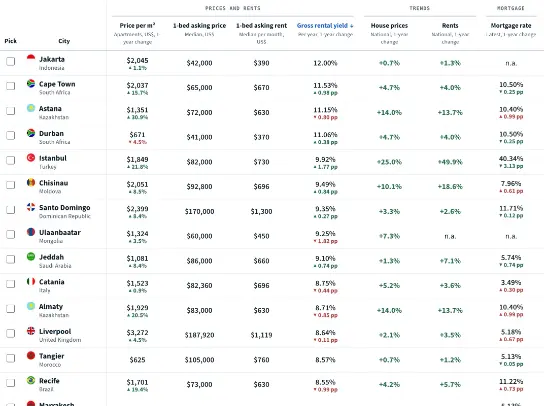
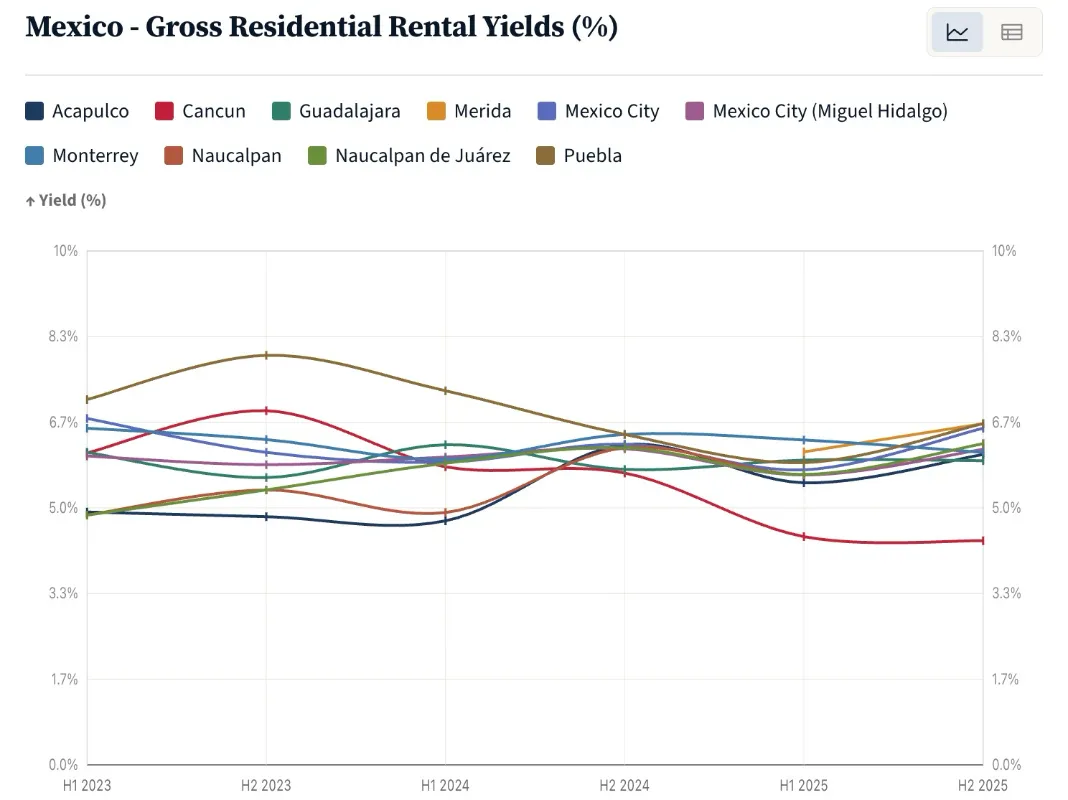
Despite the increasing gap between rent and house price growth, rental yields are still high in Canada. Global Property Guide research shows that 55-sq. m. apartments in Montreal have the highest gross rental returns, at around 8.59%. Yields are at comfortable levels, suggesting that the Canadian housing market is unlikely to be vulnerable to a significant price drop, in our view.
Canada expected to recover before the US
The housing market is expected to recover much earlier in Canada than in the US, due to Canada’s much stronger housing and financial fundamentals.
House prices are expected to fall until end-2009 to mid-2010. In 2009, the average residential resale price is projected to decline 2.1% across Canada, according to CREA, with western provinces experiencing the steepest price declines.
A slumping economy, low consumer confidence and high mortgage costs will weaken house prices and demand. "Issues affecting the overall economy are impacting housing markets across the country and the situation is not expected to be remedied until consumer confidence is restored," say the realtors, RE Max.
In addition, there is political uncertainty. The minority government of Prime Minister Stephen Harper (reelected in October 14, 2008) would have been ousted by the opposition parties, shortly after Finance Minister Jim Flaherty failed to include an economic stimulus package in his latest fiscal update. Only the fact that on December 5, 2008, Governor General Michaelle Jean granted Harper’s request to prorogue parliament until January 26, 2009, delayed the almost certain defeat of the minority government in a no-confidence vote.