Chile's Residential Property Market Analysis 2026
Chile’s housing market remains resilient, with strong house price growth underpinned by rising demand and limited new supply.
This extended overview from the Global Property Guide provides a thorough analysis of Chile’s housing market, examining its overall structure, price trends, demand and supply conditions, and regulatory framework. It places particular emphasis on recent developments while also highlighting the long-term forces shaping the sector.
Table of Contents
- Property Prices and Price Index
- Historic Perspective
- Property Demand Trends
- Property Supply Trends
- Rental Market: Rents and Rental Yields
- Mortgage Market and Interest Rates
- Economic and Social Factors
Property Prices and Price Index
The average price of residential properties rose strongly by 8.10% in Q3 2025 from a year earlier, following year-on-year increases of 8.99% in Q2 2025, 7.99% in Q1 2025, 0.33% in Q4 2024, and 2.32% in Q3 2024, according to figures published by the Chilean Chamber of Construction (CChC). When adjusted for inflation, prices were up by a moderate 3.54% during the year to Q3 2025.
Quarter-on-quarter, however, residential property prices were down slightly by 1.24% in Q3 2025 and by 2.53% in real terms.
Chile's house price annual change:
Nonetheless, there is considerable variation across different types of properties.
- For newly built apartments, the average price increased strongly by 10.87% (6.19% inflation-adjusted) during the year to Q3 2025, an acceleration from year-on-year rises of 8.53% in Q2 2025 and 8.01% in Q1 2025, a slight decline of 0.76% in Q4 2024, and an increase of 1.66% in Q3 2024. Quarterly, nominal apartment prices were up slightly by 0.22% but declined by 1.1% in real terms.
- For new houses, the average price fell by 1.58% (-5.73% when adjusted for inflation) in Q3 2025 from a year earlier, in stark contrast to year-on-year growth of 10.93% in Q2 2025, 6.89% in Q1 2025, 4.18% in Q4 2024, and 3.28% in Q3 2024. Quarter-on-quarter, house prices plunged by 7.37% (-8.58% inflation-adjusted) during the latest quarter.
The South recorded the highest price growth for new apartments, recording a y-o-y increase of 14.63% (9.8% inflation-adjusted) in Q3 2025, and was closely followed by the Central region, which saw a house price increase of 13.01% (8.25% inflation-adjusted). Both the Northwest and Northeast regions saw moderate price growth, rising 3.29% (-1.07% in real terms) and 3.03% (-1.31% in real terms), respectively.
The average price of apartments across Chile is around US$170,000, while detached houses are priced at about US$270,000.
Demand is increasing rapidly again. Nationwide, the total number of residential properties sold rose by a huge 26.6% to 13,242 units in Q3 2025 as compared to the same period last year, a sharp acceleration from year-on-year growth of 1% in Q2 and 3.8% in Q1, based on figures released by CChC. Cumulatively, in the first three quarters of 2025, residential property sales in the country were up by 10.8% y-o-y to 33,080 units, following an annual decline of 8% in 2024.
Property demand in Greater Santiago follows the national trend. In Q3 2025, the number of residential properties sold in Greater Santiago rose strongly by 18.3% to 7,690 units as compared to the preceding year, a sharp acceleration from minuscule growth of 1.8% in Q2 and 0.9% in Q1. Overall, total residential property sales in Greater Santiago increased by 7.7% to 18,946 units in the first three quarters of 2025 from the prior year.
Yet, residential construction activity remains weak. During 2025, the total number of dwellings authorized in the whole country plummeted by 19.7% y-o-y to 69,058 units, following annual declines of 5.1% in 2024, 23.2% in 2023, and 19.4% in 2022, according to data released by INE. This is far below the 138,000 new dwelling units authorized annually from 2012 to 2022. Likewise, the total area of dwelling permits authorized in the country dropped sharply by 13.4% y-o-y to approximately 6 million square meters (sq. m) last year.
In Greater Santiago, the number of dwelling permits plunged by 25.4% y-o-y to 19,089 units in 2025 while the total area dropped 20.7% to 1.66 million sq. m.
Nicolás León, manager of Studies and Public Policies at the CChC, noted that “the real estate sector continues to struggle with restrictions on accessing mortgage financing, leading to lower sales and a significant disincentive to start new projects, which today also involve higher construction costs due to increases in the price of materials and permits, among other factors.”
During 2025, Chile’s economy grew by approximately 2.4%, slightly below the 2.6% recorded a year earlier but well above the 0.5% expansion in 2023. Growth was supported by firmer domestic demand, a gradual recovery in private consumption, and stronger commodity exports.
Looking ahead, the International Monetary Fund (IMF) projects growth of 2% this year and 2.3% in 2027, broadly in line with the World Bank’s forecasts of 2.2% this year and 2.1% next year, pointing to steady but moderate expansion in the medium term.
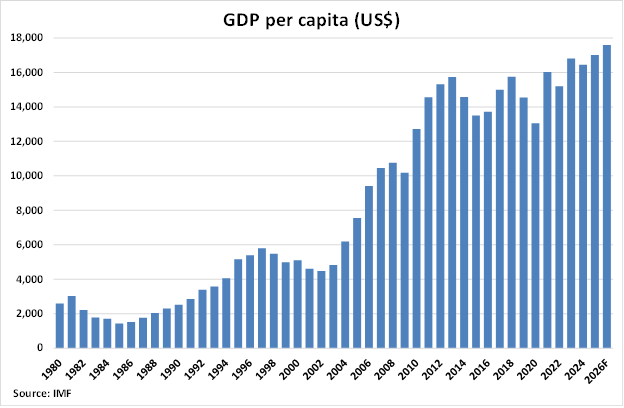
Chile is an upper-middle-income economy, with a total population of about 20.2 million people and a GDP per capita of around US$17,000 in 2025, according to figures released by the IMF.
Historic Perspective:
Dynamics of Chile’s housing market cycle
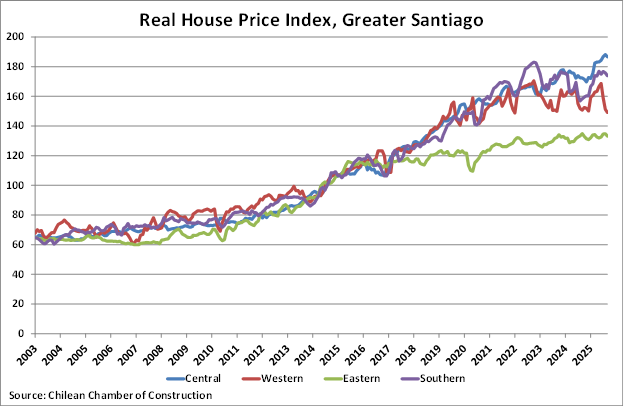
Residential property prices in Greater Santiago surged by about 157% (66% in real terms) between 2004 and 2016, reflecting a prolonged period of strong demand, favorable credit conditions, and sustained economic growth. The global financial crisis of 2008 had barely impacted the housing market, registering a small decline of just 4.7% (-3.4% inflation-adjusted) from Q3 2008 to Q2 2010.
Following the 2010 earthquake, house prices rebounded strongly, rising by 12.2% in 2011. Growth remained robust in the succeeding years, with increases of 7.5% in 2012, 10.6% in 2013, and a notable 16.5% in 2014. Demand strengthened particularly in the northwest and southern areas of Greater Santiago from early 2014, driven largely by activity in the apartment segment. The upward momentum continued in 2015, when house prices in Greater Santiago climbed by a further 13.3%.
In January 2016, a VAT of 19% was imposed on property sales in Chile by “habitual sellers” such as real estate companies, or persons who sell their properties in less than a year. The measure effectively increased the cost of new homes by an estimated 4% to 11%, making older homes more attractive.
Combined with subdued economic growth, the new tax contributed to a mild downturn in the housing market in 2016. By year-end, house prices in Greater Santiago had edged down by 0.4% year-on-year (-3% in real terms). Nationwide, home sales and housing starts fell sharply, declining by about 35% and 31%, respectively, reflecting weaker demand and a slowdown in new project launches.
However, the impact of the property sales tax quickly waned, with new residential property prices rising again by 10.7% in 2017 and by another 9.5% in 2018. In 2019, the housing market continued to expand, with prices increasing by 10.5%.
Chile saw another housing market downturn during the onset of the Covid-19 pandemic. During 2020, residential property sales plummeted by 28.2% y-o-y to 22,672 units. Construction activity was also adversely affected, with dwelling permits falling by 22.2% y-o-y to 123,779 units in 2020.
Chile’s housing market began to recover in 2021 as pandemic-related restrictions were gradually lifted. Residential property prices in Greater Santiago rose by 12% year-on-year (4.5% in real terms), supported by a strong rebound in demand that saw sales surge by 31%. The recovery gained further momentum in 2022, with residential property prices accelerating sharply by 18.4% (5% inflation-adjusted), reflecting robust market activity during the post-pandemic rebound.
In 2023, nationwide property prices continued to rise, albeit at a significantly slower pace, even as demand showed signs of improvement. Prices increased by a modest 5.32% (1.33% in real terms) during the year. The housing market cooled further in 2024, with nominal price growth slowing sharply to just 0.33%, translating into a real decline of 3.99% after adjusting for inflation.
Momentum began to recover in the succeeding months, with house price growth accelerating to 8.1% (3.54% inflation-adjusted) in the year to end-Q3 2025, signaling a renewed strengthening of market conditions.
Property Demand Trends
Nationwide property sales increasing again
Nationwide, the total number of residential properties sold rose by a huge 26.6% to 13,242 units in Q3 2025 as compared to the same period last year, a sharp acceleration from year-on-year growth of 1% in Q2 and 3.8% in Q1, based on figures released by CChC. Quarterly, sales volumes also increased strongly by 21.1% in Q3 2025.
Cumulatively, in the first three quarters of 2025, residential property sales in the country were up by 10.8% y-o-y to 33,080 units, following an annual decline of 8% in 2024 and an increase of 23.7% in 2023.
By property type:
- Apartments: The number of apartments sold in the country surged by 23.5% y-o-y to 11,025 units in Q3 2025, sharply up from year-on-year increases of just 1.7% in Q2 and 3.4% in Q1. Quarter-on-quarter, property sales were up by 17.6% during the latest quarter. Overall, market activity improved in the first nine months of the year, with total apartment sales increasing by 9.9% year-on-year to 27,821 units.
- Houses: Sales volume nationwide soared by a huge 45% y-o-y to 2,217 units in Q3 2025 from the prior year, following a huge decline of 41.5% in 2022, following a drop of 3% in Q2 and a moderate increase of 5.6% in Q1. Quarter-on-quarter, house sales skyrocketed by 42.3% during the latest quarter. Overall, the total number of houses sold rose by 15.8% y-o-y to 5,259 units in the first three quarters of 2025.
Greater Santiago mirrors the national trend
Property demand in Greater Santiago follows the national trend. In Q3 2025, the number of residential properties sold in Greater Santiago rose strongly by 18.3% to 7,690 units as compared to the preceding year, a sharp acceleration from minuscule growth of 1.8% in Q2 and 0.9% in Q1. Quarter-on-quarter, sales were up by 20.9% during the latest quarter.
Overall, total residential property sales in Greater Santiago increased by 7.7% to 18,946 units in the first three quarters of 2025 from the prior year.
By property type:
- Apartments: Sales volume was up by 15.8% to 6,630 units in Q3 2025 from the prior year, an improvement from a y-o-y increase of 2.4% in Q2 and a contraction of 1.6% in Q1. Quarterly, apartment sales increased strongly by 18.7% during the latest quarter. Overall, the total number of apartments sold reached 16,390 units in the first three quarters of 2025, up by 6.3% from the previous period.
- Houses: Sales were up by a huge 37.5% y-o-y to 1,060 units in Q3 2025, following a decrease of 2% in Q2 and an increase of 18.5% in Q1. Quarter-on-quarter, house sales surged by 37% in Q3 2025. In total, 2,556 houses were sold in the first three quarters of 2025, marking a 17.8% increase compared to the same period last year.
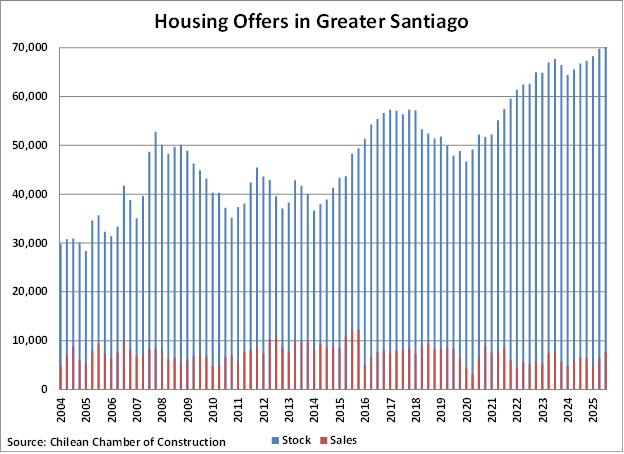
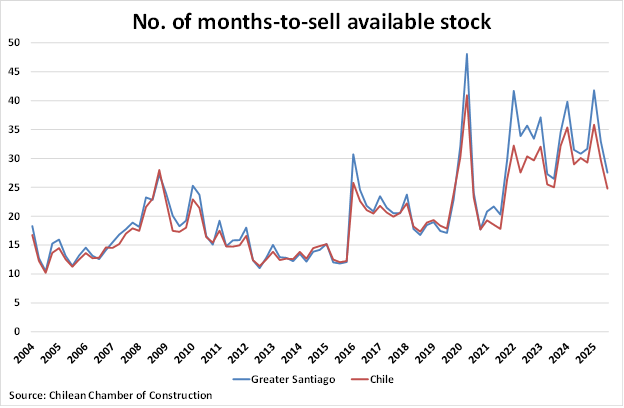
The total number of months required to sell a residential property is also declining, indicating stronger demand and improving market liquidity.
In the third quarter of 2025, the total number of months to sell the available stock in Greater Santiago was 27.6, lower than the 32.9 months recorded in the previous quarter and from the 30.8 months in the same period in the preceding year. This follows the national trend, which showed that the average months-to-sell available properties nationwide declined to 24.8 in Q3 2025, from 29.7 months in the prior quarter and from 30.1 months in the same period of 2024.
Foreign homebuying still limited but shows signs of growth
Foreign homebuying in Chile remains limited compared with some neighboring countries. Unlike Argentina, where foreign investors have driven property sales in recent years, “Chile has never been a huge market for foreign buyers,” noted Matt Ridgway of Colchagua Valley-based realty firm Chile Investments.
Recent data indicate that approximately 13.3 % of new apartment purchases in the Santiago Metropolitan Region were made by foreigners in 2024, reflecting a meaningful but not overwhelming share of the market and suggesting ongoing interest from international buyers.
Most foreign buyers in Santiago are from the United States or Europe, though interest from Chinese investors is growing. Lastarria and Bellas Artes, which are close to downtown and museums, and have a walkable ‘European feel’ are popular with foreign buyers, said Nathan Lustig of Andes Property. El Golf, a sophisticated, upper-scale neighborhood located in Las Condes, Santiago, tends to attract wealthy foreigners with its private golf club, luxury housing, five-star hotels, renowned restaurants, and fancy shopping destinations.
On the policy front, there have also been discussions, such as a 2024 congressional proposal, to ease access to mortgage credit for non‑resident foreigners, which could potentially boost foreign participation and support construction activity if enacted.
Chile allows both individuals and corporate entities to acquire and own real estate regardless of residency, except in areas near the country’s borders. Property rights are strongly protected under Chilean law, providing a secure legal framework for foreign investors.
Properties for sale are typically quoted in Unidad de Fomento (UF), a currency tied to the Chilean peso (CLP) but regularly adjusted for inflation. The Central Bank of Chile posts the daily UF-to-CLP exchange rate on its website.
Property Supply Trends
Housing construction activity plummeting
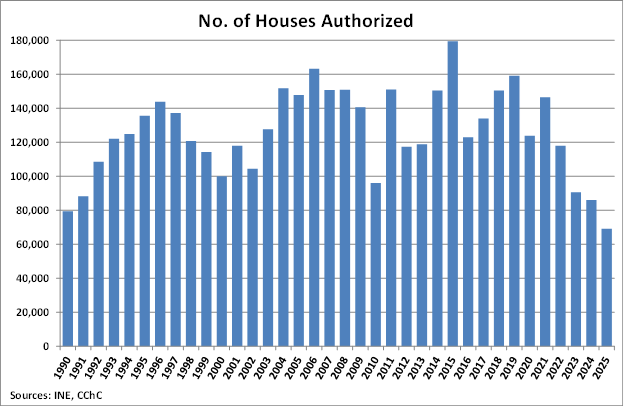
Residential construction activity is declining sharply. During 2025, the total number of dwellings authorized in the whole country plummeted by 19.7% y-o-y to 69,058 units, following annual declines of 5.1% in 2024, 23.2% in 2023, and 19.4% in 2022, according to data released by INE. This is far below the 138,000 new dwelling units authorized annually from 2012 to 2022.
Likewise, the total area of dwelling permits authorized in the country dropped sharply by 13.4% y-o-y to approximately 6 million square meters (sq. m) last year, after falling by 4.6% in 2024, 23.4% in 2023, and 18.1% in 2022, amidst gradually increasing costs of construction materials.
In Greater Santiago, the number of dwelling permits plunged by 25.4% y-o-y to 19,089 units in 2025 while the total area dropped 20.7% to 1.66 million sq. m.
The construction of new residential projects in Chile has been constrained by weak demand, sluggish sales, and a limited number of new project initiations, particularly in the private housing sector. This subdued activity has contributed to the lag in overall construction investment, as developers remain cautious amid lingering economic uncertainty, tighter financing conditions, and regulatory bottlenecks, limiting the sector’s ability to fully rebound despite ongoing government housing initiatives.
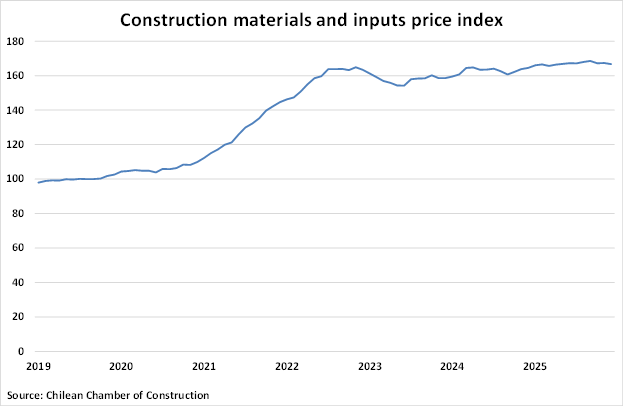
In December 2025, the construction materials and inputs price index (IPMIC) rose by 1.3% from a year earlier, following an annual increase of 3.7% in December 2024 and a decrease of 2.9% in December 2023, according to CChC.
Similarly, the high-rise construction cost index (ICE-A) also increased by 4.1% y-o-y in November 2025, following a robust growth of 6.3% in the previous year and a modest increase of 2% two years ago.
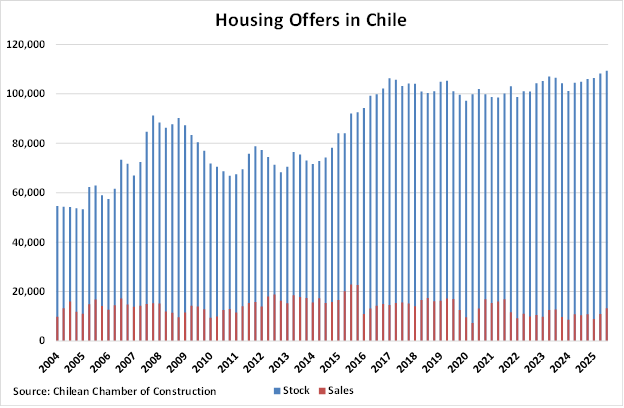
The total stock of dwellings available for sale nationwide stood at 109,352 units in Q3 2025, up by 4.3% from the same period last year. About 89.1% of which were apartments, while the remaining 10.9% were houses.
Greater Santiago accounted for nearly two-thirds of the total available dwelling stock in the country.
Chile expands housing programs while closing the housing gap
Chile’s housing shortage has been reduced by a very successful housing policy. The Ministry of Housing and Planning (Ministerio de Vivienda y Urbanismo or MINVU) was created in the 1970s and has dominated the housing sector since. It is the country’s largest real estate firm and its second-largest mortgage bank.
The special law Decreto con Fuerza de Ley 2 (DFL-2) encouraged affordable housing of less than 140 square meters (sq. m). DFL-2 properties are exempt from income tax and enjoy 50% off the Real Estate Tax for corresponding periods, according to land area. This applies regardless of the number of homes an individual may own.
However, on February 4, 2022, Chile enacted tax reform (Law No. 21.240) that reduces or eliminates certain tax exemptions to finance Law No. 21.419 (the new pension law). Beginning January 1, 2023, the said law would limit the tax benefits for DFL-2 housing to the first and second homes acquired by individuals, regardless of the acquisition date of the real property.
In addition to longstanding housing policies like DFL‑2, recent years have seen heightened government action to address Chile’s housing deficit. The Plan de Emergencia Habitacional (PEH), launched to deliver 260,000 homes by early 2026, has advanced rapidly, with over 220,000 units completed or underway and expanded programming across regions, including fair‑rent housing and integrated social housing options.
The Ministerio de Vivienda y Urbanismo has also increased its budget and intensified land‑use planning and urban infrastructure investments to support these efforts. Complementary measures include a 2023 tax benefit for new home acquisitions financed with mortgages and zoning permit reforms in 2025 designed to streamline construction. Lawmakers are debating an extension of the PEH framework to 2029, signaling a move toward more durable, long‑term housing policy.
Rental Market: Rents and Rental Yields
Rental yields hold at moderate levels as rents increase
Chile has a small but competitive rental market. Unsurprisingly, there are great variations in rental yields in Chile, particularly in its capital city, Santiago. But the overall results from a recent Global Property Guide research were pretty clear - the gross rental yields for apartments nationwide are moderately good at an average of 4.82% in Q1 2026, not significantly different from earlier figures of 4.81% in Q3 2025, 4.71% in Q3 2024, 4.73% in Q4 2023, and 4.99% in Q2 2023.
By major areas:
- In Santiago, gross rental yields for apartments range from 3.84% to 5.85% in Q1 2026, with a city average of 4.91%.
- In Concepcion, apartments offer rental returns of between 4.98% and 5.54%, with a city average of 5.31%.
- In Viña Del Mar, apartment rental yields range from 3.63% to 4.20%, with a city average of 3.89%.
- In Concon, gross rental yields currently range from 3.93% to 4.65%, with a city average of 4.28%.
- In Temuco, apartments offer gross rental yields of around 4.47% to 5.52%in Q1 2026, with a city average of5%.
- In Valparaiso, rental yields for apartments range from 3.4% to 4.42%, with a city average of 4.02%.
- In Antofagasta, rental yields are noticeably higher compared to the national average, ranging from 6.13% to 6.71% in Q1 2026, with a city average of 6.36%.
In Greater Santiago, a two-bedroom apartment, as a rough average, rents for about US$410 to US$510 per month.
Residential rents have continued to rise in recent months, though at a slower pace than in previous years. Over the past 15 to 20 years, rental prices in Chile have risen significantly, with nationwide rents increasing by approximately 68% between 2000 and 2022, driven largely by growth after 2011.
Chile's rent price index:
More recently, real estate market data indicate that rents in urban areas, particularly in Santiago, continue to increase, albeit at a more moderate pace. Year‑over‑year growth in early 2026 has ranged between 3% and 6%, suggesting that while rents are still rising, the rate of increase is relatively modest and broadly in line with inflation, assuming it remains near the central bank’s target.
Mortgage Market and Interest Rates
Mortgage market sustains its upward trend, but growth is moderating
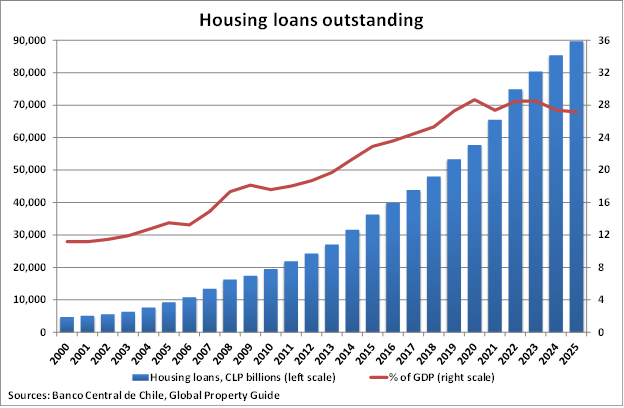
Chile’s mortgage market is one of the most developed in Latin America, having grown steadily from around 11.2% of GDP in 2000 to about 27.2% of GDP in 2025.
Chile's mortgage loan interest rates:
In January 2026, the total value of outstanding mortgage loans in the country increased by 5% year-on-year to CLP 89.75 trillion (US$104.05 billion), following annual growth of 5% in 2025, 6.2% in 2024, 7.3% in 2023, 14.3% in 2022, 13.5% in 2021, 8.1% in 2020, 11.2% in 2019, and 9.4% in 2018, according to figures released by the Central Bank of Chile.
Mortgage market growth is likely to continue in the near term, albeit more gradually, amid softening property demand.
Most mortgages are fixed rates with maximum LTV ratios of around 75% to 80%, which helps contain the banking system's credit risk.
Chile’s banks do not usually lend to foreigners, even to those with a resident’s permit. Banks have strict lending criteria that are almost impossible for foreigners to satisfy. These strict controls on mortgage lending may have reduced the country’s vulnerability to external shocks and global crises, but they have also constrained growth.
Housing interest rates continue to fall, amid ongoing monetary easing
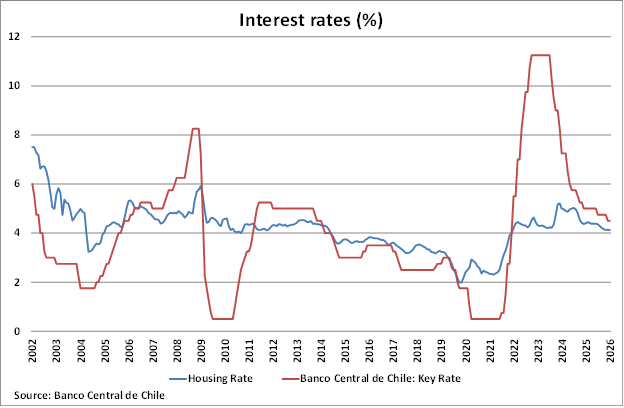
At its January 2026 meeting, the Central Bank of Chile held its benchmark interest rate steady at 4.50%, following thirteen consecutive cuts since July 2023, when the rate peaked at a 15-year high of 11.25%. The extended easing cycle was intended to support economic growth, amidst diminishing inflationary pressures.
In line with this, housing loan interest rates continue to fall, with the average rate declining to 4.12% in January 2026, down from 4.40% in January 2025 and 5.00% in January 2024.
Nationwide inflation eased to 2.8% in January 2026, from 3.5% in the previous month and 4.9% in the same period last year. In fact, this is now the lowest level recorded since February 2021 and well within the central bank’s target level of 3%.
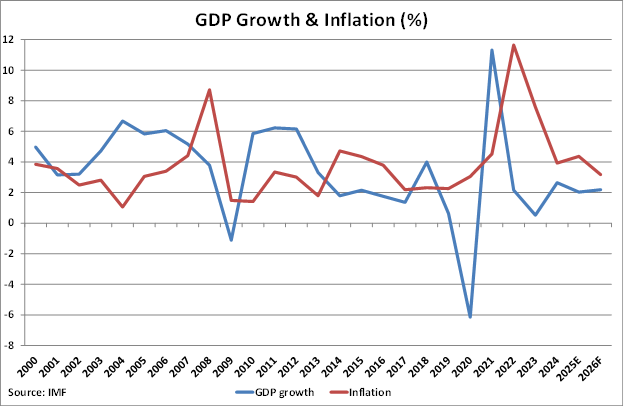
From an annual average of 2.9% in 2009 to 2021, inflation surged to 11.6% in 2022 and remained elevated at 7.6% in 2023. Inflation eased to 3.9% in 2024 and finally to 3.5% in 2025.
“Headline inflation is projected to converge to the 3% target during the first quarter of 2026 and to remain in the vicinity for the remainder of the monetary policy horizon,” said the central bank in its December 2025 Monetary Policy Report.
“On its volatile component, the projection considers a reduction in electricity rates at the beginning of next year, reflecting what has been reported by the sector authorities. This will be partially offset by an upward adjustment in fuel prices, given the higher price of gasoline compared to the September IPoM. In any case, a downward trajectory continues to be considered over the projection horizon. Market expectations are in line with these projections, forecasting inflation of 3% both at the beginning of 2026 and within the one- and two-year horizons,” added the central bank report.
Economic and Social Factors
Moderate economic growth, sound public finances
During 2025, Chile’s economy expanded by approximately 2.4%, easing slightly from the 2.6% growth recorded a year earlier. Nevertheless, this marked a clear improvement from the 0.5% expansion in 2023 and was marginally stronger than the 2.2% growth posted in 2022, reflecting a period of moderate but stabilizing economic performance. The latest expansion was buoyed by stronger domestic demand, a gradual recovery in private consumption, and improved external conditions, particularly firmer commodity exports.
“The economy is broadly balanced and growing at its potential. The global trade tensions have not yet significantly impacted the Chilean economy. However, slower growth is anticipated as the global economy decelerates. In this context, policy efforts are appropriately focused on a prudent fiscal path to ensure debt sustainability, bringing inflation back to target, and supply-side measures to boost economic dynamism, such as streamlining processes to approve investment permits,” said the International Monetary Fund (IMF).
The IMF projects Chile’s economy to expand by 2% this year and by approximately 2.3% in 2027. These forecasts are broadly in line with the World Bank ’s outlook, which anticipates growth of 2.2% this year and 2.1% next year, underscoring expectations of steady but moderate expansion over the medium term.
“Chile’s growth is forecast to slow to 2.2 percent in 2026 and 2.1 percent in 2027. Domestic demand is expected to recover gradually as the monetary policy rate converges to the neutral range and inflation returns to target,” said the World Bank in its January 2026 Global Economic Prospects report. “Investment in copper and lithium mining is anticipated to bolster growth, benefiting from strong demand from the renewable energy sector globally and especially in China. At the same time, weaker commodity demand from China’s real estate sector is expected to partly offset these gains by curbing export growth.”
Chile is an upper-middle-income economy with a track record of sustained growth. Its GDP has grown at an annual average of 5.6% from 1990 to 2007, among the highest growth rates in the world. Strong growth continued from 2008 to 2012, with an economic contraction of only 1.1% in 2009, amidst the global financial crisis. Chile then rebounded with 5.8% growth in 2010, despite the earthquake. From 2011 to 2013, there was an average growth of 5.2%.
However, since then, the economy has been hit by the decline in global demand for mining products. From 2014 to 2019, the average real GDP growth was below 2% annually.
Then in 2020, the Chilean economy recorded a contraction of 6.1% due to the COVID-19 pandemic. Economic activity bounced back quickly, with the country posting a post-pandemic economic surge of 11.3% in 2021.
Fiscal discipline is one of the pillars of Chile’s solid international image. From 2000 to 2012, Chile recorded an average budget surplus of 1.7%, reaching a record high of 8.8% of GDP in 2007. The budget surplus not only transformed Chile from a debtor to a creditor country but also placed the country in a solid position to weather global economic volatility. In May 2010, Chile became OECD’s first Southern American member, highlighting the reduction of poverty from 45% in the late 1980s to around 14% in 2009. There were other advances, such as the strengthening of state institutions and fighting corruption.
Fiscal deficit has been manageable since, ranging from just 0.6% to 2.8% of GDP in 2013-19, driven by a growth in receipts, coupled with a reduction in public spending, according to the Ministry of Finance. However, the introduction of fiscal stimulus packages to mitigate the adverse impact of the COVID-19 pandemic pushed the deficit to as high as 7.1% of GDP in 2020 and to 7.5% of GDP in 2021.
Chile’s government budget balance quickly returned to a surplus equivalent to about 1.1% of GDP in 2022.
However, the central government’s fiscal position weakened in the past three years, registering budget shortfalls of 2.3% of GDP in 2023, 2.8% in 2024, and an estimated 2.2% in 2025, amidst slowing fiscal revenues due to lower copper prices and rising fiscal expenses due to higher pension benefits, salaries, and capital expenditure.
“Revenue fell short of expectations in 2024 due to ineffective government forecast models, but the fiscal balance is improving and should reach a projected deficit of 2.2% of GDP in 2025,” said Fitch Ratings in its Ratings Action Commentary in September 2025.
“We expect the fiscal deficit to narrow to 1.6% in 2026 and 1.3% in 2027, as the government gradually implements its fiscal consolidation plan, which includes administrative savings and some legislative measures to reduce expenditures. However, some uncertainty remains regarding the budgetary path to be taken by the new government,” added Fitch Ratings.
Chile’s government debt widened to around 42.3% of GDP in 2025, up from 41.7% of GDP in 2024, 39.4% in 2023, 37.8% in 2022, 36.4% in 2021, 32.4% in 2020, 28.3% in 2019, and 25.8% in 2018. In fact, it was far higher than the record-low 3.9% of GDP in 2007 and the highest debt level recorded in recent history.
The country’s debt level is projected to increase further to approximately 43.4% of GDP over the medium term. Despite this, Chile’s fiscal position remains comparatively solid.
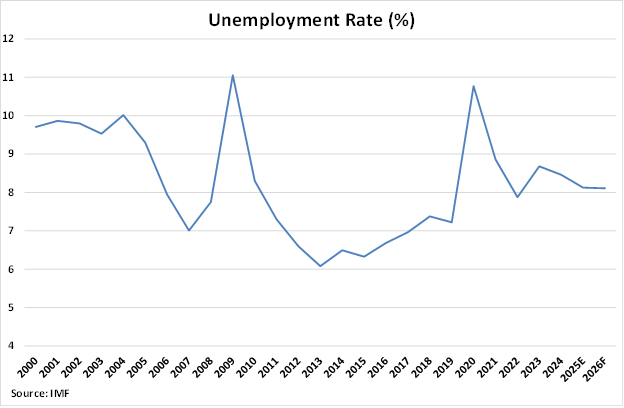
Chile’s labour market is tightening. In December 2025, the overall unemployment rate stood at 8%, down from 8.4% in the previous month and from 8.1% in the same period last year, according to INE.
The jobless rate averaged 6.8% in 2011-19 before increasing to 10.8% in 2020. It fell to 8.9% in 2021 and further to 7.9% in 2022, as pandemic-related restrictions were removed. However, the jobless rate increased again to 8.7% in 2023, amidst a struggling economy. The nationwide unemployment rate gradually declined to 8.5% in 2024 and to 8.1% in 2025.
Sources:
- Indicators (Chilean Chamber of Construction): https://cchc.cl/
- 13.3% of new apartment purchases in Chile were made by foreigners in 2024 (Eldiario Inmobiliario): https://eldiarioinmobiliario.cl/
- Congressman introduces bill that makes it easier for non-resident foreigners to obtain mortgage loans in Chile (Eldiario Inmobiliario): https://eldiarioinmobiliario.cl/
- Report shows challenging outlook for construction in Chile (Construction Briefing): https://www.constructionbriefing.com/
- Building permits (National Statistics Institute): https://www.ine.gob.cl/
- Chile enacts tax reform to fund pension reform (EY): https://globaltaxnews.ey.com/
- Minister Montes values progress on the Minvu 2026 budget after presentation to joint commission (Ministerio de Vivienda y Urbanismo): https://www.minvu.gob.cl/
- Chile: Tax Benefit for Purchases of New Properties Introduced (KPMG): https://kpmg.com/
- Emergency Housing Plan: they are studying the future acquisition of 24.8 hectares (TVU): https://www.tvu.cl/
- Housing rental prices have risen by 68% in the last 20 years (Unholster): https://www.unholster.com/
- Chile Interest Rate (Trading Economics): https://tradingeconomics.com/
- Monetary Policy Meeting – January 2026 (Banco Central de Chile): https://www.bcentral.cl/
- Monetary Policy Report December 2025 (Banco Central de Chile): https://www.bcentral.cl/
- Gross rental yields in Chile: Santiago and 7 other cities (Global Property Guide): https://www.globalpropertyguide.com/
- Chile (International Monetary Fund): https://www.imf.org/
- Chile’s President-elect Kast Will Struggle to Stabilize Government Debt (Fitch Ratings): https://www.fitchratings.com/
- Fitch Affirms Chile at 'A-'; Outlook Stable (Fitch Ratings): https://www.fitchratings.com/
- Global Economic Prospects January 2026 (World Bank): https://thedocs.worldbank.org/
- Chile Government Budget (Trading Economics): https://tradingeconomics.com/
- Chile Government Debt to GDP (Trading Economics): https://tradingeconomics.com/