Morocco Residential Real Estate Market Analysis 2026
Morocco's housing market has slipped back into decline after a brief recovery. Residential prices fell in the year to Q1 2026, sales volumes dropped by double digits, and every major city posted a quarterly contraction in both prices and transactions. Construction activity has cooled, though mortgage lending continues to grow slowly, and rental yields have improved.
Table of Contents
- Property Prices and Price Index
- Property Demand Trends
- Property Supply Trends
- Rental Market: Rents and Rental Yields
- Mortgage Market and Interest Rates
- Economic and Social Factors
Property Prices and Price Index
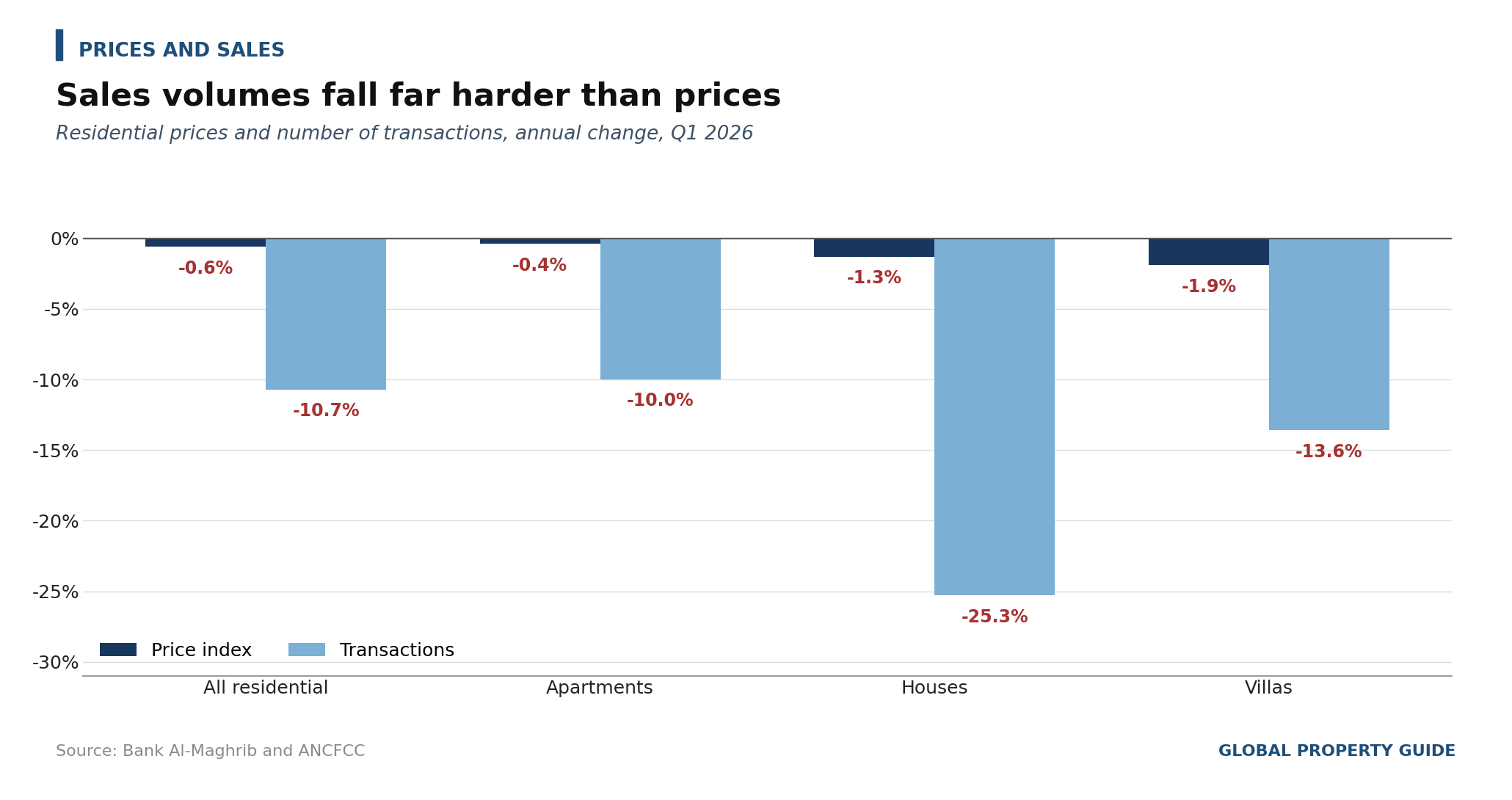
Morocco's nationwide residential property price index fell by 0.6% during the year to Q1 2026, according to figures published jointly by the central bank, Bank Al-Maghrib, and the national land registry agency, the Agence Nationale de la Conservation Foncière, du Cadastre et de la Cartographie (ANCFCC). That is the residential component of the Real Estate Asset Price Index (IPAI). Because consumer prices were themselves slightly lower over the quarter, the decline in real terms was a smaller 0.43%. The all-asset index fell by 0.4% over the same period.
The house price figures cited here come from the IPAI, which Bank Al-Maghrib and the ANCFCC have published quarterly since the first quarter of 2006 using a repeat-sales methodology, the same approach underpinning the Case-Shiller index in the United States. The index has a base of 100 in 2006, counts only properties transacted at least twice, and covers three broad asset classes and nine major cities. From Q1 2025, its coverage was widened to all land registry offices in the country.
The quarterly picture was sharper still. Residential prices fell by 3% in Q1 2026 from the preceding quarter, and the all-asset IPAI dropped by 2.4%.
Morocco's house price annual change:
By property type, during the year to Q1 2026:
- Apartments: prices fell by 0.4% (a decline of 0.23% adjusted for inflation). On a quarterly basis, apartment prices were down by 2.7%.
- Houses: nominal prices fell by 1.3%, or 1.14% in real terms. Quarter on quarter, house prices also fell by 2.7%.
- Villas: prices fell by 1.9% in nominal terms and by 1.74% in real terms, the weakest of the three residential categories. Villa prices dropped by a steep 6.4% during the latest quarter.
- Urban land: prices fell by 0.6% (a real decline of 0.43%). Quarter on quarter, land prices were down by 3%.
Prices for commercial and professional property were close to flat, easing by 0.1% over the year, as a 1.4% fall in office values offset stagnant retail prices.
What makes the Q1 2026 reading striking is that it interrupts a recovery. Over the whole of 2025, the IPAI rose by 0.6%, with residential prices up by 0.8%, land up by 0.4%, and professional property up by 0.3%. With consumer price inflation averaging 0.8% that year, residential prices in real terms were essentially unchanged. Within 2025, the pattern was uneven: residential prices were up 0.15% in Q1, 0.1% in Q2, then jumped 1.5% in Q3 before slowing to 0.2% in Q4.
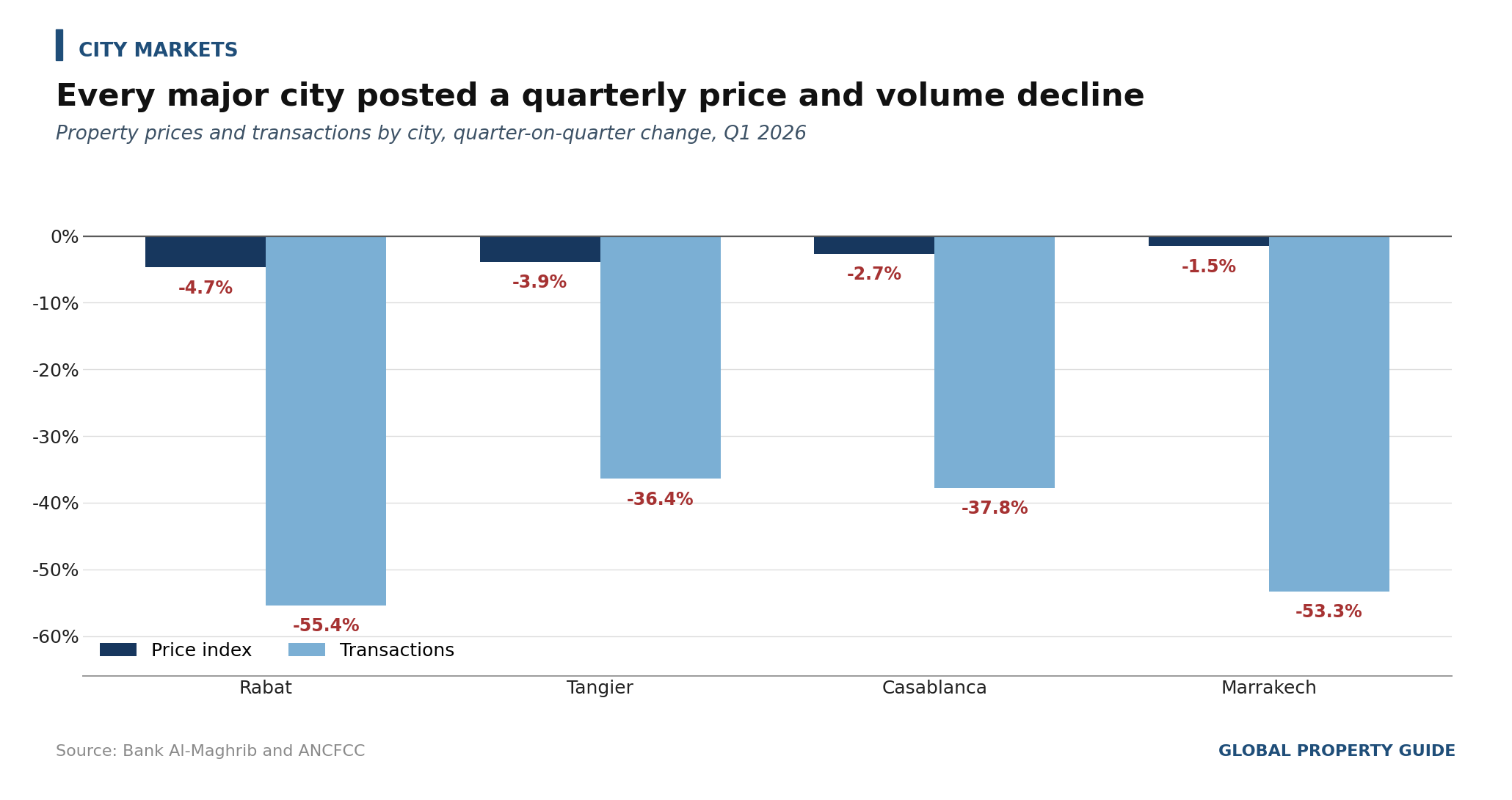
Across Morocco's largest urban markets, the reversal was universal. On a quarter-on-quarter basis in Q1 2026:
- In Rabat, property prices fell by 4.7%, the steepest decline of the four cities tracked in the quarterly note, while transactions collapsed by 55.4%.
- In Tangier, prices dropped by 3.9% and transactions by 36.4%.
- In Casablanca, prices declined by 2.7%, and the number of sales fell by 37.8%.
- In Marrakech, prices eased by 1.5%, the mildest fall, but transactions plunged by 53.3%.
Those same four cities had all recorded gains in 2025. Prices rose by 3.5% in Rabat, 1% in Marrakech, 0.9% in Casablanca, and 0.6% in Tangier, while transactions climbed by 24.1% in Marrakech, 15% in Rabat, 7.8% in Casablanca, and 3.3% in Tangier. The market in Morocco is now falling back from what was, therefore itself only a modest upswing, not a boom.
The wider economy offers little explanation for the housing weakness. Real GDP growth accelerated to an estimated 4.9% in 2025, according to the International Monetary Fund, supported by a rebound in agricultural output and a surge in large infrastructure projects. Bank Al-Maghrib expects growth to reach 5.2% in 2026 before easing to 3.1% in 2027, while the IMF projects 4.4% this year and 4.5% next. The disconnect between a fast-growing economy and a shrinking housing market is the central puzzle of Morocco's 2026 property cycle.
Property Demand Trends
Sales volumes are falling much faster than prices
The number of residential transactions fell by 10.7% in Q1 2026 from a year earlier, a far steeper move than the 0.6% price decline, according to Bank Al-Maghrib and the ANCFCC. Total transactions across all asset classes were down by 9.3%.
Quarter on quarter, residential sales dropped by 38.4%, with total transactions falling by 40.2%. Part of that reflects seasonality and the timing of Ramadan, which ran from 19 February to 19 March 2026, but the scale of the fall exceeds a normal seasonal pattern.
Sales fell across every residential category during the year to Q1 2026.
- Apartment sales fell by 10% year on year and by 37.5% during the latest quarter.
- House sales dropped by 25.3% from a year earlier, the sharpest contraction of any category, and by 51.6% quarter on quarter.
- Villa sales decreased by 13.6% year on year and by 53.1% over the quarter.
- Urban land transactions fell by 6.8% year on year and by 45.9% quarter on quarter.
| RESIDENTIAL TRANSACTIONS AND PRICES, Q1 2026 | ||
| Property type | Price, annual change (%) | Transactions, annual change (%) |
| Total residential | -0.6 | -10.7 |
| Apartments | -0.4 | -10.0 |
| Houses | -1.3 | -25.3 |
| Villas | -1.9 | -13.6 |
| Urban land | -0.6 | -6.8 |
| Data Sources: Bank Al-Maghrib and ANCFCC | ||
The contrast with 2025 is stark. Residential sales rose by 1.3% over that year as a whole, and by 0.6% in Q4 alone, while land sales climbed 7.5% and professional property sales 7.4%. Demand had appeared to be stabilising before the start of 2026.
Diaspora money keeps flowing, but not into transactions
Moroccans living abroad remain the market's most reliable source of purchasing power. Their remittances reached MAD122.02 billion (US$13.12 billion) in 2025, up from MAD118.97 billion the previous year, according to the Office des Changes. The pace has since quickened: transfers hit MAD61.48 billion in the first half of 2026, a rise of 9.9% on the same period of 2025.
Housing has long absorbed the bulk of that money. Roughly 70% of investment by Moroccan residents abroad goes into residential property, a class described by officials as safe, tangible, and manageable from a distance. Redirecting more of it into productive investment has become a stated policy objective, which, if successful, would remove some support from housing demand.
Foreign buyers face few obstacles. There are no restrictions on foreigners owning land in Morocco except for agricultural land, and the dirham is relatively stable, having traded in a narrow band against the dollar through 2026. All dirham figures in this article are converted at MAD9.3 to US$1.
Property Supply Trends
Construction activity has stalled
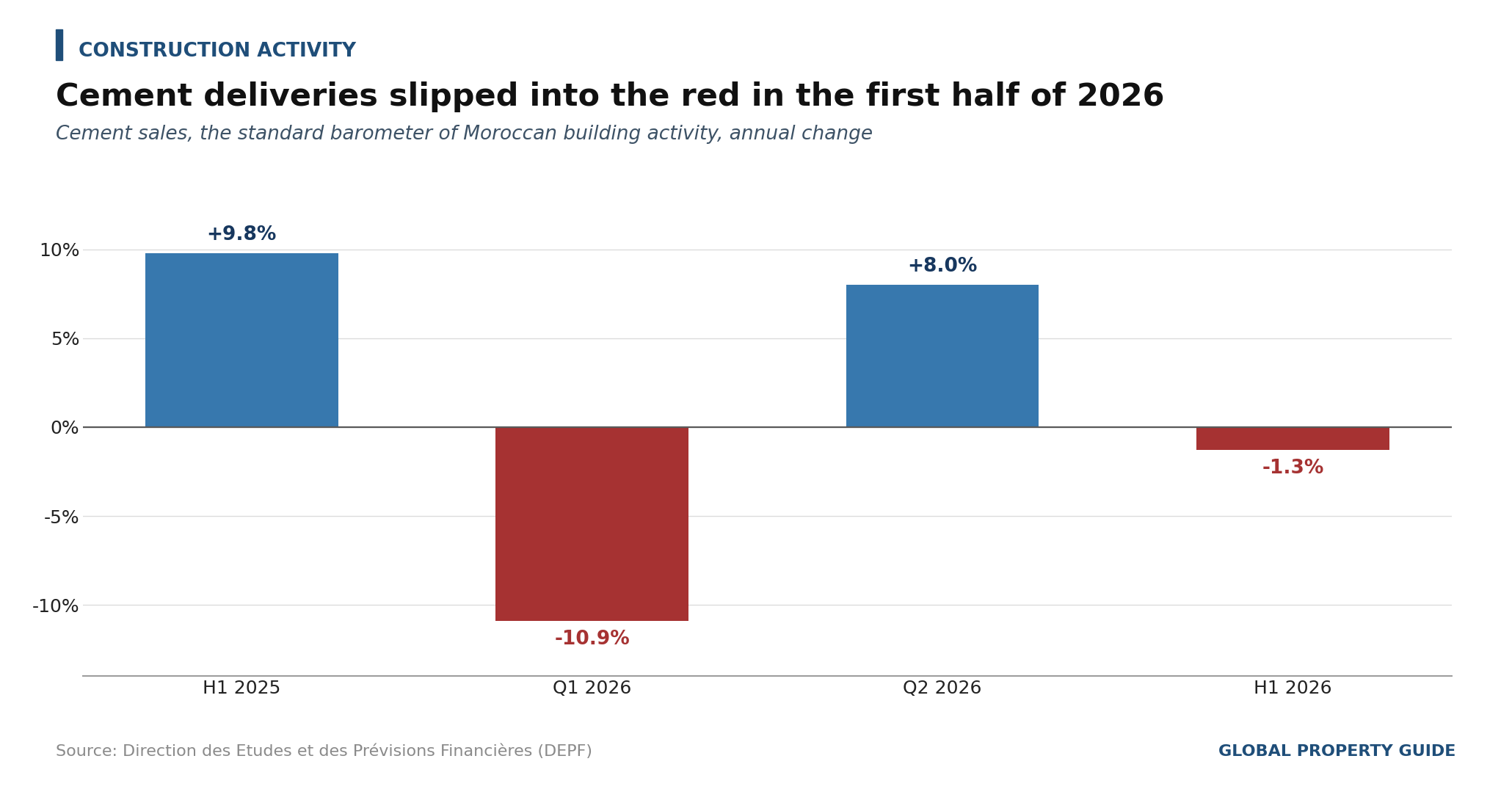
Cement deliveries, the standard barometer of Moroccan building activity, fell by 1.3% in the first half of 2026, according to the Direction des Etudes et des Prévisions Financières (DEPF). That compares with the growth of 9.8% in the same period of 2025.
The weakness was concentrated at the start of the year. Sales fell by 10.9% in Q1 2026, which the DEPF attributed to exceptionally heavy rainfall in January and February combined with the timing of Ramadan. Deliveries returned to growth in March, rising 2.5%, and the second quarter recovered by 8%, which suggests the first-quarter slump was partly a timing effect rather than a structural collapse in building.
Construction remains an important employer, accounting for 12.7% of paid employment in Q1 2026 according to the Haut-Commissariat au Plan (HCP), behind services and agriculture.
Direct housing assistance passes 105,000 beneficiaries
The Daam Sakane direct housing assistance programme, launched by King Mohammed VI in October 2023 and operational since January 2024, has become the centrepiece of Moroccan housing policy. It replaced the previous approach of subsidising developers with a grant paid directly to first-time buyers.
More than 218,000 applications had been filed, and over 105,000 households had received payment by June 2026, according to Housing Secretary of State Adib Benbrahim. Young people account for 52% of beneficiaries. Fès has drawn the largest share, followed by Berrechid, Meknès, Greater Casablanca, Kénitra, El Jadida, Benslimane, and Settat, with the ministry concentrating awards in provinces that had lagged on social housing agreements.
The grant is set at MAD100,000 (US$10,753) for homes priced at or below MAD300,000 (US$32,258), including tax, and MAD70,000 (US$7,527) for homes priced between MAD300,000 and MAD700,000 (US$75,269). Homes above that ceiling are not eligible. The programme runs to 2028 and is open to Moroccans resident at home and abroad who own no residential property in Morocco and have never received state housing aid.
Two changes took effect in 2026. The Finance Law extended eligibility to people holding property in undivided ownership, which had previously excluded many heirs to family property, particularly among the diaspora. At the same time, an anti-speculation rule now requires full repayment of the grant if the home is sold before five years of effective occupation.
Slum clearance is running against demographic pressure
Morocco has declared 62 cities and urban centres free of slums, improving conditions for around 384,818 households, with more than 81,000 households upgraded during the current government's term.
The scale of the task keeps growing, however. The number of households covered by the Villes Sans Bidonvilles programme rose from 270,000 when it launched in 2004 to 496,000 by the end of September 2025, as rapid urbanisation added to the caseload faster than clearance could reduce it. Some 370,000 of those households have had their situation regularised.
Developer financing is growing again but slowly
Bank lending to property developers reached MAD60.2 billion (US$6.47 billion) at the end of 2025, up 4% on 2024, reversing several years in which developers had been the one credit category shrinking. Growth continued into 2026, with the outstanding stock of property development loans up by 2.7% at the end of May.
Lending for middle and low-income households remains accessible through partnerships between the government and banks. The FOGARIM guarantee fund covers loans to households with informal incomes, FOGALOGE guarantees loans to independent workers, moderate-income civil servants, and Moroccans abroad, and Damane Iskan guarantees loans to formal-sector borrowers.
Rental Market: Rents and Rental Yields
Yields have improved to 7.31%
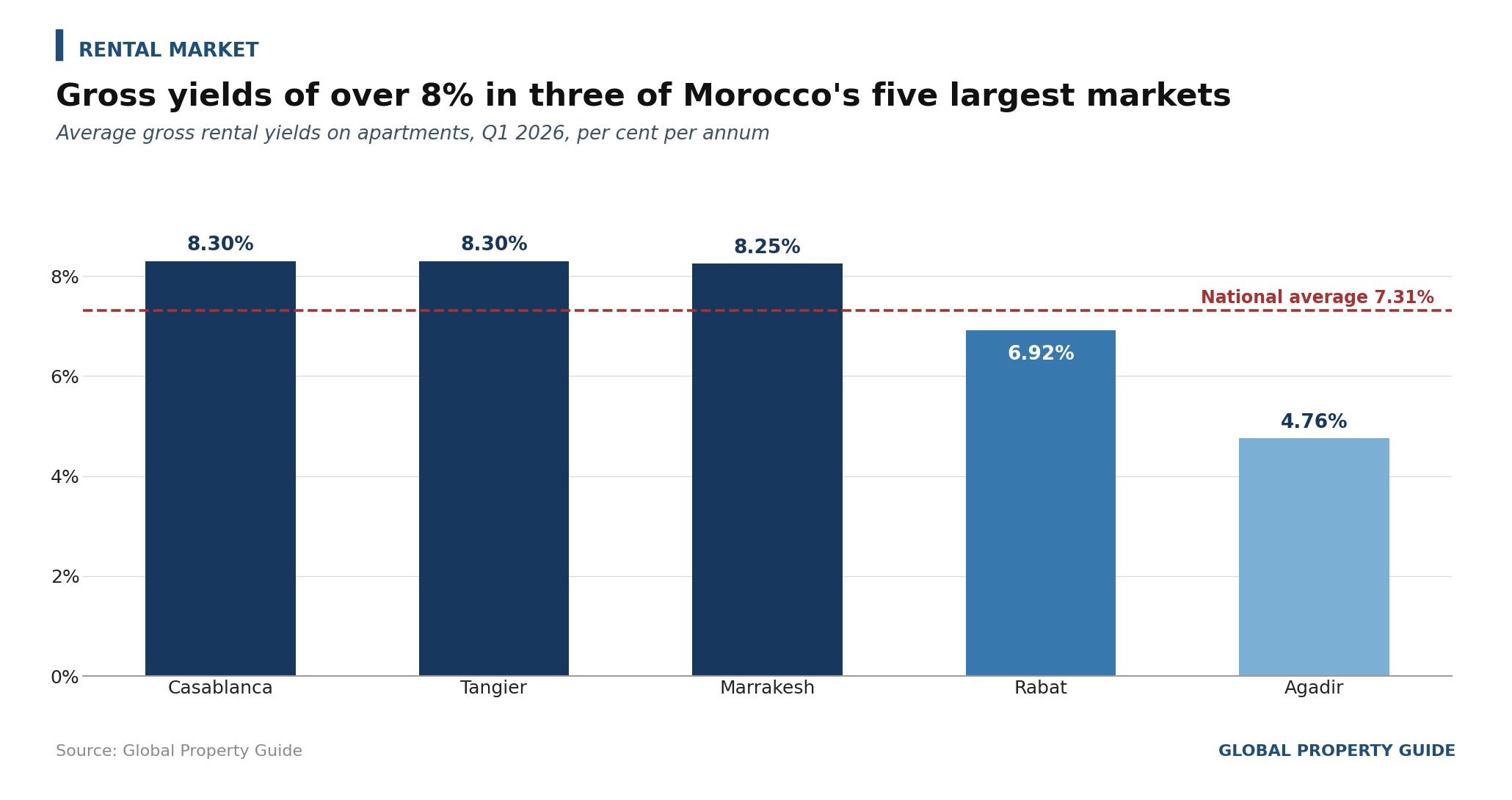
Gross rental yields in Morocco are attractive by international standards, averaging 7.31% in Q1 2026, according to research conducted by the Global Property Guide. That is a marked improvement on the 6.72% recorded in Q2 2025, and reflects the combination of flat to falling purchase prices and firmer rents.
By major city:
- In Casablanca, apartments yield between 7.83% and 9.03%, with a city average of 8.30%. Two-bedroom units are the standout, returning 9.03%.
- In Tangier, yields range from 7.39% to 8.84%, also averaging 8.30%, with studios and one-bedroom units at the top of the range.
- In Marrakesh, yields run from 7.74% to 8.84%, with a city average of 8.25%.
- In Rabat, yields range from 5.04% to 8.74%, averaging 6.92%. The spread is the widest in the country: one-bedroom units return 8.74% while three-bedroom apartments manage just 5.04%.
- In Agadir, yields are the lowest of the five markets, ranging from 4.18% to 5.35% with an average of 4.76%.
A consistent pattern runs through the data: smaller units outperform larger ones, because purchase prices scale faster than achievable rents as unit size increases. All yields quoted are gross, before taxes, repairs, agents' fees, and other costs. Net yields are typically 1.5 to 2 percentage points lower.
Mortgage Market and Interest Rates
The policy rate has been on hold for five consecutive meetings
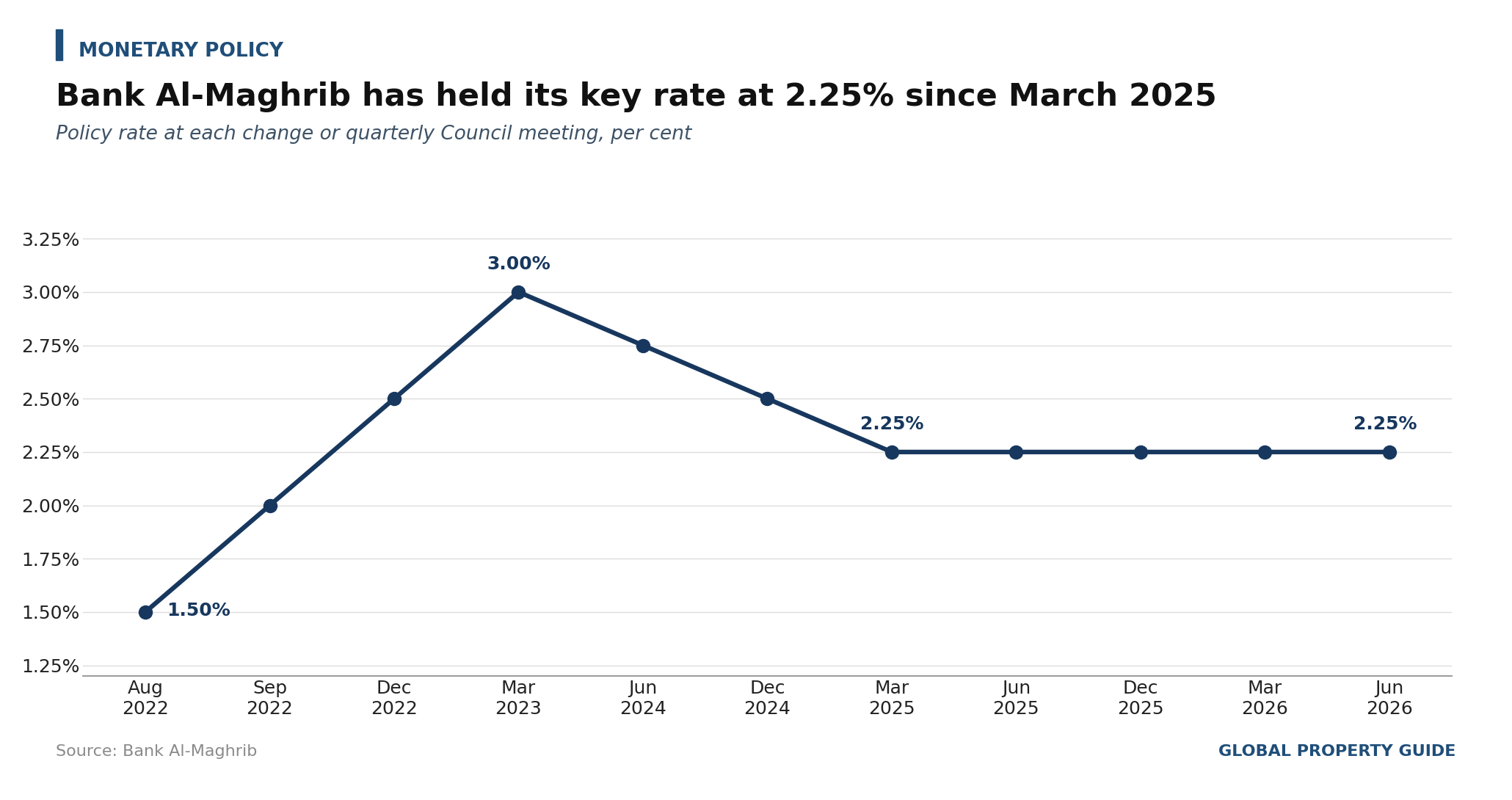
Bank Al-Maghrib kept its key rate unchanged at 2.25% at its second quarterly Council meeting of 2026, held on 23 June in Rabat. It was the fifth consecutive hold, extending a pause that has now run since March 2025.
Morocco's mortgage loan interest rates:
The bank raised its rate from a historic low of 1.5% to a peak of 3% between September 2022 and March 2023 as inflation surged, then eased in three steps of 25 basis points each between June 2024 and March 2025, a cumulative 75 basis points, before stopping.
The Council's June statement pointed to an inflation outlook consistent with medium-term price stability, continued momentum in economic activity, and a high degree of uncertainty in the global outlook. Inflation, which averaged around 0.8% over the previous two years, is now expected to reach 1.5% in 2026 before rising to 2.1% in 2027. Core inflation is projected to stay subdued at 0.2% this year, held down by lower food prices and olive oil in particular, before accelerating to 2.9% in 2027 as imported inflation picks up.
Analysts expect the pause to persist. Attijari Global Research anticipates no change through the end of 2026, with any renewed easing unlikely before the second half of 2027, pending an assessment of the energy shock and its effect on imported inflation.
Borrowing costs remain stubbornly high
The average interest rate on real estate loans stood at 5.13% in Q1 2026, down slightly from 5.19% in the previous quarter, according to Bank Al-Maghrib's quarterly survey of lending rates. The overall average rate across all bank lending fell by 16 basis points over the quarter to 4.66%. Loans to property developers eased by 7 basis points to 5.37%, while rates on household housing loans were broadly stable at 4.66%.
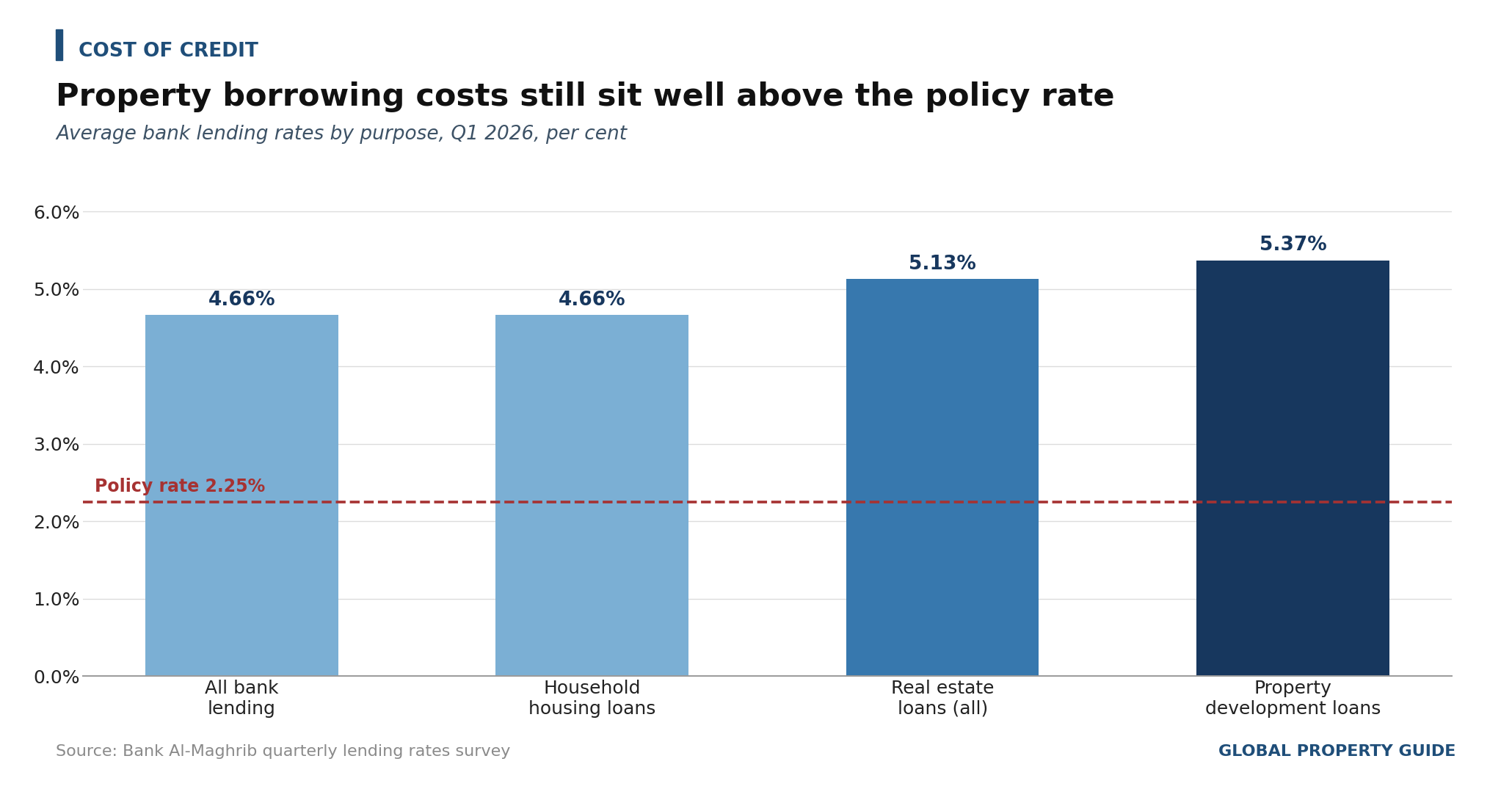
The gap between the policy rate and mortgage pricing has become a live public debate. Asked about it at the June press conference, Governor Abdellatif Jouahri noted the cumulative 75 basis point reduction in the policy rate. Bank Al-Maghrib's own analysis shows the pass-through has been only partial: by Q3 2025, lending rates to the non-financial sector had fallen 58 basis points against 75 basis points on the policy rate.
Borrowers also face a widening spread by profile. The best advertised rates now reach 4% before tax for some categories, according to broker Afdal, but the average pre-tax rate across 36,500 offers from ten banks was 4.64% in the first half of 2026, slightly above the 4.59% recorded in the second half of 2025. Once insurance is included, the effective annual rate ranges from 5.19% for retirees to 5.60% for company directors. Minimum deposits generally run from 20% to 30% of the purchase price, rising to as much as 40% for non-resident and self-employed borrowers.
Mortgage lending grows, with participative finance the fastest-moving segment
Morocco has the most advanced and diverse mortgage market in the region, according to the Center for Affordable Housing Finance in Africa (CAHF). Lending comes from private commercial banks, public banks, consumer credit companies, and microfinance institutions. The typical term is 20 years, and the loan-to-value ratio can reach 100% of the appraised value.
The total stock of property loans exceeded MAD325.8 billion (US$35.03 billion) at the end of May 2026, a rise of 3.2% year on year, holding almost exactly the growth rate recorded a year earlier. Within that, housing loans grew by 2.4% and property development loans by 2.7%.
Momentum picked up modestly in June, when real estate loans to households rose 3.8% year on year, up from 3.2% in May, according to Bank Al-Maghrib's monetary statistics. Total household credit grew 3.4% and consumer credit 4.5%. Housing lending nonetheless continues to expand more slowly than credit to businesses, where equipment loans grew 27.1%.
The clear outlier is participative finance. Outstanding Mourabaha immobilière reached MAD26.8 billion (US$2.88 billion) in June 2026, up 16.6% on a year earlier, several times the growth rate of conventional housing credit, and a growing share of first-time purchases.
Asset quality improved over the same period. Non-performing loans rose 1.9% year on year in June, down from 4.9% the previous month, and their share of total bank credit fell to 8% from 8.4% in May.
Economic and Social Factors
Strong growth that households are not yet feeling
Morocco's economy expanded by an estimated 4.9% in 2025, its strongest performance since the post-pandemic rebound, driven by a recovery in agricultural output and a wave of infrastructure investment tied to the 2025 Africa Cup of Nations and the 2030 World Cup. The African Development Bank puts 2025 growth slightly lower at 4.7%, attributing it to strong investment and household consumption on the demand side.
Fiscal performance also improved. The central government deficit closed 2025 at 3.5% of GDP, smaller than anticipated, as strong revenue more than offset higher spending on public investment and transfers to state-owned enterprises. The IMF expects the deficit path to bring central government debt down to 60.5% of GDP by 2031. The current account deficit widened to 2.1% of GDP in 2025, and Bank Al-Maghrib expects it to reach 4% in 2026 before narrowing to 3.8% in 2027, reflecting the high import content of infrastructure investment and costlier energy.
Inflation spiked on energy, then faded
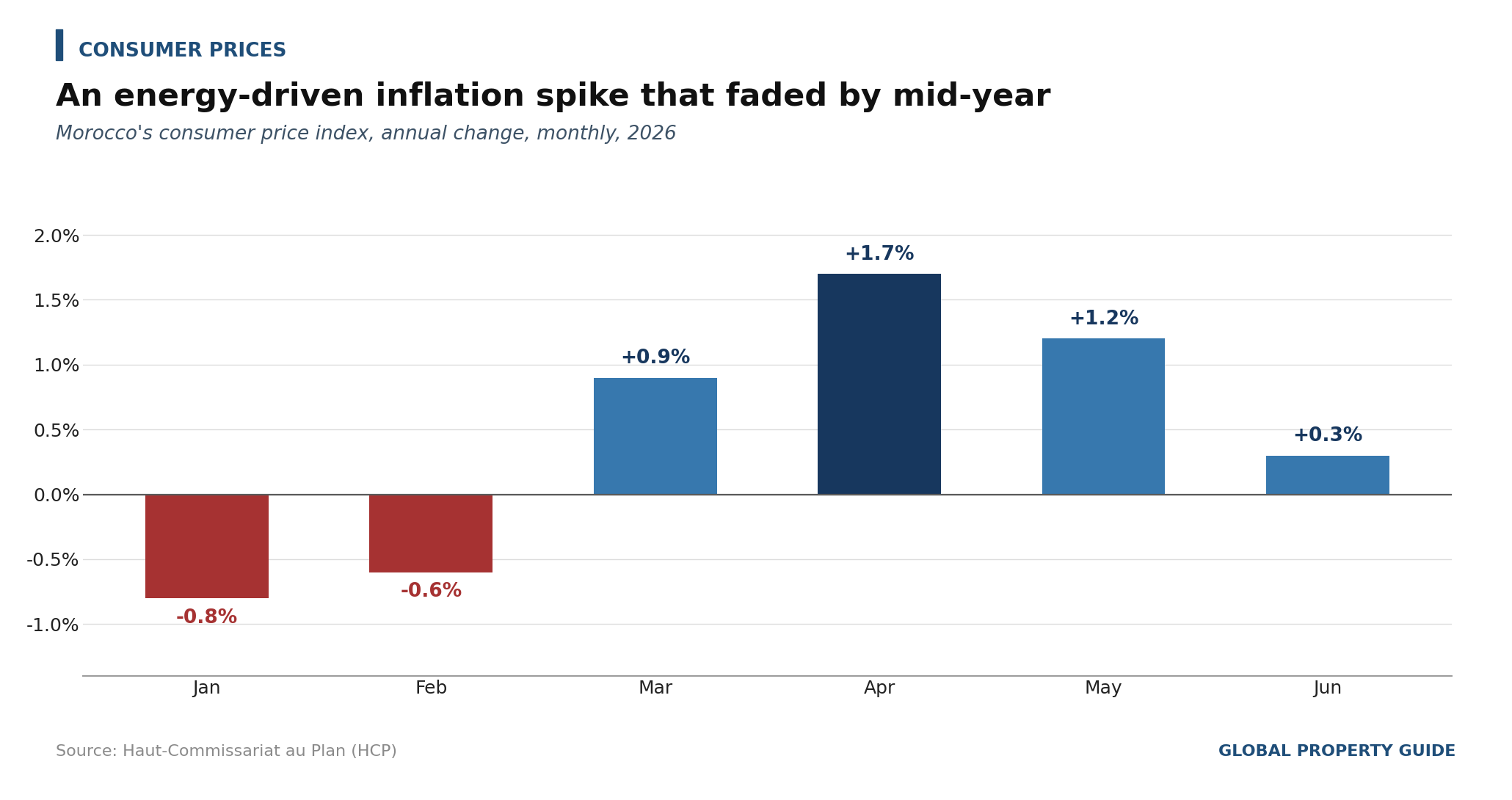
Consumer prices in Morocco were falling outright at the start of 2026, with the index down 0.8% year on year in January and 0.6% in February. Prices then turned up sharply, rising 0.9% in March and 1.7% in April, as supply disruptions linked to the conflict involving Iran pushed transport costs up 8.4%.
The spike proved short-lived. Inflation slowed to 1.2% in May and 0.3% in June, according to the HCP, as food prices fell 2.3% from a year earlier while non-food prices rose 2.3%. Consumer prices averaged just 0.4% higher across the first six months of 2026 than in the same period of 2025.
The labour market looks worse under a new measure
The HCP replaced its long-running national employment survey with a new Labour Force Survey (EMO 2026), built to standards adopted at recent International Conferences of Labour Statisticians and drawing on a sample enlarged from 90,000 to 135,000 households a year.
Under the new definitions, the strict unemployment rate stood at 10.8% in Q1 2026, or 1,253,000 people. The rate reached 13.5% in urban areas against 6.1% in rural areas, and 16.1% among women against 9.4% among men. Young people aged 15 to 24 remain the worst affected at 29.2%, followed by those aged 25 to 34 at 16.1%.
The more revealing figure is the new composite measure of labour underutilisation, which combines strict unemployment, time-related underemployment, and potential labour force, and which reached 22.5%. Participation is also strikingly low, at 41.8% overall and just 17.5% among women against 66.4% among men. Morocco's difficulty is not only a shortage of jobs but a shortage of entry into the labour market at all.
Politics turns on a generational shift
Between 27 September and 18 October 2025, Morocco saw three weeks of youth-led demonstrations under the banner GenZ212. Protesters contrasted the country's mega-project spending, particularly on sports infrastructure, with the state of public health and education, and raised concerns about youth unemployment, regional inequality, and corruption. The government responded with increased health and education budgets and financial incentives for young political candidates.
The political consequences have been considerable. Prime Minister Aziz Akhannouch, one of Morocco's wealthiest businessmen and a lightning rod for the protests, announced in February 2026 that he would not seek re-election as leader of his National Rally of Independents, which effectively rules out his return as head of government. He was succeeded as party leader by Mohamed Chaouki, previously the RNI's parliamentary faction leader. Since the King traditionally appoints the leader of the winning party as prime minister, the decision reshapes the contest.
Parliamentary elections for all 395 seats in the House of Representatives are scheduled for 23 September 2026, with campaigning to run from 10 to 22 September. The RNI won 102 seats in 2021, ahead of the Authenticity and Modernity Party on 87 and Istiqlal on 81.
Morocco's relative stability owes much to constitutional reforms introduced under King Mohammed VI, which brought social equality provisions for women, constitutional guarantees of freedom of expression, official status for Berber alongside Arabic, additional powers for the prime minister, parliamentary authority to grant amnesty, and greater judicial independence. The King remains commander-in-chief, chairs the Council of Ministers and the Supreme Security Council, and is the country's highest religious authority. Concerns about corruption and the concentration of economic power persist, and were among the grievances voiced during the 2025 protests.
Tourism reaches a new peak
Morocco welcomed a record 19.8 million tourists in 2025, up 14% on the previous year and comfortably ahead of the government's 18 million target, according to the Ministry of Tourism, Handicrafts and Social and Solidarity Economy. The figure is more than half again the 13 million recorded in the pre-pandemic year of 2019, and keeps Morocco ahead of Egypt as Africa's most visited destination.
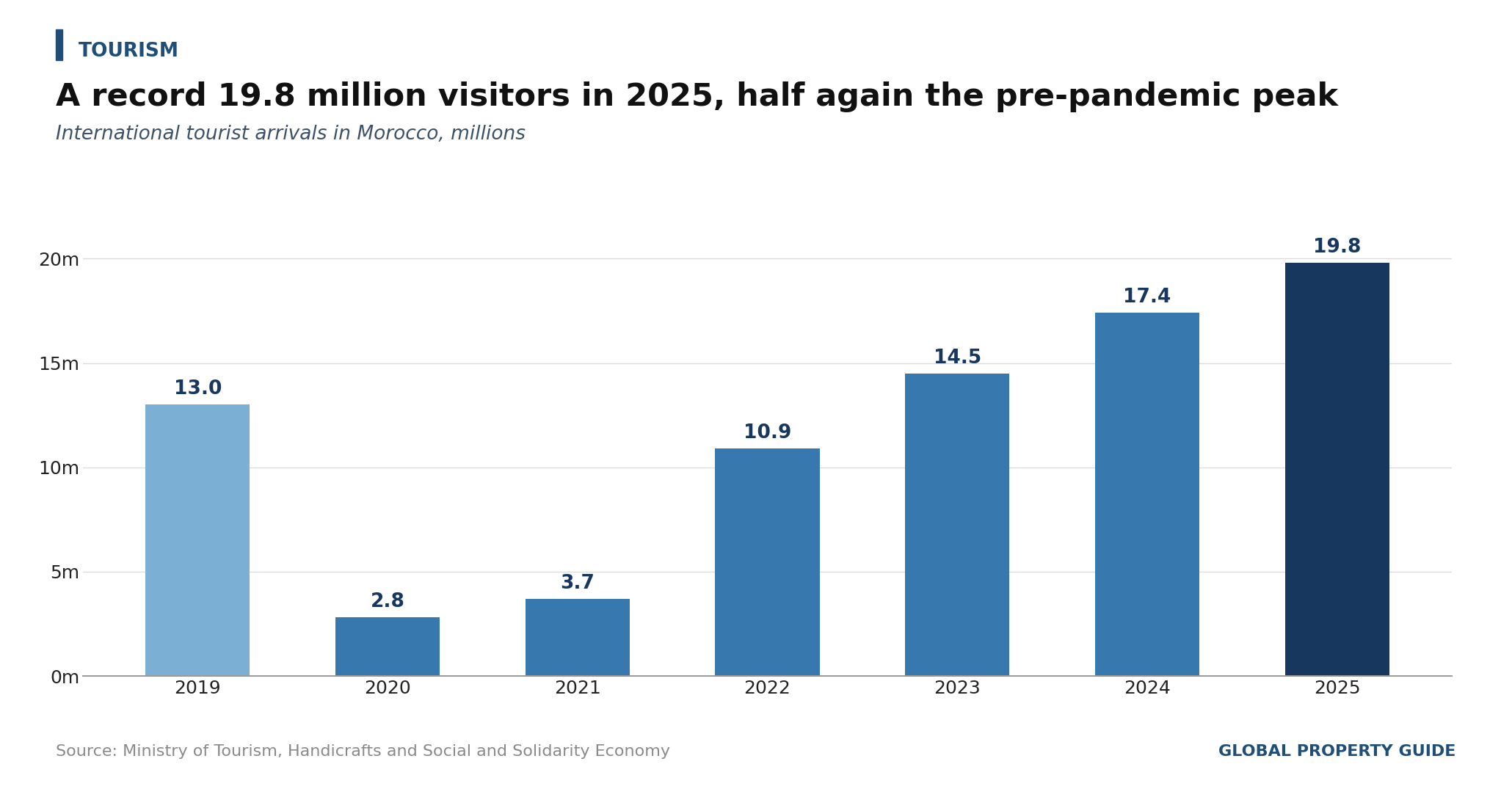
Receipts reached MAD124 billion (US$13.33 billion) in the first 11 months of 2025, a rise of 19%. The ministry credited the 2023 to 2026 tourism roadmap, which prioritised air connectivity, product diversification, and service quality, with Morocco's hosting of the Africa Cup of Nations adding further momentum.
The expansion has continued into 2026. Arrivals reached 4.3 million in the first quarter, up 7% on the same period of 2025, with March alone bringing around 1.6 million visitors, an 18% annual rise. Travel receipts totalled MAD64.898 billion in the first half of 2026, up 15.9%, overtaking diaspora remittances as Morocco's largest single source of foreign currency after the two ran almost level in 2025.
Morocco is targeting 26 million visitors by 2030, when it will co-host the FIFA World Cup with Spain and Portugal. That target is driving airport expansions, new hotel capacity, and an extension of the high-speed rail network, an investment that is reshaping property values in cities near planned infrastructure, Tangier and Marrakech in particular.
Plan Azur, reworked
Launched in 2001 under the Vision 2010 tourism strategy, Plan Azur was designed to turn Morocco into a leading Mediterranean destination through six large seaside resorts at Saidia, Lixus, Mazagan, Mogador, Taghazout, and Plage Blanche, together offering 80,000 tourist beds.
Progress was uneven. Only Saidia and Mazagan were completed, both opening around 2009. Saidia has about 7,000 beds but has struggled with low international visibility, limited year-round activity, and weak air links. Mazagan, near El Jadida, was built with a hotel, golf course, and casino, but at a reduced scope. The remaining resorts faced delays, underinvestment, or partial implementation, and Taghazout is still under phased development.
Morocco has since widened the plan to include Chbika, Ouarzazate Lake City, and Dakhla, reflecting a shift toward regional diversification. In 2023, the government launched a national tourism roadmap for 2023 to 2026 backed by MAD6.1 billion (US$656 million), aiming to create 200,000 jobs and generate MAD120 billion (US$12.9 billion) in foreign tourism revenue. On arrivals and receipts, those targets have already been met ahead of schedule.
Plan Azur fell short of its original goals, but it began Morocco's tourism expansion. With the 2030 World Cup ahead, the country is now building toward a considerably larger one.
Sources:
- Real Estate Asset Price Index (IPAI) (Bank Al-Maghrib): https://www.bkam.ma/
- Property price index falls 0.4% in Q1 2026 (TelQuel): https://telquel.ma/
- The property market slides in the first quarter (Libération, via AllAfrica): https://fr.allafrica.com/
- Property price index up 0.6% in 2025 (Finances News Hebdo): https://fnh.ma/
- Debit rates survey (Bank Al-Maghrib): https://www.bkam.ma/
- Why mortgage rates stay above 5% despite a 2.25% policy rate (Le360): https://fr.le360.ma/
- Mortgage rates at 4%, with wide gaps by borrower profile (Médias24): https://medias24.com/
- Bank Al-Maghrib keeps key interest rate unchanged at 2.25% (Yabiladi): https://en.yabiladi.com/
- AGR forecasts Bank Al-Maghrib to hold key rate at 2.25% (Morocco World News): https://www.moroccoworldnews.com/
- Monetary statistics, June 2026 (Bank Al-Maghrib, via SNRT News): https://snrtnews.com/
- Cement sales fall 1.3% in the first half of 2026 (LesEco): https://leseco.ma/
- Direct housing assistance passes 105,000 beneficiaries (Médias24): https://medias24.com/
- Housing aid, slums, and unsafe buildings: Benbrahim's figures (LeBrief): https://www.lebrief.ma/
- Direct housing assistance programme (Ministry of National Territorial Planning, Urban Planning, Housing and City Policy): https://www.mhpv.gov.ma/
- Morocco country page (Centre for Affordable Housing Finance in Africa): https://housingfinanceafrica.org/
- Gross rental yields in Morocco: Casablanca and 4 other cities (Global Property Guide): https://www.globalpropertyguide.com/
- Labour market situation in Q1 2026 (EMO 2026) (Haut-Commissariat au Plan): https://www.hcp.ma/
- Morocco's inflation eases to 0.3% in June as food prices fall (Barlamantoday): https://barlamantoday.com/
- Morocco inflation rate (Trading Economics): https://tradingeconomics.com/
- IMF Executive Board concludes 2026 Article IV consultation with Morocco (International Monetary Fund): https://www.imf.org/
- Morocco economic outlook (African Development Bank): https://www.afdb.org/
- Morocco tourist arrivals hit record 19.8 million in 2025 (Ecofin Agency): https://www.ecofinagency.com/
- Morocco records 4.3 million tourist arrivals in Q1 2026 (African Travel and Tourism Association): https://atta.travel/
- Tourism receipts overtake diaspora remittances (Bladi): https://www.bladi.net/
- Diaspora remittances pass MAD50 billion by end-May 2026 (Bladi): https://www.bladi.net/
- Morocco wants more from its diaspora than remittances for household consumption (The North Africa Post): https://northafricapost.com/
- Morocco PM Akhannouch announces end of term (AFP, via BSS News): https://www.bssnews.net/
- Government Council sets Sept. 23, 2026 date for parliamentary elections (Hespress): https://en.hespress.com/