Serbia's Residential Property Market Analysis 2026
The Serbian housing market continues to rebalance, with clearer signs of stabilization emerging across both sales and rental segments as the impact of the earlier surge in demand due to strong international migration eases.
This extended overview from Global Property Guide covers key aspects of the Serbian housing market and takes a closer look at its most recent developments and long-term trends.
Table of Contents
- Property Prices and Price Index
- Historic Perspective
- Property Demand Trends
- Property Supply Trends
- Rental Market: Rents and Rental Yields
- Mortgage Market and Interest Rates
- Economic and Social Factors
Property Prices and Price Index
The Serbian housing market is showing clearer signs of stabilization following the pronounced price acceleration of 2021–2022. The Republic Geodetic Authority (RGA) reports that the Apartment Price Index increased by 6.00% year-on-year in Q3 2025 (2.99% in real terms, inflation-adjusted), describing the current trend as “moderate and stable” and largely consistent with 2024 and H1 2025.
The pattern is also broad-based: both new-build and existing stock recorded similar annual growth rates, with resale prices up 6.04% year-on-year and first-sale prices up 5.92%, indicating normalization across market segments rather than a shift driven by one supply type.
Serbia's house price annual change:
Regional disparities remain pronounced.
Regional performance continues to be led by Serbia’s main urban and economic centers. Belgrade recorded the strongest annual price growth (6.55%), followed by Vojvodina (6.26%), where market activity is concentrated in larger cities and supported by in-migration, the expansion of IT and service sectors, and the development of new residential complexes. In contrast, Southern and Eastern Serbia and the Šumadija and Western Serbia region registered slower and more uneven dynamics, with greater divergence between new-build and resale performance and a less uniform price trajectory overall.
RGA Apartment Price Index, by region:
| First Sale Apartments YoY, % (Q3 2025 vs Q3 2024) |
Resale Apartments YoY, % (Q3 2025 vs Q3 2024) |
Total Apartments YoY, % (Q3 2025 vs Q3 2024) |
|
| Vojvodina | 7.47% | 5.51% | 6.26% |
| City of Belgrade | 6.21% | 6.74% | 6.55% |
| South and East Serbia | 6.62% | 4.94% | 5.49% |
| Sumadijaand West Serbia | 2.85% | 5.91% | 4.62% |
| Serbia Total | 5.92% | 6.04% | 6.00% |
| Data Source: RGA. | |||
In terms of achieved price levels, Belgrade continued to command the highest median sales prices per square meter in Q3 2025, with first-sale apartments at EUR 2,517 (USD 2,940) and resale apartments at EUR 2,560 (USD 2,990). Novi Sad remained the second most expensive market, with new-build units sold at EUR 2,256 (USD 2,635) per square meter and resale apartments at EUR 2,250 (USD 2,628).
"The widening regional disparities show no signs of easing. Capital remains largely concentrated in urban centers and economically more dynamic areas, while smaller towns continue to lag behind. Despite lower prices per square meter, these locations tend to be less attractive both to individual buyers and to investors,” commented Bloomberg Adria.
Median (50th percentile) per square meter price of apartments in the major cities:
| City | First Sale Q3 2025, EUR/sqm |
First Sale Q3 2025, USD/sqm |
YoY, % | Resale Q3 2025, EUR/sqm |
Resale Q3 2025, USD/sqm |
YoY, % |
| Belgrade | EUR 2,517 | USD 2,940 | 14.72% | EUR 2,560 | USD 2,990 | 17.81% |
| Novi Sad | EUR 2,256 | USD 2,635 | 12.24% | EUR 2,250 | USD 2,628 | 10.67% |
| Nis | EUR 1,650 | USD 1,927 | -4.01% | EUR 1,577 | USD 1,842 | 16.38% |
| Kragujevac | EUR 1,561 | USD 1,823 | 5.76% | EUR 1,352 | USD 1,579 | 13.90% |
| Note: Exchange rate as of Q3 2025, USD 1= EUR 0.85609. | ||||||
| Data Source: RGA. | ||||||
Overall, the market is increasingly described as strong but more rational, consistent with a transition into a more mature phase. Demand remains resilient, while limited housing availability, one of the market’s key structural constraints, continues to provide underlying support for prices. At the same time, elevated price levels have not produced renewed euphoria or abrupt corrections, aligning with a macroeconomic backdrop of easing inflation, stabilizing interest rates, and households gradually adapting to new financing conditions.
Nevertheless, affordability remains a central constraint: in Belgrade and Novi Sad in particular, price growth has continued to outpace wage growth, leaving homeownership a long-term financial burden for a significant share of households. This reinforces a two-track market in which needs-based buyers and investment purchasers coexist, with investment demand still exerting a meaningful influence on price formation.
Looking ahead to 2026, the prevailing base case among market commentators points to broad price stability and a slower-growth profile. RTS summarizes expert views that weaker construction activity and “unstable financial conditions” are likely to keep apartment prices at roughly similar levels in 2026, even as buyers become more cautious. This broadly aligns with Colliers’ summer 2025 qualitative assessment, which frames the outlook as cautiously optimistic: “While growth may be more measured, the fundamentals remain solid and aligned with a broader macroeconomic stability.”
Property Demand Trends
Sales Volumes Rise Modestly while Credit-Backed Demand Becomes More Material
Demand for housing in Serbia continued a moderate upward trajectory. According to the RGA, apartment sales in the first three quarters of 2025 totaled 35,532 transactions, up 5.67% year-on-year. The total value of apartment transactions reached EUR 3.401 billion (USD 3.973 billion), representing a 19.29% annual increase.
Colliers’ Summer 2025 Serbia note describes conditions as “relatively steady”: “Although transaction volumes have cooled slightly compared to peak periods, serious buyers are still active, especially in sought-after urban locations. The easing of price growth has allowed for a more realistic market environment, where end users and investors alike are recalibrating expectations,” commented Milos Subota, senior valuator and market research analyst.
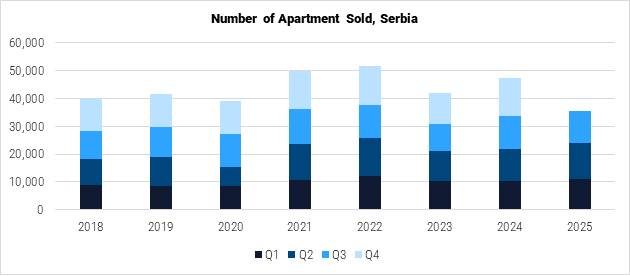
Note: In July 2025, the Ministry of Justice's information systems experienced an operational interruption. As a result, verification of purchase and sale contracts with the competent verification authorities was temporarily not possible for a certain period.
Data Source: RGA.
The RGA’s reporting also indicates a shift in the composition of demand, with credit-financed buyers accounting for a larger share of transactions, supported by targeted policy measures. In its Q3 2025 apartment price index bulletin, the Authority notes that credit-financed purchases increased sharply year-on-year and that the share of credit-backed acquisitions rose to roughly one-third of all apartment sale contracts, signaling a meaningful change in the market’s buyer mix. The RGA links part of this trend to the roll-out of subsidized housing loans for young people, with initial market effects visible from Q2–Q3 2025.
At the regional level, year-to-date data for the first three quarters of 2025 indicate that all regions recorded annual growth in both apartment sales volumes and transaction values. Belgrade remained the clear center of activity, accounting for 35% of units sold and 52% of total transaction value. “Demand in the capital remains strong, both from domestic buyers and from investors who see apartments as a protection of capital in conditions of limited investment options,” noted Bloomberg Adria.
Apartment sales, by region:
| Number of Apartments Sold, Q1-Q3 2025 |
YoY, % | Value of Apartments Sold, EUR M, Q1-Q3 2025 |
YoY, % | |
| Vojvodina | 9,939 | 6.13% | 810 | 23.66% |
| City of Belgrade | 12,575 | 2.12% | 1,776 | 12.62% |
| South and East Serbia | 4,759 | 24.22% | 300 | 55.44% |
| Sumadijaand West Serbia | 8,259 | 1.76% | 515 | 20.89% |
| Serbia Total | 35,532 | 5.67% | 3,401 | 19.29% |
| Data Source: RGA. | ||||
Foreign demand remains a relevant, though segment-specific, source of purchase activity in Serbia’s most liquid urban markets, where incremental inflows can have an outsized impact on absorption of prime, ready-to-occupy stock. Ivana Štrbac, head of the Real Estate Appraisal Department of the RGA, estimates that Russian nationals lead foreign purchases, with demand concentrated mainly in Belgrade, Novi Sad, and Subotica.
Russian business media further suggest that residency considerations are a key motivation behind a meaningful share of these cross-border transactions. Kommersant reports that for Serbia (alongside Greece and Cyprus) “100% of requests to acquire real estate… are linked to the goal of obtaining a residence permit”. Interfax, citing NF Group, similarly notes that in 2025, “Serbia has moved to second place” among destinations where Russian investors more often invest in overseas property.
Property Supply Trends
Stabilizing Completions Amid a Gradual Cooling in Permits
Responding to demand from both domestic and foreign buyers, the number of residential units completed in Serbia has increased substantially in recent years, with growth recorded even at the onset of the pandemic in 2020 and during the high-inflation period of 2022. According to the latest annual data from the Statistical Office of the Republic of Serbia (SORS), 2024 marked a phase of stabilization, with 35,380 dwellings completed. This was virtually unchanged from 2023 (a marginal decline of 0.76%), yet still 42.64% above the pre-pandemic level recorded in 2019.
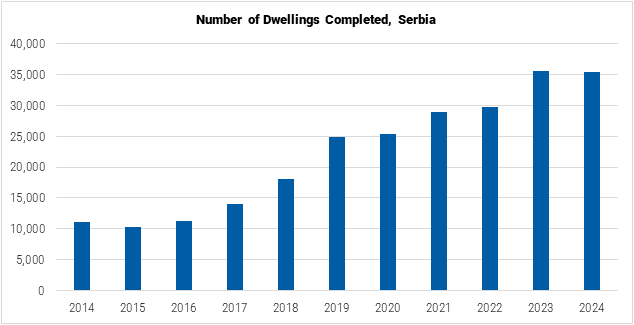
Data Source: SORS.
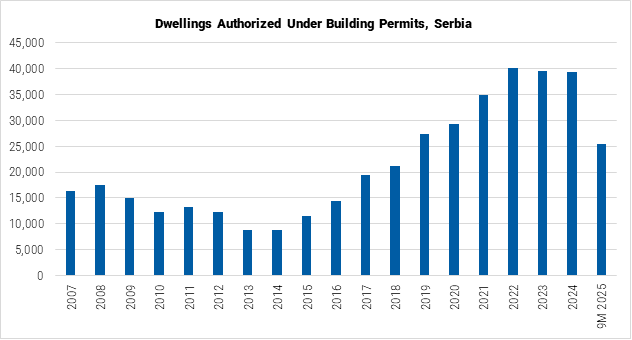
At the same time, leading indicators point to a more cautious construction pipeline. After several years of robust growth in approvals, the number of building permits issued in Serbia leveled off in 2024 and began to edge down in 2025. The SORS data shows that the cumulative number of dwellings for which building permits had been issued reached 25,354 in the first nine months of 2025, marking a 3.58% year-on-year decline. Official statistics and local business media frame this not as a downturn, but as a gradual cooling: fewer projects are entering the pipeline, while the average value per permit is rising, suggesting that developers are focusing on a smaller number of larger or higher-margin schemes rather than broad-based expansion.
Data Source: SORS.
Looking ahead, most market observers expect construction activity in Serbia to remain elevated, but to follow a more stable trajectory than in the previous boom phase. The Eastern European Construction Forecasting Association’s 2025 forecast indicates that residential construction will “maintain historically high volumes” in the current cycle, even as its growth pace is expected to lag behind that of the non-residential segment.
In parallel, CBRE anticipates that new housing supply will be unevenly distributed, with development increasingly concentrated in the largest urban markets, where consistently strong demand continues to underpin the need for additional stock. Belgrade and Vojvodina are projected to remain the most attractive regions for developers, given their population base and the depth of market activity, with particularly strong investment momentum along development corridors associated with EXPO 2027 around Surčin.
Rental Market: Rents and Rental Yields
Market Rebalances as Impact of Foreign Demand Eases
Similar to other post-transition economies, Serbia is characterized by a high homeownership rate. During the 2022 census, only 6.4% of occupied dwellings were reported as rented. The market remains largely unregulated, with many private landlords renting out their investment properties unofficially. The demand for mid- and short-term rental apartments, especially in larger cities, is often driven by foreigners working in the country, digital nomads, domestic and international students, as well as tourists.
Serbia's rent price index:
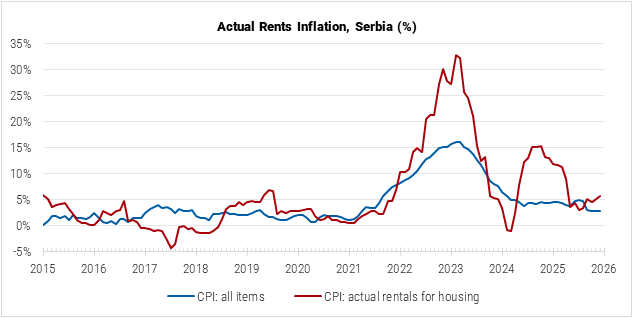
Following the influx of foreign nationals at the onset of the conflict in Ukraine, which had previously led to a sharp spike in demand for rental apartments across Serbia, the market is now recalibrating, rental rates cooling or even declining in some areas, especially outside prime neighborhoods, according to anecdotal evidence from local professionals. While still trending above the overall price growth in the country, rental inflation (measured by the annual change in actual rentals for the housing component of the consumer price index) moderated significantly from peak levels observed in 2022-2024 and was most recently reported by the SORS at 5.6% in December 2025.
“Part of the decline was due to the socio-economic situation, because there are not so many foreign companies coming and locating in Serbia at the moment. All of this has influenced the demand in the rental sector to drop drastically,” Miloš Mitić, operational director of the City Expert real estate agency, explained in an interview to Biznis.rs earlier last year. “In this year alone, we have a drop of some 10% compared to the prices in 2024, which we analyzed and which also recorded a drop of 20% compared to 2023. It is certain that collectively we have a drop of 30-40% compared to prices that were after the impact of the Russian-Ukrainian crisis, and this has been going on for a long period of time."
At the same time, as outlined in recent market insights from Colliers, the country’s rental market, particularly in Belgrade, continues to be undersupplied, with demand generally rising for long-term leasing options. “This imbalance opens up new opportunities for build-to-rent developments and investment strategies focused on generating consistent yield,” the experts summarized.
Data Source: SORS.
In nominal terms, the November 2025 analysis from City Expert (based on one-bedroom apartments around 50 sqm) shows asking rents at EUR 7-13 per sqm in Belgrade, EUR 10-12 per sqm in Novi Sad, and around EUR 8 per sqm in Niš - all three locations now more affordable than a year prior, according to the agency.
Strong rental yields
At the time of this research in January 2026, based on listings on the 4zida platform, average advertised rents in key submarkets ranged from EUR 207-308 for a studio apartment to EUR 408-1,058 for a 3-bedroom apartment. The highest rents per unit were traditionally observed in the capital city of Belgrade, followed by Novi Sad, while Niš and Kragujevac offered more affordable options.
Earlier last year, research conducted by Global Property Guide found gross rental yields for residential properties in Serbia’s key submarkets at the average level of 5.57%, with Belgrade demonstrating stronger potential performance for rental properties (6.35%) compared to Novi Sad (4.79%).
Average advertised rents, by property type and submarket:
| Studio, January 2026 |
1-bedroom apartment, January 2026 |
2-bedroom apartment, January 2026 |
3-bedroom apartment, January 2026 |
|
| Belgrade | EUR 308 (USD 361) |
EUR386 (USD 452) |
EUR 668 (USD 782) |
EUR 1,058 (USD 1,239) |
| Novi Sad | EUR 277 (USD324) |
EUR 308 (USD 361) |
EUR 453 (USD 530) |
EUR658 (USD 770) |
| Niš | EUR 236 (USD 276) |
EUR 266 (USD311) |
EUR 328 (USD 384) |
EUR 413 (USD 484) |
| Kragujevac | EUR207 (USD242) |
EUR 244 (USD 286) |
EUR 299 (USD350) |
EUR 408 (USD 478) |
| Note: Exchange rate as of December 2025, EUR 1 = USD 1.1709. | ||||
| Data Source: 4zida. | ||||
Mortgage Market and Interest Rates
Interest Rates Capped Legislatively, Lending Activity Surges
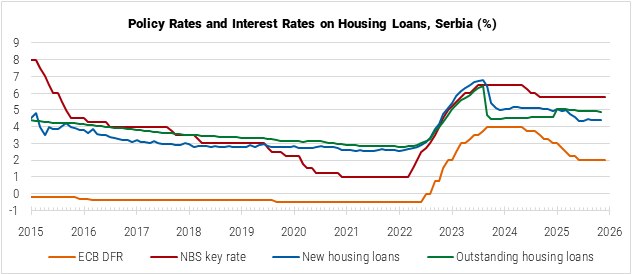
Given that the vast majority of housing loans in Serbia are EUR-indexed, the latest monetary policy easing cycle of the European Central Bank (ECB) translated into generally lower borrowing costs for Serbian citizens in 2025. However, after eight consecutive cuts to its benchmark rates (which brought the deposit facility rate to 2.00%, the main refinancing operations rate to 2.15%, and the marginal lending facility rate to 2.40%), the ECB has maintained its stance since June 2025, making no further moves at the December meeting of the Governing Council.
Serbia's mortgage loan interest rates:
At the same time, the key rate of the National Bank of Serbia (NBS), which typically affects RSD-indexed loans, has remained unchanged at 5.75% since October 2024. In January 2026, the regulator once again decided to keep the rate on hold, based on actual and expected inflation in the country, which recently stabilized slightly below the target midpoint.
Apart from monetary policy decisions, the sharp drop and subsequent relatively stable trend for mortgage interest rates observed in Serbia after September 2023 was facilitated by the NBS placing and extending a temporary cap on housing loan rates to ensure market stability and protect the borrowers. This temporary measure from the central bank was later formalized by the new Law on the Protection of Financial Service Consumers, which went into effect in July 2025.
Under the new legislation, interest rates on housing loans in Serbia will be capped at the following levels:
- Variable-rate loans: weighted average rate on existing variable-rate loans +1/5 (2026-2027), weighted average rate on existing variable-rate loans +1/4 (from 2028 onwards);
- Fixed-rate loans: weighted average rate on new fixed-rate loans +1/5 (2026-2027), weighted average rate on new fixed-rate loans +1/4 (from 2028 onwards).
Data Sources: NBS, ECB.
In this environment, the weighted average interest rate on new housing loans in Serbia, as reported by the NBS, reached 4.41% in November 2025, down from 5.05% a year earlier. The weighted average interest rate on outstanding housing loans, while dropping from its 6.40% peak recorded in August 2023, went slightly up from a year ago, reaching 4.90% in November 2025.
Interest rates on housing loans, monthly weighted average:
| November 2025 |
YoY | November 2024 |
YoY | November 2023 |
|
| New loans | 4.41% | ↓ | 5.05% | ↓ | 5.11% |
| - Indexed to FX and FX loans | 4.40% | ↓ | 5.02% | ↓ | 5.07% |
| - RSD | 10.88% | ↑ | 10.60% | ↓ | 11.94% |
| Outstanding loans | 4.90% | ↑ | 4.56% | ↑ | 4.47% |
| - Indexed to FX and FX loans | 4.89% | ↑ | 4.54% | ↑ | 4.45% |
| - RSD | 9.32% | ↓ | 10.05% | ↑ | 9.64% |
| Data Source: NSB. | |||||
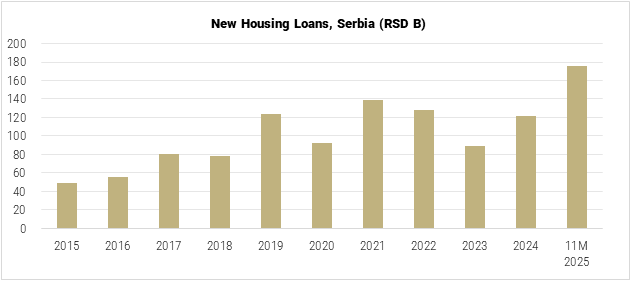
Past monetary policy easing, the authorities’ measures to limit interest rates, as well as measures to facilitate more favorable borrowing conditions for lower-income citizens, and the introduction of a subsidized housing loan program for young people between the ages of 20 and 35, boosted lending activity in Serbia, which had previously been in decline in 2022-2023. Following a 37.7% rebound growth in 2024, the cumulative value of new housing loans increased even more substantially last year, amounting to RSD 175.8 billion (USD 1.7 billion) between January and November, which was 71.0% above the comparable level a year prior.
“These two loan categories [housing and cash loans to households] saw record-high increments in September <…>, thanks also to the application of temporary measures of the NBS, including the offer of cheaper loans for lower-income citizens. In addition, housing loans growth was supported by the approval of loans under the youth programme, which accounted for 45% of the increase in housing loans in Q3,” the central bank commented on the developments in its quarterly report on lending trends.
Data Source: NBS.
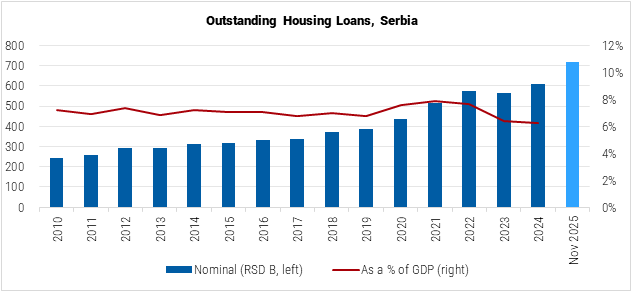
The total value of outstanding housing loans maintained by the Serbian banks, based on the NBS data, also recovered after a contraction in 2023, showing an 8.1% annual increase in 2024 and a further 17.6% growth in the eleven months of 2025, reaching RSD 718.3 billion (USD 7.1 billion) in November 2025. Sized against the national economy, however, the market decreased from a decade peak of 7.9% of GDP at current prices in 2021 to an estimated 6.3% in 2024.
In general, the use of credit in residential purchases in Serbia remains limited, especially outside major cities. Based on data collected from purchase and sale contracts, the Republic Geodetic Authority (RGA) reported that only 34.5% of all apartments nationwide were paid for with credit funds in Q3 2025, the proportion was slightly higher in larger cities: 43.0% in Belgrade, 44.2% in Novi Sad, 40.1% in Niš, and 41.5% in Kragujevac.
Data Sources: NBS, SORS.
Economic and Social Factors
Resilient Growth in a Challenging Environment
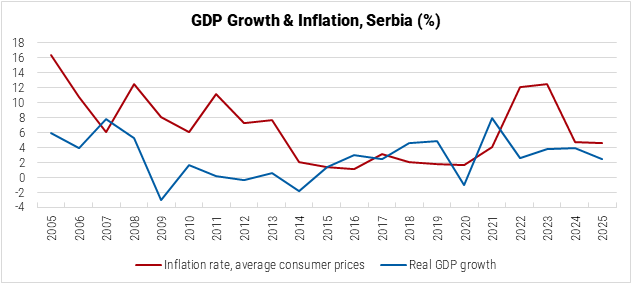
Serbia’s macroeconomic performance remains resilient amid a challenging global environment, although rising headwinds are weakening a cyclical upswing of the economy. In 2025, the real GDP growth slowed to an estimated 2.4% from 3.9% in 2024, due to waning economic sentiment and subdued demand in key export markets. The latest projections from the NBS anticipate re-acceleration of growth to 3.5% in 2026 and 5.0% in 2027. The forecast from the International Monetary Fund (IMF) also expects more pronounced economic expansion, with growth reaching respective 3.6% and 4.6% in the next two years.
Consumer price index (CPI) inflation in the country has largely stabilized over the last two years, reaching average annual levels of 4.7% in 2024 and 4.6% in 2025. It was most recently reported by the SORS at 2.9% in December 2025, just below the central bank’s target midpoint. The NBS expects the inflation to remain within the target tolerance band for the forecast period. The IMF projections support this view, placing the indicator at 4.0% for 2026 and 3.6% for 2027.
Data Source: IMF.
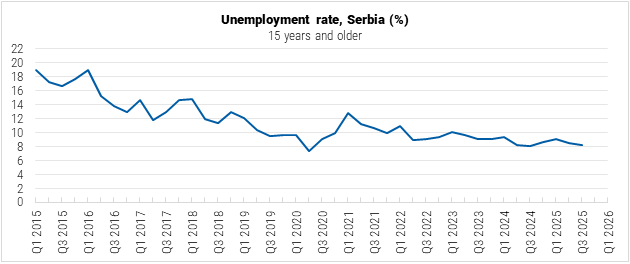
Against this background, Serbia’s labor market presents as relatively stable. Based on the figures reported by the SORS, nationwide employment reached 51.3% in Q3 2025, while unemployment was at 8.2%, nearing historic lows. Average salaries and wages registered a 6.8% real growth between January and October 2025.
At the same time, as a recent macroeconomic outlook from the World Bank notes, the labor market is characterized by persistent and deep structural challenges, such as high youth unemployment fueled by skill mismatches and limited job opportunities. “Many young Serbians migrate abroad, fueling brain drain and a shrinking workforce. While regional disparities are severe, there is very little internal labor mobility,” said the report.
Data Source: SORS.
Looking ahead, positive expectations for the Serbian economy are tied to the new investment cycle associated with the “Leap into the Future — Serbia EXPO 2027” development plan announced in 2024. This ambitious plan includes programs to raise the standard of living and various projects in the fields of science and technology, education, infrastructure development, energy, ecology, agriculture, health, and tourism, as well as preparing and hosting the International Specialized Exhibition EXPO 2027 in Belgrade. The total announced investment for the plan amounts to EUR 17.8 billion over several years.
In July 2025, Fitch Ratings affirmed Serbia’s ‘BB+’ rating with a positive outlook, citing the country’s solid, investment-led economic growth, underpinned by the "Leap into the Future" plan, as well as continued government debt reduction and sound management of the recent inflation shock. At the same time, increased domestic political uncertainty and social polarization, highlighted by continued protests across the country after the infrastructure accident in late 2024, create risks for the economic outlook.
Sources:
- Government of the Republic of Serbia
- Youth Housing Loan Program, a Measure for Serbia’s Future: https://www.srbija.gov.rs/
- First Four Agreements Signed for Affordable Housing Loans for Young People: https://www.srbija.gov.rs/
- Leap into the Future – Serbia EXPO 2027 Plan Presented: https://www.srbija.gov.rs/
- Statistical Office of the Republic of Serbia (SORS)
- Construction Statistics: https://www.stat.gov.rs/
- National Accounts: https://www.stat.gov.rs/
- Consumer Prices: https://www.stat.gov.rs/
- Labor Market: https://www.stat.gov.rs/
- Census 2022: Dwellings by Density Standard, Type of Ownership and Occupancy Status: https://publikacije.stat.gov.rs/
- National Bank of Serbia (NBS)
- Interest Rates and Exchange Rate: https://www.nbs.rs/
- Key Policy Rate Kept on Hold: https://www.nbs.rs/
- NBS Places a Temporary Cap on Housing Loan Rates: https://www.nbs.rs/
- NBS Adopts Decision on Temporary Interest Rate Cap: https://www.nbs.rs/
- Law on the Protection of Financial Service Consumers: https://www.nbs.rs/
- Trends in Lending, Q3 2025: https://www.nbs.rs/
- Semi-Annual Monetary Policy Report, January-June 2025: https://www.nbs.rs/
- Macroeconomic Developments and Financial Sector Movements in Serbia, January 2026: https://www.nbs.rs/
- Republic Geodetic Authority (RGA)
- RGA Apartment Price Index Report, Q3 2025 (SR): https://www.rgz.gov.rs/
- RGA’s Apartment Price Index, Q3 Press Release (SR): https://www.rgz.gov.rs/
- Real Estate Market Report, Q3 2025 (SR): https://www.rgz.gov.rs/
- European Central Bank (ECB)
- Key ECB Interest Rates: https://www.ecb.europa.eu/
- Monetary Policy Decisions, 18 December 2025: https://www.ecb.europa.eu/
- International Monetary Fund (IMF)
- Country Overview: Republic of Serbia: https://www.imf.org/
- 2025 Article IV Staff Report: https://www.imf.org/
- Republic of Serbia: Selected Issues: https://www.imf.org/
- World Bank
- Serbia MPO, October 2025: https://thedocs.worldbank.org/
- 4zida
- Price Movement Calculator (SR): https://www.4zida.rs/
- Fitch Ratings
- Fitch Affirms Serbia at 'BB+'; Outlook Positive: https://www.fitchratings.com/
- Colliers
- Market Insights for Summer 2025 in Serbia: https://www.colliers.com/
- EECFA – Buildecon
- EECFA 2025 Summer Construction Forecast: https://buildecon.blog/
- Bloomberg Adria
- Apartment Price Growth is Not Stopping, But the Pace is Slowing… (SR): https://rs.bloombergadria.com/
- Euronews
- An Earthquake Has Begun on the Serbian Real Estate Market… (SR): https://www.euronews.rs/
- “Investors Focus on Locations That Promise Rapid Development”… (SR): https://www.euronews.rs/
- RTS
- Will Housing Construction Continue to Fall and Prices Will Rise… (SR): https://www.rts.rs/
- Kommersant
- Russian Buyers’ Preferences Have Changed (RU): https://www.kommersant.ru/
- Interfax
- NF Group Noted an Increase in Russian Interest in Real Estate in Serbia and Greece (RU): https://www.interfax.ru/
- Biznis.rs
- Decrease in the Number of Issued Building Permits… (SR): https://biznis.rs/
- Can Students Hope for More Affordable Rents? (SR): https://biznis.rs/
- Lower Rental Prices in Belgrade - Should You Rent an Apartment Now? (RS): https://biznis.rs/
- CityExpert
- How Much Does Renting an Apartment Cost in 2025? Updated prices in Belgrade, Novi Sad & Niš: https://cityexpert.rs/