Norway's Residential Real Estate Market Analysis 2026
Norway's housing market has split in two. Nationwide prices are still rising, but Oslo has stalled and turned negative while Bergen, Stavanger and the western coast post double-digit gains. Behind the divergence sits a monetary policy reversal: after two cuts in 2025, Norges Bank raised its policy rate in May 2026 for the first time since 2023, and mortgage rates have begun climbing again.
This extended overview from Global Property Guide covers key aspects of the Norwegian housing market and takes a closer look at its most recent developments and long-term trends.
Table of Contents
- Property Prices and Price Index
- House Price Variations
- Property Demand Trends
- Property Supply Trends
- Rental Market: Rents and Rental Yields
- Mortgage Market and Interest Rates
- Economic and Social Factors
All conversions in this report use a single reference pair, USD 1 = NOK 9.42 and EUR 1 = USD 1.1585, the market rates on 17 August 2026.
Property Prices and Price Index
In Q2 2026, the nationwide price index for existing dwellings rose by 4.4% from the same period last year, following year-on-year growth of 3.84% in Q1 2026, 5.94% in Q4 2025, 5% in Q3 2025, 4.54% in Q2 2025 and 6.49% in Q1 2025, based on figures from Statistics Norway.
Adjusted for inflation, which ran at 3% in July 2026, Norwegian house prices rose by a more muted 1.36% over the same period.
Quarter-on-quarter, nationwide house prices were up by just 0.4% in Q2 2026 on a seasonally adjusted basis, a marked slowdown from the pace recorded through 2025.
Norway's house price annual change:
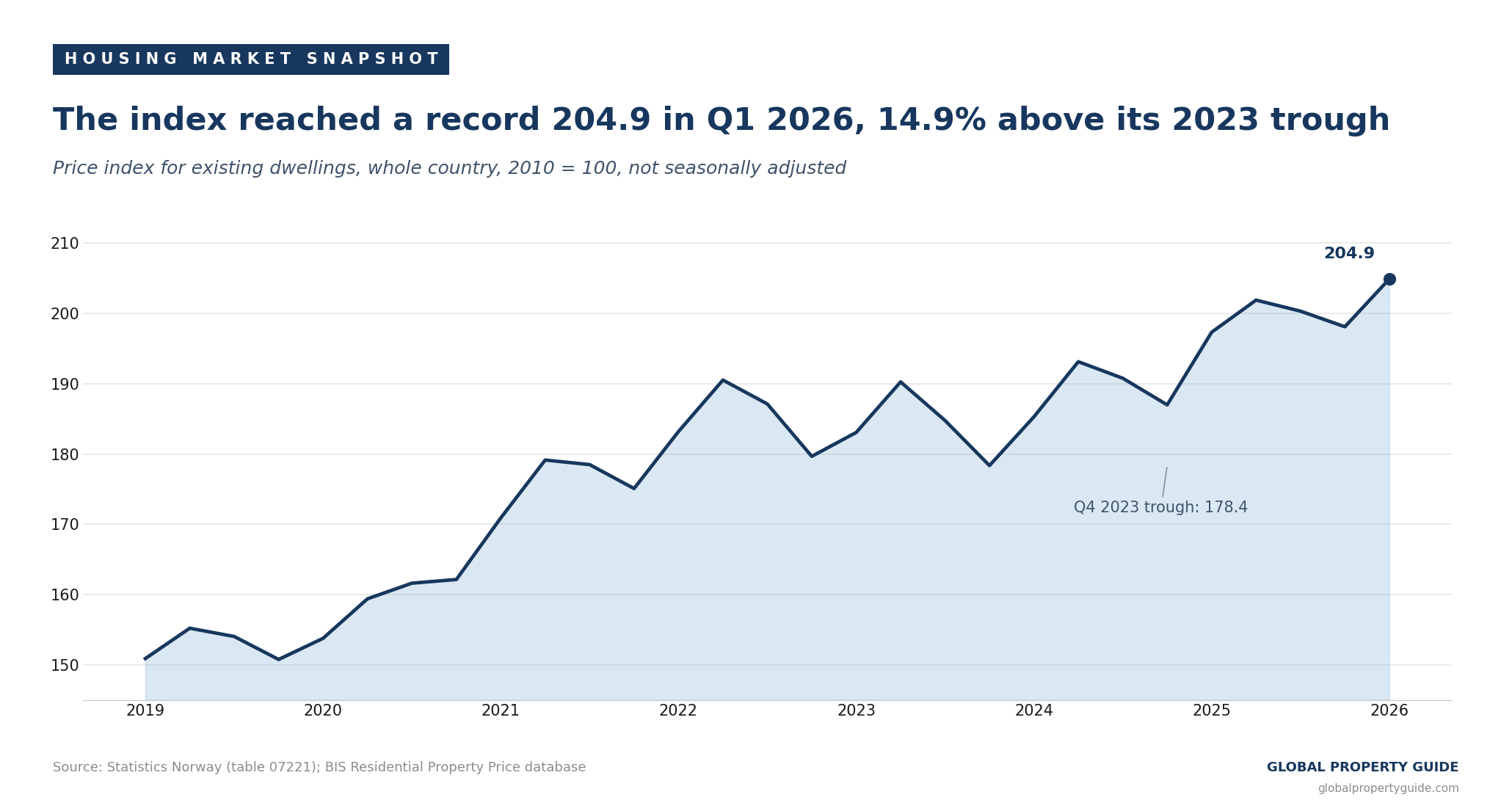
The index itself reached 204.9 in Q1 2026 on a 2010 base, a record level and 14.9% above the trough of 178.4 recorded in Q4 2023. The recovery from that trough has now run for nine consecutive quarters, though its momentum has clearly faded.
More recent monthly data point to outright weakness over the summer. Second-hand dwelling prices fell by 2.6% in July 2026, or 1.1% after adjusting for seasonal variation, according to Eiendom Norge, which compiles monthly statistics with Eiendomsverdi and FINN.no. The average price of a Norwegian dwelling stood at NOK 4,389,536 (US$465,980) at the end of July. Prices were nonetheless still up by 2.8% over the first seven months of the year.
Eiendom Norge described the July outcome as weaker than expected, noting that prices fell in nominal terms in every area covered and that several districts in eastern Norway are now recording negative price development.
House Price Variations
Regional differences have widened to the point where the national average conceals more than it reveals. The gap between the strongest and weakest of Statistics Norway's eleven regions reached 10.5 percentage points in the year to Q2 2026.
During the year to Q2 2026:
- In Bergen, the house price index was up by 11.3%, the strongest of any region, following a 10.97% rise in the year to Q2 2025. Quarter-on-quarter, prices rose by 2.3% in Q2 2026.
- In Stavanger, house prices rose by 10.9%, easing from the exceptional 13.86% recorded a year earlier. Quarterly, prices were up by 1.4%.
- In Trondheim, house prices increased by a modest 2%, down from 3.17% in the year to Q2 2025. Quarter-on-quarter, prices rose by 1%.
- In Oslo including Baerum, the house price index rose by a mere 0.8%, sharply weaker than the 4.29% recorded a year earlier. Quarter-on-quarter, prices actually fell by 1.3% in Q2 2026, the weakest quarterly outcome of any region.
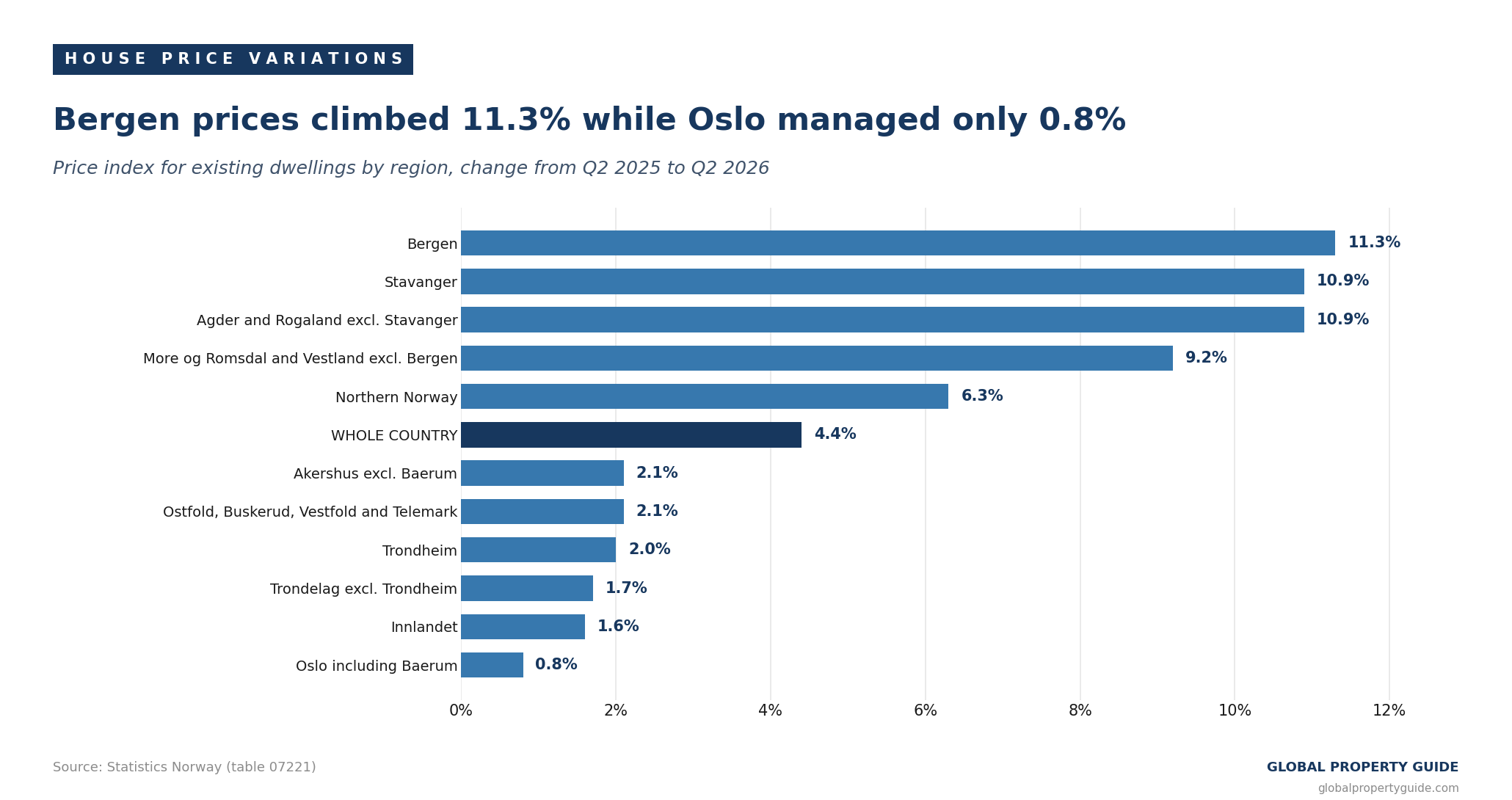
Outside the four largest cities, the pattern follows the same east-west split. Agder and Rogaland excluding Stavanger recorded growth of 10.9% and Møre og Romsdal and Vestland excluding Bergen 9.2%, while Innlandet managed 1.6%, Trøndelag excluding Trondheim 1.7%, and both Akershus excluding Bærum and the Østfold, Buskerud, Vestfold and Telemark group 2.1%. Northern Norway sat in between at 6.3%.
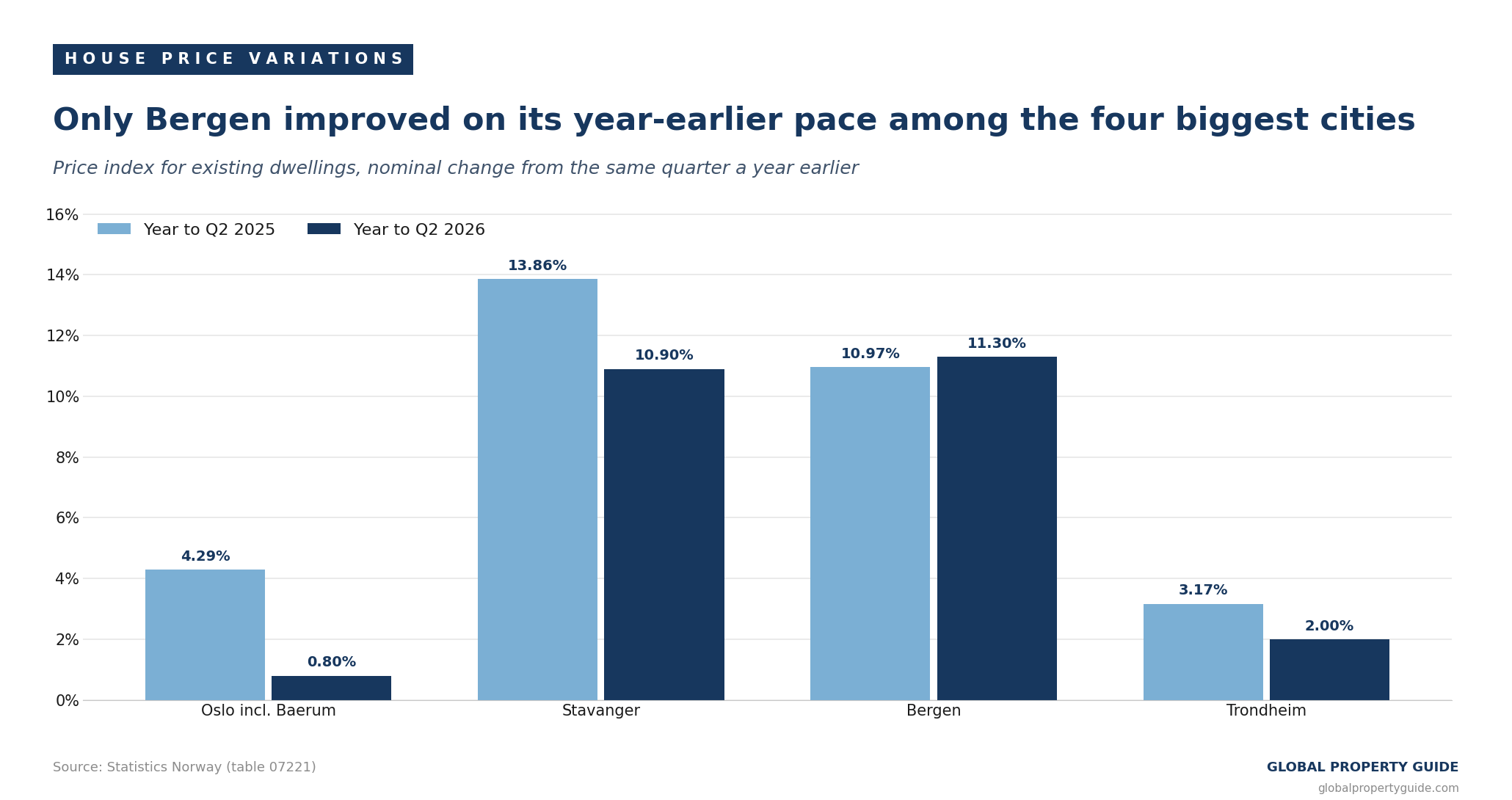
Bergen was the only one of the four biggest cities to improve on its year-earlier pace. The reversal in Oslo is the more consequential development, given the capital's weight in the national index and its role in previous cycles as the market's leading indicator.
Monthly figures confirm that the capital has turned. Oslo prices were down by 0.8% over the first seven months of 2026, against a national increase of 2.8%. Ålesund and district led all areas with growth of 10.9%, and Tromsø followed at 9.7%, while Tønsberg with Færder was weakest at negative 1.6%.
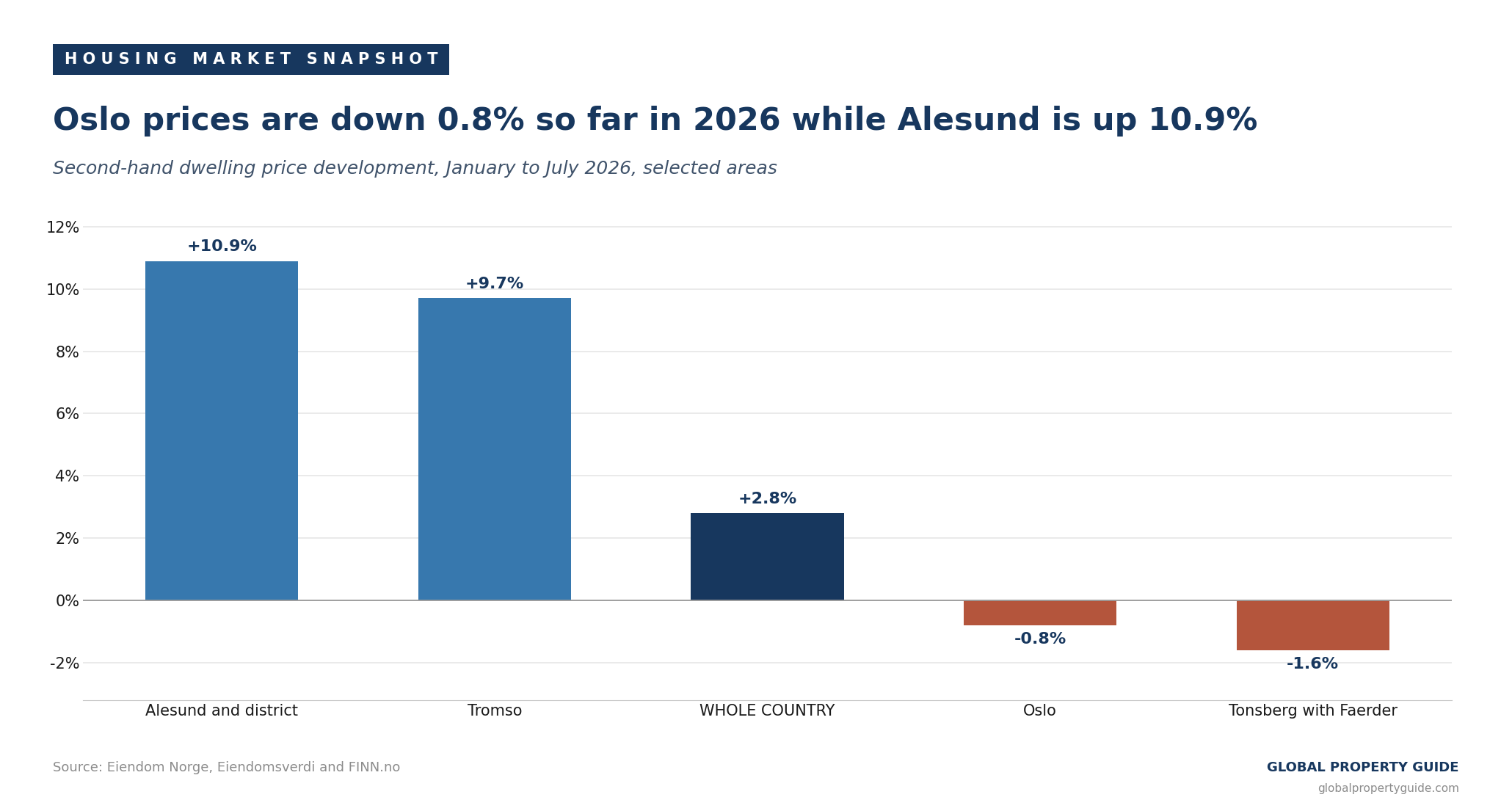
Eiendom Norge's chief executive Henning Lauridsen warned that with a normal cyclical path, Oslo price development would probably end the year several per cent down, and that the outcome could be weaker still if Norges Bank delivers the further rate rise it has signalled.
Property Demand Trends
Turnover remains high by historical standards
Activity in the second-hand market has come off the record pace of 2025 but remains strong in absolute terms. A total of 62,696 dwellings were sold in Norway over the first seven months of 2026, down by 4.7% from the same period last year, according to Eiendom Norge. In July alone, 5,016 dwellings changed hands, 11.3% fewer than in July 2025.
Lauridsen noted that activity in the second-hand market remains very high despite the decline, and that historically only 2025 saw more homes sold and listed than 2026.
Supply of listings is holding up
A total of 68,406 dwellings were advertised for sale over the first seven months of 2026, down by a smaller 1.6% from the same period last year. In July, 3,677 dwellings were listed, 2.3% more than in July 2025.
Listings have therefore exceeded sales by 5,710 units so far this year, which points to a gradual accumulation of unsold stock and helps explain the softening in prices over the summer.
Selling times have lengthened sharply
It took an average of 62 days to sell a dwelling in July 2026, up from 40 days in June. Bergen recorded the shortest selling time at 17 days, consistent with its position as the strongest price performer, while Bodø and Fauske recorded the longest at 109 days.
The spread in selling times mirrors the spread in prices, and both point to the same conclusion: demand is concentrating in western and northern Norway while the eastern market absorbs the weight of higher borrowing costs.
Property Supply Trends
Dwelling starts recovered in 2025 but are slipping again
Registered dwelling start permissions rose by 8.1% to 20,184 units in 2025, the first increase in four years, following declines of 18% in 2024 and 23.4% in 2023, according to Statistics Norway. Utility floor space approved for dwellings rose by 12.8% to 2,470,000 square metres over the same year.
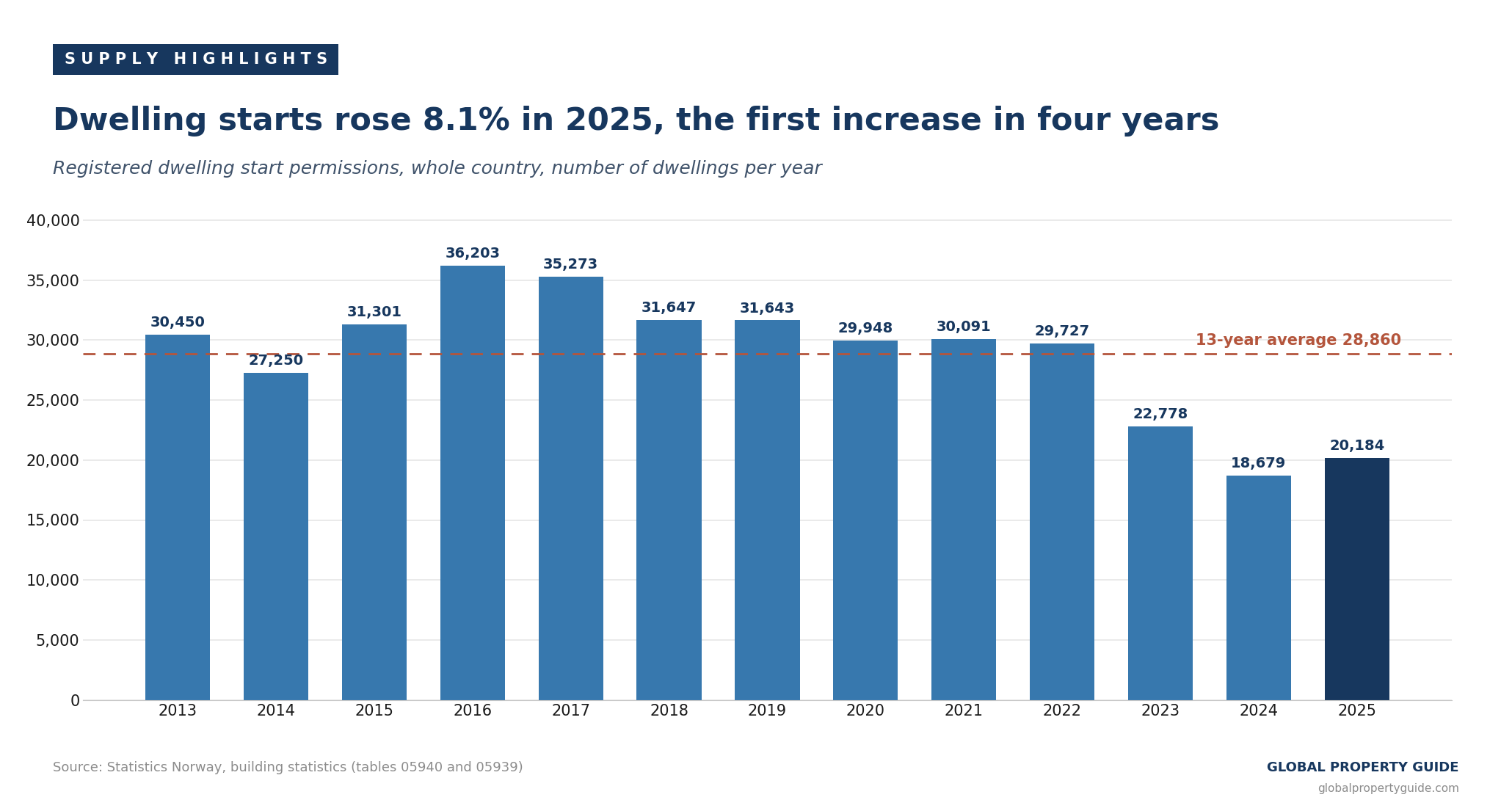
The recovery needs to be kept in proportion. At 20,184 units, starts in 2025 were still 44.25% below the 2016 peak of 36,203 units. Starts averaged 32,076 units a year between 2016 and 2022 but only 20,547 units a year between 2023 and 2025.
The 2026 figures suggest the recovery has already stalled. Only 4,604 dwellings were registered as started in Q2 2026, down by 10.1% from the same quarter last year and by 9.2% from the previous quarter on a seasonally adjusted basis. Over the twelve months to June 2026, starts totalled 19,149 units, 3% fewer than in the preceding twelve months.
Lauridsen has characterised the situation as a set of imbalances between a well-functioning second-hand market, a new-build market with a broken back, and a rental market under severe pressure, arguing that Norges Bank should weigh those imbalances when setting interest rates.
Dwelling stock growth continues to decelerate
There were 2,762,504 dwellings in Norway in 2026, up by 0.68% from a year earlier, according to Statistics Norway. This was a further deceleration from the 0.8% growth recorded the previous year.
By type of building:
- Detached houses: total stock rose by 0.27% to 1,306,558 units, a net addition of 3,493 dwellings.
- Houses with 2 dwellings: total stock increased by 0.45% to 244,516 units.
- Row houses, linked houses and houses with 3 or more dwellings: total stock rose by 0.81% to 332,898 units.
- Multi-dwelling buildings: stock was up by 1.21% to 725,715 units, an addition of 8,657 dwellings.
- Residences for communities: stock rose by 2.94% to 76,517 units, the fastest growth of any category.
- Other buildings: total stock increased by 0.86% to 76,300 units.
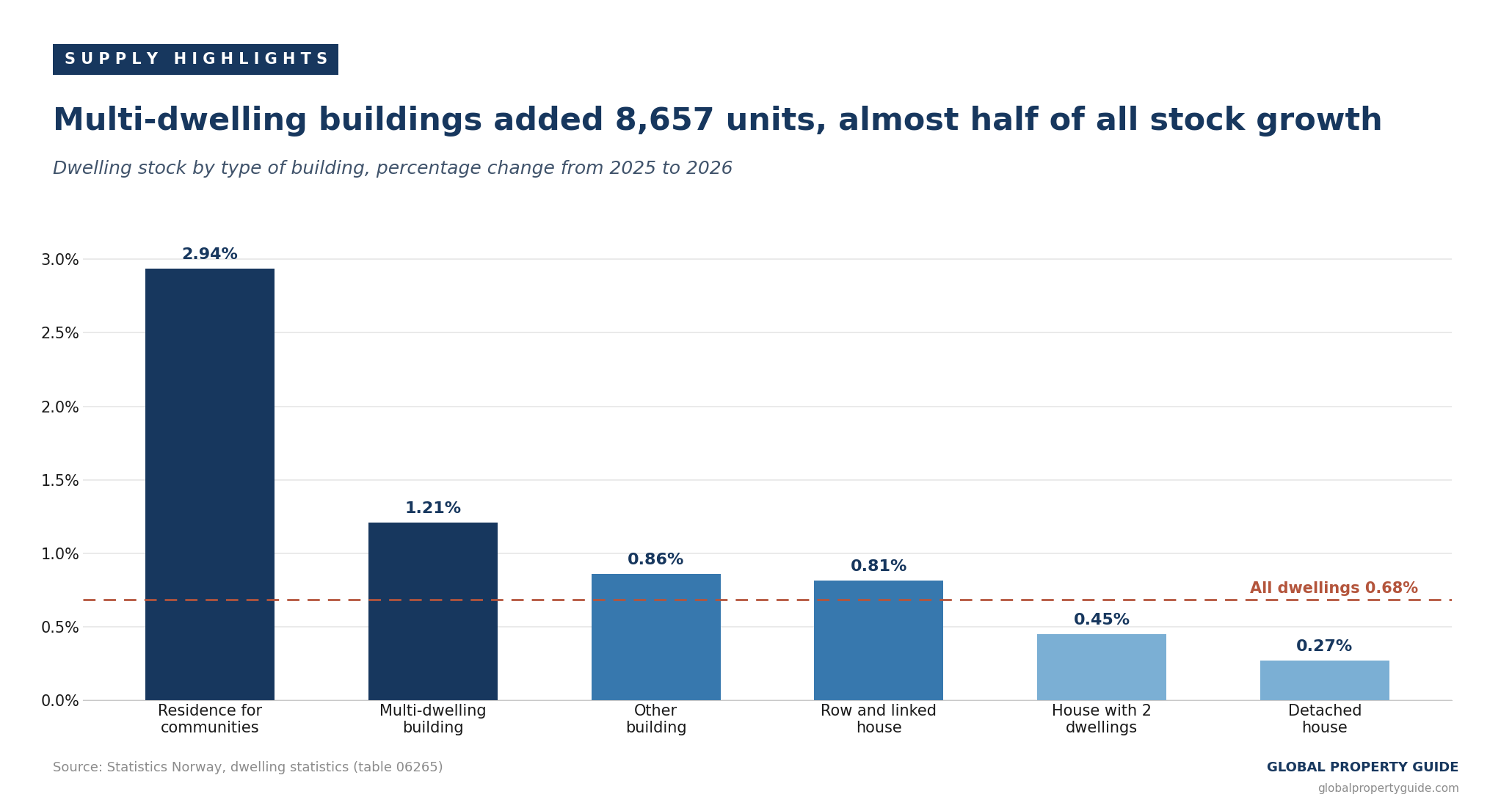
Multi-dwelling buildings accounted for 8,657 of the 18,761 net additions to the stock, almost half of all growth, despite representing only 26.3% of the total. Detached houses still make up 47.3% of the stock but contributed less than a fifth of its growth.
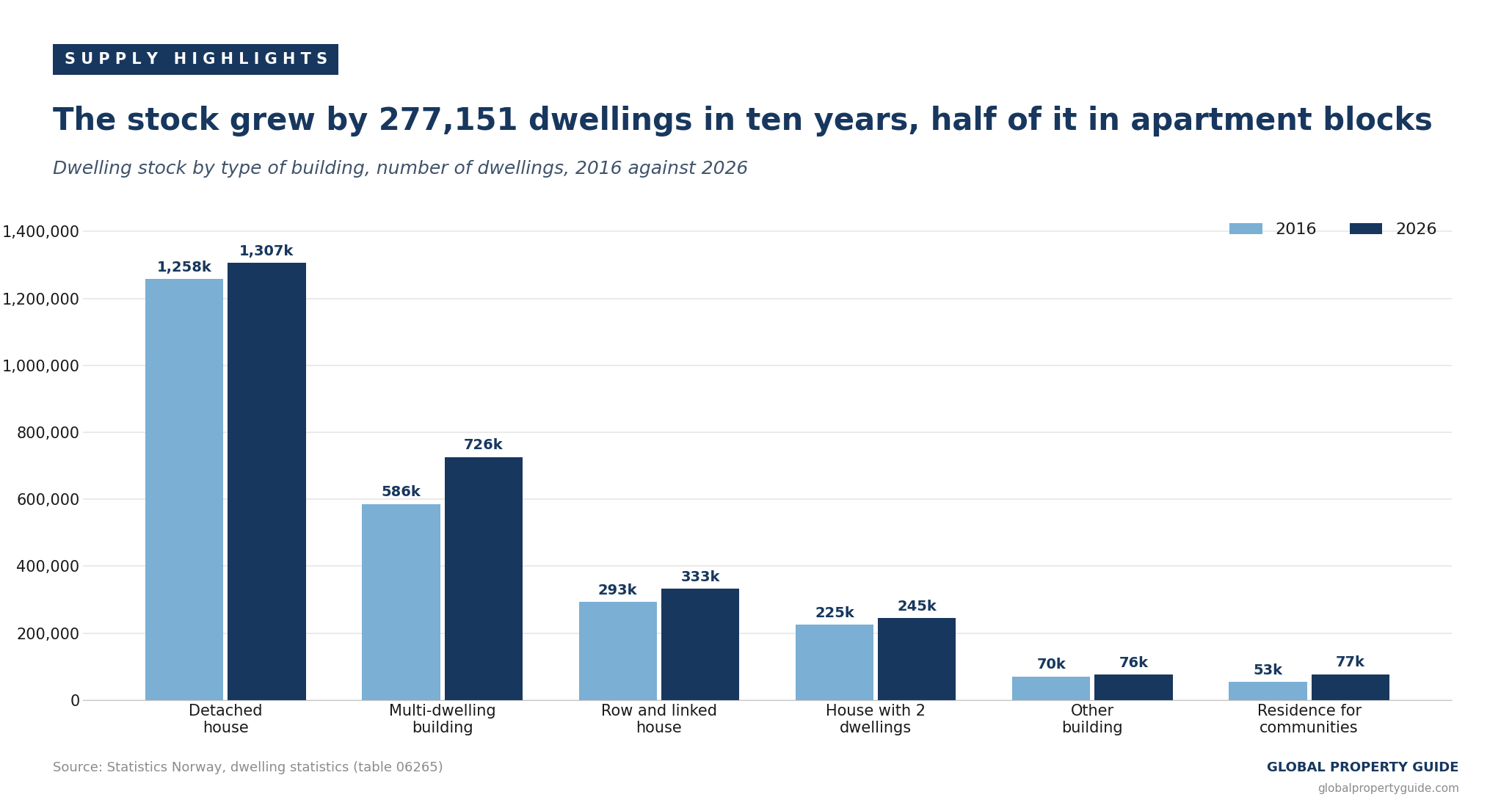
Over the decade to 2026, the stock expanded by 277,151 dwellings, equivalent to 11.15% in total or about 1.06% a year. Half of that expansion came in apartment blocks, where the stock grew from 585,679 to 725,715 units.
Rental Market: Rents and Rental Yields
Yields are low to moderate, and rents are rising faster than prices
Rental yields for residential properties in Norway are low to moderate, averaging 4.95% in Q3 2026, up from 4.58% in Q1 2026, according to research conducted by Global Property Guide. As in most markets, smaller properties typically offer higher rental yields than larger ones.
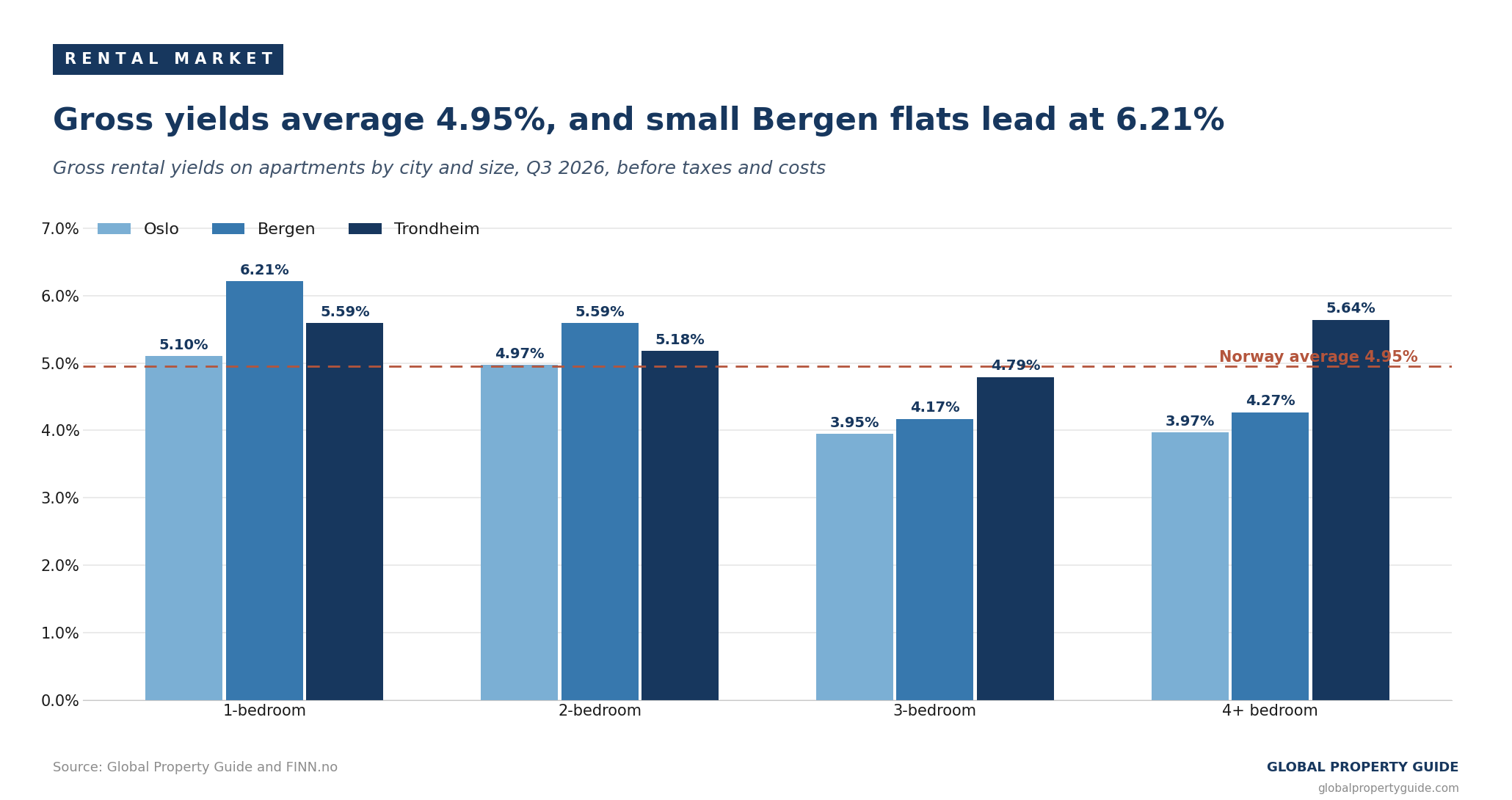
By city, Trondheim offered the highest average gross yield at 5.3%, followed by Bergen at 5.06% and Oslo at 4.5%. One-bedroom apartments in Bergen were the strongest single segment at 6.21%, while three-bedroom apartments in Oslo were the weakest at 3.95%.
After almost a decade of continuous house price increases in Norway, Oslo's residential property prices remain very high, making Oslo one of the world's most expensive cities in which to buy a home. In terms of residential prices, we believe that Oslo is also one of the most expensive capital cities in Europe, and not surprisingly has some of the lowest rental yields of any of Europe's capitals.
Rents rose between 6% and 11% in 2025
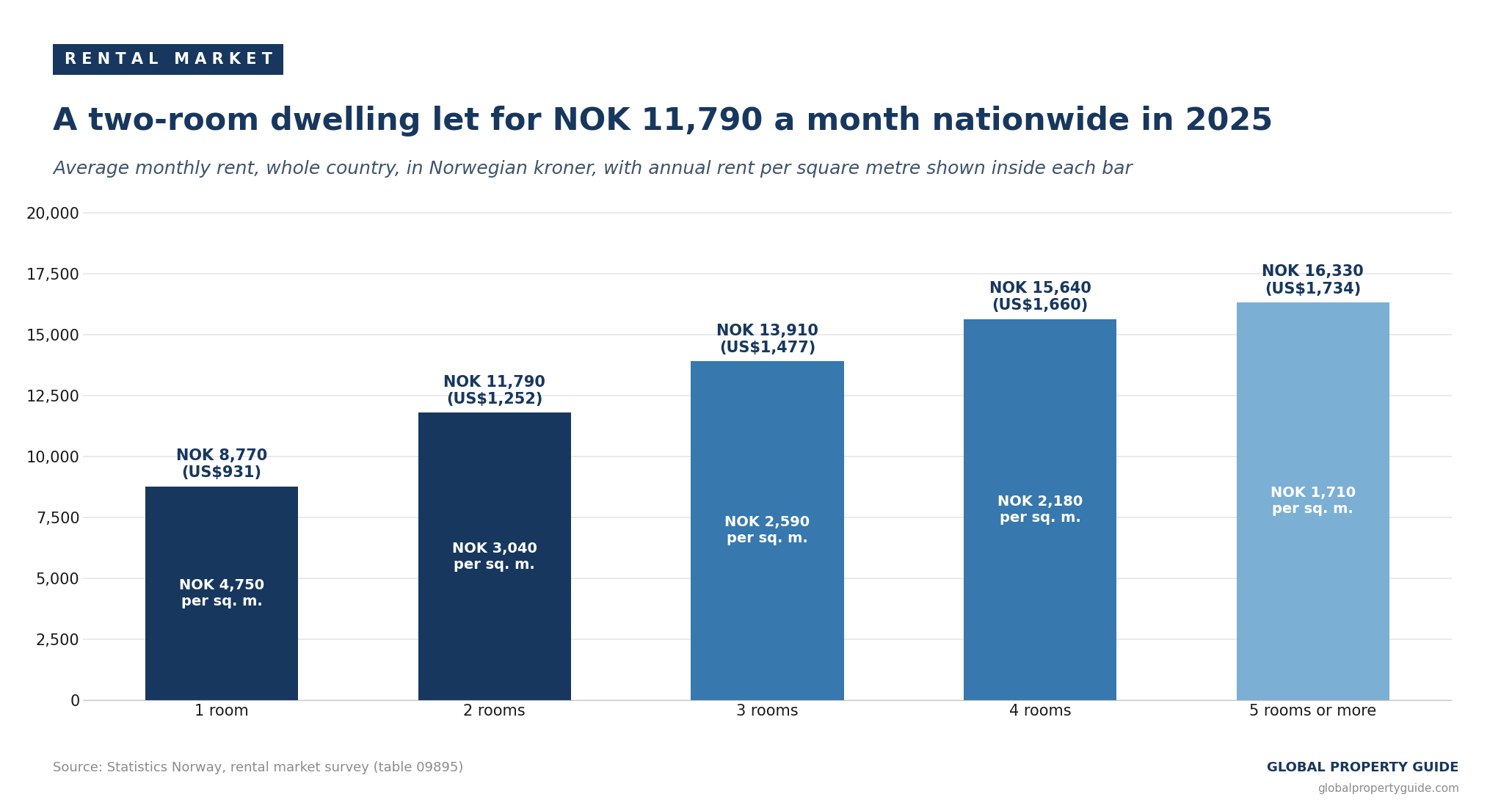
Nationwide, the average monthly rent for two-room dwellings rose by 6.6% to NOK 11,790 (US$1,252) in 2025, according to Statistics Norway. Rents for three-room dwellings increased by 7.16% to an average of NOK 13,910 (US$1,477) per month.
Norway's rent price index:
Smaller dwellings command far higher rents per square metre. One-room dwellings let for NOK 8,770 (US$931) a month, equivalent to NOK 4,750 per square metre a year, while dwellings of five rooms or more let for NOK 16,330 (US$1,734) a month, or only NOK 1,710 per square metre.
In 2025:
- In Oslo including Bærum, two-room dwellings had an average monthly rent of NOK 15,260 (US$1,620) while three-room dwellings cost NOK 19,030 (US$2,020) monthly. One-room dwellings let for NOK 10,090 (US$1,071) and dwellings of five rooms or more for NOK 26,250 (US$2,787).
- In the municipality of Trondheim, two- and three-room dwellings rented for NOK 11,850 (US$1,258) and NOK 14,430 (US$1,532), respectively.
- In Bergen, two- and three-room dwellings rented for NOK 11,870 (US$1,260) and NOK 13,720 (US$1,456) per month, respectively.
- In Stavanger, rents averaged NOK 11,400 (US$1,210) per month for two-room dwellings and NOK 13,630 (US$1,447) for three-room dwellings.
- In Akershus county except Bærum, two-room dwellings had an average monthly rent of NOK 12,520 (US$1,329) while three-room dwellings cost NOK 14,160 (US$1,503) per month.
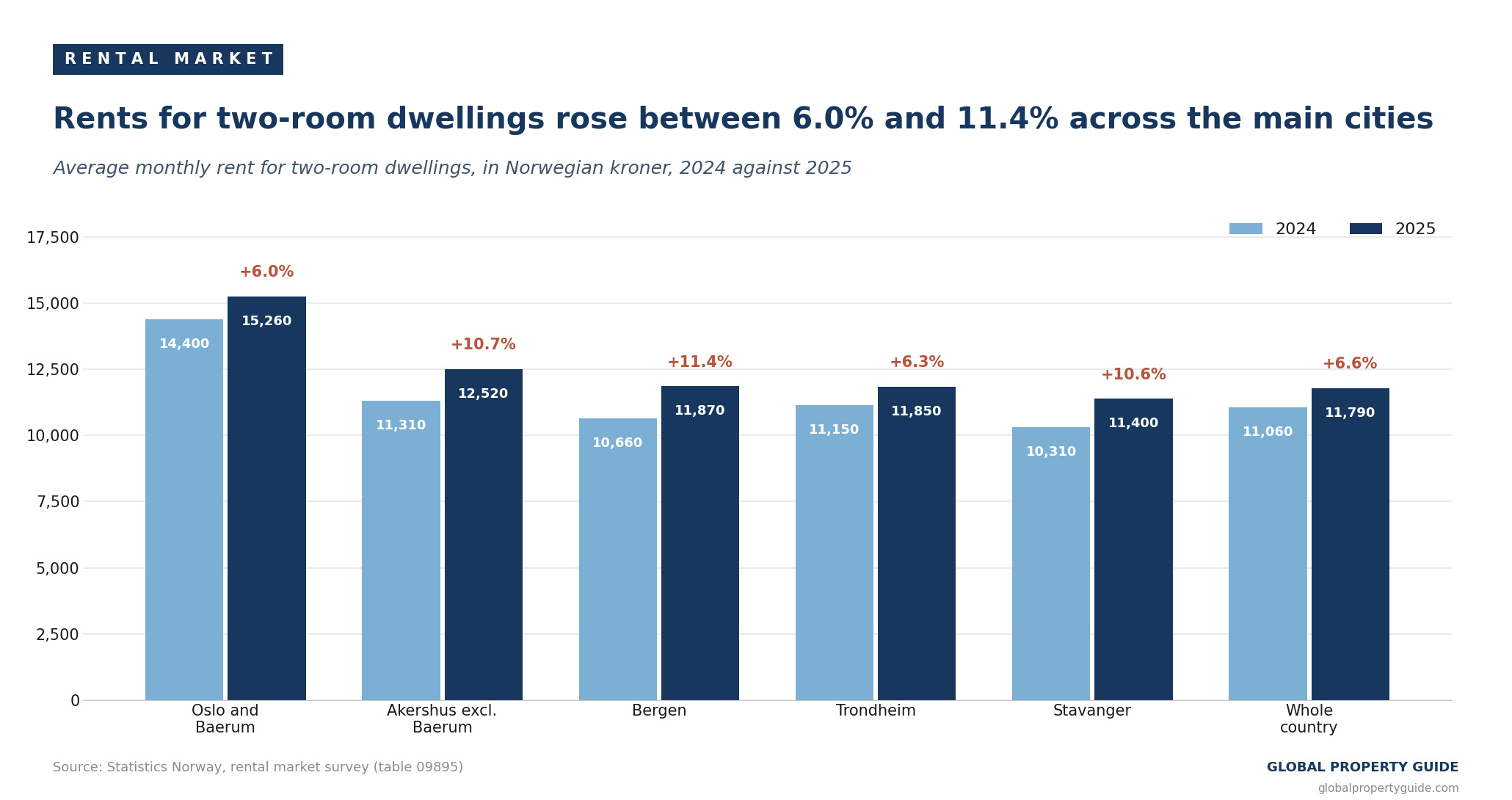
Rent increases were fastest where the survey had previously recorded the lowest levels. Bergen recorded growth of 11.35% for two-room dwellings, Akershus except Bærum 10.7% and Stavanger 10.57%, against 5.97% in Oslo and Bærum. Statistics Norway cautions that its rental market survey draws a fresh sample each year, so year-to-year comparisons should be read as indicative of levels rather than as a precise price index.
Outside the main cities, two-room rents averaged NOK 9,880 (US$1,049) in urban settlements of more than 20,000 inhabitants, NOK 8,660 (US$920) in settlements of 2,000 to 19,999 inhabitants and NOK 7,450 (US$791) in smaller settlements and sparsely populated areas.
Bubble territory? Less likely than a year ago
Is Norway experiencing a housing bubble? Normally there is a clear pattern to housing bubbles, with house price rises greatly outpacing rent rises during the boom. The current data point the other way. Nationwide house prices rose by 4.4% in the year to Q2 2026 while average rents for two-room dwellings rose by 6.6% and for three-room dwellings by 7.16% in 2025.
In Oslo, where house prices have historically outpaced rents by the widest margin, prices were down by 0.8% over the first seven months of 2026 while rents in the capital rose by 5.97% in 2025. On this measure, the classic bubble signature, prices accelerating away from rents, is currently absent from the Norwegian market.
There are two long-standing reasons why house prices have tended to outpace rental rises in Oslo. First, many investors have purchased apartments to rent out, which keeps rent prices down. Second, owning a home has been relatively cheaper than renting, partly because of strong tax support for ownership. The rise in mortgage rates since 2022 has narrowed that second advantage considerably.
Mortgage Market and Interest Rates
Norges Bank has reversed course
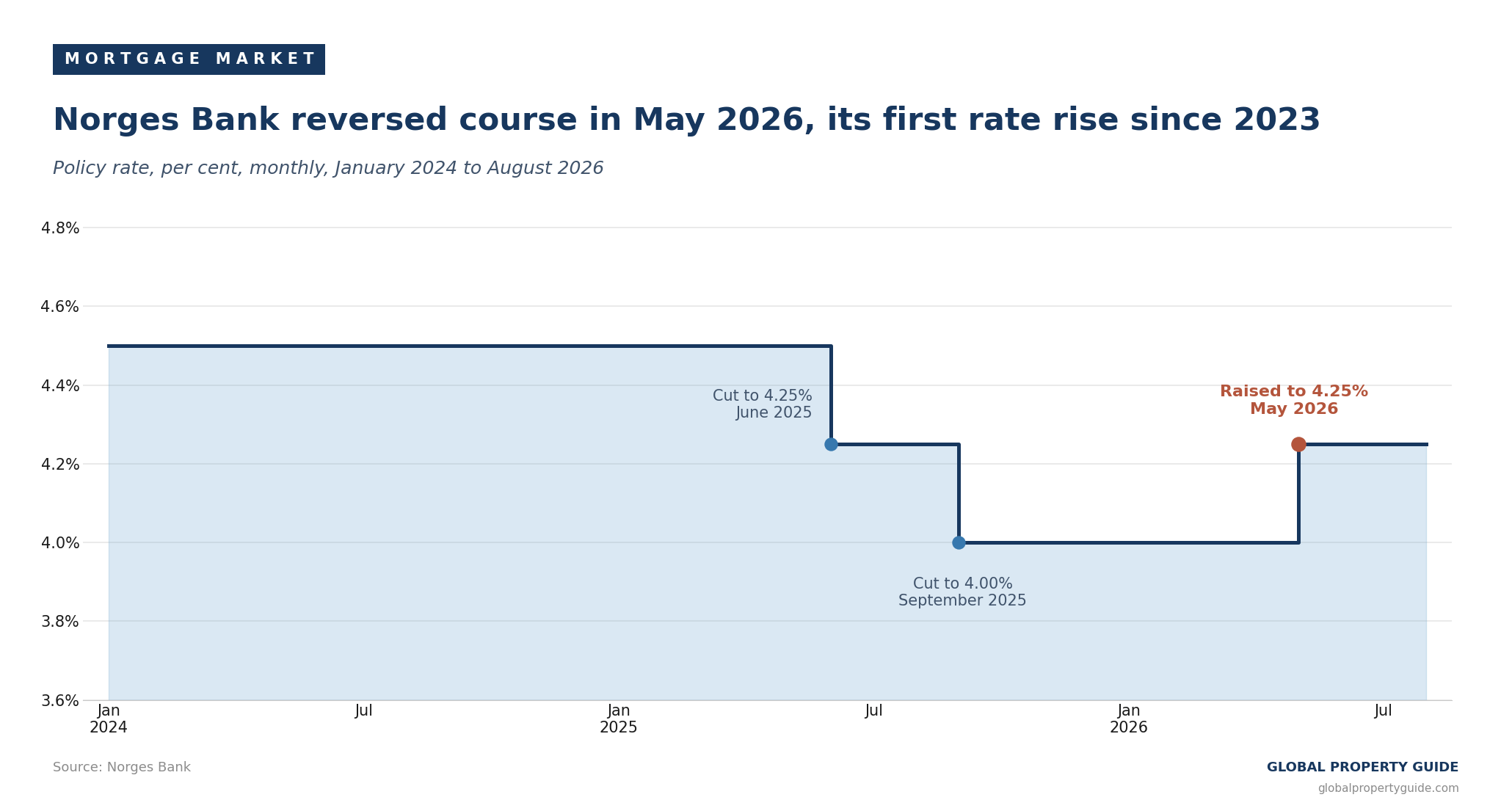
Norges Bank, the country's central bank, raised its policy rate by 25 basis points to 4.25% at its meeting on 6 May 2026, the first increase since 2023. The Committee kept the rate unchanged at 4.25% at its subsequent meetings on 17 June and 12 August 2026.
Norway's mortgage loan interest rates:
This reversed a short-lived easing cycle. The bank had cut its key rate in June 2025 and again in September 2025, taking it from a peak of 4.5% down to 4%, and had envisaged further easing during 2026.
Governor Ida Wolden Bache explained the change of direction in a hearing before the Storting's Standing Committee on Finance and Economic Affairs, saying the background for the rate increase was that inflation is too high and that a higher policy rate is needed to return inflation to target within a reasonable time horizon.
The trigger was external. Oil prices rose sharply after hostilities in the Middle East escalated at the end of February 2026, and prices for other commodities including aluminium and fertilisers also increased. Norges Bank noted that higher energy prices feed through to households directly via fuel prices and indirectly through business costs.
At the August meeting, the Committee held the rate steady while keeping a further increase explicitly in view. Inflation had slowed to 3% in July, with the CPI adjusted for tax changes and excluding energy products at 2.7%, six-tenths of a percentage point below the bank's June forecast. Governor Bache observed that slower inflation is welcome news, but that inflation remains too high and that it is too early to conclude that the inflation outlook has changed materially, so it may still become necessary to raise the policy rate.
The next decision is due on 24 September 2026, when Monetary Policy Report 3/26 will be published alongside it. The June policy rate forecast implied a rate just above 4.5% by the end of 2026.
Mortgage rates have bottomed and turned
Mortgage interest rates have followed the policy rate down and are now following it back up. In June 2026, the average interest rate on new loans secured on dwellings stood at 5.23%, up by 0.1 percentage points from 5.13% in May, according to Statistics Norway. That remains 0.37 percentage points below the 5.6% recorded in May 2025.
In June 2026:
- Floating interest rate (up to 3 months): 5.23% on new loans, up from 5.13% in May
- Fixed interest rate (more than 3 months): 5.33% on new loans, unchanged from May
- New credit lines secured on dwellings: 5.31%, up from 5.2% in May
- Outstanding loans secured on dwellings: 5.09%, of which floating 5.13% and fixed 4.18%
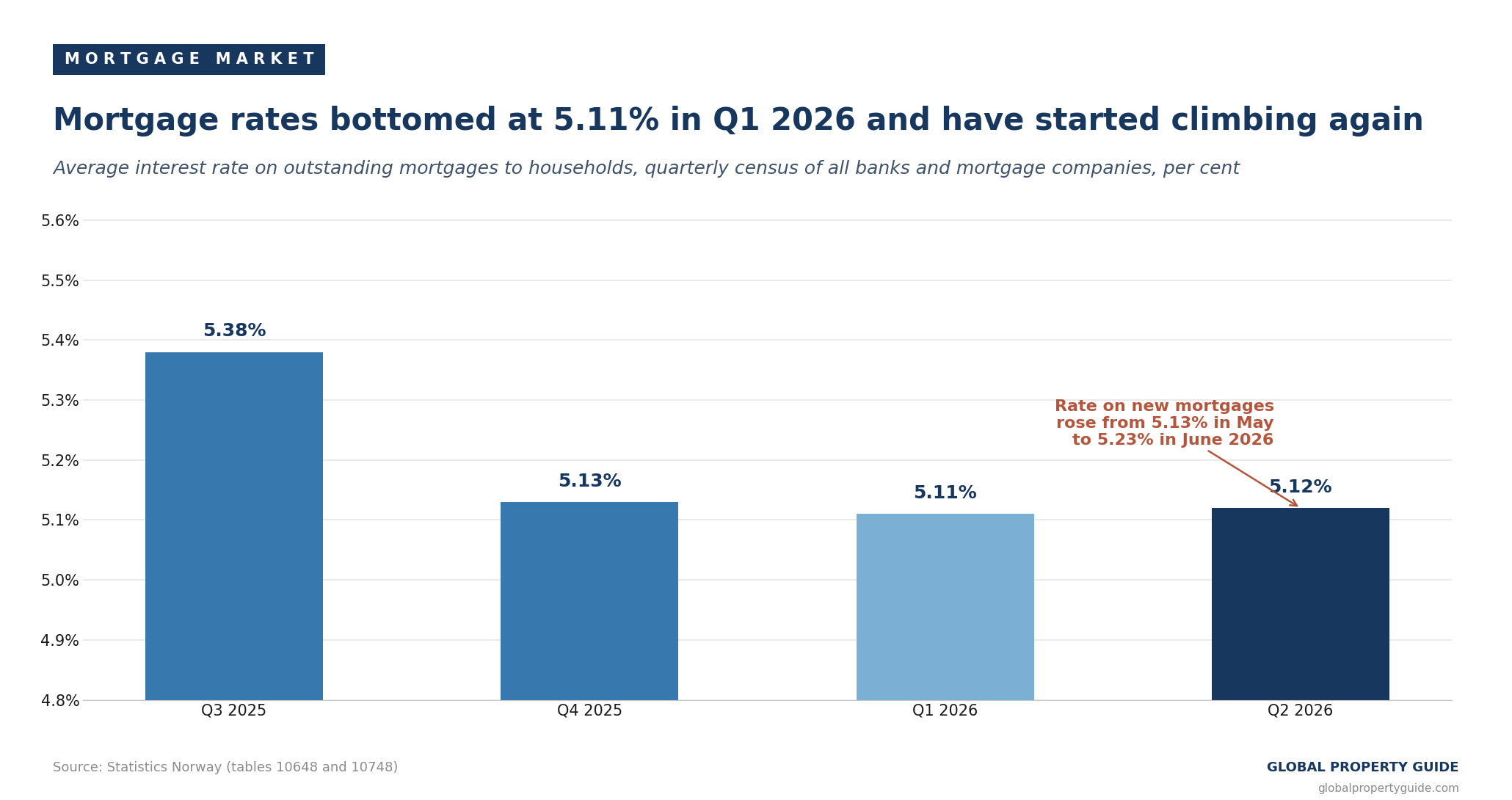
The quarterly census of all banks and mortgage companies shows the turning point clearly. The average rate on outstanding mortgages to households fell from 5.38% in Q3 2025 to 5.13% in Q4 2025 and bottomed at 5.11% in Q1 2026, before edging back up to 5.12% in Q2 2026.
Norwegian borrowers remain overwhelmingly exposed to floating rates. In Q2 2026, loans with a remaining fixed-rate period of up to three months accounted for 95.8% of the total mortgage stock, at an average rate of 5.16%, while fixed-rate loans made up only 4.2% at an average of 4.37%. Within the fixed segment, rates ranged from 3.65% on loans of three to five years to 4.78% on loans of one to three years.
That concentration in floating-rate debt is what makes each policy decision transmit so quickly to household budgets, and it is the mechanism through which the May 2026 increase is now working its way into the Oslo market in particular.
Mortgage loan regulations
Norwegian households carry among the highest debt burdens in the OECD, which is why the Ministry of Finance maintains a binding regulation on lending standards. The lending regulation applies to residential mortgages, consumer credit and loans secured on assets other than real estate.
The requirements cover the customer's debt-servicing ability, the customer's debt-to-income ratio, mortgage size relative to property value, and principal payments on consumer loans and higher loan-to-value mortgages.
Effective 31 December 2024, the Ministry of Finance adopted amendments to the lending regulation. The notable changes were:
- The maximum loan-to-value ratio for mortgages was increased from 85% to 90%, reducing the minimum equity requirement from 15% to 10%;
- The debt-servicing capacity requirement was revised to allow lenders to factor in the risk-mitigating benefits of fixed-rate loans;
- The debt-to-income ceiling was maintained at 500%.
The regulation had contained a sunset clause since its inception in 2015 and was due to expire on 31 December 2024. It is now continued indefinitely, in line with the recommendation of the Financial Supervisory Authority, though the Ministry of Finance will continue to assess it periodically.
| CURRENT RESIDENTIAL MORTGAGE LENDING REQUIREMENTS | |
| Requirement | Setting |
| Maximum loan-to-value (LTV) ratio, instalment loans | 90% |
| Maximum LTV ratio, home equity credit lines | 60% |
| Required principal payments | Loans with an LTV ratio above 60% |
| Maximum debt-to-income ratio | 500% |
| Stress test of debt-servicing ability | Interest rate increase of 3 percentage points, minimum 7% |
| Note: The separate 60% LTV limit for secondary dwellings in Oslo, in force from 2017, expired on 31 December 2022. | |
| Data Sources: Ministry of Finance. | |
The easing of the loan-to-value limit has drawn caution from international observers. The OECD noted in its 2026 survey that macroprudential rules have been slightly eased, including a higher loan-to-value ratio, that household debt is expanding, and that while it is supported by rising incomes it warrants close monitoring.
The OECD also identified the underlying constraint, observing that the housing market remains tight mostly because of lagging housing supply. That diagnosis points to construction rather than credit as the binding problem, and the 2026 slide in dwelling starts suggests it is not being resolved.
DNB, Nordea and Danske Bank are among the country's top mortgage lenders.
Economic and Social Factors
Owner occupancy is strongly subsidised by the state
State policy has had a strong impact on housing preferences in Norway:
- Preferential interest rates are offered to households through the State Housing Bank.
- Buyers can purchase municipal land at subsidised prices.
- Owner-occupiers get tax relief on mortgage interest payments.
- Owner-occupied housing is taxed at a lower effective rate than rental housing.
- Owner-occupied dwellings are capital gains tax-exempt.
The long-term impact of these measures has been a massive shift in the structure of Norway's housing market. In 1920, 47% of Norway's households were renters. Recently, only about 17.9% were renters, while around 70.6% were freeholders and 11.5% shareholders.
Oslo has the lowest proportion of homeowners at about 42.4%, while 25.9% of households in Oslo rent, with shareholders at 31.6% of total households. At the same time, there is a consensus that the free market does not provide sufficient housing for the poor. Social rental housing made up around 15% of the total rental stock in Norway.
The mainland economy is growing at a normal pace
The mainland economy, which excludes petroleum extraction and ocean transport, grew by 1.8% in 2025, a marked improvement on the 0.6% recorded in 2024, according to Statistics Norway.
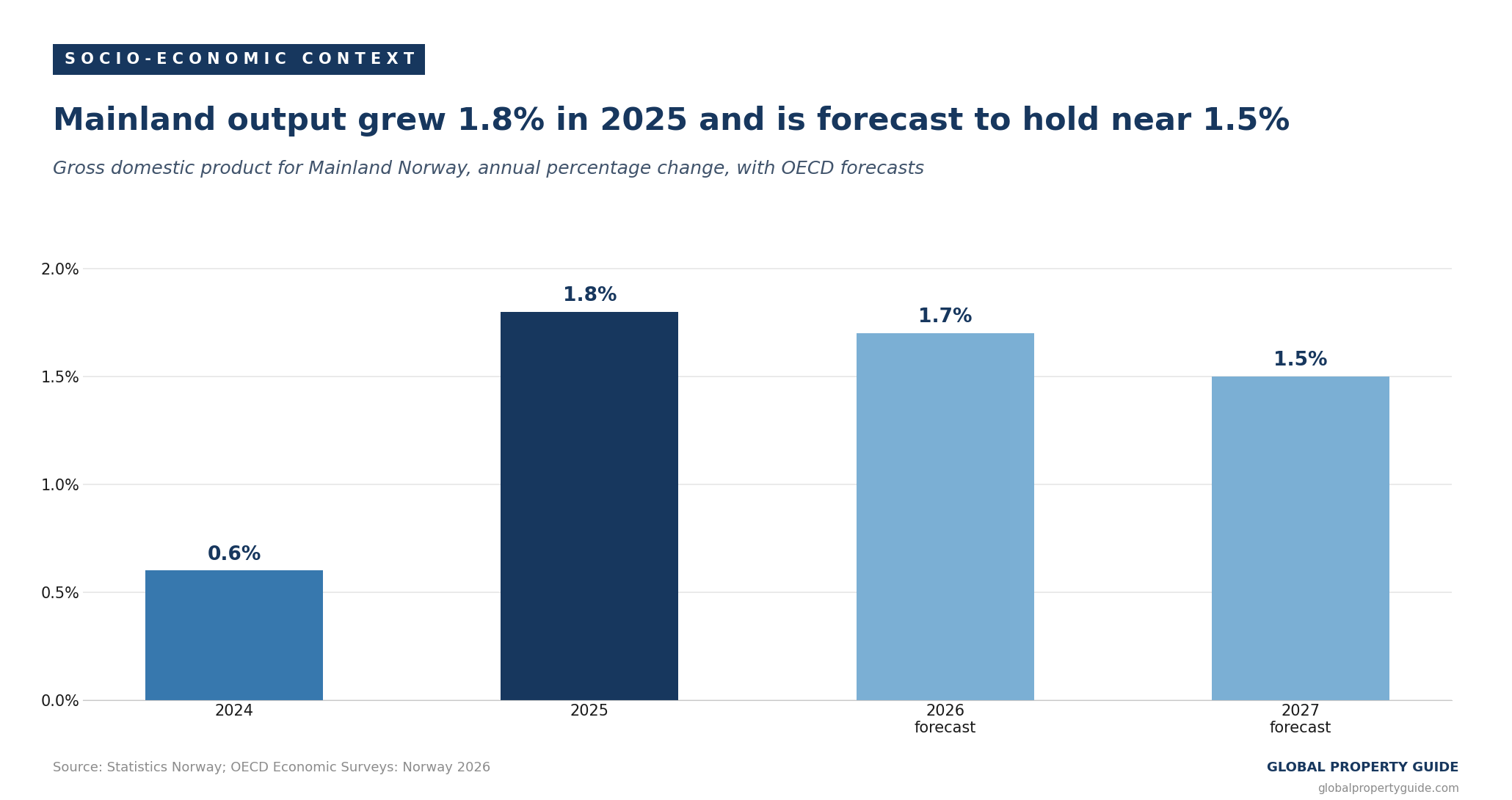
The OECD expects mainland GDP to grow by 1.7% in 2026 and 1.5% in 2027, supported by consumption. It describes Norway as remaining among the world's most prosperous and equal economies, underpinned by sound macroeconomic management and a highly skilled labour force, while noting that growth is slow and inflation persistently above the 2% target.
Housing investment accounts for about a fifth of overall mainland investment, and the slowdown in residential construction in recent years has therefore weighed directly on activity in the economy as a whole. Preliminary national accounts figures indicate that construction output fell by 0.3% from Q4 2025 to Q1 2026.
The labour market has tightened again
The nationwide unemployment rate fell to 4.5% in June 2026 on a seasonally adjusted basis, according to Statistics Norway, down sharply from 5.4% in the same month last year, though slightly up from 4.4% in May. There were 139,000 unemployed people in June, 27,000 fewer than a year earlier. On a trend basis, the rate held at 4.7% for a fourth consecutive month.
The employment rate rose to 70.2% in June from 69.5% in May. Norges Bank judges capacity utilisation in the Norwegian economy to be close to a normal level, though drifting down.
Inflation remains above target
Inflation stood at 3% in July 2026, a full percentage point above Norges Bank's 2% target but down from 3.6% in April. Underlying inflation, measured by the CPI adjusted for tax changes and excluding energy products, eased to 2.7% in July from 3% in April.
Nationwide inflation averaged just 2% from 2010 to 2020 before accelerating to 3.5% in 2021 and 5.8% in 2022. It remained high at an average of 5.5% in 2023 before easing to 3.1% in 2024 and holding at around 3% through 2025.
Petroleum and the krone
Norway's petroleum sector remains a cornerstone of the economy even as it reaches maturity, and 2026 has been a year of elevated prices. Brent crude settled at US$100.69 per barrel on 23 July 2026, its highest settlement since May, after renewed attacks raised concerns about energy shipments through the Red Sea. The petroleum industry is the country's largest, accounting for more than 20% of GDP and around 47% of exports by value.
Higher energy prices cut both ways for the housing market. They support the krone and Norwegian incomes, particularly along the western coast where Bergen and Stavanger have recorded the strongest price growth, but they also feed the inflation that has forced Norges Bank back into tightening.
The krone has been comparatively firm. It strengthened from late 2025, which damped imported inflation, then weakened over the early summer with EUR/NOK peaking near 11.35 in June 2026 before recovering. USD/NOK stood at about 9.42 in mid-August 2026, close to the bottom of its recent range and roughly 7.5% stronger than a year earlier.
Sources
- Price index for existing dwellings (Statistics Norway): https://www.ssb.no/
- 07221: Price for existing dwellings, by type of dwelling and region (Statistics Norway): https://www.ssb.no/
- Residential Property Prices for Norway (Bank for International Settlements): https://www.bis.org/
- Housing price statistics (Eiendom Norge): https://eiendomnorge.no/
- Building statistics (Statistics Norway): https://www.ssb.no/
- Dwellings (Statistics Norway): https://www.ssb.no/
- 06265: Dwellings, by type of building (Statistics Norway): https://www.ssb.no/
- Rental market survey (Statistics Norway): https://www.ssb.no/
- 09895: Rental market survey, average rents per sqm (Statistics Norway): https://www.ssb.no/
- Gross rental yields in Norway: Oslo, Bergen and Trondheim (Global Property Guide): https://www.globalpropertyguide.com/
- Mortgage rates on new loans (Global Property Guide): https://www.globalpropertyguide.com/
- Rate decision May 2026 (Norges Bank): https://www.norges-bank.no/
- Rate decision August 2026 (Norges Bank): https://www.norges-bank.no/
- Policy rate (Norges Bank): https://www.norges-bank.no/
- Interest rates in banks and mortgage companies (Statistics Norway): https://www.ssb.no/
- 10748: Interest rates on new loans secured on dwellings (Statistics Norway): https://www.ssb.no/
- The lending regulation (Government.no): https://www.regjeringen.no/
- Amendments to the lending regulation (Government.no): https://www.regjeringen.no/
- OECD Economic Surveys: Norway 2026 (Organisation for Economic Co-operation and Development): https://www.oecd.org/
- National accounts (Statistics Norway): https://www.ssb.no/
- Labour force survey (Statistics Norway): https://www.ssb.no/
- Consumer price index (Statistics Norway): https://www.ssb.no/
- Exchange rates (Norges Bank): https://www.norges-bank.no/