Czech Republic's Residential Property Market Analysis 2025
Supported by easing financing conditions, strong demand, and persistent supply shortages, the renewed momentum in the Czech housing market is likely to persist, with sales prices outpacing rents and constraining potential yields.
This extended overview from Global Property Guide covers key aspects of the Czech housing market and takes a closer look at its most recent developments and long-term trends.
Table of Contents
- Housing Market Snapshot
- Historic Perspective
- Demand Highlights
- Supply Highlights
- Rental Market
- Mortgage Market
- Socio-Economic Context
Housing Market Snapshot
According to the latest data from the Czech Statistical Office (CZSO), the Residential Real Estate Price Index in the Czech Republic rose by 9.94% year-on-year in Q1 2025, marking a rapid and notable rebound following the decline observed from late 2022 through early 2023. When adjusted for inflation, the index increased by 7.02%, slightly exceeding pre-COVID growth levels, which stood at 6.9% (inflation-adjusted) in Q1 2019.
Prices for residential units in new buildings rose by 13.00% (9.99% inflation-adjusted), while prices for units in existing buildings increased by 9.32% (6.41% inflation-adjusted).
Czech Republic's house price annual change:
The latest edition of Deloitte's Real Index recorded the average price of apartments sold in Prague and the regional capitals at CZK 110,100 (USD 4,657) per square meter as of Q4 2024, reflecting a 15.29% year-on-year increase. Among the surveyed cities, the highest year-on-year growth was recorded in Ostrava (21.68%), Zlín (18.04%), and Pilsen (16.79%).
Housing price dynamics in Prague and the regional capitals:
| City | Average Price of Apartments Sold, Q4 2024, CZK/sqm |
Average Price of Apartments Sold, Q4 2024, USD/sqm |
YoY, Q4 2024 vs Q4 2023 |
| Brno | CZK 108,000 | USD 4,569 | 6.09% |
| České Budějovice | CZK 70,800 | USD 2,995 | 1.72% |
| Hradec Kralove | CZK 86,400 | USD 3,655 | 15.51% |
| Jihlava | CZK 63,500 | USD 2,686 | 7.81% |
| Karlovy Vary | CZK 51,000 | USD 2,157 | 12.09% |
| Liberec | CZK 65,600 | USD 2,775 | 8.25% |
| Olomouc | CZK 81,400 | USD 3,443 | 15.30% |
| Ostrava | CZK 52,200 | USD 2,208 | 21.68% |
| Pardubice | CZK 74,300 | USD 3,143 | -0.67% |
| Pilsen | CZK 77,900 | USD 3,295 | 16.79% |
| Prague | CZK 139,900 | USD 5,918 | 14.95% |
| Prague Vicinity* | CZK 89,800 | USD 3,799 | 13.24% |
| Ústí nad Labem | CZK 38,500 | USD 1,629 | 9.38% |
| Zlín | CZK 68,700 | USD 2,906 | 18.04% |
| Total (Prague and regional capitals) | CZK 110,100 | USD 4,657 | 15.29% |
| *Average for the towns of Benešov, Beroun, Kladno, and Mladá Boleslav, and the districts of Prague-East and Prague-West. | |||
| Note: CNB exchange rate as of Q4 2024, 1 USD = 23.640 CZK. | |||
| Data Source: Deloitte CZ. | |||
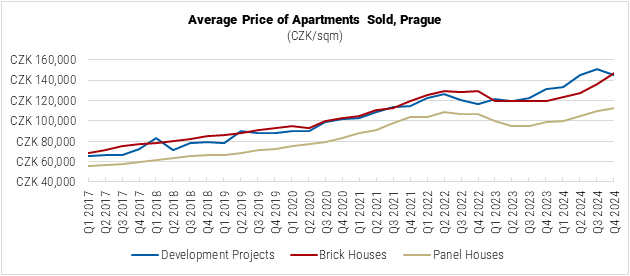
In Prague, units within development projects were sold at an average price of CZK 144,700 (USD 6,121) per square meter, representing a 10.46% year-on-year increase. Prices for units in brick houses recorded the strongest growth, rising by 23.78% year-on-year to CZK 147,300 (USD 6,231) per square meter. Panel house units also saw a notable rise, with prices increasing by 13.56% to CZK 112,200 (USD 4,746) per square meter.
Data Source: Deloitte CZ.
The highest average selling price was observed in the Prague 1 district, where prices reached CZK 194,400 (USD 8,223) per square meter. This was followed by Prague 2 at CZK 177,000 (USD 7,487) and Prague 7 at CZK 164,500 (USD 6,959) per square meter.
Housing price dynamics in Prague's city districts:
| District | Average Price of Apartments Sold, Q4 2024, CZK/sqm |
Average Price of Apartments Sold, Q4 2024, USD/sqm |
YoY, Q4 2024 vs Q4 2023 |
| Prague 1 | CZK 194,400 | USD 8,223 | -0.31% |
| Prague 2 | CZK 177,000 | USD 7,487 | 23.95% |
| Prague 3 | CZK 155,500 | USD 6,578 | 19.16% |
| Prague 4 | CZK 129,500 | USD 5,478 | 20.69% |
| Prague 5 | CZK 148,300 | USD 6,273 | 15.95% |
| Prague 6 | CZK 144,300 | USD 6,104 | 16.46% |
| Prague 7 | CZK 164,500 | USD 6,959 | 28.32% |
| Prague 8 | CZK 134,400 | USD 5,685 | 10.62% |
| Prague 9 | CZK 122,200 | USD 5,169 | 12.94% |
| Prague 10 | CZK 127,800 | USD 5,406 | 15.14% |
| Note: CNB exchange rate as of Q4 2024, 1 USD = 23.640 CZK. | |||
| Data Sources: Deloitte CZ, CNB. | |||
Looking ahead, the Czech National Bank (CNB), in its Spring 2025 Financial Stability Report, projects residential property prices to continue demonstrating solid, albeit gradually moderating, growth throughout 2025 and 2026. This outlook is supported by easing financing conditions, strong demand, and persistent supply shortages.
Historic Perspective:
Housing Cycles Affected by Central Bank Policies and Economic Shifts
Following the country's EU accession in 2004, the Czech housing market saw substantial growth, driven by economic integration and increasing foreign interest. Initially, restrictions on property purchases by non-Czech EU citizens limited foreign demand, which only fully materialized after these restrictions were lifted in 2009.
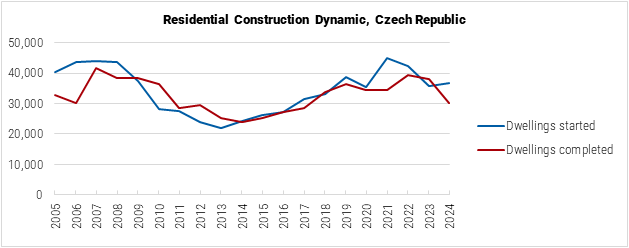
The years 2006-2008 marked peak housing construction, with over 43,700 new dwellings started annually. However, the 2008 global financial crisis ended this boom, causing a subsequent decline in both housing prices and construction activity. By the end of 2009, nominal house prices dropped by 6.76% year-on-year, with an even more substantial inflation-adjusted decline of 7.20%. Construction dynamics followed, with new dwelling starts bottoming out at 22,108 units in 2013.
The recovery was gradual, supported by low interest rates and government initiatives like the State Housing Development Fund, which provided affordable loans and funded social housing. The market began to stabilize, and by 2014, real house prices started rising again.
From 2015 onward, the market entered a phase of significant expansion. By the end of 2021, house prices surged by over 25% year-on-year, driven by strong economic growth, low interest rates, and increasing demand, particularly in urban areas like Prague. Construction also rebounded, with nearly 45,000 new dwellings started in 2021.
However, the rapid price increase led to concerns about market overheating. The CNB responded by tightening monetary policy from 2017 onwards, raising interest rates to cool the market. The COVID-19 pandemic initially caused uncertainty, but the market remained resilient due to continued demand and the CNB's measures, temporarily relaxing lending rules and lowering key rates to support the economy.
By 2021, inflationary pressures prompted the CNB to hike interest rates again, which began to cool the market. By the end of 2022, while nominal prices still rose by 6.93% year-on-year, inflation-adjusted prices dropped by 7.58%. The trend continued into 2023, with both nominal and real prices decreasing, reflecting the ongoing impact of high inflation and increased borrowing costs.
In 2024, the Czech residential market began to recover, with clear signs of renewed momentum. The rebound was driven by stabilizing macroeconomic conditions, the gradual easing of interest rates, and a noticeable return of buyer confidence. While supply constraints and affordability challenges persisted, the market's resilience signaled a positive shift toward sustained growth.
20-year annual house price change (based on end-of-year CZSO house price index):
| Year | Nominal house prices (%) | Inflation-adjusted house prices (%) | Year | Nominal house prices (%) | Inflation-adjusted house prices (%) | |
| 2005 | n/a | n/a | 2015 | 4.52% | 4.42% | |
| 2006 | n/a | n/a | 2016 | 10.91% | 9.31% | |
| 2007 | n/a | n/a | 2017 | 8.42% | 5.67% | |
| 2008 | n/a | n/a | 2018 | 9.89% | 7.65% | |
| 2009 | -6.76% | -7.20% | 2019 | 8.93% | 5.74% | |
| 2010 | 0.00% | -2.01% | 2020 | 8.95% | 6.16% | |
| 2011 | -0.84% | -3.13% | 2021 | 25.77% | 18.50% | |
| 2012 | -0.74% | -3.51% | 2022 | 6.93% | -7.58% | |
| 2013 | 0.11% | -1.04% | 2023 | -1.03% | -7.98% | |
| 2014 | 3.73% | 3.28% | 2024 | 8.43% | 5.44% | |
| Data Source: CZSO. | ||||||
20-year construction activity dynamic (started and completed housing units):
Data Source: CZSO.
Demand Highlights:
Persistent Supply Shortages and Rising Demand Challenge Market Stability
Residential demand in the Czech Republic remained robust, as seen in a notable rebound in housing sales activity. Based on insights from the Czech Banking Association (CBA) and Flat Zone, the market is undergoing a relatively rapid return to pre-crisis performance levels.
In 2024, residential transactions across the country increased by 33.6% year-on-year, signaling a steady recovery to levels last seen before the downturn in late 2022. The most significant rise was observed in new apartment sales, which surged by 51.1% year-on-year, totaling 21,615 transactions. Meanwhile, sales of older apartments rose by 24.2%, reaching 33,206 transactions. The market maintained its momentum into early 2025. In the first quarter, residential sales activity recorded a 24.6% year-on-year increase compared to Q1 2024, with newly built apartments rising by 29.6% year-on-year and older apartments up by 21.4%.
"Throughout most of 2024, we saw continued growth in sales activity across all segments. In the case of new homes, we even saw the second-highest number of homes sold in the last 15 years. At the same time, demand has long outstripped supply the most in the capital [Prague], Brno, and the Central Bohemian Region. There is still a situation where the construction of new flats is completely inadequate in the places with the highest demand and where the price increase is the highest," explained Milan Roček, Managing Director of Flat Zone.
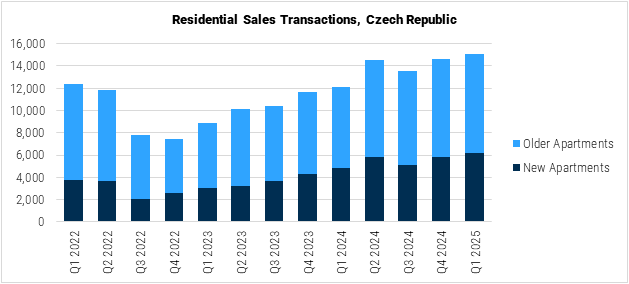
Note: The category of "new apartments" according to the Flat Zone methodology includes first sales of new flats and resales of new/replacement flats built after 1995. Flats built before 1995 fall under the category of "older apartments".
Data Source: CBA Monitor based on Flat Zone data.
The structural issue of the growing imbalance between demand and supply for housing in the Czech Republic's major urban hubs has been a longstanding concern. The Trend Report 2025 by the Association for Real Estate Market Development (ARTN) highlights that, although previously delayed projects from 2022 and 2023 were brought to market in 2024, the housing supply was rapidly depleted and remained insufficient to satisfy strong demand. The strain was further exacerbated by institutional investors who purchased entire developments or large segments thereof for rental housing, thereby diverting a considerable portion of the already limited supply.
Analysis indicates that, given Prague's long-standing housing deficit, at least 10,000 new units would need to be permitted and built annually to keep pace with demographic growth and rising housing demand. Looking ahead, ARTN's forecasts suggest that sustained demand pressures, coupled with regulatory limitations, will continue to drive property prices upward. The long-term sustainability of the housing market will depend largely on whether permitting processes can be streamlined and new construction adequately supported.
Supply Highlights:
Weak Permitting Activity Points to Deeper Fall in Completions
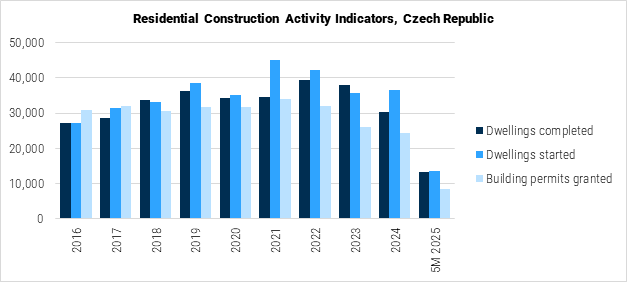
According to the CZSO data on residential construction activity, following a robust year-on-year growth of 13.9% in 2022, housing completions declined by 3.4% in 2023 and contracted further in 2024 by a significant 20.5%, reaching 30,274 units. The negative trend persisted into 2025, with completions falling by 12.6% year-on-year during the first five months of the year.
Forward-looking indicators, including the number of building permits granted and new dwellings started, suggest a continued decline in housing supply across the country in the short to medium term. While the number of new dwellings started in 2024 reached 36,614, reflecting a marginal 2.5% year-on-year increase, the first five months of 2025 saw a 6.3% year-on-year drop.
The negative trajectory was also evident in the number of building permits issued, which declined by 6.7% year-on-year in 2024 to 24,260. This downward trend persisted into 2025, with permits falling by a further 16.2% year-on-year during the first five months.
Data Source: CZSO.
Experts highlight that, although certain regions have shown strong new start figures so far this year, this activity is primarily attributed to previously approved projects that were delayed due to adverse economic conditions. It is the decline in the number of newly issued permits that is expected to create a future supply gap. "Many developers had permits but did not build. Now they are starting construction because credit conditions have improved and construction work can be completed for at reasonable prices," said Petr Palička of EP Real Estate to Seznam Zprávy, adding that the current high backlog reflects delayed decisions rather than a smoothly functioning system.
From an administrative standpoint, a key issue lies in the inefficiencies of the new digital permitting system. Originally intended to streamline the approval process, the system has instead led to widespread confusion and delays. "The current permitting system does not match the pace of modern construction or the needs of cities and municipalities. If the situation is not resolved, we will face a period of tension between growing demand and insufficient market capacity," warned František Konečný, Vice Chairman of the Board of Directors of the Czech Chamber of Chartered Engineers and Technicians.
Residential construction dynamic, by region:
| Region | Number of Dwellings Completed, Jan-May 2025 |
YoY, % | Number of Dwellings Started, Jan-May 2025 |
YoY, % | Number of Building Permits Granted, Jan-May 2025 |
YoY, % |
| Prague | 2,081 | -32.8% | 4,178 | 36.6% | 565 | -9.6% |
| Středočeský | 2,442 | 9.6% | 1,788 | -13.3% | 1,787 | -9.9% |
| Jihočeský | 753 | 12.9% | 1,102 | 17.0% | 594 | -15.7% |
| Plzeňský | 667 | -36.4% | 490 | -60.3% | 550 | 2.2% |
| Karlovarský | 228 | -21.1% | 305 | 67.6% | 204 | 3.0% |
| Ústecký | 733 | 50.5% | 534 | 12.9% | 497 | -14.3% |
| Liberecký | 360 | -8.4% | 408 | 5.2% | 329 | -15.2% |
| Královéhradecký | 425 | -35.8% | 603 | 0.5% | 408 | -28.3% |
| Pardubický | 548 | -44.7% | 581 | -4.0% | 512 | -0.6% |
| Vysočina | 559 | -9.4% | 466 | -29.2% | 462 | -24.5% |
| Jihomoravský | 1,724 | -0.7% | 1,533 | -30.6% | 942 | -30.3% |
| Olomoucký | 1,209 | 9.2% | 485 | -40.0% | 504 | -10.6% |
| Zlínský | 572 | -11.5% | 489 | -10.1% | 465 | -18.7% |
| Moravskoslezský | 886 | 1.0% | 677 | -10.2% | 746 | -26.9% |
| Nationwide | 13,187 | -11.2% | 13,658 | -6.0% | 8,567 | -16.2% |
| Data Source: CZSO. | ||||||
Rental Market:
Rental Growth Outpaced by Sales Prices
Within the last decade, the share of renters in the Czech Republic increased from 21.1% in 2014 to 25.3% in 2024, according to Eurostat, and the tenant pool is likely to expand further. The country's Rental Housing Association (ANB) projects a continued rise in the number of renters, with up to 40,000 additional people expected to begin renting in 2025.
Czech Republic's rent price index:
The ANB Vice President, Michal Hrbatý, stated in a January 2025 press release: "Apartment prices will rise faster than incomes and rents. The availability of owner-occupied housing will definitely not increase; we are seeing the opposite. This means increased pressure on rental housing and a larger number of people in rent."
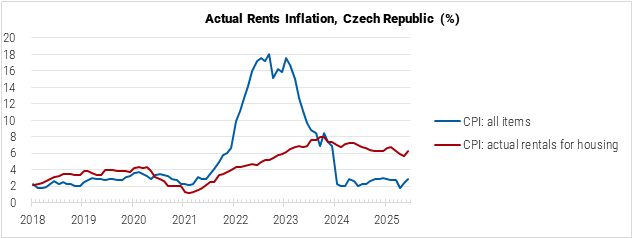
Against the background of sustained and growing demand, rental inflation in the Czech Republic remains elevated, even after the overall price growth stabilization in 2024 and early 2025. The actual rentals for the housing component of the consumer price index (CPI) reported by the CZSO registered a 6.3% year-on-year growth in June 2025, while the all-item CPI increased by just 2.9% during the same period.
In line with this trend, experts across the housing sector anticipate rent increases of approximately 6-8% in 2025, according to the ANB. University cities are to experience even sharper growth, as elevated demand and limited availability continue to drive upward pressure on local rental markets. Rental growth, however, is still expected to be outpaced by sales prices. "It is definitely clear that rent prices will not grow as fast as apartment prices," noted Jakub Vysocký, President of the ANB.
Data Source: CZSO.
In nominal terms, the Q1 2025 edition of Deloitte's Rent Index series showed the average rent per square meter for realized apartment offers at CZK 316 (USD 13.3) nationwide (7.1% year-on-year increase) and CZK 438 (USD 18.4) in Prague (9.5% year-on-year increase). Beyond the capital city, the most expensive apartment rents were reported in Brno at CZK 363 (USD 15.2) and the Central Bohemian Region -Prague vicinity -at CZK 302 (USD 12.7). Among the regional capitals, the most pronounced increase in listed rents was observed in Liberec (18.4% year-on-year).
Average apartment rents in key submarkets:
| Average Rent per sqm, Q1 2025 |
YoY, Q1 2025 vs Q1 2024 |
||
| Czech Republic | CZK 316 | USD 13.3 | 7.1% |
| Prague | CZK 438 | USD 18.4 | 9.5% |
| Prague Vicinity* | CZK 302 | USD 12.7 | 10.6% |
| Brno | CZK 363 | USD 15.2 | 10.3% |
| České Budějovice | CZK 269 | USD 11.3 | 8.9% |
| Hradec Kralove | CZK 291 | USD 12.2 | 11.1% |
| Jihlava | CZK 257 | USD 10.8 | 5.3% |
| Karlovy Vary | CZK 238 | USD 10.0 | 10.7% |
| Liberec | CZK 283 | USD 11.9 | 18.4% |
| Olomouc | CZK 281 | USD 11.8 | 5.2% |
| Ostrava | CZK 228 | USD 9.6 | 7.0% |
| Pardubice | CZK 283 | USD 11.9 | 6.8% |
| Pilsen | CZK 282 | USD 11.8 | 11.0% |
| Ústí nad Labem | CZK 208 | USD 8.7 | 7.2% |
| Zlín | CZK 290 | USD 12.2 | 6.6% |
| *Average for the towns of Benešov, Beroun, Kladno, and Mladá Boleslav and the districts of Prague-East and Prague-West. | |||
| Note: Exchange rate as of Q1 2025, USD 1 = CZK 23.844. | |||
| Data Source: Deloitte CZ. | |||
Despite the sustained rental growth across the country, the estimated profitability of rental housing in the Czech Republic remains hindered by high property prices, limited availability of housing in larger cities, and elevated financing costs. The research conducted by Global Property Guide in June 2025 found gross rental yields for residential units in the country at the average level of 3.28%, down from 3.55% previously reported in April 2024 and 3.92% in July 2023. Regional performance varied, with yields above the national average observed in Prague (3.59%), Ostrava (3.56%), and Pilsen (3.49%).
At the same time, CBRE's latest real estate outlook for the Czech Republic identifies institutional rental housing as a rising force in the residential sector, especially in Prague, where tenant demand is fueled by a growing population, increased urbanization, and a preference for renting among younger demographics. The market for institutional rental housing is expanding, with investors increasingly focusing on long-term rental apartment buildings, which represent a relatively new dynamic within the Czech market.
Mortgage Market:
Lower Interest Rates Support Demand for Loans, Homeownership Still Out of Reach for Many
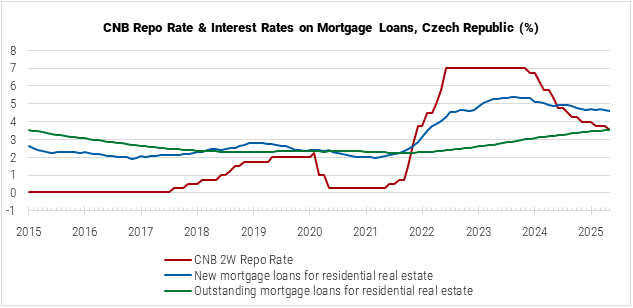
Throughout the second half of 2024 and early 2025, the CNB continued to gradually relax its monetary policy stance, the latest cut in May 2025 bringing the two-week repo rate to 3.50%, the discount rate to 2.50%, and the Lombard rate to 4.50%. At the most recent meeting in June, however, the regulator decided to keep the rates unchanged.
Czech Republic's mortgage loan interest rates:
The CNB board member Jakub Seidler told Reuters that the scope for another interest rate cut is limited and monetary policy is likely to be stable for some time, as services inflation stays high and the economy improves. "Based on all current information, I would say the (main) rate would stay stable for some time ... Unless we see some unexpected developments, it is even possible that we are done [in the rate-cutting cycle]," he said, adding the discussion could again be opened if some inflationary risks calm.
At the same time, analysts from the Czech Banking Association (CBA) see room for one further cut this year, anticipating the two-week repo rate to be reduced to 3.25% by the end of 2025 and to 3% in 2026, which would support credit affordability and further stimulate lending activity in the country.
Data Source: CNB.
In line with the easing policy, after peaking at 5.37% in September 2023, the average interest rate on new residential mortgages reported by the CNB has been steadily declining. It reached 4.61% in May 2025, reflecting a decrease of 0.10 percentage points since January and 0.30 percentage points compared to the same period last year. However, it still remains above pre-2022 levels. At the same time, the upward trend for the average interest rate on outstanding residential mortgages has not reversed yet, the indicator standing at 3.53% in May 2025. against 3.21% a year earlier and 2.75% two years ago.
Interest rates on mortgage loans to households for residential real estate:
| May 2025 | YoY | May 2024 | YoY | May 2023 | |
| New loans | 4.61% | ↓ | 4.90% | ↓ | 5.28% |
| - Floating rate and IRF up to 1 year | 4.83% | ↓ | 5.40% | ↓ | 7.13% |
| - IRF of over 1 and up to 3 years | 4.67% | ↓ | 5.13% | ↓ | 5.91% |
| - IRF of over 3 and up to 5 years | 4.59% | ↑ | 4.58% | ↓ | 5.38% |
| - IRF of over 5 years | 4.04% | ↑ | 3.17% | ↓ | 3.99% |
| Outstanding loans | 3.53% | ↑ | 3.21% | ↑ | 2.75% |
| Data Source: CNB. | |||||
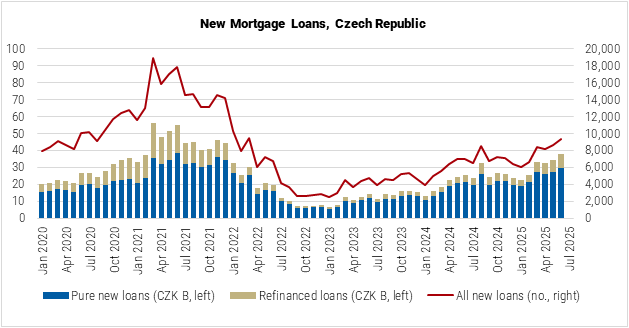
After a notable drop in the volume and value of new mortgages drawn in 2022-2023, brought on by the hike in interest rates, the CNB's restrictive measures to limit excessive lending, and overall economic uncertainty, the mortgage market showed signs of recovery in 2024 and the first six months of 2025.
In its June update, the Czech Banking Association (CBA) reported CZK 184.9 billion (USD 8.1 billion) in new mortgages provided by banks and building societies in the first six months of the year, which is 56% above the comparable period in 2024. Of those, CZK 149.8 billion are pure new loans, and CZK 35.1 billion are refinanced loans.
As for the average size of a mortgage, it was most recently recorded by the CBA at CZK 4.21 million (about USD 195,500) in June 2025, reflecting a 13.3% year-on-year increase compared to the same month the previous year.
"June's numbers confirm once again that, barring anything dramatic, the mortgage market is headed inexorably for its second most successful year on record. However, it is hard to compare with 2021, when rates were around 2% in the first half of the year, whereas today the average mortgage rate is more than double that," Ondřej Šuchman, Mortgage Manager at Komerční banka Group, commented to the CBA. "Mortgages are being driven up mainly by dynamic house price growth and also by the expectation that interest rates will not get much cheaper any time soon. Thanks to the experience of the last two years, many households no longer want to wait for a better 'property price vs. rate' ratio and are investing in real estate now."
Data Source: CBA.
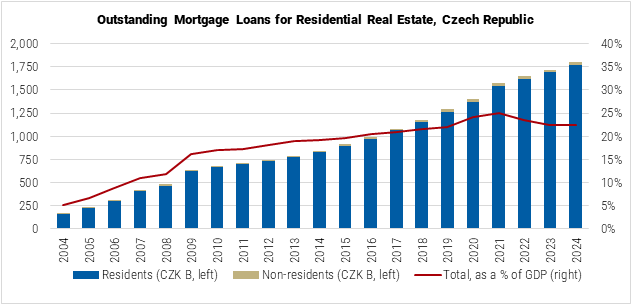
According to the CBN data, the total value of outstanding residential mortgage loans in the Czech Republic recorded a 4.8% year-on-year increase in 2024, which was slightly above the 4.1% growth recorded the previous year, but notably below the more robust average annual expansion of over 9% observed between 2016 and 2021. As of May 2025, the mortgage stock stood at CZK 1.85 trillion (USD 83.6 billion), of which 1.9% was represented by loans to non-residents. Sized against the national economy, the mortgage market is estimated to equal 22.4% of GDP at current prices.
With mortgage rates gradually returning to long-term norms, demand for housing loans in the Czech Republic is likely to remain steady. However, challenges such as limited supply and rising property prices could continue to strain housing accessibility, especially for first-time buyers. "Despite this positive development [falling interest rates and recovering demand], we cannot ignore the fact that real estate prices continue to rise and housing remains financially unaffordable for a large part of the population. Therefore, it is crucial that, in addition to the revival of owner-occupied housing, investments in quality rental housing go hand in hand - both by banks and the state," Petra Skrbková, Director of the Housing Team at Česká spořitelna, commented to the CBA.
Data Sources: CNB, CZSO.
Socio-Economic Context:
Economy Returned to Growth, Inflation Within Target Band
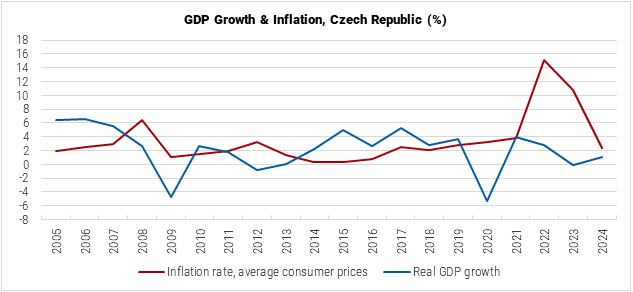
In 2024, the Czech economy returned to growth, recording a real GDP increase of 1.1%. The European Commission sees this expansion as fueled primarily by domestic demand, as external conditions remain unfavorable, namely trade wars and an economic slowdown among the Czech Republic's trading partners. At the same time, domestically, real wage growth has revitalized household consumption, positioning it as the key driver of economic activity. The European Commission projects this momentum to continue, with growth accelerating to 1.9% in 2025 and 2.1% in 2026, while the forecast from the International Monetary Fund (IMF) is more conservative, anticipating growth at 1.6% and 1.8%, respectively, in the next two years.
Consumer Price Index (CPI) inflation in the country has fallen sharply from the record-high 15.1% in 2022 to 10.7% in 2023 and 2.4% in 2024. The latest reporting from the CZSO shows CPI inflation in the Czech Republic at 2.9% in June 2025, an uptick in recent months tied to accelerated food inflation propelled by agricultural commodity prices. The annual inflation level, however, is expected to remain low this year (2.2% projected by the European Commission and 2.5% projected by the IMF) and slow further to 2.0% in 2026.
Data Source: IMF.
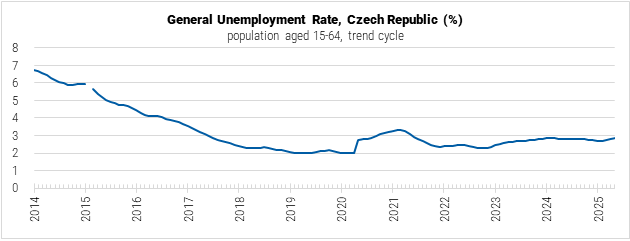
The Czech labor market is tight, with unemployment still at historical lows and among the lowest in the EU (2.8% general unemployment rate reported by the CZSO in May 2025). Despite the recent acceleration of economic growth, the European Commission expects the indicator to remain stable at the annual level of 2.6% for the coming two years. In parallel, nominal wage growth in the country reached 5.9% in 2024 (surpassing inflation) and is forecast to continue at 6.5% in 2025 and 5.3% in 2026.
The 2024 Article IV report from the IMF also points out structural job shortages, particularly among skilled workers, which constrain the development of higher value-added sectors amid the ongoing redistribution of employment from manufacturing to services. "The Czech Republic is evolving from a heavily manufacturing-based, export-oriented hub to a more mature and diversified economy. Non-auto manufacturing, energy, and construction, once important Czech engines of growth, have run out of steam, hampered by decelerating productivity growth, higher energy costs, and sluggish demand. <…> Higher value-added sectors, including ICT services, are constrained by a lack of skilled labor and limited access to capital, undermining their ability to compete in global markets," said the report.
Data Source: CZSO.
Overall, declining inflation and rising real wages and purchasing power suggest the Czech economy is on track for a positive turnaround, fueled by a revival in household consumption. According to the IMF assessment, growth is poised to gain momentum as the policy mix becomes more supportive of economic activity and external demand gradually strengthens. At the same time, weak productivity growth and structural labor shortages are set to weigh down potential expansion.
Within the first half of this year, Fitch Ratings and S&P Global Ratings affirmed their respective 'AA-' and 'AA-/A-1+' ratings for the Czech Republic with a stable outlook. The country's strong government and external balance sheets, including sizable international reserves at the central bank, are expected to cushion the effects of a more muted economic performance in the face of slower recovery of key EU trade partners, as well as the unclear trajectory of global trade disputes and the manufacturing-centered economy's structural challenges.
In June 2025, the current Czech government survived a no-confidence vote triggered by a recent bitcoin scandal. The turmoil, however, is likely to further boost the opposition's prospects at the upcoming general election scheduled for October.
Sources:
- Czech National Bank (CNB)
- Bank Board Decisions: https://www.cnb.cz/
- Monetary and Financial Statistics: https://www.cnb.cz/
- Commentary on Interest Rates of Monetary Financial Institutions (CZ): https://www.cnb.cz/
- Financial Stability Report (Spring 2025): https://www.cnb.cz/
- Central Bank Exchange Rate Fixing: https://www.cnb.cz/
- Czech Statistical Office (CZSO)
- Annual National Accounts: https://csu.gov.cz/
- Government Finance Statistics: https://csu.gov.cz/
- Inflation, Consumer Prices: https://csu.gov.cz/
- Employment and Unemployment (LFS): https://csu.gov.cz/
- Residential Real Estate Price Indices: https://csu.gov.cz/
- Residential and Non-residential Construction and Building Permits: https://csu.gov.cz/
- Czech Banking Association (CBA)
- CBA Hypomonitor: https://www.cbamonitor.cz/
- Czech Real Estate Market Strengthened by More Than a Third: https://www.cbamonitor.cz/
- Real Estate Prices: https://www.cbamonitor.cz/
- CBA Forecast: https://www.cbamonitor.cz/
- CBA Hypomonitor: Lower June Rate to 4.56% Brought a Recovery in New Mortgages: https://www.cbamonitor.cz/
- European Commission
- Economic Forecast for Czechia: https://economy-finance.ec.europa.eu/
- Distribution of Population by Tenure Status, Type of Household and Income Group - EU-SILC Survey: https://ec.europa.eu/
- International Monetary Fund (IMF)
- Country Overview: Czech Republic: https://www.imf.org/
- 2024 Article IV Staff Report: https://www.imf.org/
- Rental Housing Association (ANB)
- Up to 40,000 More People Will Start Living in Rented Accommodation in 2025, the Digitalization of Renting Will Accelerate, and Housing Will Become a Key Election Issue (CZ): https://www.asociacenajemnihobydleni.cz/
- Association for Real Estate Market Development (ARTN)
- Trend Report 2025 (CZ): https://artn.cz/
- Deloitte CZ
- Deloitte Real Index Q4 2024: https://www.deloitte.com/
- Deloitte Rent Index Q1 2025: https://www.deloitte.com/
- CBRE
- Czech Republic Real Estate Market Outlook 2025: https://www.cbre.com/
- S&P Global
- Research Update: Czech Republic 'AA-/A-1+' Foreign Currency And 'AA/A-1+' Local Currency Ratings Affirmed; Outlook Stable: https://www.spglobal.com/
- Fitch Ratings
- Fitch Affirms Czech Republic at 'AA-'; Outlook Stable: https://www.fitchratings.com/
- Reuters
- Czech Central Banker Seidler Sees Limited Scope for Further Rate Cut: https://www.reuters.com/
- Czech Populist Opposition Leads as Election Set for October: https://www.reuters.com/
- Politico
- Czech Government Survives No-Confidence Vote Over Bitcoin Scandal: https://www.politico.eu/
- Seznam Zprávy
- A Record That No One Boasts. Dramatic Decline in Building Permits (CZ): https://www.seznamzpravy.cz/