Belgium's Residential Property Market Analysis 2026
The activity in the Belgian housing market is expected to moderate this year, as the effects of the regional tax reset (which previously supported a rebound in demand across the country) fade, while mortgage interest rates continue to edge upwards.
This extended overview from the Global Property Guide covers key aspects of Belgium’s housing market and takes a closer look at its most recent developments and long-term trends.
Table of Contents
- Property Prices and Price Index
- Historic Perspective
- Property Demand Trends
- Property Supply Trends
- Rental Market: Rents and Rental Yields
- Mortgage Market and Interest Rates
- Economic and Social Factors
Property Prices and Price Index
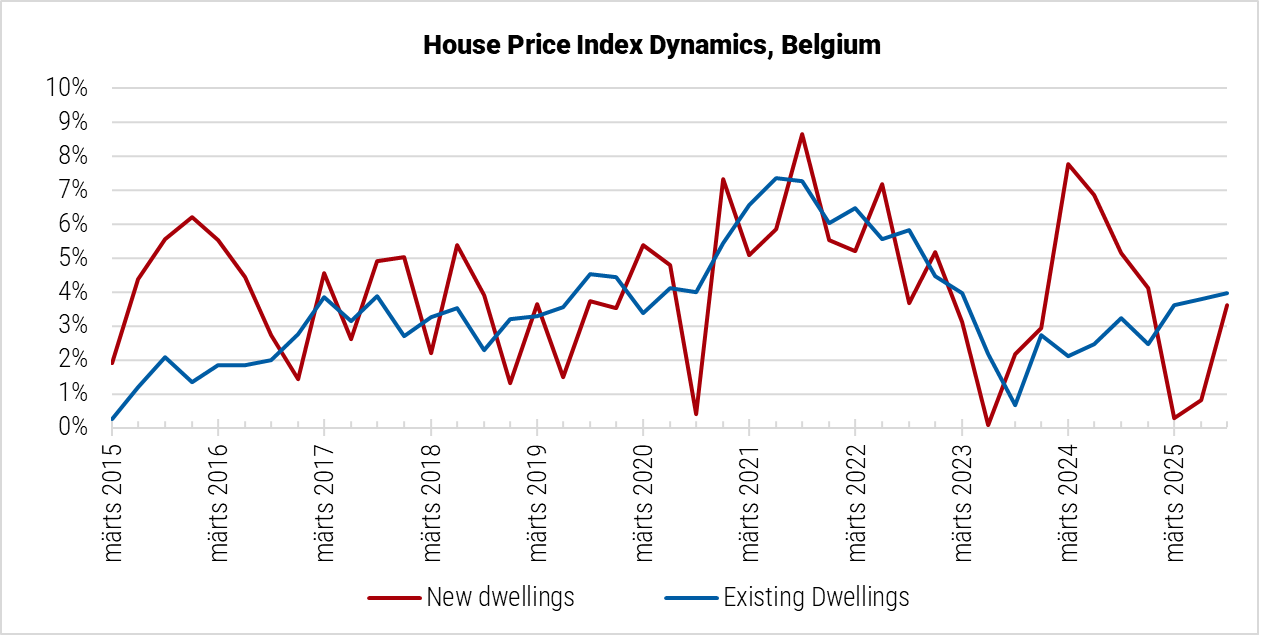
Belgium’s residential pricing cycle strengthened in 2025, reflecting policy-supported demand meeting still constrained effective supply. According to the Belgian Statistical Office’s (Statbel) House Price Index (HPI), in Q3 2025, residential prices rose by 3.71% year-on-year (1.69% in real terms). In quarter-on-quarter terms, prices increased by 2.41% (1.83% inflation-adjusted).
Belgium's house price annual change:
The gap between existing and new dwellings narrowed as the year progressed: in Q3 2025, annual growth reached 3.96% for existing dwellings and 3.62% for new dwellings, indicating that new-build pricing regained traction after a softer start to 2025.
Regional performance in the secondary segment remained uneven, with Wallonia (+5.0% year-on-year) outpacing Brussels (+3.7%) and Flanders (+3.6%). A key short-term driver was the 2025 recalibration of transaction taxes across all three regions; however, the largest effective cut was in Wallonia (for eligible owner-occupier primary-residence purchases), which amplified demand and fed through to prices more visibly compared to the rest of the country.
In the words of the Belgian Federation of Notaries' (Fednot) spokesperson Axelle Laine, “market dynamism logically puts pressure on prices,” while the notary Bart van Opstal noted that Wallonia’s stronger price effect is “still significant, but already easing” compared with the start of the year.
Data Source: Statbel.
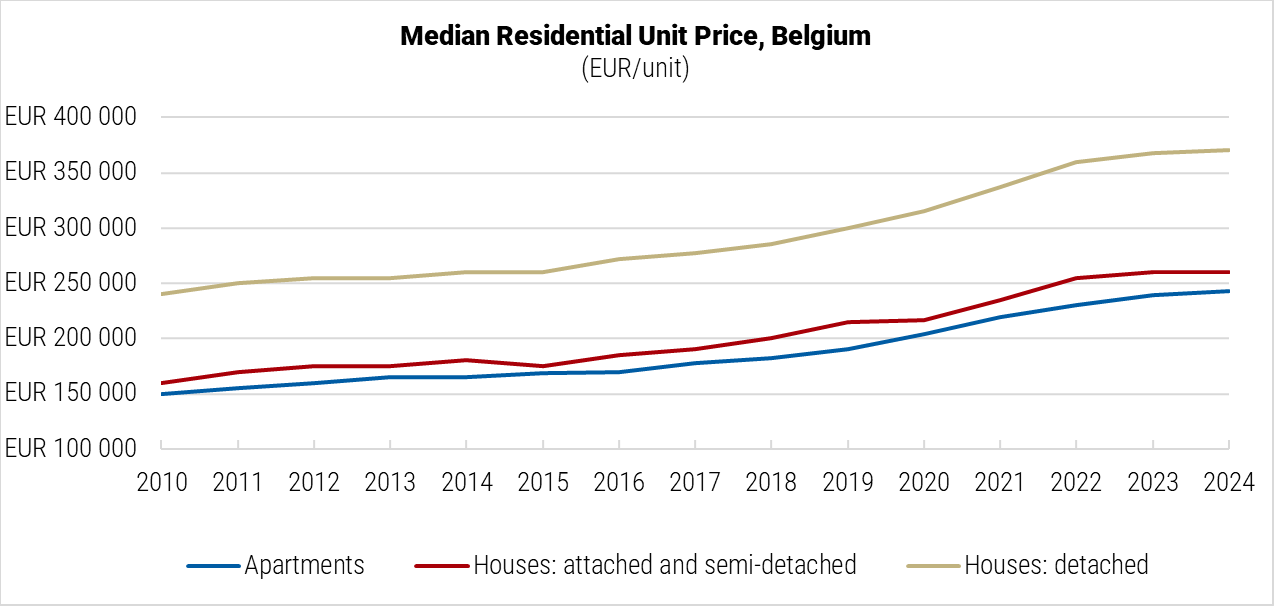
Statbel’s deed-based reporting (FPS Finances registrations) indicates that the national median apartment price in Q3 2025 reached EUR 255,000 (USD 297,866), up 4.08% year-on-year. The Brussels-Capital Region remained the most expensive apartment market, with a regional median of EUR 274,550 (USD 320,702); within Brussels, observed municipality medians ranged from EUR 340,000 (USD 397,154) in Ixelles to EUR 230,000 (USD 268,663) in Berchem-Sainte-Agathe.
Apartments price dynamics by region:
| Median price per unit, EUR |
Median price per unit, USD |
YoY, % | |
| Flemish region | EUR 263,000 | USD 307,210 | 5.20% |
| Walloon region | EUR 195,000 | USD 227,780 | 8.33% |
| Brussels-Capital region | EUR 274,550 | USD 320,702 | 2.92% |
| Nationwide | EUR 255,000 | USD 297,866 | 4.08% |
| Note: Exchange rate as of Q3 2025, USD 1 = EUR 0.8561. | |||
| Data Source: Statbel. | |||
In the houses segment, price appreciation was somewhat slower. The national median reached EUR 280,000 (USD 327,068) for attached/semi-detached houses (+2.00% year-on-year) and EUR 390,000 (USD 455,559) for detached houses (+2.63% year-on-year).
House prices by region:
| Attached and Semi-Detached, EUR/unit |
Attached and Semi-Detached, USD/unit |
YoY, % | Detached, EUR/unit |
Detached, USD/unit |
YoY, % | |
| Flemish region | EUR 317,500 | USD 370,872 | 3.76% | EUR 430,000 | USD 502,283 | 2.38% |
| Walloon region | EUR 197,000 | USD 230,116 | 6.49% | EUR 330,000 | USD 385,473 | 8.20% |
| Brussels-Capital region | EUR 525,000 | USD 613,253 | 3.96% | EUR 1,112,500 | USD 1,299,511 | 9.04% |
| Nationwide | EUR 280,000 | USD 327,068 | 2.00% | EUR 390,000 | USD 455,559 | 2.63% |
| Note: Exchange rate as of Q3 2025, USD 1 = EUR 0.8561. | ||||||
| Data Source: Statbel. | ||||||
Looking ahead, baseline forecasts still point to continued nominal growth, but with less policy distortion. KBC’s latest Belgium baseline implies HPI at +3.3% in 2025, +3.4% in 2026, and +3.2% in 2027, and states that Q3 “does not substantially change” its medium-term view. ING is directionally similar on continuation, but with a stronger 2025 front-loading profile and clearer deceleration thereafter (+4.6% in 2025; +1.6% in 2026), arguing that the early-2025 policy-related “rush” should cool as one-off fiscal effects fade.
Historic Perspective
From Credit-Fueled Expansion to Inflation-Era Real Price Adjustment
Over the past two decades, Belgium’s housing market has been characterized by long, moderate cycles rather than sharp boom-bust swings. The pre-2008 phase was a clear expansion period, supported by favorable credit conditions, rising household purchasing power, and steady owner-occupier demand. After the global financial crisis, momentum slowed materially. From 2009 through the mid-2010s, the market moved into a low-growth phase, with nominal increases becoming subdued and real price growth frequently close to zero or negative as inflation absorbed much of the headline gain.
A new upcycle formed from the mid-2010s to 2019, largely underpinned by the prolonged low-rate environment across the euro area. Cheap mortgage financing improved affordability for financed buyers and supported gradual price appreciation, especially in better-located and higher-quality stock. The pandemic period then created a second acceleration wave in 2020–2021: very low borrowing costs, high household savings, and shifting housing preferences reinforced demand and pushed prices up more quickly.
The cycle turned again in 2022 as inflation surged and interest rates rose sharply. Higher financing costs reduced borrowing capacity and cooled transactional momentum, leading to a real-price adjustment phase even where nominal prices still increased. In 2023–2024, the market showed signs of stabilization: nominal growth remained positive but slower, while real outcomes stayed constrained by inflation and affordability pressure.
20-year annual house price change (based on end-of-year House Price Index and Consumer Price Index):
| Year | Nominal house prices (%) |
Inflation-adjusted house prices (%) |
Year | Nominal house prices (%) |
Inflation-adjusted house prices (%) |
|
| 2005 | n/a | n/a | 2015 | 2.25% | 0.81% | |
| 2006 | 8.60% | 7.05% | 2016 | 2.43% | 0.55% | |
| 2007 | 6.74% | 3.88% | 2017 | 3.12% | 1.03% | |
| 2008 | 3.22% | -0.26% | 2018 | 2.72% | 0.09% | |
| 2009 | -0.83% | -0.55% | 2019 | 4.24% | 3.68% | |
| 2010 | 3.20% | 0.20% | 2020 | 5.86% | 5.27% | |
| 2011 | 3.39% | -0.24% | 2021 | 5.90% | 0.70% | |
| 2012 | 1.71% | -0.69% | 2022 | 4.61% | -5.82% | |
| 2013 | 1.13% | 0.32% | 2023 | 2.77% | 1.93% | |
| 2014 | 0.68% | 0.81% | 2024 | 2.82% | -0.36% | |
| Data Sources: Statbel, OECD, Global Property Guide. | ||||||
Data Source: Statbel.
Property Demand Trends
Strong Transaction Recovery Driven by Regional Fiscal Asymmetry
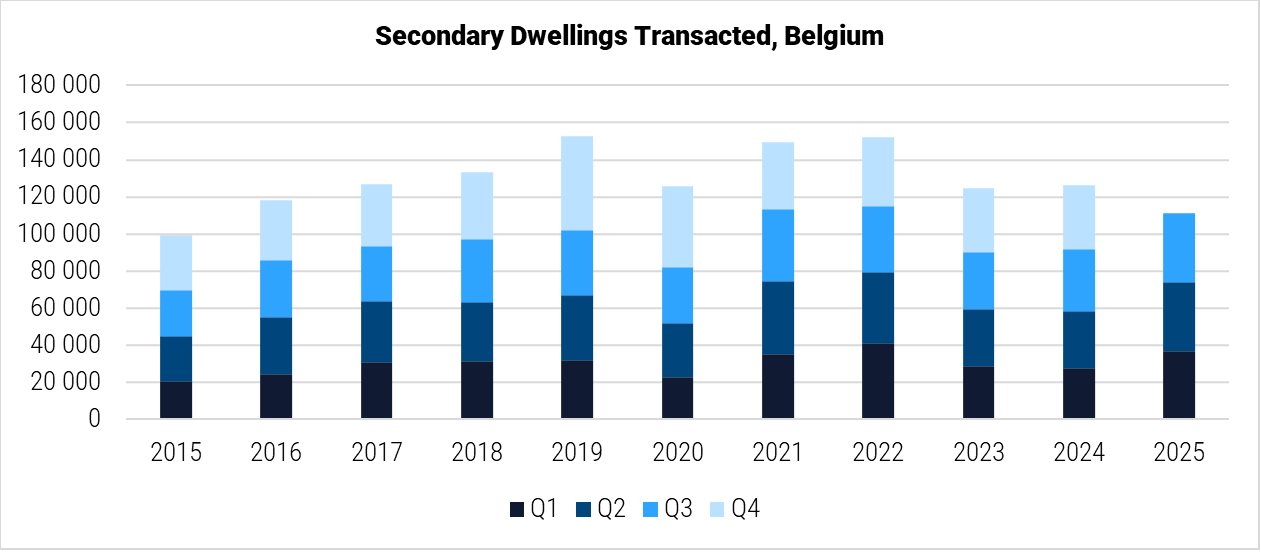
Belgium’s housing market recorded a clear rebound in sales activity in 2025. Based on Statbel transaction records, 111,249 existing dwellings were sold in Q1–Q3 2025, up 21.42% year on year. Fednot’s Real Estate Barometer data indicates similar dynamics describing 2025 as a “year of revival”, with total residential sales up 15% year-on-year during the first nine months of 2025.
A key part of the demand rebound is the asymmetric regional tax reset. In Flanders, the reduced registration duty for an owner-occupied sole home was lowered from 3% to 2% from 1 January 2025. In Wallonia, the change was much larger: the rate moved from 12.5% to 3% for eligible purchases of a primary sole residence, alongside the removal/reworking of older support mechanisms. Brussels did not cut the headline duty in the same way; instead, it strengthened the abatement system (including exemption on the first EUR 200,000 of the taxable base for qualifying purchases up to EUR 600,000, plus an additional renovation-linked abatement).
This policy asymmetry is reflected in regional transaction outcomes. Wallonia recorded the strongest acceleration in secondary transactions (+23.82% year on year), followed by Flanders (+21.70%), while Brussels expanded at a slower pace (+12.99%). The pattern is consistent with the size and design of the regional fiscal impulse.
Data Source: Statbel.
Number of secondary dwellings transacted by region:
| Number of Secondary Transactions, Q1-Q3 2025 |
YoY, % | |
| Flemish region | 70,290 | 21.70% |
| Walloon region | 30,819 | 23.82% |
| Brussels-Capital region | 10,140 | 12.99% |
| Nationwide | 111,249 | 21.42% |
| Data Source: Statbel. | ||
Colliers notes that lower registration duties, particularly Wallonia’s move to 3%, improved affordability and encouraged households to bring forward purchases, while the stabilization of mortgage rates at around 3% after the 2023 peak further supported buying capacity. Fednot spokesperson Sophie Maquet similarly emphasizes that the rebound cannot be attributed to tax reform alone: with mortgage rates around 3–4% increasingly accepted by buyers, the incentive to postpone purchases in anticipation of a return to 1% financing has diminished.
Looking ahead, transaction growth is expected to stabilize in 2026. Secondary-market data already point to a cooling pace, with annual growth easing from +32.87% in Q1 2025 to +13.00% in Q3 2025. Fednot commentary on notarial data also indicates that, after an exceptionally strong start to the year, momentum became less pronounced in later quarters. In parallel, ING Think characterizes part of the 2025 policy boost as temporary and expects Belgium’s housing market to moderate in 2026, as one-off fiscal front-loading effects fade.
Property Supply Trends
Low New-Build Authorizations and High Renovation Share Signal Limited Near-Term Expansion
Belgium’s residential supply backdrop remains constrained despite a relatively large legacy housing stock. Deloitte’s 2025 Property Index estimates Belgium at 490 dwellings per 1,000 inhabitants versus a European average of 450, but also stresses that a high stock ratio does not by itself ensure effective, market-ready availability where new supply is needed most. As Cédric Van Meerbeeck, Head of Infrastructure & Real Estate Valuation & Insights at Deloitte Belgium, notes: “Belgium’s housing stock remains relatively high by European standards, but that does not automatically translate into sufficient availability. Demographic shifts like urbanization, ageing, and the rise of one-person households are reshaping demand in ways that the current housing supply doesn’t always match.”
The number of building permits issued remains structurally low. Based on calculations from Statbel’s monthly building-permit dataset (through October 2025), 38,675 residential buildings were authorized in January–October 2025 (new construction plus renovation), down 4.60% year on year. Renovation permits accounted for approximately 55% of the total (21,133), while permits for new residential buildings totaled 17,542. This composition is consistent with a long-running structural pattern: Statbel notes that renovation permits have generally exceeded permits for new residential construction since 2007 (with only a brief interruption around 2018–early 2019), indicating that a significant share of permitting activity is directed toward upgrading existing stock rather than materially expanding it.
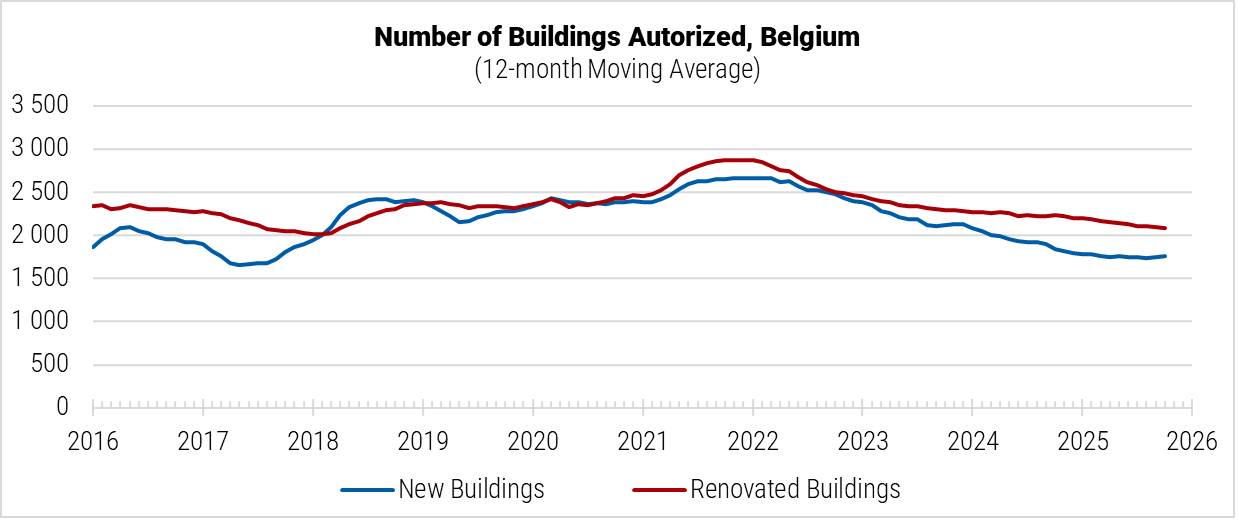
Data Source: Statbel.
The new buildings authorized during the first ten months of 2025 included a total of 34,341 dwellings, representing an 8.12% year-on-year decline, with contraction especially apparent in the apartment segment (down 13.31% year on year). ING Think notes that “building permits remain at historically low levels, especially for apartment projects,” and highlights that this continues to widen the gap between required housing formats and the supply that is actually reaching the market.
Regional performance varied, with the Flemish Region accounting for the largest share of activity (75%). The Brussels-Capital Region, despite the smallest share (6%), was the only region to register year-on-year growth in authorized dwellings (+17.70%), while the steepest decline was recorded in Wallonia (-23.05%). Colliers emphasizes that high construction costs, tighter energy and environmental requirements, and limited land availability continue to constrain new development, especially in urbanized and economically stronger submarkets.
Number of dwellings authorized in new buildings by region:
| Apartments, Jan-Oct 2025 |
YoY, % | Single-Family Homes, Jan-Oct 2025 |
YoY, % | |
| Flemish region | 13,680 | -10.94% | 12,011 | 2.90% |
| Walloon region | 2,998 | -33.51% | 3,650 | -11.62% |
| Brussels-Capital region | 1,964 | 20.20% | 38 | -43.28% |
| Nationwide | 18,642 | -13.31% | 15,699 | -1.08% |
| Data Source: Statbel. | ||||
Looking ahead, the supply outlook points to stabilization from a low base rather than a rapid rebound. ING Think indicates that permit volumes may have bottomed out, with only gradual normalization expected, while also warning that higher financing costs and slow, complex permitting procedures remain key downside risks. Sector sentiment is broadly aligned: near-term recovery in new residential supply is likely to remain uneven and modest, with meaningful improvement dependent on faster approvals, better project viability, and a sustained easing of delivery-side constraints.
Rental Market: Rents and Rental Yields
Structural Supply Shortage Puts Upward Pressure on Rents
With over 29% of Belgian households renting rather than owning their residence as of 2025, the consistently high tenant demand in the country continues to be met with structural supply shortages, which in turn puts upward pressure on rents in key submarkets. The annual rental barometer recently published by the Federation of French-Speaking Real Estate Agents (Federia) in collaboration with the Confederation of Real Estate Professions (CIB) and rental insurance provider Korfine, highlighted a further contraction in the number of available properties and new rental contracts signed across Flanders and Brussels in 2025.
Belgium's rent price index:
“On the surface, the Brussels rental market gives the impression of normalizing. But structurally, all the indicators are flashing red: fewer properties available, less investment, and prices that remain high. Without a change in political direction, this problem is likely to persist,” commented Patrick Boterbergh, CEO of Korfine.
In this environment, rental inflation in Belgium (as measured by the annual change in actual rentals for the housing component of the consumer price index), now more stable than in 2022-2024, nonetheless continued to trend notably above the overall price growth. Most recently, Statbel reported the indicator at 3.5% in January 2026, while the all-item CPI registered a 1.1% growth.
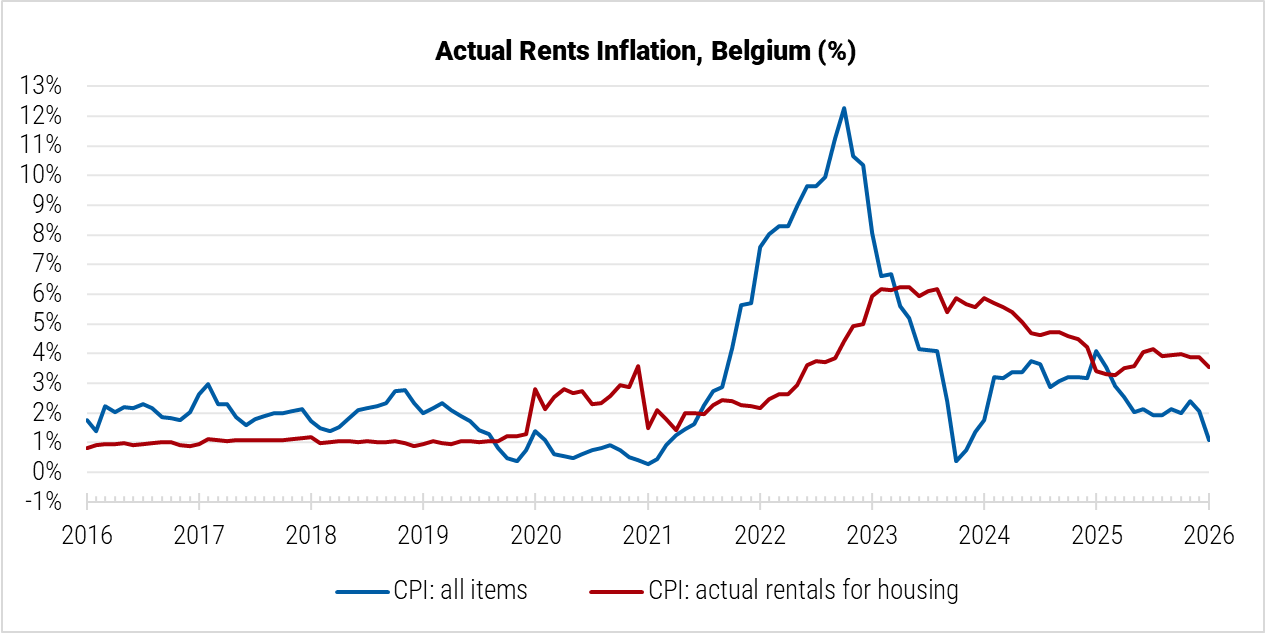
Data Source: Statbel.
The nominal figures from the 2025 rental barometer also indicate that although rent increases have slowed somewhat after particularly sharp rises in 2023 and 2024, the pressure on the market is persistent. The average rent per unit across all types of housing in 2025 reached EUR 888 (USD 1,003) in Wallonia, EUR 966 (USD 1,092) in Flanders, and EUR 1,376 (USD 1,555) in Brussels.
Within the capital region, the average rent threshold of EUR 1,000 per month has now been exceeded in all Brussels municipalities, with the highest average rents observed in Woluwe-Saint-Pierre at EUR 1,576 (USD 1,781), Uccle at EUR 1,474 (USD 1,666), Watermael-Boitsfort at EUR 1,145 (USD 1,633), Ixelles at EUR 1,432 (USD 1,618), and Woluwe-Saint-Lambert at EUR 1,419 (USD 1,603).
The report also notes an increase in median rents in Brussels over recent years, which, according to Charlotte De Thaye, Director General of Federia, points to an ongoing restructuring. “The significant increase in median rents highlights the disproportionate disappearance of the most affordable housing, mainly older and less energy-efficient apartments. These properties are leaving the market at a rapid pace and are not being replaced by new rentals, which further exacerbates structural tensions in the market,” she said.
Average rent levels, by region:
| Region | Average rent per unit, EUR 2025 |
Average rent per unit, USD 2025 |
YoY, % 2025 vs 2024 |
| Wallonia | EUR 888 | USD 1,003 | 5.4% |
| Flanders | EUR 966 | USD 1,092 | 4.5% |
| Brussels | EUR 1,376 | USD 1,555 | 3.7% |
| Note: Exchange rate as of 2025, EUR 1 = USD. | |||
| Data Source: Federia in collaboration with CIB and Korfine. | |||
Reflecting market trends, research by Global Property Guide conducted in January 2026 found gross rental yields for housing in Belgium at the average level of 4.32%, up from 4.23% previously reported in January 2025. The strongest potential performance among the monitored submarkets was observed in the district of Brussels (5.75%) and the district of Liège (5.17%), while the lowest yield levels were recorded in the district of Brugge (2.83%).
Mortgage Market and Interest Rates
Interest Rates Expected to Continue Edging Upwards
Despite the stabilization of the European Central Bank’s (ECB) monetary policy in recent months, with key rates on hold since June 2025 and no further moves announced at the February 2026 meeting of the Governing Council, interest rates on housing loans in the Belgian market (primarily comprised of fixed-rate loans and more closely tied to 10-year government yields than short-term refinancing rates) continued to climb upwards throughout 2025.
Belgium's mortgage loan interest rates:
The average interest rate on loans to households for house purchase in Belgium was most recently reported by the ECB at 3.45% for new housing loans and 2.41% for outstanding housing loans in December 2025, with further gradual increases expected in the upcoming periods.
“[The Belgian 10-year sovereign yield] is expected to rise over the projection horizon, reaching 4% by the end of 2028,” the National Bank of Belgium noted in its latest economic review. “Against this backdrop, the average mortgage rate is also expected to edge upwards and to exceed 4% by the end of the forecast horizon.”
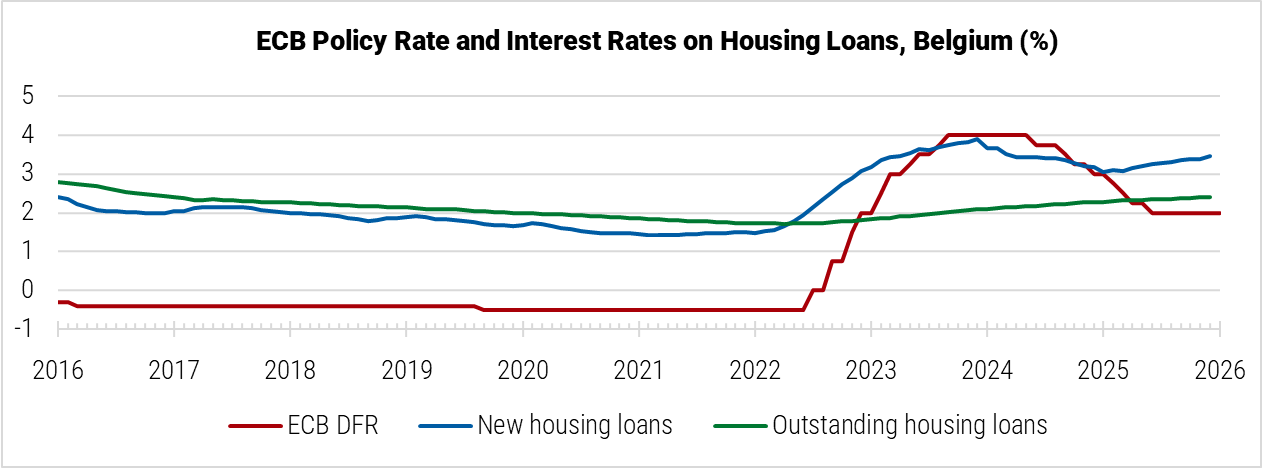
Data Source: ECB.
Average interest rates on loans to households for house purchase:
| Dec 2025 | YoY | Dec 2024 | YoY | Dec 2023 | |
| New housing loans | 3.45% | ↑ | 3.16% | ↓ | 3.90% |
| - Floating rate and IRF up to 1 year | 4.18% | ↓ | 4.61% | ↓ | 5.66% |
| - IRF of over 1 and up to 5 years | 3.72% | ↓ | 4.00% | ↓ | 5.02% |
| - IRF of over 5 and up to 10 years | 3.17% | ↑ | 3.08% | ↓ | 3.91% |
| - IRF of over 10 years | 3.33% | ↑ | 2.89% | ↓ | 3.60% |
| Outstanding housing loans | 2.41% | ↑ | 2.27% | ↑ | 2.09% |
| - Original maturity up to 1 year | 4.27% | ↓ | 5.08% | ↓ | 5.26% |
| - Original maturity over 1 and up to 5 years | 2.96% | ↑ | 2.76% | ↑ | 2.32% |
| - Original maturity of over 5 years | 2.39% | ↑ | 2.25% | ↑ | 2.07% |
| Data Source: ECB. | |||||
At the same time, lending activity in Belgium continued to recover in 2025, the total value of new housing loans (including pure new loans and renegotiations) issued between January and December reaching EUR 42.7 billion (USD 48.2 billion), a solid 25.7% increase compared to 2024.
The Belgian Financial Sector Federation (Febelfin) attributes this positive trend, in part, to a reduction in registration duties in certain parts of the country and anticipates that the momentum will continue this year. "The sharp reduction in registration duties in Wallonia on 1 January 2025 has strongly stimulated the production of mortgage loans [last year]. The increase in the purposes ‘purchase’ and ‘purchase + renovation’ gives us hope that this trend will continue sustainably,” said the federation’s January 2026 release.
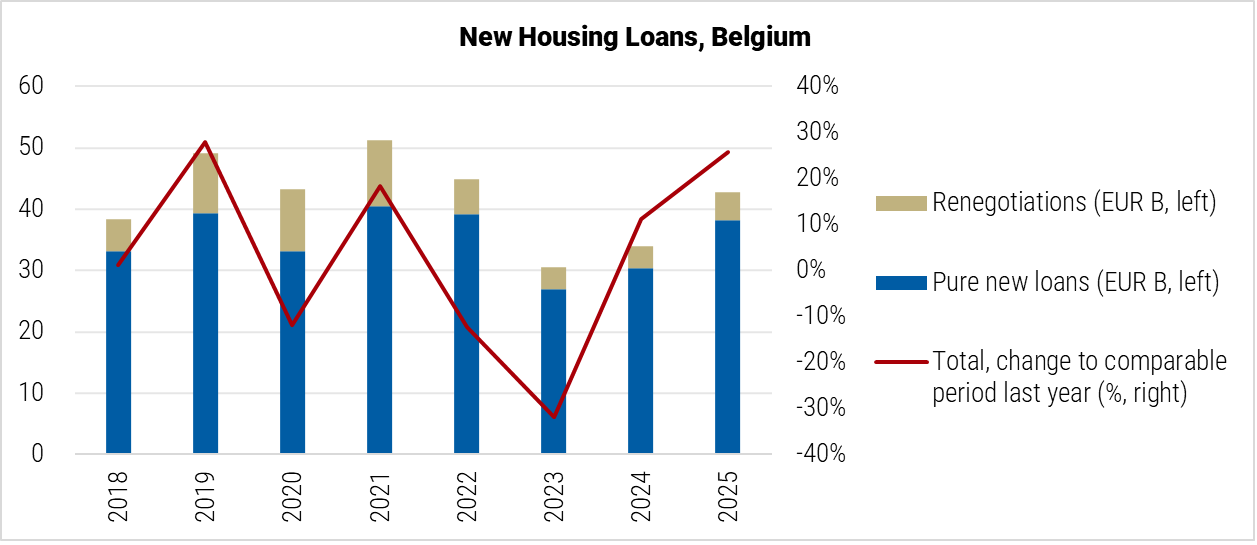
Data Source: ECB.
Against this backdrop, the overall mortgage portfolio in Belgium continued its moderate expansion in nominal terms. According to the ECB, the total value of outstanding housing loans in the country stood at EUR 250.4 billion (USD 283.0 billion) at the end of 2025, a 2.7% increase compared to end-2024. The relative size of the market has declined somewhat from its peak level of an estimated 42.6% of GDP at current prices in 2020 to an estimated 39.3% in 2024.
The overall level of mortgage indebtedness in Belgium remains high, with 43.1% of households reported as owning their residences with a mortgage or housing loan as of 2025, which is notably above the EU average of 24.3%.
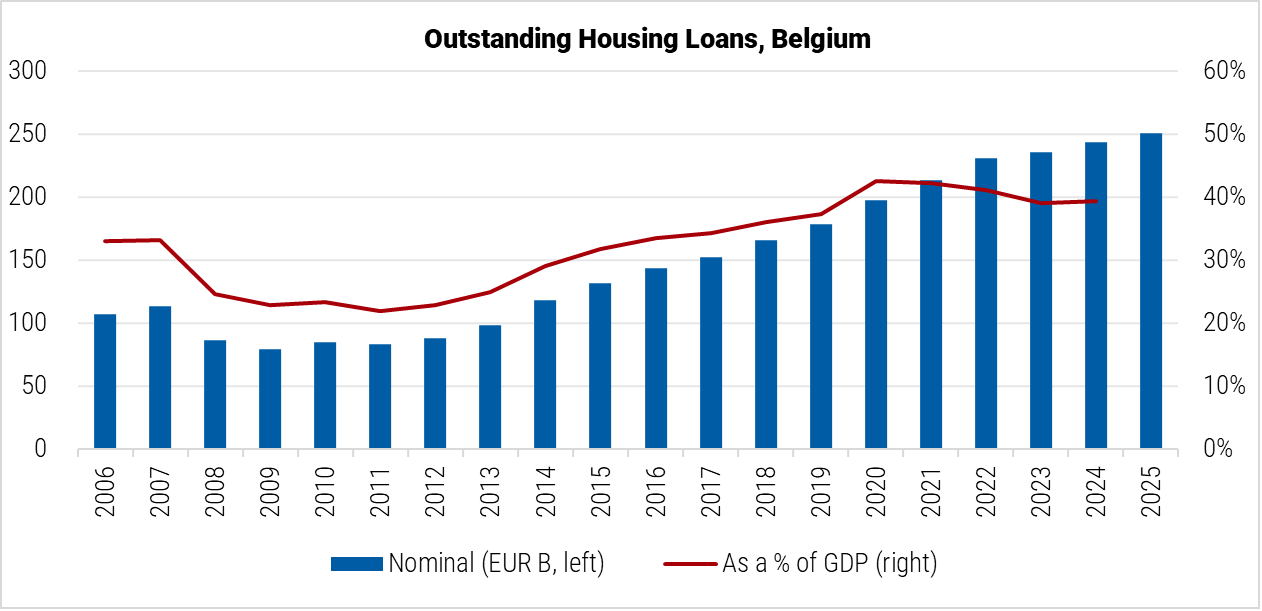
Data Source: ECB.
Economic and Social Factors
Stable Yet Moderate Growth and Vulnerability in Public Finances
The Belgian economy has been resilient through turbulence, but continues to face structural challenges, including sizeable fiscal deficits, a high and increasing level of public debt, and a fragile external position. Due to high global uncertainty and decreased exports, the country’s real GDP growth remains modest, estimated at 1.1% in 2025 and projected by the European Commission to accelerate only slightly over the forecast horizon, reaching 1.1% in 2026 and 1.3% in 2027. Based on the current environment and the measures officially announced by the federal government, the latest NBB projections through 2028 also expect stable moderate growth to continue, with some changes in terms of growth composition predicted; however, as fiscal consolidation is expected to decrease the contribution of public expenditure, while private investment picks up.
Driven by lower price pressures for industrial goods and energy, consumer price index (CPI) inflation in the country fell from an average annual level of 4.3% in 2024 to 2.6% in 2025 and was most recently reported by Statbel at just 1.1% in January 2026. The European Commission forecast expects inflationary pressures to ease further to the average level of 1.8% this year, before converging to 2.0% target in 2027, when the introduction of a new emissions trading system (ETS2), if not delayed, is expected to lead to an increase in energy prices.
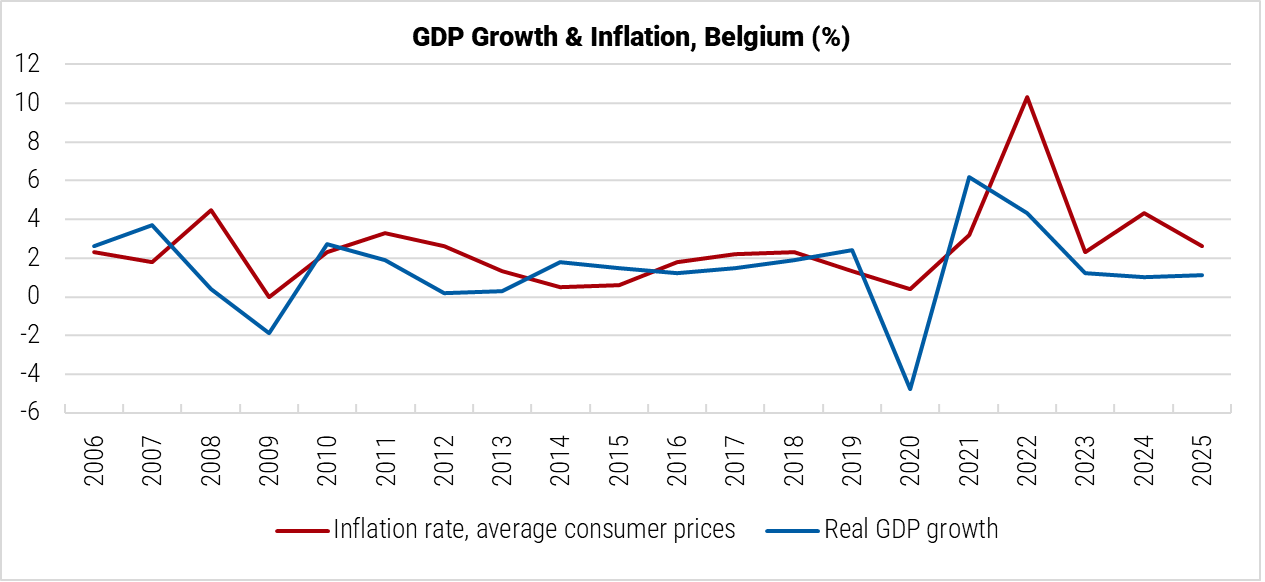
Data Source: IMF.
At the same time, deteriorating public finances remain among the key vulnerabilities of the Belgian economy. The country’s general government deficit was assessed to increase from 4.4% of GDP in 2024 to 5.3% of GDP in 2025, driven up by ageing costs (mainly in pensions and healthcare), interest payments, and defence expenditures. Even considering the anticipated impact of federal and regional measures decided late last year, the European Commission forecast sees the deficit rising further, reaching 5.5% in 2026 and 5.9% in 2027 on the back of elevated defence spending and payments on the rising debt. Belgium’s gross public debt is forecast to increase from 107.1% of GDP in 2025 to 112.2% in 2027.
As a short-term consequence of significant labor market and pension reforms initiated by Belgium as part of its medium-term fiscal plan aiming to mitigate increases in the deficit and debt, the unemployment rate in the country rose to 6.5% in Q3 2025 from 5.6% reported two years earlier. The European Commission analysis expects the unemployment to continue rising in 2026, before decreasing slightly in 2027, as employment growth picks up. In parallel, wage growth is expected to ease gradually as labor supply increases.
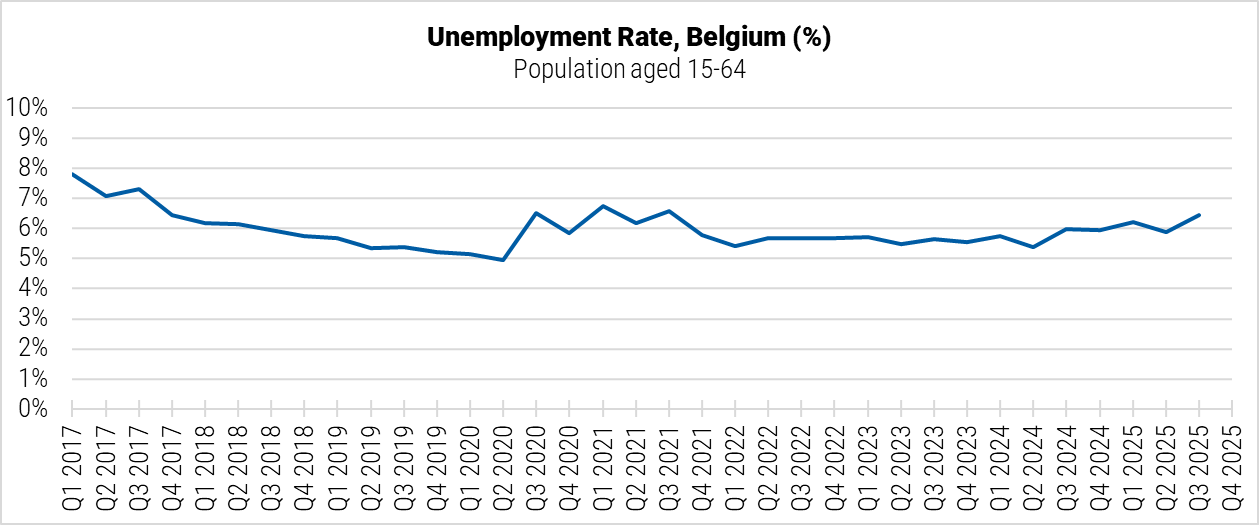
Data Source: Statbel.
Overall, Belgium is seen as a diversified and wealthy economy with a resilient growth trend. The economy’s strengths, however, are balanced by challenging public finances and a political and institutional context that complicates fiscal adjustment. The 2026 Article IV mission-concluding statement from the International Monetary Fund (IMF) noted that the Belgian authorities’ current fiscal plan and measures added in the 2026 federal budget are a step forward, but “insufficient to stop increases in the deficit and debt”. Weaker external demand, geopolitical and trade tensions, and prolonged global uncertainty are also weighing on the outlook.
Signaling growing concerns about the country’s public finances against the background of modest growth and external headwinds, in June 2025, Fitch Ratings downgraded Belgium’s sovereign rating from ‘AA-’ to ‘A+’ with a stable outlook.
Sources:
- Belgian Statistical Office (Statbel)
- House Price Index – 3rd Quarter 2025: https://statbel.fgov.be/
- House Prices – 3rd Quarter 2025: https://statbel.fgov.be/
- Sales on the Secondary Market: https://statbel.fgov.be/
- Building Permits: October 2025: https://statbel.fgov.be/
- Consumer Price Index: https://statbel.fgov.be/
- Employment and Unemployment: https://statbel.fgov.be/
- National Bank of Belgium (NBB)
- Macroeconomic Projections for Belgium: https://www.nbb.be/
- Economic Projections for Belgium, December 2025: https://www.nbb.be/
- Financial Stability Report 2025: https://www.nbb.be/
- The Current Monetary Policy Cycle May Be Ending: Are More Expensive Mortgages on the Horizon?: https://www.nbb.be/
- The Official Website of the Flemish Government
- The Right for Sale When Purchasing Your Only Home: Overview (NL): https://www.vlaanderen.be/
- The Official Website of Wallonia
- Benefits from the Housing Voucher (FR): https://www.wallonie.be/
- The Official Website of Brussels Capital Region
- Reduction in Sales Duties (FR): https://be.brussels/
- European Central Bank (ECB)
- ECB Data Portal: https://data.ecb.europa.eu/
- Key ECB Interest Rates: https://www.ecb.europa.eu/
- Monetary Policy Decisions, 5 February 2025: https://www.ecb.europa.eu/
- European Commission
- Economic Forecast for Belgium: https://economy-finance.ec.europa.eu/
- Distribution of Population by Tenure Status, Type of Household, and Income group: https://ec.europa.eu/
- International Monetary Fund (IMF)
- Country Overview: Belgium: https://www.imf.org/
- Belgium: Staff Concluding Statement of the 2026 Article IV Mission: https://www.imf.org/
- Fednot
- Real Estate Barometer: the Real Estate Market is Reviving… (NL): https://www.fednot.be/
- Real estate in Walloon Brabant in 2025 (FR): https://www.notaire.be/
- Real Estate Sales in the First Nine Months of 2025… (FR): https://www.notaire.be/
- Belgian Financial Sector Federation (Febelfin)
- 2025: an Excellent Year for Mortgage Lending: https://febelfin.be/
- Federation of French-Speaking Real Estate Agents (Federia)
- Rental Barometer 2025 (FR): https://www.federia.immo/
- KBC
- Economic Outlook for Belgium (NL): https://www.kbc.com/
- ING Think
- Study on Real Estate in Belgium (FR): https://www.ing.be/
- Eurozone Housing: Consolidation, Complexity and Nuance: https://think.ing.com/
- Belgian Construction Sector Shows Gradual Recovery From Slump: https://think.ing.com/
- Belgium: Those Care-Free Days are Over: https://think.ing.com/
- Colliers
- Belgium Real Estate Market 2025 | From Correction to Selective Recovery: https://www.colliers.com/
- Deloitte
- Deloitte Property Index 2025: Belgium Records...: https://www.deloitte.com/
- Fitch Ratings
- Fitch Downgrades Belgium to 'A+'; Outlook Stable: https://www.fitchratings.com/
- Embuild
- The Number of Building Permits is at a Historically Low Level… (FR): https://embuild.be/
- L’Echo
- Why are Mortgage Rates Expected to Rise in 2026? (FR): https://www.lecho.be/