Property Investment in Panama: Foreigner’s Guide (2025)
Panama is a top choice for vacationers, businesses, and expats — especially retirees and remote workers — creating strong opportunities for real estate investors. Its strategic location, modern infrastructure, tax perks, stable economy, minimal investment restrictions, and use of the U.S. dollar – along with stunning beaches and mountains – make Panama an attractive place to invest in property.
This newly updated 2025 edition guide will take you through the basic steps and important things to consider when buying property in Panama as a foreign first-time buyer.
12 Things to Know Before Buying a Property in Panama
- Can Foreigners Buy Property in Panama
- Best Cities and Regions to Invest
- Square Meter / Square Foot Prices
- Median Asking Prices
- Rental Yields and Rents
- Market Performance (Past and Present)
- Landlord and Tenant Laws
- Property Related Taxes
- Buying (and Selling) Costs
- Short-Term Rental Regulations
- Mortgage and Financing Options
- How to buy property in Panama: step-by-step
1) Can Foreigners Buy Property in Panama?
Yes, foreigners can legally buy property in Panama. Because Panama’s constitution guarantees that both Panamanian citizens and foreign nationals have the right to own private property, foreigners have almost the same opportunities as citizens. There are a few restrictions – foreigners cannot own land that’s within 10 km of international borders, and the first 22 meters of beachfront property cannot be privately owned.
2) Best Regions and Cities to Invest
Panama City
As the capital and economic engine of the country, Panama City is the top destination for real estate investment. High-end neighborhoods such as Punta Pacifica, Costa del Este, and Avenida Balboa are known for their modern high-rises, ocean views, and proximity to financial institutions. With a strong rental market fueled by expats, multinational companies, and government agencies, Panama City offers stable returns on both residential and commercial properties.
Boquete
Located in the highlands of Chiriquí Province, Boquete is a favorite among retirees and eco-conscious investors. Known for its temperate climate, lush scenery, and growing expat community, Boquete offers opportunities in residential housing, boutique hotels, and wellness tourism. Real estate here tends to be more affordable than in the capital, making it attractive for long-term lifestyle investments.
David
As the capital of Chiriquí and Panama’s second-largest city, David is quickly becoming a hub for logistics, commerce, and regional growth. With improved infrastructure and access to nearby beaches and mountains, the city presents opportunities in both residential developments and commercial real estate. The growing airport and regional investments also support demand for short- and medium-term rentals.
Coronado and the Pacific Beaches
Just over an hour from Panama City, Coronado and the surrounding Pacific beach towns—such as San Carlos and Playa Blanca—are highly popular for vacation homes, Airbnb rentals, and retirement properties. The area features a mix of gated communities, resorts, and condos, making it ideal for short-term income generation and lifestyle-driven investment.
Bocas del Toro
An archipelago on Panama’s Caribbean coast, Bocas del Toro attracts investors looking for boutique tourism, eco-lodges, and waterfront properties. The region’s appeal to surfers, backpackers, and adventure travelers creates consistent demand for hospitality and rental properties. While more remote, Bocas offers high potential for those seeking alternative investment niches.
Pedasí and the Azuero Peninsula
Known for its cultural heritage, surfing beaches, and growing eco-tourism industry, Pedasí is an up-and-coming destination for real estate investment. The region attracts both Panamanian and foreign buyers looking for coastal land, vacation homes, and boutique resorts. Its relaxed lifestyle and natural beauty offer long-term growth potential as infrastructure improves.
3) Square Meter / Square Foot Prices
While Panama City’s square meter prices are the second highest in Latin America, the highest, San Juan, Puerto Rico, are over twice the cost of Panama’s. Panama City’s prices are considered moderate for the area, pricing within $100 of other popular areas of the region, including San Jose and Mexico City.
- Panama City - $2,529 per square meter
4) Median Asking Prices
Median asking prices for 1-bedroom apartments vary in Panama. While Panama City’s average costs are the highest in the Latin American region, other areas of Panama, like Oeste, are less than many popular tourist spots in Mexico.
- Panama City: $215,000
- Oeste: $170,000
5) Rental Yields and Rents
Rental Yields in Panama are higher than those in many Latin American countries, but different areas of the country and the cities vary. For example, Panama City averages an 8.65% yield for studio and one-bedroom apartments, but this varies by neighborhood. Panama City’s Coco Del Mar neighborhood yields the city’s lowest (6.8%) rate, while the highest, Bella Vista, almost doubles that at 12.41%.
Oeste and Cocle – both of which are in close proximity to Panama City – also present respectable yields. Oeste is a growing residential community, while Cocle offers both residential and tourist investment opportunities.
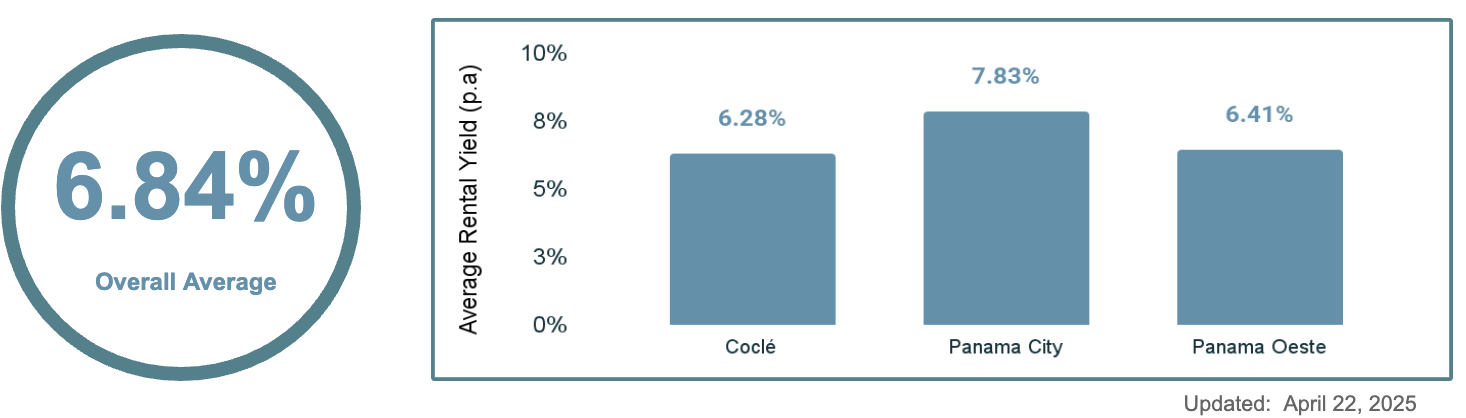
As of April 2025, rental rates for 1-bedroom properties in Panama’s major cities are approximately as follows:
- Panama City: 7.84%
- Oeste: 6.41%
- Cocle: 6.28%
Panama's rent price index:
Data Source: Instituto Nacional de Estadística y Censo.
6) Market Performance (Past and Present)
From 2000 to 2019, Panama proved to be one of the fastest-growing economies in Central America, thanks largely to the Panama Canal, as well as air and financial services. Starting in 2007, the US invested $5.25 billion into expanding and improving the Canal’s capacity. The 2020 pandemic’s international effect hit the Canal hard, and Panama experienced a 17.7% GDP loss. This was the first decline since 1988 and Panama’s worst economic performance in recent history.
The economy has since bounced back, but has slowed some since 2022.
Panama's house price annual change:
Data Source: Encuentra24.
7) Landlord and Tenant Laws
Panama’s laws are judged by the Global Property Guide as neutral between landlord and tenants. On the tenant side, Panama’s rental laws allow for eviction delays and offer strong procedural protections for tenants. However, landlords have substantial contractual autonomy, with the exception of older, rent-controlled housing.
8) Property Related Taxes
Non-residents are taxed based on property value and income earned in Panama. Rental income tax is progressive, increasing based on the property’s registered value.
Panama’s property taxes are different for primary residences versus secondary and investment properties. Primary residences are exempt from paying property taxes on the first $120,000 of the home’s registered value, and properties under $120,000 are exempt from property taxes altogether.
Most secondary residences, commercial, and industrial properties are taxed using a progressive scale based on the value of the property, as declared in the Panama Public Registry:
- $0 and $30,000: No Taxes
- $30,001 and $ 250,000: 0.6%.
- Between $250,001 and $ 500,000: 0.8%
- More than $ 500,000: 1.0%.
Corporations are taxed at 15.76% for rental income.
Individual non-residents are also taxed on any income earned in Panama. Like with property taxes, rental income is charged at a progressive rate. Property owners can deduct municipal and national taxes, property maintenance and repairs, property depreciation, and some administrative costs from their gross income.
Capital gains earned by companies through normal business operations are taxed at the standard progressive income tax rates. However, any capital gains resulting from transactions outside the company’s ordinary business activities are taxed at a special 10% flat rate. Additionally, companies must pay a 5% withholding tax at the time of the transaction, which will later be credited toward the taxpayer’s capital gains tax liability.
Leased permanent property is subject to a 7% value-added tax on the gross rent for properties that earn more than $3,000 per month or $36,000 annually.
9) Buying (and Selling) Costs
Compared to other Latin American communities, Panama’s property transaction costs are relatively low. In addition to the purchase price, buyers should expect to pay an additional 2.10%, while sellers pay an additional 5% to 7%.
Here's a full breakdown:
| Transaction Costs | ||
| Who Pays? | ||
| Property Transfer Tax | 2.00% | buyer |
| Legal Fees | 2.00% | buyer |
| Notary Fees | 0.10% | buyer |
| Real Estate Agent Fee | 3.00% - 5.00% | seller |
| Costs Paid by Buyer | 2.10% | |
| Costs Paid by Seller | 5.00% - 7.00% | |
| ROUNDTRIP TRANSACTION COSTS | 7.10% - 9.10% | |
| Source: Global Property Guide, PWC | ||
10) Short-Term Rental Regulations
Short-term rentals (fewer than 45 days) are not allowed in Panama City. The exceptions are hotels (or properties associated with hotels) and properties in mixed-use zones with required commercial licensing. Fines for violating this law range from $5,000 to $50,000, plus the potential of being shut down.
Other parts of Panama are more short-term rental-friendly. A reputable real estate professional and/or attorney can help buyers know about specific local regulations.
11) Mortgage and Financing Options
Many Panamanian banks and financial institutions offer mortgage loans to international buyers, but there are some key differences between their loans and U.S. mortgages. For one, Panama’s loan terms are shorter than in the U.S. – usually 20 years maximum – and down payments are higher.
Credit history plays less of a role in Panama than in the US, although good credit may be helpful. Lenders focus more on the ability to repay the loan, looking more at employment status and income. Applications generally require including a copy of a resume / CV, bank recommendation letters, and other paperwork.
12) How to Buy Property in Panama: Step-by-Step
- Research and Find Property: Panama’s diverse regions offer buyers a range of investment opportunities. To learn more about available properties, visit popular websites like Realtor.com International and Encuentra24.com, or contact a reputable licensed real estate agent who understands the area and the market.
- Research Pricing, Yields, and Legal Restrictions: Panama has some of the most straightforward property laws around, giving foreign buyers the same rights as locals. This makes the buying process much easier than in some other countries. Many of the sought-after communities offer good returns. That said, Panama City itself does not allow short-term rentals without exception. You’ll find more flexibility in nearby communities outside the city. Connect with a local real estate expert to make sure no local regulations are missed.
- Research Long-Term Market Changes: Panama is the top destination for expats, especially retirees and digital nomads, opening new doors for real estate investors looking to purchase rental property. The COVID-19 pandemic had a negative impact on Panama’s economy, but the country has bounced back since. New infrastructure, tax incentives, tourism, and growing expat relocations are all keeping the economy strong.
- Research Local Taxation and Landlord Laws: Non-residents must pay taxes on both their property and any income made in Panama. Property taxes and rental income are taxed on a progressive scale for individuals. Corporations pay a flat 15.76% on rental income. Expect to pay an additional 7% tax on long-term rentals earning more than $3,000 per month. Landlord laws tend to be neutral. They do support tenants by allowing eviction delays and other protections. However, rental contracts are generally left up to the landlord, except for rent-controlled buildings.
- Get Legal Advice: A reputable bilingual local attorney will check the property title for any outstanding liens, debts, or legal concerns. They can also guide you through each step of the purchase. They will verify that the property is properly titled and review or draft your purchase contract. For condos or HOAs, they will also check association rules and any unpaid fees.
- Make an Offer and Conduct Due Diligence: Offers usually include conditions (like financing or inspection). If accepted, sign a preliminary contract. Note that offers are usually higher than the selling price due to the high demand. A three-day cooling-off period applies, so you can cancel within that time period - no reason needed. Hire a building inspector to check for defects.
- Sign the Sale Contract: Closing takes place at the public notary’s office, and both the buyer and seller (or their legal representatives) must be present. At this time, they will sign the final deed of sale (Escritura Pública) and pay any remaining balance, taxes, and fees.
- Payment and Registration: Ownership is officially transferred when the new deed is filed by the buyer’s attorney or notary at the Public Registry.
Timeline: Expect 1-3 months from offer to official registration.
Need Help?
Buying property in a foreign country can feel overwhelming, but we're here to help.
At Global Property Guide, we offer:
- Data-backed insights on property prices, rental yields, and taxes
- Country-specific legal and tax guidance through our partner network
- Pre-screened investment properties, including income-generating Airbnb units
- 1-on-1 consultations with real estate experts focused on international buyers
- Step-by-step buyer support, from due diligence to closing
Whether you're looking for your first investment in Panama or expanding your international portfolio, we can help you make smart, secure decisions.
Contact our team or book a free consultation to get started.