Singapore's state-of-the-art industries, political stability, centralized location, and advanced business-friendly economy attract real estate investors from across the globe. Over the past decade, the Singaporean government has attempted to cool the real estate market by implementing increased fees and stricter rules, leading to higher prices and lower returns for foreign investors. Nonetheless, Singapore remains highly attractive to many investors due to the country’s economic resilience, strong housing demand, and reputation as one of the safest property markets in the world.
This recently updated 2025 edition guide will walk you through the basic steps and important considerations for first-time buyers looking to invest in Singapore.
12 Things to Know Before Buying a Property in Singapore
- Can Foreigners Buy Property in Singapore
- Best Cities and Regions to Invest
- Square Meter / Square Foot Prices
- Median Asking Prices
- Rental Yields and Rents
- Market Performance (Past and Present)
- Landlord and Tenant Laws
- Property Related Taxes
- Buying (and Selling) Costs
- Short-Term Rental Regulations
- Mortgage and Financing Options
- How to buy property in Singapore: step-by-step
1) Can Foreigners Buy Property in Singapore?
Yes, but with several restrictions based on the property type. Foreigners can freely purchase private condos and commercial properties, which makes them the easiest and most popular options for investors. HBD flats, which are a type of publicly-owned Singaporean apartment, are off limits to foreign investors. Landed residential properties (i.e., property that sits on land and includes the land title) require special government approval, which is usually only granted in Sentosa Cove, not the mainland.
2) Best Regions and Cities to Invest
Singapore offers a highly structured, transparent, and globally connected real estate market, combining a strong financial hub, prime luxury districts, well-planned residential towns, and strategic innovation zones.
Central Core (CBD and Marina Bay)
As Singapore’s financial and business heart, the Central Core remains one of the most prestigious and resilient investment zones. Marina Bay, Raffles Place, and Tanjong Pagar are defined by Grade-A office towers, luxury condominiums, and world-class infrastructure. Demand here is driven by multinational corporations, high-income professionals, and international executives, supporting premium rents and strong capital stability. Limited land availability and ongoing urban transformation projects continue to reinforce long-term value.
Orchard Road and River Valley
Orchard Road and the surrounding River Valley area represent Singapore’s prime residential belt. Known for luxury shopping, high-end dining, and proximity to the city center, these districts attract affluent locals and expatriates seeking upscale urban living. Freehold and high-quality leasehold condominiums in this area tend to hold value exceptionally well, with consistent rental demand supported by proximity to international schools, embassies, and lifestyle amenities.
East Coast (Marine Parade, Katong, and East Coast Road)
The East Coast is prized for its blend of seaside living, strong local culture, and convenient access to the city and Changi Airport. Katong and Marine Parade, in particular, are popular with families and long-term expatriates due to established neighborhoods, reputable schools, and lifestyle appeal. Properties here benefit from stable owner-occupier demand and steady rental interest, while ongoing transport improvements further enhance accessibility and long-term growth prospects.
Novena and Newton
Novena and Newton occupy a strategic position between the city center and suburban districts, making them highly attractive for both investors and tenants. Novena’s role as a medical and healthcare hub, combined with excellent MRT connectivity, supports strong rental demand from professionals and expatriates. Newton, known for its exclusivity and low-density developments, offers a more private residential environment with enduring appeal and solid capital preservation.
Bukit Timah and Holland Village
Bukit Timah is one of Singapore’s most established and prestigious residential districts, renowned for landed homes, low-rise condominiums, and proximity to top local and international schools. Holland Village complements this appeal with a vibrant lifestyle scene popular among expatriates. Limited development density and strong family-oriented demand make this area particularly attractive for long-term investors focused on stability rather than short-term yield.
Jurong Lake District
Positioned as Singapore’s second central business district, the Jurong Lake District represents one of the city’s most compelling long-term growth stories. Significant government investment, new commercial developments, and enhanced transport links are transforming the area into a major employment and lifestyle hub. Residential properties nearby are increasingly attractive to investors seeking future appreciation driven by decentralization and sustained urban development.
3) Square Meter / Square Foot Prices
Singapore’s square meter prices are the second highest in Asia, following only prices in Hong Kong.
As of October 2025, average square meter prices were as follows:
4) Median Asking Prices
Singapore’s median asking prices are the second highest in Asia, next to Hong Kong. The overall average price for a one-bedroom apartment is $886,000, but this varies by city.
As of November 2025, median asking prices for one-bedrooms across Singapore were as follows:
- Orchard / River Valley – $1,063,000
- Tanglin / Holland / Bukit Timah – $1,055,000
- East Coast / Marine Parade – $986,000
- Newton / Novena – $986,000
- Alexandra / Commonwealth – $924,600
- Hougang / Punggol / Sengkang – $684,900
5) Rental Yields and Rents
Rental yields across Singapore are considered poor, with an overall average of just 3.13%. In fact, one-bedroom apartments in Hougang / Punggol / Sengkang were the only properties yielding over 4% in the fourth quarter of 2025.
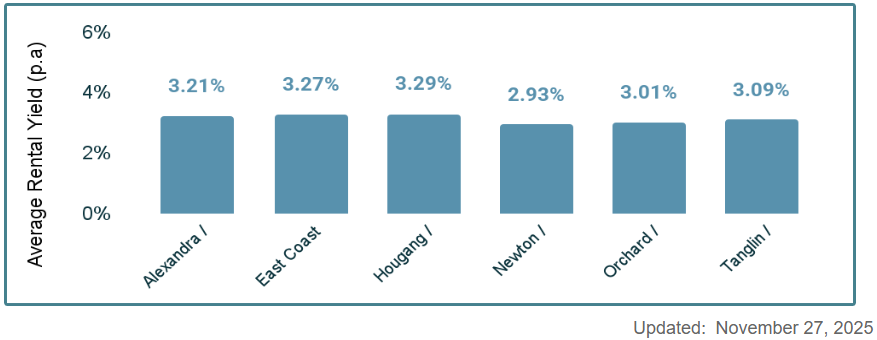
As of November 2025, rental yields averaged as follows:
- Hougang / Punggol / Sengkang – 3.29%
- East Coast / Marine Parade – 3.27%
- Alexandra / Commonwealth – 3.21%
- Tanglin / Holland / Bukit Timah – 3.09%
- Orchard / River Valley – 3.01%
- Newton / Novena – 2.93%
Singapore's rent price index:
Data Source: Statistics Singapore.
6) Market Performance (Past and Present)
From 2006 to 2008, private home prices in Singapore surged, thanks to the strong economy, easy global capital flow, and increasing international appeal. As more foreign investors grew interested in Singaporean real estate, the market experienced rapid price growth, especially in the high-end residential segment, where rising prices outpaced household incomes.
The global financial crisis of 2008–2009 temporarily stifled this momentum, but as the economy rebounded during the early 2010s, housing demand surged, and prices started to rise again. Policymakers began implementing cooling measures targeted at foreign investors, including introducing Additional Buyer’s Stamp Duty (ABSD) and tightening loan-to-value limits. These measures, which are still in place, increased transaction costs for investors and multiple-property buyers, slowed price growth, and reinforced Singapore’s longstanding culture of favoring housing stability over aggressive market growth.
Singapore's house price annual change:
Data Source: Urban Redevelopment Authority.
7) Landlord and Tenant Laws
Singapore's landlord and tenant laws are judged by the Global Property Guide to be more pro-landlord than pro-tenant, although tenants do have some protections, especially in public housing.
Lease agreements are different from tenant licenses. Leases provide tenants with a legal interest in the property and more protections, while licenses are rental agreements allowing the tenant to use the property for a specified amount of time – generally a minimum of six months.
Property owners who either rent out their property or have unoccupied property must pay annual property taxes, ranging from 12% to 36% for residential property that is not occupied by the owner. The amount is based on the property’s annual rental value (AV)
Non-resident individual foreign investors must also pay annual income tax, which is currently at 24% per year.
9) Buying (and Selling) Costs
All property buyers in Singapore must pay a Buyer’s Stamp Duty (BSD), which ranges from 1% to 6% depending on the property value. However, foreign buyers must also pay an Additional Buyer’s Stamp Duty (ABSD), which is 60% of the market value or purchase price. A $1 million property, for example, would require an ABSD of $600,000. The ABSD depends heavily on the buyer profile; paying 60% in taxes is rare in most cases.
Here's a full breakdown:
|
Transaction Costs
|
| |
|
Who Pays? |
| Buyer Stamp Duty (BSD) |
1.00% - 6.00% |
buyer |
| Additional Buyer Stamp Duty (ABSD) |
5.00% - 60.00% |
buyer |
| Seller Stamp Duty |
0.00% - 16.00% |
seller |
| Registration Fee |
SGD70 (US$52) |
buyer |
| Legal Fee |
0.30%
0.15% |
buyer
seller |
| Real Estate Agent Fee |
1.00%
2.00% |
buyer
seller |
| Costs paid by the buyer |
7.30% - 67.30% |
| Costs paid by the seller |
2.15% - 18.15% |
| ROUNDTRIP TRANSACTION COSTS |
9.45% - 86.45% |
10) Short-Term Rental Regulations
Singapore does not allow short-term residential rentals of less than three months. Property owners who break this rule may face hefty fines of up to $200,000 for first-time offenses and may even face jail time.
11) Mortgage and Financing Options
Foreign investors can get mortgages in Singapore for qualifying properties, but they will likely have to pay higher interest rates and a larger down payment – often 25% to 40%. This is part of Singapore’s loan-to-value ratio set by the government to help slow down foreign property investments.
In Singapore, the maximum loan lengths on property are capped at up to 35 years or until the buyer turns 75, whichever comes first.
12) How to Buy Property in Singapore: Step-by-Step
-
Research legal restrictions: Singapore has strict regulations on which properties foreign investors can purchase. Private condominiums are the only type of residential property that foreigners can buy without government approval. Landed properties require government approval from the Singapore Land Authority (SLA). Obtaining such approval is rare and usually requires significant financial contributions to the country.
Another important consideration is that short-term rentals of fewer than 30 days are outlawed in Singapore. Those caught violating this law can face substantial fines of up to $200,000 for their first offense, as well as possible jail time.
- Research tax policies: Before even looking for property in Singapore, it’s important to understand the country’s tax system. Most significantly, foreign buyers must pay a 60% Additional Buyer’s Stamp Duty (ABSD), which adds considerably to the property's purchase price. Investors must also pay annual income and real estate taxes.
- Research pricing and rental yields: Property prices vary across Singapore, with the highest rates located in the Orchard and River Valley district, almost doubling those in Singapore’s least expensive area of Hougang, Punggol, Sengkan. Rental yields across Singapore are considered poor, averaging just above 3%.
- Apply for mortgage pre-approval: In Singapore, most foreign buyers apply for an in-principle approval (IPA) before making an offer on a property. While preapproval is not final, it does help buyers know if they qualify for a mortgage and how much the bank is willing to lend. The preapproval process usually takes 2-3 weeks for foreign investors.
- Search for property: Buyers can start to understand the market by searching for property online. Popular real estate websites in Singapore include propertyguru.com.sg, 99.co, and srx.com.sg. Serious buyers are highly advised to work with a licensed real estate agent who is registered with the Council for Estate Agencies (CEA) and who understands the Singaporean market, districts, and regulations.
- Make an offer: Once a legally qualifying property of interest is found, it is time to make an offer. If accepted, the seller will provide an Option to Purchase (OTP). The buyer usually puts down 1% to hold the property. The buyer will then pay an additional deposit, usually 4%, while due diligence is performed by a real estate attorney.
- Hire an attorney: In Singapore, a conveyancing attorney oversees due diligence, pays stamp duties and other fees, and registers the property with the Singapore Land Authority within the allotted time period. An attorney will also draft and review the purchase agreement, file and pay stamp duties, and file the property transfer with the Singapore Land Authority (SLA). The attorney can sign paperwork as the buyer’s legal representative if a Power of Attorney is given.
- Complete and file paperwork: The sale is completed once the paperwork has been signed and filed with the SLA, and all transactional fees, including stamp duty payments, are completed.
Timeline: 2-3 months from offer to completion.
Need Help?
Buying property in a foreign country can feel overwhelming, but we're here to help.
At Global Property Guide, we offer:
- Data-backed insights on property prices, rental yields, and taxes
- Country-specific legal and tax guidance through our partner network
- Pre-screened investment properties, including income-generating Airbnb units
- 1-on-1 consultations with real estate experts focused on international buyers
- Step-by-step buyer support, from due diligence to closing
Whether you're looking for your first investment in Singapore or expanding your international portfolio, we can help you make smart, secure decisions.
Contact our team or book a free consultation to get started.