Spain's Residential Property Market Analysis 2026
Strong demand, driven by population growth, migration inflows, and low interest rates, coupled with supply constraints, has pushed sales price growth in the Spanish housing market into double digits, while increases in asking rents moderated somewhat.
This extended overview from Global Property Guide covers key aspects of the Spanish housing market and takes a closer look at its most recent developments and long-term trends.
Table of Contents
- Property Prices and Price Index
- Historic Perspective
- Property Demand Trends
- Property Supply Trends
- Rental Market: Rents and Rental Yields
- Mortgage Market and Interest Rates
- Economic and Social Factors
Property Prices and Price Index
Spain’s house-price upswing strengthened further at the end of 2025, with the widening imbalance between demand and available stock continuing to push values higher. According to the National Statistics Institute (INE), the transaction-based House Price Index rose by 12.89% year-on-year in Q4 2025, with second-hand housing prices increasing by 13.15% and new-housing prices by 11.22%.
In the appraisal-based series, the appraised value of free-market housing reported by the Ministry of Housing and Urban Agenda (MIVAU) reached EUR 2,230 per square meter (USD 2,594), up 13.08% year-on-year and marking the highest level in the history of the series.
Spain's house price annual change:
Although price acceleration was broad-based, the territorial pattern remained highly uneven. CaixaBank Research distinguishes two broad groups of provinces. On the one hand, the most tourism-exposed markets and the main economic hubs, including the Balearic Islands, Malaga, Santa Cruz de Tenerife, Valencia, Alicante, and Madrid, recorded double-digit price growth in both 2024 and 2025. On the other hand, a second group of inland provinces, including Ciudad Real, Palencia, Ourense, Jaén, and Zamora, recorded much more moderate price growth.
The appraised value of free-market housing in selected provinces:
| Appraised Value, Q4 2025 EUR/sqm |
Appraised Value, Q4 2025 USD/sqm |
YoY, % | |
| Madrid | EUR 3,902 | USD 4,540 | 15.78% |
| Barcelona | EUR 3,083 | USD 3,587 | 11.42% |
| Valencia | EUR 1,832 | USD 2,131 | 16.82% |
| Seville | EUR 1,780 | USD 2,071 | 11.81% |
| Alicante | EUR 1,903 | USD 2,214 | 14.83% |
| Malaga | EUR 2,897 | USD 3,371 | 14.87% |
| Balearic Islands | EUR 3,810 | USD 4,432 | 14.87% |
| Las Palmas | EUR 2,151 | USD 2,503 | 12.70% |
| Note: Exchange rate as of Q4 2025, USD 1 = EUR 0.8595. | |||
| Data Source: MIVAU. | |||
Looking ahead, house prices are expected to continue rising in 2026 and 2027, albeit at a slower pace than in 2025. CaixaBank Research forecasts the INE transaction-price index to rise by 10.1% in 2026 and 5.5% in 2027, while MIVAU’s appraised-value series is expected to increase by 10.0% and 5.0%, respectively. BBVA Research is similarly constructive, projecting the INE transaction-price index to rise by 10.2% in 2026 and 6.8% in 2027, arguing that household formation will continue to outpace housing production.
Historic Perspective:
From Overbuilding to Structural Undersupply
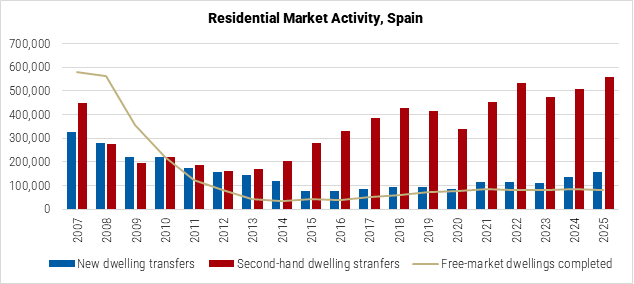
Spain’s residential market has passed through three broad phases over the past two decades. The pre-2008 cycle was characterized by exceptionally strong development activity and very high transaction volumes. The global financial crisis then triggered a deep correction: house prices fell sharply, sales declined, and residential construction collapsed as financing conditions tightened and the market gradually worked through the large stock accumulated during the boom years.
From 2014 onwards, the market entered a gradual recovery. Prices stabilized and returned to growth, while transaction activity improved steadily, increasingly driven by the second-hand segment. A more supportive macroeconomic environment, including stronger employment, favorable financing conditions, and renewed demographic growth, helped underpin demand, while new construction recovered only slowly from its post-crisis lows.
The pandemic caused only a temporary interruption to this trend. Demand rebounded relatively quickly and strengthened further in the following years, supported by population growth, lower interest rates, and improving purchasing power, but the supply response remained much more limited. Over time, the market shifted from the pre-crisis problem of overbuilding to a new imbalance shaped by persistent underproduction, with new housing delivery failing to keep pace with household formation, particularly in the main urban, coastal, and tourism-driven markets. As a result, the recent cycle has been marked by a growing reliance on the resale segment, constrained additions to stock, and renewed house-price acceleration.
20-year annual house price change (based on end-of-year transaction-based HPI and Consumer Price Index):
| Year | Nominal house prices (%) |
Inflation-adjusted house prices (%) |
Year | Nominal house prices (%) |
Inflation-adjusted house prices (%) |
|
| 2006 | n/a | n/a | 2016 | 4.48% | 3.48% | |
| 2007 | n/a | n/a | 2017 | 7.19% | 5.66% | |
| 2008 | -5.40% | -7.66% | 2018 | 6.61% | 4.82% | |
| 2009 | -4.35% | -4.49% | 2019 | 3.61% | 3.15% | |
| 2010 | -1.90% | -4.34% | 2020 | 1.48% | 2.22% | |
| 2011 | -11.17% | -13.55% | 2021 | 6.38% | 0.54% | |
| 2012 | -12.79% | -15.40% | 2022 | 5.45% | -1.07% | |
| 2013 | -7.80% | -7.92% | 2023 | 4.22% | 0.93% | |
| 2014 | 1.76% | 2.28% | 2024 | 11.26% | 8.70% | |
| 2015 | 4.23% | 4.57% | 2025 | 12.89% | 9.58% | |
| Data Sources: INE, OECD, Global Property Guide. | ||||||
Residential market activity (number of new and existing dwelling transfers, and the number of free-market dwellings completed):
Data Sources: INE, MIVAU.
Property Demand Trends
Strong Underlying Demand Persists, Increasingly Constrained by Limited Housing Availability
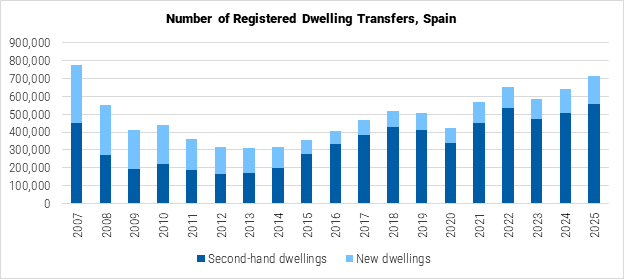
Residential demand in Spain continued to strengthen in 2025. Based on INE’s provisional year-end data, 714,237 dwelling transfers were registered nationwide, representing an 11.53% year-on-year increase. Second-hand dwellings continued to account for the majority of transactions (78%), rising by 10.33% annually to 558,327 transfers. The remaining 155,910 transfers were attributed to new dwellings, which recorded a faster annual increase of 16.06%.
CaixaBank Research describes Spain’s housing market as entering a “new expansionary phase”, with demand having reactivated strongly since mid-2024 and remaining at levels not seen since 2007. The underlying demand drivers remain primarily structural. Stronger demographics and household formation are listed as the key support factors, alongside improved household purchasing power, tight rental-market conditions, and a mounting housing deficit. BBVA Research points in the same direction, noting that demand fundamentals remain firm, supported by employment growth, rising incomes, and migration inflows, but that market activity is increasingly constrained by limited supply and rising prices.
Data Source: INE.
Regionally, demand growth was broad-based, with all autonomous communities posting positive annual trends. At the provincial level, the picture remained similarly widespread, though uneven. Madrid continued to lead in absolute transaction volume, while stronger year-on-year growth was seen in several other major markets, most notably Barcelona and Seville. Coastal and island provinces also remained highly active, although growth there was generally more moderate, reflecting the high base already established in tourism-driven destinations.
Number of registered dwelling transfers in selected provinces:
| Number of Registered Dwelling Transfers, 2025 |
YoY | |
| Madrid | 81,681 | 4.80% |
| Barcelona | 73,412 | 14.42% |
| Valencia | 41,553 | 6.82% |
| Seville | 26,562 | 17.84% |
| Alicante | 54,767 | 4.59% |
| Malaga | 36,806 | 4.27% |
| Balearic Islands | 14,525 | 5.07% |
| Las Palmas | 13,417 | 0.15% |
| Data Source: INE. | ||
Foreign demand remained a key pillar of market depth, particularly in coastal and island locations. According to Spain’s Association of Registrars (Colegio de Registradores de España), foreign buyers accounted for 13.82% of registered home purchases on the interannual (rolling 12-month) measure to Q4 2025, down from 14.60% a year earlier but still high by historical standards. In absolute terms, however, foreign demand remained strong: while the Association’s 2024 annual report recorded around 93,000 foreign home purchases, the 2025 year-end data suggest a further increase to roughly 97,000–98,000 transactions, despite the modest decline in market share. This indicates that the share eased mainly because domestic demand expanded more quickly, rather than because foreign demand weakened materially.
In Q4 2025, foreign buyers represented 13.52% of registered home purchases, with just over 24,200 transactions. British buyers remained the largest group, followed by Germans, Dutch, Moroccans, French, Romanians, and Italians. By autonomous community, the highest foreign-buyer shares were recorded in the Balearic Islands, the Valencian Community, the Canary Islands, the Region of Murcia, Catalonia, and Andalusia. At the provincial level, Alicante remained the clear leader, with foreigners accounting for nearly half of all transactions, followed by the Balearic Islands, Malaga, Santa Cruz de Tenerife, Girona, Murcia, Almería, and Las Palmas.
Looking ahead, the demand outlook remains positive, but with a clearer ceiling on further acceleration. CaixaBank expects sales to remain dynamic in the coming quarters, while BBVA Research frames the market as entering a more constrained, “mature” phase in which demand fundamentals stay constructive but transaction growth is increasingly limited by supply shortages and affordability pressures. BBVA’s published outlook points to housing sales remaining around the current high plateau (roughly 725,000 in 2026), which is consistent with the combination of resilient buyer demand and tighter market constraints.
Property Supply Trends
Completions Fall as Pipeline Activity Strengthens
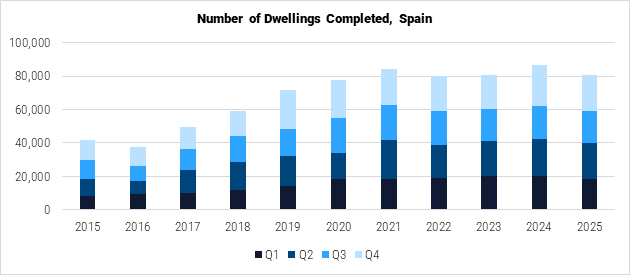
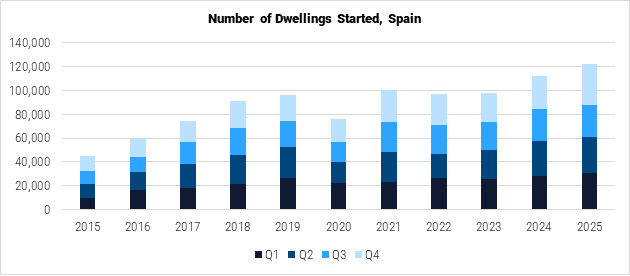
The shortage of new housing supply remains the key distortion in Spain’s residential market. According to MIVAU’s free-market housing series, 80,792 free-market dwellings were completed in 2025, down 6.7% year-on-year, despite the stronger pace of project initiation seen earlier in the cycle. The Bank of Spain noted that, in 2025, “housing completions stood below housing starts two years earlier,” which suggests that “the frictions in the sector limiting growth in the supply of new dwellings persist.” CaixaBank Research likewise argues that the delay in completed housing points to “increasingly significant bottlenecks,” citing labor shortages, supply delays, bottlenecks in electricity infrastructure, and regulatory burden among the main obstacles slowing delivery.
Data Source: MIVAU.
At the same time, the pipeline has strengthened with free-market housing starts rising to 121,827 units in 2025, up 8.6% year-on-year. Even so, the improvement is still not enough to close the structural gap. CaixaBank Research estimates that Spain’s accumulated housing deficit has already risen to more than 730,000 homes, and stresses that this shortage is heavily concentrated geographically, with almost half located in just five provinces: Madrid, Barcelona, Valencia, Alicante, and Murcia. In other words, the problem is not only that Spain is building too little overall, but also that new supply is not expanding fast enough in the markets where household creation and price pressure are strongest.
Data Source: MIVAU.
Looking ahead, the most likely scenario is one of gradual pipeline improvement but continued near-term delivery constraints. CaixaBank Research says it will be difficult to see completed housing rise above 100,000 units in 2026, and argues that faster supply growth will depend on streamlining licenses and planning processes and unlocking public land. Its broader assessment is that the current bottlenecks will only be absorbed gradually, so new housing supply will probably remain insufficient relative to household formation in 2026–2027. The Bank of Spain is similarly cautious, expecting housing starts to stabilize at around 140,000 units per year, which points to resilience in the pipeline but not to a decisive break with current supply constraints.
For a slightly longer-term angle, BBVA Research is somewhat more constructive on permit growth, projecting new building permits to rise by an average of 12.5% in 2026–2027 to around 160,000 annual units. However, even under that scenario, it still expects the accumulated housing deficit to hover around 800,000 homes by 2027.
Rental Market: Rents and Rental Yields
Rents for New Contracts Continue to Grow Strongly, Government Plans Further Intervention
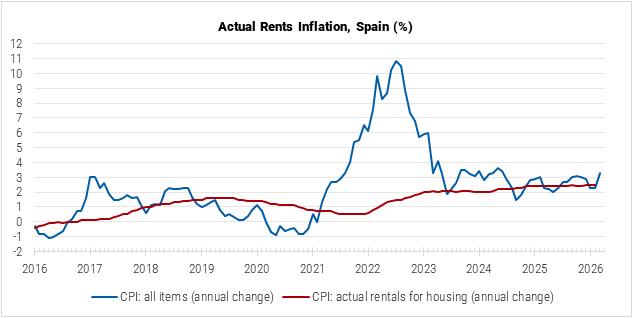
In the rental segment of the Spanish housing market, rental inflation for existing contracts (as measured by the annual change in actual rentals for the housing component of the consumer price index) remained moderate through 2025 and early 2026, tracking close to the overall inflation levels and most recently reported by INE at 2.5% in February.
Spain's rent price index:
Under current legislation, increases to all rental contracts in Spain signed after May 2023 are tied to the Reference Index for Housing Rentals ( IRAV), developed by INE based on CPI and medium-term inflation expectations. As of February 2026, the annual variation in IRAV stood at 2.16%.
At the same time, pressure on the price of new rentals remains much more pronounced. “After periods of negative growth at the end of 2019 and the beginning of the pandemic, rental prices for newly contracted properties have rebounded strongly,” CaixaBank Research observed in their analysis of high-frequency data on direct debit payments for housing rentals. “Since 2024, the increase has been significantly higher than inflation, and in the last months of 2025, both the average and median year-on-year growth rates exceeded 10%.”
A similar dynamic is revealed by the data from the property platform Idealista, which showed a 7.1% year-on-year increase in asking rents across Spain in March 2026, a strong, though moderating, growth compared to a 10.3% and 12.6% annual increase previously reported in March 2025 and March 2024, respectively.
Moderate Rental Yields
In parallel, research conducted by Global Property Guide showed gross rental yields for apartments in Spain at the average level of 5.45% in March 2026, down from 5.60% previously reported in March 2025 and 6.17% in February 2024. The highest potential performance among the surveyed submarkets was estimated for rental properties in Barcelona (7.40%) and Murcia (6.14%), while the lowest yields were reported in Palma de Mallorca (4.41%).
Data Source: INE.
In nominal terms, according to Idealista, the median asking rent in March 2026 reached EUR 15.0 (USD 17.3) per square meter nationwide. Regionally, Madrid (EUR 21.3 / USD 24.6), Balearic Islands (EUR 19.7 / USD 22.8), and Barcelona (EUR 19.2 / USD 22.2) provinces demonstrated rent levels substantially above the national median, while Seville (EUR 11.9 / USD 13.8) and Alicante (EUR 12.3 / USD 14.2) remained relatively more affordable.
Notably, Barcelona province stood out among key submarkets, as the only one where asking rents registered a decline in year-on-year terms, according to Idealista. Market commentary generally attributes this dynamic to the impact of a new housing law passed in 2023, which gave regional governments power to designate so-called “stressed areas” and apply special measures to curb surging rents. However, despite a decline in asking rents, affordable apartments in Barcelona are reportedly increasingly difficult to find, as the supply of rental housing across Catalonia remains at historic lows.
“While both domestic and international demand continue to grow steadily, rent control measures introduced by the authorities have not delivered the intended effect of curbing price increases. Instead, they have led many landlords to withdraw properties from the long-term rental market or shift them to seasonal lets, which are not subject to price caps in areas classified as stressed markets, commented Xavier Aránega, partner at real estate firm Revel, as quoted by Idealista.
Median asking rents in selected submarkets:
| Province | Median Monthly Rent, EUR/sqm March 2026 |
Median Monthly Rent, USD/sqm March 2026 |
YoY, % March 2026 vs March 2025 |
| Madrid | EUR 21.3 | USD 24.6 | 10.3% |
| Barcelona | EUR 19.2 | USD 22.2 | -4.1% |
| Valencia | EUR 14.0 | USD 16.2 | 8.7% |
| Seville | EUR 11.9 | USD 13.8 | 8.0% |
| Alicante | EUR 12.3 | USD 14.2 | 10.9% |
| Malaga | EUR 16.8 | USD 19.4 | 8.3% |
| Balearic Islands | EUR 19.7 | USD 22.8 | 6.3% |
| Las Palmas | EUR 15.8 | USD 18.3 | 9.0% |
| Spain | EUR 15.0 | USD 17.3 | 7.1% |
| Note: Exchange rate as of March 2026, EUR 1 = USD. | |||
| Data Source: Idealista. | |||
According to Eurostat reporting, the overall size of the rental market in Spain has increased over the past decade, with the share of tenant households growing from 21.8% in 2015 to 26.4% in 2025. However, current affordability constraints are likely to affect this dynamic in the coming years.
Looking ahead, despite a somewhat slowing trajectory, rents in the largest Spanish cities and surrounding metro areas can be expected to continue growing due to the persistent undersupply of the market. In 2025, Idealista reported a 56% decline in the supply of rental housing in Spain since the pandemic, led by cities like Barcelona, a consequence of the boom in tourist rentals and legal uncertainty exacerbated by new regulations.
In their most recent real estate report, Bankinter highlighted that “renting is no longer a viable option for domestic demand”, as affordability ratios now exceed 50% of income, compared to around 35% required to buy. A similar sentiment was expressed by Caixabank Research, whose 2026 outlook said that “limited availability of housing in the rental market will continue to shift demand to the sales market”.
In this environment, the Spanish government reportedly plans to “continue intervening in the rental market", as Prime Minister Pedro Sanchez recently said at an event marking the start of works at a large public housing project. According to Reuters’ reporting, a new decree is expected to rebate personal income tax for landlords renewing leases without rent hikes and cap room rents, as well as tighten conditions for seasonal rental contracts and introduce sanctions for their use as a substitute for long-term leases.
Mortgage Market and Interest Rates
Interest Rates Stabilize at Low Levels, Boost Lending Activity
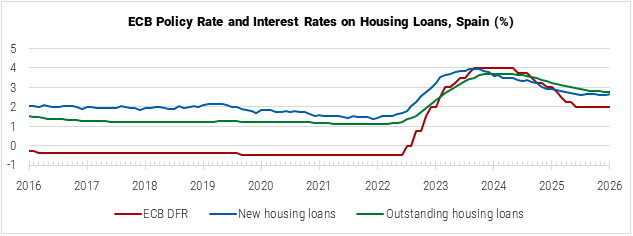
After a series of cuts through 2024 and early 2025, the European Central Bank (ECB) has kept its key rates unchanged since last June, making no further moves at the latest meeting of the monetary policy committee in March 2026. In a corresponding press statement, the regulator noted that longer-term inflation expectations for the euro area are well anchored, and the region’s economy has shown resilience over recent quarters, although the conflict in the Middle East has “made the outlook significantly more uncertain, creating upside risks for inflation and downside risks for economic growth”.
Spain's mortgage loan interest rates:
While heightened uncertainty has led some experts to consider the possibility of a key rate hike later this year, most economists polled by Reuters in March still expect the ECB to maintain interest rates unchanged through 2026.
In this environment, as the transmission of prior policy easing had already run its course, mortgage interest rates in Spain have stabilized over recent months and are expected to remain at current levels in the upcoming periods. The average interest rate on loans to households for house purchase was most recently reported by the ECB at 2.75% for new housing loans and 2.77% for outstanding housing loans in February 2026.
“Although the rate-cutting cycle is expected to end, interest rates will remain relatively low, which could continue to boost new lending,” BBVA Research commented in their outlook for the Spanish real estate market in 2026.
Data Source: ECB.
Average interest rates on loans to households for house purchase:
| Feb 2026 | YoY | Feb 2025 | YoY | Feb 2024 | |
| New housing loans | 2.75% | ↓ | 2.87% | ↓ | 3.62% |
| - Floating rate and IRF up to 1 year | 2.89% | ↓ | 3.27% | ↓ | 4.01% |
| - IRF of over 1 and up to 5 years | 3.28% | ↓ | 3.38% | ↓ | 4.07% |
| - IRF of over 5 and up to 10 years | 3.83% | ↑ | 3.78% | ↓ | 3.97% |
| - IRF of over 10 years | 2.56% | ↓ | 2.62% | ↓ | 3.12% |
| Outstanding housing loans | 2.77% | ↓ | 3.18% | ↓ | 3.71% |
| - Original maturity up to 1 year | 2.99% | ↓ | 3.57% | ↓ | 4.05% |
| - Original maturity over 1 and up to 5 years | 5.79% | ↓ | 6.15% | ↓ | 6.19% |
| - Original maturity of over 5 years | 2.76% | ↓ | 3.18% | ↓ | 3.70% |
| Data Source: ECB. | |||||
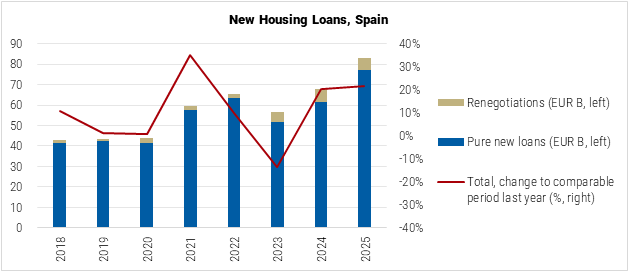
Stabilizing and relatively low interest rates (among the lowest in the EU) supported a surge in lending activity in Spain in 2025, with the total value of new housing loans (including pure new loans and renegotiations) issued between January and December reaching EUR 82.7 billion (USD 93.5 billion), a 21.8% increase compared to 2024.
Responding to this sharp increase in new mortgage originations, the Bank of Spain previously said it is “monitoring lending standards closely” and is “strengthening its analytical framework”, preparing to implement macroprudential limits, i.e., borrower-based measures, to prevent risky borrowing, when needed.
Data Source: ECB.
At the same time, despite hitting their highest level in a decade, new loans in Spain are still significantly below volumes seen in the 2000s, and vulnerabilities in the property market remain lower than those before the 2007-2008 housing crisis.
“Despite the rebound in mortgage lending, household debt stands at only 42.5% of GDP, compared to just over 80% in 2010. What is more, there are no signs of a relaxation of lending standards – a key point if we are to avoid repeating the mistakes of the past,” CaixaBank Research noted in their recent analysis of the housing market, adding that mortgage-to-GDP ratio in the country is also well below the levels of the previous boom, and the overall use of credit in house purchases remains stable, with approximately two in every three transactions currently involving the buyer taking out a mortgage.
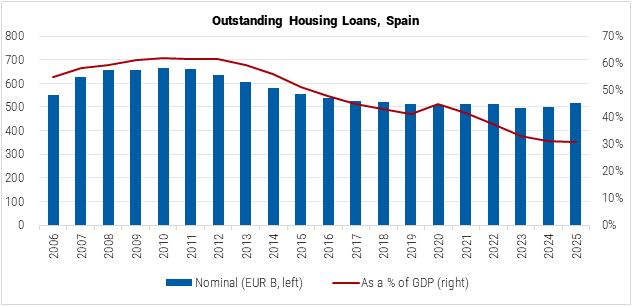
According to the ECB, the total value of outstanding housing loans in the country increased by 3.6% in 2025 and reached EUR 518.6 billion (USD 613.2 billion) as of February 2026. The relative size of the market has declined from the peak of 61.8% of GDP in 2010 to an estimated 30.6% in 2025. The overall level of mortgage indebtedness in Spain has also declined over the past fifteen years, with 28.1% of households reported as owning their residences with a mortgage or housing loan as of 2025, compared to 34.3% in 2010.
Data Source: ECB.
Economic and Social Factors
Solid Near-Term Growth Expected Despite External Headwinds
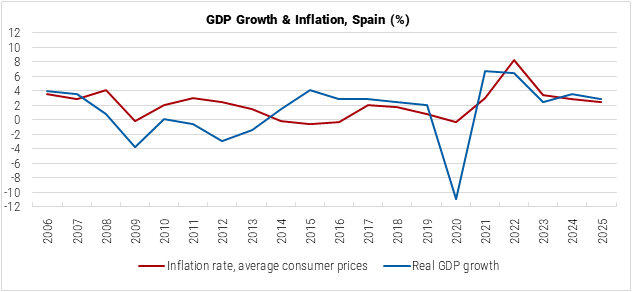
In 2025, Spain’s economy continued to perform strongly, expanding faster than euro area peers, as strong domestic demand offset subdued exports. The International Monetary Fund (IMF) estimates real GDP growth for the year at 2.9% and projects it to remain robust in the near term before slowing gradually (2.1% in 2026 and 1.8% in 2027).
“Notwithstanding the adverse effect and heightened uncertainty from the conflict in the Middle East, growth is expected to stay solid this year, before slowing gradually as immigration inflows moderate and demographic aging intensifies,” summarized the concluding statement of the IMF’s 2026 Article IV Mission.
Consumer price index (CPI) inflation in the country previously eased from an average annual level of 3.4% in 2023 to 2.9% in 2024 and 2.4% in 2025. More recently, however, INE’s flash estimate reported an uptick in the indicator from 2.3% in February to 3.3% in March 2026, mainly attributed to the rise in fuel prices. Reflecting the global impact of higher oil prices, the latest IMF forecast expects headline inflation in Spain to reach about 3.0% by the end of 2026 before falling to 2.2% by the end of 2027.
Data Source: IMF.
In the Spanish labor market, substantial migration inflows, albeit slowing, continue to expand the labor force and boost the pace of job creation. Based on preliminary data from INE, as of January 1, 2026, the country’s foreign population reached 7.2 million (14.6% of the total population), demonstrating a 4.8% year-on-year growth. The main immigrant nationalities were Colombian, Venezuelan, and Moroccan.
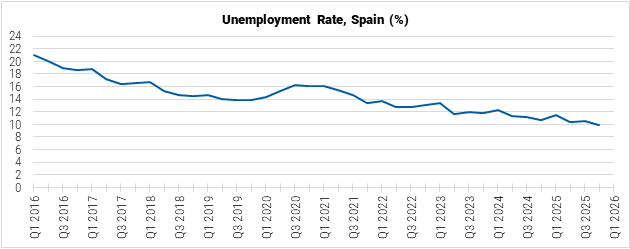
In this environment, the unemployment rate has been consistently trending downward, reaching 9.9% in Q4 2025, according to INE. The European Commission expects this dynamic to continue over the forecast horizon (average unemployment rate of 9.8% and 9.6% projected for 2026 and 2027, respectively), noting that such levels, although still among the highest in the EU, have not been seen in Spain in over a decade.
Data Source: INE.
Considering the economy’s strong expansion in the previous years, growth potential among the highest for major advanced economies, moderate fiscal deficits, and falling debt levels, Fitch Ratings affirmed Spain’s ‘A’ sovereign rating with a stable outlook in March 2026.
At the same time, while economic activity is expected to remain solid in the upcoming periods, risks are now tilted to the downside, including from the Middle East conflict, an escalation of other geopolitical tensions and trade measures, as well as domestic political fragmentation leading to minority government’s inability to secure approval of budgets and continued reliance on royal decrees for policy approval.
In light of the latest global and domestic developments, the March 2026 macroeconomic projections from the Bank of Spain outlined a “more unfavorable scenario for both 2026 and 2027”, including a downward revision for the GDP growth forecast and an upward revision for the inflation forecast.
Sources:
- National Statistics Institute (INE)
- Housing Price Index (HPI). Base 2015. Fourth Quarter 2025: https://www.ine.es/
- Statistics on Transfer of Property Rights (STPR). December 2025 and Year 2025. Provisional Data: https://www.ine.es/
- Flash Estimate of the Consumer Price Index (CPI), March 2026: https://ine.es/
- Consumer Price Index (CPI), February 2026: https://www.ine.es/
- Economically Active Population Survey (EAPS), Q4 2025: https://www.ine.es/
- Reference Index of Housing Rentals, Latest Data: https://www.ine.es/
- Continuous Population Statistics, 1 January 2026, Provisional Data: https://www.ine.es/
- Bank of Spain
- Macroeconomic Projections and Quarterly Report on the Spanish Economy, March 2026: https://www.bde.es/
- Financial Stability Report, Autumn 2025: https://www.bde.es/
- Ministry of Housing and Urban Agenda (MIVAU)
- Appraised Value of Housing Series (ES): https://www.mivau.gob.es/
- Housing and Land Observatory (ES): https://www.mivau.gob.es/
- Spain’s Association of Registrars (Colegio de Registradores de España)
- Property Registry Real Estate Statistics: Fourth Quarter 2025 (ES): https://www.registradores.org/
- European Central Bank (ECB)
- ECB Data Portal: https://data.ecb.europa.eu/
- Key ECB Interest Rates: https://www.ecb.europa.eu/
- Monetary Policy Decisions, 19 March 2026: https://www.ecb.europa.eu/
- European Commission
- Economic Forecast for Spain: https://economy-finance.ec.europa.eu/
- Distribution of Population by Tenure Status, Type of Household, and Income group: https://ec.europa.eu/
- International Monetary Fund (IMF)
- Country Overview: Spain: https://www.imf.org/
- Spain: Staff Concluding Statement of the 2026 Article IV Mission: https://www.imf.org/
- World Economic Outlook Update, January 2026: https://www.imf.org/
- CaixaBank Research
- The Shortage of New Housing Continues to Put Pressure on the Residential Market in Spain (ES): https://www.caixabankresearch.com/
- Spain’s Housing Market is Entering a New Expansionary Phase: https://www.caixabankresearch.com/
- New Housing is Lacking Where it is Needed Most… (ES): https://www.caixabankresearch.com/
- What Does High-Frequency Data Tell Us About Rentals in Spain? (ES): https://www.caixabankresearch.com/
- BBVA Research
- Spain | Real Estate Sector Outlook and Profitability. March 2026: https://www.bbvaresearch.com/
- Spain | Housing Shortage: When Supply Doesn’t Keep Up With Demand (ES): https://www.bbvaresearch.com/
- Bankinter
- Bankinter Real Estate Report, February 2026 (ES): https://broker.bankinter.com/
- Idealista
- Price Evolution of Housing for Rent in Spain: https://www.idealista.com/
- Rental Housing Supply in Catalonia to Stay at Historic Lows in 2026: https://www.idealista.com/
- Bankinter: "Renting in Spain is no Longer a Viable Option for Demand": https://www.idealista.com/
- Five Years Into the Rental Market After the Pandemic…: https://www.idealista.com/
- Fitch Ratings
- Fitch Affirms Spain at 'A'; Outlook Stable: https://www.fitchratings.com/
- Reuters
- ECB Still Set to Hold Interest Rates Through 2026, Most Economists Say: Reuters Poll: https://www.reuters.com/
- Bank of Spain Steps up Oversight of Lending as Mortgages Rise: https://www.reuters.com/
- Spain to Tighten Rental Rules With Room Rent Caps, Seasonal Lease Curbs: https://www.reuters.com/
- El Pais
- The Euribor Takes Another Slight Break in February and Faces a Long Period of Stability (ES): https://elpais.com/
- Rental Prices are Falling in Barcelona, but People Can't Find Apartments… (ES): https://elpais.com/