Cyprus’s Residential Property Market Analysis 2026
Still structurally challenged by insufficient supply, the Cypriot housing market remains robust, with growth in sales prices and rents especially notable in coastal districts impacted by foreign and investment-led demand.
This extended overview from Global Property Guide covers key aspects of Cyprus’s housing market and takes a closer look at its most recent developments and long-term trends.
Table of Contents
- Property Prices and Price Index
- Historic Perspective
- Property Demand Trends
- Property Supply Trends
- Rental Market: Rents and Rental Yields
- Mortgage Market and Interest Rates
- Economic and Social Factors
Property Prices and Price Index
Cyprus’ residential sale prices strengthened further in late 2025, with the Residential Property Price Index published by the Central Bank of Cyprus (CBC) accelerating from a 4.84% year-on-year increase in Q1 2025 to 7.06% in Q4 2025. As the CBC noted, this reflected continued strong demand from both local and foreign buyers, alongside only a gradual increase in supply and construction costs that remained at historically high levels. Overall, the market remained clearly demand-led, with the apartment segment continuing to absorb the strongest pricing pressure: apartment prices rose by 9.61% year-on-year in Q4 2025, while house prices increased by a more modest 3.40%.
Cyprus's house price annual change:
Regional price growth remained uneven. Limassol recorded the strongest annual increase in the overall residential index, at 9.90% in Q4 2025, followed by Larnaca and Paphos, while growth was much weaker in Nicosia and flat in Famagusta. This pattern broadly reflects differences in buyer mix and market positioning: the coastal districts continue to benefit more from foreign and investment-led demand, whereas Nicosia remains more dependent on domestic owner-occupier demand and is therefore less exposed to the same intensity of price pressure.
Residential property price index dynamics in key submarkets:
| District | QoQ, Q4 2025 vs Q3 2025, Nominal |
QoQ, Q4 2025 vs Q3 2025, Inflation-adjusted |
YoY, Q4 2025 vs Q4 2024, Nominal |
YoY, Q4 2025 vs Q4 2024, Inflation-adjusted |
| Nicosia | 1.00% | 1.03% | 0.99% | 1.54% |
| Limassol | 2.68% | 2.71% | 9.90% | 10.50% |
| Larnaca | 1.95% | 1.99% | 8.29% | 8.88% |
| Paphos | 2.96% | 2.99% | 7.64% | 8.23% |
| Famagusta | 0.70% | 0.74% | 0.05% | 0.59% |
| Data Source: CBC. | ||||
While the CBC index shows where underlying price growth was strongest, PwC’s transaction analysis based on completed transactions data from the Department of Lands and Surveys (DLS) provides a complementary view of market positioning across districts and property types. It points to a market in which the coastal districts continue to command the strongest nominal values and investor interest, while Nicosia remains comparatively more affordable and domestically anchored.
Average price per unit by region:
| District | Apartments | Houses | ||||
| Average price, EUR/unit, 2025 |
Average price, USD/unit, 2025 |
Trend, 2025 vs 2024 |
Average price, EUR/unit, 2025 |
Average price, USD/unit, 2025 |
Trend, 2025 vs 2024 |
|
| Nicosia | EUR 177,000 | USD 205,922 | ↑ | EUR 244,000 | USD 283,870 | ↑ |
| Limassol | EUR 403,000 | USD 468,850 | ↑ | EUR 414,000 | USD 481,648 | ↓ |
| Larnaca | EUR 178,000 | USD 207,085 | ↑ | EUR 269,000 | USD 312,955 | ↑ |
| Famagusta | EUR 150,000 | USD 174,510 | ↓ | EUR 352,000 | USD 409,517 | ↑ |
| Paphos | EUR 230,000 | USD 267,582 | ↑ | EUR 466,000 | USD 542,144 | ↑ |
| Note: Exchange rate as of Q4 2025, USD 1 = EUR 0.8595. | ||||||
| Data Source: PwC analysis of DLS data. | ||||||
At the same time, the current upturn does not appear to amount to broad-based overheating. The CBC has said there are no signs of widespread overvaluation, even though the market remains sensitive to external risks given its reliance on foreign demand. Meanwhile, the RICS Cyprus Property Index with KPMG in Cyprus described Q4 2025 as a “resilient market environment”, with residential assets maintaining momentum.
Looking ahead, the near-term outlook remains cautiously positive. As part of the IN Business Forecasting 2026 series, Yiannis Misirlis, Chairman of Imperio Group, said the real estate sector should continue its upward trajectory in 2026, supported by a strong domestic economy, continued investment activity, and Cyprus’s broader attractiveness to investors. He nevertheless cautioned that insufficient supply remains the market’s main structural challenge, while delays in the development licensing system and shortages of human resources continue to constrain the pace at which new stock can come to market. This suggests that price pressures are unlikely to disappear quickly, particularly in the most supply-constrained districts. At the same time, the CBC has noted that the European Commission’s short-term property price expectations index eased during much of 2025, pointing to lower expectations for further price increases, although any slowdown is expected to be gradual rather than abrupt.
Historic Perspective:
From Boom and Bust to Renewed Growth
Cyprus’s housing market has moved through several distinct phases over the past two decades. In the run-up to the global financial crisis, the market experienced a strong upswing, supported by EU accession, rapid mortgage expansion, easier credit conditions, and strong foreign demand, particularly from UK and Russian buyers.
That boom was followed by a prolonged correction. The global financial crisis, and later Cyprus’s domestic banking and sovereign debt crisis, sharply weakened both demand and development activity. House prices fell for several consecutive years, while construction contracted significantly, and the market did not begin to stabilize until the mid-2010s.
A gradual recovery began from 2017 onward, supported by improving macroeconomic conditions, renewed foreign demand, and stronger tourism- and rental-related activity, especially in coastal areas. Over time, the foreign-buyer base also became more diversified, including buyers attracted by residency-linked investment, helping support the market beyond its earlier dependence on a narrower group of source countries.
More recently, the market has remained on an upward path, though not in a straight line. After price growth slowed in 2024, momentum strengthened again in late 2025, reflecting continued strong demand from both local and foreign buyers, only a gradual rise in supply, and construction costs that remained historically high.
20-year annual house price change (based on end-of-year residential property price index and consumer price index):
| Year | Nominal house prices (%) |
Inflation-adjusted house prices (%) |
Year | Nominal house prices (%) |
Inflation-adjusted house prices (%) |
|
| 2006 | n/a | n/a | 2016 | -0.94% | -0.69% | |
| 2007 | 22.12% | 17.52% | 2017 | 1.77% | 2.36% | |
| 2008 | 9.74% | 7.48% | 2018 | 2.54% | 0.83% | |
| 2009 | -1.91% | -3.88% | 2019 | 2.09% | 1.36% | |
| 2010 | -3.60% | -5.16% | 2020 | 0.77% | 1.93% | |
| 2011 | -4.94% | -8.54% | 2021 | 2.66% | -2.06% | |
| 2012 | -4.67% | -5.71% | 2022 | 6.54% | -1.28% | |
| 2013 | -8.57% | -6.41% | 2023 | 8.34% | 6.60% | |
| 2014 | -7.92% | -6.56% | 2024 | 4.60% | 1.93% | |
| 2015 | -1.85% | -0.89% | 2025 | 7.06% | 7.64% | |
| Data Sources: CBC, OECD, Global Property Guide. | ||||||
Property Demand Trends
Housing Demand Strengthened, Supported by Domestic End-Users and Foreign Buyers
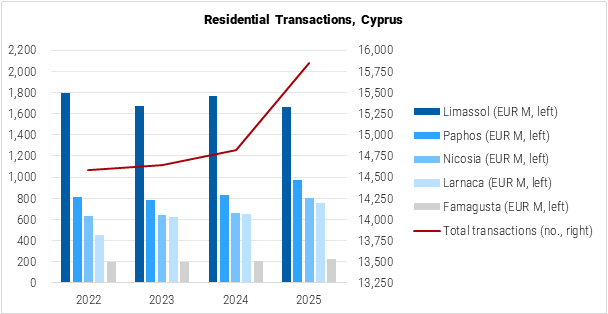
According to the latest PwC analysis based on the DLS data, the Cyprus real estate market remained robust throughout 2025, reaching a record-high transaction value of EUR 6.5 billion (USD 7.6 billion), up 8% year-on-year. Foreign-buyer activity in the overall market strengthened further, rising by 16% year-on-year and accounting for around 28% of all transactions, with Paphos, Larnaca, and Limassol recording the most significant annual gains.
Residential real estate remained the main driver of the market activity, with a total of 15,853 residential transactions registered across all districts in 2025, up 7.0% year-on-year. The cumulative value of residential investments reached EUR 4.4 billion (USD 5.1 billion), reflecting annual growth of 7.6%. Apartments accounted for 69% of all residential transactions during the year, while houses made up the remaining 31%, underlining the continued dominance of more liquid and accessible housing stock in the market.
Data Source: PwC analysis of DLS data.
Regionally, demand patterns remained differentiated. Nicosia appears to have been supported more by domestic end-user demand, while Larnaca combined relative affordability with growing interest from both domestic and foreign buyers. By contrast, the coastal districts remained more exposed to foreign and investment-led demand. Limassol remained the largest district market by transaction volume, with 4,205 residential deals recorded in 2025, but sales growth there was broadly flat, suggesting a degree of normalization after several years of exceptionally strong expansion.
PwC’s pricing analysis shows that residential demand throughout 2025 remained concentrated in the lower-to-mid price brackets, with 71% of apartment transactions and 41% of house transactions involving properties priced below EUR 250,000 (USD 290,850). Demand in this more affordable segment continued to come from both domestic owner-occupiers and smaller-scale investors. At the same time, the high-end segment, defined as properties priced at EUR 1.5 million (USD 1.7 million) or more, remained relatively stable, with 203 transactions recorded, of which 89% were in Limassol and Paphos.
Residential transactions in key submarkets:
| District | Apartments | Houses | ||
| No. of transactions, 2025 |
YoY, % 2025 vs 2024 |
No. of transactions, 2025 |
YoY, % 2025 vs 2024 |
|
| Nicosia | 2,995 | 17.87% | 1097 | 21.75% |
| Limassol | 3,081 | 5.23% | 1,124 | -9.57% |
| Larnaca | 2,808 | 10.20% | 951 | 6.73% |
| Famagusta | 431 | -4.86% | 461 | 5.98% |
| Paphos | 1,632 | 0.37% | 1,273 | 1.35% |
| Data Source: PwC analysis of DLS data. | ||||
Looking ahead, residential demand in Cyprus is expected to remain supportive in 2026, although growth is likely to become more measured. Continued foreign demand, tourism-related investment, and Cyprus’s ongoing appeal as a business, lifestyle, and relocation hub should continue to underpin market activity. At the same time, affordability and supply-side constraints, together with geopolitical uncertainty, are likely to limit the scope for another broad-based surge in demand. As Pavlos Loizou, CEO of Ask Wire, has noted, the next phase of the market will depend on whether Cyprus can balance demand, costs, broader international pressures, and the need for a more mature development model.
Property Supply Trends
Residential Pipeline Rebounded, but Delivery Is Likely to Remain Gradual
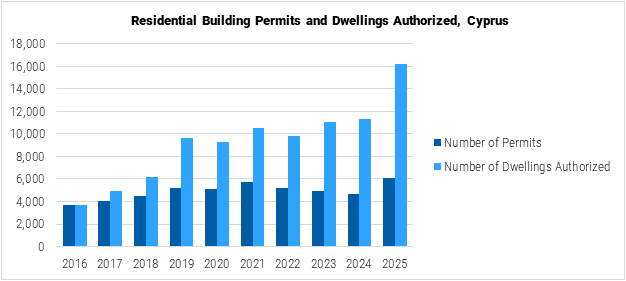
Cyprus’ residential supply pipeline strengthened markedly in 2025, as permit issuance rebounded after several weaker years, supported by housing policy measures and efforts to accelerate licensing, although the conversion of this stronger pipeline into completed housing is still likely to remain gradual. According to the Statistical Service of Cyprus (CYSTAT), 6,089 residential building permits were issued in 2025, up 29.4% year over year, while the number of authorized dwellings rose by an even stronger 42.7% to 16,171 units.
The largest share of dwelling authorizations was concentrated in Nicosia, with 5,374 units (33% of the total), followed by Limassol with 4,745 units (29%) and Larnaca with 3,778 units (23%). By contrast, the planned pipeline remained more limited in Paphos (1,729 units) and Famagusta (545 units).
Data Source: CYSTAT.
The improvement in supply conditions reflects a more active housing policy framework. The Ministry of Interior states that Cyprus’s housing policy is centered on increasing supply through measures such as Build-to-Rent on private land, revised urban planning incentives, affordable housing schemes through the Cyprus Land Development Corporation, and the Renovate-to-Rent program, which is designed to return vacant or underused homes to the rental market. In March 2026, the government announced that applications already submitted under planning incentives and additional building-coefficient schemes are expected to support the gradual construction of more than 2,500 residential units over the next two years.
At the same time, industry experts caution that stronger permit figures should not be interpreted as a guarantee of equally rapid delivery, as structural constraints continue to weigh on the rollout of new projects. In comments to Cyprus Mail, Mersina Isidorou, general manager of the Cyprus Property Developers Association, said that “delays in the licensing of new developments,” together with “the lack of sufficient labor in the construction sector,” are among the key obstacles slowing the smooth development of the market and the implementation of new projects.
Overall, Cyprus’ residential supply outlook appears to be improving, but in a gradual and measured way rather than through a sharp acceleration in development activity. Market commentary suggests that new deliveries are likely to rise progressively in response to still-resilient demand, while the risk of oversupply remains limited. Tranio Capital argued that the recent rebound in permits reflects a process of market normalization rather than aggressive expansion. As the firm observed, “developers are not building ahead of demand – and this removes the main risk of a price correction,” indicating that project volumes are likely to remain broadly aligned with underlying market needs.
Rental Market: Rents and Rental Yields
Rental Inflation Re-Accelerates, Raises Affordability Concerns
Over the past decade, the share of tenants among Cypriots increased from 27.0% in 2015 to 30.8% in 2025, while the homeownership rate declined from 73.0% to 69.2%. The expanding pool of renters set against the undersupply of available properties, exacerbated by the conversion of traditional long-term rental units into short-term holiday rentals, contributes to persistent rental growth across the country, which in turn raises affordability concerns.
Cyprus's rent price index:
“There has indeed been a significant increase in rental prices in Cyprus in recent years, with the result that a large part of the population is struggling to make ends meet, also due to the cost-of-living crisis caused by rising energy prices,” Polys Kourousidis, President of the Cyprus Association of Property Valuers, recently told Politis, commenting on the state of the market.
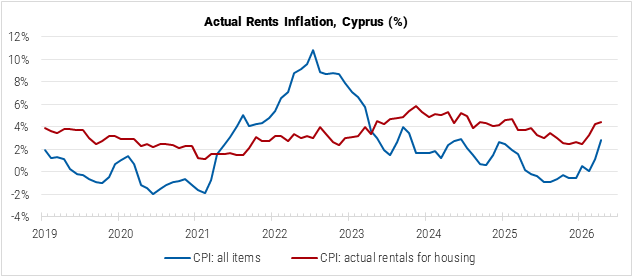
Based on CYSTAT reporting, after easing somewhat throughout 2025, rental inflation in Cyprus, as measured by the annual change in actual rentals for the housing component of the consumer price index, re-accelerated again in early 2026, rising from 2.5% in January to 4.5% in April. For comparison, the all-item CPI registered a 2.8% annual increase in April (up from 0.5% in January).
An accelerating trend is also demonstrated by the RICS KPMG Rental Index, which in Q4 2025 posted a 5.79% year-on-year change in the rental value of apartments and a 2.34% year-on-year change in the rental value of houses nationwide, both indicators up from the respective 4.78% and 2.22% in Q3 and 1.33% and 0.77% in Q2.
Data Source: CYSTAT.
In nominal terms, according to the survey conducted by Eurostat in cooperation with real estate agencies in major European cities, the average monthly rent for quality apartments in Nicosia (within residential areas of good quality, typically favored by expatriates and professional people) in 2025 reached EUR 750 (USD 848) for 1-bedroom units, EUR 910 (USD 1,028) for 2-bedroom units, and EUR 1,200 (USD 1,356) for 3-bedroom units. Over the past five years, the average rates increased by 23-28% for the types of apartments surveyed.
Across a wider spectrum of properties, research by Global Property Guide in March 2026 found average asking rents in the capital:
- EUR 650 (USD 751) for 1-bedroom units,
- EUR 880 (USD 1,017) for 2-bedroom units,
- EUR 1,150 (USD 1,329) for 3-bedroom units.
At the same time, the country’s largest rental submarket, Limassol, posted much higher average rents:
- EUR 1,300 (USD 1,503) for 1-bedroom units,
- EUR 2,000 (USD 2,312) for 2-bedroom units,
- EUR 2,700 (USD 3,121) for 3-bedroom units.
In Pathos, average rents for respective unit types reached EUR 870 (USD 1,060), EUR 1,200 (USD 1,387), and EUR 1,600 (USD 1,849).
The corresponding gross rental yields averaged 4.88% across these submarkets, with Limassol (5.32%) traditionally demonstrating higher potential performance than Nicosia (4.67%) and Pathos (4.66%). RICS and KPMG previously reported rental yields in Cyprus at 5.45% for apartments and 2.96% for houses in Q4 2025, with only marginal movement observed compared to the respective 5.41% and 3.03% in Q4 2024.
Mortgage Market and Interest Rates
Lower Interest Rates and Continued Shift Towards Fixed-Rate Loans
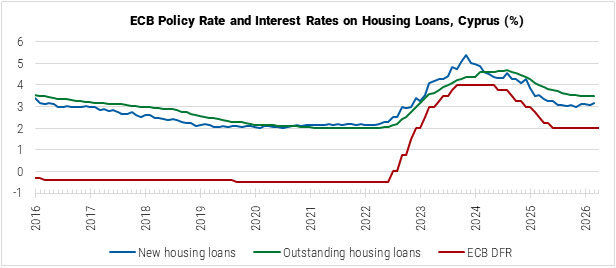
As earlier policy rate cuts from the European Central Bank (ECB) were passed through to retail lending, financing conditions in Cyprus improved throughout 2025, with average interest rates on housing loans easing further from their peaks in 2023-2024 and demonstrating a more stable trend in recent months. As of March 2026, the average interest rates on housing loans in Cyprus stood at 3.15% for new loans and 3.48% for outstanding loans, both indicators down year-on-year but exceeding the respective pre-2022 levels.
Cyprus's mortgage loan interest rates:
At the same time, interest rates in Cyprus remain structurally higher than in some other euro area countries due to the smaller size of the country’s banking sector and limited competition (with mortgage pricing largely a matter of individual lender strategy), as well as the historic prevalence of variable-rate credit.
Data Source: ECB.
Average interest rates on loans to households for house purchase:
| Mar 2026 | YoY | Mar 2025 | YoY | Mar 2024 | |
| New housing loans | 3.15% | ↓ | 3.53% | ↓ | 4.59% |
| - Floating rate and IRF up to 1 year | 3.86% | ↓ | 4.10% | ↓ | 4.75% |
| - IRF of over 1 and up to 5 years | 3.10% | ↓ | 3.32% | ↓ | 4.33% |
| - IRF of over 5 and up to 10 years | n/a | n/a | n/a | n/a | n/a |
| - IRF of over 10 years | n/a | n/a | n/a | n/a | n/a |
| Outstanding housing loans | 3.48% | ↓ | 4.01% | ↓ | 4.61% |
| - Original maturity up to 1 year | 3.25% | ↑ | 3.47% | ↑ | 3.19% |
| - Original maturity over 1 and up to 5 years | 4.42% | ↑ | 4.23% | ↑ | 4.00% |
| - Original maturity of over 5 years | 3.48% | ↓ | 4.01% | ↓ | 4.63% |
| Data Source: ECB. | |||||
Historically, the Cypriot mortgage market used to be dominated by variable-rate loans, making it more vulnerable to short-term interest rate fluctuations; in recent years, however, the share of such loans in total new credit for house purchase has declined sharply from over 90%, on average, in 2022 to about 12% most recently reported in March 2026, indicating a shift in demand toward more stable financing options against the background of global uncertainty. According to the latest CBC economic bulletin, fixed-rate housing loans of medium-term duration (with an IRF between 1 and 5 years) became the largest segment of new lending in the ten months of 2025, reflecting “households’ growing preference for stability in their interest-rate risk exposure and for greater predictability in their financial obligations”.
Considering the increasing relevance of fixed-rate mortgage lending, the CBC now believes the transmission of future ECB monetary policy decisions may occur at a slower pace, as a larger share of the mortgage portfolio will not be directly affected by changes in policy rates.
Data Source: CBC.
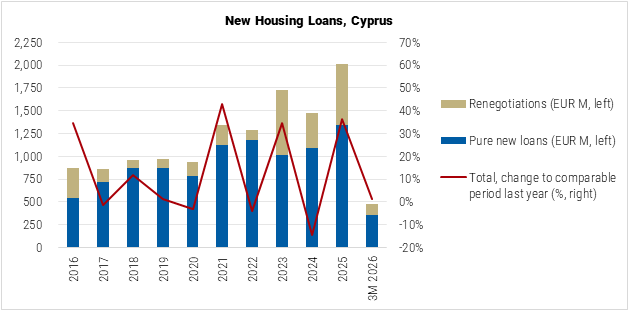
Lower and more stable interest rates provided an additional boost to lending activity in Cyprus. According to the CBC analysis, the upward trend has also been supported by strong local demand for homeownership, buy-to-let investment, and short-term rental properties against the backdrop of the favorable performance of the tourism sector and the increased number of foreign students brought by the expansion of tertiary education.
The total value of new housing loans reported by the CBC in 2025 reached EUR 2.0 billion (USD 2.3 billion), a 36.4% increase compared to 2024, driven both by a substantial growth in pure new loans (23.1% year-on-year) and a surge in renegotiations (73.6% year-on-year). The positive dynamic for pure new loans appears to have carried into 2026, with new loans in this category granted between January and March up by 24.5% compared to the same period last year.
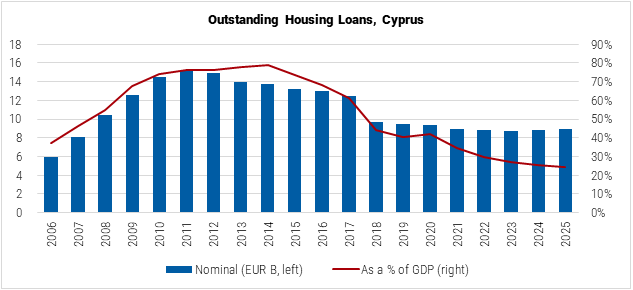
Overall, based on the latest Eurostat figures, 18.8% of Cyprus’s population currently live in owner-occupied residences with an outstanding mortgage or housing loan (compared to 20.1% a decade ago in 2015). After years of gradual decline, the total value of outstanding housing loans in the country, as reported by the CBC, returned to modest growth, registering a 0.8% annual increase in 2024, a 1.2% annual increase in 2025, and reaching EUR 8.8 billion (USD 10.2 billion) as of March 2026. The relative size of the market, measured as the loan-to-GDP ratio, however, continued to decline from its peak level of 78.8% in 2014 to an estimated 24.4% in 2025.
Data Sources: CBC, CYSTAT.
Economic and Social Factors
Resilient Growth to Continue Despite Global Disruptions
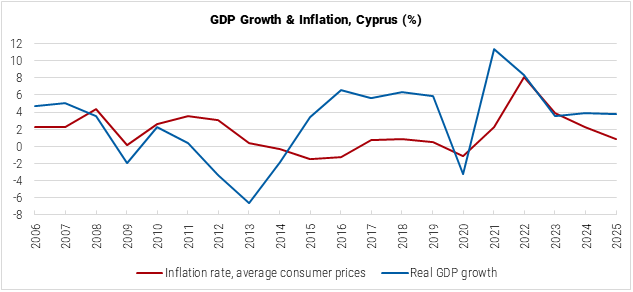
Supported by strong private consumption and continued expansion of export-oriented services, such as ICT and tourism, Cyprus’s economy has demonstrated impressive resilience over recent years, with real GDP growth consistently among the highest in the EU: 3.6% in 2023, 3.9% in 2024, and 3.8% in 2025. Despite disruption from the war in the Middle East, growth is expected to remain robust this year at around 2.5%, according to the latest projections from the International Monetary Fund (IMF).
Consistently serving as the backbone of the economy, Cyprus’s tourism sector delivered record-breaking numbers in visits and revenue in 2025. With over 4.5 million tourist arrivals (+12.2% compared to 2024), revenues from the sector were estimated at EUR 3.7 billion, a 15.2% increase from 2024 levels. During the year, visitors from the UK (31.8%) represented the largest share of the total tourist traffic, followed by Israel (13.0%), Poland (8.2%), Germany (6.1%), Greece (3.9%), and Sweden (3.4%). Although affected by global developments in recent months, travel and tourism-related activities are expected to partially recover during the peak season and continue generating a significant amount of GDP.
In parallel, consumer price index (CPI) inflation in the country previously eased from an average annual level of 3.9% in 2023 to 2.3% in 2024 and 0.8% in 2025, but has re-accelerated in recent months, reaching 2.8% in April 2026, according to CYSTAT. The IMF staff expects higher oil prices to push up inflation in Cyprus to around 3.5% on average for 2026, which will weaken real incomes and consumption, leading to a moderation in economic expansion.
Data Source: IMF.
In line with growth outlook, conditions in Cyprus’s labor market are set to remain strong, with solid job creation levels, high employment, and record-low unemployment (most recently reported by CYSTAT at 4.0% in Q4 2025, the lowest level since 2008). At the same time, as outlined in the European Commission’s assessment, significant inflows of foreign workers, which have been supporting employment growth, are expected to gradually moderate as the initial wave of corporate relocations under government incentives encouraging multinational companies to establish their headquarters in Cyprus is coming to an end.
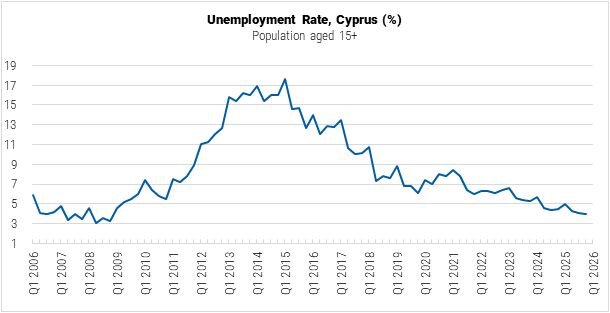
Data Source: CYSTAT.
Reflecting the country’s significant improvements in fiscal and debt indicators, as well as its economy’s resilience, Cyprus previously received sovereign credit rating upgrades from all major agencies in 2024. More recently, Fitch Ratings affirmed the country’s ‘A-’ standing with a positive outlook, noting its “continued debt deleveraging and favorable growth prospects that are increasing fiscal and external resilience”.
Overall, while near-term risks to Cyprus’s economy are seen as tilted to the downside, medium- to long-term risks are considered broadly balanced. ”A further escalation of the war in the Middle East could further raise inflation and weaken growth, especially from tourism,” noted the IMF staff in the concluding statement for the 2026 Article IV Mission. “Over the medium term, geopolitical fragmentation and infrastructure bottlenecks could weigh on activity, although continued structural reforms and further expansion in digital economy sectors offer significant upside potential.”
Sources:
- Cyprus Statistical Service (CYSTAT)
- Building Permits Statistics, Dec 2025: https://www.cystat.gov.cy/
- Consumer Price Index, April 2026: https://www.cystat.gov.cy/
- Tourism Statistics, 2025: https://www.cystat.gov.cy/
- Labor Force Survey Q4 2025: https://www.cystat.gov.cy/
- National Accounts: https://www.cystat.gov.cy/
- Central Bank of Cyprus (CBC)
- Residential Property Price Index (RPPI), 2025 Q4: https://www.centralbank.cy/
- Financial Stability Report, July 2025: https://www.centralbank.cy/
- Economic Bulletin, December 2025: https://www.centralbank.cy/
- Statistics on Interest Rates Applied by Monetary Financial Institutions, March 2026: https://www.centralbank.cy/
- Monetary Financial Institutions (MFIs) Deposits and Loans Statistics, March 2026: https://www.centralbank.cy/
- Economic Bulletin, December 2025: https://www.centralbank.cy/
- Department of Lands and Surveys (DLS)
- Statistical Data on Transfers of Sales and Sales Contracts: https://portal.dls.moi.gov.cy/
- Ministry of Interior of the Republic of Cyprus
- Policy, Housing Policy, and European Affairs Section: https://www.gov.cy/
- European Central Bank (ECB)
- ECB Data Portal: https://data.ecb.europa.eu/
- Key ECB interest rates: https://www.ecb.europa.eu/
- Monetary Policy Decisions, 30 April 2026: https://www.ecb.europa.eu/
- European Commission
- Economic Forecast for Cyprus: https://economy-finance.ec.europa.eu/
- Distribution of Population by Tenure Status, Type of Household, and Income group: https://ec.europa.eu/
- International Monetary Fund (IMF)
- Country Overview: Cyprus: https://www.imf.org/
- Cyprus: Staff Concluding Statement of the 2026 Article IV Mission: https://www.imf.org/
- PwC
- Cyprus Real Estate Market. Year in Review – 2025: https://www.pwc.com.cy/
- KPMG
- RICS Cyprus Property Index with KPMG in Cyprus, Q4 2025: https://assets.kpmg.com/
- Cyprus Mail
- Minister Outlines Plan to Tackle Cyprus Housing Shortage: https://cyprus-mail.com/
- Cyprus Property Developers Warn of Pan-European Housing Crisis: https://cyprus-mail.com/
- Philenews
- The Real Estate Market in Cyprus in Looking for Resilience, Quality and a New Balance (EL): https://www.philenews.com/
- Fitch Ratings
- Fitch Affirms Cyprus at 'A-'; Outlook Positive: https://www.fitchratings.com/
- Fitch Upgrades Cyprus to 'A-'; Outlook Stable: https://www.fitchratings.com/
- Moody's Ratings
- Moody's Ratings Upgrades Cyprus' Ratings to A3 and Changes Outlook to Stable: https://ratings.moodys.com/
- S&P Global
- Cyprus Upgraded to 'A-' on Economic and Fiscal Outperformance; Outlook Stable: https://disclosure.spglobal.com/
- In Business
- Yiannis Misirlis on Why the Real Estate Sector Will be on the Rise in 2026: https://inbusinessnews.reporter.com.cy/
- Tranio Capital
- Cyprus Property Market: 2025 Review and 2026 Outlook: https://tranio.com/
- Politis
- The Interest Rate Landscape for Loans and Deposits: https://en.politis.com.cy/
- High Rents in Cyprus 'Eat Up' Wages: https://en.politis.com.cy/