Property Investment in Austria: Foreigner’s Guide (2025)
Austria’s rich history and breathtaking scenery have made it one of Europe’s top tourism spots, hosting over 46 million visitors in 2024. While Austria may seem like a desirable location for real estate investors, the country’s increasing restrictions (especially for citizens of non-EU countries) and slowing economy make this beautiful country less attractive for investors seeking strong returns.
This newly updated 2025 edition guide will take you through the basic steps and important things to consider when buying property in Austria as a foreign first-time buyer.
12 Things to Know Before Buying a Property in Austria
- Can Foreigners Buy Property in Austria
- Best Cities and Regions to Invest
- Square Meter / Square Foot Prices
- Median Asking Prices
- Rental Yields and Rents
- Market Performance (Past and Present)
- Landlord and Tenant Laws
- Property Related Taxes
- Buying (and Selling) Costs
- Short-Term Rental Regulations
- Mortgage and Financing Options
- How to buy property in Austria: step-by-step
1) Can Foreigners Buy Property in Austria?
Yes, but purchasing rights vary.
Citizens of EU countries have the same purchasing rights as Austrian Citizens. Citizens of EEA countries and Switzerland require more paperwork, but can generally purchase Austrian property as well.
Citizens of other countries face restrictions on the types and locations of the property they can buy. Several provinces – including Vorarlberg, Tyrol, and Salzburg – have added strict quotas on the purchase of second homes or investment properties by non-EU members. Other areas require non-EU citizens to be approved by the provincial land transfer. Some properties must be advertised for a specific amount of time before non-EU citizens can purchase them.
Additionally, companies wanting to purchase real estate can only do so through an Austrian-based company.
For these reasons, it’s best for non-EU members to work closely with an attorney before beginning the property search process, especially as the requirements and restrictions continue to change.
2) Best Regions and Cities to Invest
Vienna
As the capital and largest city of Austria, Vienna is a top-tier destination for real estate investment. Known for its high quality of life, rich history, and cultural heritage, Vienna boasts a stable and well-regulated property market. Districts such as Innere Stadt, Leopoldstadt, and Neubau are particularly attractive due to their blend of historical buildings, modern amenities, and strong rental demand. With a robust economy and a significant international community, Vienna offers consistent returns for both residential and commercial investments.
Graz
Austria’s second-largest city, Graz, is a rising star for property investors. With a large student population and a vibrant mix of Baroque architecture and contemporary design, Graz is known for its lively atmosphere and growing tech sector. Areas like Geidorf and Lend are popular with both locals and expats, offering a mix of affordable housing and steady rental income. The city’s position as a university and innovation hub enhances its long-term investment potential.
Linz
Located along the Danube River, Linz is an important industrial and cultural center. As Austria’s third-largest city, Linz features a diverse economy and ongoing urban development, making it appealing for investors looking for growth potential. The city’s cultural scene, along with infrastructure investments and revitalized neighborhoods such as Urfahr and the city center, provide promising opportunities for both residential and mixed-use developments.
Salzburg
Famed for its baroque architecture and musical heritage, Salzburg offers a luxury real estate market that attracts both international buyers and domestic investors. The city’s picturesque setting, proximity to the Alps, and status as a UNESCO World Heritage site contribute to strong demand for high-end properties, particularly in districts like Altstadt, Aigen, and Leopoldskron. The blend of tourism, culture, and prestige supports long-term value retention and potential appreciation.
3) Square Meter / Square Foot Prices
Austria’s square meter prices are on the moderately high end of the European market. Prices dropped some in Q4 of 2024, but have crept up since. As of July 2025, average square meter prices were as follows:
- Vienna - €7,702
- Salzburg - €9,241
- Graz - €4,494
4) Median Asking Prices
The average price of a 1-bedroom apartment in Austria is moderately high compared to other European countries:
- Vienna - €315,000
- Salzburg - €410,000
- Graz - €216,000
5) Rental Yields and Rents
Rental yields in Austria are considered poor. One-bedroom apartments average just 3.70% across the country, making Austria’s yields some of the lowest in Europe – especially in Salzburg, where prices are higher and restrictions are tighter.
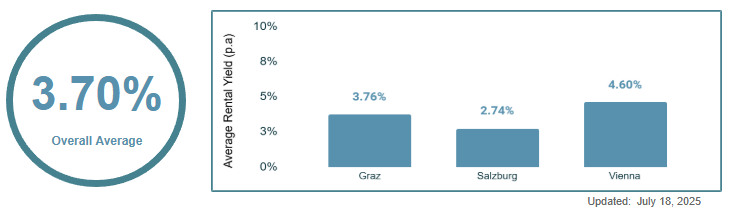
As of July 2025, rental rates for 1-bedroom properties in major Austrian cities are approximately as follows:
- Vienna - 4.57%
- Salzburg - 4.17%
- Graz - 3.22%
Multi-bedroom apartments generally had lower yields, while studio apartments did better – with Vienna’s Favoriten District 10 yielding the highest at 6.60%.
Austria's rent price index:
Data Source: OECD.
6) Market Performance (Past and Present)
Austria’s real estate market has experienced major shifts over the past two decades. Residential property prices doubled from 2005 to 2022. Vienna especially experienced major growth, thanks to low interest rates and increased demand. However, this transition impacted Austrian citizens who often struggled to afford property.
In 2022, prices slightly declined as interest rates increased. Since that time, the country’s once-booming housing market has slowed down and prices have fallen – especially in Vienna, which historically leads the national housing trend. The number of new housing loans dropped by more than 50% in 2024 compared to 2021. Building permits have also dropped, indicating reduced demand.
Austria's house price annual change:
Data Source: Österreichische National Bank.
7) Landlord and Tenant Laws
Austrian landlord and tenant laws are judged by the Global Property Guide to be pro-tenant. Austrian laws provide strong tenant protections for properties covered by tenancy laws, which regulate rents and eviction restrictions – especially for older and municipal housing.
Newer buildings and luxury apartments have fewer regulations, granting landlords more rights. However, while rent can currently be freely negotiated at first, tenants can later request a regulatory assessment, and 6 months of excess payments may have to be refunded.
Newer, unregulated properties will likely soon see more restrictions as well. In June 2025, Austria’s Prime Minister and Vice Chancellor and Housing Minister Andreas Babler announced plans to apply rent caps on unregulated properties by the fall. Rent caps were already expected to be added to all properties in 2028.
8) Property Related Taxes
Austria’s annual property taxes are low and based on the property’s assessed value. The rate varies by location but is usually a small percentage that equates to a few hundred dollars per year.
Newly constructed property has a value-added tax of 20%. Rental properties can sometimes reclaim VAT taxes, but rental income taxes must be paid.
Rental income is taxed using Austria’s progressive income tax brackets, which range from 0% up to 55% based on the amount of income earned, minus applicable depreciation and deductions. Austria also has double taxation treaties with several countries worldwide, which can provide some taxation relief.
A stamp duty is required for commercial properties but not for residential leases. Stamp duty is levied on various transactions in Austria, including lease contracts. Stamp duty rates range from 0.8% to 2%.
9) Buying (and Selling) Costs
Austria’s property transaction costs are moderately high compared to other European countries. Buyers pay most or all of the additional fees and costs above the property’s sale price.
In addition to legal, notary, and real estate fees, buyers must pay a property transfer tax and a land registration fee.
Here's a full breakdown:
| Transaction Costs | ||
| Who Pays? | ||
| Property Transfer Tax | 3.50% | buyer |
| Legal Fees | 1.00% - 3.00% (+20% VAT) | buyer |
| Notary Fees | €120 per signature (+20% VAT) | buyer |
| Land Registration Fee | 1.00% | buyer |
| Real Estate Agent Fee | 1.50% - 2.00% (+20% VAT) 1.50% - 2.00% (+20% VAT) |
buyer seller |
| Costs Paid by Buyer | 7.10% - 9.60% | |
| Costs Paid by Seller | 1.50% - 2.00% | |
| ROUNDTRIP TRANSACTION COSTS | 8.60% - 11.60% | |
| Source: Global Property Guide, PWC | ||
10) Short-Term Rental Regulations
Across Austria, all short-term rentals must keep a guest register and comply with various regional regulations.
In Vienna, for example, short-term rentals are not allowed in residential or municipal housing areas. Additionally, all hosts must collect and pay a city tax on the 15th of each month for any stays during the prior month.
In Salzberg, hosts must get permission from local authorities and register rentals with tax authorities. Registration provides hosts with a tax registration number, which must be displayed in rental listings and on the property. Overnight guests are required to pay an overnight accommodation tax, and hosts must contribute to the Tourism Promotion Fund.
In Graz, visitors must pay a tourism tax that must be collected by the host. Properties must also be registered with the city.
Tyrol requires hosts to register with the local tourism office, pay tourism taxes, and report activity. Unless they are renting part of their main residence (with a few exceptions), hosts must get a special permit to rent out the property.
11) Mortgage and Financing Options
While foreign investors can obtain mortgages in Austria, how easily it can be done depends on where the investor is located. Because EU citizens have the same property-owning rights as Austrian citizens, it’s easier for them to get an Austrian-based mortgage. EEU and Swiss citizens also have fewer restrictions than those in other countries.
Citizens of non-EU/EEA countries face bigger hurdles and larger down payments – usually 30% to 50% of the property value, compared to 20% for EU citizens.
Austria's mortgage loan interest rates:
Data Source: ECB.
12) How to Buy Property in Austria: Step-by-Step
- Contact a Real Estate Attorney: Given the differing rights for EU versus non-EU based buyers, and the changing landscape on rental property restrictions, it’s smart to contact a reputable real estate attorney before even considering buying property in Austria. A lawyer can also help non-EU-based buyers apply for approval with the Land Transfer Authority (Grundverkehrsbehörde) where the desired property is located. While this process varies by area, it typically includes proof of intent, financing, and residency status.
- Research and Find Property: Investors can use sites such as Properstar and Immobilien Scout to start their property search. Because real estate laws vary depending on citizenship and are regularly changing, working with a knowledgeable real estate agent can help identify the benefits and risks of specific investment properties.
- Research Pricing, Rental Yields, and Legal Restrictions: Rental prices and yields vary by city and neighborhood, as well as the size of the property. Overall, yields are considered poor across the country. Additionally, rental caps are expected to be added to unregulated properties by 2028, but new legislative talks indicate such caps could begin this year. Legal restrictions vary by area, but are getting tighter – especially for short-term rentals.
- Research Long-Term Market Trends: Historically, Austria’s property market was known for its stability and long-term growth. Between 2003 and 2021, property prices in Vienna more than doubled thanks to high demand, low interest rates, and increased investor interest. These trends reversed starting in 2022 and have not yet recovered.
- Research Local Taxation and Landlord Laws: Foreign investors have to pay annual property taxes, which are on a sliding scale and relatively low. Newly constructed properties require a 20% value-added tax (VAT). Annual income tax must also be paid for rental income, after deductions, and can range from 0% to 55% depending on the amount earned. Several countries have double taxation treaties with Austria to help reduce double taxation
- Make an Offer and Sign the Contract: Your real estate professional and attorney represent you and work to ensure that you are protected. When you’ve found the right property for your investment needs, your agent will help you make an offer, which is usually about 5% to 10% below the asking price.
If accepted, your attorney and notary will help you work up a contract to sign (the Kaufanbot), and you’ll be expected to put down a deposit, usually equivalent to 10%. - Apply for a Tax Identification Number: Before property can be purchased, foreign buyers must obtain an Austrian tax number for registration and taxation purposes. It can typically be secured through your real estate agent or notary.
- Perform Due Diligence: Your licensed notary or real estate attorney will check the land registry (Grundbuch) to verify the legal owner, confirm there are no outstanding debts or liens, and review zoning and usage rights. They will also review the purchase contract for legal compliance and ensure it protects your interests. Additional due diligence may involve technical inspections, reviewing the legally required energy certificate, and confirming that the property is eligible to be used as intended, such as a short or long-term rental. For non-EU buyers, this step also includes securing approval from the regional land authority to purchase the property (if this has not already been completed).
- Sign the Final Contract: Once all the other steps and due diligence are complete, both parties will sign a binding purchase agreement (Kaufvertrag). It must often be signed in front of a notary.
- Payment and Registration: Once signed, your notary will submit the deed to the National Land Agency to update the property owner’s name and title rights. The notary will help calculate, file, and collect required taxes and other fees. After this step is complete, the purchase process is finalized.
Timeline: Expect 1 to 4 months for EU, EEA, or Swiss citizens; 3 to 6 months for non-EU, EEA, or Swiss citizens.
Need Help?
Buying property in a foreign country can feel overwhelming, but we're here to help.
At Global Property Guide, we offer:
- Data-backed insights on property prices, rental yields, and taxes
- Country-specific legal and tax guidance through our partner network
- Pre-screened investment properties, including income-generating Airbnb units
- 1-on-1 consultations with real estate experts focused on international buyers
- Step-by-step buyer support, from due diligence to closing
Whether you're looking for your first investment in Austria or expanding your international portfolio, we can help you make smart, secure decisions.
Contact our team or book a free consultation to get started.