Property Investment in Hungary: Foreigner’s Guide (2025)
Hungary is an attractive destination for foreign property investors, especially with its rich cultural heritage, moderate yields, and vibrant tourism industries. Plus, investors from EU-based countries enjoy the same property rights as citizens.
However, buying property in Hungary as a foreigner comes with growing challenges. Non-EU citizens must obtain a purchase permit, and navigating the legal process can be complex without local expertise. While locals enjoy the income the tourism industry provides, there are concerns with rising rent prices and housing shortages. For those reasons, new regulations are tightening on short-term rentals.
This newly updated 2025 edition guide will take you through the basic steps and important things to consider when buying property in Hungary as a first-time foreign buyer.
12 Things to Know Before Buying a Property in Hungary
- Can Foreigners Buy Property in Hungary
- Best Cities and Regions to Invest
- Square Meter / Square Foot Prices
- Median Asking Prices
- Rental Yields and Rents
- Market Performance (Past and Present)
- Landlord and Tenant Laws
- Property Related Taxes
- Buying (and Selling) Costs
- Short-Term Rental Regulations
- Mortgage and Financing Options
- How to buy property in Hungary: step-by-step
1) Can Foreigners Buy Property in Hungary?
Yes, foreigners can buy property in Hungary, but the laws vary based on the buyer’s nationality, the location of the property, and the type of property being purchased.
Buyers from the EU, EEA countries, and Switzerland have the same property purchasing rights as Hungarian citizens. Citizens of other countries must first be granted a property purchase permit from the local government office where the property is located. The permit application takes about 30 days to process and costs approximately €130-€161.
Additionally, foreigners cannot purchase most historical properties or agricultural land.
2) Best Regions and Cities to Invest
Hungary offers a range of real estate opportunities, from its vibrant capital and cultural hubs to emerging regional centers that combine lifestyle appeal with growing economic potential.
Budapest
As the capital and economic powerhouse of Hungary, Budapest dominates the national real estate market. Districts such as the historic Castle District (District I), the vibrant city center (District V), and the upscale areas of Buda (District II and XII) are particularly sought after. The combination of strong rental demand from students, expats, and tourists, alongside limited supply in prime neighborhoods, makes Budapest highly attractive for both residential and commercial investors.
Debrecen
Known as Hungary’s “second capital,” Debrecen has emerged as a key hub for education, healthcare, and industry. The University of Debrecen brings a steady stream of students, while recent investments in the automotive and technology sectors are fueling job creation and housing demand. Modern developments in areas close to the university and city center are popular choices for long-term rental investors.
Szeged
A vibrant cultural and academic city near the Serbian border, Szeged is best known for its university and youthful population. Its historic charm, lively squares, and relatively affordable housing make it appealing for investors targeting the student rental market. As the city continues to attract international students and research projects, real estate in central districts and near the university holds strong potential.
Győr
Strategically located between Budapest, Vienna, and Bratislava, Győr has become a significant industrial and logistics hub, particularly in the automotive sector. With companies such as Audi operating major facilities in the city, demand for housing among professionals and expats remains strong. Residential developments in modern neighborhoods and properties near business districts are popular among investors seeking stable rental income.
Pécs
Rich in history and culture, Pécs is a university city in southern Hungary with a strong emphasis on the arts and education. The city’s architectural heritage and cultural events attract both students and tourists, creating opportunities for rental properties and boutique-style investments. Neighborhoods near the university and the historic center are especially appealing for those seeking affordable entry points with steady demand.
3) Square Meter / Square Foot Prices
Hungary’s square meter prices are some of the lowest in Europe, as of July 2025:
- Budapest - €3,000
4) Median Asking Prices
Hungary’s property rates are in the moderate range compared to other European countries.
One-bedroom prices average as follows:
- Budapest - €191,000
- Debrecen - €145,000
- Pécs - €106,000
- Nyíregyháza - €97,000
5) Rental Yields and Rents
Hungary’s median rental yields are moderate compared to those in other European countries. In Q3, 2025, yields averaged 5.06%, dropping a little from Q1’s 5.25%
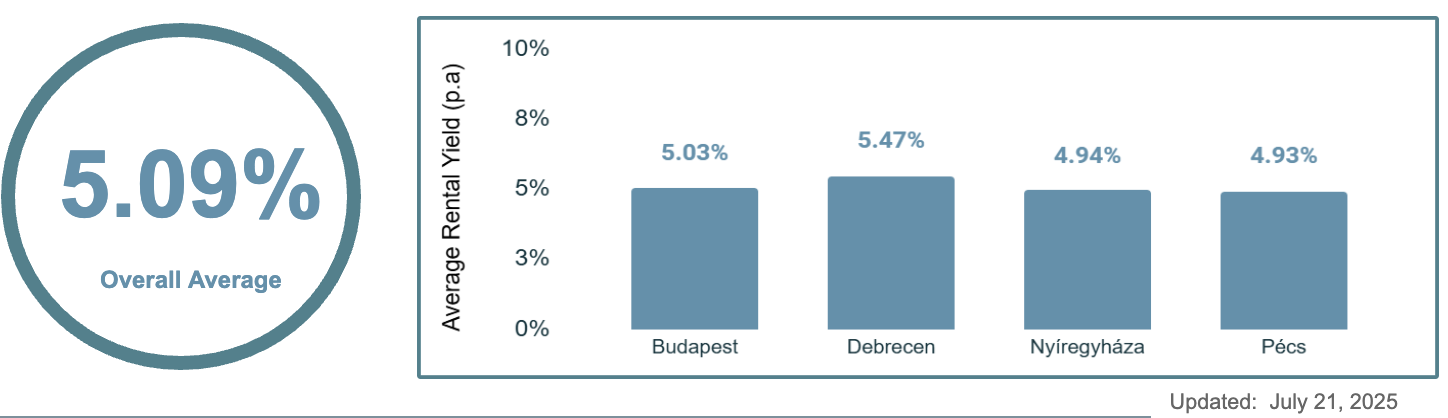
The following are median rental yields for one-bedroom apartments across key Hungarian cities as of July 21, 2025:
- Budapest - 5.54%
- Debrecen - 5.05%
- Pécs - 5.42%
- Nyíregyháza - 5.06%
Budapest’s yields vary slightly by district, with only District XI (Újbuda) dropping below 4%. In several communities across Hungary, larger apartments presented slightly higher yields, especially in Debrecen, where 3-bedrooms averaged 6.28%.
Hungary's rent price index:
Data Source: ECB.
6) Market Performance (Past and Present)
Hungary’s real estate had ups and downs from 1990 and into the early 2000s, as the country experienced changes such as increases in private housing, government-supported credit programs, and mortgage lending.
The 2008 global financial crisis was especially hard on Hungary’s construction market. In 2015, two programs – the Family Housing Allowance Program (CSOK) and the rural CSOK – offered subsidies, which helped increase demand and made loans more affordable.
These programs turned Hungary’s real estate market around, and construction activity grew until 2020. Prices also surged more than 240% from 2014 to 2022, not counting 2020. However, the market slowed again after mid-2022, but started showing signs of recovery in mid-2024.
Tourism has exceeded pre-pandemic levels, but locals are concerned that the millions of tourists each year are negatively impacting the area’s historic sites, overwhelming infrastructure, and raising the cost of living, especially property and rent prices. New restrictions are being placed on short-term rentals.
Hungary's house price annual change:
Data Source: MNB Statistics.
7) Landlord and Tenant Laws
Hungarian landlord and tenant laws are judged by the Global Property Guide to be pro-tenant. It can be difficult to evict tenants, even for non-payment, and requires a court ruling. Leases for residential properties are highly regulated, and written contracts must be signed by both parties. Emailed contracts are not valid. For these reasons, it’s wise to have formal legal contracts written and have both parties sign in front of two witnesses.
8) Property Related Taxes
Foreign investors in Hungary must get a tax identification number so they can pay taxes.
Property tax rates vary because they are based on the local municipality. The rate cannot exceed 1,100 HUF (Hungarian forint) per square meter, or 1.8% of the property’s actual value.
Hungary only taxes the income earned in the country. Rental income tax is subject to a 15% flat personal income tax rate based on income minus allowed deductions. Over 80 countries have double taxation treaties with Hungary, which can provide some additional tax relief for investors.
At just 9%, Hungary’s corporate taxes are low compared to many European Union countries to help attract foreign investors. This rate includes rental income.
In most instances, real estate is exempt from value-added taxes (VAT) unless the seller opts to apply VAT or the property is new. When required, VAT is a general 27%. If the property meets specific size criteria or is part of particular brownfield development projects, the VAT rate may be reduced.
Capital gains taxes are usually 15% of the amount of the gains. However, the percentage of gains that is taxable goes down depending on how long the seller owned the property. For example, 100% of the gains are taxed at 15% for property that’s been owned for less than five years. For the fifth year, only 90% of the gains are taxed.
9) Buying (and Selling) Costs
The costs of buying and selling property in Hungary are relatively simple.
Buyers pay a 4% property transfer tax, which is one of the lowest in Europe.
Buyers pay the majority of costs and should expect to pay up to 10% of the purchase cost in fees, plus any additional travel expenses.
Here's a full breakdown:
| Transaction Costs | ||
| Who Pays? | ||
| Property Transfer Tax | 2.00% - 4.00% | buyer |
| Legal Fees | 1.00% - 5.00% | buyer |
| Notary Fees | 0.01% - 0.05% | buyer |
| Real Estate Agent Fee | 3.00% - 5.00% (+27% VAT) | seller |
| Costs Paid by Buyer | 3.01% - 9.05% | |
| Costs Paid by Seller | 3.00% - 5.00% | |
| ROUNDTRIP TRANSACTION COSTS | 6.01% - 14.05% | |
| Source: Global Property Guide, PWC | ||
10) Short-Term Rental Regulations
To help address the lack of housing and soaring housing prices, as of January 1, 2025, Hungary has placed a two-year moratorium on all short-term rentals. This means that no new short-term or private rentals can be registered with the country until December 31, 2026.
Beginning January 1, 2026, Budapest’s ‘Terézváros’ (Theresa city) district voted to ban short-term rentals in the area altogether due to over-tourism. There is concern that a similar ban may take place in other parts of the city.
Those short-term rentals that are already in place must meet all legal paperwork and registration requirements. These include acquiring a tax ID number, registering the property, and reporting all activities to the National Tourism Data Centre and the district notary. They must also digitally scan all guest identification documents, then report these online.
Other regulations can be determined by each legislative district. It’s important to check each district’s specific laws to ensure the short-term rental is run legally.
11) Mortgage and Financing Options
IWhile foreigners can obtain mortgages in Hungary, there are several additional conditions, including a valid residence permit.
Expect to pay a higher down payment of at least 30%. Interest rates are also higher than in many Western European countries.
Hungary's mortgage loan interest rates:
Data Source: MNB.
12) How to Buy Property in Hungary: Step-by-Step
- Research the Real Estate Market: Hungary’s market is changing, with new laws – especially for short-term rentals – affecting the market. It’s important to stay on top of these changes, as well as learn about the varying Hungarian cities and neighborhoods.
- Research Hungarian Properties for Sale: You can begin by looking for properties online through websites like Ingatlan.com, RealEstateHungary.hu, and HungarianHomes.com. When you’re ready, it’s important to work with a local, English-speaking real estate agent. In addition to helping you navigate the local laws and communities, they may have access to additional listings that aren’t online.
- Get Necessary Permits: While members of EU countries have the same purchasing rights as Hungarian citizens, residents of other countries must apply for a property purchase permit from the local government office where the property is located. These usually take 30 to 60 days to be approved.
- Find a Reputable Bilingual Real Estate Attorney: This is a legal requirement for real estate transactions in Hungary. Your attorney will guide you through property laws and help you through the purchasing process.
- Make an Offer and Sign the Preliminary Contract: Once you find a property that you want to purchase, make an offer and negotiate the terms. Buyers usually put down a 10% to 20% deposit to show they are serious.
- Conduct Due Diligence: Your attorney or agent will check to ensure there are no legal issues with the property. This includes checking the title deed, zoning and building regulations, and the owner’s right to sell, among other things. Due diligence in rural areas is particularly important as verifying property records can be more difficult.
- Finalize the Sale Contract: This is the next step for EU citizens and non-EU citizens who have received the required permit. The final contact must be signed with a Hungarian attorney or notary present.
- Complete the Payment: Once payment is made either by bank transfer or through escrow, the buyer receives ownership of the property.
- Register the Sale: The buyer’s attorney submits the completed signed contract to the Hungarian Land Office. It usually takes one to two months for the property to be fully registered and the title deed to be transferred.
Timeline: Expect 2-6 months from offer to official registration.
Need Help?
Buying property in a foreign country can feel overwhelming, but we're here to help.
At Global Property Guide, we offer:
- Data-backed insights on property prices, rental yields, and taxes
- Country-specific legal and tax guidance through our partner network
- Pre-screened investment properties, including income-generating Airbnb units
- 1-on-1 consultations with real estate experts focused on international buyers
- Step-by-step buyer support, from due diligence to closing
Whether you're looking for your first investment in Hungary or expanding your international portfolio, we can help you make smart, secure decisions.
Contact our team or book a free consultation to get started.