Hungary's Residential Property Market Analysis 2026
Following a strong upswing in sales prices last year, supported by the launch of a new subsidized mortgage program, the Hungarian housing market is likely heading to a normalization phase, as affordability constraints are becoming more binding for potential buyers.
This extended overview from Global Property Guide covers key aspects of the Hungarian housing market and takes a closer look at its most recent developments and long-term trends.
Table of Contents
- Property Prices and Price Index
- Historic Perspective
- Property Demand Trends
- Property Supply Trends
- Rental Market: Rents and Rental Yields
- Mortgage Market and Interest Rates
- Economic and Social Factors
Property Prices and Price Index
Residential property prices in Hungary remained in a strong upswing through 2025. In Q3 2025, the MNB House Price Index from the Hungarian National Bank (MNB) showed annual growth of 21.29% nationwide (16.29% in real terms), with a further 5.02% quarter-on-quarter increase (4.46% real), indicating that momentum was still building into late 2025.
Hungary's house price annual change:
Price growth remained uneven across regions: Budapest led with a 26.15% year-on-year increase, followed by the cities of Central Transdanubia (23.28%) and Northern Hungary (22.82%), while the weakest urban growth was recorded in the Pest region (8.74%).
MNB House Price Index dynamic in key submarkets:
| QoQ House Price Index (cities) Q3 2025* vs Q2 2025* |
YoY House Price Index (cities) Q3 2025* vs Q3 2024 |
|||
| Nominal | Real | Nominal | Real | |
| Budapest | 3.21% | 2.66% | 26.15% | 20.95% |
| Pest | 1.46% | 0.92% | 8.74% | 4.26% |
| Central Transdanubia | 5.62% | 5.05% | 23.28% | 18.20% |
| Western Transdanubia | -0.88% | -1.41% | 13.34% | 8.66% |
| Southern Transdanubia | 3.41% | 2.86% | 20.65% | 15.68% |
| Northern Hungary | 10.52% | 9.93% | 22.82% | 17.76% |
| Northern Great Plain | 3.05% | 2.50% | 19.68% | 14.75% |
| Southern Great Plain | -1.07% | -1.60% | 20.11% | 15.16% |
| Note: *Preliminary data. | ||||
| Data Source: MNB. | ||||
Hungarian Central Statistical Office’s (KSH) transaction-based data through Q2 2025 also confirms that this acceleration translated into higher market levels, with the national average price per square meter at HUF 539,000 (USD 1,512) for second-hand dwellings and HUF 1,261,000 (USD 3,537) for new dwellings, and the highest absolute prices continuing to concentrate in Budapest.
The acceleration was driven primarily by policy-supported demand, most notably after the introduction of the Otthon Start (Home Start) Program, interacting with still-rigid effective supply, as residential completions remained subdued. The MNB estimates that prices were already about 18.8% above fundamentals by Q2 2025 and warns that “without a substantial and rapid adjustment in housing supply,” stronger demand can lead to “further increases in housing prices.”
Housing price dynamics in key submarkets:
| Mean Price (second-hand dwellings), Q2 2025* |
Mean Price (new dwellings)**, Q2 2025* |
|||
| HUF/sqm | USD/sqm | HUF/sqm | USD/sqm | |
| Budapest | HUF 1,208,000 | USD 3,389 | HUF 1,719,000 | USD 4,822 |
| Pest | HUF 576,000 | USD 1,616 | - | - |
| Central Transdanubia | HUF 537,000 | USD 1,506 | - | - |
| Western Transdanubia | HUF 497,000 | USD 1,394 | HUF 943,000 | USD 2,645 |
| Southern Transdanubia | HUF 390,000 | USD 1,094 | HUF 1,349,000 | USD 3,784 |
| Northern Hungary | HUF 343,000 | USD 962 | - | - |
| Northern Great Plain | HUF 340,000 | USD 954 | HUF 910,000 | USD 2,553 |
| Southern Great Plain | HUF 279,000 | USD 783 | - | - |
| Note: *Preliminary data. Note2: **Split of mean prices for new dwellings is not available for all submarkets due to the low number of transactions. Exchange rate as of Q2 2025, USD 1 = HUF 356.4706. |
||||
| Data Source: KSH. | ||||
Looking ahead, market commentary suggests that 2026 is likely to mark a normalization phase in pricing dynamics. One reason is that part of the late-2025 demand impulse linked to Home Start is unlikely to be repeated at the same intensity. In parallel, affordability constraints are becoming more binding after rapid repricing: RE/MAX notes that the “continuous rise in prices may increasingly curb demand,” implying narrower market breadth as more price-sensitive buyers step back.
Consistent with this view, OTP Jelzálogbank acknowledges strong late-2025 momentum but expects only “smaller fluctuations” over the following half-year, while OTP Ingatlanpont similarly indicates that prices may continue to rise in 2026, but at a slower pace than in 2025. Taken together, this supports a base case of continued nominal house-price growth with deceleration from late-2025 peaks, with Budapest still likely to outperform due to tighter effective supply and stronger demand concentration.
Historic Perspective:
Housing Cycles Driven by Global Events and Domestic Reforms
After the change of political regime in 1989, Hungary faced a transformative period in the 1990s and early 2000s, including numerous fluctuations in the real estate sector and nationwide challenges such as large-scale housing privatization, establishment of the mortgage system, and government-backed credit programs. After over a decade of reforms, Hungary became an EU member in 2004, without full monetary integration and adopting the euro as its primary currency. It kept the country exposed to the volatility of the national currency and high inflation, and eventually exacerbated the effect of the global financial crisis.
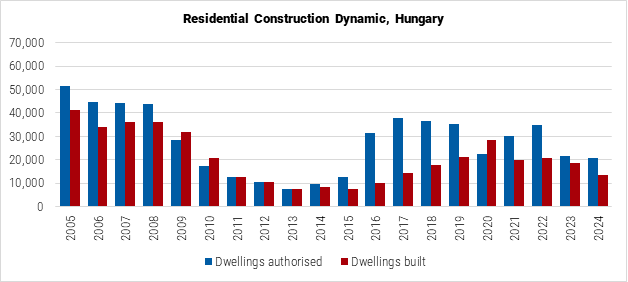
The aftermath of the 2008 global crisis was particularly devastating for the mortgage market and the construction industry in Hungary, as many transactions and development projects at the time were financed by loans based on foreign currency or state support, both brought down by the weakening forint. The decline in real house prices continued for 24 consecutive quarters, resulting in about a 21% drop in nominal prices and about a 35% drop in inflation-adjusted prices between 2008 and 2013. In parallel, dwelling deliveries kept falling as well, reaching a historic low of just 7,293 new units in 2013.
The recovery began in 2014 when the new legislation introduced by the Hungarian government required financial institutions to convert outstanding foreign currency-based loans into forint. As a result, the share of foreign exchange loans in the total value of housing loan stock dropped from nearly 53% in 2013 to 0.2% in 2015 and is a marginal 0.02% as of 2024.
Another large-scale initiative launched in 2015 to help reverse the consequences of the crisis and revive the housing market was the Family Housing Allowance Program (CSOK), which offered families with children non-refundable state subsidies for buying or extending homes. The rural CSOK (aimed at halting depopulation in rural areas) offered subsidies to those who wanted to buy or renovate a dwelling on a homestead or in a small settlement.
The resurgence in demand supported by the government subsidies and improved affordability of loans led to a period of considerable expansion that earned Hungary the reputation of one of the EU’s “hottest property markets”. Construction activity rebounded, with the annual volume of new deliveries growing by an average of 30% between 2016 and 2020 to a post-crisis high of over 28,200 new units added in 2020. Prices surged by more than 240% (over 160% inflation-adjusted) between 2014 and early 2022, with double-digit increases every year, the only exception being 2020, when the onset of the COVID-19 pandemic slowed down the growth to 8.93% (5.94% inflation-adjusted).
The global shortages and rise of construction material prices, as well as the shortage of skilled manpower in the market, led to a considerable decline in construction activity since the pandemic, further exacerbated by the inflation hike and overall economic recession in 2022-2023. In terms of prices, the market decelerated to the annual growth in nominal house prices of 12.3% and 10.0% in 2022 and 2023, respectively, which, due to high inflation, translated into an actual decrease of 8.5% in 2022 and a marginal rise of 2.1% in 2023.
The recent reversal of Hungary’s housing market began in 2024 and has been largely driven by broader economic recovery and a series of government measures including tightened regulations on short-term rentals, the extension of preferential VAT rates, the launch of a rural home renovation program, and new provisions allowing individuals to use voluntary pension fund savings or a portion of their SZÉP Card balance for housing-related expenses. On the supply side, the Housing Capital Program, launched at the end of 2024, was introduced to encourage new residential development, further supporting market growth.
In 2025, housing policy shifted toward targeted owner-occupier stimulus, centered on the Home Start program, which introduced a fixed-rate 3% mortgage channel for first-time buyers. The MNB links this policy shift to a strong demand impulse and warns that, without faster supply adjustment, stronger demand is likely to translate into further house-price increases.
20-year annual house price change (based on end-of-year MNB aggregated house price index):
| Year | Nominal house prices (%) |
Inflation-adjusted house prices (%) |
Year | Nominal house prices (%) |
Inflation-adjusted house prices (%) |
|
| 2005 | 2.70% | -0.57% | 2015 | 14.36% | 13.80% | |
| 2006 | 5.85% | -0.53% | 2016 | 15.37% | 13.92% | |
| 2007 | 11.11% | 3.76% | 2017 | 14.64% | 12.07% | |
| 2008 | 0.21% | -3.90% | 2018 | 16.51% | 12.87% | |
| 2009 | -9.26% | -13.72% | 2019 | 18.12% | 14.21% | |
| 2010 | 0.54% | -3.65% | 2020 | 8.93% | 5.94% | |
| 2011 | -3.91% | -7.66% | 2021 | 21.93% | 13.87% | |
| 2012 | -6.56% | -11.35% | 2022 | 12.30% | -8.51% | |
| 2013 | -3.56% | -4.28% | 2023 | 10.00% | 2.10% | |
| 2014 | 6.56% | 7.29% | 2024 | 14.30% | 10.09% | |
| Data Sources: MNB, Global Property Guide. | ||||||
20-year construction activity dynamic (authorized and completed housing units):
Data Source: KSH.
Property Demand Trends
Housing Demand Recovered Unevenly, With a Clear Policy-Led Upswing into Year-End
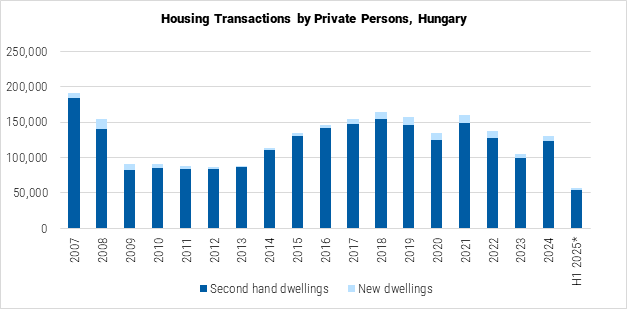
According to preliminary KSH tabulations, in H1 2025, Hungary recorded 56,656 residential transactions, down 16.33% year-on-year. Secondary-market homes still accounted for the vast majority of demand (96%), with 54,434 transactions, a 14.99% annual decline, while new-home transactions were materially weaker at 2,222 (-39.65% year-on-year). Regionally, activity remained concentrated in Budapest, where 11,850 transactions were recorded, down 31.55% year-on-year.
This apparent contraction, however, should be interpreted with caution. The KSH transaction-based datasets are administrative in nature and are completed progressively, which means in-year readings can be temporarily understated and revised as additional records are processed. In methodological terms, the KSH notes that the most recent periods are preliminary within gradually completed databases.
Note: *Preliminary data.
Data Source: KSH.
Housing transactions by private persons, by region:
| Region | Second-Hand Housing Transactions, H1 2025* |
YoY, % | New Housing Transactions, H1 2025* |
YoY, % |
| Budapest | 10,848 | -30.84% | 1,002 | -38.41% |
| Pest | 4,426 | -27.18% | 218 | -65.88% |
| Central Transdanubia | 5,874 | -7.99% | 176 | -30.71% |
| Western Transdanubia | 5,532 | -2.57% | 313 | -16.76% |
| Southern Transdanubia | 5,434 | -5.28% | 193 | -20.25% |
| Northern Hungary | 6,730 | -7.16% | 41 | -37.88% |
| Northern Great Plain | 8,264 | -7.90% | 155 | -41.73% |
| Southern Great Plain | 7,326 | -11.19% | 124 | -41.51% |
| Nationwide | 54,434 | -14.99% | 2,222 | -39.65% |
| Note: *Preliminary data. | ||||
| Data Source: KSH. | ||||
On fundamentals, the MNB describes the demand backdrop as improving through 2025 despite uneven monthly execution. In its latest Housing Market Report, the central bank states that in H1 2025 “several macroeconomic indicators determining demand in the housing market developed favorably,” citing high employment, rising real wages, stronger household balance sheets, and additional support from savings inflows out of the government-securities market.
This macro improvement was then amplified by policy: the Otthon Start (Home Start) Program launched in September 2025 with widely available fixed-rate loans at a preferential 3% rate. Consistent with a policy-driven timing effect, the MNB reports that ingatlan.com’s demand proxy for homes for sale rose by 46% year on year in August and 26% in September; estimated completed transactions also rebounded to around 16,400 in September, up 37% year on year.
Taken together, the most defensible cross-source reading is that recorded activity was patchy early in the year and likely affected by preliminary-record effects, while underlying demand momentum improved materially from late summer into Q3, with a visible policy-related spike around Otthon Start. For full-year 2025, Duna House estimates approximately 129,000 residential transactions, at the upper end of its earlier 120,000–130,000 guidance range, representing a 3.61% year-on-year increase.
For 2026, experts point to elevated but uneven housing demand rather than a straight-line acceleration. Duna House expects turnover to remain broadly in the 110,000–130,000 band, while OTP Jelzálogbank describes near-term conditions as volatile but still supportive, noting that Q1 2026 could strengthen again and that annualized activity could reach 180,000–200,000 if favorable credit conditions persist.
Property Supply Trends
Pipeline Momentum Improves While Completion Volumes Stay Historically Low
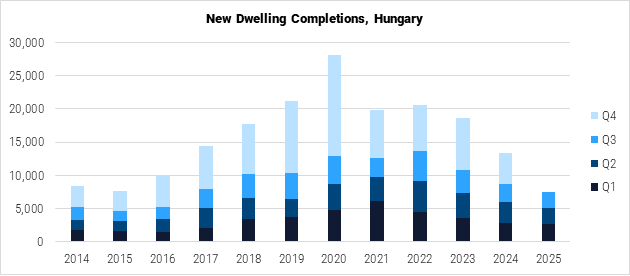
Residential construction in Hungary remained weak in 2025, despite early signs of pipeline rebuilding. According to the KSH reporting, 7,490 dwellings were completed nationwide in Q1–Q3 2025, down 14.00% year-on-year. The MNB characterizes this as a low-delivery phase, noting that output for this period has not been this weak since 2016.
The geographic distribution of completions remained concentrated in and around the capital. Budapest accounted for approximately 33% of national completions, followed by Pest County (26%), Transdanubia (25%), and the Great Plain and North region (15%). Within Budapest, 57% of newly delivered homes were concentrated in Districts VIII, IX, and XI.
Data Source: KSH.
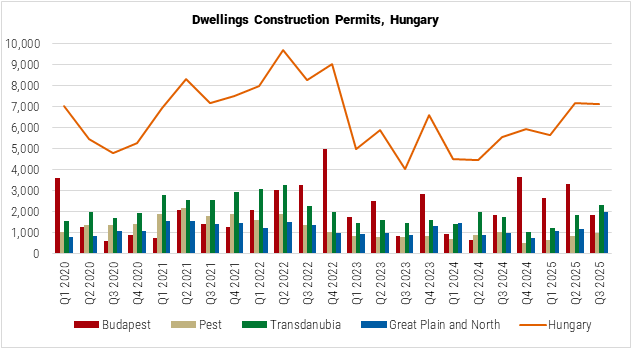
In contrast, forward-looking indicators strengthened materially. The KSH data shows that dwellings authorized for construction increased by 37.08% year-on-year in Q1–Q3 2025, reaching 19,947 units. Budapest led this upswing, with 7,841 permits issued, 2.3 times the level recorded a year earlier. Permit issuance was also highly concentrated: four districts accounted for more than three-quarters of all approvals in the capital, with District XI alone receiving permits for approximately 3,400 dwellings. In parallel, MNB, citing iBuild data, reports a sharp rise in new starts in H1 2025 (around 8,700 units in multi-dwelling projects nationwide, +133% year-on-year; +238% in Budapest), pointing to improving development momentum.
The permit rebound, however, should be interpreted with caution. The MNB indicates that part of the increase, particularly in Q2, likely reflected projects brought forward ahead of the July 2025 implementation of stricter TÉKA rules (updated baseline urban-planning and construction requirements), with additional support from measures linked to the Home Start program.
Data Source: KSH.
Key dwellings supply indicators, by region:
| Region | Number of dwellings completed, Q1-Q3 2025 |
YoY, % | Number of construction permits issued, Q1-Q3 2025 |
YoY, % |
| Budapest | 2,509 | -9.13% | 7,841 | 131.23% |
| Pest | 1,916 | 1.64% | 2,480 | -5.74% |
| Transdanubia | 1,908 | -22.00% | 5,369 | 4.37% |
| Great Plain and North | 1,157 | -28.45% | 4,257 | 25.76% |
| Nationwide | 7,490 | -14.00% | 19,947 | 37.08% |
| Data Source: KSH. | ||||
Looking ahead, the MNB projects around 12,400 housing completions for full-year 2025 (approximately 7% year-on-year decline), with no material increase expected through Q1–Q3 2026. This combination of still-low completions and stronger starts is consistent with a lagged supply response, with a more visible impact on delivered stock likely from 2027 onward. Overall, the near-term outlook remains one of tight effective supply despite improving forward indicators.
Mortgage Market and Interest Rates
New Subsidized Program Supports Demand for Housing Loans
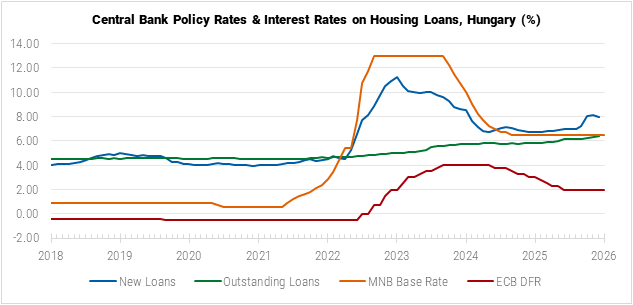
Both the European and the Hungarian regulators have maintained their respective policy rates in the second half of 2025 and early 2026. The European Central Bank (ECB) has kept its deposit facility rate at 2.00% since June 2025, and the MNB has kept its base rate at 6.50% since September 2024.
Hungary's mortgage loan interest rates:
Despite the overall monetary policy stabilization, interest rates on housing loans in Hungary trended upwards in recent months. In December 2025, the ECB reporting showed the average interest rate on new housing loans at 8.00%, 1.25 p.p. up from December 2024, while for outstanding loans the indicator reached 6.39%, demonstrating a 0.60 p.p. increase from the same period a year prior.
Apart from lenders passing on their long-term financing costs to customers, the uptick in the average interest rate on newly issued loans is primarily attributed to the launch of the Otthon Start (Home Start) subsidized mortgage program for first-time buyers in September 2025. The new scheme offering loans on properties priced up to HUF 1.5 million per sqm at a fixed 3% interest rate for a maximum term of 25 years led to a rise in the proportion of subsidized loans (which typically have a higher annual percentage rate of charge compared to market-priced loans) in overall disbursements, which, in turn, pushed up the average rate.
The December 2025 report from the MNB shows the APRC on new housing credit to households at 8.44% for subsidized loans and 6.63% for market-priced loans.
Data Sources: ECB, MNB.
Average interest rates on loans to households for house purchase:
| Dec 2025 | YoY | Dec 2024 | YoY | Dec 2023 | |
| New housing loans | 8.00% | ↑ | 6.75% | ↓ | 8.65% |
| - Floating rate and IRF up to 1 year | 8.41% | ↑ | 7.77% | ↓ | 8.20% |
| - IRF of over 1 and up to 5 years | 8.38% | ↑ | 6.62% | ↓ | 12.93% |
| - IRF of over 5 and up to 10 years | 6.15% | ↓ | 6.30% | ↓ | 7.18% |
| - IRF of over 10 years | 6.77% | ↑ | 6.69% | ↓ | 7.51% |
| Outstanding housing loans | 6.39% | ↑ | 5.79% | ↑ | 5.73% |
| - Original maturity up to 1 year | 7.37% | ↑ | 7.18% | ↓ | 9.95% |
| - Original maturity over 1 and up to 5 years | 6.45% | ↑ | 6.14% | ↑ | 5.71% |
| - Original maturity of over 5 years | 6.39% | ↑ | 5.78% | ↑ | 5.73% |
| Data Source: ECB. | |||||
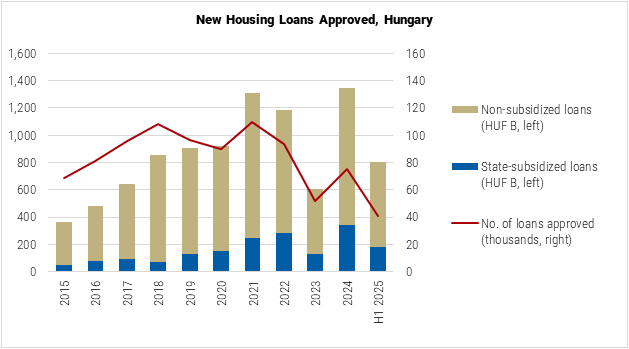
The improvement in lending conditions, compared to the period of elevated interest rates and heightened uncertainty in 2022-2023, continues to support a rebound in new lending in Hungary. In the first half of 2025, the KSH reported a total of 40,680 approved loans amounting to HUF 802.6 billion (USD 2.0 billion), a 6.5% increase in volume and a 26.5% increase in value compared to the same period in 2024. The proportion of government-subsidized loans in new approvals stood at 22.2% during this period and is set to increase in the following quarters with the launch of Home Start. According to the MNB, in Q3 2025, the majority of Hungarian banks experienced an upturn in demand for housing loans and expect this trend to continue, supported by wider use of the new subsidized scheme.
Home lending continues to be dominated by loans for the purchase of second-hand dwellings, which accounted for 76.5% of the total amount disbursed in H1 2025. Simultaneously, the purchase of new dwellings represented only 11.6% of the total amount of credit extended.
Data Source: KSH.
In this environment, the use of financing for home purchase and the overall size of the Hungarian mortgage portfolio continue to expand as well. In its most recent analysis of the housing market, the MNB noted that “the share of homes purchased with loans has been steadily rising since the end of 2024, and the 39% rate seen in [Q2 2025] exceeded the long-term average”.
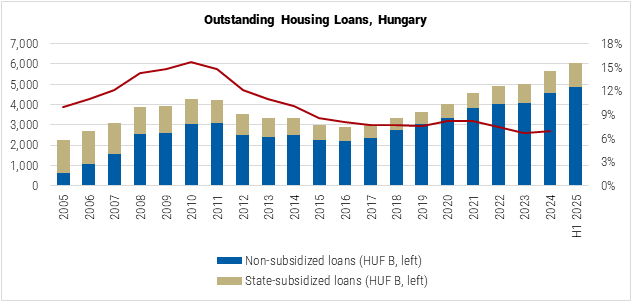
The total value of outstanding housing loans in Hungary reached HUF 6.1 trillion (USD 15.0 billion) as of H1 2025, a 7.3% increase since the end of the previous year. Subsidized loans comprised about 20% of the stock. The relative size of the market represented by the loans-to-GDP ratio has declined substantially in recent years, however, dropping from an estimated 15.6% of GDP at current prices in 2010 to 6.9% in 2024.
Data Source: KSH.
Rental Market: Rents and Rental Yields
Rental Growth Slows Further, Decline in Yields Continues
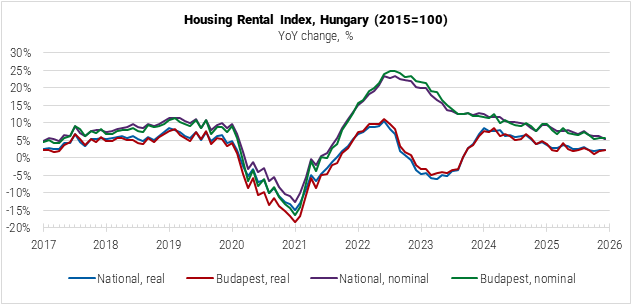
In the second half of 2025, rental inflation in Hungary continued to moderate, now reaching levels previously observed in 2017-2018. According to experimental statistics reported by the KSH together with the property website Ingatlan.com, the year-on-year growth of the nominal rent index in December 2025 was recorded at 5.5% nationwide and 5.6% in Budapest, down from the respective 7.3% and 6.7% in June. In real terms, rental growth reached 2.1% nationwide and 2.3% in Budapest, compared to the respective 2.6% and 2.0% six months prior.
Hungary's rent price index:
On the regional level, the most pronounced annual increase in the nominal rent index was observed in the Southern Great Plain (11.8%), followed by Pest (7.6%), while the slowest growth was reported in the Northern Great Plain (0.9%).
Data Sources: KSH, Inglatan.com.
In nominal terms, average asking rents, as reported by the KSH and Ingatlan.com, ranged from HUF 274,000 (USD 678) in Pest and HUF 272,000 (USD 673) in the capital city of Budapest to HUF 142,000 (USD 351) in Northern Hungary in H1 2025.
Decent Rental Yields
According to research by Global Property Guide, as of July 2025, gross rental yields for apartments in Hungary averaged 5.09%, down from 5.11% previously reported in January of that year and 5.78% in March 2024. Among the monitored regional submarkets, the highest average yield was observed in Debrecen (5.47%) and Budapest (5.03%), while Nyíregyháza and Pécs showed slightly lower potential performance at 4.94% and 4.93%, respectively.
The latest housing market report from the MNB also indicated a continued compression of rental yields in Budapest and rural towns alike, with investors now “present in higher numbers on the supply side of the market”.
Average monthly rent (based on home rental ads posted on ingatlan.com):
| Region | Average monthly rent, HUF H2 2025 |
Average monthly rent, USD H2 2025 |
Annual change, H2 2025 vs H2 2024 |
| Budapest | HUF 272,000 | USD 673 | 6.0% |
| Pest | HUF 274,000 | USD 678 | 5.5% |
| Central Transdanubia | HUF 197,000 | USD 487 | 5.7% |
| Western Transdanubia | HUF 194,000 | USD 480 | 8.2% |
| Southern Transdanubia | HUF 183,000 | USD 453 | 5.7% |
| Northern Hungary | HUF 142,000 | USD 351 | 4.5% |
| Northern Great Plain | HUF 222,000 | USD 549 | 5.6% |
| Southern Great Plain | HUF 181,000 | USD 448 | 11.8% |
| Note: Exchange rate as of Q2 2025, USD 1 = HUF 404.11. | |||
| Data Source: KSH. | |||
Overall, the rental market in Hungary remains limited, as the country’s homeownership ratio is one of the highest in the EU at over 91%, according to Eurostat data. At the same time, only 4.2% of the population are tenants renting at market rates. Based on national census data, the share of renting households in Budapest is notably above the national average (around 9%) and reached 17.5% during the 2022 Census. Both in the capital and nationwide, this indicator is up, however, from the respective 7.4% and 12.7% reported a decade earlier during the 2011 Census.
Looking ahead, the diverging trends in sales prices and rents across Hungary may lead some prospective buyers to choose renting instead due to affordability issues. The MNB analysis notes intensifying signs of overvaluation in the market, with the value of the house price-to-rent ratio now significantly exceeding the level typically seen in the past two decades. “In the longer term, this may steer buyers purchasing homes for housing purposes towards renting and buyers looking to rent out properties towards other investment instruments,” the central bank experts believe.
Economic and Social Factors
Modest Recovery Underway, Inflation Still Above Target
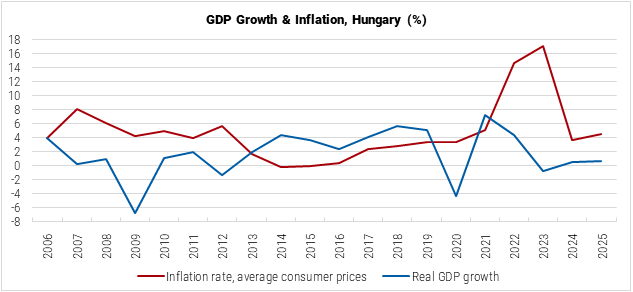
Following a 0.8% contraction in 2023, the Hungarian economy has been slowly recovering, with real GDP growth of 0.5% in 2024 and an estimated 0.6% in 2025, supported primarily by domestic demand. In the next two years, the European Commission forecasts a moderate acceleration in economic activity, supported by fiscal stimulus, with growth projected at 2.3% in 2026 and 2.1% in 2027.
In parallel, although consumer price index (CPI) inflation in the country has decreased from the peak level of 17.1% in 2023 to 4.5% in 2025, underlying inflationary pressures remain strong. While the most recent reporting from the KSH showed inflation slowing from 4.3% in mid-2025 to 2.1% in January 2026, the analysis from the European Commission points out that prices are likely to adjust upward once the temporary regulations implemented by the Hungarian government last year end. In the next two years, average inflation is set to moderate but remain above target at projected 3.6% in 2026 and 3.5% in 2027.
“The Hungarian economy is at a challenging juncture with stagnant output over the past three years and inflation above target,” the 2025 Article IV staff report from the IMF summarized.
Data Source: IMF.
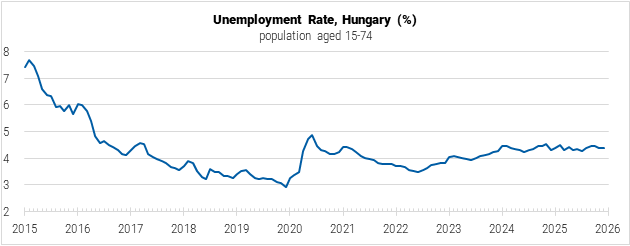
While remaining tight by historical standards, the Hungarian labor market eased somewhat in recent years, with the unemployment rate for the population aged 15-74 increasing from 3.5% in mid-2022 to 4.4% in December 2025, according to the KSH reporting. The average net monthly earnings in the country reached HUF 525,900 (USD 1,369) in November 2025, a 6.2% year-on-year increase.
According to the European Commission’s forecast, a pick-up in economic growth expected this year is projected to raise private sector employment and lower the unemployment rate to the average annual level of 4.3% by 2027. Nominal wage growth is set to remain elevated in 2026, driven by public sector and minimum wage increases, but is projected to moderate in 2027 as these impacts ease.
Data Source: KSH.
Overall, Hungary’s economic recovery continues to face headwinds, with a further escalation in trade measures, intensification of regional conflicts, a delay in the required fiscal adjustment domestically, and cancellation of EU funds, posing significant downside risks to growth, according to the IMF assessment.
Reflecting the projected widening of Hungary’s general government deficit, rising debt levels, and “uncertain fiscal consolidation path” characterized by frequent revisions to the government's targets, in December 2025, Fitch Ratings revised the outlook for the country’s ‘BBB’ standing from stable to negative.
Sources:
- Hungarian Central Statistical Office (KSH)
- Census Database: https://nepszamlalas2022.ksh.hu/
- Housing: https://www.ksh.hu/
- HCSO–ingatlan.com Rent Index, December 2025: https://www.ksh.hu/
- Employment and Unemployment First Releases, December 2025: https://www.ksh.hu/
- Earnings First Releases, November 2025: https://www.ksh.hu/
- Consumer Prices First Releases, January 2026: https://www.ksh.hu/
- Press Release: Fewer New Dwellings, More Construction Permits: https://www.ksh.hu/
- Hungarian National Bank (MNB)
- MNB Statistics: https://statisztika.mnb.hu/
- MNB House Price Index: https://statisztika.mnb.hu/
- Housing Market Report November 2025: https://www.mnb.hu/
- Information Release on Household and Non-Financial Corporate Sector Interest Rates: https://statisztika.mnb.hu/
- Exchange Rates: https://www.mnb.hu/
- Base Rate History: https://www.mnb.hu/
- Press Release on the Monetary Council Meeting of 27 January 2026: https://www.mnb.hu/
- Government of Hungary
- Fixed 3 Percent Home Loan for First-Time Home Buyers (HU): https://startolj-ra.hu/
- European Commission
- In-Depth Review 2025: Hungary: https://economy-finance.ec.europa.eu/
- Economic Forecast for Hungary: https://economy-finance.ec.europa.eu/
- Distribution of Population by Tenure Status, Type of Household, and Income Group: https://ec.europa.eu/
- European Central Bank (ECB)
- ECB Data Portal: https://data.ecb.europa.eu/
- Key ECB Interest Rates: https://www.ecb.europa.eu/
- International Monetary Fund (IMF)
- Country Overview: Hungary: https://www.imf.org/
- 2025 Article IV Staff Report: https://www.imf.org/
- OTP Jelzálogbank
- The Home Start Program Brought an Unprecedented Boost… (HU): https://www.otpbank.hu/
- RE/MAX Hungary
- Housing Market Report – 2025 Q2: https://www.remax.hu/
- Duna House
- Duna House Barometer – Issue 174, Q4 2025 and December 2025: https://newdhapi01.dh.hu/
- Fitch Ratings
- Fitch Revises Hungary's Outlook to Negative; Affirms at 'BBB': https://www.fitchratings.com/
- OTP Ingatlanpont
- Can the Price Increase Continue?… (HU): https://www.otpip.hu/
- ScienceDirect
- Dwellings and Housing Market in Hungary, 1990-2015: https://www.sciencedirect.com/