Austria's Residential Property Market Analysis 2026
As the Austrian economy gradually emerges from a two-year recession, the country’s housing market is entering a mild nominal recovery, supported by lower financing costs and stabilizing purchasing power against the background of persistent supply tightness.
This extended overview from Global Property Guide covers key aspects of the Austrian housing market and takes a closer look at its most recent developments and long-term trends.
Table of Contents
- Property Prices and Price Index
- Property Demand Trends
- Property Supply Trends
- Rental Market: Rents and Rental Yields
- Mortgage Market and Interest Rates
- Economic and Social Factors
Property Prices and Price Index
From its 2022 expansion peak, Austria’s housing market moved through a two-year correction and entered a mild nominal recovery in 2025. The National Bank of Austria (OeNB) reports that, as of Q4 2025, the nationwide Residential Property Price Index (RPPI) rose by 2.12% year-on-year; however, in real (inflation-adjusted) terms, prices remained in decline, falling by 1.74%. In the OeNB’s wording, the market is “gradually stabilizing after the interest-rate turnaround,” with nominal growth returning while affordability remains improved relative to the 2022 peak period.
Regional divergence is visible, though moderate. Vienna outperformed, with price growth of 2.93% year-on-year versus 1.57% in Austria excluding Vienna. At a more granular level in Q4 2025, condominium prices increased by 3.08% in Vienna and 1.23% outside Vienna, while single-family house prices rose by 1.37% in Vienna and 2.09% outside Vienna.
Austria's house price annual change:
From a market-structure perspective, the key pricing feature remains the new-versus-existing split. The OeNB figures show that during the tightening phase (Q3 2022–Q2 2024), existing apartments corrected materially more than new stock. Since the first ECB rate cut (June 12, 2024), both segments have rebounded, with new apartments again showing stronger momentum. The OeNB attributes this to limited downward flexibility in new-build pricing, linked to previously high land, construction, and financing costs, as well as embedded return expectations.
Price trends in new and existing condominiums:
| Policy Rate at the Effective Lower Bound, Q3 2020 – Q2 2022 |
First Policy Rate Increase, Q2 2022 – Q2 2024 |
First Policy Rate Cut, Q3 2024 – Q4 2025 |
|
| Existing condominiums | |||
| Vienna | 20.5% | -9.4% | 2.8% |
| Austria, excl. Vienna | 24.1% | -6.5% | 1.9% |
| New condominiums | |||
| Vienna | 21.3% | -0.1% | 3.8% |
| Austria, excl. Vienna | 22.7% | 2.9% | 2.7% |
| Data Source: OeNB. | |||
Transaction-based evidence from RE/MAX/IMMOunited supports this stabilization narrative. In H1 2025, the average transacted condominium price reached EUR 263,639 (USD 306,717) per unit (+2.84% year-on-year) and EUR 4,300 (USD 5,003) per square meter (+3.30% year-on-year), with the highest per-unit levels recorded in western states and the highest per square meter level in Vienna (EUR 5,464/USD 6,357). RE/MAX links improving activity to a combination of lower financing pressure, income adjustments, and prior price corrections, while noting that high construction costs are shifting part of the demand toward existing stock.
Condominium price dynamics by region:
| Avg price per unit, EUR |
Avg price per unit, USD |
YoY, % | Avg price per sqm, EUR |
Avg price per sqm, USD |
YoY, % | |
| Vienna | EUR 311,814 | USD 362,764 | 3.20% | EUR 5,464 | USD 6,357 | 6.10% |
| Styria | EUR 177,567 | USD 206,581 | -0.70% | EUR 2,849 | USD 3,315 | 1.30% |
| Upper Austria | EUR 227,962 | USD 265,211 | 1.10% | EUR 3,406 | USD 3,963 | -0.80% |
| Lower Austria | EUR 207,710 | USD 241,650 | 2.70% | EUR 3,386 | USD 3,939 | -4.90% |
| Tyrol | EUR 323,537 | USD 376,403 | 5.50% | EUR 4,839 | USD 5,630 | 7.00% |
| Salzburg | EUR 322,806 | USD 375,553 | 2.10% | EUR 5,133 | USD 5,972 | 3.00% |
| Vorarlberg | EUR 354,753 | USD 412,720 | 10.00% | EUR 5,227 | USD 6,081 | 6.70% |
| Carinthia | EUR 224,509 | USD 261,194 | -2.70% | EUR 3,754 | USD 4,367 | -1.70% |
| Burgenland | EUR 140,185 | USD 163,091 | -6.47% | EUR 1,965 | USD 2,286 | -48.00% |
| Austria | EUR 263,639 | USD 306,717 | 2.84% | EUR 4,300 | USD 5,003 | 3.30% |
| Note: Exchange rate as of Q4 2025, USD 1 = EUR 0.8595. | ||||||
| Data Source: RE/MAX based on IMMOunited data. | ||||||
In the single-family segment, the national average price rose to EUR 337,052 (USD 392,126), up 2.20% year-on-year. Vienna remained a high-price outlier at a unit price of EUR 778,707 (USD 905,948), despite a 6.60% year-on-year decline. The data, however, should be interpreted with caution: the city’s single-family segment is relatively thin, district-level outcomes are highly dispersed, and RE/MAX notes that a statistically robust “typical price” can be derived only for a limited subset of districts in a given half-year.
Single-family homes price dynamics by region:
| Avg price per unit, EUR |
Avg price per unit, USD |
YoY, % | |
| Lower Austria | EUR 274,097 | USD 318,884 | 1.90% |
| Styria | EUR 281,814 | USD 327,862 | 6.30% |
| Upper Austria | EUR 345,335 | USD 401,763 | 4.60% |
| Carinthia | EUR 314,323 | USD 365,683 | 8.10% |
| Burgenland | EUR 198,502 | USD 230,937 | -2.20% |
| Salzburg | EUR 627,181 | USD 729,662 | -9.10% |
| Tyrol | EUR 707,973 | USD 823,656 | -13.70% |
| Vienna | EUR 778,707 | USD 905,948 | -6.60% |
| Vorarlberg | EUR 617,842 | USD 718,797 | -11.10% |
| Austria | EUR 337,052 | USD 392,126 | 2.20% |
| Note: Exchange rate as of Q4 2025, USD 1 = EUR 0.8595. | |||
| Data Source: RE/MAX based on IMMOunited data. | |||
Looking ahead, moderate nominal appreciation is expected to continue in 2026. RE/MAX’s RREFIX, a cross-segment real-estate sentiment survey, points to annual price growth of roughly 3.4% nationwide and around 4.2% in Vienna, with the market described as entering a steadier, less volatile phase. Raiffeisen Research, which focuses exclusively on housing, is more conservative, projecting approximately 2.5% year-on-year growth in Austrian residential prices in 2026, as lower financing costs and stabilizing purchasing power support demand without signaling an overheating cycle.
The medium-term upside risk remains mainly supply-driven. RE/MAX experts warn that insufficient new construction could mean “more demand meets less supply,” increasing price pressure by 2027/2028, while CBRE describes residential conditions as “extremely tight,” with “no sign of a trend reversal” in near-term supply dynamics.
Property Demand Trends
Market Sentiment Strengthens, Signaling Continued but Orderly Demand Recovery
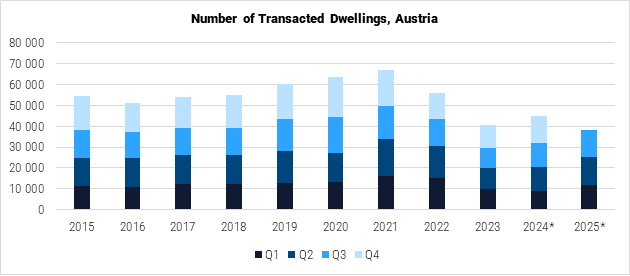
After two subdued years, 2025 marked a visible recovery in Austrian housing demand. Preliminary Statistics Austria tabulations indicate 38,329 dwelling transactions recorded in Q1–Q3 2025, up 19.91% year on year, while the value of transacted dwellings increased by 22.17% to EUR 13.51 billion. Beyond base effects, the pattern points to better market execution, as improved financing visibility helped convert previously deferred demand into completed purchases.
Engel & Völkers characterizes 2025 as a “turning point,” linking the rebound in buyer willingness to interest-rate stabilization and gradually easier financing conditions. RE/MAX similarly attributes the improvement to lower rates, temporary fee relief for many land-registry entries, and “habituation effects” after the shock period, as households adjusted to the post-2022 financing environment.
Note: *Preliminary data.
Data Source: Statistics Austria.
This national pattern is clearly visible in Vienna, with the real estate service provider EHL reporting a noticeable recovery in condominium demand and a gradual shift toward owner-occupation, supported by lower financing costs versus recent peaks, sustained rental-market pressure, and a broader selection of units in the for-sale segment. As Karina Schunker, Managing Director of EHL Wohnen, notes: “The sharply increased rents on the one hand and the lower interest rates compared to previous years, with improved financing conditions, on the other, make condominiums significantly more attractive again from a financial perspective.” EHL also highlights improving buy-to-let investor interest and stronger foreign demand, especially from Central and Eastern European buyers, reinforcing Vienna’s role as a stable destination market and a key demand anchor.
Looking ahead, industry sentiment points to a broad-based normalization in Austrian housing demand, as confidence has improved across segments. RE/MAX’s latest market view suggests that the recovery is becoming more synchronized across property categories, with the breadth of confidence now more notable than the magnitude of growth itself. As Anton Nenning (RE/MAX Austria) notes, the “stuttering restart” of 2025 appears to have been overcome, with expectations for a steadier, more orderly market in 2026.
Till-Fabian Zalewski, CEO of Engel & Völkers D-A-CH, similarly emphasizes continuity of the trend: “Interest rate stability ensures planning security, which restores buyer confidence. For 2026, we expect this trend to continue – with rising transaction numbers and moderate price increases, especially in regions with high new-build demand.”
Property Supply Trends
Structural Supply Tightness Persists Despite Early Permit Improvement
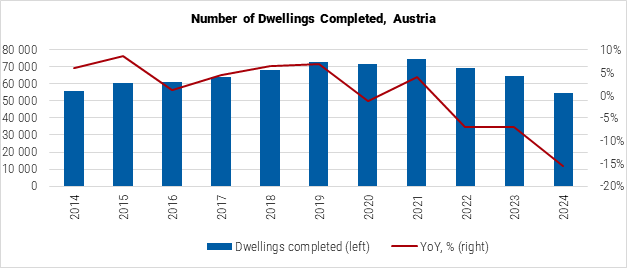
Supply-side indicators continue to signal a historically weak phase in Austria’s residential construction cycle. According to the latest available data from Statistics Austria, 54,472 dwellings were completed nationwide in 2024, down 15.59% year on year; of these, 41,762 were completed in new buildings, down 20.19%. This marks the third consecutive annual decline in completions and confirms that the construction downturn is now fully visible in delivered stock.
“There are currently significantly fewer new flats on the market than in previous years. <…> completions in residential construction are following the trend in building permits with a time lag. Since 2021, we have seen declines compared to the previous year, which were particularly sharp in 2022 and 2023 and only leveled off somewhat in 2024. We therefore expect to see significantly fewer completions in residential construction in the coming years,” Manuela Lenk, Director General of Statistics at Statistics Austria, explained.
Data Source: Statistics Austria.
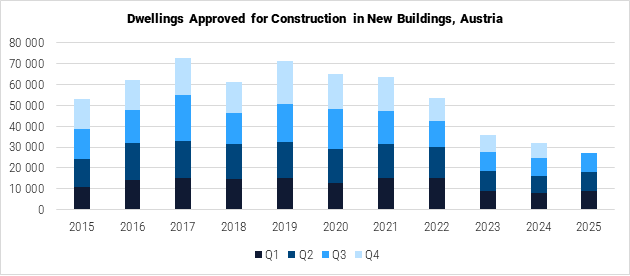
Permit dynamics improved in 2025, but from a very low base. In the first three quarters, 27,000 dwellings in new buildings were authorized, up 8.12% year on year. With 2024 marking the lowest level of new-building permits since 2010, the 2025 increase is better interpreted as early stabilization than a full recovery signal. This implies that any improvement in completions is likely to remain delayed and gradual.
Data Source: Statistics Austria.
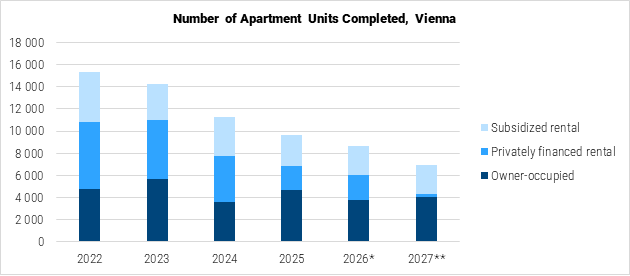
Vienna-specific evidence from EHL indicates that supply tightness is already binding in the core urban market. In 2025, completions fell to 9,688 units (-14% year on year; -32% versus 2023), dropping below 10,000 for the first time in almost a decade. The decline was most pronounced in privately financed rental housing (2,087 units, -49% year on year), while subsidized rental delivery fell to 2,894 units (-19%). The temporary increase in owner-occupied completions (+31% year-on-year) mainly reflected project repositioning (rental schemes sold unit-by-unit), rather than a structural recovery in new supply. EHL’s baseline points to a further decline in the capital’s completions to around 8,630 units in 2026.
At the national level, industry pipeline expectations also suggest that the trough in delivery is still ahead. WKO/Exploreal’s New Construction Report points to further weakness in completions through 2026, followed by stabilization in 2027 and recovery only from 2028 onward. Overall, the near-term outlook remains one of constrained residential delivery, with any recovery expected to be gradual.
Note: *EHL Forecast | **As known at the time of the publication.
Data Source: EHL.
Rental Market: Rents and Rental Yields
Inflation Curbed by New Regulation, Undersupply in Vienna Drives Up Asking Rates
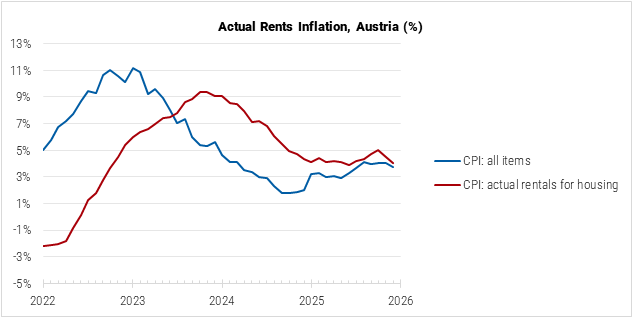
After falling from its peak levels previously reached in late 2023, rental inflation in Austria (as measured by the annual change in actual rentals for the housing component of the consumer price index) continued to trend above the overall price growth in the country in 2025, but followed a more steady trajectory, indicating market stabilization. In December 2025, Statistics Austria reported the indicator at 4.1%, while the all-item CPI registered a 3.8% growth.
Austria's rent price index:
Moving forward, rental inflation in Austria is expected to be constrained by the affordable rents regulations package introduced by the federal government in the fall of 2025. The new measures establish common rules for nearly all rental agreements, allowing landlords to increase rates for existing contracts only once a year and setting limits on those increases. For the unregulated sector, if inflation exceeds 3%, only half of the portion above that threshold can be passed on as a rent increase. For the regulated sector, increases were capped at 1%. Aiming to mitigate the trend towards short-term leases, the package also extended the minimum fixed-term lease for all new or renewed agreements from 3 to 5 years.
“We have halted rent increases for 2025 and have now capped them for the coming years as well,” Housing Minister Andreas Babler commented on the reform. “And, this is particularly important to me: rent control now also applies to the previously unregulated market. This means that tenants will never again face such dramatic price increases as in the past.”
Accounting for the impact of these measures, the OeNB now projects that unregulated rents will rise by 3.3% in 2026, instead of approximately 3.6% expected before the package was approved.
Data Source: Statistics Austria.
In nominal terms, the nationwide average rent reached EUR 507.3 (USD 592.6) per unit and EUR 7.7 (USD 9.0) in Q3 2025, Statistics Austria reports, both indicators registering moderate year-on-year growth of 2.2% and 4.1%, respectively. Regionally, over the past decade, the highest average rents have been consistently observed in the states of Salzburg, Tyrol, Vorarlberg, and Vienna, while Burgenland, Carinthia, Lower Austria, Upper Austria, and Styria remained more affordable with rents typically below the national average.
Low Rental Yields
Against this background, gross rental yields for housing in Austria averaged 3.82%, according to research by Global Property Guide conducted in January 2026, up from 3.70% previously reported in July 2025 and 3.50% in January 2025. The strongest potential performance among the monitored submarkets was observed in Vienna (4.84%), while in Graz and Salzburg, average yields were notably lower as 3.73% and 2.91%, respectively.
Average rents (running costs not included):
| EUR Q3 2025 | USD Q3 2025 | YoY, % (Q3 2025 vs Q3 2024) |
|
| Average rent per unit | EUR 507.3 | USD 592.6 | 2.2% |
| Average rent per sqm | EUR 7.7 | USD 9.0 | 4.1% |
| Note: Exchange rate as of Q3 2025, EUR 1 = USD 1.1681. | |||
| Data Source: Statistics Austria. | |||
As of 2024, 45.5% of households in Austria were reported to be renting their residence. With over 41% of Austria’s rented dwellings concentrated in the capital region, Vienna remains the largest rental submarket in the country, which, nonetheless, is consistently undersupplied, according to local experts. The undersupply, in turn, supports consistent growth in asking rents, especially for well-located new properties.
According to the real estate company OTTO Immobilien, the average asking price for first-time occupancy and new construction rentals in Vienna ranges from EUR 13.97 per sqm in District 11 to EUR 23.30 per sqm in District 1, and continues to move in only one direction-upwards. “We recorded significant increases in all districts. The continuing high demand for rental apartments and the low supply that has persisted for years are currently putting prices under severe pressure,” noted the company’s fall 2025 market report. “New projects with high-quality fittings in good locations, in particular, are achieving peak values that hardly anyone on the Vienna housing market would have thought possible a few years ago. Due to the subdued demand for residential property over the last two years, rental properties are increasingly in demand and are being quickly absorbed by the market.”
Looking forward, the long-standing demand-supply gap is expected to continue putting pressure on asking rents in the capital. In their 2026 Austria Real Estate Market Outlook, CBRE experts project prime rents will reach EUR 20.30 per sqm in top locations, while average rents will also see an increase. “Given the current developments [severe supply shortage and limited number of rental apartments expected to be handed over in 2026], rents in Vienna will continue to rise this year,” the CBRE report summarized. “The amount of newly signed rental agreements is also taking on greater importance, as the adopted rent control law means that existing agreements can only be adjusted once a year.”
Mortgage Market and Interest Rates
Lower Interest Rates Stimulate Demand for Housing Loans
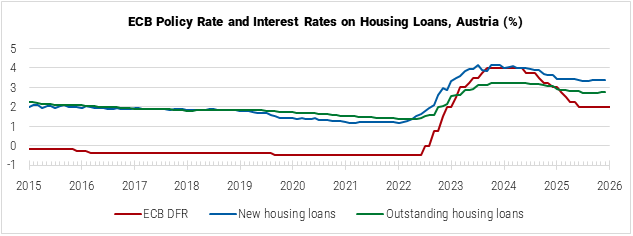
The European Central Bank’s (ECB) monetary policy easing cycle is now clearly over after eight consecutive cuts, with key rates on hold since June 2025 (the deposit facility rate at 2.00%, the main refinancing operations rate at 2.15%, and the marginal lending facility rate at 2.40%) and no further moves announced at the February 2026 meeting of the Governing Council.
Austria's mortgage loan interest rates:
Along with the trajectory of the regulator’s benchmarks, the average interest rates on new and existing loans to households for house purchase in Austria have fallen from their peak levels previously observed in late 2023 and early 2024, and have been relatively stable in recent months. The indicator was most recently reported at 3.38% for new housing loans and 2.74% for outstanding housing loans in December 2025. Any notable shifts are unlikely in the upcoming months as the ECB is now expected to maintain its current rates for the rest of 2026.
Florian Pfaffinger, a member of the expert council of Dr. Klein Privatkunden AG, cited by Haufe, believes the sideways movement of mortgage interest rates observed over the past months will continue in 2026, and expects the levels to be between 3.1% and 3.7% this year. The expert also notes that these levels are already seen as the new normal by potential property buyers in Austria, which supports renewed investment in residential property: "People have accepted that it's not worth waiting for interest rates to fall [further]."
Data Source: ECB.
Average interest rates on loans to households for house purchase:
| Dec 2025 | YoY | Dec 2024 | YoY | Dec 2023 | |
| New housing loans | 3.38% | ↓ | 3.62% | ↓ | 4.16% |
| - Floating rate and IRF up to 1 year | 3.32% | ↓ | 4.33% | ↓ | 5.05% |
| - IRF of over 1 and up to 5 years | 3.37% | ↓ | 3.70% | ↓ | 4.22% |
| - IRF of over 5 and up to 10 years | 3.27% | ↓ | 3.42% | ↓ | 3.93% |
| - IRF of over 10 years | 3.44% | ↑ | 3.36% | ↓ | 3.38% |
| Outstanding housing loans | 2.74% | ↓ | 3.08% | ↓ | 3.22% |
| - Original maturity up to 1 year | 3.70% | ↓ | 4.73% | ↓ | 5.22% |
| - Original maturity over 1 and up to 5 years | 3.62% | ↓ | 4.32% | ↑ | 4.14% |
| - Original maturity of over 5 years | 2.73% | ↓ | 3.05% | ↓ | 3.19% |
| Data Source: ECB. | |||||
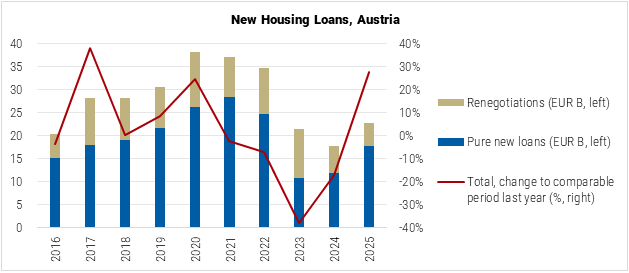
According to the results of the bank lending survey published by the OeNB, lower interest rates, along with rising real household incomes, indeed boosted demand for housing loans in Austria throughout 2025. This assessment is supported by the ECB data, which shows a 27.5% annual increase in the total value of all new housing loans, which reached EUR 22.7 billion (USD 25.7 billion) in 2025. Pure new loans demonstrated a 48.4% year-on-year growth, while renegotiations dropped by 15.1%, also pointing to a more dynamic market.
Previously, apart from elevated interest rates, the mortgage market in Austria had been significantly slowed by the Credit Institutions Real Estate Financing Measures Ordinance (KIM-V)-a regulation established by the Financial Market Authority (FMA) to contain the overheating market and requiring, among other things, 20% equity, a 40% debt service limit, and a maximum loan term of 35 years. After its expiration in mid-2025, the relaxation of credit conditions by individual lenders became possible, although the FMA continues to encourage banks to informally adhere to prudent lending standards.
Data Source: ECB.
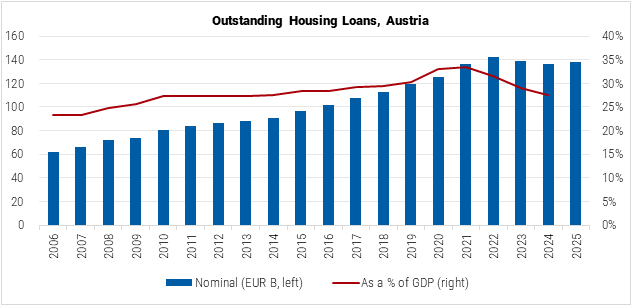
In this environment, the overall mortgage portfolio in Austria also returned to growth in 2025 after two years of declines. According to the ECB, the total value of outstanding housing loans in the country stood at EUR 138.1 billion (USD 156.1 billion) at the end of the year, a modest 1.3% increase compared to end-2024.
At the same time, the relative size of the market has declined in recent years from an estimated 33.5% of GDP at current prices in 2021 to an estimated 27.6% in 2024. Austria also maintains a moderate level of indebtedness, with 22.6% of households reported as owning their residences with a mortgage or housing loan as of 2024, which is below the EU average of 24.3%.
Data Source: ECB.
Economic and Social Factors
Economy Emerged from Recession, Slow Recovery Underway
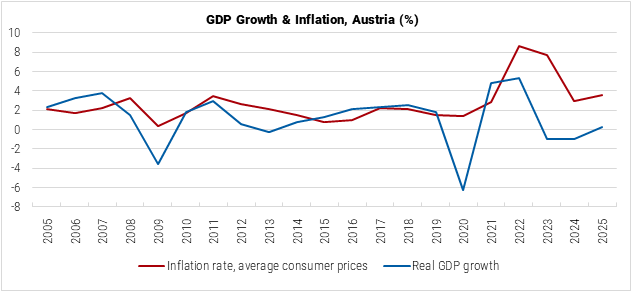
After a two-year recession triggered by the energy-price shock and subsequent monetary tightening, Austria’s economy is on a path of slow recovery, driven by increased private consumption and a stabilization of investment, with the real GDP growth for 2025 estimated at 0.3%. According to the European Commission forecast, growth is set to strengthen over the next two years, reaching 0.9% in 2026 and 1.2% in 2027.
At the same time, consumer price index (CPI) inflation in the country reaccelerated to an average annual rate of 3.6% in 2025, fueled by a spike in electricity prices following the expiration of several energy relief measures and higher public service fees, arising from fiscal consolidation. As the effect of higher electricity prices fades and limited wage growth slows services inflation, the European Commission projects a decline in inflation to the average level of 2.4% in 2026 and 2.2% in 2027.
Most recently, the indicator was reported by Statistics Austria at 2.0% in January 2026.
Data Source: IMF.
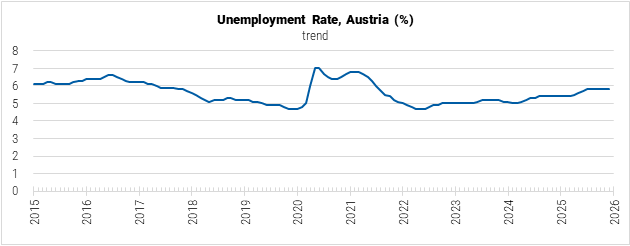
The prolonged period of weak economic growth has affected the Austrian labor market, with the unemployment rate increasing steadily over the past several years from its post-pandemic lows. In December 2025, Statistics Austria reported the unemployment rate trend at 5.8%, up from 4.7% in mid-2022. The forecast from the European Commission anticipates only moderate improvement over the next two years, while the economic outlook from the OeNB states that the unemployment “will not come down before 2027”.
At the same time, after strong wage growth in 2024 to compensate for past inflation, wages are set to grow more moderately over the forecast horizon. “Losses in price competitiveness and strong pressure for austerity in the public sector have led to moderate wage agreements in the fall of 2025,” the OeNB report explained. “The multiyear agreements in the metal industry, the public sector, and the retail and wholesale sector are below the rolling inflation rate, some markedly so.”
Data Source: Statistics Austria.
Aiming to narrow deficits and stabilize public finances, Austria’s federal government implemented a broad fiscal consolidation package in its 2025/2026 double budget, with measures including pension regime adjustments, changes to early retirement rules, and cuts to climate/energy subsidies.
Despite these substantial consolidation efforts, the European Commission expects Austria’s general government deficit to remain above 4% over the next two years, declining from 4.7% of GDP in 2024 to 4.1% in 2026, before increasing again to 4.3% of GDP in 2027. In the environment of continued fiscal deficits and subdued economic growth, Austria’s debt ratio is also expected to continue rising over the forecast horizon, reaching 83.9% of GDP in 2027.
Following an earlier downgrade based on the country’s continued fiscal and macroeconomic challenges, Fitch Ratings affirmed Austria at ‘AA’ with a stable outlook in December 2025, noting that issues stemming from an ageing demographic and limited progress in structural reform make consolidation of expenditures in healthcare, education, and social services difficult.
Overall, Austria's economy is expected to gradually recover over the next few years, though there are persistent risks from external economic headwinds and insufficient expenditure control limiting fiscal consolidation domestically. “A return to growth is expected from 2026 onwards, though the medium-term growth and fiscal outlook faces significant headwinds from demographic aging and sluggish productivity growth,” the latest Article IV staff report from the International Monetary Fund (IMF) summarized.
Sources:
- National Bank of Austria (OeNB)
- Press Release: National Bank: Rise in Residential Property Prices Remains Below Inflation (DE): https://www.oenb.at/
- OeNB Report 2026/2: Credit Demand Rises as the Economy Slowly Recovers (DE): https://www.oenb.at/
- OeNB Report 2025/23: Economy Stabilizes Amid Challenging Environment: https://www.oenb.at/
- Statistics Austria
- House Price Index and OOH PI: https://www.statistik.at/
- Press Release: Number of Completed Dwellings Decreased Significantly in 2024: https://www.statistik.at/
- Building Permits Statistics: https://www.statistik.at/
- Unemployed, Seeking Work: https://www.statistik.at/
- Rents in Q3 Remain Virtually Unchanged: https://www.statistik.at/
- Inflation at 3.8% in December 2025: https://www.statistik.at/
- Inflation in January 2026 According to the Flash Estimate at 2.0%: https://www.statistik.at/
- Federal Ministry for Housing, Arts, Culture, Media and Sport
- Affordable Housing: Rent Package Adopted (DE): https://www.bmwkms.gv.at/
- Federal Ministry of Finance
- Marterbauer: Consolidating Public Finances: https://www.bmf.gv.at/
- European Central Bank (ECB)
- ECB Data Portal: https://data.ecb.europa.eu/
- Key ECB Interest Rates: https://www.ecb.europa.eu/
- Monetary Policy Decisions, 5 February 2025: https://www.ecb.europa.eu/
- European Commission
- Economic Forecast for Austria: https://economy-finance.ec.europa.eu/
- Distribution of Population by Tenure Status, Type of Household, and Income group: https://ec.europa.eu/
- International Monetary Fund (IMF)
- Country Overview: Austria: https://www.imf.org/
- 2025 Article IV Staff Report: https://www.imf.org/
- Financial Market Authority (FMA)
- Residential Mortgage Loans (DE): https://www.fma.gv.at/
- OTTO Immobilien
- Vienna Residential Market Report, Fall 2025: https://www.otto.at/
- RE/MAX
- Real Estate Market Report: Condominium Market, First Half of 2025 (DE): https://www.remax.at/
- Real Estate Market Report: Single-Family Homes, First Half of 2025 (DE): https://www.remax.at/
- RE/MAX study Real Estate Market 2026 (DE): https://www.remax.at/
- Raiffeisen Research
- Real Estate Focus: Austria (DE): https://www.raiffeisen.at/
- EHL
- Vienna Housing Market: Review 2025 & Outlook 2026 (DE): https://www.ehl.at/
- CBRE
- Austria Real Estate Market Outlook 2026: https://www.cbre.at/
- Engel & Völkers
- Engel & Völkers Identifies 2025 as a Turning Point for the Austrian Residential Property Market: https://www.engelvoelkers.com/
- WKO
- First Austrian New Construction Report – Quarterly Update 04/2025 (DE): https://www.wko.at/
- Fitch Ratings
- Fitch Affirms Austria at 'AA'; Outlook Stable: https://www.fitchratings.com/
- Fitch Downgrades Austria to 'AA'; Outlook Stable: https://www.fitchratings.com/
- S&P Global
- Austria 'AA+/A-1+' Ratings Affirmed; Outlook Stable: https://www.spglobal.com/
- Haufe
- Mortgage Rate Forecast: What Will 2026 Bring? (DE): https://www.haufe.de/
- Reuters
- ECB Keeps Rates Unchanged, Signal Comfort With Dollar Weakness: https://www.reuters.com/