Taiwan's Residential Real Estate Market Analysis 2026
Taiwan’s previously red-hot housing market is now cooling rapidly, with demand plunging amid tighter credit controls and stricter lending rules. Residential construction activity is also slowing sharply, and house prices have begun to decline.
This comprehensive analysis by the Global Property Guide examines Taiwan’s residential property market, covering recent price trends, underlying demand, construction activity, affordability conditions, and the broader economic factors shaping the market.
Table of Contents
- Property Prices and Price Index
- Historic Perspective
- Property Demand Trends
- Property Supply Trends
- Rental Market: Rents and Rental Yields
- Mortgage Market and Interest Rates
- Economic and Social Factors
Property Prices and Price Index
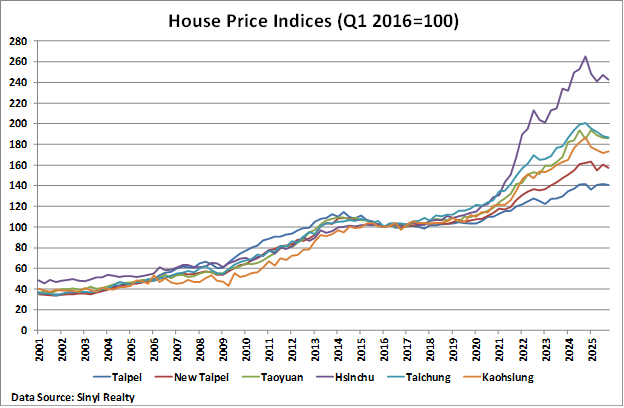
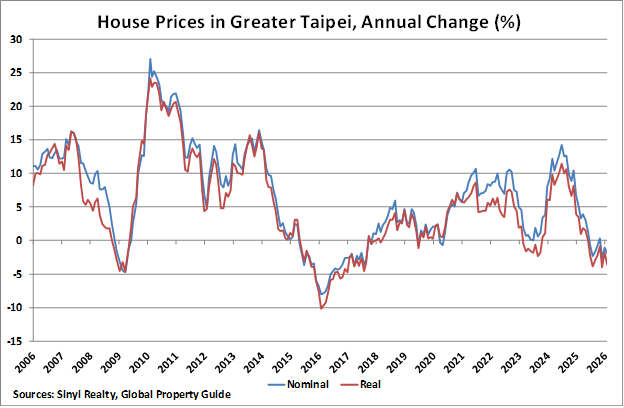
In the fourth quarter of 2025, Taiwan’s Lutheran home price index fell by 3.66% from a year earlier, a sharp turnaround from the double-digit growth of 10.44% seen in Q4 2024, based on figures released by Sinyi Real Estate Planning and Research. It marked the market’s worst showing since Q1 2016, when prices declined by 6.04%.
When adjusted for inflation, nationwide house prices were actually down by 4.90% year-on-year in Q4 2025, their third consecutive quarter of decline.
Quarterly, nationwide house prices were down by 3.25% in Q4 2025 (-3.61% inflation-adjusted).
Taiwan's house price annual change:
In Taipei, the capital, house prices fell slightly by 0.62% (-1.90% inflation-adjusted) year-on-year in Q4 2025, in contrast to the previous year’s 6.78% growth. It marked the capital city’s first year-on-year decline since Q1 2020. Quarterly, nominal house prices in Taipei dropped by 0.54% during the latest quarter, and by 0.92% in real terms.
For the country’s other major cities:
- New Taipei house prices were down by 3.02% (-4.27% inflation-adjusted) year-on-year in Q4 2025, in stark contrast to the prior year’s strong growth of 9.97%. It marked the city’s worst performance since Q2 2016. Quarter-on-quarter, prices declined by 2.22% (-2.59% inflation-adjusted).
- Taoyuan house prices increased by a miniscule 0.59% in Q4 2025 from a year ago, a sharp deceleration from the year-on-year growth of 10.17% recorded in Q4 2024. In real terms, prices actually dropped 0.70% during the year to Q4 2025. Quarterly, prices were down slightly by 0.17% (-0.55% inflation-adjusted).
- Hsinchu house prices declined by a huge 8.52% (-9.69% inflation-adjusted) during the year to Q4 2025, in contrast to the year-on-year growth of 13.37% recorded in the previous year. It was the third consecutive quarter of year-on-year price fall and its worst showing in recent memory. During the latest quarter, prices were down by 1.79% (2.16% inflation-adjusted) q-o-q.
- Taichung house prices also declined by 6.79% (-7.98% inflation-adjusted) in Q4 2025 from a year earlier, as compared to a strong year-on-year growth of 12.68% in the previous year. It was the third consecutive quarter of decline and the biggest fall since Q1 2016. Quarterly, house prices fell by 0.63% (-1.01% inflation-adjusted).
- Tainan registered the biggest year-on-year decline in house prices in Q4 2025, at 12.99% (-14.11% inflation-adjusted). It was a sharp turnaround from the prior year’s strong growth of 19.10%. Quarterly, prices were down by 5.08% (-5.44% inflation-adjusted) during the latest quarter.
- Kaohsiung house prices fell by 7.33% (-8.52% inflation-adjusted) year-on-year in Q4 2025, in contrast to the strong growth of 14.54% in Q4 2024. It marked the city’s biggest decline since Q2 2009. Yet quarterly, prices were up slightly by 0.95% (0.57% inflation-adjusted).
Demand continues to plunge, mainly due to the central bank’s ongoing selective credit controls, tighter loan restrictions, and limited supply of new homes. During 2025, housing transactions in Taiwan plummeted by 25.5% year-on-year to 261,000 units, according to the Ministry of Interior. It marked the lowest level recorded in nine years.
The housing market continued to weaken this year, with the number of property transactions in Taiwan’s six major cities – Taipei, New Taipei, Taoyuan, Taichung, Tainan, and Kaohsiung – totaling only 28,717 units in the first two months of 2026, down by 3.7% as compared to the same period last year.
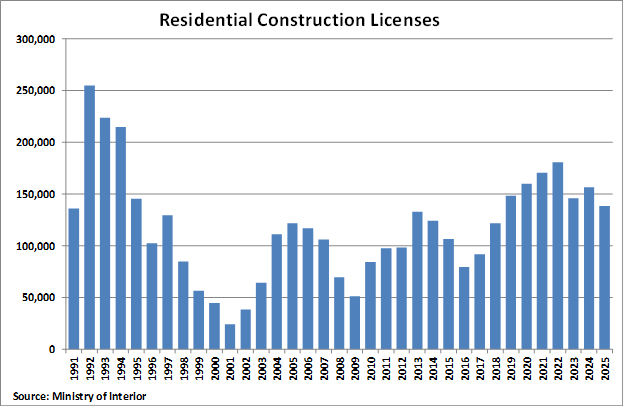
Similarly, residential construction activity is declining. During 2025, the total number of residential construction licenses fell by 11.5% y-o-y to 138,792 units, in stark contrast to the prior year’s 7.3% growth, according to figures from the Ministry of Interior. Then, in the first two months of 2026, residential construction licenses issued in Taiwan plummeted further by around 30% y-o-y to just 15,386 units.
Despite subdued housing market activity, Taiwan’s overall economic performance remains solid. In the fourth quarter of 2025, the economy expanded strongly by 12.65% as compared to the same period in the prior year, an acceleration from year-on-year growth of 8.42% in Q3, 7.71% in Q2, and 5.54% in Q1, according to figures from the Directorate-General of Budget, Accounting and Statistics (DGBAS). It marked the fastest growth of any single quarter since 1987.
For the whole year of 2025, Taiwan registered a strong economic growth of 8.68% - its best showing since 2010. The strong economic expansion was fueled by exports, led by AI chips and consumer electronics. The United States overtook China and Hong Kong as Taiwan’s largest export market, as higher US tariffs on Chinese goods redirected production to Taiwan.
DGBAS forecasts Taiwan’s economy to remain robust this year, with real GDP growth projected at 7.71%.
Historic Perspective:
Housing affordability eases but remains severely constrained
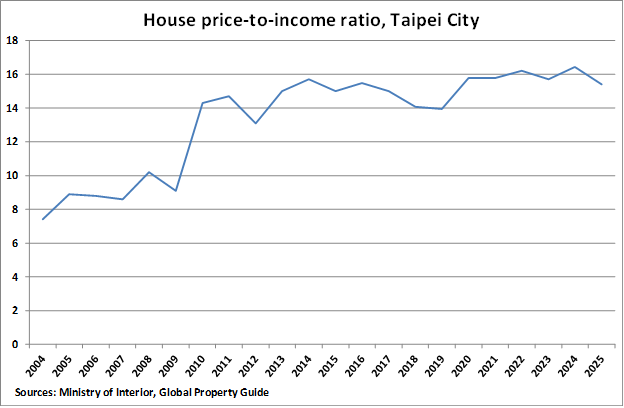
In 2025, Taipei’s house price‑to‑income ratio stood at 15.41, down from 16.43 in 2024, mainly due to the recent decline in house prices, according to data from the Ministry of the Interior (MOI). Despite this slight improvement, it remains dramatically higher than the 6.4 recorded in 2004.
In fact, Taipei remains one of the world’s most expensive cities. The city’s house price-to-income ratio was far higher than Greater London (9.1x), New York (7.4x), Toronto (8.4x), Sydney (13.8x), or Vancouver (11.8x). It was even higher than Hong Kong’s 14.4, which was ranked by Demographia’s 2025 International Housing Affordability report as the world’s least affordable market.
Nationwide, the house price-to-income ratio stood at 9.89 in 2025, down from 10.76 in 2024 but remains higher than the 9.6 recorded in 2023 and from 8.58 before the Covid-19 pandemic, based on MOI figures.
Years ago, Taipei’s former mayor, Ko Wen-je, stressed the urgent need to resolve the country’s affordable housing crisis before it provokes social unrest, similar to the case of Hong Kong.
“[In Hong Kong], high rent and housing prices are causing class struggle, a widening wealth disparity, and accumulating resentment among young people,” said Ko. “Unless the problem is resolved, Hong Kong’s problem today could become Taiwan’s tomorrow.”
To address the problem, Ko announced that the city plans to build 50,000 public housing units in the next seven years.
From 2015 to 2023, about 200,000 social housing units have been added in Taiwan - 120,000 built by the government and 80,000 from government-sponsored leases. In early December 2023, Taiwan’s Cabinet approved a new plan to raise the supply of social housing to 1 million units by 2032.
In 2025, the government has allocated a budget of TWD 42.8 billion (US$1.34 billion) for the Million Rental Housing Support Plan. As of September 2025, MOI announced that Taiwan had reached 222,144 social housing units. Of these, 121,077 were directly constructed, and 101,067 were under effective leasing contracts.
Recently, MOI refined its goal into an eight-year plan (2025-2032) that includes 250,000 newly built units, 250,000 sub-leased or managed rental units, and rent subsidies for 500,000 households.
Housing demand was boosted after 2009 when the government cut inheritance tax rates from 50% to 10%, and interest rates were cut. Unmonitored speculation, low housing supply, and a long tradition of homeownership pushed house prices in Taiwan, particularly in the capital city, and especially on high-end properties. A three-bedroom apartment, which cost just TWD6 million (US$188,000) to TWD7 million (US$219,000) in 1995, was sold for over TWD20 million (US$625,000) last year.
From 2000 to 2025, house prices in Taiwan’s major cities have skyrocketed:
- In Taipei, the house price index was up strongly by 282% (181% inflation-adjusted).
- In New Taipei City, the house price index rose by 351% (232% inflation-adjusted).
- In Taoyuan, the house price index rose by a whopping 430% (290% inflation-adjusted).
- In Hsinchu, the house price index was up by a huge 403% (270% inflation-adjusted).
- In Taichung, the house price index soared by 420% (282% inflation-adjusted).
- In Kaohsiung, the house price index increased by 330% (216% inflation-adjusted).
“Unfortunately, buying a home remains unaffordable for most young Taiwanese, a situation we don't expect to change in the medium term,” said Emily Dabbs of Moody’s Analytics. An average household in Taipei needs to pay two-thirds of its income for a mortgage loan, far above the affordable limit of 30%.
Taiwan’s two-decade struggle to curb property speculation
Worries about mainland speculators peaked in early 2008 when residential property prices rose by more than 10% y-o-y during the first quarter. Upward pressure further increased when Chinese banks based in Taiwan were able to offer mortgages after the signing of an MOU in November 2009.
From October 2009 onwards, the central bank actively urged banks to closely monitor mortgage lending risks. A big step was to assign a 100% risk weighting to non-owner-occupied residential mortgages. Risk weightings for other home mortgage portfolios range from 50% to 80%, compared with 10% to 20% for banks in other developed markets in Asia-Pacific that practice the Internal Ratings-Based Approach to credit risk.
In 2011, a luxury tax was introduced. Second homes not occupied by the owner and sold within one year of purchase were taxed at 15%, and those sold within two years of purchase were taxed at 10%.
From March 2014, much tougher measures were introduced, which caused house prices in Taiwan to drop 7.9% (3.7% inflation-adjusted) from Q2 2014 to Q1 2016. House prices increased by a minimal 1.8% in 2017 and 1.9% in 2018.
These were the measures:
- In March 2014, property taxes on non-owner-occupied residential properties were raised to between 1.5% and 3.6%, from 1.2% to 2%.
- Inspections of pre-sale house transactions were tightened. State-owned banks lowered loan-to-value ratios for first-time buyers from 80% to 70%, and from 60% to 50% for people owning more than one property.
- On January 1, 2016, a new property gains tax of as much as 45% took effect. Property sellers are now required to pay between 15% and 45% of gains based on market prices, instead of the previously used government-assessed values. Qualified property sellers with gains of less than TWD4 million (US$125,000) are exempt from the tax.
However, as the effect of these market-cooling measures wanes, house price growth has accelerated again in recent years. House prices have risen by 7.6% in 2022, following y-o-y increases of 14.6% in 2021, 6.5% in 2020, and 3.2% in 2019.
Because of this, the Executive Yuan approved the Healthy Real Estate Market Plan in December 2020, uniting key agencies to curb speculation, limit excessive property lending, expand social housing, and promote transparency in the housing market.
The government has also introduced measures that would tax houses and presale projects resold within five years of purchase. Accordingly, under the Amendments to the House and Land Transactions Income Tax 2.0, which came into force on July 1, 2021, a tax of 45% will be paid on gains from the sale of property within two years of purchase, and 35% for gains made between two and five years. Foreign individuals and businesses are also required to pay the same amount of tax. According to the Ministry of Finance, the amended holding periods apply to houses and land acquired after January 1, 2016, and sold after July 1, 2021.
| FOR INDIVIDUALS: | ||||
| Pre-amendment | Post-amendment | |||
| Real property holding period | Tax rate | Real property holding period | Tax rate | |
| Resident Individual | Less than 1 year | 45% | Less than 2 years | 45% |
| 1-2 years | 35% | 2-5 years | 35% | |
| 2-10 years | 20% | 5-10 years | 20% | |
| More than 10 years | 15% | More than 10 years | 15% | |
| Non-resident Individual | Less than 1 year | 45% | Less than 2 years | 45% |
| More than 1 year | 35% | More than 2 years | 35% | |
| Data Sources: Ministry of Finance, Ernst & Young | ||||
Alongside legislative reforms, Taiwan’s central bank continued tightening real‑estate lending, lowering LTV ratios for second homes and urging banks to strengthen controls. The seventh amendment in Q3 2024 further restricted mortgage terms, with measures remaining in place through 2025 as market activity cooled.
To improve long-term affordability, the government launched a national program to supply 1 million social-housing units by 2032. By late 2025, tens of thousands of public-rental units had been completed, with more under construction.
Property Demand Trends
Property demand continues to fall
Property demand continues to decrease sharply, mainly due to the central bank’s ongoing selective credit controls, tighter loan restrictions, and limited supply of new homes.
During 2025, housing transactions in Taiwan plummeted by 25.5% year-on-year to 261,000 units, according to the Ministry of Interior. It marked the lowest level recorded in nine years. Tseng Ching-te, project manager at Sinyi Realty’s research center, said many of last year’s transactions were handovers of pre-sale homes. Excluding these, demand for existing homes would be even weaker than the headline figures suggest.
Historically, Taiwan recorded its lowest housing transaction volume in 2016, with about 245,000 units sold, followed by around 259,000 units in 2001 after the dot-com bust. Last year’s sales volume marked the third-lowest level on record.
According to Hsu Chia-hsin, executive director at H&B Realty, the housing market was hit by the government’s seventh round of credit controls and tighter bank liquidity, triggering a sharp decline in demand and bringing an end to the housing bull market that began in 2019.
Among major municipalities, excluding outlying islands with relatively low transaction volumes, Keelung and Hsinchu recorded the sharpest annual declines last year, at 43.5% and 42.2%, respectively.
Taiwan’s housing market is expected to remain subdued this year until bank liquidity improves and the central bank relaxes credit controls. Evertrust Rehouse Co. forecasts home sales of 251,000 to 264,000 units in 2026, implying a possible 3% decline or a modest 2% increase from the previous year.
In fact, in the first two months of 2026, property transactions in Taiwan’s six major cities – Taipei, New Taipei, Taoyuan, Taichung, Tainan, and Kaohsiung – totaled 28,717 units, down by 3.7% as compared to the same period last year.
Though demand varies widely across cities:
- In Taipei, property transfers were up by 6.4% y-o-y to 3,675 units in the first two months of 2026.
- In New Taipei City, property transactions increased by a meager 0.8% y-o-y to 6,502 units in Jan-Feb 2026.
- Taoyuan registered 5,509 property transfers in Jan-Feb 2026, down by 6% from the prior year.
- In Taichung, there were 5,384 transactions recorded, down by a huge 16.5% from the previous year.
- In Tainan, there were 3,107 property transactions, up strongly by 17.8% from the preceding year.
- In Kaohsiung, property transactions totaled 4,540 units, down by 8.7% from the previous year.
Property Supply Trends
Residential construction activity declining again
The residential construction sector is noticeably weakening. During 2025, the total number of residential construction licenses fell by 11.5% to 138,792 units as compared to the previous year, according to figures from the Ministry of Interior. This followed an increase of 7.3% in the full year of 2024 and a sharp decline of 19.1% in 2023.
Before registering a huge contraction in 2023, construction activity had been continuously rising in the past several years. Residential construction licenses increased by an annual average of 23% from 2017 to 2019, before slowing to an annual growth of less than 7% from 2020 to 2022.
All of Taiwan’s major cities experienced a decline in residential construction activity last year:
- In Taipei City, the total number of residential construction licenses plunged by 26.8% y-o-y to 9,052 units in 2025.
- In New Taipei City, residential construction licenses fell by 10.6% y-o-y to 20,531 last year.
- In Taoyuan, residential construction licenses declined by 7.2% to 26,923 in 2025 from a year earlier.
- In Taichung, residential construction licenses were down by 10.9% y-o-y to 27,174 in 2025.
- In Tainan, licenses dropped by a huge 31.9% y-o-y to 6,161 units in 2025.
- In Kaohsiung, licenses fell by a modest 3.1% to 19,683 units in 2025 from a year earlier.
It seems that last year’s weakness in the residential construction sector has continued and worsened this year. In the first two months of 2026, the total number of residential construction licenses issued in Taiwan plummeted by around 30% y-o-y to just 15,386 units.
Rental Market: Rents and Rental Yields
Taiwan’s vanishingly low rental yields
Taipei now vies with Monaco for the lowest yields in the world. Taipei is not a happy place to be a landlord. The owner of an apartment in Taipei will be lucky to realize more than 3% yields, except for the very smallest apartments.
In Q4 2025, the average gross rental yield in Taiwan stood at 2.20%, not significantly different from 2.24% in Q2 2025, 2.15% in Q3 2024, and 2.17% in Q1 2024, based on a recent research conducted by the Global Property Guide.
In major cities:
- In Taipei City, gross rental yields for apartments ranged from 1.66% to 2.13% in Q4 2025, with a city average of 1.93%. Surprisingly, smaller apartments have the lowest rental returns.
- In New Taipei City, apartments generate rental returns between 1.91% and 2.36%, with a city average of 2.12%. Here, smaller-sized apartments offer the highest rental yields.
- In Taoyuan City, gross rental yields ranged from 2.1% to 2.6% in Q4 2025, with a city average of 2.39%.
- In Kaohsiung City, apartments generate rental yields between 1.96% and 2.73%, with a city average of 2.43%.
- In Tainan City, gross rental yields for apartments ranged from 1.99% to 2.39% in Q4 2025, with a city average of 2.14%.
Such low yields are often a sign of an overvalued market. Given that the Global Property Guide’s figures are for gross rental yields, i.e., do not make any allowance for vacant periods, legal costs, administration costs, cleaning and repairs, rental taxes, property taxes, and other taxes, it is safe to say that landlords in Taiwan earn nothing on their apartments.
Paradoxically, Taiwan has one of the highest homeownership rates in the world at around 84% to 87% over the past decade, while social housing accounts for only about 5% of households. And the trend toward home ownership is increasing. Because of this, Taiwan’s rental market is quite small, with renters accounting for only about 8% to 11% of total households, or roughly nine million to twelve million households.
Mortgage Market and Interest Rates
Central bank credit controls aimed at cooling housing speculation and reducing banks’ real estate risks
In September 2024, the central bank announced a seventh wave of selective credit controls with four main measures, in an effort to further crack down on housing speculators:
- Buyers with existing properties cannot have a grace period for their first home loans, which means that they will have to simultaneously pay the interest and principal.
- The loan-to-value (LTV) ratio for second-home mortgages has been reduced from 60% to 50% across the country.
- The LTV ratio for corporations and individuals buying luxury homes and third properties has been reduced from 40% to 30%.
- The LTV ratio for developers who use unsold homes as collateral has been reduced from 40% to 30%.
“Going forward, the Bank will keep watch on concentration on real estate lending so as to channel credit resources towards accommodating the funding needs of productive enterprises for real investment, and towards uses aligned with government initiatives such as those in support of non-homeowner mortgage borrowers, urban renewal and reconstruction of unsafe and dilapidated homes, and social housing projects,” noted the central bank in an earlier report.
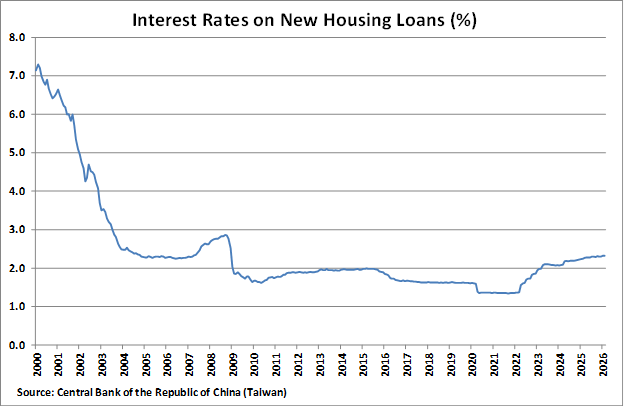
Taiwan's mortgage loan interest rates:
“Meanwhile, the Bank will review the effectiveness of the selective credit control measures, closely monitor potential impacts of real estate sector-related policies on the housing market, and adjust relevant measures as needed in order to promote financial stability and sound banking operations,” added the central bank.
In 2025 and early 2026, the central bank maintained its existing selective credit control framework and continued to closely monitor banks’ real estate exposure, rather than introducing another round of tightening. The authorities emphasized prudent management of property lending concentration and required banks to maintain close oversight of mortgage growth and speculative activity.
Instead of further lowering credit limits, the central bank indicated it would begin modest relaxation of oversight starting in 2026. Banks would be allowed to manage real‑estate lending internally (within their own quantitative controls), subject to monthly data reporting to the central bank.
More than a year after implementation, the measures appear to be producing tangible results.
“In September 2024, the Bank made the seventh amendment to its selective credit control measures. Meanwhile, financial institutions continued with their respective internal quantitative management of aggregate real estate lending. With these efforts, the loan brackets under the credit controls have witnessed lower loan-to-value (LTV) ratios; consumer expectations for housing price rises have eased, housing market transactions have continued to cool down, and the annual growth rate of housing prices has come down,” said the central bank in its Q1 2026 Monetary Policy Decision.
“Data also show that housing loans granted by domestic banks to non-homeowners have continued to increase as a share of total housing loans. Loans for urban renewal and reconstruction of unsafe and dilapidated housing have also been rising as a share of construction loans,” added the central bank.
Though in a modest policy adjustment, the LTV cap for natural persons’ second-home mortgages was raised from 50% to 60%, effective March 2026, partly to address concerns that earlier restrictions could unduly constrain genuine housing demand. The move signaled a shift toward more calibrated supervision while keeping the broader macroprudential controls in place.
Prior to all these measures, the central bank introduced new credit controls on second-home loans by lowering the maximum LTV ratio for second-home mortgages from 75% to 70% in Taipei, New Taipei City, Taoyuan, Taichung, Tainan, and Kaohsiung, as well as in Hsinchu city and county, effective June 16, 2023.
After drawing criticism from housing experts and property developers, who commented that these measures would harm people who need to relocate, the central bank announced in July 2023 that the rule would not apply to those who sell their first home within a year.
Taiwan’s Financial Supervisory Commission (FSC) also raised the regulatory risk weights (RW) in February 2022, and applied for new domestic property loans in an effort to reduce banks' property exposure. More specifically:
- The RW for new housing loans to retail buyers with more than two properties, as well as to corporate buyers, was raised to 50% - 100%, from 20% - 30%, to control speculative property investment.
- The RW for new loans to finance land acquisition and housing inventories was also increased to 150% - 200%, from 75% - 150%.
Key rate unchanged, mortgage interest rates continue to increase
In its March 2026 meeting, the Central Bank of the Republic of China (Taiwan) decided to keep the discount rate, the rate on refinancing of secured loans, and the rate on temporary accommodations at their current levels of 2%, 2.375%, and 4.25%, respectively.
The latest decision aligns with market expectations and extends the pause in place since March 2024.
In the first two months of the year, overall inflation remained moderate at 1.23% and core inflation at 1.93%. For the year as a whole, inflation is expected to remain contained, supported by tax reductions on some commodities and a gradual easing in service prices. However, the recent conflict in the Middle East has pushed up international oil and commodity prices. Taking this into account, and factoring in the government’s energy price stabilization measures, the central bank expects its full-year inflation to reach 1.80% and core inflation to average 1.75%.
The central bank raised its key interest rates six times from March 2022 to March 2024 to curb inflationary pressures. It has also increased the reserve requirements ratio several times to strengthen the effectiveness of its selective credit control measures.
“Going forward, the Bank will closely monitor the implications of uncertainty factors – including geopolitical risks, the impact of U.S. economic and trade policies, the pace of monetary policy adjustments by major central banks, the development of AI-related industries, and extreme weather – for Taiwan’s economic activity, financial conditions, and price trends,” said the central bank in its March 2026 Monetary Policy Decision.
“The Bank will adjust its monetary policy accordingly in a timely manner, as warranted to fulfill the statutory duties of maintaining financial and price stability and fostering economic development within the scope of the aforementioned objectives,” added the same report.
In February 2026, the average interest rate for housing loans in Taiwan’s five major banks, Bank of Taiwan, Taiwan Cooperative Bank, Land Bank of Taiwan, Hua Nan Bank, and First Bank, stood at 2.322%, up slightly from 2.245% a year earlier, 2.077% two years ago, and 1.98% three years ago. Despite the increase, it remains very low by international standards.
New housing loans declining
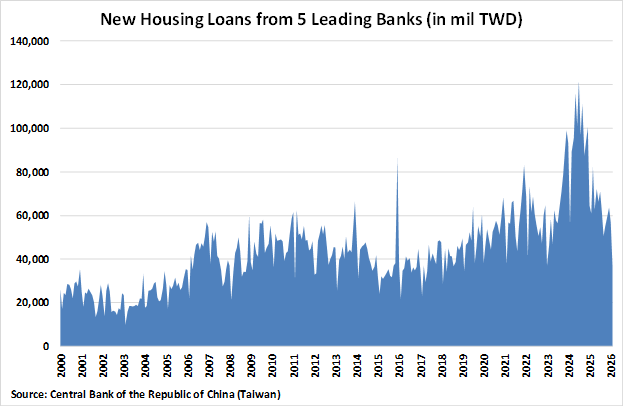
Taiwan’s residential mortgage market is now showing signs of a slowdown. During 2025, the total amount of new housing loans plunged by a huge 33.9% from a year earlier, to TWD 769.45 billion (US$24.05 billion), in sharp contrast to year-on-year increases of 51.7% recorded in 2024 and 8.4% in 2023, based on data from the Central Bank of the Republic of China (Taiwan).
Then in the first two months of 2026, new housing loans plummeted further by 25.5% y-o-y to TWD 93.53 billion (US$2.92 billion).
This can be partly attributed to the central bank’s recent policies. In September 2024, the central bank intensified its real estate tightening, directing banks to strengthen internal controls on property lending and later revising its selective credit measures. These actions resulted in lower loan-to-value ratios, easing expectations of housing price increases, and a continued cooling of property transactions.
Loans to non-homeowners and financing for urban renewal and the reconstruction of unsafe or dilapidated housing grew as a share of total housing and construction loans. Consequently, the proportion of real estate loans in total bank lending has declined from the peak of 37.61% recorded in June 2024 to 36.71% in August 2025 and further to 36.0% in February 2026.
As a result, the annual growth rate of the total value of outstanding real estate loans in Taiwan slowed from its September 2024 peak of 9.4% to just 3.7% in February 2026. In particular, the annual growth rate of housing loans declined from a high of 11.3% in September 2024 to 5.4% in September 2025 and further to 4.5% in February 2026.
On the other hand, the total value of outstanding loans for construction dropped by 1.5% in February 2026, following a minimal contraction of 0.4% in September 2025 and an increase of 4.2% in September 2024.
These trends suggest an improvement in the previously observed excessive flow of bank credit to the real estate sector.
Size of residential mortgage market to remain steady
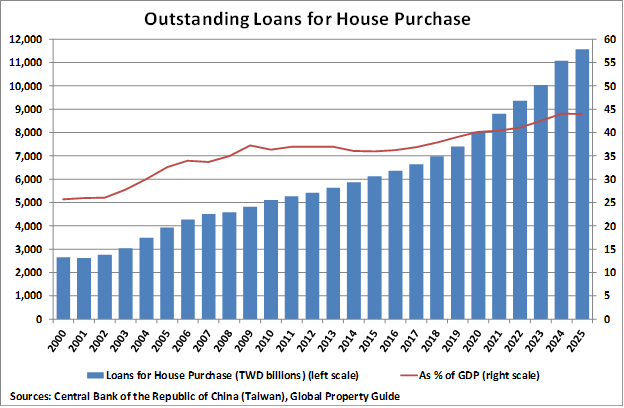
Total outstanding housing loans rose by an average of 5.6% annually from 2009 to 2025.
As a proportion of GDP, the country’s residential mortgage market grew to about 44% of GDP in 2025, nearly unchanged from the preceding year but up from 42.5% in 2023, 39.2% in 2019, and less than 35% in 2015.
Because of the sharp slowdown in new housing loans, the Global Property Guide projects that the size of the residential mortgage market will be more or less steady at approximately 44% of GDP this year.
Most residential mortgages in Taiwan are variable-rate mortgages, with an average maturity of 25 years.
Economic and Social Factors
Taiwan’s economy grows strongly on surging AI-driven export demand
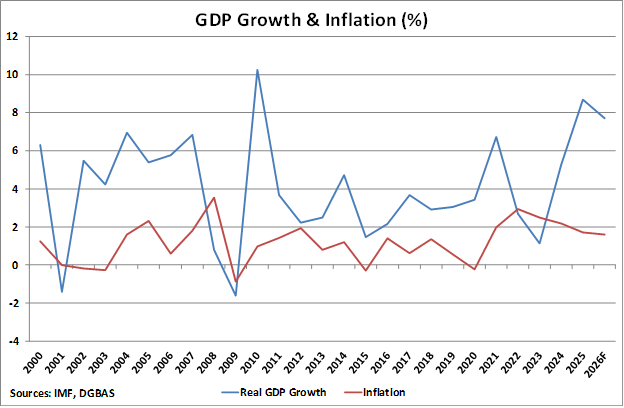
In the fourth quarter of 2025, Taiwan’s economy expanded strongly by 12.65% as compared to the same period in the prior year, an acceleration from year-on-year growth of 8.42% in Q3, 7.71% in Q2, and 5.54% in Q1, according to figures from the Directorate-General of Budget, Accounting and Statistics (DGBAS). It marked the fastest growth of any single quarter since 1987.
For the whole year of 2025, Taiwan registered a strong economic growth of 8.68% - its best showing since 2010.
The strong economic expansion was fueled by exports, led by AI chips and consumer electronics. The United States overtook China and Hong Kong as Taiwan’s largest export market, as higher US tariffs on Chinese goods redirected production to Taiwan.
“On the demand side, due to stronger-than-expected external demand driven by emerging technologies, such as artificial intelligence (AI), real exports of goods and services grew by 38.81%. Imports also grew by 24.59%,” said DGBAS.
“In addition, real private final consumption grew by 3.45% in 2025Q4, mainly driven by expenditures such as information and communication, entertainment, transport, and outbound tourism, as well as the securities transaction fees caused by the stock market boom,” added DGBAS.
On a quarterly, seasonally-adjusted, annualized basis, the real GDP surged by 23.55% in Q4 2025.
DGBAS forecasts Taiwan’s economy to remain robust this year, with real GDP growth projected at 7.71%.
“The booming development of AI is driving broad and sustained structural growth in Taiwan’s exports. In aggregate with services exports, real exports of goods and services will grow by 12.68% in 2026,” said DGBAS. “Real private consumption is projected to grow by 2.51%, supported by robust corporate earnings leading to wage increases and higher dividend payouts, the wealth effect stemming from the rising stock market, and booming outbound tourism.”
Taiwan, which is heavily dependent on exports, was seriously affected by the US economic recession in 2008. The economy bounced back in 2010 with spectacular growth of 10.6%. From 2011 to 2019, the Taiwanese economy grew by an annual average of 2.9%. Despite the Covid-19 pandemic, the economy managed to post a modest growth of 3.4% in 2020.
As the economy reopened and activity rebounded, Taiwan recorded a strong 6.7% growth rate in 2021, its fastest in over a decade.
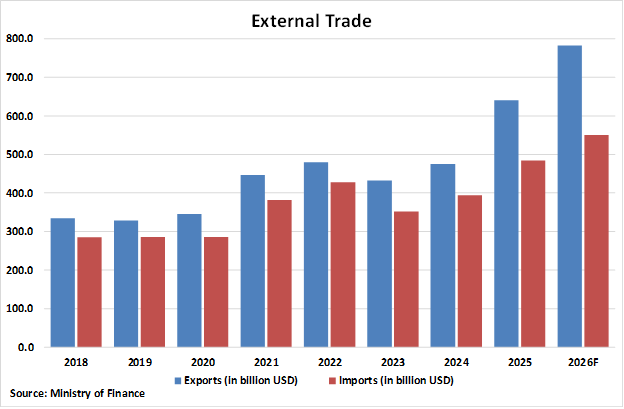
Exports, which account for about 60% of the country’s GDP, continue to increase strongly. During 2025, exports reached a record high of US$640.7 billion – a huge increase of 34.9% from the preceding year, according to the Ministry of Finance. In fact, it was also the biggest growth rate recorded in 15 years. The record growth in exports last year was mainly driven by strong global demand for artificial intelligence (AI) applications, high-performance computing tools, and the release of new mobile devices.
Exports surged in two major categories: ICT and video/audio products, which jumped 89.5% y-o-y to a record US$251.15 billion in 2025, and electronic components, which increased 25.8% y-o-y to US$222.87 billion. Together, these two sectors accounted for about 74% of Taiwan’s total exports last year.
In 2025, the United States became Taiwan’s largest export market for the first time in 26 years, accounting for 30.9% of total exports, or US$198.27 billion. It surpassed China and Hong Kong, which together made up 26.6% of exports. Exports to China and Hong Kong rose 13.2% year-on-year to US$170.48 billion, ending a three-year decline.
Imports are also surging. In 2025, the total value of imports reached a new record high of US$483.6 billion in 2025, an increase of 22.6% from the prior year. As such, the trade surplus was up by a whopping 95% in 2025 from a year earlier to a record US$157.14 billion.
The overall inflation rate stood to 1.75% in February 2026, up from 0.69% in the previous month and 1.62% in the same period last year, based on figures from the National Statistics. The nationwide inflation rate averaged less than 1% in 2010-2020, before increasing to 1.97% in 2021 and further to 2.95% in 2022. Inflation remained elevated at an annual average of 2.34% in 2023 and 2024, before easing to 1.66% in 2025.
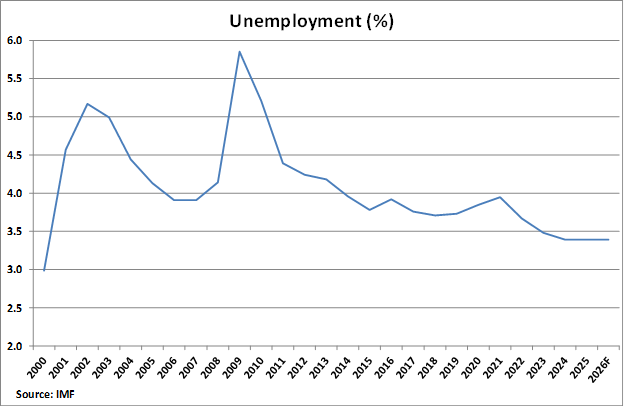
In February 2026, the seasonally-adjusted unemployment rate was 3.33%, slightly down from 3.36% in the previous month and from 3.35% a year earlier, as labor market conditions remain robust.
Taiwan’s jobless rate has remained steadily below 4% over the past decade.
Pro-sovereignty leadership reinforces Taiwan’s divergence from China
In the January 2024 presidential elections, Taiwanese voters elected yet another pro-sovereignty candidate, William Lai, to become the new president of Taiwan, solidifying a direction that is increasingly divergent from Mainland China. Lai officially assumed office in May 2024. This marked the third presidential election win for the independence-leaning Democratic Progressive Party (DPP).
Taiwan has continued efforts to expand its international participation. The government has reiterated its intention to join major international organizations, including the IMF, and continues to seek participation in the World Health Organization’s World Health Assembly and Interpol to enhance its global standing. Taiwan’s application to join the Comprehensive and Progressive Agreement for Trans-Pacific Partnership (CPTPP), formally submitted in September 2021, remains under review, with China’s competing bid and broader political sensitivities slowing progress.
Lai adopted a firmer stance toward Beijing. In March 2025, his administration officially designated China as a “foreign hostile force,” citing growing infiltration and coercion efforts. In response, China launched large-scale military drills around Taiwan in April 2025, widely viewed as a direct show of force against Lai’s government. Military pressure continued into late 2025 and early 2026, with repeated air and naval exercises conducted near Taiwan, underscoring persistent cross-strait tensions.
Taiwan’s diplomatic space also remains constrained. In January 2024, Nauru became the latest country to sever diplomatic ties with Taiwan and recognize Beijing, leaving Taiwan with only 12 formal diplomatic allies.
“China stealing our allies, pressuring our international space won’t shrink the distance across the strait and won’t allow for peaceful, friendly development of cross-strait relations,” said Taiwan’s former foreign minister Joseph Wu.
China has continued efforts to isolate Taiwan internationally, including pressuring companies and airlines to avoid references to Taiwan and stepping up diplomatic and military pressure.
Cross-strait tensions have been elevated since 2016, when Tsai Ing-wen of the DPP assumed office and pursued policies aimed at reducing Taiwan’s economic reliance on mainland China while strengthening ties with Southeast Asia and other partners. Beijing responded by cutting official communication channels and increasing military pressure, while Taiwan deepened cooperation with the United States and like-minded economies.
Amid the heightened security environment, Taiwan has steadily increased its defense spending in recent years. The government allocated a record US$19 billion in 2024, equivalent to about 2.5% of GDP, including special funds for advanced weapons and asymmetric defense programs. The defense budget rose further to about US$19.7 billion in 2025 and climbed significantly to US$31 billion in 2026 – equivalent to roughly 3.3% of projected GDP – as Taiwan accelerates military modernization. It is the first time that the defense budget would cross the 3% threshold since 2009.
The government has also proposed an additional US$40 billion multi-year special defense budget for 2026-2033, which would further boost military spending starting in 2026-2027.
Despite these increases, China’s defense spending remains vastly larger, estimated to be more than twelve times that of Taiwan’s.
Prior to this, relations between mainland China and Taiwan thawed when President Ma of the Kuomintang Party (KMT) assumed office in May 2008. He vowed greater cooperation with Mainland China and denounced independence for Taiwan, a sharp contrast to his nationalist but corrupt predecessor, Chen Shui-bian. In November 2009, several memoranda of agreement between Taiwan and China on financial cooperation were signed. These gestures reassured investors and home buyers alike. In June 2010, an Economic Cooperation Framework Agreement (ECFA) was signed by Taiwan and China. President Ma also accepted the 1992 consensus, which played a crucial role in lowering tensions with China and boosting cross-strait economic ties.
Ironically, most Taiwanese people favor neither formal independence nor eventual unification with China. Based on a December 2025 survey conducted by the Election Study Center of the National Chengchi University, only 4.4% of the population supported independence as soon as possible, while 1.1% were in favor of unification with mainland China. The majority preferred maintaining the current situation without moving toward either independence or unification.
Sources:
- Greater Taipei Price Index (Xinyi District Housing Price Index), February 2026 (Sinyi Real Estate Planning and Research): https://www.sinyinews.com.tw/
- Fourth quarter of 2025 (Xinyi Housing Price Index) (Sinyi Real Estate Planning and Research): https://www.sinyinews.com.tw/
- Demographia International Housing Affordability 2025 Edition (Chapman University): https://www.chapman.edu/
- Cabinet approves social welfare housing measures (Taipei Times): https://www.taipeitimes.com/
- Cabinet approves plan to raise social housing to 1 million units by 2032 (Focus Taiwan): https://focustaiwan.tw/
- Taiwan surpasses 220,000 social housing units milestone (TVBS): https://news.tvbs.com.tw/
- Excerpts of Amendments to House and Land Transactions Income Tax 2.0 (Ministry of Finance): https://www.mof.gov.tw/
- Taiwan real estate sales down 25% to 9-year low (Taiwan News): https://www.taiwannews.com.tw/
- Taiwan property market to stay lukewarm in early 2026: Business executive (Focus Taiwan): https://focustaiwan.tw/
- Housing market to consolidate next year: broker (Taipei Times): https://www.taipeitimes.com/
- Taiwan housing market tipped for modest price softening in 2026 (Taiwan News): https://www.taiwannews.com.tw/
- Taiwan housing market faces record supply as sales drop, banking chief warns (Radio Taiwan International): https://www.rti.org.tw/
- Taiwan’s monthly property transactions reach 10-year low (Taiwan News): https://www.taiwannews.com.tw/
- Gross rental yields in Taiwan: Taipei and 4 other cities (Global Property Guide): https://www.globalpropertyguide.com/
- Taiwan’s Central Bank hits housing speculators with four curbs (Taiwan News): https://www.taiwannews.com.tw/
- Monetary Policy Decision of the Board Meeting (2025Q3) (Central Bank of the Republic of China (Taiwan)): https://www.cbc.gov.tw/
- New loan amounts and interest rates of the five major banks (Central Bank of the Republic of China (Taiwan)): https://www.cbc.gov.tw/
- Central bank maintains rates (Taipei Times): https://www.taipeitimes.com/
- Monetary Policy Decision of the Board Meeting (2026Q1) Central Bank of the Republic of China (Taiwan): https://www.cbc.gov.tw/
- Credit controls eased on 2nd-home buyers to replace old houses (Focus Taiwan): https://focustaiwan.tw/
- Consumer loans and construction loans outstanding (Ministry of Digital Affairs): https://data.gov.tw/
- Taiwan Province of China (International Monetary Fund): https://www.imf.org/
- GDP: Preliminary Estimate for 2025Q4, and Outlook for 2026 (Directorate-General of Budget, Accounting and Statistics): https://eng.dgbas.gov.tw/
- Taiwan rides the AI wave to rapid economic growth (East Asia Forum): https://eastasiaforum.org/
- Taiwan’s GDP continues to defy all expectations (ING): https://think.ing.com/
- Taiwan’s exports, imports, trade surplus smash records in 2025 (Overseas Community Affairs Council, R.O.C. (Taiwan)): https://www.ocac.gov.tw/
- Annual External Trade Report in 2025 (Ministry of Finance): https://service.mof.gov.tw/
- Taiwan reports record high foreign trade in 2025 (Taiwan Today): https://www.taiwantoday.tw/
- CPI Change Rate (National Statistics): https://eng.stat.gov.tw/
- Taiwan Unemployment Rate (Trading Economics): https://tradingeconomics.com/
- Taiwan country profile (BBC News): https://www.bbc.com/
- Taiwan seeks to join the IMF (Taipei Times): https://www.taipeitimes.com/
- Taiwan wants to join the IMF to get financial protection from China (AP): https://apnews.com/
- Taiwan submits application to join CPTPP trade deal (Focus Taiwan): https://focustaiwan.tw/
- Taiwan’s president labels China a ‘foreign hostile force’ and ramps up security measures citing ‘infiltration’ (The Guardian): https://www.theguardian.com/
- China targets Taiwan's president with military drills, calls him ‘parasite’ (The Washington Post): https://www.washingtonpost.com/
- Taiwan loses diplomatic ally to China days after presidential election (CNN): https://edition.cnn.com/
- Diplomatic Allies (Ministry of Foreign Affairs): https://en.mofa.gov.tw/
- Taiwan’s 2024 defense budget to hit record NT$606.8bn: Tsai (Taipei Times): https://www.taipeitimes.com/
- Ex-U.S. Army secretary praises Taiwan’s pledge to raise defense spending (Focus Taiwan): https://focustaiwan.tw/
- Defense spending to reach 5% of GDP by 2030: President (Overseas Community Affairs Council, R.O.C. (Taiwan)): https://www.ocac.gov.tw/
- U.S. welcomes Taiwan's NT$1.25 trillion defense spending plan (Focus Taiwan): https://focustaiwan.tw/
- Taiwan Independence vs. Unification with the Mainland (1994/12~2025/12) (Election Study Center, National Chengchi University): https://esc.nccu.edu.tw/