Mongolia's Residential Real Estate Market Analysis 2026
Mongolia’s residential property market continues to strengthen, supported by robust demand, a rapidly expanding residential construction sector, and sustained economic growth.
This extended overview from Global Property Guide provides a detailed assessment of Mongolia’s housing market, analyzing recent developments, price trends, and demand-supply fundamentals, together with underlying long-term dynamics.
Table of Contents
- Property Prices and Price Index
- Historic Perspective
- Property Supply and Demand Trends
- Mortgage Market and Interest Rates
- Rental Market: Rents and Rental Yields
- Economic and Social Factors
Property Prices and Price Index
In February 2026, the nationwide housing price index rose strongly by 10.4% from the same period last year, according to the Mongol Bank, the country’s central bank. However, when adjusted for inflation, house prices were up by a more modest 4.15% over the same period.
Mongolia's house price annual change:
Graph: Mongolia (Ulaanbaatar) House Price Index / Monthly
Source: National Statistics Office of Mongolia.
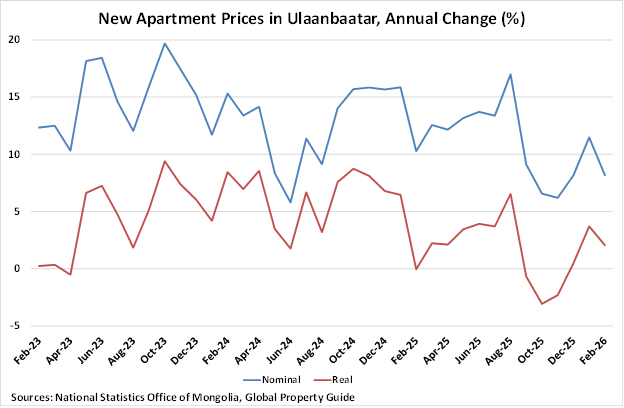
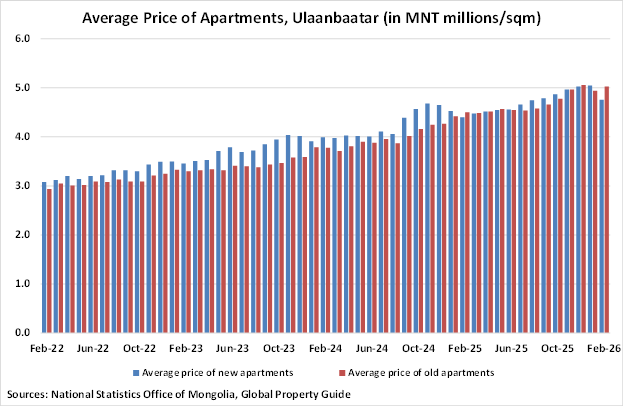
For new apartments in Ulaanbaatar, Mongolia’s capital and most populous city, the average price stood at MNT 4.76 million (US$1,335) per square meter (sqm) in February 2026, up by 8.18% from a year earlier. In real terms, new apartment prices increased by 2.06%.
By district:
- Sukhbaatar has the highest price of newly built apartments in the capital city, at an average of MNT6.25 million (US$1,753) per sqm. It also registered the biggest y-o-y price growth of 11.41% (5.1% inflation-adjusted) in February 2026.
- In Bayanzurkh, the price of a newly built apartment averaged MNT4.44 million (US$1,246) per sqm in February 2026, up by 9.36% (3.17% inflation-adjusted) from a year earlier.
- In Bayangol, the average price of new apartments was MNT4.46 million (US$1,251) per sqm, up by 7.99% (1.88% inflation-adjusted) from the previous year.
- In Khan-Uul, new apartment prices stood at an average of MNT4.64 million (US$1,302) per sqm, up by 5.22% from a year earlier. However, in real terms, prices actually declined slightly by 0.74%.
- In Songinokhairkhan, new apartment prices dropped slightly by 0.61% y-o-y in February 2026 to an average of MNT3.25 million (US$912) per sqm. Real prices fell by a bigger 6.24% over the period.
- In Chingeltei, new apartment prices declined by 1.37% (-6.95% inflation-adjusted) y-o-y to an average of MNT4.33 million (US$1,215) per sqm in February 2026.
- In Dundaj, new apartment prices reached an average of MNT4.76 million (US$1,335) per sqm in February 2026, up by 8.18% (2.06% inflation-adjusted) from a year ago.
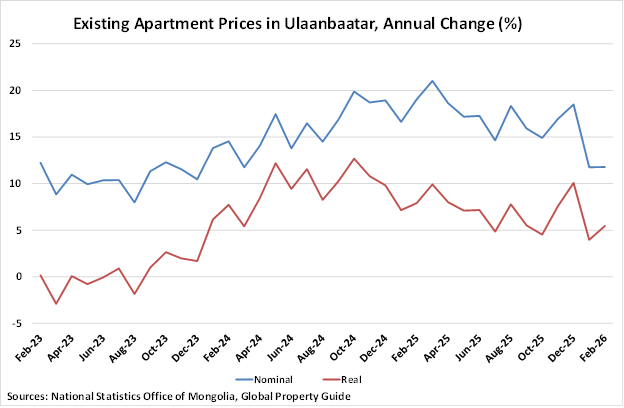
For old apartments in the capital city, the average price surged by 11.78% (5.45% inflation-adjusted) to MNT 5.03 million (US$1,411) per sqm in February 2026 as compared to the previous year.
By district:
- In Sukhbaatar, the average price of old apartments increased by 9.7% y-o-y to reach MNT6.22 million (US$1,7145) per sqm. Real prices were up by 3.49%.
- In Bayanzurkh, old apartment prices averaged MNT 4.55 million (US$1,276) per sqm over the same period, up by 10.17% (3.93% inflation-adjusted) from a year ago.
- In Bayangol, the average price of old apartments rose strongly by 9.51% y-o-y to MNT4.26 million (US$1,195) per sqm. Real prices were up by a modest 3.31%.
- Khan-Uul recorded the largest year-on-year increase in old apartment prices in February 2026, rising by 14.38% (7.9% inflation-adjusted) to an average of MNT5.49 million (US$1,540) per sqm.
- In Songinokhairkhan, old apartment prices were up by 8% y-o-y to reach an average of MNT3.24 million (US$909) per sqm. When adjusted for inflation, prices rose by 1.89%.
- Chingeltei was the only district to record a year-on-year decline in old apartment prices, falling by 2.01% (-7.56% inflation-adjusted) to an average of MNT 5.35 million (US$1,501) per sqm.
- In Dundaj, old apartment prices were up strongly by 11.78% y-o-y to reach an average of MNT5.03 million (US$1,411) per sqm in February 2026. Real prices increased by 5.45% over the period.
The residential real estate market of Ulaanbaatar is divided between a buoyant lower end and a steadily growing upper-end/luxury market:
- Over half of the residents of Ulanbaatar still live in traditional dwellings known as gers, or housing that is not well connected to permanent infrastructure. This is creating a large demand in the lower-end market, encouraged by rising wages and massive government-sponsored access to mortgage financing.
- The luxury segment of the real estate market is experiencing gradual growth, with ongoing development projects catering to higher-income buyers and an increasing appetite for modern, high-end residences.
The “Embassy District” and the area around the State Department Store, also known as the 7 Courtyards, are two of the most popular residential areas for foreign homebuyers and tenants, as well as wealthy Mongolians.
Land in Mongolia is under state ownership, and this affects condominiums since, ultimately, they sit on land. Although the Constitution allows for the possibility of private ownership of urban and arable land, until recently the legislative framework lacked a clear mechanism for implementing such private land ownership.
However, the reality is that developed freehold property can be bought and sold by foreigners and by Mongolians, but the terminology is not that of a sale of land, but that of a ‘lease’, or alternatively, of an ‘Immovable Property Ownership Certificate’.
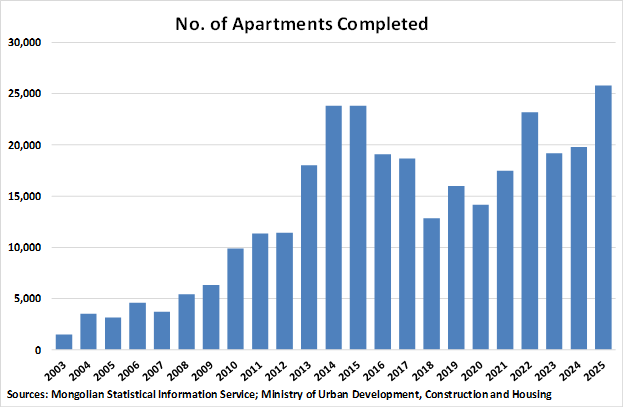
Residential construction activity is rapidly growing. In 2025, Mongolia achieved a record level of residential construction, with 25,817 new apartment units completed, marking the highest number in the country’s history. This was more than 30% surge as compared to the 19,790 completions registered in the preceding year.
Likewise, residential buildings completed in Mongolia also increased strongly by 22.9% in 2025 from the previous year, following a robust growth of 43% in 2024 and a decline of 3% in 2023.
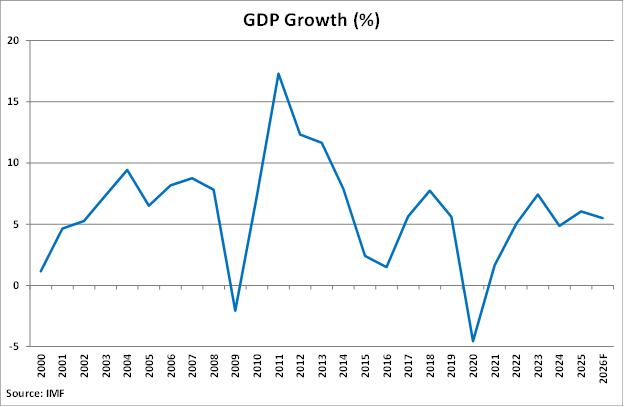
The continued expansion of Mongolia’s residential property market is underpinned by strong economic fundamentals. During 2025, Mongolia’s economy grew by another robust 6.8% from a year earlier, according to the Mongol Bank, following annual expansions of 5.1% in 2024, 7.4% in 2023, and 5% in 2022, mainly driven by strong performances in mining and quarrying, and in the industry and construction sectors.
The International Monetary Fund (IMF) projects the Mongolian economy to expand by an annual average of 5.5% in the next two years. This outlook is broadly consistent with forecasts from other international institutions, including the World Bank, the European Bank for Reconstruction and Development, and the Asian Development Bank, which expect Mongolia’s economy to grow by roughly 5.5% to 5.7% in 2026.
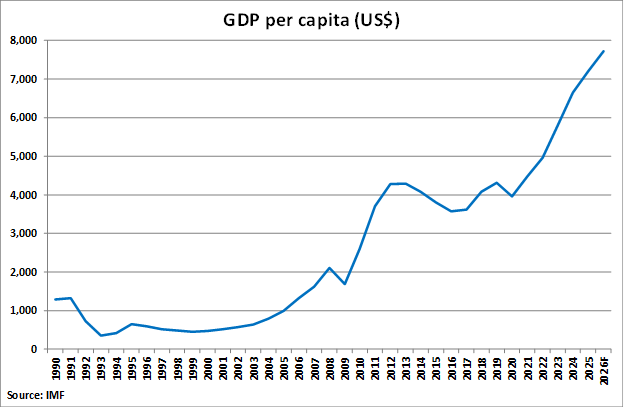
Reflecting this sustained expansion, GDP per capita rose to approximately US$7,200 in 2025, representing an increase of about 89% compared to a decade earlier, supporting housing demand and continued activity in the residential property market.
Historic Perspective:
A history of Mongolia’s property market
The boom of the early 2000s.
Residential property prices in Mongolia surged during the 2000s, driven by strong economic growth, elevated copper prices, and a sharp rise in gold production. From 2001 to 2008, the economy expanded by an average of 7.2% annually.
The mining boom attracted a wave of foreign companies, while international trade, particularly with China, expanded rapidly. Expatriates, foreign diplomats, and corporate executives moved to Ulaanbaatar en masse, fueling demand for quality housing. The capital quickly transformed into a boom town, marked by rising incomes, increased vehicle ownership, and a proliferation of upscale developments. Global luxury brands such as Louis Vuitton, Emporio Armani, Burberry, and Hugo Boss also established a presence in Ulaanbaatar, reflecting the city’s growing affluence.
The global economic crisis hit hard
However, Mongolia’s heavy reliance on commodity prices as a catalyst for economic growth meant that the global crisis hit hard. The price of copper, the country’s single largest export, plunged by almost 65% from July 2008 to February 2009. In 2009, the economy contracted by 2.1%.
The Mongolian Tugrik (MNT) became unstable. Foreign investment dried up. Banks stopped lending. Construction projects screeched to a halt. Housing demand, especially from foreign expatriates, vanished, causing the residential property market to stagnate from 2008 to 2010.
Economic recovery
By late 2009, Mongolia’s economy began to recover, supported by strong demand from China and a rebound in global copper prices. The turnaround was swift, with real GDP growth reaching 7.3% in 2010.
The property market regained momentum in the second half of 2010 as confidence among developers and homebuyers gradually returned. By 2011, residential property prices in major city-centre locations surged by an impressive 41.5%.
The passage of the long-awaited Oyu Tolgoi Investment Agreement, which was aimed at developing one of the world’s largest untapped copper deposits, further boosted economic activity. As a result, the economy expanded by 17.3% in 2011, followed by growth of 12.3% in 2012 and 11.6% in 2013.
Political uncertainty and disputes with Rio Tinto deter investors
Mongolia’s macroeconomic environment changed drastically in 2014, with economic growth slowing to 7.9%. Problems began when Rio Tinto’s Turquoise Hill Resources arm, then operating under its former name Ivanhoe Mines, announced plans to sell its stake in South Gobi Resources (a large Mongolian coal mine) to the Aluminum Corporation of China (Chalco) in April 2012. This was around two months before the national elections in June 2012, and the proposed deal allowed populist appealing politicians and pundits to claim that Ivanhoe/Turquoise Hill was not only trying to deceive the people of Mongolia on its biggest mining asset but was also selling a large Mongolian coal mine to China, to which Mongolia has a testy relationship.
Half a month after the deal was announced, the Mineral Resource Authority of Mongolia announced to the media that it had received requests to suspend South Gobi’s mining licenses. On May 18, 2012, the government passed a Strategic Entities Foreign Investment Law (SEFIL) blocking its sale to a Chinese company.
Three South Gobi executives were then detained under Mongolia’s controversial visa exit ban policy, and the case continued for the following two years. The executives were only released in March 2015. Disputes over cost overruns, profit sharing, management control, and a US$30 million tax bill on the Oyu Tolgoi project further scared investors.
This has called into question Mongolia’s ability to work with foreign corporations and investors. Foreign investments dropped by 47% in the first eight months of 2013. Again in 2014, foreign direct investment declined 81% from a year earlier, according to the central bank. This massive capital flight caused a roughly 40% depreciation of the Mongolian Tugrik versus the US dollar over two years, greatly weakening the once hot Mongolian economy.
Economic growth slowed sharply to just 2.4% in 2015 and 1.5% in 2016. Fiscal deficit surged to 17% of GDP in 2016, up from 8.5% in 2015, 11.3% in 2014, 8.9% in 2013, and 9.1% in 2012. The government racked up debts worth nearly 90% of GDP by the end of 2026, amidst plunging coal prices.
Global coal prices plummeted by more than 60% in January 2016 from their peak levels seen five years ago.
All these have adversely affected the housing market. House prices fell by 4.4% in 2016 (-5.6% inflation-adjusted), following declines of 11.3% in 2015 and 0.6% in 2014.
Housing market recovery alongside economic rebound.
In February 2017, the IMF approved a much-needed US$5.5 billion stimulus package for Mongolia on the condition that the government would implement fiscal reforms and strengthen its banking system.
Buoyed by a global rebound in coal prices, Mongolia’s economy grew by 5.6% in 2017, 7.7% in 2018, and 5.6% in 2019. The improved economic environment supported a gradual recovery in the housing market, with house prices increasing by 0.4% in 2017 and 4.15% in 2018. However, when adjusted for inflation, real price growth remained negative, indicating that housing affordability challenges persisted despite the uptick in nominal prices.
Onset of the Covid-19 pandemic
Mongolia’s economy contracted sharply by 4.6% in 2020 due to the disruptive effects of the Covid-19 pandemic. Recovery was slow, with real GDP growth remaining subdued at just 1.6% in 2021.
The housing market reflected these economic challenges. Apartment prices declined by 0.5% in 2019 and a further 0.2% in 2020, with the decreases more pronounced when adjusted for inflation. In 2021, prices saw a modest recovery, rising by 2.7%, but growth remained limited, highlighting the pandemic’s lingering impact on the residential property market.
Post-pandemic rebound
Mongolia’s economy regained momentum in the years following the pandemic, expanding by 5% in 2022, 7.4% in 2023, and 4.9% in 2024. Growth was driven primarily by a strong mining sector, alongside robust household consumption and increased government spending.
The recovering economy has energized the housing market. In 2023, residential property prices in Ulaanbaatar rose sharply, with new apartments up 15.2% (6.8% inflation-adjusted) and old apartments increasing by 10.5% (2.4% inflation-adjusted). The upward trend accelerated in 2024, as new apartment prices jumped 15.7% (6.2% inflation-adjusted) and old apartment prices surged 18.7% (9.2% inflation-adjusted), reflecting renewed confidence among homebuyers and investors.
Property Supply and Demand Trends
Residential construction activity increasing sharply
In 2025, Mongolia achieved a record level of residential construction, with 25,817 new apartment units completed in residential buildings, marking the highest number in the country’s history. This was more than 30% surge as compared to the 19,790 completions registered in the preceding year.
The number of completed apartments averaged 17,800 units per year from 2010 to 2025 - a sharp increase from an annual average of just 4,000 units from 2003 to 2009.
Likewise, residential buildings completed in Mongolia also increased strongly by 22.9% in 2025 from the previous year, following a robust growth of 43% in 2024 and a decline of 3% in 2023. Yet there were huge regional variations.
By region:
- In Ulaanbaatar, residential building completions were up by 11.3% y-o-y to 2025, following a surge o 50% in 2024 and a contraction of 12.3% in 2023.
- In the Western region, completions rose by a whopping 163.8% y-o-y in 2025, after declining by 16.5% in 2024 and surging by 159.3% two years earlier.
- In the Khangai region, completions soared by 44.2% y-o-y in 2025, following a modest decline of 5.3% in the preceding year and a huge growth of 123% two years prior.
- In the Central region, completions surged by surged by 76.7% last year, following a strong growth of 72.9% in 2024 and an annual fall of 18.6% in 2023.
- In the Eastern region, completions were up by 25.6% in 2025, following annual increases of 64.1% in 2024 and 35.8% in 2023.
According to the Ministry of Urban Development, Construction, and Housing, the total value of construction and major renovation works reached MNT 11.7 trillion (US$3.27 billion), representing a 28% increase from the previous year and the highest level ever recorded. Residential buildings accounted for 37.8% of total construction activity, underscoring the critical role of new housing supply in driving growth within the construction sector.
The construction sector made a significant contribution to Mongolia’s overall economic performance, which grew by 6.8% in 2025. The sector alone contributed 0.5 percentage points to total economic growth, with increased activity in residential construction serving as a major factor in this expansion.
By the fourth quarter of 2025, market research firms reported that 61,200 new residential units had been supplied to the market. Of these, 70.4% were standard-class apartments, with an average price of approximately MNT 3.8 million (US$1,064) per sqm. Over 11,000 mid-range apartments were also completed, averaging MNT 5 million (US$1,400) per sqm. Meanwhile, prices for business-class and high-end apartments ranged from MNT 6.7 million (US$1,875) to MNT 8.3 million (US$2,323) per sqm.
Mortgage Market and Interest Rates
Mortgage interest rates continue to rise
Mortgage interest rates are high. In February 2026, the weighted average interest rate for new mortgage loans increased to 13.58%, sharply up from 11.76% in the previous year and from 10.21% two years earlier, according to Mongol Bank, the country’s central bank.
Interest rates for new mortgage loans issued:
- The average interest rate for loans denominated in domestic currency stood at 17.26% in February 2026, far higher than the 15.62% in the same period last year and from 14.62% two years ago.
- The average interest rate for those drawn under the Housing Mortgage Program was 6% in February 2026, unchanged since September 2023.
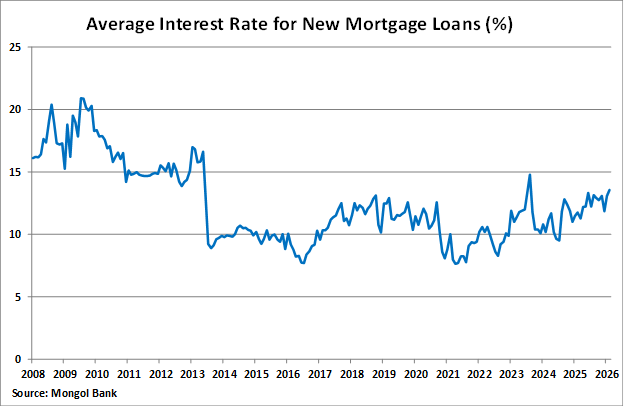
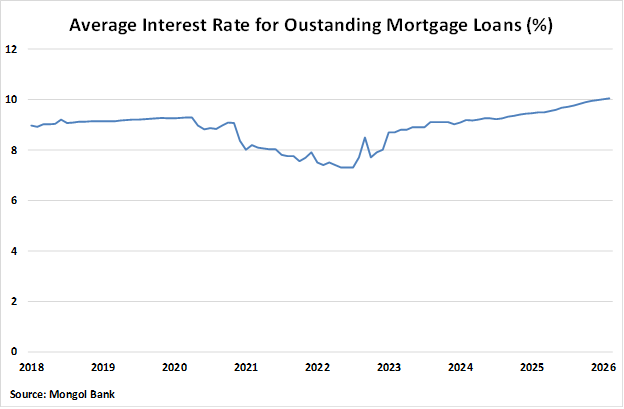
Similarly, the average interest rate for outstanding mortgage loans increased to 10.05% in February 2026, up from 9.48% in February 2025 and from 9.16% in February 2024.
Interest rates for outstanding mortgage loans:
- The interest rate for outstanding loans denominated in domestic currency averaged 15.23% in February 2026, up from 14.57% in the same period last year and from 13.39% two years ago.
- The average interest rate for those loans denominated in foreign currency was 2.62% in February 2026, down from 2.72% in the previous year and from 3.7% two years earlier.
- The average interest rate for those drawn under the Housing Mortgage Program was 6.5% in February 2026, slightly down from 6.64% in February 2025 and from 6.85% in February 2024.
The loan-to-value (LTV) ratio is 70% of the appraised value of the property. The term period is usually over 20 years.
Mortgage interest rates are expected to continue rising in the coming months after Mongolia’s central bank decided to maintain its policy rate at a high level of 12% in March 2026. The rate has remained unchanged since it was increased by 200 basis points in March 2025, as part of efforts to rein in inflationary pressures.
“The MPC decided to keep the policy rate unchanged at 12 percent, based on the assessment that external and geopolitical uncertainty has intensified, while domestic economic conditions and the outlook have improved,” said the Mongol Bank in its March 2026 Monetary Policy Statement.
“Inflation declined to 6.5 percent as of February 2026, approaching the midpoint of the target range, reflecting the effects of the monetary policy implemented last year. This decline was primarily attributable to a moderation in price increases for non-food goods and services. However, food prices have intensified in recent months, exerting upward pressure on inflation. Inflation is expected to remain within the target range. Nevertheless, elevated risks of increases in fuel and food prices could weigh on the inflation outlook going forward,” added the central bank.
New mortgage loans declining
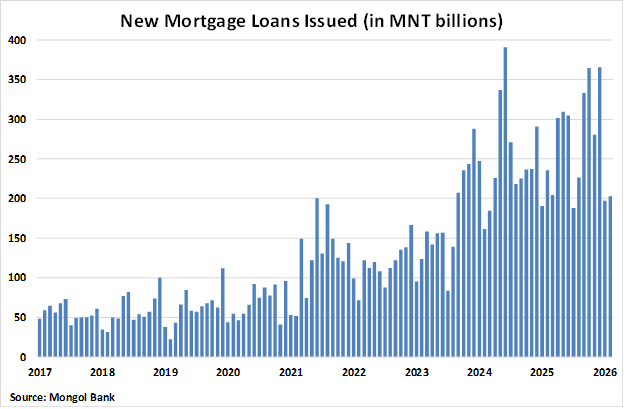
Mongolia’s mortgage market seems to be slowing, amidst the continued increase in interest rates. During 2025, the total value of new mortgage loans issued reached about MNT 3.3 trillion (US$926.17 million), up by 9.23% from the previous year, based on figures released by Mongol Bank. Last year’s growth was a sharp slowdown from annual increases of 49.1% in 2024 and 45.3% in 2023.
Then in the first two months of 2026, new mortgage loans issued fell by 6.21% to MNT 399.46 billion (US$111.96 million) as compared to the same period last year. About 65.8% of which were from banks’ own sources, while the other 34.2% were from the Housing Mortgage Program.
Outstanding loans continue to surge, but mortgage market remains underdeveloped
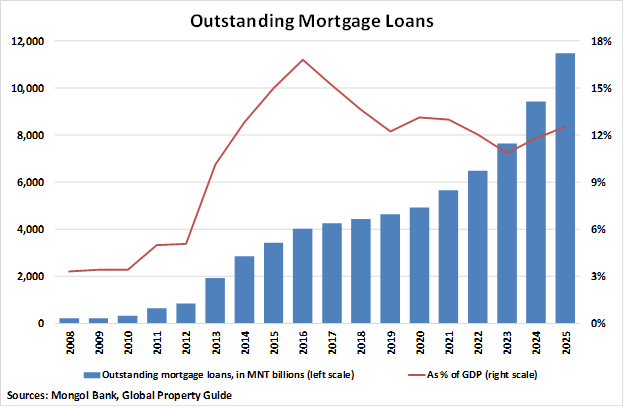
Despite the slowing of new mortgage loan issuance, outstanding loans continue to increase strongly. As of February 2026, the total amount of outstanding mortgage loans in Mongolia rose by a huge 20.7% y-o-y to MNT 11.67 trillion (US$3.27 billion), according to the central bank. This followed an annual average growth of 18.5% in 2021-25 and 5.2% in 2017-20.
By source:
- Banks’ own sources: MNT 4.74 trillion (US$1.33 billion) in February 2026, up by a whopping 39% from the same period last year
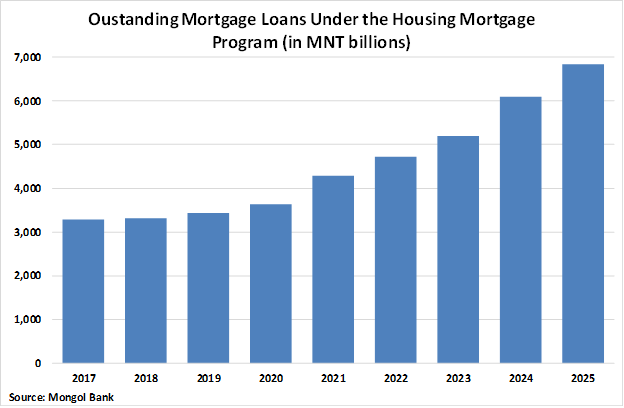
- Housing Mortgage Program: MNT 6.91 trillion (US$1.94 billion), up by 11.6% from a year earlier
- Other sources: MNT 26.86 billion (US$7.53 million), a huge decline of 62.2% from the same period last year
Yet, Mongolia’s mortgage market is still underdeveloped and very small. Housing finance was introduced only in the early 2000s. During 2025, the size of the mortgage market was equivalent to 12.5% of the country’s GDP, up from 11.8% of GDP in 2024 but a contraction from 13% in 2021, 15.2% in 2017, and 16.8% in 2016.
There were 133,691 mortgage loan borrowers in Mongolia as of February 2026, up by 7.74% from the prior year.
The share of past due in arrears in the total outstanding mortgage loans was 1.51% as of February 2026, slightly up from 1.31% in the same period last year and from 1.16% two years earlier. Those that are doubtful and loss mortgage loans accounted for 0.21% and 0.41%, respectively.
Mongolia’s banking sector is highly concentrated, with four banks (XacBank, Khan Bank, Golomt Bank, and Trade and Development Bank) dominating the market.
Government support boosts low-end housing market
The Mongolian government introduced a low-cost mortgage lending scheme in 2012, which is the most significant development in terms of residential real estate in the past few years.
When it was introduced, the “Housing Mortgage Program” offered interest rates as low as 8% for purchasing apartments, with a term period of up to 20 years (which has since been extended to 30 years).
Initially, the program was meant for poorer households looking to purchase apartments under the “100,000 homes project,” which will provide 75,000 homes within the capital alone. But in order to reduce pressures created by rapid purchase price increases, the program was extended to all first-time buyers. To qualify for the mortgage, potential homeowners should not own any existing apartments, and the apartments they buy must be new-build developments of 80 sqm or less.
As of September 2017, mortgage loans worth MNT 233 billion (US$65.31 million) were issued to more than 2,700 borrowers.
In 2018, the central bank transferred around MNT 118 billion (US$33.07 million) out of MNT 310 billion (US$86.89 million) funding for the program, according to A. Enkhjin, the Director of the Reserve Management and Financial Markets Department of the Mongol Bank.
“Through the mortgage loan, loans worth about MNT 100 billion were given to 1,152 borrowers in December 2018,” said A. Enkhjin. “Last year, 4,676 flats were sold through the mortgage loans.”
By the end of 2018, the government increased the program’s annual allocation to MNT 500 billion (US$140.14 million). The funds were distributed to commercial banks through the central bank.
In addition, housing loans up to MNT 60 million (US$16,817) are issued to individuals for the construction of a private house that satisfies requirements such as not being bigger than 120 sqm, being energy efficient, and having engineering facilities.
On October 1, 2020, the central bank issued Decree A-392 to lower the interest rate on housing mortgage loans to 6%. This reduced rate applies only to new mortgage loans issued from that date onward.
Currently, participating banks under the program provide loans of up to MNT 160 million (US$44,845) to eligible borrowers, with a down payment of 30%.
In October 2024, Minister of Urban Planning, Construction, and Housing Batsuuri Jamba announced plans to raise mortgage loan sources to MNT 1.2 trillion (US$336.34 million) for the year 2025. This initiative aims to provide loans to 60,000 households, with over half targeted at rural areas. Additionally, the government plans to commission apartments for 150,000 households over the next four years.
As of February 2026, the total number of mortgage borrowers under the Housing Mortgage Program reached 94,605, up by a modest 3.74% from the previous year.
Over the same period, the total value of outstanding mortgage loans issued under the Housing Mortgage Program rose strongly by 11.6% to MNT 6.91 trillion (US$1.94 billion) as compared to the same period last year, following annual growth of 12.3% in 2025, 17.2% in 2024, 10% in 2023, 10.3% in 2022 and 17.7% in 2021.
Rental Market: Rents and Rental Yields
Tight rental market, high gross rental yields
Gross rental yields for luxury residential properties in Ulaanbaatar are high, ranging from 8.3% to 13.63%, with a city average of 10.75% in Q4 2025, according to a recent research conducted by the Global Property Guide. Yet this is slightly lower than the 11.075 rental yields recorded in Q2 2025.
Smaller properties typically offer higher rental yields.
By major district:
- In Sukhbaatar - Downtown UB, gross rental yields ranged from as high as 13.55% for studio-type properties to 10.43% for three-bedroom or larger properties.
- In Bayangol, residential properties offer rental yields ranging from 11.06% for studio-type properties to 8.62% for two-bedroom properties.
- In Khan-Uul, rental yields ranged from as high as 13.5% for studio-type properties to 10.6% for four-bedroom or larger properties.
- In Songinokhairkhan, residential properties offer rental returns ranging from 13.63% for smaller studio units to 10.24% for bigger units.
- In Bayanzurkh, gross rental yields range from 11.72% for studio-type properties to 9.29% for bigger three-bedroom units.
While rental prices may still be affordable compared to major international cities, they can be expensive for average Mongolian households. The demand from expatriates, diplomats, and wealthier locals drives up prices in prime areas, especially for modern apartments with better amenities.
Currently, studio-type apartments in Ulaanbaatar rent for an average of MNT1.28 million (US$360) per month; one-bedroom properties are rented for about MNT1.78 million (US$500) per month; two-bedroom properties for MNT3 million (US$840) per month; three-bedroom properties for MNT4.28 million (US$1,200) per month; and four-bedroom or bigger properties are rented for an average of MNT6.95 million (US$1,950) per month.
State Rental Housing Program launched to address high rents
Because of high rents and a tight supply of affordable housing, the government launched the State Rental Housing Program in July 2015. The program aims to provide affordable housing to low- and middle-income citizens, typically offering rental rates below prevailing market prices to ensure accessibility.
Applicants are prioritized based on age, income, and other factors that determine their need for access to low-cost rental housing.
Originally, the program aimed to establish 16,000 rental apartments in Ulaanbaatar and an additional 4,000 units in provincial areas.
In early 2017, about 360 apartments built in Ulaanbaatar and various provinces were integrated into the state rental housing reserve. Then, in June 2019, an additional 1,542 apartments constructed in Ulaanbaatar, Orkhon, Khuvsgul, and Gobi-Altai were incorporated into the rental housing fund.
Efforts to expand the program continued in 2024, when new rental housing projects were launched for vulnerable groups. In October, a project in Uvs Province targeted the elderly and persons with disabilities, followed by another project in Dundgovi Province in November under the Human Resources Development Sub-Program.
In 2025, the government continued to emphasize rental housing as part of broader housing affordability initiatives. New residential construction reached a record level, with more than 25,000 units completed nationwide, helping expand the potential pool for social and rental housing allocation. Authorities reiterated plans to expand access to affordable housing through state-supported rental schemes and targeted housing for vulnerable households.
By early 2026, housing affordability remained a policy concern amid rising construction costs and relatively high borrowing rates.
Economic and Social Factors
Economic growth remains strong, inflation easing
During 2025, Mongolia’s economy grew by another robust 6.8% from a year earlier, following annual expansions of 5.1% in 2024, 7.4% in 2023, and 5% in 2022, mainly driven by strong performances in mining and quarrying, and in the industry and construction sectors.
“Economic growth accelerated to 6.8 percent in 2025, driven by robust performance in the agriculture, mining, and industrial sectors. In 2026, growth is expected to be supported by the mining sector and the implementation of large-scale projects. Over the medium term, growth is expected to stabilize around its potential level,” said the Mongol Bank.
“In the external environment, the negative impact of tariff policies was lower than expected, and the growth outlook for major trading partners has improved. In addition, global prices of gold and copper have reached historically high levels, positively affecting Mongolia’s terms of trade. However, ongoing conflicts in the Middle East have heightened risks to the global economic outlook and commodity prices,” added the central bank.
The International Monetary Fund (IMF) projects the Mongolian economy to expand by an annual average of 5.5% in the next two years. This outlook is broadly consistent with forecasts from other international institutions, including the World Bank, the European Bank for Reconstruction and Development, and the Asian Development Bank, which expect Mongolia’s economy to grow by roughly 5.5% to 5.7% in 2026.
Mongolia’s parliament approved the 2026 state budget with a modest fiscal deficit following the balanced budget adopted for 2025. Total revenue is projected at about MNT 31.9 trillion (US$8.9 billion), equivalent to 31.2% of GDP, while total expenditure is estimated at MNT 32.98 trillion (US$9.2 billion), or 32.2% of GDP, resulting in a deficit of roughly MNT 1.05 trillion, or around 1.0% of GDP. The 2026 budget also includes increased spending on salaries, pensions, and social benefits, while implementing expenditure rationalization measures to maintain fiscal discipline.
Though the jobless rate is gradually increasing. In Q4 2025, the country’s unemployment rate stood at 5.6%, slightly up from 5.5% in the previous quarter and from 5.3% in the same period last year, according to the National Statistics Office.
Yet it remains far lower than the average unemployment rate of 7.3% annually in the past decade.
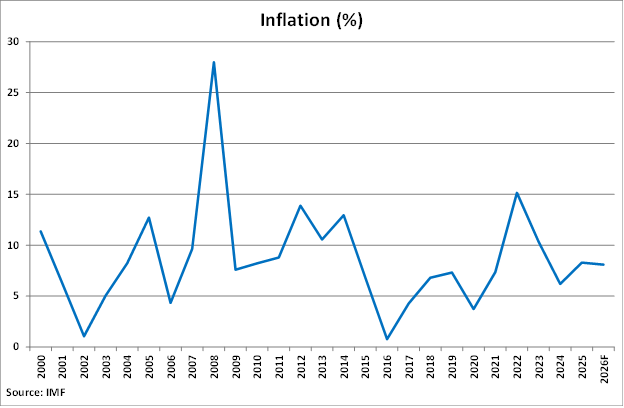
Inflationary pressures are easing. In February 2026, the nationwide inflation rate slowed to 6.5%, down from 7.5% in the previous month and 9.6% a year earlier, according to Mongol Bank. This marked the lowest inflation level since August 2024.
Inflation averaged 5.3% from 2015 to 2021 before rising to 15.2% in 2022. It gradually eased to 10.3% in 2023 and further to 6.2% in 2024. Though inflation increased again to 8.3% in 2025.
Sources:
- House prices (National Statistics Office of Mongolia): https://www.nso.mn/
- Average new house prices in Mongolia’s capital up 10.8 pct in December 2025 (Xinhua): https://english.news.cn/
- Construction (National Statistical Office of Mongolia): https://www.1212.mn/
- Housing stock, housing area, per year (National Statistics Office of Mongolia): https://www.nso.mn/
- The housing stock (2025) (Bureau of National Statistics): https://stat.gov.kz/
- Official Interest Rates of BOM (Mongol Bank): https://www.mongolbank.mn/
- Monetary policy committee statement- 2026 - 02 (Mongol Bank): https://www.mongolbank.mn/
- Money and Finance (Mongol Bank): https://stat.mongolbank.mn/
- The Bank of Mongolia funds mortgage loans with MNT16 billion per month (Montsame): https://montsame.mn/
- MNT500 billion to be spent on housing mortgage (Montsame): https://www.montsame.mn/
- Interest rate of the housing mortgage loans reduced to 6% (MIK): https://www.mik.mn/
- Mortgage Loan Sources to Be Increased to Solve Housing Problems (Montsame): https://montsame.mn/
- Gross rental yields in Mongolia: Ulaanbaatar (Global Property Guide): https://www.globalpropertyguide.com/
- Day 816: Mongolia Prefers Economic Suicide Over Ending SouthGobi Vendetta (Forbes): https://www.forbes.com/
- Mongolia signs agreement with IMF on $5.5bn aid package (Nikkei Asia): https://asia.nikkei.com/
- Mongolia (International Monetary Fund): https://www.imf.org/
- Mongolia’s GDP rises by 6.8% in 2025 (Kazinform International News Agency): https://qazinform.com/
- Mongolian parliament approves 2026 state budget (Xinhua): https://english.news.cn/
- Consumer Price Indices (Central Bank of Mongolia): https://www.mongolbank.mn/