Saudi Arabia's Residential Property Market Analysis 2026
Saudi Arabia’s housing market is cooling rapidly after several years of strong growth fueled by rising oil revenues and large-scale development projects. Market conditions are expected to deteriorate further in the coming months as the ongoing conflict in the Middle East continues, likely dampening demand and undermining investor confidence.
This comprehensive analysis by the Global Property Guide examines recent developments in the housing market of the Kingdom of Saudi Arabia, including price movements, demand and supply dynamics, recent laws and policies, and the broader socio-economic environment shaping the real estate sector.
Table of Contents
- Property Prices and Price Index
- House Price Variation
- Property Demand Trends
- Property Supply Trends
- Rental Market: Rents and Rental Yields
- Mortgage Market and Interest Rates
- Economic and Social Factors
Property Prices and Price Index
The Kingdom’s real estate index for the residential sector fell by 2.24% during the year to Q4 2025, worse than the prior quarter’s 0.9% decline and in stark contrast with the year-on-year increases of 0.44% in Q2 2025, 5.12% in Q1 2025, and 3.09% in Q4 2024, according to the General Authority for Statistics (GAStat). It marks the weakest showing of the residential sector in recent years.
When adjusted for inflation, prices were down by 4.25% year-on-year in Q4 2025.
Quarter-on-quarter, residential property prices in the Kingdom dropped by 0.38% in Q4 2025 (-0.77% inflation-adjusted), its third consecutive quarter of decline.
Saudi Arabia's house price annual change:
By property type:
- Apartments: prices declined by 2.46% year-on-year in Q4 2025 (-4.47% inflation-adjusted), following a modest increase of 2.9% in the same period in the prior year.
- Villas: prices fell by 1.35%, on average, year-on-year in Q4 2025 (-3.38% inflation-adjusted), a turnaround from the prior year’s robust growth of 6.5%.
- Single-floor residential buildings: prices fell slightly by 0.21% year-on-year in Q4 2025 (-2.26% inflation-adjusted), following a minimal decline of 0.7% in the preceding year.
- Residential lots: prices were down by an average of 2.43% during the year to Q4 2025 (-4.44% inflation-adjusted), in contrast to year-on-year growth of 2.5% a year earlier.
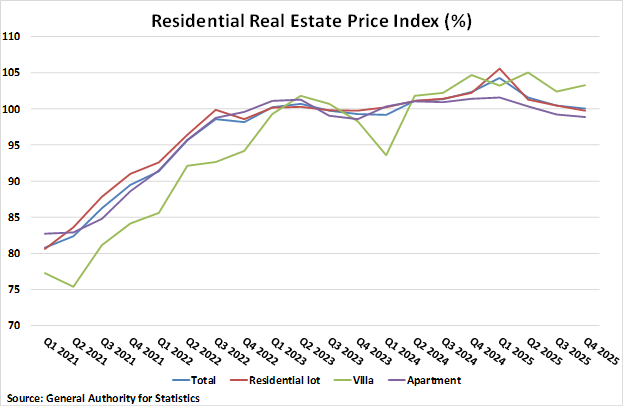
Nationwide house prices have fallen by 18.2% (-20.4% inflation-adjusted) from 2014 to 2019, amidst weak economic growth and low oil prices. It was fully offset by the cumulative price growth of 26.7% (17.4% inflation-adjusted) from 2021 to 2024. However, the housing market began to show signs of weakening last year and is expected to face further softening in the coming months.
The real estate index indicator released by GAStat was launched in April 2017, based on the available registry data of real estate transactions from the Ministry of Justice.
Prior to the outbreak of the conflict involving the United States, Israel, and Iran, housing demand in Saudi Arabia remained robust. Residential demand was the primary driver of the Kingdom’s real estate sector, accounting for 63% of the SAR 123.8 billion (US$32.9 billion) total transaction value recorded in the first half of 2025. During the said period, the number of residential property transactions in the Kingdom rose by 7% year-on-year to nearly 93,700 deals, with a total value of SAR 77.5 billion (US$20.6 billion).
The outlook for Saudi Arabia’s real estate market in 2026 is cautiously subdued. While long-term fundamentals, such as continued population growth, Vision 2030 housing initiatives, and easing of foreign ownership restrictions, remain supportive, near-term conditions are under significant pressure. The ongoing war in the Middle East, involving Israel, the United States, and Iran, has heightened geopolitical risks and fueled global oil price volatility, weakening investor confidence and housing demand. As such, residential property prices are forecast to continue their downward trajectory in the coming months.
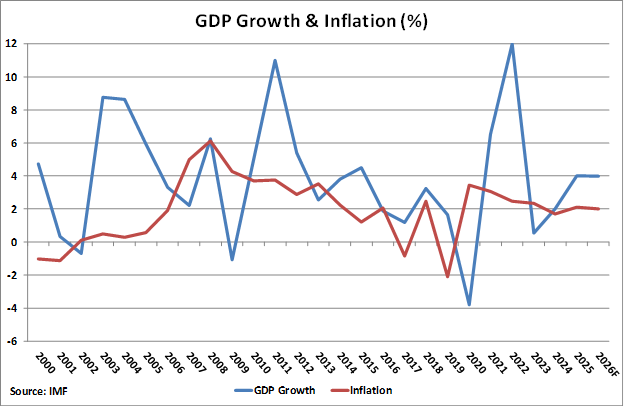
During 2025, KSA’s overall economy experienced a strong growth of around 4.5% to 5%, driven by a rebound in oil production as OPEC+ cuts ease and sustained, robust non-oil sector activity. This followed annual expansions of 2% in 2024, 0.5% in 2023, 12% in 2022, and 6.5% in 2021.
“The resilience shown in 2025 underscores the progress already achieved in reducing the economy’s exposure to oil fluctuations. Despite oil prices falling nearly 30 percent below their 2022 peak, the non-oil economy maintained strong momentum. This strength reflects the impact of Saudi Vision 2030 reforms-diversification gaps with emerging markets have narrowed, and the business environment now rivals that of advanced economies,” said the International Monetary Fund (IMF).
The Saudi unemployment rate stood at 7.5% in Q3 2025, up from 6.8% in the previous quarter but slightly lower than the 7.8% seen a year earlier, according to GAStat. Though the overall unemployment rate, which includes Non-Saudis, is low at 3.4% in Q3 2025.
The Kingdom’s inflation rate was manageable at 1.8% in January 2026, down from 2.1% in the previous month and 2% in the same period last year. The nationwide inflation rate averaged just 1.7% in the past decade.
House Price Variation:
Local house price variations
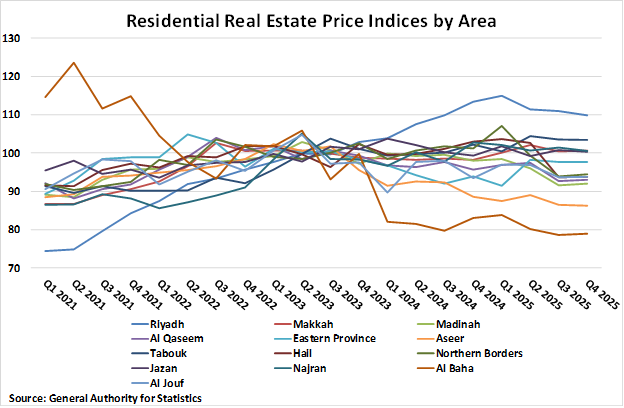
Among the country’s thirteen administrative provinces (regions), Riyadh had the best performance during 2025, posting a modest growth in its residential property prices of an average of 2.9%. However, it represented a sharp slowdown from year-on-year increases of 8.6% in 2024, another 8.6% in 2023, and 17.7% in 2022, according to GAStat. Quarter-on-quarter, Riyadh residential property prices declined slightly by 0.9% in Q4 2025.
Across the country, only six provinces recorded modest to minimal price increases, while seven provinces experienced price declines during the year.
During 2025:
- In Jazan, residential property prices were down slightly by 0.8%, in stark contrast to year-on-year increases of 1.3% in 2024, 3.8% in 2023, and 0.5% in 2022. Quarterly, prices fell slightly by 0.8% in Q4 2025.
- Al Baha’s residential property prices fell by 1.5%, following a huge annual contraction of 18.4% in 2024, a minuscule increase of 0.7% in 2023, and another decline of 14.4% three years ago. Quarter-on-quarter, prices were up slightly by 0.4% in Q4 2025.
- In Hail, residential property prices were down by 2.5% in 2025, following annual increases of 0.9% in 2024, 1% in 2023, and 5.4% in 2022. In Q4 2025, prices increased by a meager 0.1% compared to the previous quarter.
- In Al Qaseem, residential prices fell by 1.7% in 2025, after declining by 3.4% in the prior year and increasing by 0.2% in 2023 and 10.1% in 2022. In Q4 2025, prices were up slightly by 0.4% q-o-q.
- In Najran, prices were up by 1.8% during 2025, after falling slightly by 0.7% in the preceding year and increasing by 13.4% in 2023 and 0.6% in 2022. Quarterly, prices declined by 0.8% in Q4 2025.
- In Madinah, residential property prices fell by 4.7%, following a slight decline of 0.8% in 2024 and annual growth of 2.4% in 2023 and 6.8% in 2022. Quarter-on-quarter, prices were up slightly by 0.4% in Q4 2025.
- In Tabouk, prices were up by a modest 2.6% in 2025, following annual increases of 0.3% in the prior year, 9.3% two years ago, and 1% three years earlier. In Q4 2025, prices declined by 0.2% q-o-q.
- In Aseer, residential property prices dropped by 4.3%, after falling by 8.8% in 2024 and increasing by 3.8% in 2023 and 5.4% in 2022. Quarterly, prices were down slightly by 0.3% in Q4 2025.
- In Makkah, prices rose by 2.4% during 2025, following a decline of 1.6% in 2024 and increases of 2% in 2023 and 11.1% in 2022. In Q4 2025, prices were up slightly by 0.2% from the previous period.
- In Al Jouf, prices increased by a miniscule 0.7% during 2025, following an annual decline of 5.4% in 2024, a robust growth of 5.2% in 2023, and a slight fall of 0.2% three years ago. In Q4 2025, prices were up slightly by 0.2% from the prior quarter.
- In the Eastern Province, prices were up by 2.1% during 2025, following annual declines of 5.8% in 2024 and 0.7% in 2023, and an increase of 6.2% in 2022. Quarter-on-quarter, prices were unchanged in Q4 2025.
- In the Northern Borders, prices were down by 2%, following a slight increase of 0.5% in 2024, a marginal decline of 0.1% in 2023, and a strong growth of 9.3% in 2022. Quarterly, prices were up slightly by 0.5% in Q4 2025.
Property Demand Trends
Property sales strong, but geopolitical uncertainty clouds outlook
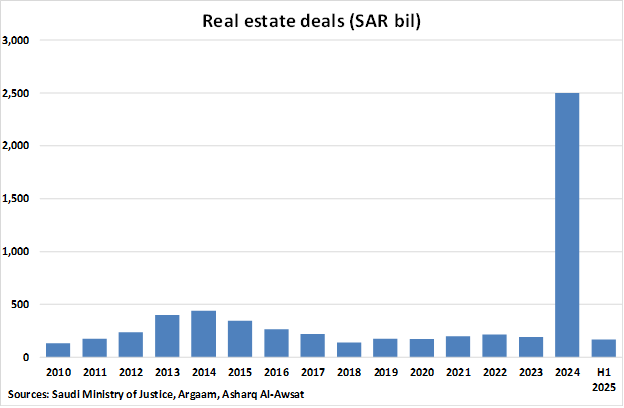
Before the outbreak of the conflict involving the United States, Israel, and Iran, housing demand in Saudi Arabia remained robust. Residential demand was the primary driver of the Kingdom’s real estate sector, accounting for 63% of the SAR 123.8 billion (US$32.9 billion) total transaction value recorded in the first half of 2025.
Over the same period, the number of residential property transactions in the Kingdom rose by 7% year-on-year to nearly 93,700 deals, with a total value of SAR 77.5 billion (US$20.6 billion).
In the Holy City of Madinah, residential sales transactions surged by 49% y-o-y to SAR 3.4 billion (US$904 million) in H1 2025, the highest growth seen across the Kingdom.
Prior to this, real estate transactions in the Kingdom hit a record-high SAR 2.5 trillion (US$533 billion) in 2024, with over 622,000 deals covering approximately 5.8 billion square meters, according to the Saudi Ministry of Justice. Accordingly, more than 520,000 properties were traded last year. The total transaction value in 2024 surged from just SAR 193.5 billion (US$51.5 billion) in 2023 and SAR216.7 billion (US$57.6 billion) in 2022.
Real estate expert Ahmed Al-Faqih called the 2024 market surge expected, citing investor incentives and Saudi Arabia’s success in hosting major global events, making it a top investment destination.
While the housing market’s underlying fundamentals remain strong, heightened geopolitical uncertainty may pose risks to demand and investment activity.
Expat workers play a vital role in Saudi’s housing market
Saudi Arabia’s expatriate population continues to play a significant role in the Kingdom’s real estate market. Recent estimates indicate that the number of non-Saudi residents has grown to around 15.7 million, representing about 44.4% of the country’s population of approximately 35.3 million. Expatriates remain a major source of demand for both residential and commercial properties, particularly in key urban centers such as Riyadh, Jeddah, and the Eastern Province.
Expat workers also dominate the labor market. As of 2025, more than 14 million expatriates are employed in Saudi Arabia, accounting for roughly 77% of the total workforce. Their presence has been driven by the Kingdom’s large-scale development projects and economic diversification efforts under Vision 2030, which continue to attract foreign professionals and workers across sectors such as construction, tourism, technology, and services.
In an effort to improve labor market attractiveness, Saudi Arabia eased foreign workers’ contractual restrictions five years ago, including the freedom to change jobs. The reforms, which took effect in March 2021, gave non-Saudi workers the right to change jobs by transferring their sponsorship from one employer to another and permit them to leave and re-enter the Kingdom and secure final exit visas without the consent of their employer.
More recently, the government has taken additional steps to attract foreign capital and residents. In January 2025, Saudi Arabia allowed foreign investors to participate in companies owning real estate in the holy cities of Mecca and Medina. This policy aims to attract international capital and enhance the liquidity of projects in these cities, which are central to the Kingdom's religious and economic activities.
The Kingdom’s efforts to attract foreign investment and diversify its economy are expected to continue influencing the real estate market dynamics in the coming years.
KSA eases restrictions on foreign real estate ownership
Saudi Arabia has introduced a new legal framework for foreign property ownership that took effect in January 2026, marking one of the most significant changes to the Kingdom’s real estate regulations in decades. Under this updated law, non‑Saudis, including individuals and companies, can acquire and own real estate in designated geographic zones across the country, a major shift from earlier restrictions that severely limited foreign ownership.
For individual foreign residents, the new rules permit ownership of one residential property outside restricted areas, with certain limitations in cities such as Makkah and Madinah, where ownership remains restricted except under specific conditions. Non‑resident buyers are now allowed to own property only within officially designated zones approved by the authorities.
The changes also open the door for corporate and investment ownership, with foreign‑owned companies, investment funds, and special‑purpose entities permitted to hold real estate for business, development, or operational purposes under regulatory oversight. To ensure transparency and compliance, all foreign buyers must register their ownership with Saudi authorities, and transactions may be subject to fees and penalties for non‑compliance.
New RETT rules provide relief for homebuyers
Saudi Arabia’s Real Estate Transaction Tax Law (RETT), approved on September 22, 2024, and effective from April 9, 2025, has now been fully implemented along with detailed implementing regulations issued by the Zakat, Tax and Customs Authority (ZATCA). This updated framework maintains the 5% tax on real estate transactions but provides greater clarity on scope, calculation, and exemptions to improve compliance and reduce uncertainty in the property market.
The implementing regulations clarify that the tax base includes not only the property’s sale value but also certain movable assets permanently associated with the property and key accessory rights. They also introduce a 30 % rule for share disposals in real estate companies (where transfers under 30 % may be excluded) and specify additional exclusions and exemptions, such as transfers of real estate to public entities, mergers and acquisitions, subscription to publicly offered securities of a real estate company, trading of securities/units, and forced sales in liquidation.
To encourage compliance and reduce disputes, the regulations also define procedures for tax payment timelines, objections and appeals, and introduce a refund mechanism for excess or incorrect payments. Responsibility for remitting the tax remains primarily with the seller, but buyers may be held jointly liable in certain cases.
Prior to this, in October 2020, the government strengthened its efforts to boost the housing market:
- All property deals have been exempted from the 15% value-added tax (VAT), and are instead subject to a new 5% tax on transactions.
- The threshold for the tax exemption for first-time homebuyers was increased to SAR 1 million (US$266,432) from SAR 850,000 (US$226,467).
These moves support Crown Prince Mohammed bin Salman’s Vision 2030 of increasing homeownership to 70% by end-2030.
The Saudis have been encouraging residential investment
Mindful of the lessons of the 1970s to early 1980s, the Saudis have in recent years spent their petrodollars cautiously, reinvesting a large portion of the windfall into real estate and encouraging foreign investment.
After a deep recession in the 1990s, a Foreign Investment Law was passed in April 2000 to encourage a service-oriented economy. Legally resident non-Saudis were allowed to own a private residence by a new Real Estate Law, except in Mecca and Medina, provided they obtained a license from the Ministry of Interior. They can also own real estate to conduct business and accommodate employees, again with Ministry of Interior permission. To prevent speculation, five years must elapse before a property can be sold.
From 2002 to 2005, house prices rose by 13.7% annually while average land prices rose 16.5% per year, according to the National Commercial Bank Capital (NCBC). Residential property prices continued to rise from 2006 to 2013, albeit at a much slower pace.
As the economy slowed between 2016 and 2019, the housing market also weakened. However, in recent years, it has rebounded rapidly as the economy recovers from the impact of the Covid-19 pandemic.
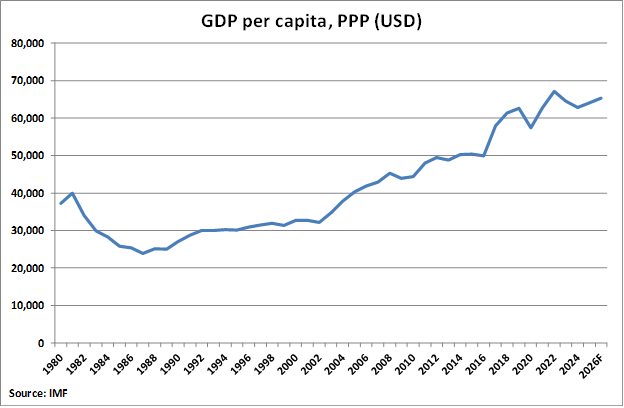
The housing market has been steadily driven by affluent Saudis. Over the past two decades, Saudi Arabia’s GDP per capita (PPP) has grown by nearly 60%, increasing from $40,308 in 2005 to $64,037 in 2025.
Property Supply Trends
Major real estate developments
Saudi Arabia continues to pursue large-scale real estate and infrastructure projects under its national transformation agenda, Saudi Vision 2030. Many of these developments are being implemented through public-private partnerships and are designed to diversify the economy, boost tourism, and create new urban centers. Key flagship projects include NEOM, The Red Sea Project, Qiddiya, and Amaala.
The ambitious urban project NEOM is a 26,500 sq. km. futuristic mega-city and business zone located on the Red Sea near Saudi Arabia’s northeast border with Jordan and Egypt. Originally announced in 2017 by Crown Prince Mohammed bin Salman, the US$500-billion project includes several sub-developments such as The Line, Oxagon, Trojena, and Sindalah. Construction activity accelerated in 2024 and 2025, with early infrastructure works and the opening of the Sindalah luxury island destination in late 2024, while a 5-km initial segment of The Line is targeted for completion by 2030. The full project is expected to be finished by 2045.
The tourism-focused The Red Sea Project has also progressed significantly. Located between the cities of Umluj and Al-Wajh and spanning around 28,000-34,000 sq. km, the project aims to develop 50 luxury resorts and about 8,000-10,000 hotel rooms across numerous islands and inland sites. The first phase was largely completed in 2023, including the opening of Red Sea International Airport and several luxury resorts. Additional resorts and tourism facilities are scheduled to open progressively through the late 2020s, with full completion targeted by 2030.
Another major development is Qiddiya, a 334 sq. km entertainment and leisure city located about 40 km from Riyadh. Construction began in 2019 and continues to advance, with the project set to feature major attractions including a Six Flags-branded theme park, sports venues, cultural attractions, hotels, and residential communities. Qiddiya is expected to become one of the Kingdom’s largest entertainment destinations and could eventually accommodate over 500,000 residents and visitors when fully developed.
Meanwhile, Amaala is being developed as a luxury wellness and tourism destination on Saudi Arabia’s northwestern Red Sea coast. Covering around 3,800 sq. km, the project will include approximately 2,500 luxury hotel rooms, 700 villas, 200 retail establishments, marinas, and cultural facilities. The first phase is expected to begin operations in the mid-2020s, with the broader development scheduled to be completed by 2039.
Other residential construction projects in the Kingdom, either recently completed or currently ongoing, include: Thakher City Residential Towers (2,750 apartments); Jeddah Gate (4,000 apartments); Rafal Sky Gardens (286 apartments; ETLAL Residence (182 apartments); Jabal Omar Development (509 apartments); Jeddah Tower (500 apartments); and Saudi Aramco - Fadhili Residential Compound - Housing Package (2,000 villas).
Saudi Arabia also has other construction projects, aiming to improve infrastructure, diversify its economy, and raise the citizens’ living standards. The Kingdom's other top construction projects, among many others, include:
- The Riyadh Metro (officially opened in December 2024)
- Riyadh Rapid Bus Transit System (the first phase officially began operations in 2023)
- Jeddah Tower (expected to be completed around 2027)
- The third expansion of Makkah Grand Mosque (while most of the work has already been completed, it is expected that the full third expansion will be completed around 2026-27)
- Expansion of the King Fahad Medical City (expected to be completed around 2026-27)
- King Abdullah Bin Abdulaziz Medical Complexes (expected to be completed in the next two to three years)
- King Salman Energy Park (Spark) (being developed in three phases, with full completion expected around 2035)
Housing supply continues to grow, but shortage persists
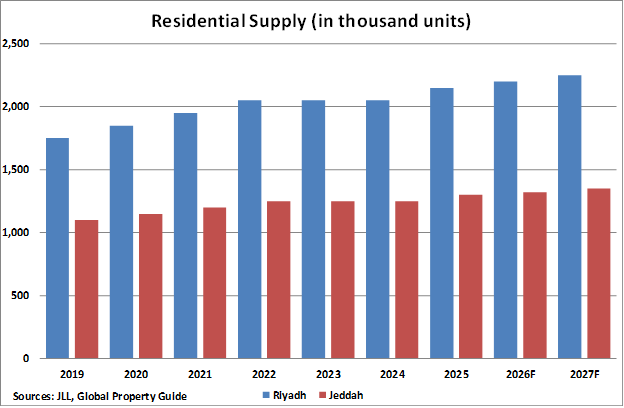
Housing supply continues to increase in the major areas in the Kingdom, particularly in Riyadh, Jeddah, and the Dammam Metropolitan Area (DMA), according to a Q3 2025 report published by Jones Lang LaSalle (JLL).
- Riyadh’s total residential stock increased to 2.18 million units by end-Q3 2025, with nearly 9,500 units estimated to have been completed in Q4 2025.
- Jeddah’s residential supply reached approximately 1.23 million units, following the completion of about 4,320 units in Q3 2025.
- The DMA, including Dammam, Al Khobar, and Dhahran, saw the completion of 428 residential units in Q3 2025, bringing the total stock to 725,812 units. An additional 400 units were estimated to have entered the market in the last quarter of 2025.
Strong housing demand in Riyadh has prompted private developers to cater to a wide range of market segments across the city. Upcoming projects include high-end gated communities in the northern districts, as well as more affordable apartment-led developments in the southern and eastern areas, reflecting efforts to address varying affordability levels and housing preferences, according to the JLL report.
In Jeddah, developers are increasingly focusing on the mid-market segment amid rising affordability concerns. Most new residential developments are concentrated in the northern districts, where ongoing infrastructure expansion continues to attract residential investment and sustain buyer interest.
In the DMA, new residential supply is gradually expanding inland and toward the southern districts, suggesting growing demand beyond Al Khobar’s traditional waterfront locations. While Al Khobar is expected to remain the primary hub for high-end developments, many new projects are increasingly focused on apartment-led communities targeting mid- and upper-middle-income residents seeking more affordable housing options inland.
“From a supply standpoint, residential development pipelines stay robust across major cities, driven by government housing initiatives and continued private sector involvement. However, delivery timelines are expected to extend slightly as developers adapt project phases to navigate regulatory changes, rising construction costs, and near-term pricing impacts from rent freeze policies,” said the JLL report.
Saudi Arabia faces an acute housing shortage. Based on research conducted by Knight Frank, over 115,000 housing units need to be built annually until 2030 to meet the demand from Saudi nationals.
To tackle this, a comprehensive housing program was introduced in 2018, including the Sakani initiative, which has facilitated over 800,000 contracts. Moreover, Saudi Arabia’s cabinet approved a 2.5% tax on undeveloped and idle urban land plots or “white lands” a decade ago, applicable to landowners of plots exceeding 5,000 square meters.
“The continued enforcement and expansion of the White Land Tax schemes is prompting development activity, as landowners are incentivised to activate vacant plots, particularly in high-demand zones in Riyadh, to mitigate tax liabilities and capitalise on strong residential demand,” noted JLL.
Initiatives to expand homeownership
The Kingdom’s population of 35.3 million has grown by about 2% annually in the past decade. It is dominated by young middle-class Saudis who are first-time homebuyers, as 45% of the country’s population is below 20 years old. Expatriates represent almost a third of the total population, and they too need accommodation. Low and middle-income households make up about 80% of the unmet demand.
To boost affordable housing and the property market, mortgage financing is being made more accessible for Saudis:
- In 2016, the National Housing Company (NHC) was established, which has been instrumental in developing new housing units in the Kingdom.
- The Ministry of Housing’s “Sakani” program, which was launched in 2018, offers affordable housing options and helps with financing. The Sakani program helped over 157,000 families in 2018 and 300,041 families in 2019. During the first installment in FY 2020, 32,285 families have benefitted from the program. Then in 2021, the program assisted over 210,000 Saudi families in 2021, raising the total beneficiaries to 1.2 million. The Sakani program has been supporting families every year, and in 2023, more than 96,000 families benefited from the program, and over 20,000 families were assisted through developmental housing tracks. More than 54,000 Saudi families benefited from the Sakani housing program in the first half of 2025, following over 117,000 beneficiaries recorded in 2024.
- Earlier, the downpayment for the first housing was lowered from 10% to 5% in April 2018, according to Real Estate Development Fund (REDF) General Supervisor Khalid bin Mohammed Al-Amoudi. The REDF also launched the “flexible installment” that allows adjustments to monthly installments in accordance with the beneficiary's income.
- The Saudi Arabian Monetary Agency (SAMA), the country’s central bank, allowed banks to supply a higher share of funding for home purchases by increasing the banks’ maximum loan-to-value ratio for mortgages for first-time homebuyers from 85% to 90% in 2018.
- In January 2018, the REDF started offering subsidized mortgage financing to its existing recipients.
- The REDF approved a mortgage guarantee program in October 2017, which makes it easier for a relative to be nominated as a guarantor for mortgage loan financing.
- In October 2017, Saudi Arabia’s Public Investment Fund launched a mortgage refinancing company, called the Saudi Real Estate Refinance Company (SRC). The intention is that within 5 years, it will refinance mortgages worth SAR 75 billion (US$ 20 billion). “The new company is designed to stimulate housing sector development in the kingdom by injecting liquidity in the real estate market,” said a statement.
- The SRC launched an initiative in August 2018, allowing new and existing borrowers to apply for long-term mortgages at fixed rates. Aside from improving Saudi mortgage financing availability, this new initiative also provides protection from interest rate hikes.
- As of the first half of 2024, the Ministry of Municipal, Rural Affairs, and Housing has reportedly signed over 26,000 land development contracts, including 11,000 in Q4 2023, to provide affordable housing and boost homeownership among Saudis.
- In May 2025, Saudi Arabia lowered the minimum eligibility age for housing support from 25 to 20 years old, enabling younger citizens to access financing and housing assistance earlier.
These measures are part of Saudi Arabia’s National Transformation Program 2030, which aims to achieve a 70% homeownership rate by 2030. By early 2025, the nationwide homeownership rate reached 65.4%, up from 63.7% in the prior year and from just 47% in 2016.
Rental Market: Rents and Rental Yields
Gross rental yields are high, rents rising strongly
The average gross rental yield in Saudi Arabia stands at 6.84% in Q1 2026, according to a recent survey conducted by the Global Property Guide. Previously, in Q3 2025, the rental yield was 7.34%.
This is consistent with an earlier STC Real Estate Index report published by Stephane Tajick Consulting, which showed that the average gross rental yield remained high at 8.89% in Riyadh and around 7.89% in Jeddah.
Moreover, Saudi Arabia’s rental market has been growing strongly recently, amidst robust demand both from Saudis and expat workers.
During the year to Q3 2025:
- In Riyadh, apartment rental rates rose sharply by 19.6% year-on-year, reaching an average of SAR30,832 (US$8,201), while villa rents surged 17.2% year-on-year to SAR88,715 (US$23,598), according to JLL.
- In Jeddah, the rental market showed mixed performance, with apartment rents rising by 2.6% year-on-year to SAR25,013 (US$6,653), while villa rents fell by 2.7% year-on-year to SAR65,163 (US$17,333).
Saudi Arabia's rent price index:
“The newly introduced five-year rent freeze in Riyadh is expected to anchor rental values in the short term and reduce upward pressure on occupier costs, though its impact may be less pronounced in Jeddah and DMA, where no equivalent regulation has been announced as yet,” said the JLL report. “With the regulatory environment tightening in Riyadh, landlords and developers may focus more on differentiation through quality, service, and amenity upgrades to maintain occupancy and value.”
Mortgage Market and Interest Rates
New residential mortgage loans declining, despite falling interest rates
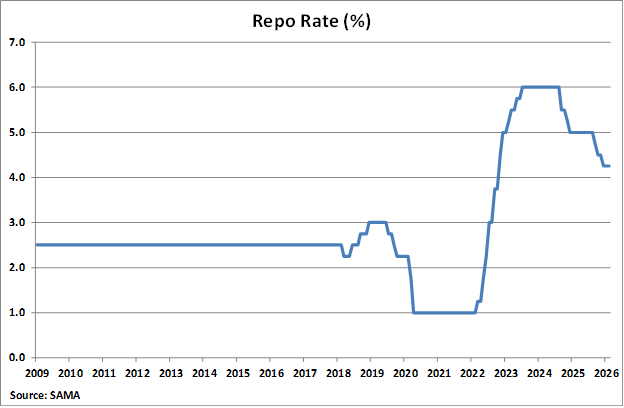
The Saudi Arabian Monetary Agency (SAMA), the Kingdom’s central bank, lowered its key policy rates in December 2025, reducing the repurchase rate to 4.25% and the reverse repo rate to 3.75% in response to global monetary easing and evolving domestic conditions. This adjustment followed earlier rate cuts in mid‑2025 that aligned SAMA’s policy with rate reductions by the U.S. Federal Reserve and other Gulf central banks aimed at supporting economic activity amid slowing inflation.
This marked the sixth consecutive rate cut by the central bank since August 2024. SAMA has kept its key interest rates unchanged since December 2025, maintaining policy stability amid evolving economic conditions.
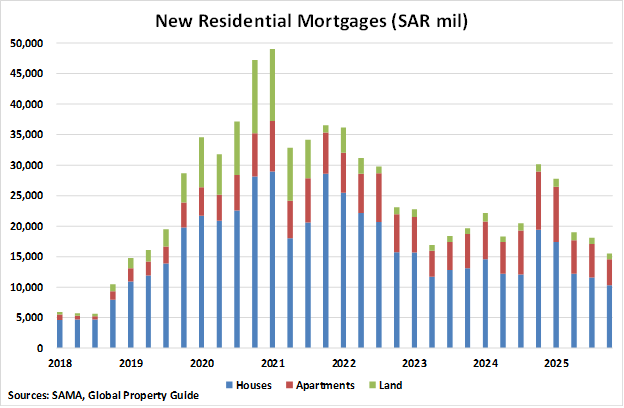
Despite this, the mortgage market seems to be stalling again. During 2025, the number of new residential mortgage loans totaled 108,795 contracts, down by 11% from the prior year, according to figures released by SAMA. This followed a strong growth of 18.9% in 2024 and annual contractions of 33.4% in 2023, 23.4% in 2022, and 10.5% in 2021.
Likewise, the total value of new residential mortgage loans also declined by 11.7% y-o-y to SAR 80.42 billion (US$21.43 billion) last year, in contrast to the annual growth of 17.1% seen in 2024.
By property type, in 2025:
- Houses: SAR 51.44 billion (US$13.71 billion), down by 11.8% from a year earlier
- Apartments: SAR 24.3 billion (US$6.48 billion), down by 13.5% from the preceding year
- Land: SAR 4.68 billion (US$1.25 billion), unchanged from the prior year
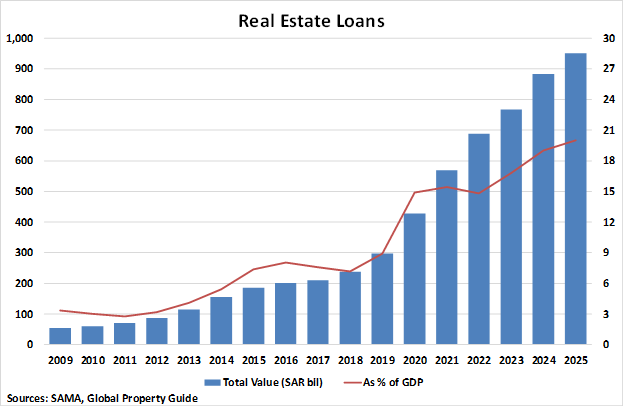
Though real estate loans continue to increase. During 2025, the total amount of real estate loans outstanding rose by 7.7% to SAR 951.3 billion (US$253.46 billion), according to SAMA figures. It has been growing by an average of 20% annually from 2010 to 2025.
Lending to individuals constituted the largest portion, representing 76.7% of the total, with an annual growth rate of 7.2%.
Real estate loans currently make up around 30% of the total loan portfolio of Saudi banks.
As a percentage of GDP, the mortgage market grew to approximately 20% of GDP in 2025, slightly up from 19% in the previous year, 16.8% in 2023, and 14.8% in 2022, and far higher than just 3% in 2010, based on figures from the Global Property Guide.
The Real Estate Development Fund (REDF), a state-funded entity, currently dominates the home financing market.
Economic and Social Factors
The impact of oil price fluctuations and geopolitical tensions
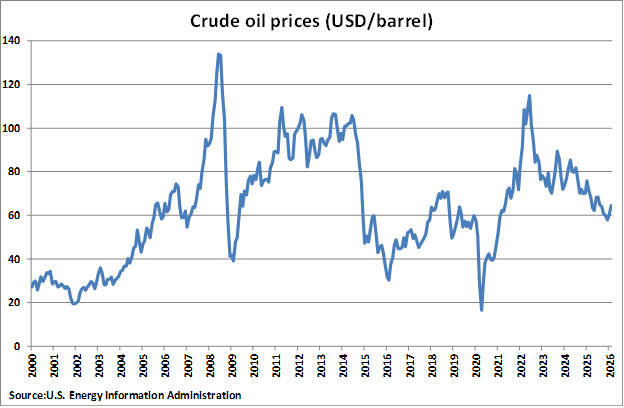
Oil price volatility continues to influence Saudi Arabia’s housing market. For instance, the sharp decline in oil prices in 2014 triggered a downturn in property values, as government revenues and economic activity slowed.
Saudi Arabia, in its effort to maintain global market share, contributed to the price drop, with Brent crude averaging just US$57.1 per barrel between 2015 and 2019 - well below the country’s estimated breakeven price of US$100 per barrel.
In the succeeding years, oil prices rebounded, peaking above US$120 per barrel in mid-2022 due to geopolitical tensions and supply constraints. This resurgence fueled economic growth, boosting government spending and real estate demand. However, by late 2023 and early 2024, oil prices softened again, averaging around US$80 per barrel, raising concerns over fiscal sustainability and its potential impact on housing market momentum.
Then by end-2024, Brent crude oil price stood at an average of US$73.83 per barrel, down by 5.2% from the same period last year.
More recently, however, geopolitical tensions in the Middle East have once again reshaped global oil market dynamics. The ongoing conflict involving Israel and the United States on one side and Iran on the other has heightened concerns over disruptions to energy infrastructure and critical shipping routes in the region. As the conflict spreads to neighboring areas, including Saudi Arabia, global energy markets have reacted sharply.
In early March 2026, oil prices surged in global markets amid fears of supply disruptions, with Brent crude rising above US$80 per barrel as tensions escalated and energy shipments from the Middle East faced increasing risks.
Reports also indicate that facilities of Saudi Aramco, including the major Ras Tanura refinery, one of the largest in the kingdom, were targeted in a drone attack linked to the wider regional conflict. While the incident caused only limited damage and temporary operational disruptions, it nevertheless heightened market concerns over the vulnerability of energy infrastructure in the Gulf.
Such developments underscore how geopolitical instability in the Middle East can rapidly influence global oil supply expectations and price movements. Any sustained escalation that constrains production or export routes could further push oil prices upward.
While the Saudi real estate sector remains supported by the country’s diversification strategy under Saudi Vision 2030, the ongoing conflict introduces new uncertainty. Prolonged geopolitical tensions and oil market volatility may adversely affect investor confidence and economic activity, potentially slowing housing demand in Saudi Arabia.
Fiscal resilience amid oil price volatility
Despite oil price volatility, Saudi Arabia has far larger cash reserves and is able to withstand a downturn in prices for much longer. Saudi Arabia is the world’s largest oil producer and exporter, and also has huge clout as the leader of the Organization of the Petroleum Exporting Countries (OPEC). Petroleum accounts for more than 75% of government revenues and 90% of exports.
Saudi Arabia has compensated for its reduced oil revenues by running fiscal deficits. There was a deficit of 15.8% of GDP in 2015, 12.9% in 2016, 9.2% in 2017, 5.7% in 2018, and 4.4% in 2019. This was in sharp contrast with budget surpluses of about 13% of GDP from 2003 to 2013.
The sharp increase in Saudi Arabia’s budget deficit in 2015 and after can be attributed to:
- The sharp decline in crude oil prices,
- Following King Salman’s accession to the throne in January 2015, he immediately spent a substantial amount of money on subsidies and public job bonuses, including extra months of additional salary for all government employees, in an effort to increase his popularity.
- Significant military expenditures on conflicts in Yemen and Syria, and support for Egypt.
The deficit climbed to around 11.2% of GDP in 2020 due to increased government spending during the pandemic. However, as oil prices rebounded, the shortfall was swiftly reduced to 2.3% of GDP in 2021. By 2022, the country achieved a surplus of around 2.5% of GDP, driven by soaring crude oil prices and strong economic growth. However, in 2023 and 2024, the country slipped back into a deficit of about 2% of GDP due to weaker economic performance.
For 2025, total revenues reached SAR 1.11 trillion (US$295.7 billion) against expenditures of SAR 1.39 trillion (US$370 billion), resulting in a budget deficit of SAR 276.6 billion (US$73.7 billion). This exceeded earlier government projections as oil revenues declined. As a percentage of GDP, the Kingdom’s deficit increased sharply to around 5.3%, its worst showing since the 2020 Covid-19 pandemic.
From having the lowest share of public debt in the world at less than 2% of GDP in 2014, the kingdom’s public debt ballooned to around 22.8% of GDP in 2019 and further to 32.5% of GDP in the pandemic year of 2020. In the succeeding four years, public debt has fluctuated between 23% and 30% of GDP.
Then in 2025, public debt rose to SAR1.52 trillion (US$405 billion), up from SAR1.22 trillion (US$325 billion) a year earlier, as the Kingdom increased borrowing to finance fiscal deficits while continuing to fund large-scale development and infrastructure projects. As a result, Saudi Arabia’s government debt-to-GDP ratio reached 31.7% in 2025, marking the highest level recorded in recent years.
Crown Prince Mohammed bin Salman is Saudi’s de facto ruler
Crown Prince Mohammed bin Salman, widely regarded as Saudi Arabia’s de facto ruler, has played a pivotal role in reshaping the Kingdom’s political and economic landscape. Since his appointment as crown prince in June 2017 by King Salman bin Abdulaziz Al Saud following the removal of Mohammed bin Nayef, he has consolidated authority while advancing a broad reform agenda aimed at transforming the country’s economy and governance structures.
Shortly after assuming the role, the crown prince launched a large-scale anti-corruption campaign that resulted in the detention of senior princes, ministers, and prominent business figures, including billionaire investor Al‑Waleed bin Talal. The campaign was officially framed as part of an effort to combat corruption and recover state funds, though some observers interpreted it as part of a broader process of political consolidation.
Saudi Arabia’s foreign policy under the crown prince has been more assertive compared with previous periods. The Kingdom played a central role in the 2017 diplomatic and economic rift with Qatar, which was resolved in 2021 through a regional reconciliation agreement. Relations with Iran have historically been strained, reflecting wider geopolitical competition in the region, although both countries agreed in 2023 to restore diplomatic relations following negotiations mediated by China. Saudi Arabia has also been a leading participant in the coalition intervention in Yemen since 2015, a conflict that has had significant humanitarian and geopolitical implications.
One of the most widely reported international controversies associated with the crown prince was the 2018 killing of Saudi journalist Jamal Khashoggi inside the Saudi consulate in Istanbul. The incident drew strong international criticism and prompted investigations and intelligence assessments, including a 2021 report by the Office of the Director of National Intelligence in the United States, which stated that the crown prince likely approved the operation. Saudi authorities have rejected allegations of direct involvement by the crown prince, and several individuals were prosecuted in Saudi courts. The event temporarily strained relations with some Western governments and investors, though diplomatic and economic engagement has largely resumed in subsequent years.
In recent years, Saudi Arabia has increasingly positioned itself as a regional diplomatic actor. The Kingdom has sought to support dialogue aimed at de-escalating conflicts in countries such as Sudan and Yemen, while also responding to the evolving security environment linked to the ongoing regional tensions surrounding the Israel-Hamas War that began in 2023. The conflict and related instability in the Middle East have underscored the Kingdom’s balancing role between regional security concerns and economic development priorities.
Domestically, the crown prince continues to lead the implementation of Saudi Vision 2030, an economic transformation strategy aimed at reducing the Kingdom’s reliance on oil and expanding sectors such as tourism, entertainment, and advanced industries. Major flagship developments include NEOM, a planned large-scale smart city project on the Red Sea coast, alongside broader investments in infrastructure, renewable energy, and urban development. The reform agenda has also included social and regulatory changes, such as expanded workforce participation opportunities for women and the growth of cultural and entertainment industries.
The ongoing conflict involving the United States and Israel with Iran has heightened regional risks and economic uncertainty, affecting Saudi Arabia and neighboring states, and it remains unclear how Crown Prince Mohammed bin Salman and the Saudi leadership will balance emerging security challenges with the Kingdom’s economic objectives and Vision 2030 priorities.
Sources:
- Real Estate Prices Statistics (General Authority for Statistics): https://www.stats.gov.sa/
- Kingdom of Saudi Arabia Living Market Dynamics, Q3 2025 (JLL): https://www.jll.com/
- Saudi Arabia’s Residential Market: Jan 2026 Foreign Ownership Laws, Mortgage Growth, and Rising Housing Supply (Ken Research): https://www.kenresearch.com/
- Riyadh’s housing pipeline set to surge with 57,000 new units by 2026-27 (International Finance): https://internationalfinance.com/
- Saudi Arabia’s home sales boom - even before new law takes effect in Jan. 2026 (Gulf News): https://gulfnews.com/
- Saudi Real Estate Transactions Surpass $533 Billion in 2024 (Asharq Al-Awsat): https://english.aawsat.com/
- Saudi Arabia's real estate deals fall 11% to SAR 193.45B in 2023 (Argaam): https://www.argaam.com/
- Saudi Real Estate Market Surpasses $44 Billion in First Half of 2025 (Asharq Al-Awsat): https://english.aawsat.com/
- Saudi Arabia’s population hits 35.3M in 2024, expats make up 44.4 pc (The Siasat Daily): https://www.siasat.com/
- Saudi workforce rises to 18.2M in Q2 2025 (Argaam): https://www.argaam.com/
- Saudi Arabia to remove key restrictions on foreign workers (Al Jazeera): https://www.aljazeera.com/
- Saudi Arabia allows foreigners to invest in firms with property in Mecca, Medina (Reuters): https://www.reuters.com/
- Saudi Arabia to roll out new foreign property ownership law in 2026 (Saudi Gazette): https://saudigazette.com.sa/
- Saudi Arabia publishes new foreign ownership property rules (MEED): https://www.meed.com/
- Saudi Arabia issues Real Estate Transaction Tax Law (EY): https://taxnews.ey.com/
- New RETT Implementing Regulations (PwC): https://www.pwc.com/
- Saudi Tax Relief Unleashed for Home Buyers to Keep Boom Rolling (Bloomberg): https://www.bloomberg.com/
- NEOM releases first progress film, showing construction so far – up to January 2023 (NEOM): https://www.neom.com/
- Statistical Report (Saudi Arabian Monetary Agency): https://www.sama.gov.sa/
- Saudi Arabia Repo Rate (Trading Economics): https://tradingeconomics.com/
- Gross rental yields in Saudi Arabia: Riyadh and Jeddah (Global Property Guide): https://www.globalpropertyguide.com/
- The Real Estate Index by Global Residence Index (Global Residence Index): https://globalresidenceindex.com/
- Oil jumps nearly 5% on Middle East conflict (The Star): https://www.thestar.com.my/
- Over 1 million new homes planned as Saudi Arabia tackles housing shortage (Prop News Time): https://propnewstime.com/
- Sakani (Vision 2030): https://www.vision2030.gov.sa/
- Saudi Ministry’s ‘Sakani’ programme benefits 32,285 families in January (Construction Week): https://www.constructionweekonline.com/
- Transforming the Housing Sector in Saudi Arabia (PwC): https://www.pwc.com/
- Over 48,000 Saudi families move into first home in H1 2025: Sakani (Argaam): https://www.argaam.com/
- Saudi central bank lifts loan-to-value rate for 1st-time-buyer mortgages (Reuters): https://www.reuters.com/
- REDF to start subsidy program for existing mortgages (Argaam): https://www.argaam.com/
- Saudi launches mortgage guarantee programme (Gulf Business): https://gulfbusiness.com/
- Saudi Wealth Fund Widens Economic Role With Mortgage Company (Bloomberg): https://www.bloomberg.com/
- New mortgages to boost home ownership in Saudi Arabia (Arab News): https://www.arabnews.com/
- Saudi Vision 2030: Achieving milestones in the Kingdom’s housing sector (Global Business Outlook): https://globalbusinessoutlook.com/
- Saudi Arabia Lowers Housing Support Eligibility Age to 20 in Push to Boost Homeownership (Khaleej Mag): https://khaleejmag.com/
- Repo Rate (Saudi Arabian Monetary Agency): https://www.sama.gov.sa/
- Saudi Arabia Government Budget (Trading Economics): https://tradingeconomics.com/
- Saudi Arabia’s budget deficit widens to $25.3bn in Q4 2025 as spending rises (Arab News): https://www.arabnews.com/
- Saudi budget deficit hits five-year high amid oil price rout (Salaam Gateway): https://salaamgateway.com/
- Saudi Arabia (International Monetary Fund): https://www.imf.org/
- Saudi Arabia’s Path Forward Amid Lower Oil Prices (International Monetary Fund): https://www.imf.org/
- Labor Market Statistics (General Authority for Statistics): https://www.stats.gov.sa/