Macau's Residential Real Estate Market Analysis 2026
Macau’s housing market continues to face significant headwinds, with residential property prices posting double-digit declines amid weakening demand and slowing economic growth.
This extended overview from the Global Property Guide examines key aspects of Macau’s housing market, with a detailed focus on recent developments and long-term trends.
Table of Contents
- Property Prices and Price Index
- Historic Perspective
- Property Demand Trends
- Property Supply Trends
- Rental Market: Rents and Rental Yields
- Mortgage Market and Interest Rates
- Economic and Social Factors
Property Prices and Price Index
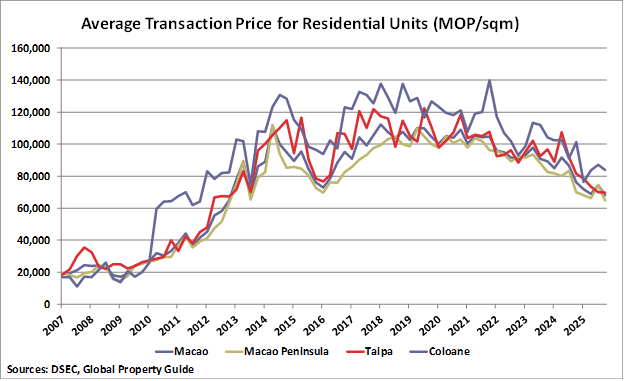
Transaction prices of residential units plummeted by 16.7% year-on-year in 2025 to an average of MOP 70,935 (US$8,810) per square meter (sqm), according to the Statistics and Census Service (DSEC). It marked its seventh consecutive year of falling residential property prices and its worst showing in recent history.
When adjusted for inflation, prices were actually down by a huge 17.4% last year.
Quarter-on-quarter, residential property prices in Macau declined by 8.3% (-8.6% inflation-adjusted) in Q4 2025.
This is supported by JLL’s March 2026 report: “Capital values declined across various property sectors in 2025 amid weak demand and macroeconomic uncertainties.”
“In 2025, with developers proactively lowering prices to boost the sales of new residential properties, residential prices experienced relatively significant adjustments,” noted Mark Wong, Senior Director of Value and Risk Advisory at JLL in Macau.
Macau's house price annual change:
Locally, residential property prices are also generally falling rapidly.
- In Macau Peninsula, the historic center of Macau, the average transaction price of residential properties plunged by 12.5% y-o-y to MOP 68,894 (US$8,557) per sqm in 2025. In real terms, prices in the peninsula were down by 13.3%.
Of the 17 areas on the island where figures are available, 14 saw house price falls.
Barca registered the biggest house price fall in the Macau Peninsula, at a whopping 44.6% in 2025 from a year earlier, followed by Fai Chi Kei (-37.6%), ZAPE (-25.6%), Móng Há & Reservatório (-24.2%), Barra & Manduco (-23%), Guia (-22.5%), Ilha Verde (-21.5%), Baixa de Macau (-18.4%), Doca do Lamau (-15.7%), Areia Preta & Iao Hon (-15.2%), Tamagnini Barbosa (-13.8%), and Conselheiro Ferreira de Almeida (-11.8%).
More moderate price declines were recorded in NATAP and Horta Costa & Ouvidor Arriaga, at 6.7% and 3.7%, respectively.
In contrast, Praia Grande & Penha was the only district to register strong price growth, rising by 22.5%, while modest to minimal increases were recorded in Grande (2.3%) and Patane & São Paulo (0.8%).
- In Taipa, where there are many hotels, casinos, and shopping malls, and which is home to the Macau Jockey Club racecourse, residential property prices were down by a huge 22.3% y-o-y to MOP 72,971 (US$9,063) per sqm in 2025. When adjusted for inflation, prices plummeted by 23% last year.
Baixa da Taipa saw the biggest house price fall of 23.7% last year, followed by Cidade & Hipódromo da Taipa (-22.1%), Jardins do Oceano & Taipa Pequena (-17%), and Pac On & Taipa Grande (-8.6%). Only Universidade & Baía de Pac On registered a modest price growth of 4.3% in 2025.
- In Coloane, home to two of Macau’s best beaches, Cheoc Van and HacSa, residential property prices were also down by 18.2% y-o-y to MOP 81,500 (US$10,122) in 2025. In real terms, prices dropped 18.9% over the same period.
NAPE & Aterros da Baía da Praia Grande, located on the Macau Peninsula, has the most expensive housing, with an average transaction price of MOP 90,249 (US$11,209) per sqm in 2025. It was followed by NATAP, with an average price of MOP 82,394 (US$10,233) per sqm; Coloane, with MOP 81,500 (US$10,122) per sqm; Pac On & Taipa Grande, with MOP 80,727 (US$10,026) per sqm; and Doca do Lamau, with MOP 80,605 (US$10,011) per sqm.
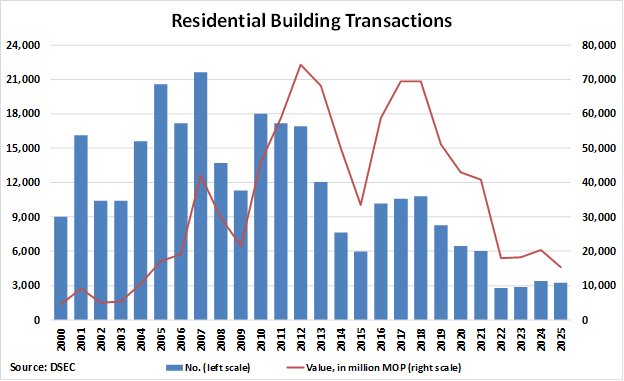
Demand is falling again. Residential property transactions in Macau fell by 4% to 3,245 units in 2025 from a year earlier, in contrast to year-on-year increases of 17.4% in 2024 and 2.5% in 2023, according to DSEC. This follows a series of sharp contractions in earlier years, with transactions plunging by 53.2% in 2022, 7.4% in 2021, 21.7% in 2020, and 23.5% in 2019.
Likewise, total transaction values were down by a huge 24.6% y-o-y to MOP 15.33 billion (US$1.9 billion) in 2025, following annual increases of 11.1% in 2024 and 1.8% in 2023 and contractions of 56% in 2022, 5% in 2021, 15.9% in 2020, and 26.5% in 2019.
Despite falling demand, residential construction activity is showing signs of improvement. Residential construction permits surged by a whopping 258% y-o-y from just 107 units in 2024 to 383 units in 2025, according to DSEC. Despite this, it remains one of the lowest levels recorded in recent history. Of these, 382 permits were in Macau Peninsula last year. Only one permit was in Coloane, and no permit was issued in Taipa.
Similarly, residential building completions rose strongly by 66.9% y-o-y to 1,068 units in 2025, following an annual surge of nearly 250% in 2024 and declines of 63.4% in 2023 and 79.1% in 2022. Despite the improvement, it remains very low compared to the historical average.
The overall economy continues to slow. Macau’s economic growth eased to 4.7% in 2025 from a year earlier, a sharp slowdown from the year-on-year expansions of 8.8% in 2024 and 75.1% in 2023, according to the Statistics and Census Service. Last year’s real economic output of MOP 417.28 billion (US$51.83 billion) corresponded to about 89.6% of the pre-pandemic level in 2019, suggesting that the economy has yet to achieve a full recovery.
Macau continues to navigate challenges stemming from the Covid-19 pandemic’s lingering effects and regulatory changes in its gaming industry, which remains a key driver of economic activity. The uncertainty caused by the conflict in the Middle East adds another layer of external risk to the city’s tourism and gaming recovery outlook.
The International Monetary Fund (IMF) forecasts Macau’s economic growth to slow further to 2.8% this year, whereas Fitch Ratings and the University of Macau present a more upbeat outlook, with projected real GDP growth of 4% and 6.3%, respectively.
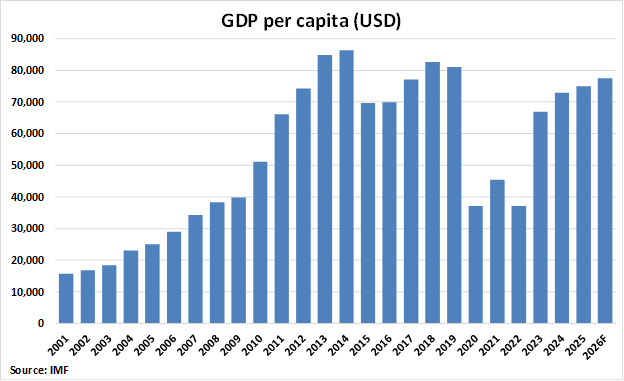
Macau has one of the highest GDP per capita in the world, at around US$77,440 in 2025, based on IMF figures.
Historic Perspective:
Macau’s housing market mirrors broader economic trends
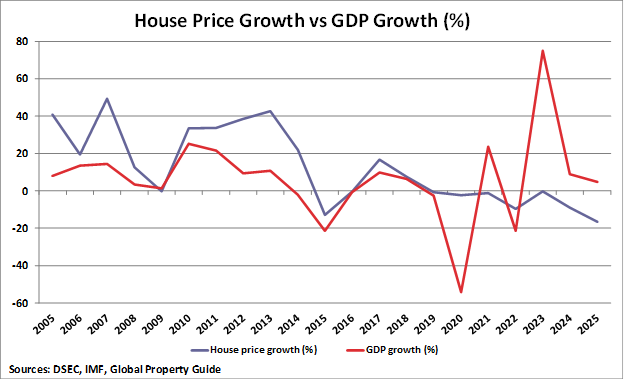
Macau’s housing market generally follows its economy. Residential property prices skyrocketed by a total of 330% (233% in real terms) from 2010 to 2014, more than 14 times the rise in inflation, rising by double-digits every year, after a slight decrease of 0.3% (-1.5% in real terms) in 2009 due to the global crisis. The economy grew by an annual average of 17% from 2010 to 2014.
When the economy was in recession in 2015, house prices fell by 13% (-16.8% in real terms).
The economy grew by an annual average of 7.2% in 2017 and 2018, and this was reflected in the housing market. Residential property prices rose by 16.8% in 2017 and by 7.5% in 2018 (15.4% and 4.4% in real terms).
The economy contracted by 2.6% in 2019 amidst the slowdown in the gaming sector. Then in 2020, the economy plummeted by a whopping 54.3% due to the Covid-19 pandemic. As such, residential property prices also dropped by 0.8% in 2019 and by another 2.3% in 2020.
Macau’s economic performance has been erratic, growing by 23.5% in 2021, as pandemic-related restrictions eased, but contracted again by 19.6% in 2022 due to a combination of factors, including weakened domestic consumption, regulatory changes in the gaming industry, and Mainland China’s Zero-Covid Policy. The economy expanded by a spectacular 75.1% in 2023 but slowed again in 2024, growing by a moderate 8.8%.
The housing sector has been weak since, with residential property prices falling by 1.1% in 2021, 9.7% in 2022, 0.3% in 2023, and another 9% in 2024.
“Macau’s home prices have plunged since the pandemic, with overall prices dropping over 20% from the market peak. Some units have even seen declines of up to 30%. Developers have to adopt aggressive pricing strategies to boost home sales since the financing costs are high,” said Mark Wong of JLL Macau. “However, the price correction in the housing market has led to substantial losses for flat owners who bought residential flats in recent years, which has also affected their investment and consumption interests. Additionally, despite an adequate housing supply, demand remains limited.”
Macau’s housing market conditions continued to deteriorate amid weakening demand and a slowing economy. As economic growth moderated to 4.7% in 2025, residential property prices fell sharply by 16.7% (-17.4% in real terms) over the same period.
Property Demand Trends
Demand falling again
Residential property transactions in Macau fell by 4% to 3,245 units in 2025 from a year earlier, in contrast to year-on-year increases of 17.4% in 2024 and 2.5% in 2023, according to DSEC. This follows a series of sharp contractions in earlier years, with transactions plunging by 53.2% in 2022, 7.4% in 2021, 21.7% in 2020, and 23.5% in 2019.
Residential property transactions averaged nearly 16,000 units every year from 2001 to 2012 before falling to an annual average of 9,400 units in 2013 to 2019, and further to just 4,100 units annually from 2010 to 2025.
Likewise, total transaction values were down by a huge 24.6% y-o-y to MOP 15.33 billion (US$1.9 billion) in 2025, following annual increases of 11.1% in 2024 and 1.8% in 2023 and contractions of 56% in 2022, 5% in 2021, 15.9% in 2020, and 26.5% in 2019.
By major area:
- In Macau Peninsula, the number of residential property transactions rose by 6.8% y-o-y to 2,453 units in 2025, while transaction values dropped by 12.2% to MOP 10.2 billion (US$1.27 billion).
- In Taipa, residential property transactions plummeted by 36.7% y-o-y to 552 units in 2025, and transaction values were down by a huge 47.4% to MOP 3.67 billion (US$456.07 million). It was the lowest level of transactions recorded since data became available in 2004.
- In Coloane, residential property transactions increased by 13.7% y-o-y to 240 units in 2025, but sales values were down by 16.3% to MOP 1.45 billion (US$180.59 million).
Property Supply Trends
Residential construction activity improving
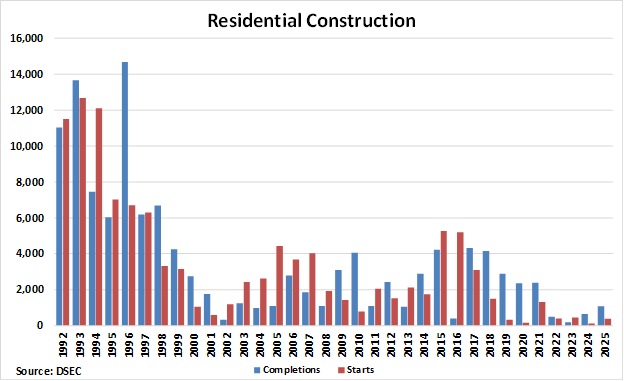
Residential construction permits surged by a whopping 258% y-o-y from just 107 units in 2024 to 383 units in 2025, according to DSEC. Despite this, it remains one of the lowest levels recorded in recent history.
Of these, 382 permits were in Macau Peninsula last year. Only one permit was in Coloane, and no permit was issued in Taipa.
Similarly, residential building completions rose strongly by 66.9% y-o-y to 1,068 units in 2025, following an annual surge of nearly 250% in 2024 and declines of 63.4% in 2023 and 79.1% in 2022. Despite the improvement, it remains very low compared to the historical average.
“In 2025, 10 projects received pre-sale permits, providing a total of 484 residential units for sale, covering a total gross floor area of approximately 33,344 sq m. They are mainly mass residential projects located on the Macau Peninsula. Amongst them, the 312-unit Lake Yoho project has a relatively large scale. Its sales activities commenced last year with approximately 200 units sold during 2025,” said JLL.
However, historically, the issuance of construction permits for residential buildings has significantly declined, dropping from an annual average of nearly 8,000 units in the 1990s to fewer than 2,000 units between 2000 and 2025. Similarly, residential completions, which averaged 9,000 units per year in the 1990s, have fallen to just around 2,000 units annually over the same period.
Residential construction activity in Macau has weakened in recent years due to limited land supply, subdued demand, and regulatory constraints. Developers also face high construction costs and lingering economic uncertainty, making them hesitant to launch new projects. Stricter housing policies and cooling measures implemented over the past decade have further slowed market activity, while a slow post-pandemic recovery has kept demand low.
However, with the government now moving to ease housing regulations and mortgage restrictions, residential construction activity is now showing signs of improvement.
Housing stock continues to increase
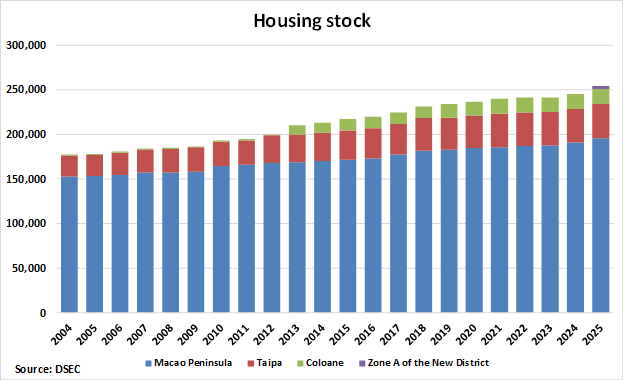
The total housing stock in Macau increased by 3.5% to 253,971 units in 2025, according to DSEC. This is an acceleration from minimal growth of 1.7% in 2024, 0.1% in 2023, and 0.6% in 2022, and the biggest increase since 2013.
By major area:
- In Macau Peninsula, there were 195,807 residential units in 2025, up by 2.6% from the previous year. This followed annual increases of 1.9% in 2024, 0.1% in 2023, and 0.8% in 2022.
- In Taipa, the housing stock increased by 1.9% y-o-y to 38,202 units in 2025, following nearly zero growth in the past three years.
- In Coloane, the number of residential units was unchanged in 2025 from a year ago, at 16,945 units. This followed a modest growth of 2.4% in 2024, zero growth in 2023, and a minimal increase of 0.2% in 2022.
Vacant residential units increasing sharply
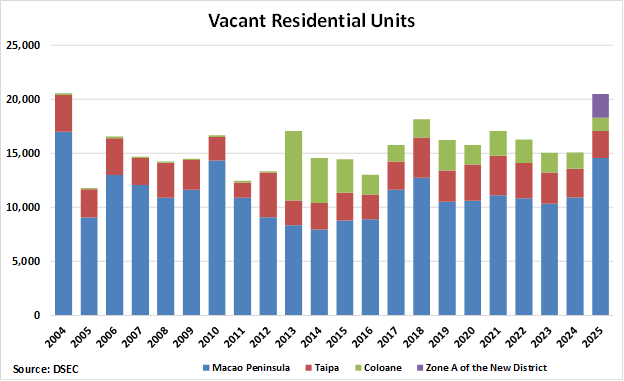
The number of vacant residential units is increasing sharply. In the second half of 2025, there were 20,467 vacant residential units in Macau, up by a huge 35.7% from the preceding year, according to DSEC. It was a sharp acceleration from the minimal increase of 0.4% registered in H2 2024.
The current vacant residential units account for about 8.1% of the total housing stock.
By major area:
- In Macau Peninsula, the number of vacant residential units soared by 33.6% y-o-y to 14,546 units in H2 2025.
- In Taipa, vacant residences fell by 6.3% y-o-y to 2,504 units in H2 2025.
- In Coloane, vacant residences declined by 18.7% y-o-y to 1,232 units.
- In Zone A of the New District, there were 2,185 vacant residential units recorded in H2 2025.
Rental Market: Rents and Rental Yields
Residential rents continue to increase, albeit at slower pace
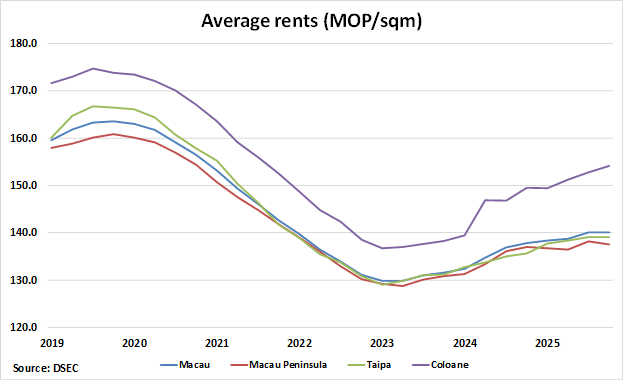
During 2025, the average rent per square meter of usable area of residential units in Macau increased by a modest 2.12% y-o-y to MOP 139.4 (US$17.3), following an annual growth of 3.88% in 2024 and declines of 2.38% in 2023, 8.81% in 2022, 8.55% in 2021, and 1.1% in 2020, according to figures published by DSEC.
Macau's rent price index:
On the other hand, JLL figures indicate mixed performance in the residential leasing market. According to the JLL Macau Property Index, rents for high-end residential properties edged up by 1.1% year-on-year in 2025, while rents for mass residential flats declined by 10.3% over the same period.
“Some residential properties in Macau saw fewer rental activities due to slower growth in the number of foreign employees,” said JLL.
By major area:
- In Macau Peninsula, the average rent for residential units increased slightly by 1.33% to MOP 137.4 (US$17.1) per sqm in 2025 from a year earlier, according to DSEC, after a growth of 3.83% in 2024 and decreases of 2.1% in 2023, 8.94% in 2022, 8.09% in 2021, and 0.81% in 2020.
- In Taipa, rents for residential units averaged MOP 138.2 (US$17.2) per sqm in 2025, up by 2.52% from the prior year. This followed an annual growth of 2.98% in 2024 and declines of 2.75% in 2023, 8.44% in 2022, 9.82% in 2021, and 1.57% in 2020.
- In Coloane, residential rents were up by 3.54% y-o-y in 2025 to reach an average of MOP 152.3 (US$18.9) per sqm, a slowdown from an annual increase of 6.36% in 2024. Yet it is still a better showing compared to declines of 2.95% in 2023, 9.81% in 2022, 7.39% in 2021, and 1.56% in 2020.
Gross rental yields remain very low
Gross rental yields in Macau averaged 2.08% in Q1 2026, slightly up from 1.91% in Q3 2025 and 1.81% in Q1 2025, according to a recent research conducted by the Global Property Guide. Despite the gradual improvement, it remains very low by international standards.
By property type:
- For studio-type apartments, gross rental yields averaged 1.96% in Q1 2026, an improvement from 1.55% in Q1 2025.
- One-bedroom apartments offer rental yields of about 2.21%, up from the previous year’s 2.01%.
- Two-bedroom apartments earned rental returns of approximately 1.90% in Q1 2026, higher than the preceding year’s 1.61%.
- For three-bedroom apartments, the average rental yield was 2.25% in Q1 2026, up from 2.08% in Q1 2025.
Gross rental yields in Macau are very low due to high property prices, weak rental demand due to preference to homeownership, and a market dominated by investors rather than renters. Many property owners treat real estate as a long-term asset rather than a source of rental income, keeping rental prices relatively low.
Mortgage Market and Interest Rates
Residential mortgage loans declining, despite key rate cuts
In December 2025, the Monetary Authority of Macau (AMCM) lowered its key interest rate by 25 basis points to 4%, after its Hong Kong counterpart made the same move following the U.S. Fed’s decision to cut its key rate. This was the third consecutive rate cut in 2025, bringing borrowing costs to the lowest level since October 2022, amidst slowing economic growth.
The Macanese pataca (MOP) is linked to the Hong Kong dollar, which is also linked to the US dollar.
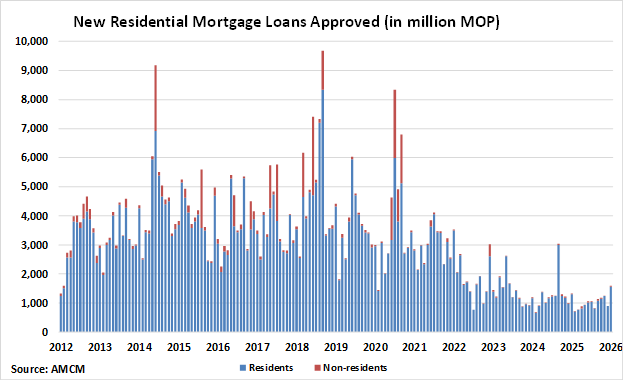
Despite the successive rate cuts, new mortgage loans continue to fall. During 2025, the total value of new residential mortgage loans (RMLs) approved plunged by 22.3% to MOP 12.05 billion (US$1.5 billion) as compared to a year earlier, based on figures released by the central bank. This followed annual declines of 9.1% in 2024, 25.3% in 2023, and 37.3% in 2022.
New RMLs released to residents accounted for around 97.5% of the total new approvals last year, while the remaining 2.5% were to non-residents.
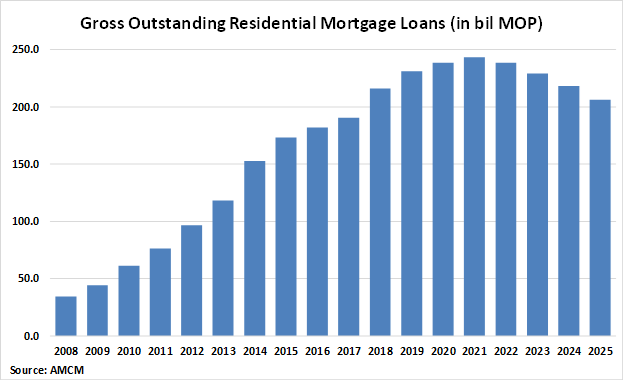
As a result, the total outstanding RMLs dropped by 5.4% y-o-y to MOP 206.45 billion (US$25.64 billion) in 2025, after falling by 4.9% in 2024, 3.9% in 2023, and 2% in 2022, according to AMCM.
Of these, the resident component made up about 96.7% of the total RMLs.
Although new RMLs rose by 19.6% y-o-y to MOP 1.59 billion (US$197.13 million) in January 2026, the total value of gross outstanding RMLs still decreased by 5.3%, reaching MOP 206.06 billion (US$25.59 billion) during the same period.
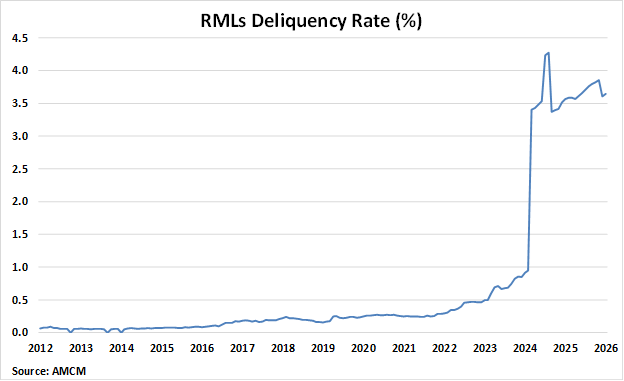
In January 2026, the delinquency rate for RMLs stood at 3.6%, unchanged from the previous month and the same period last year. Yet it is far higher than the average delinquency rate of just 0.2% from 2009 to 2023. It started to surge in February 2024 and reached a record high of 4.3% in August 2024.
These figures suggest that borrowers in Macau are facing increasing difficulties in meeting their mortgage obligations, potentially due to factors such as economic downturns and policy changes in the gaming industry.
SAR government scraps housing market cooling measures
The SAR government has moved to remove long-standing housing market cooling measures in an effort to support the weakening property sector.
In April 2024, the Executive Council submitted a proposal to the Legislative Assembly to eliminate tax-related real estate restrictions, including the special stamp duty, additional stamp duty, and acquisition stamp duty. These measures, which had been in place for more than a decade, were originally introduced to curb speculation but were later viewed as constraints on market recovery. The proposal was subsequently approved and implemented, effectively removing these cooling measures.
Alongside the tax changes, mortgage lending restrictions were also relaxed to improve affordability and stimulate property transactions. The Monetary Authority of Macao (AMCM) standardized the maximum loan-to-value (LTV) ratio at 70% for both residents and non-residents, while affordable housing purchases were allowed a higher LTV of up to 90%. In addition, the requirement for a stress test against a 2% interest-rate increase was suspended.
These policy adjustments were introduced amid concerns from real estate industry groups over weakening housing demand and declining property prices, with authorities aiming to support market stability and revive transaction activity.
Additional housing support measures introduced
Recently, Macau introduced additional housing support measures to revive demand and stabilize the weakening residential market.
In November 2025, alongside the 2026 Policy Address, the government announced a stamp duty exemption for eligible residents purchasing residential properties, covering the first MOP6 million (US$ 745,207) of property value, in an effort to support end-user demand and improve affordability.
In addition, the SAR government also proposed relaxing mortgage lending rules by raising the LTV ratio from 70% to 80%, aimed at lowering upfront payment requirements and stimulating property transactions.
“The Macau government announced measures in November 2025, such as stamp duty exemption for the first MOP6 million of property value and relaxing the loan-to-value ratios for residential mortgages. Coupled with multiple interest rate cuts by banks recently, the measures are expected to help alleviate mortgage burdens and stabilize the residential market in the short term,” said JLL.
Early signs of policy impact emerged in January 2026, when residential mortgage approvals rose sharply by 76.7% month-on-month to MOP1.59 billion (US$197.48 million), suggesting improved borrowing activity following the implementation of the support measures.
Economic and Social Factors
The gaming sector continues to improve, but still far below peak years
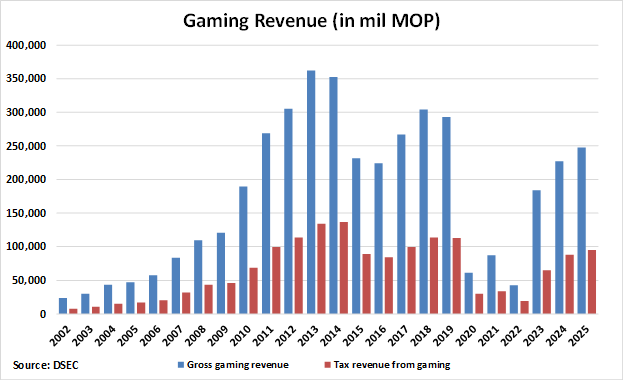
During 2025, gross gaming revenues for Macau casino operators amounted to MOP 248.03 billion (US$30.81 billion), up by 9.1% from a year earlier, according to the Statistics and Census Service (DSEC). It followed year-on-year growth of 23.8% in 2024 and a whopping 328.8% in 2023, and a contraction of 51.1% in 2022.
Yet, it remains far below the MOP 303.88 billion (US$37.74 billion) and MOP 293.31 billion (US$36.43 billion) recorded in 2018 and 2019, respectively, as well as the peak level of MOP 352.71 billion (US$43.81 billion) seen in 2014.
During 2025:
- VIP baccarat revenue, which accounted for a 27.4% share of the total gross gaming revenue, rose strongly by 24.1% y-o-y to MOP 67.98 billion (US$8.44 billion). However, it accounted for just around 50% of the total VIP baccarat revenue generated in the pre-pandemic year of 2019.
- Mass market baccarat revenue, which accounted for approximately 57.5% share, rose by a modest 3.4% y-o-y to MOP 142.65 billion (US$17.72 billion) in 2025. It now represents about 118.1% of the 2019 mass market baccarat gross revenue.
- Slot machine revenues, which accounted for about 5.6% share of the total gross gaming revenue, increased by 7.3% y-o-y to reach MOP 13.87 billion (US$1.72 billion) last year. It represents around 91.6% of the full-year 2019 revenues from slot machines.
Then in January 2026, the total gross gaming revenue amounted to MOP 22.7 billion (US$2.82 billion), up strongly by 24% compared to the same period last year.
The Macao government set a conservative gross gaming revenue target of MOP 236 billion (US$29.31 billion) for 2026, below the previous year’s actual level. The estimate reflects cautious expectations amid ongoing recovery in tourism and gaming activity, as authorities anticipate gradual improvement but not yet a return to the sector’s boom-year performance.
This is in line with the forecast released by global credit rating agency, S&P Global: “Weaker consumption in China and limited new capacity will crimp gross gaming revenue (GGR) growth for Macao in 2026.”
“Macao’s gaming boom is fading. The sector will be moving from a post-pandemic rebound to a more maturity-driven phase, as capacity limits and potentially softer mass demand temper growth. We think 2026 revenue growth will slow, but steady operations, selective share gains, and deleveraging still support modest upside,” added S&P Global.
Macau’s gaming industry continues to face structural challenges. Casino operators have been affected by tighter gaming regulations that have significantly weakened the VIP segment. Previously, junket agents operated VIP rooms, extended credit to high-roller clients, and shared in gaming revenues. Under the revised regulatory framework, however, junkets are limited to earning commissions for referring players and are no longer allowed to share in gaming revenues or extend credit, reducing incentives to attract VIP customers. At the same time, stricter Mainland China controls on cross-border gambling and capital flows have further constrained operators’ ability to target high-roller clients, limiting growth in the VIP market.
About 60% of Macau’s economy depends on the gaming industry, and another 11% on related sectors like hotels, shops, and restaurants, according to economics professor Ricardo Siu of the University of Macau.
Tourist arrivals surpass pre-pandemic levels
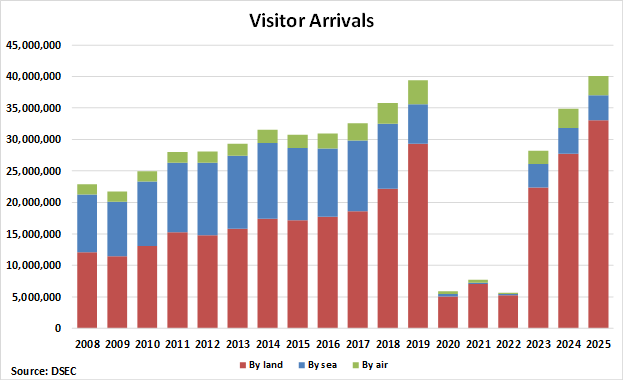
During 2025, the total number of visitor arrivals in Macau increased by 14.7% to 40.07 million people compared to the previous year, following annual growth of 23.8% in 2024 and 394.9% in 2023 and a decline of 26% in 2022, based on figures from DSEC. This supports the government’s view that tourism is normalizing alongside a wider recovery in the services sector.
Last year’s figures surpassed the previous record high of 39.41 million visitor arrivals registered during the pre-pandemic year of 2019.
Same-day visitors, which accounted for nearly 59% of the total arrivals last year, surged by 24.6% y-o-y to 23.52 million people in 2025. Similarly, overnight visitors, which represented the remaining 41% share, were up by a modest 3.1% y-o-y to 16.54 million people.
By mode of transport, in 2025:
- By land: arrivals increased strongly by 19.1% y-o-y to 33.08 million people, following an annual growth of 24.1% in the prior year.
- By air: arrivals fell slightly by 0.5% y-o-y to 3.05 million people, in stark contrast to the strong growth of 43.9% in 2024.
- By sea: arrivals declined by 3.9% y-o-y to 3.94 million people last year, in contrast to the annual increases of 10.7% in the preceding year.
Mainland Chinese visitors continued to dominate Macau’s tourism market in 2025, accounting for about 72.4% of total arrivals, equivalent to roughly 29.02 million visitors. Hong Kong remained the second-largest source with about 7.3 million visitors, equivalent to around 18% share, followed by Taiwan with approximately 996,000 arrivals or about 2.5% share. Arrivals from other key markets, including the Philippines and Korea, also increased, though each continued to account for only a small share of the overall visitor mix.
The number of guests in hotels and guesthouses continued to rise in 2025, increasing by around 5.8% year-on-year to approximately 15.25 million people. Meanwhile, visitors on package tours also recorded a modest increase of about 1.2% to roughly 3.88 million people last year.
In the first two months of 2025, the number of visitor arrivals in Macau rose strongly by 15.1% y-o-y to 7.82 million people, according to DSEC. Visitors travelling by land increased by 17.6% y-o-y to around 6.55 million people, and those travelling by air rose by 14.2% to 578,973 people. In contrast, visitors travelling by sea fell by 3.2% to 696,211 people over the same period.
The Macao Government Tourism Office (MGTO) projects visitor arrivals to rise to around 41 million in 2026, while the Macau Tourism Association holds a more optimistic outlook, forecasting up to 44 million arrivals for the year, which would significantly surpass the 40 million record set in the previous year, despite potential disruptions from geopolitical tensions in the Middle East.
The Macao Government Tourism Office (MGTO) expects visitor arrivals to increase to approximately 41 million this year, but the Macau Tourism Association is more optimistic, projecting arrivals to reach 44 million for the whole year of 2026, far exceeding the 40 million record set last year, despite disruptions caused by the conflict in the Middle East.
The average occupancy rate in hotels and guesthouses was 94.6% in February 2026, up from 90.6% in February 2025, 85.1% two years ago and 76.1% three years ago.
Macau’s economic growth slowing, but inflation accelerating
Macau’s economy grew by a moderate 4.7% in 2025 from a year earlier, a sharp slowdown from the year-on-year expansions of 8.8% in 2024 and 75.1% in 2023, according to the Statistics and Census Service.
Last year’s real economic output of MOP 417.28 billion (US$51.83 billion) corresponded to about 89.6% of the pre-pandemic level in 2019, suggesting that the economy has yet to achieve a full recovery.
Macau continues to navigate challenges stemming from the Covid-19 pandemic’s lingering effects and regulatory changes in its gaming industry, which remains a key driver of economic activity. The uncertainty caused by the conflict in the Middle East adds another layer of external risk to the city’s tourism and gaming recovery outlook.
The International Monetary Fund (IMF) forecasts Macau’s economic growth to slow further to 2.8% this year, whereas Fitch Ratings and the University of Macau present a more upbeat outlook, with projected real GDP growth of 4% and 6.3%, respectively.
“Fitch forecasts GDP growth will moderate to 4.0% in 2026 from 4.7% in 2025, with gross gaming revenue (GGR) recovering to nearly 89% of its 2019 level this year. We expect gaming tourism growth to slow but remain solid in 2026, supported by favourable visa-entry policies, expanded cultural and entertainment offerings, and continued non-gaming investments,” said the Fitch Ratings report released in February 2026. “A significant slowdown in China’s economy, weighing on consumer sentiment and travel spending, poses a key downside risk to Macao’s gaming tourism outlook. Macao remains exposed to policy shifts affecting the gaming tourism sector.”
Accordingly, Macau’s heavy reliance on the gaming industry makes its economy highly volatile, a challenge that became even more evident during the pandemic. To reduce this vulnerability, authorities have intensified efforts to diversify the economy by offering tax incentives and subsidies. These measures aim to address structural challenges such as the region’s dependence on tourism, small population, and limited land resources.
After expanding by almost 17% per year from 2010 to 2013, Macau suffered a three-year slump in 2014-16 (with 2015 registering a whopping 21.6% decline), after its main industry - gaming activities - took a major hit from China's anti-corruption campaign.
Fortunately, the economy bounced back in 2017 and 2018, with GDP growth of 9.9% in 2017 and another 6.4% in 2018, buoyed by massive infrastructure investments and booming tourism. However, the economy contracted again by 2.6% in 2019 and by a whopping 54.3% in 2020 due to the adverse effects of the Covid-19 pandemic.
Macau’s economy expanded again by 23.5% in 2021 amidst the easing of pandemic-related restrictions.
However, in 2022, Macau’s economy shrank again by 26.8% in real terms, driven by weak tourism and gaming activity.
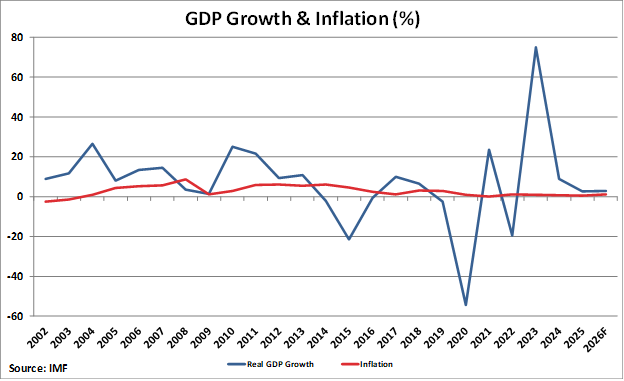
Overall inflation increased to 1.16% in February 2026, up from 0.54% in the previous month and from -0.16% in the same period last year, according to DSEC. The latest figure marked the sharpest rise since February 2024, driven mainly by higher costs for transport, recreation, sport and culture, and miscellaneous goods and services.
Inflation averaged 4% per year from 2010 to 2019 before slowing significantly to just 0.7% annually between 2020 and 2025.
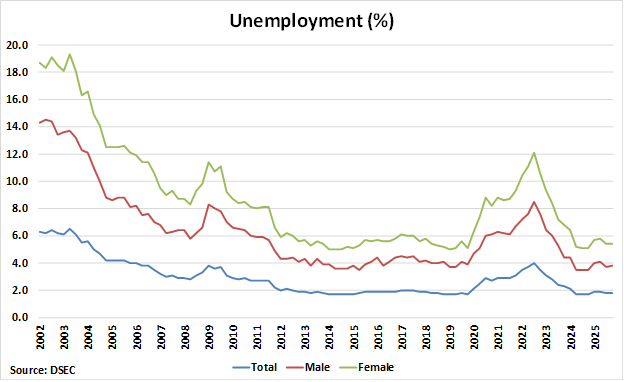
The unemployment rate was 1.8% in the fourth quarter of 2025, unchanged from the previous quarter but slightly up from 1.7% a year earlier. Male unemployment averaged 2.0% in Q4 2025, while female unemployment stood at 1.6%.
The jobless rate averaged 2.2% in the past decade.
Sam Hou Fai, a 62-year-old former judge, won the Chief Executive Election on October 13, 2024, and was officially appointed as the sixth-term Chief Executive of the Macao Special Administrative Region by the State Council through Decree No. 794 on October 25, 2024. He officially assumed office on December 20, 2024. Ordinary citizens have no direct say in the appointment of their chief executive.
Recently, Sam Hou Fai emphasized policy priorities on administrative reform, economic diversification, and improved governance efficiency, in line with the 2026 Policy Address and the 15th Five-Year Plan framework.
Improved infrastructure and increased connectivity to benefit tourism and the housing market
In recent years, Macau has undertaken several infrastructure projects to enhance its connectivity, housing availability, and tourism facilities. Notable developments include:
- The 50-km Hong Kong-Zhuhai-Macau Bridge, operational since 2018, connects Macau with Hong Kong and Zhuhai, facilitating regional integration within the Greater Bay Area.
- The Macau Light Rapid Transit (LRT) system continues to expand under a long-term network plan. Following the Taipa Line (2019), the Seac Pai Van Line (2024), and the Hengqin Line (2024), the government has advanced plans for a broader multi-line expansion, including additional lines connecting key urban districts, new reclamation areas, and major border checkpoints, to form a more integrated rail network supporting both tourism and daily mobility.
- The Fourth Macau-Taipa Bridge was opened in October 2024 to provide an additional connection between the Macau Peninsula and Taipa.
- The Grand Taipa Tunnel project was launched in October 2024 when Macau’s Public Works Department launched the bidding process for its design and construction to ease traffic and improve connectivity.
- Public housing developments in Macau totaled around 48,000 units in 2022, with plans to add over 40,000 more in the medium to long term, including about 28,000 units in the New Urban Zone A.
- The 24-km Shenzen-Zhongshan Bridge, which opened in June 2024, reduces the average travel time between Shenzhen and Zhongshan from two hours to less than 30 minutes.
- The expansion of Macau International Airport remains ongoing under the 2024-2029 development framework. Land reclamation and capacity enhancement works are underway to support higher passenger throughput and reinforce Macau’s position as a regional aviation hub, with medium-term completion expected to significantly improve air connectivity.
Sources:
- Residential Property Price Index (Statistics and Census Service): https://www.dsec.gov.mo/
- Residential property price index for November 2025 – January 2026 (Government Portal of Macao Special Administrative Region of the People’s Republic of China): https://www.gov.mo/
- JLL: Macau’s commercial and housing rents are expected to stabilise in 2026 (JLL): https://www.jll.com/
- JLL: Government stimulus needed amid asset slump denting economic confidence (JLL): https://www.jll.com/
- Private Sector Construction and Real Estate Transactions (Statistics and Census Service): https://www.dsec.gov.mo/
- Macau interest rate (Trading Economics): https://tradingeconomics.com/
- Mortgage loan statistics – January 2026 (Government Portal of Macao Special Administrative Region of the People’s Republic of China): https://www.gov.mo/
- New property measures may boost sales but not prices: industry reps (Plataforma): https://www.plataformamedia.com/
- AMCM proposes increasing the mortgage loan-to-value ratio to 80% (Macau Daily Times): https://macaudailytimes.com.mo/
- Rental Statistics (Statistics and Census Service): https://www.dsec.gov.mo/
- Gross rental yields in Macau (Global Property Guide): https://www.globalpropertyguide.com/
- Gaming sector (Statistics and Census Service): https://www.dsec.gov.mo/
- VIP gaming growth faces pressure from weaker visitor spending: CreditSights (Macau Business): https://macaubusiness.com/
- Beyond The Boom: Macao 2026 Gaming Outlook In Charts (S&P Global): https://www.spglobal.com/
- Fitch expects Macau’s GDP to grow 4pct in 2026 on ‘solid’ gaming tourism (GGR Asia): https://www.ggrasia.com/
- Macau government estimates full-year 2026 casino GGR will reach US$29 billion (GGR Asia): https://www.ggrasia.com/
- Visitor arrivals for December and the whole year of 2025 (Government Portal of Macao Special Administrative Region of the People’s Republic of China): https://www.gov.mo/
- Macau international visitor arrivals up 13.7% in 2025 as total visits topped 40M (Asia Gaming Brief): https://agbrief.com/
- Macau eyes return to pre-Covid international visitor levels in 2026 (Macau Business): https://macaubusiness.com/
- Macau could break tourism record with 44M tourists in 2026: industry expert (Asia Gaming Brief): https://agbrief.com/
- Package tours and hotel occupancy rate for February 2026 (Government Information Bureau of the Macao SAR): https://www.gcs.gov.mo/
- Gross Domestic Product (Statistics and Census Service): https://www.dsec.gov.mo/
- Fitch affirms Macau’s ‘AA’ rating, predicts 4 pct GDP growth in 2026 (Macau Business): https://macaubusiness.com/
- UM releases macroeconomic forecast for Macao 2026 (University of Macau): https://cms.um.edu.mo/
- People’s Republic of China – Macao Special Administrative Region (International Monetary Fund): https://www.imf.org/
- Inflation rate (Statistics and Census Service): https://www.dsec.gov.mo/
- Chief Executive Sam Hou Fai (Government Portal of Macao Special Administrative Region of the People's Republic of China): https://www.gov.mo/
- Macau profile (BBC): https://www.bbc.com/