Australia's Residential Property Market Analysis 2026
In the environment of still-constrained supply, housing price growth in Australia’s regional submarkets continues to outperform capital cities, where the ongoing re-tightening of borrowing conditions exacerbates already acute affordability pressures.
This extended overview from Global Property Guide covers key aspects of the Australian housing market and takes a closer look at its most recent developments and long-term trends.
Table of Contents
- Property Prices and Price Index
- Historic Perspective
- Property Demand Trends
- Property Supply Trends
- Rental Market: Rents and Rental Yields
- Mortgage Market and Interest Rates
- Economic and Social Factors
Property Prices and Price Index
Residential property prices in Australia continued to rise in early 2026, although growth remained highly uneven across submarkets. By the end of February 2026, the national median dwelling value stood at AUD 922,838 (USD 657,614), up 9.9% year-on-year, according to Cotality’s Home Value Index. Across the combined capitals, the median value reached AUD 1,014,401 (USD 722,862), reflecting an annual growth of 9.6%, while combined regional markets continued to outperform, with dwelling values rising 11.1% year-on-year to a median of AUD 751,327 (USD 535,396).
Australia's house price annual change:
The annual figures, however, mask a marked loss of momentum in the country’s two largest housing markets. Sydney and Melbourne both recorded flat monthly growth in February, and values were down 0.1% and 0.4%, respectively, over the rolling three months. By contrast, Perth posted monthly growth of 2.3%, Brisbane 1.6%, Adelaide 1.3%, and Hobart 1.2%, underlining the continued outperformance of the mid-sized capitals. Cotality attributed this divergence in part to tighter stock levels in Perth, Brisbane, and Adelaide, while Sydney and Melbourne appeared more sensitive to February’s rate hike and weaker sentiment.
Price growth also remained increasingly concentrated in the more affordable segments of the market. Tim Lawless, Cotality’s research director, noted that competition remained strongest for lower-priced stock, where first-home buyers, investors, and upgraders continued to compete, while serviceability constraints weighed more heavily on higher-value properties. In Sydney, for example, lower-quartile house values rose 0.8% over the month, while upper-quartile values fell 0.9%. This helps explain why relatively affordable markets such as Perth and Darwin continued to deliver much stronger annual gains than Sydney and Melbourne despite already elevated borrowing costs.
Median dwelling value dynamics in state/territory capitals:
| Median Dwelling Value (AUD), Feb 2026 |
Median Dwelling Value (USD), Feb 2026 |
YoY, % | |
| Sydney | AUD 1,296,039 | USD 923,557 | 6.0% |
| Melbourne | AUD 826,132 | USD 588,702 | 4.7% |
| Brisbane | AUD 1,080,538 | USD 769,991 | 17.3% |
| Adelaide | AUD 922,991 | USD 657,723 | 10.9% |
| Perth | AUD 989,211 | USD 704,912 | 22.0% |
| Hobart | AUD 728,815 | USD 519,354 | 7.7% |
| Darwin | AUD 602,284 | USD 429,188 | 19.4% |
| Canberra | AUD 903,374 | USD 643,744 | 6.2% |
| Note: Exchange rate as of February 2026, USD 1 = AUD 1.4033. | |||
| Data Source: Cotality. | |||
Looking ahead, the outlook remains positive, but growth is expected to moderate and remain segmented by city and price point. KPMG forecasts national house prices to rise by 7.7% in 2026 and unit (apartment) prices by 7.1%, with Perth expected to lead house-price growth at 12.8%, followed by Brisbane at 10.9% and Darwin at 10.5%. Melbourne, Sydney, and Canberra are forecast to record more moderate gains of 6.8%, 5.8%, and 4.7%, respectively. National Australia Bank (NAB) is more conservative, projecting around 5% growth in the eight-capital-city dwelling price index over 2026.
Professional commentary suggests that the main constraint on the outlook is monetary policy. While persistent supply shortages and limited listings should continue to support prices in relatively affordable markets, tighter borrowing conditions are likely to place a firmer cap on growth in Sydney and Melbourne, where affordability pressures are already more acute.
Historic Perspective:
From Cyclical Swings to a Supply-Constrained Recovery
Australia’s housing market has moved through several distinct phases over the past two decades. After a strong upswing ahead of the Global Financial Crisis, prices and transaction activity softened in 2008, although the downturn was relatively modest by international standards. The rebound in 2009 and 2010 was supported by sharp interest rate cuts, improved affordability, and first-home-buyer stimulus. The market then entered a softer phase in 2011 and 2012, with prices broadly stable, transaction volumes low by historical standards, and building activity subdued. From 2013 to 2017, the cycle turned upward again, supported by very low interest rates and stronger investor demand, particularly in the eastern capitals.
The next downswing, from 2017 to 2019, was driven largely by tighter credit conditions. The Australian Prudential Regulation Authority’s lending restrictions on investor and interest-only loans, together with broader tightening in lending standards, helped cool the market. The pandemic then triggered a powerful new upswing, as ultra-low interest rates, the HomeBuilder program, and shifting housing preferences all supported demand through 2020 and 2021. That boom reversed in 2022, when the Reserve Bank of Australia’s (RBA) rapid tightening cycle reduced borrowing capacity and weighed on prices. From 2023 onward, however, the market recovered sooner than many had expected, as strong population growth and tight rental conditions met limited new supply. By 2025, the housing market had shifted into a renewed but supply-constrained recovery, with prices and turnover picking up again while construction activity and approvals remained low relative to underlying demand.
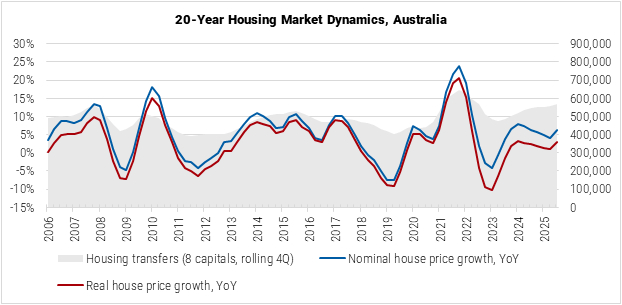
Note: For Australia, OECD house price data reflects a weighted average of residential property price movements across the eight capital cities. The real series is the nominal index adjusted for inflation.
Data Sources: OECD, ABS.
Property Demand Trends
Underlying Housing Need Remained Firm Despite Rising Affordability Pressures
According to preliminary data from the Australian Bureau of Statistics (ABS), 565,073 dwelling transfers were recorded nationwide throughout 2025, representing a moderate 2.60% year-on-year increase. Established houses accounted for 64% of all transfers, up 3.73% year on year, while attached dwellings were broadly stable, rising by 0.65%. Demand remained supported by strong structural fundamentals. Continued population growth, persistent rental-market pressure, and a chronic shortage of new housing kept underlying buyer demand firm, particularly in markets where supply remained especially constrained.
At the capital-city level, Melbourne, Sydney, and Brisbane registered the highest number of transfers across both established houses and attached dwellings. The strongest year-on-year growth was recorded in Darwin, where transactions rose by 30.41% for established houses and 48.01% for attached dwellings.
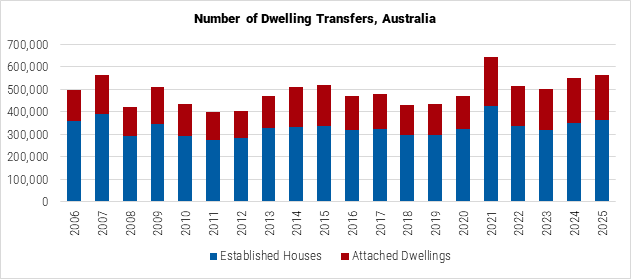
Note: Preliminary data. Attached dwellings include flats, units, and apartments, and semi-detached, row, and terrace houses.
Data Source: ABS.
Number of dwelling transfers in state/territory capitals:
| Established Houses, 2025 |
YoY, % | Attached Dwellings, 2025 |
YoY, % | |
| Sydney | 53,159 | 2.15% | 51,975 | -1.96% |
| Melbourne | 66,016 | 8.83% | 57,769 | 5.16% |
| Brisbane | 36,896 | -4.45% | 19,065 | -8.14% |
| Adelaide | 18,908 | 7.35% | 9,041 | 6.69% |
| Perth | 27,105 | -2.14% | 13,063 | -13.06% |
| Hobart | 3,097 | 0.16% | 1,206 | 0.67% |
| Darwin | 2,054 | 30.41% | 1,267 | 48.01% |
| Canberra | 4,358 | 6.06% | 4,616 | 13.81% |
| Data Source: ABS. | ||||
At the same time, conditions became more uneven at the start of 2026. The RBA’s February 2026 increase in the cash rate to 3.85% added renewed pressure to borrowing capacity and buyer confidence. Reflecting this, the Westpac–Melbourne Institute survey showed that sentiment towards purchasing a home weakened further in March 2026, with the “time to buy a dwelling” index falling to 82.9, a new cycle low and well below its long-run average of 120. Westpac said the deterioration was most evident among households with a mortgage, pointing to the growing tension between still-solid underlying housing demand and increasingly stretched affordability.
Looking ahead, housing demand is likely to remain supported by structural supply shortages, population-driven housing needs, and continued policy support for owner-occupiers, including the expanded Australian Government 5% Deposit Scheme and the launch of Help to Buy applications in December 2025. However, effective demand is expected to become more selective and affordability-sensitive in the near term.
Foreign investment in Australian residential real estate remains below pre-pandemic levels. Commonwealth Treasury figures cited by KPMG Australia show that in the first half of FY25, 2,134 residential real estate investment proposals were approved, with a combined value of AUD 2.6 billion. Investors from China accounted for the largest share (AUD 0.8 billion), followed by Singapore and Taiwan (each AUD 0.3 billion). “While this biannual figure provides an early snapshot, it represents only around 34% of the full-year outcomes recorded in FY22 to FY24,” commented KPMG, suggesting that foreign investment is likely to remain subdued amid policy and regulatory headwinds.
From April 1, 2025, to March 31, 2027, foreign persons, including temporary residents and foreign-owned companies, have generally been banned from purchasing established dwellings in Australia, unless an exemption applies. Foreign investment is still permitted in new housing and in certain cases that materially add to supply, such as large-scale redevelopment or commercial housing projects. In parallel, Australia has tightened compliance settings by applying doubled vacancy fees to relevant foreign-owned residential properties left vacant for more than 183 days in a vacancy year and by strengthening enforcement against land banking, with the aim of improving housing availability and encouraging timely development.
Property Supply Trends
Delivery Remains Constrained Despite Early Signs of Pipeline Improvement
Australia continues to face significant challenges in lifting housing supply, which has remained persistently below what is needed to meet both underlying demand and the federal Housing Accord target. According to the ABS, housing construction activity remained weak in 2025, with 128,924 dwellings completed during the first three quarters of the year, representing a 2.73% year-on-year decline.
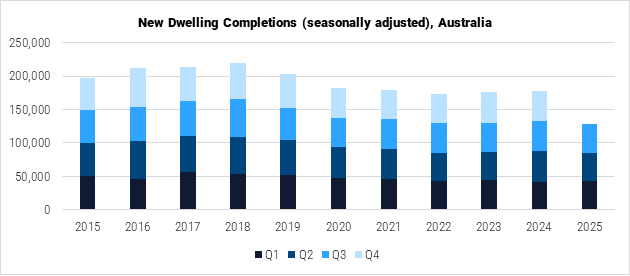
Data Source: ABS.
The National Housing Supply and Affordability Council (NHSAC) projects that gross new housing supply will remain subdued from 2025 through early 2027, averaging around 183,000 dwellings annually. Over the five-year Housing Accord period, total output is expected to reach 938,000 dwellings, falling short of the 1.2 million target by approximately 262,000 units. The weakest target attainment rates are anticipated in the Northern Territory, Tasmania, and New South Wales.
The Council expects detached housing to account for most new supply over the forecast period, while higher-density delivery is likely to remain comparatively weak because of poor project feasibility, low approvals already in the pipeline, and the longer lead times associated with apartment development.
Gross new housing supply by state and territory vs housing targets:
| Gross new housing supply, 2024–25 to 2028–29 (forecast) |
Share of 1.2 million Housing Accord target* |
Gross new supply forecast, ratio to share of target (%)* |
|
| New South Wales | 246,000 | 376,000 | 65% |
| Victoria | 300,000 | 306,000 | 98% |
| Queensland | 194,000 | 246,000 | 79% |
| Western Australia | 105,000 | 129,000 | 81% |
| South Australia | 59,000 | 84,000 | 71% |
| Tasmania | 13,000 | 26,000 | 51% |
| Australian Capital Territory | 16,000 | 21,000 | 78% |
| Northern Territory | 4,000 | 11,000 | 31% |
| Australia | 938,000 | 1,200,000 | 78% |
| *The Council has apportioned the Housing Accord target to each state and territory by using their share of the national population in December 2022. | |||
| Note: Housing supply data, forecasts, and population-implied shares are rounded to the closest thousand. Totals, ratios, and shares may not be consistent with component figures due to rounding. | |||
| Data Sources: NHSAC; ABS. | |||
The near-term outlook has improved, but only cautiously. The NHSAC argues that the “balance of risks” to supply is skewed to the upside because its forecasts do not yet fully incorporate structural planning and land-market reforms. Likewise, the RBA’s February 2026 Statement on Monetary Policy points to resilient detached-housing construction activity and gradually improving conditions in the high-density segment, although capacity remains highly uneven across states.
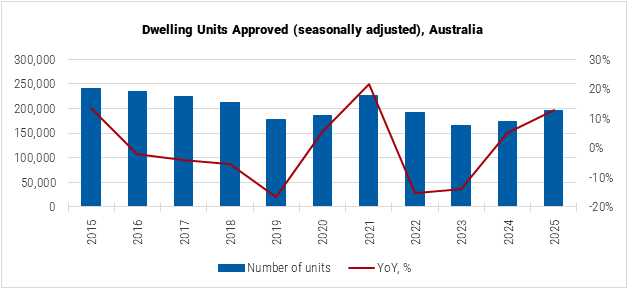
Leading indicators for 2025 turned positive. ABS data shows that building approvals rose 12.83% year on year in 2025, with 196,182 dwellings approved between January and December. Similarly, new dwelling commencements increased by 11.59% year-on-year to 48,778 in Q3 2025, the latest available reporting period. Together, these figures suggest that the housing pipeline may be strengthening from a low base, although a sustained recovery in completed supply is still likely to be only gradual.
Data Source: ABS.
Rental Market: Rents and Rental Yields
Undersupply Sustains Rental Growth Above Long-Term Benchmark
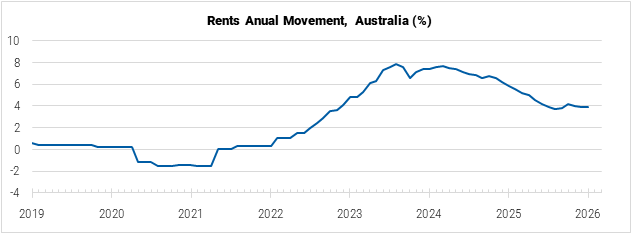
Rental market conditions in Australia remain tight despite an easing in migration-based population growth. With national rental listings reportedly about 11% lower in Q4 2025 than a year prior and 17% down on the previous five-year average, low supply continues to drive up rental rates across the country. Nationwide rental inflation, as measured by the annual change in the rents component of the Consumer Price Index (CPI), was reported by the ABS at 3.9% in January 2026, down from 5.8% observed a year prior and its peak level of 7.8% in August 2023, but still elevated compared to the long-term average of 3%.
Australia's rent price index:
In their January 2026 residential property market outlook, KPMG Australia projected annual rent growth of around 3.5% through 2026 and 2027 and estimated that “new dwelling completions would need to be around 17% higher than current forecasts for this above-trend rental growth to be pulled back to normal levels while still allowing for the expected population growth over the next few years”.
Data Source: ABS.
In nominal terms, the median weekly rent in Q4 2025 reached AUD 681 (USD 447) nationwide, demonstrating a 1.3% quarter-on-quarter and 5.2% year-on-year growth, an uptick from the previous quarter, according to the real estate analytics company Cotality. The national-level vacancy rate stood at 1.7%, compared to 2.1% twelve months earlier. Regionally, the highest median rent level among major cities was recorded in Sydney at AUD 817 (USD 536), and the lowest level was recorded in Hobart at AUD 601 (USD 395). Vacancy rates fell compared to the same period in 2024 in all key submarkets, except Adelaide, where the indicator remained unchanged.
Moderate Rental Yields
In this environment, research carried out by Global Property Guide in February 2026 found gross rental yields for residential properties in Australia at the average level of 4.69%, down from 4.92% reported in August and 5.04% in February 2025. Regional performance varied, with the highest average yield of 6.14% registered in Darwin, followed by Melbourne (5.64%) and Canberra (5.22%).
Median weekly rent per submarket:
| Median Weekly Rent (AUD), Q4 2025 |
Median Weekly Rent (USD), Q4 2025 |
QoQ | YoY | Vacancy Rate | |
| Sydney | AUD 817 | USD 536 | 1.4% | 5.3% | 2.0% |
| Melbourne | AUD 624 | USD 410 | 0.8% | 2.9% | 1.6% |
| Brisbane | AUD 708 | USD 465 | 1.0% | 6.2% | 2.1% |
| Adelaide | AUD 635 | USD 417 | 0.7% | 3.4% | 1.1% |
| Perth | AUD 738 | USD 484 | 1.6% | 5.9% | 1.3% |
| Hobart | AUD 601 | USD 395 | 2.5% | 7.2% | 1.4% |
| Darwin | AUD 688 | USD 452 | 0.3% | 8.2% | 2.6% |
| Canberra | AUD 683 | USD 448 | 0.8% | 3.0% | 1.9% |
| Australia | AUD 681 | USD 447 | 1.3% | 5.2% | 1.7% |
| Note: Exchange rate as of Q4 2025, USD 1 = AUD 1.52325. | |||||
| Data Source: Cotality. | |||||
Overall, rental costs in Australia have been outpacing wage growth in recent years, putting increasing pressure on housing affordability, with households in Australia now dedicating a record high 33.4% of their pre-tax income to rent, according to Cotality’s analysis. Based on the company’s index, national rents have surged 42.9% over the past five years, adding approximately AUD 204/week to the median rental value. In contrast, the five years prior saw rents rise by just 7.5% or AUD 33/week.
"Since 2020, a combination of tight vacancy rates, smaller household sizes, and sluggish new housing supply has pushed the market into a very different phase, one where rents are clearly in the driver's seat," commented Lawless, as quoted by ABC News.
Mortgage Market and Interest Rates
Interest Rate Trend Shifts Along With Policy Re-Tightening
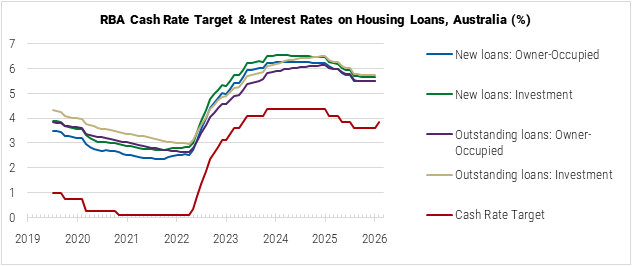
The outlook for Australia’s mortgage market changed in February 2026 after the Reserve Bank of Australia (RBA) raised its policy rate by 25 bps to 3.85% after a six-month holding period. In the respective media statement, the regulator noted that inflationary pressures in the country “picked up materially” in the second half of 2025 and inflation is “likely to remain above target for some time”, necessitating an increase in the cash rate target.
Australia's mortgage loan interest rates:
While the latest available official data on mortgage rates does not yet reflect this shift, more recent commentary from local brokers and industry experts indicates a corresponding upward movement for both variable and fixed-rate housing loans, as lenders brace for possible further cash rate action.
Economists from Australia’s largest banks, cited by the financial platform Canstar, believe policy re-tightening is likely to continue, all forecasts calling for at least one more 25 bps hike in the months to come.
As of January 2026, the average interest rate on new housing loans stood at 5.50% for loans on owner-occupied properties and at 5.66% for loans on investment properties, both indicators down year-on-year but largely stable in recent months. Demonstrating a similar pattern, rates on outstanding housing loans stood at 5.50% for owner-occupied and 5.74% for investment housing, according to the RBA.
Data Source: RBA.
Interest rates on housing loans to individuals:
| January 2026 |
YoY | January 2025 |
YoY | January 2024 |
|
| New loans — Owner-Occupied | 5.50% | ↓ | 6.22% | ↓ | 6.27% |
| - Variable rate | 5.51% | ↓ | 6.25% | ↓ | 6.27% |
| - IRF of up to 3 years | 5.27% | ↓ | 5.80% | ↓ | 6.24% |
| - IRF of over 3 years | 5.95% | ↓ | 6.52% | ↓ | 6.82% |
| New loans — Investment | 5.66% | ↓ | 6.45% | ↓ | 6.54% |
| - Variable rate | 5.67% | ↓ | 6.46% | ↓ | 6.54% |
| - IRF of up to 3 years | 5.51% | ↓ | 6.07% | ↓ | 6.53% |
| - IRF of over 3 years | 6.17% | ↓ | 6.52% | ↓ | 7.22% |
| Outstanding loans — Owner-Occupied | 5.50% | ↓ | 6.15% | ↑ | 5.88% |
| - Variable rate | 5.51% | ↓ | 6.31% | ↓ | 6.37% |
| - IRF of up to 3 years | 5.28% | ↑ | 4.16% | ↑ | 3.39% |
| - IRF of over 3 years | 6.01% | ↓ | 6.19% | ↑ | 4.99% |
| Outstanding loans — Investment | 5.74% | ↓ | 6.49% | ↑ | 6.20% |
| - Variable rate | 5.75% | ↓ | 6.58% | ↓ | 6.67% |
| - IRF of up to 3 years | 5.28% | ↑ | 4.96% | ↑ | 3.72% |
| - IRF of over 3 years | 6.57% | ↓ | 6.95% | ↑ | 5.07% |
| Data Source: RBA. | |||||
With the RBA indicating that it is too soon to know the impact the conflict in the Middle East will have on Australia’s economy, the ultimate extent of current monetary policy re-tightening remains uncertain. In this environment, it remains to be seen whether the previously observed momentum in lending activity will carry into this year.
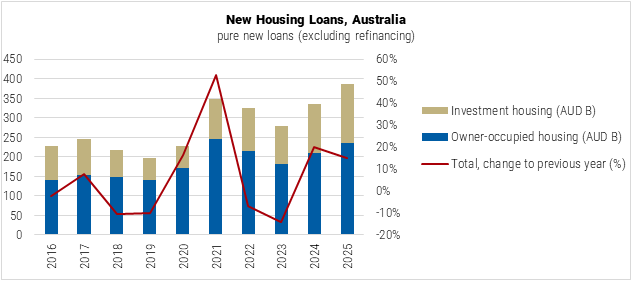
In 2025, the ABS reported AUD 385.0 billion (USD 248.1 billion) in pure new housing loan commitments (excluding refinancing), a 14.9% increase from the previous year and a decade high. Notably, the investor segment continued to demonstrate stronger growth (18.9% year-on-year) than the owner-occupied segment (12.5%). In both segments, the purchase of existing dwellings was the dominant borrowing purpose, representing 85.0% of owner-occupied and 82.6% of investor loan commitments, followed by dwelling construction and the purchase of newly completed properties.
Throughout the year, nearly 4,000 new housing loans worth AUD 3.3 billion (USD 2.1 billion) were committed to non-residents.
Data Source: ABS.
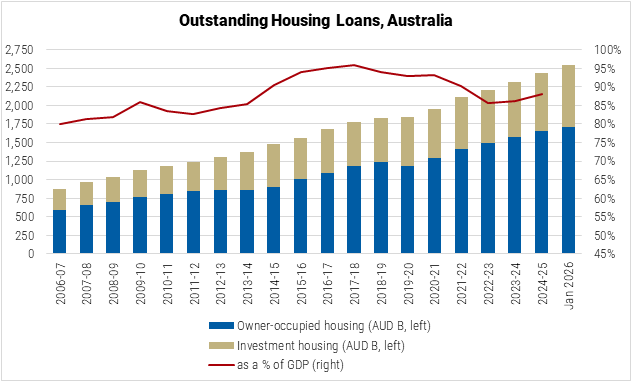
The overall size of the mortgage market in Australia also continues to expand. As of January 2026, the total value of outstanding housing loans stood at AUD 2.54 trillion (USD 1.72 trillion), up 6.7% from January 2025. Loans on owner-occupied housing represented 67.5% and loans on investment housing 32.5% of the combined stock.
Sized against the national economy, the market grew from an 85.5% loans-to-GDP ratio in 2022-23 to an estimated 88.0% in 2024-25. Based on the 2021 Housing Census data, 35% of occupied private dwellings in the country are owned with a mortgage.
Note: Reporting for financial years ending in June.
Data Sources: RBA, ABS.
Economic and Social Factors
Recovery Amid Global Uncertainties
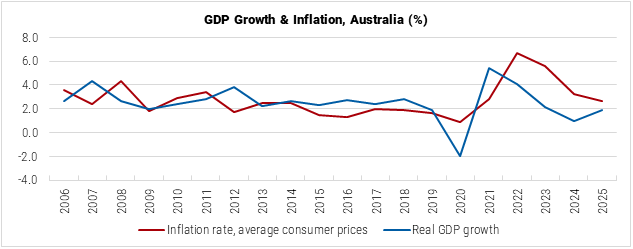
Following a weaker year in 2024, the Australian economy has managed a soft landing, with real GDP growth estimated at 1.9% in 2025, driven by a recovery in private demand. The International Monetary Fund (IMF) projects the momentum will strengthen further in the near term as pass-through from prior monetary easing and recent improvements in consumer sentiment support private demand, with growth accelerating to 2.1% in 2026 and 2.2% in 2027.
At the same time, while the average annual level of consumer price index (CPI) inflation in Australia eased from 3.2% in 2024 to 2.6% in 2025, inflationary pressures re-emerged in recent months, with the ABS reporting the indicator at 3.8% in January 2026. These developments already prompted the RBA to begin monetary policy re-tightening, which is likely to continue throughout the year. The central bank now expects the national economy to return to balance and inflation to approach the midpoint of the 2-3% target range only by mid-2028.
Data Source: IMF.
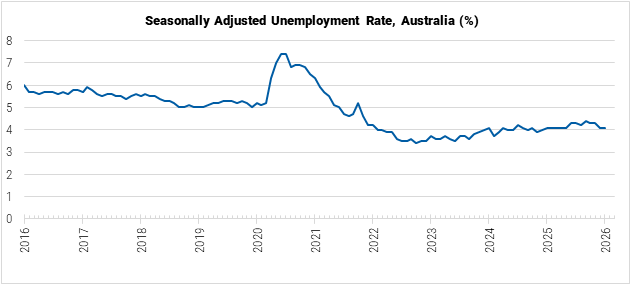
As outlined in the IMF staff report, conditions in Australia’s labor market have been easing gradually after a period of tightness, although the unemployment rate (most recently reported by the ABS at 4.1% percent in January 2026), remains low by historical standards.
Labor supply growth, previously bolstered by migration inflows and record-high labor force participation, has eased as net migration softened from post-pandemic peaks, and participation rates have declined slightly. Based on figures from the ABS, net overseas migration in the financial year 2024-25 eased to 306,000 people from 429,000 a year earlier (-28.7% year-on-year), with migrant arrivals dropping by 14%, while migrant departures increased by 13% year-on-year. India, China, the United Kingdom, and New Zealand remained among the top countries of birth for overseas migrants in Australia.
The RBA now expects labor market conditions to remain relatively stable over the next few quarters, with the unemployment rate gradually rising from late 2026 and reaching 4.6% by mid-2028.
Data Source: ABS.
Overall, Australia’s economic recovery is expected to continue in the near term. Earlier last year, Fitch Ratings affirmed Australia’s ‘AAA’ sovereign credit rating with a stable outlook, noting that the country’s institutional strengths continue to support its economic resilience to shocks.
The outlook for growth and inflation, however, remains clouded by uncertainty over global trade and has been further complicated by the recent outbreak of military conflict in the Middle East.
“The resurgence of Australian inflation, already a factor before the Middle East conflict, now risks intensifying, creating a problem for the incumbent government,” The Guardian wrote in early March 2026.
“Risks to Australia’s economic outlook are skewed toward slower growth and higher inflation. External threats such as global trade tensions, financial instability, and volatile commodity prices can potentially dampen demand and employment <…> Domestically, persistent inflationary pressures may arise from strong labor markets and constrained supply capacity <…>” noted the 2025 Article IV staff report from the IMF.
Sources:
- Australian Bureau of Statistics (ABS)
- Total Value of Dwellings: https://www.abs.gov.au/
- Building Approvals: https://www.abs.gov.au/
- Building Activity: https://www.abs.gov.au/
- Australian National Accounts: https://www.abs.gov.au/
- Government Finance Statistics, Australia: https://www.abs.gov.au/
- Lending Indicators: https://www.abs.gov.au/
- Housing: Census: https://www.abs.gov.au/
- Consumer Price Index: https://www.abs.gov.au/
- Labor Force: https://www.abs.gov.au/
- Overseas Migration: https://www.abs.gov.au/
- Reserve Bank of Australia (RBA)
- Cash Rate Target: https://www.rba.gov.au/
- Lenders' Interest Rates: https://www.rba.gov.au/
- Financial Aggregates: https://www.rba.gov.au/
- Economic and Financial Statistics: https://www.rba.gov.au/
- Statement on Monetary Policy: February 2026: https://www.rba.gov.au/
- Statement by the Monetary Policy Board: Monetary Policy Decision: https://www.rba.gov.au/
- Measures of Consumer Price Inflation: https://www.rba.gov.au/
- Australian Government Department of Treasury
- First Time Home Buyers Program: https://firsthomebuyers.gov.au/
- Albanese Government Clamping Down On Foreign Purchase Of Established Homes And Land Banking: https://ministers.treasury.gov.au/
- Guidance Note 4: https://foreigninvestment.gov.au/
- Guidance Note 6: https://foreigninvestment.gov.au/
- Delivering the National Housing Accord: https://treasury.gov.au/
- Australian Government Taxation Office
- Residential Fees for a Foreign Person: https://www.ato.gov.au/
- National Housing Supply and Affordability Council (NHSAC)
- State of Housing System 2025: https://nhsac.gov.au/
- International Monetary Fund (IMF)
- Country Overview: Australia: https://www.imf.org/
- 2025 Article IV Staff Report: https://www.imf.org/
- World Economic Outlook Update, January 2026: https://www.imf.org/
- Cotality
- Cotality Indices: https://www.cotality.com/
- Housing Market Splits…: https://www.cotality.com/
- Monthly Housing Chart Pack – February 2026: https://www.cotality.com/
- Rental Growth Accelerates as Vacancy Rates Tighten: https://www.cotality.com/
- KPMG Australia
- Residential Property Market Outlook, January 2026: https://assets.kpmg.com/
- NAB
- NAB Residential Property Survey Q4 2025: https://news.nab.com.au/
- University of Melbourne
- Westpac-Mi Consumer Sentiment Bulletin, 10 March 2026: https://library.westpaciq.com.au/
- Fitch Ratings
- Fitch Affirms Australia at 'AAA'; Outlook Stable: https://www.fitchratings.com/
- Canstar
- Interest Rate Forecast and Predictions for 2026: https://www.canstar.com.au/
- The Guardian
- Trump’s Re-election May Have Helped Albanese – but the US War in Iran is Creating Economic Conundrums: https://www.theguardian.com/