Morocco Residential Real Estate Market Analysis 2025
Morocco's housing market remains sluggish, marked by a sustained drop in sales transactions and stagnant property prices. Residential construction shows limited momentum, while mortgage lending continues to grow, though at a significantly slower pace.
This extended overview from Global Property Guide covers key aspects of the Moroccan housing market and takes a closer look at its most recent developments and long-term trends.
Table of Contents
- Housing Market Snapshot
- Demand Highlights
- Supply Highlights
- Rental Market
- Mortgage Market
- Socio-Economic Context
Housing Market Snapshot
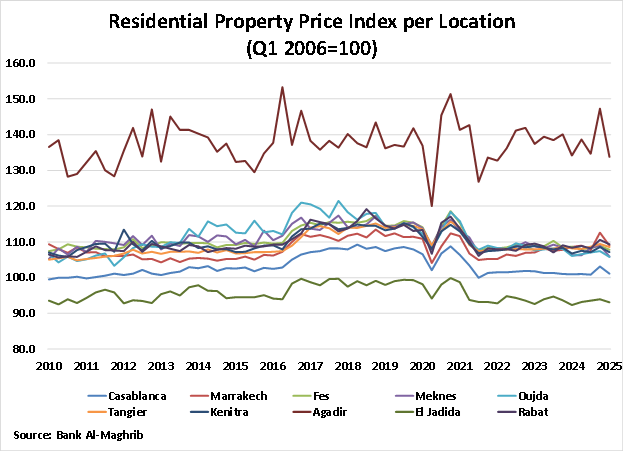
During the year to Q1 2025, the nationwide residential real estate price index (REPI) rose slightly by 0.15%, following a year-on-year increase of 1.65% in Q4 2024 and declines of 0.26% in Q3, 0.29% in Q2, and 0.59% in Q1, based on figures released by Morocco's central bank, Bank Al-Maghrib. However, when adjusted for inflation, residential property prices declined by 1.43% y-o-y in Q1 2025.
Quarter-on-quarter, the REPI declined by 2.12% (-2.94% inflation-adjusted) in Q1 2025.
Morocco's house price annual change:
By property type:
- Apartments: prices rose slightly by 0.27% (but declined by 1.32% when adjusted for inflation) in Q1 2025 from a year earlier. On a quarterly basis, apartment prices were down by 1.95% (-2.69% inflation-adjusted) in Q1 2025.
- Houses: nominal prices decreased slightly by 0.06% in Q1 2025 from a year earlier, while real prices fell by 1.64%. Quarter-on-quarter, house prices fell by 1.6% (-2.34% inflation-adjusted) during the latest quarter.
- Villas: prices fell slightly by 0.71% y-o-y in Q1 2025 and actually dropped by 2.28% when adjusted for inflation. In Q1 2025, villa prices declined by 1.08% (-1.82% inflation-adjusted) q-o-q.
- Urban land: prices dropped slightly by 0.15% y-o-y in Q1 2025 (-1.73% inflation-adjusted). Quarter-on-quarter, urban land prices fell by 2.49% (-3.22% inflation-adjusted) in Q1 2025.
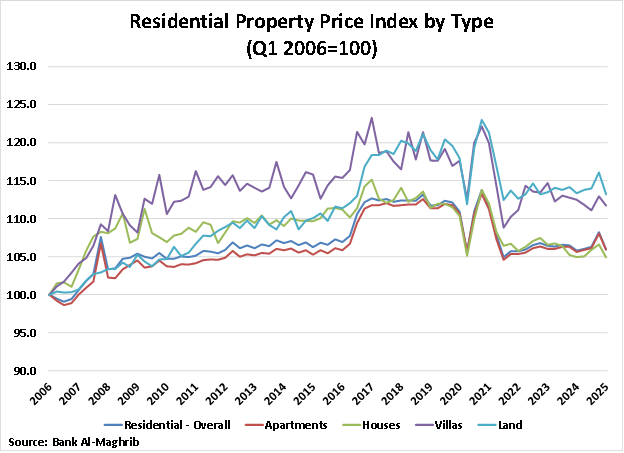
During the year to Q1 2025, almost all of Morocco's major cities registered lackluster performance:
- In Casablanca, residential property prices rose by a meager 0.24% y-o-y in Q1 2025 but declined by 1.34% when adjusted for inflation.
- In Marrakech, residential property prices rose slightly by 0.32% y-o-y in Q1 2025 but dropped 1.26% in real terms.
- In Fes, nominal residential property prices fell by 0.8% in Q1 2025 from a year earlier and dropped by a bigger 2.36% in real terms.
- In Meknes, residential property prices were down slightly by 0.28% and declined by 1.85% when adjusted for inflation.
- In Oujda, residential property prices fell slightly by 0.31% but actually dropped by 1.88% when adjusted for inflation.
- In Tangier, residential property prices rose by a meager 0.34% in nominal terms but actually dropped by 1.24% in real terms.
- In Kenitra, nominal prices increased slightly by 0.35% but declined by 1.23% in real figures.
- In Agadir, residential property prices fell by 0.28% and 1.85% in nominal and real figures, respectively.
- In El Jadida, nominal residential property prices rose by 0.89% but real figures fell by 0.7%.
- In Rabat, nominal prices increased by 0.96% in Q1 2025 but dropped 0.63% in inflation-adjusted terms.
Demand continues to fall, with the total number of residential transactions declining by 14.5% in Q1 2025 from a year earlier, worse than the year-on-year decline of 3.1% recorded in Q1 2024, according to Bank Al-Maghrib. Quarter-on-quarter, residential sales transactions plummeted by a bigger 29.3% in Q1 2025.
After contracting by 7.2% in 2020 due to the Covid-19 pandemic, the Moroccan economy bounced back immediately in 2021, registering a strong real GDP growth rate of 8.2%. The economy grew further in 2022 but at a much slower pace of just 1.5%. The country experienced modest economic expansion in the succeeding two years, registering real GDP growth rates of 3.4% in 2023 and 3.2% in 2024.
The International Monetary Fund (IMF) expects the Moroccan economy to grow by 3.9% this year and by another 3.7% in 2026.
In the previous decade, Morocco's property market surged, on the back of high GDP growth during the years 2001 (GDP growth of 7.3%), 2003 (6%), 2006 (7.6%), 2008 (5.9%), and 2011 (5.2%).
Demand Highlights:
Demand continues to fall
The housing market's lackluster performance may continue in the medium term because demand remains weak. Residential transactions fell by 14.5% in Q1 2025 from a year earlier, worse than the year-on-year decline of 3.1% recorded in Q1 2024, according to Bank Al-Maghrib.
Quarter-on-quarter, residential sales transactions plummeted by a bigger 29.3% in Q1 2025.
"The latest figures from the Real Estate Asset Index are alarming and should serve as a wake-up call," said Anis Benjelloun, vice president of the National Federation of Real Estate Developers (FNPI). "These aren't just complaints from developers - the data comes from credible public institutions like Bank Al-Maghrib and the land registry."
Sales transactions across all property types also fell significantly.
- Apartment sales fell by 14.5% y-o-y in Q1 2025, far worse than the prior year's 2.2% decline. During the latest quarter, the number of apartments sold dropped 29%.
- House sales fell sharply by 15.3% in Q1 2025 from a year ago, following a y-o-y contraction of 13.7% in Q1 2024. But house sales transactions saw a bigger quarterly decline of 34.6% over the same period.
- Villa sales decreased by 8.9% y-o-y in Q1 2025, compared to the prior year's 21.6% decline. On a quarterly basis, sales fell by a huge 31.8% during the latest quarter.
- Urban land transactions also dropped by 16.4% in Q1 2025 from a year earlier, in contrast to the prior year's 3.6% increase. Quarter-on-quarter, urban land sales also plunged by 33.1% in Q1 2025.
| RESIDENTIAL TRANSACTIONS, Q1 2025 | ||
| Property type | Annual change (%) | Quarterly change (%) |
| Total Residential | -14.5 | -29.3 |
| Apartments | -14.5 | -29.0 |
| Houses | -15.3 | -34.6 |
| Villas | -8.9 | -31.8 |
| Urban Land | -16.4 | -33.1 |
| Source: Bank Al-Maghrib | ||
"Property transactions have suffered significantly in recent months due to delays in processing tax-related documentation for property transfers," noted real estate expert Amine Mernissi.
Despite this, Mernissi emphasized that the underlying demand remains strong. "There is still confidence among buyers, particularly with the return of Moroccan expatriates this year."
There are no restrictions on foreigners owning land in Morocco, except for areas designated for agricultural purposes. The Dirham (MAD), Morocco's currency, is relatively stable.
Morocco's top real estate investment locations
Morocco's appeal lies in its historic cities-such as Marrakech, Fes, Meknes, and Casablanca its vibrant coastal resorts like Agadir and Essaouira, all of which have become increasingly attractive destinations for tourists and real estate investment.
Marrakech
Marrakech dates back at least to 1070 A.D. It is famous for its palaces, open markets, and gardens. It is an extraordinarily exotic city, with its drama heightened by its location at the foot of the Atlas Mountains.
Marrakech has a complete tourism zone, Aguedal. A public transport system carries tourists from the district into the city center for its souks and traditional markets selling copperware, wool merchandise, carpets, and kaftans. There are at least 27 5-star hotels in Marrakech.
Marrakech is also considered the country's best and largest golf destination, with more than 10 different golf courses designed by famous names like Robert Trent Jones, Kyle Philips, Jack Nicklaus, and Colin Montgomerie, among others.
TripAdvisor recently named Marrakech as one of the best tourist destinations in the world, with the city voted as the 8th best city for tourists in 2025, describing the city as a "magical place". It was ranked next to London, Bali, Dubai, Sicily, Paris, Rome, and Hanoi. This means that Marrakech remained the most popular tourist destination in Africa this year.
Fes
For over 400 years, Fes was the capital of Morocco. Founded in 789 A.D., it is the world's oldest and largest. Considered Morocco's intellectual and religious capital, it is a UNESCO World Heritage Site.
It was at its peak in the 14th century and saw a fresh burst of glory in the 17th century. Whether for its historic madrasas, its traditional tanneries, or its vibrant cultural life, Fes remains a captivating window into Morocco's rich and layered history. Though its narrow streets prevent the entry of cars into much of the city.
Casablanca
Here, the French built a city in a French idiom, heavily influenced by the architecture of the Arab-Andalusian Empire. The result is a city center that exudes modernist grandeur-broad boulevards, art deco facades, and elegant white buildings bathed in light.
Today, Casablanca is Morocco's largest city and its economic and business capital. It is a vibrant urban hub with a dynamic port, lively nightlife, and a contemporary cultural scene. Landmarks like the monumental Hassan II Mosque-one of the largest mosques in the world-highlight the city's blend of tradition and modernity. With its Atlantic coastline, upscale neighborhoods, and proximity to at least ten golf courses within an hour's drive, Casablanca offers both leisure and lifestyle.
Meknes
Meknes was recognized as a World Heritage Site in 1996. Its physical location, on a plateau, made it Morocco's trade crossroads. Its magnificent architecture was built by the 17th-century Ruler, Sultan Moulay Ismail. For over 55 years, he built palaces, mosques, gardens, and lakes. At his death, the unfinished buildings, including the royal palace - the Versailles of Morocco - fill most of the old city.
Agadir
Agadir is Morocco's main seaside destination. Beautiful beaches, luxurious hotels, and an ultra-modern airport are all combined with a moderate climate. Agadir's beach is spectacular. 10 kilometers in length, it is clean and wide. Agadir enjoys a continuous breeze from the Atlantic, so the temperature is pleasant all day.
A major earthquake completely destroyed the city in 1960. It was rebuilt from scratch. Agadir today is a modern city.
Tangier
Tangier had a louche reputation from the 1920s onwards when it was an outpost for British pederasts. Then in the 1950s, beats, dropouts, and writers like Burroughs and Bowles, Ginsberg and Kerouac, and Leary and Eldridge Cleaver came to Tangier. It is a messy, rather chaotic city. Today, its coastline is rapidly changing, with new resorts and developments reshaping its identity. Yet despite the transformation, it remains a city shaped by contrasts-old and new, wild and refined.
Essaouira
Essaouira is popular with independent travelers. This is partly because of its long beach, and partly because of its laid-back atmosphere. The town has long been a magnet for Moroccan poets and creative talent. In the Place de Lâ Independence, which is the main square in the center of Essaouira, there are dozens of cafes and restaurants. It is a pleasant place to eat, drink, and watch the world go by.
Essaouira is also famed for its music. Each summer, the Gnaoua World Music Festival draws international crowds, transforming the quiet town into a stage for hypnotic African rhythms and global sounds.
Supply Highlights:
Shortage of affordable housing
Despite a significant reduction in poverty in recent years, about 20% of the country's population (or 6.4 million Moroccans) struggles to afford decent housing. In contrast, the high-end market is well-supplied. Morocco is a highly unequal country, and around 820,000 units are either vacant or used as vacation or secondary homes.
The government has implemented numerous housing projects over the past decade, mobilizing thousands of hectares of land and giving developers incentives to invest in social housing projects. Social housing sales are VAT exempt (for areas between 50 sqm and 80 sqm), and prices are capped at MAD250,000 (US$27,601). Middle-income housing costs are capped at MAD6,000 (US$662) per sqm for units ranging from 80 sqm to 120 sqm.
In partnership with the private sector, the government is sustaining the implementation of its existing housing programs. As of March 2024, under the MAD250,000 (US$27,486) social housing initiative, 1,450 agreements were signed with private sector partners for the construction of 2,037,466 housing units, according to the 2024 Africa Housing Finance Yearbook published by the Centre for Affordable Housing Finance (CAHF).
Other housing programs included the Cities Without Slums and viable housing at MAD140,000 (US$15,392). Under this housing scheme, 52 agreements were finalized by early 2024, covering a total of 24,463 units.
Lending for middle- and low-income families is accessible through partnerships between the government and banks:
- The FOGARIM mortgage guarantee fund guarantees 70% of a mortgage loan made to a household with an informal income, to buy a housing unit worth less than MAD250,000 (US$27,486), helping about 1,200 new beneficiaries every month.
- Another guarantee program, FOGALOGE, guarantees loans to middle-class independent workers, moderate-income civil servants, and non-resident Moroccans purchasing or building houses up to about MAD1 million (US$109,945) in value.
Morocco's housing deficit has fallen to 400,000 units from 1.2 million units in 2002. However, due to rising prices of building materials caused by the Covid-19 pandemic and the Russia-Ukraine war, many construction projects were delayed, which slowed the response to the housing deficit. Fortunately, many previously delayed projects have resumed construction or reached completion over the past three years.
2024 Finance Law introduces key changes to Housing Assistance Programme
The 2024 Finance Law introduced key updates to the Direct Housing Assistance Programme for 2024-2028. Under Article 10, which amends Article 8 of the 2023 Finance Law (No. 50-22), several conditions are outlined. To qualify, the property must be a first sale, have a residence permit dated from 1 January 2023, and include at least two rooms. It must also serve as the buyer's main residence for at least five years from the final sale contract.
The said law also defines a "main residence" as a home that cannot be rented out or used for business purposes. For Moroccans living abroad, the property must either be retained for five years or made available rent-free to direct family members. If the property is sold before the five-year period ends, the housing aid must be repaid. If the final sales contract is not completed, the notary is responsible for recovering the aid amount.
Rental Market:
Good rental yields
Gross rental yields in Morocco are moderately good, averaging 6.72% in Q2 2025, according to research conducted by the Global Property Guide. Yet it is actually a decline from 7.75% in Q3 2024. Yields in Marrakesh are a little higher than in Casablanca, reflecting the fact that rents are not dissimilar, but the prices of properties are lower in Marrakesh.
By major area:
- In Casablanca, gross rental yields range from 5.61% to 8.18%, with a city average of 7%.
- In Marrakesh, one can earn higher rental yields of around 6% to 8.38%, with an average of 7.08%.
- In Rabat, apartments offer rental yields ranging from 5.91% to 7.14%, with an average of 6.68%.
- In Tangier, rental yields are relatively high, falling between 6.89% and 9.28%, with a city average of 8%.
- In Agadir, rental yields range from 4.4% to 5.19%, with an average of 4.82%.
Mortgage Market:
Policy rate kept steady as inflation eases
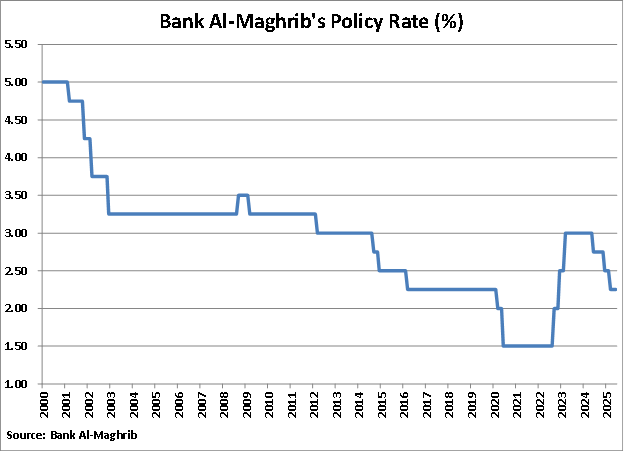
In June 2025, the Bank Al-Maghrib kept its policy rate unchanged at 2.25%, following a 25-basis-point reduction in March. This marks the lowest level since November 2022.
The latest decision was driven by a sharp decline in inflation, which is projected to average around 1.0% by the end of the year and 1.8% in 2026-well within the range consistent with price stability. With inflationary pressures easing and considerable uncertainty persisting in the global and domestic outlook, the central bank judged that maintaining the current monetary stance was appropriate.
In June 2025, nationwide inflation stood at 0.4%, unchanged from the previous month but down from 1.8% in the same period last year.
Overall inflation averaged just 1.0% from 2011 to 2021, before accelerating to 6.6% in 2022, the highest level recorded since 1992. Inflation remained high at 6.1% in 2023. As economic conditions improved, inflation eased significantly to 0.9% in 2024.
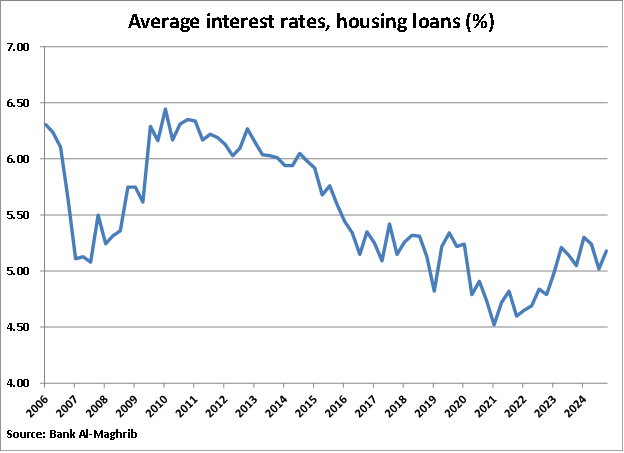
In Q1 2025, the average interest rate for real estate loans in Morocco stood at 5.18%, slightly up from 5.02% in the previous quarter and 5.05% in the same period last year, according to the Bank Al-Maghrib.
The average interest rate has not shifted dramatically during the past decade but has declined slightly, from an annual average of 6.11% in 2012 to 5.03% in 2023 and 5.15% last year. Overall, the interest rate for real estate loans averaged 5.31% in the past decade.
Mortgage market continues to grow, albeit at slower pace
Morocco has the most advanced and diverse mortgage market in the region, according to the Center for Affordable Housing Finance in Africa (CAHF). There is a wide range of sources for mortgage lending, including private commercial banks, public banks, consumer credit companies, and microfinance companies. The typical term period is 20 years, and the loan-to-value ratio can reach 100% of the property's appraised value.
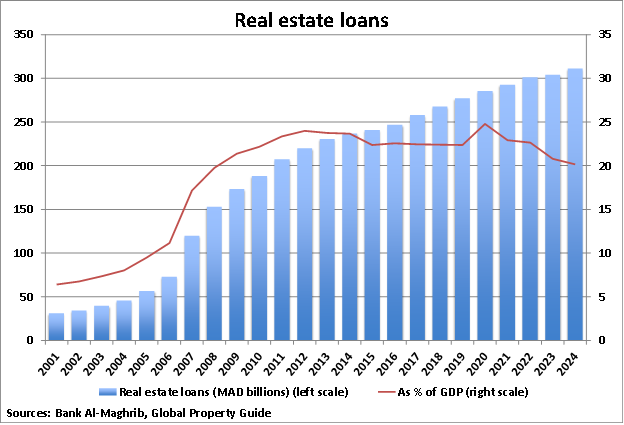
Morocco's mortgage market expanded rapidly to 24% of GDP in 2012, from just 6.4% of GDP in 2001, due to the surge in Morocco's GDP growth, particularly from 2002 to 2008, causing housing demand to rise rapidly. Since then, GDP growth has been somewhat slower, and in 2024, the size of the mortgage market has actually contracted to 20.1% of GDP.
Partnerships between the government and banks make lending accessible to middle- and low-income families, through the establishment of mortgage guarantee funds such as FOGARIM and FOGALOGE.
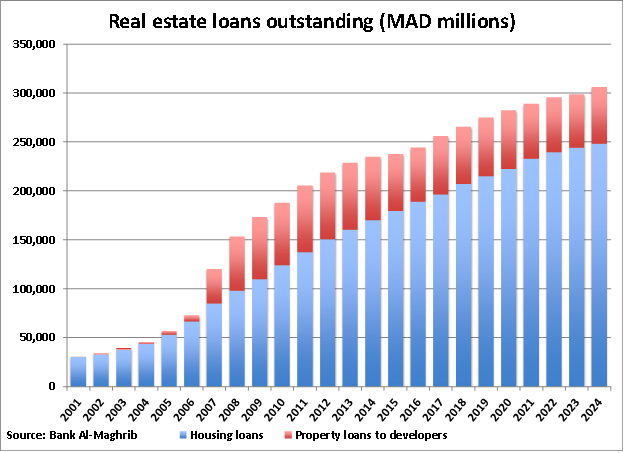
In May 2025, the total value of property loans in Morocco rose by a modest 3.2% y-o-y to MAD315.69 billion (US$34.85 billion), according to the figures released by Bank Al-Maghrib. Over the same period:
- Housing loans outstanding increased by 2.5% y-o-y to MAD 251.07 billion (US$27.72 billion).
- Property loans to developers were up by 6.9% y-o-y to MAD 59.49 billion (US$6.57 billion).
Socio-Economic Context:
Government: significant reforms, but significant corruption too.
Like other Middle Eastern countries, Morocco has experienced social and political unrest. However, unlike other countries, Morocco's political achievements, as well as the authorities' responsiveness, have reduced the scale of the unrest.
It has certainly helped that Morocco has not experienced a single period of economic contraction during the entire period from 1997 to 2019, causing unemployment to decline from 15.4% in 1997 to 9.3% in 2019.
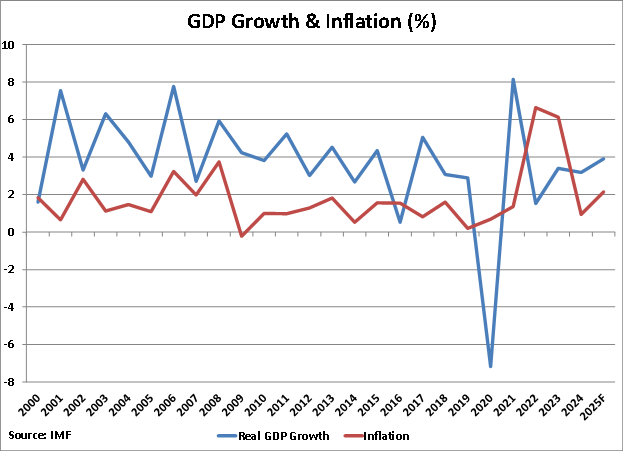
After contracting by 7.2% in 2020 due to the Covid-19 pandemic, the Moroccan economy bounced back immediately in 2021, registering a strong real GDP growth rate of 8.2%. The economy grew further in 2022 but at a much slower pace of just 1.5%. The country experienced modest economic expansion in the succeeding two years, registering real GDP growth rates of 3.4% in 2023 and 3.2% in 2024.
The International Monetary Fund (IMF) expects the Moroccan economy to grow by 3.9% this year and by another 3.7% in 2026.
Consumer prices in Morocco are more or less steady. In June 2025, the nationwide inflation rate stood at just 0.4%, unchanged from the previous month but down from 1.8% in the same period last year.
Inflation averaged just 1.4% annually from 2000 to 2021, before rising sharply to 6.6% in 2022 and 6.1% in 2023. As economic conditions improved, inflation eased significantly to 0.9% in 2024.
The country's relative stability can partly be attributed to King Mohammed VI's economic and constitutional reforms:
- New civil rights, including social equality for women, and constitutional guarantees of freedom of expression;
- Berber was made an official language, alongside Arabic;
- The Arab-Hassani Language and Morocco's other linguistic components are seen as part of the national heritage;
- Additional powers to the prime minister, who the King must appoint from the winning party in parliamentary elections;
- Parliament now has the power to grant amnesty;
- Independence of the judiciary;
- The King, however, remains commander-in-chief, holding complete control over the armed forces. He is also the chair of the Council of Ministers and the Supreme Security Council, and the highest religious authority in the country.
Yet despite positive achievements under King Mohammed VI, corruption remains prevalent, reaching the palace itself. Royal involvement in business is a major topic in Morocco, unsurprisingly as the King is the Kingdom's leading businessman and banker, and the royal family has one of the world's biggest fortunes. Decisions on big investments in the Kingdom are taken by only three people: the King, his secretary Mounir Majidi, and the monarch's close friend, adviser, and former classmate Fouad Ali Himma. Corruption originating in the royal palace especially affects the housing sector, as Wikileaks documents released in 2010 showed.
In 2011, thousands of people rallied in Rabat and other cities, calling for a new constitution that curbs the powers of the King.
A decade later, the liberal party, National Rally of Independents, led by oil and gas billionaire Aziz Akhannouch, narrowly won the September 2021 election, pushing the conservative Islamist Justice and Development Party (PJD) out of power after it had led Moroccan politics for a decade. The PJD lost favor with voters amid the country's lagging economic performance during the Covid-19 pandemic.
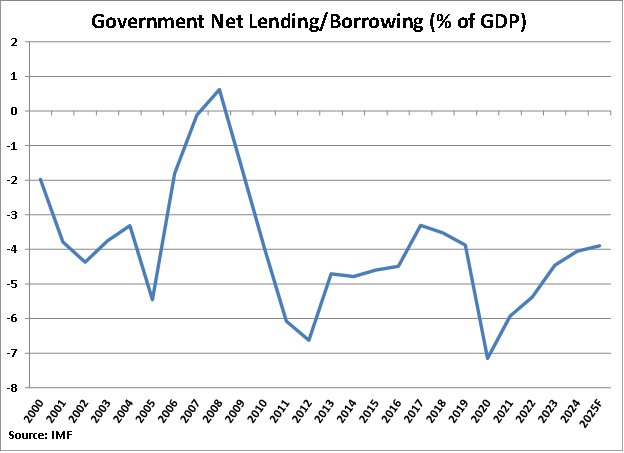
The budget deficit continues to fall
To dampen popular protests at the time of the Arab Spring, the King went on a spending spree in 2011, raising public sector wages and pensions, as well as subsidies. The budget deficit widened to 6.7% of GDP in 2011, up from 4.4% in 2010, according to the African Development Bank - a dramatic contrast to previous surpluses. The budget deficit rose further to 7.4% of GDP in 2012.
Morocco's budget deficit has since been reduced to 3.6% of GDP in 2019.
However, due to the introduction of pandemic-related measures, the shortfall soared again to about 7.1% of GDP in 2020.
The budget deficit gradually dropped to 5.9% of GDP in 2021 and to 5.3% of GDP in 2022. Based on Bank Al-Maghrib's figures, the deficit narrowed further to about 4.4% of GDP in 2023 and to 4.1% of GDP in 2024, due to the combined effect of strong budget revenues and lower subsidies.
"The central government fiscal deficit improved more than envisaged in the 2024 Budget. The 2024 overall deficit closed at 4.1 percent of GDP, about 0.2 percent of GDP less than projected in the 2024 Budget," said the IMF. "This reflects better-than-expected tax revenues that more than offset higher spending. The reform of the Organic Budget Law envisages the introduction of a new fiscal rule based on a medium-term debt anchor."
Morocco's budget deficit is projected to narrow further to below 4% of GDP this year.
Public debt was equivalent to around 70% of GDP in 2024, slightly up from 69.5% in 2023 but lower than the 71.5% recorded in 2022.
New peak in tourist arrivals
Tourism's share of GDP is about 18% when indirect contributions are considered. In addition, the tourism sector employs more than 2.5 million people (both direct and indirect) - representing almost 25% of the total labor force.
Tourism is one of the country's largest providers of hard currency.
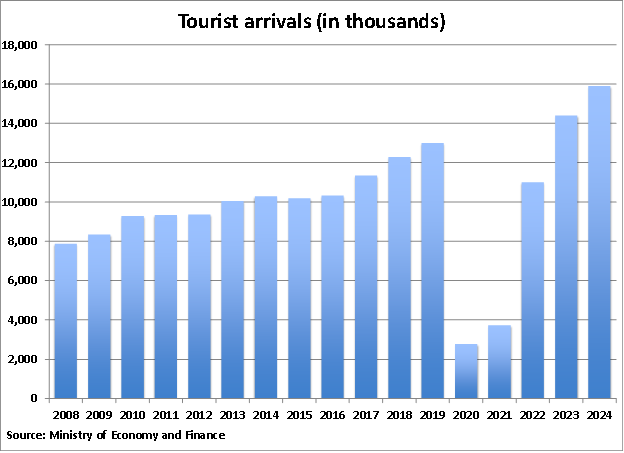
In 2024, Morocco welcomed about 17.4 million tourists, sharply up by 20% as compared to the prior year. In fact, it far exceeded the 13 million arrivals seen during the pre-pandemic year of 2019.
The top destinations for overnight stays were Marrakech, accounting for nearly 40% of all tourist visits, followed by Agadir with around 25%, Casablanca with 9%, and Tangier with 7%.
Following these record-breaking arrivals, the country's tourism revenues also reached an all-time high of MAD112 billion (US$12.4 billion), up by 7% from the preceding year and by 43% compared to 2019. This followed year-on-year increases of 12% in 2023 and 166.1% in 2022 and a decline of 5.9% in 2021.
The growth of the tourism sector continues this year. In the first half of 2025, tourist arrivals rose by a huge 19% from a year earlier to 8.9 million. In June 2025 alone, there were a total of 1.7 million arrivals, an increase of 11% as compared to the same period last year.
"These results confirm Morocco's attractiveness and our ability to draw a growing number of tourists," said Tourism Minister Fatim-Zahra Ammor. "As we enter the second half of the year, we are prioritizing two major areas: strengthening air connectivity and accelerating the development of accommodation and entertainment options to meet the expectations of an increasingly selective clientele."
The upward trend was mainly attributed to the growth in outbound tourism markets, including the Spanish, British, Italian, and American markets. Moreover, the government's recent efforts to boost the sector through improved marketing and air connectivity, and position Morocco as among the top 10 destinations worldwide through its newly developed 2023-2026 action plan called "Light in Action", are starting to yield positive results.
Morocco aims to expand accommodation capacity to 340,000 beds by 2026 and attract 26 million visitors by 2030, when the country will co-host the World Cup together with Spain and Portugal.
The rise, stall, and reinvention of Plan Azur
Launched in 2001 under Morocco's ambitious "Vision 2010" tourism strategy, Plan Azur was designed to transform the country into a leading Mediterranean destination. The plan aimed to create six large-scale seaside resorts-Saidia, Lixus, Mazagan, Mogador, Taghazout, and Plage Blanche-offering a total of 80,000 tourist beds, multiple golf courses, and integrated tourism infrastructure. These resorts were to be strategically placed along the Mediterranean and Atlantic coasts to encourage regional development and attract international visitors.
However, progress has been uneven. Only two of the six resorts-Saidia and Mazagan-have been completed and are operational, both opening around 2009. Saidia, located on the Mediterranean, has about 7,000 beds but struggles with low international visibility, limited year-round activity, and weak air connectivity. Mazagan, located near El Jadida, was developed with a hotel, golf course, and casino, but its original scope was scaled down due to financial and logistical constraints. The remaining resorts, including Lixus, Mogador (Essaouira), Taghazout Bay, and Plage Blanche, have faced delays, underinvestment, or partial implementation. Some, like Taghazout, are still under phased development.
In response to these challenges, Morocco expanded the vision of Plan Azur to include additional sites such as Chbika, Ouarzazate Lake City, and Dakhla. This evolution reflects a broader shift in tourism strategy toward regional diversification and sustainability.
In 2023, Morocco launched a new national tourism roadmap for 2023-2026, backed by a MAD6.1 billion (US$673.5 million) investment. This initiative aims to attract 17.5 million tourists, create 200,000 new jobs, and generate MAD120 billion (US$13.25 billion) in foreign tourism revenue by 2026. As part of this push, the Moroccan National Tourist Office (ONMT) rolled out its "Light In Action" plan to enhance Morocco's global image and bring the country into the top 10 global tourist destinations.
The upcoming 2030 FIFA World Cup, which Morocco will co-host with Spain and Portugal, is also accelerating infrastructure investment. Major projects are underway, including airport expansions, the development of new hotels, and the expansion of the country's high-speed rail network to connect 43 cities by 2040. These efforts aim to support increased tourist flow and improve access to emerging destinations like Saidia, Taghazout, and Dakhla.
Plan Azur fell short of its goals, but it helped start Morocco's tourism growth. With new plans and the 2030 World Cup ahead, the country aims to attract more visitors.
Sources:
- Real Estate Asset Price Index (Bank Al-Maghrib): https://www.bkam.ma/
- Morocco's real estate market struggles amid prolonged slowdown in sales and transactions (Hespress English): https://en.hespress.com/
- Africa Housing Finance Yearbook 2024: Morocco (Centre for Affordable Housing Finance in Africa): https://housingfinanceafrica.org/
- Moroccan central bank holds benchmark interest rate at 2.25% (Reuters): https://www.reuters.com/
- Debit rates (Bank Al-Maghrib): https://www.bkam.ma/
- Morocco Interest Rate (Trading Economics): https://tradingeconomics.com/
- Morocco Tourist Arrivals (Trading Economics): https://tradingeconomics.com/
- Morocco on track for another record-breaking tourism year in 2025 (Travel Mole): https://www.travelmole.com/
- Morocco Attracts 8.9 Million Tourists in First Half of 2025 (Morocco World News): https://www.moroccoworldnews.com/
- Indice des prix à la consommation (IPC 2017) par grandes divisions Mensuel (Haut-Commissariat Au Plan): https://www.hcp.ma/
- Gross rental yields in Morocco: Casablanca and 4 other cities (Global Property Guide): https://www.globalpropertyguide.com/
- Marrakech Among TripAdvisor's 'Best of the Best Travel Destinations' in 2025 (Morocco World News): https://www.moroccoworldnews.com/
- Morocco dethrones Egypt, becomes main popular destination for tourist to Africa (The New Arab): https://www.newarab.com/
- Tripadvisor Reveals 2025's Must-Visit Destinations: Top Picks From Travelers Around the World (TripAdvisor): https://tripadvisor.mediaroom.com/
- Morocco (International Monetary Fund): https://www.imf.org/
- Morocco Government Budget (Trading Economics): https://tradingeconomics.com/
- Morocco: budget deficit exceeds 2 billion euros (Financial Afrik): https://www.financialafrik.com/.
- Morocco faces a budget deficit of 22.9 billion dhms by May (Maghrebi.org): https://maghrebi.org/
- Morocco: 2025 Article IV Consultation and Third Review Under the Arrangement Under the Resilience and Sustainability Facility-Press Release; Staff Report; and Statement by the Executive Director for Morocco (International Monetary Fund): https://www.imf.org/
- Inflation and core inflation (Bank Al-Maghrib): https://www.bkam.ma/
- Morocco country profile (BBC News): https://www.bbc.com/