Israel's Residential Real Estate Market Analysis 2026
Israel's housing market is now falling under the weight of its own supply, with a record overhang of unsold new homes holding prices down even as the central bank cuts interest rates.
Table of Contents
- Property Prices and Price Index
- House Price Variations
- Property Demand Trends
- Property Supply Trends
- Rental Market: Rents and Rental Yields
- Mortgage Market and Interest Rates
- Historic Perspective
- Economic and Social Factors
Property Prices and Price Index
Israel's nationwide home price index rose by a marginal 0.1% in May to June 2026 compared with the previous two-month period, but remained 1.5% lower than a year earlier, according to figures published by the Central Bureau of Statistics (CBS). Adjusted for inflation, prices were down by 2.96% over the same period.
This is one of the few sustained annual declines recorded in Israel over the past decade. Prices have now fallen in nine of the last twelve months, and every two-month reading published so far in 2026 has shown a year-on-year decrease. The steepest of them came in April to May 2026, when prices dropped by 1% against the preceding period, the largest two-month fall in eight years.
Israel's house price annual change:
The market's weakness is no longer principally a story about interest rates. The Bank of Israel (BOI) cut its key rate by 25 basis points to 3.5% on July 6, 2026, the fourth reduction since November 2025 and a cumulative easing of a full percentage point. Money has become cheaper, yet prices continue to slip. What is holding the market down is supply: a record 86,090 new dwellings sat unsold at the end of December 2025, equivalent to 29.2 months of sales at the prevailing absorption rate.
One measure of the market points the other way, and the divergence needs to be stated plainly. The average price actually paid for a dwelling in Israel reached ILS 2,435,000 (US$817,114) in the second quarter of 2026, up by 3.7% on the previous quarter and by 7.9% on the same quarter a year earlier. That series is a simple mean of transaction values and is not adjusted for the size, age, location, or quality of the homes changing hands. When the mix of transactions shifts towards larger or better-located properties, the average rises even while like-for-like values fall. The quality-adjusted index is the measure that tracks the value of a given home, and it is the one used throughout this report.
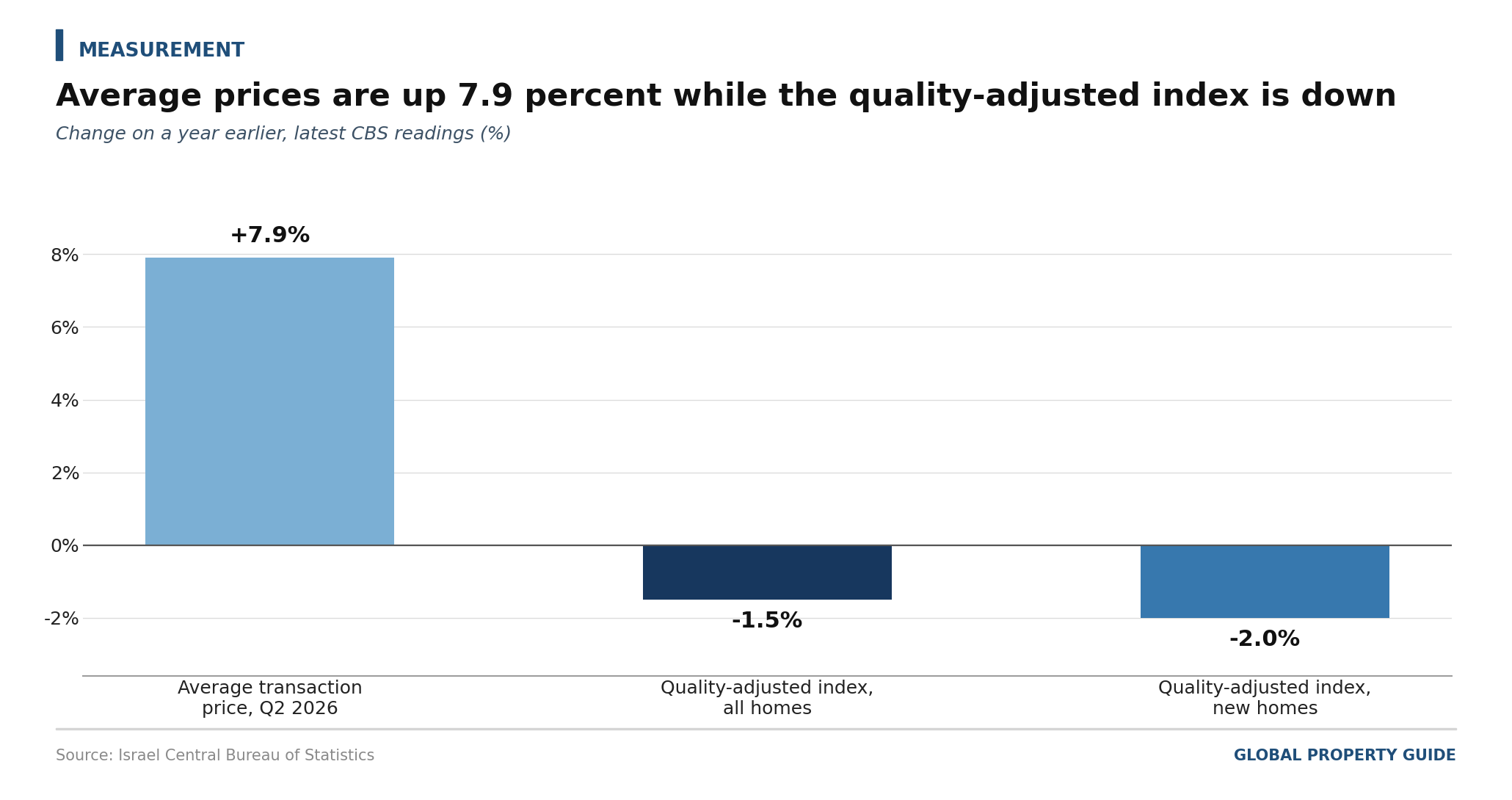
Tel Aviv remains by far the most expensive market in the country, with an average dwelling price of ILS 4,553,500 (US$1,528,020) in the second quarter of 2026. Beersheba was the cheapest of the major cities at ILS 1,236,200 (US$414,832), meaning a home in Tel Aviv costs about 3.7 times as much as one in the Negev capital.
The shekel has been a powerful force on the market this year. It has appreciated by about 13.4% against the US dollar since the previous edition of this report, trading at roughly ILS 2.98 to the dollar in mid-August 2026. All conversions in this report use that rate. For overseas buyers, the currency move has raised the dollar cost of Israeli property by more than the local price decline has reduced it.
House Price Variations
The Central district is carrying the correction
House price movements vary sharply across Israel's six districts, and the burden of the current decline is distributed very unevenly.
The Central district recorded the steepest annual fall in May to June 2026, at 4.1%, nearly three times the national rate of decline. It was followed by Haifa at 1.8% and Tel Aviv at 1.7%. The Southern district was essentially flat, rising by 0.1%.
Two districts are still appreciating. Jerusalem posted the strongest annual increase at 1.8%, with the Northern district close behind at 1.6%.
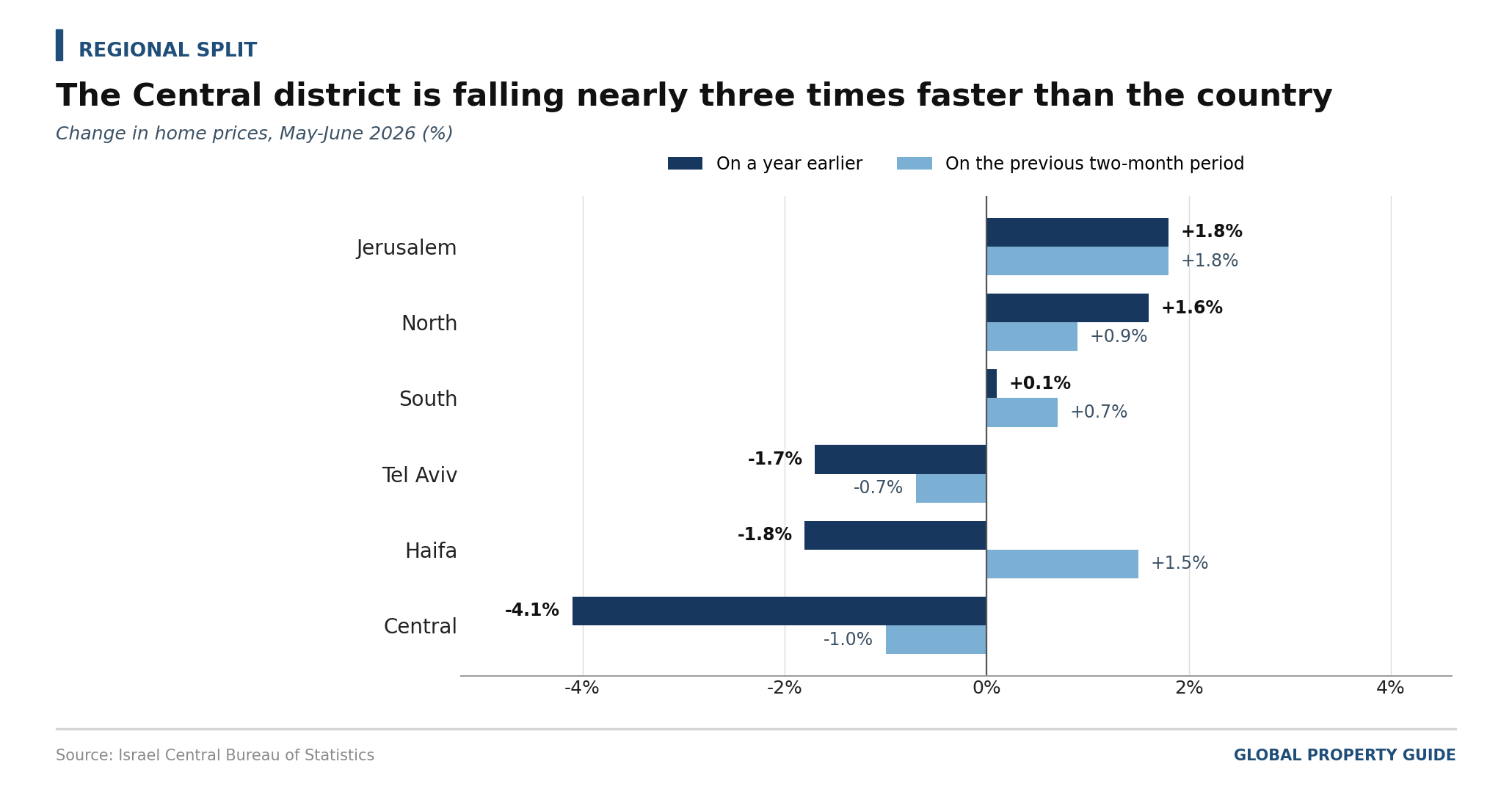
The two-month picture shows the same split forming from a different direction. Jerusalem rose by 1.8% against the preceding period, Haifa by 1.5%, the North by 0.9%, and the South by 0.7%, while the Central district fell by 1% and Tel Aviv by 0.7%. Haifa's sharp monthly gain against a negative annual reading suggests the northern port city may be finding a floor earlier than the centre of the country.
New homes are falling faster than the market as a whole
The new-build segment is under greater pressure than the second-hand market. The new home price index fell by 2% over the year to May and June 2026, against 1.5% for all homes.
The published new-home figure also flatters the segment. Government-subsidised transactions, sold at administratively set prices, made up 38.4% of new home sales in the period, up from 36.4% in the preceding period. Stripping those out, the new home index rose by 0.9% in the two months rather than the 0.5% reported including them, which indicates that free-market new-build prices are being supported by a growing share of subsidised sales in the reported mix.
Over five years, the gap is clear. Compared with May to June 2021, new home prices have risen by 26.2%, against 30.6% for all homes. That is a compound annual rate of 4.76% for new builds against 5.48% for the market overall.
City-level averages tell a different story from the index
At the level of individual cities, the average transaction price series again diverges from the index. Among Israel's largest cities, average prices in the second quarter of 2026 rose most in Ashdod, up 11% on the same quarter a year earlier, and in Tel Aviv, up 8.4%.
The largest declines in average prices were recorded in Ashkelon, down 2.4%, followed by Bnei Brak and Netanya, both down 1.7%.
Readers should treat these city figures as movements in the mix of what is being sold rather than as changes in the value of a given property. Tel Aviv's average transaction price rose 8.4% over the year while the district's quality-adjusted index fell 1.7% over the same window.
Property Demand Trends
Transactions fell through 2025, with the new-build market taking the damage
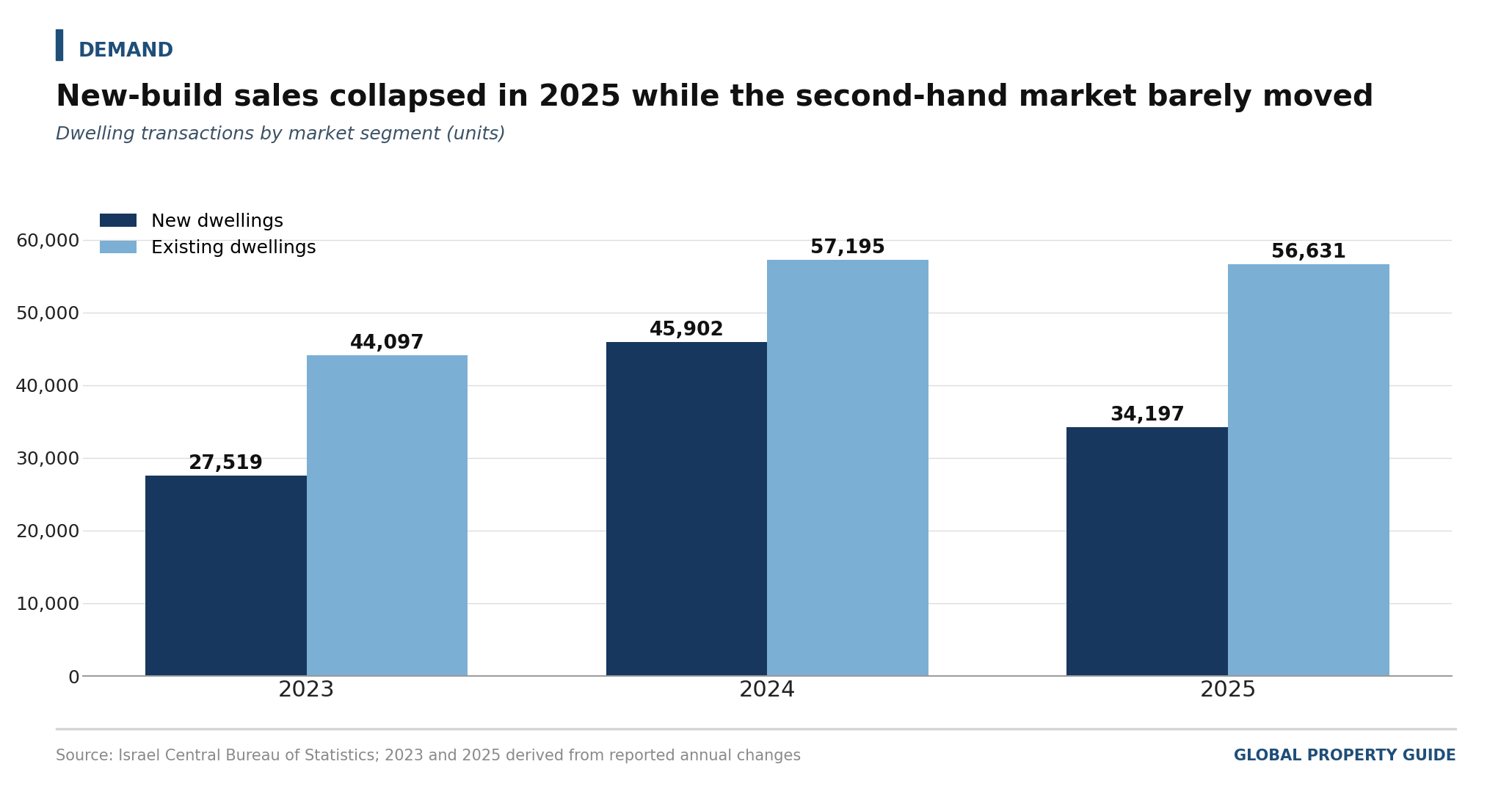
The total number of dwellings sold in Israel fell by 11.9% during 2025 to around 90,830 units, according to CBS figures, reversing the 44% surge recorded in 2024.
The contraction was concentrated almost entirely in one segment:
- New dwellings sold collapsed by 25.5% year on year to approximately 34,200 units.
- Existing dwellings sold were close to flat, easing by about 1% to roughly 56,630 units.
That divergence is the single most revealing statistic in the 2025 data. Israeli households did not stop buying homes. They stopped buying new ones.
The deceleration gathered pace through the year. In the fourth quarter of 2025 alone, 21,710 units were sold, down 14.7% on the same quarter of 2024 and down 9.2% after seasonal adjustment. Separately, the Ministry of Finance recorded 84,879 transactions over the full year on its own narrower measure, an annual fall of 11%.
2026 has been dominated by the war and its aftermath
Trading conditions in the first half of 2026 were shaped by the confrontation with Iran, which ran from February 28 to a ceasefire on April 8.
- In March 2026, 7,395 apartments were sold, an 8% decline on March 2025 though a 3% gain on the previous month.
- In April 2026, sales fell to 5,081 units, down 19% year on year and down 31% on March. The Ministry of Finance described the month as exceptionally weak by historical standards, with the Passover holiday reducing the number of working days.
- In May 2026, transactions rebounded to 8,246 units, a 23% increase on May 2025 and a 63% jump on April.
The May composition is worth noting. New apartment sales, including subsidised units, totalled 3,613, up 51% on a year earlier, while 4,633 second-hand apartments changed hands, up 7%. New builds accounted for 43.8% of the month's sales, a marked recovery in a segment that had been the weakest part of the market throughout 2025.
Investors returned, foreign buyers did not
Investor activity picked up sharply in May 2026, with 1,319 apartments purchased by investors, a 43% increase on May 2025 and a 76% rise on the previous month. Investors sold 1,275 apartments over the same month, leaving them net buyers by a margin of just 44 units. Investors accounted for 16% of all purchases in the month.
Foreign demand has moved in the opposite direction. The Ministry of Finance's Chief Economist published the government's first detailed breakdown of overseas purchases by the country issuing the buyer's passport, covering the first quarter of 2026:
- American buyers acquired 238 apartments, down from 248 in the first quarter of 2025.
- French buyers purchased 130 apartments, up sharply from 84.
- British buyers took 57 apartments, up from 37.
- Canadian buyers acquired 16 and Australian buyers 10.
The overall softness in dollar-denominated demand has been attributed to the shekel's appreciation, which has made Israeli property substantially more expensive for anyone converting from foreign currency.
Property Supply Trends
Construction reached an all-time record just as demand fell away
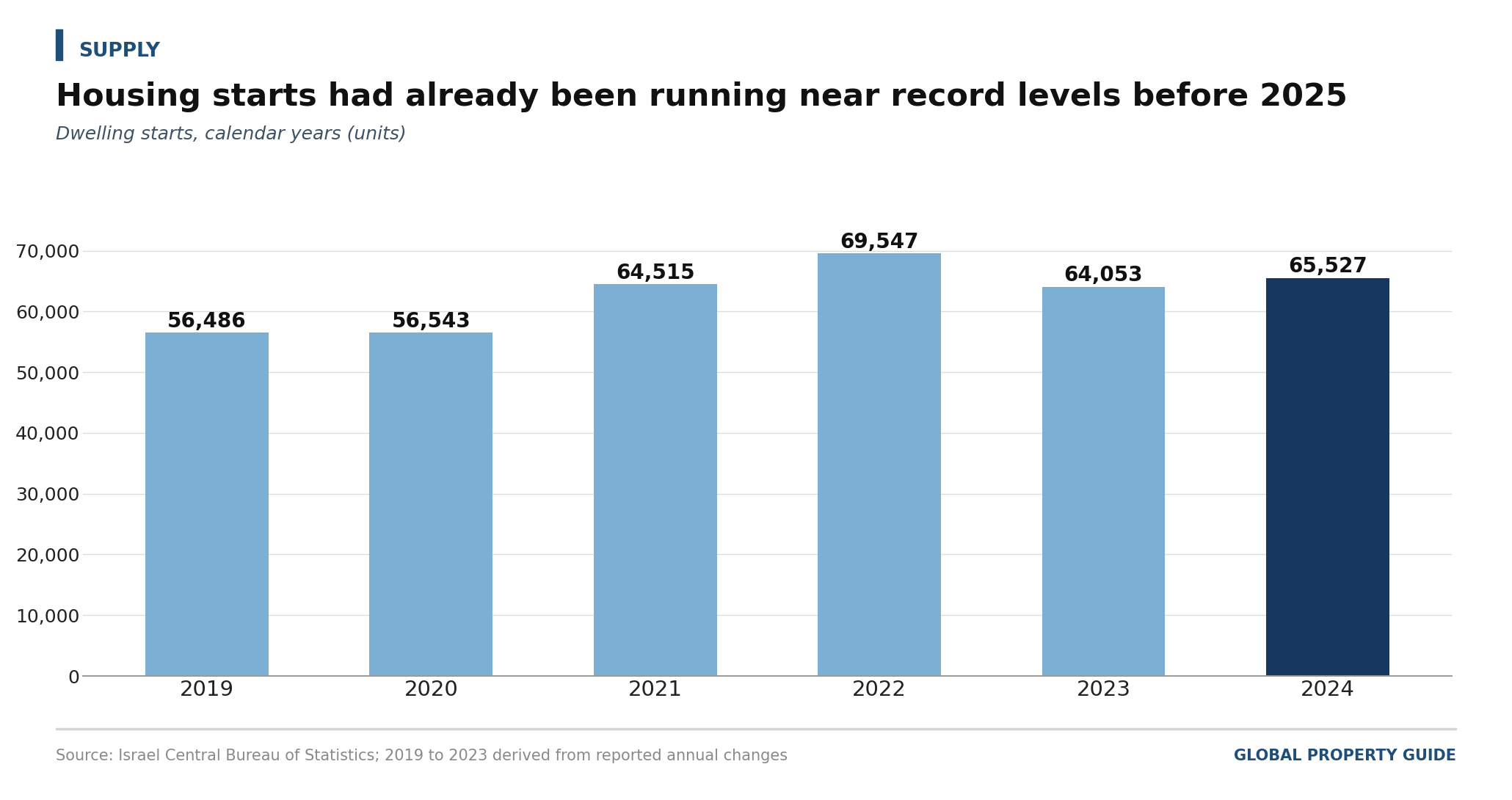
Israel began construction on approximately 81,020 apartments in the twelve months from October 2024 to September 2025, an increase of 31.5% on the preceding twelve months and an all-time record, based on CBS figures. Permits were issued for around 81,560 new apartments over the same period, up 10.9%.
Of the units started, 93.2% represent net additions to the housing stock, with roughly 5,480 existing apartments demolished, giving net construction starts of about 75,540 apartments.
The building wave is concentrated in three districts
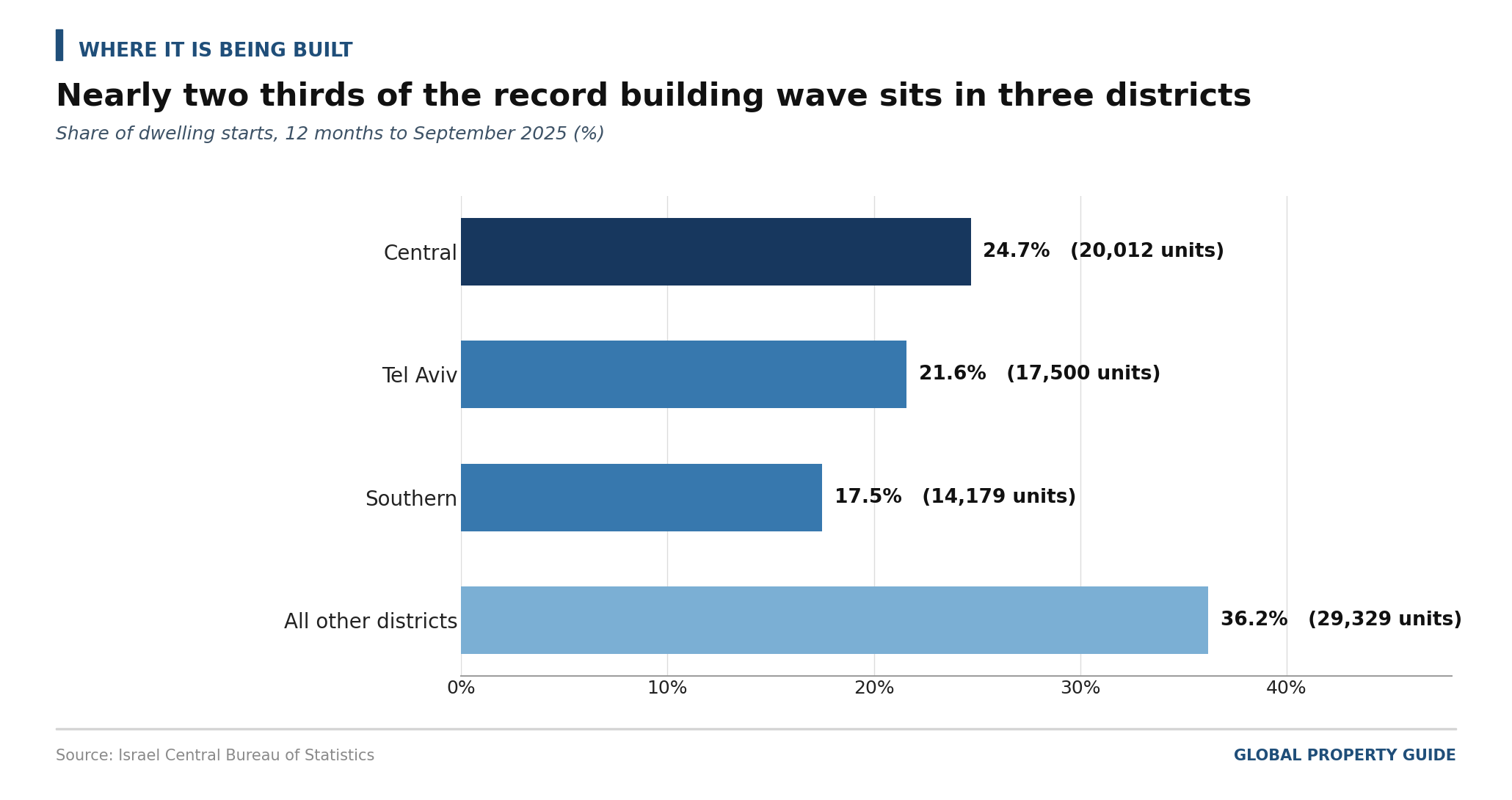
Just under two-thirds of the record volume of starts is located in three of Israel's six districts:
- The Central district accounted for 24.7% of all starts, or about 20,010 apartments.
- The Tel Aviv district accounted for 21.6%, or about 17,500 apartments.
- The Southern district accounted for 17.5%, or about 14,180 apartments.
Some 72.1% of the apartments started were built for sale, and 15% of those, roughly 8,760 units, carried a government subsidy. The Central district took the largest share of subsidised construction at about 3,610 apartments, or 41.2% of the national total, followed by the Southern district with about 2,220 apartments, or 25.3%.
The concentration matters because it maps almost exactly onto the districts where prices are falling fastest. The Central district and Tel Aviv together account for 46.3% of all starts, and both are among the three weakest districts for annual price growth.
Building has run well ahead of what the market can absorb
The arithmetic of the imbalance is stark. The record twelve-month pace equates to roughly 20,255 starts per quarter. In the third quarter of 2025, by contrast, only around 8,800 new apartments were sold, including subsidised units. Developers were therefore beginning construction on roughly 11,455 more apartments each quarter than the market was buying, an excess of some 3,800 units a month.
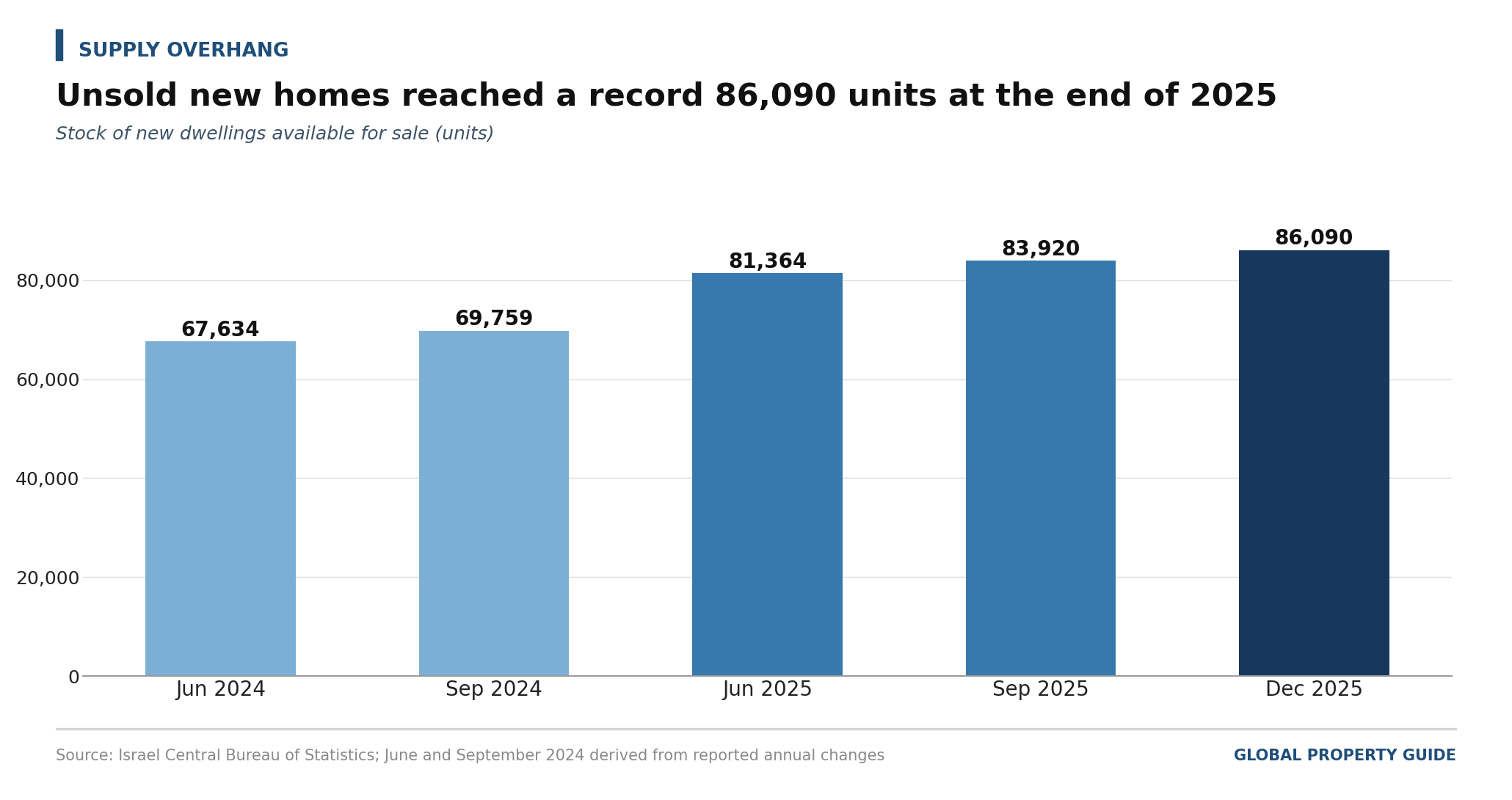
The stock of unsold new dwellings has risen accordingly. It stood at 81,364 units in June 2025, 83,920 units at the end of September 2025, and a record 86,090 units at the end of December 2025. The BOI noted in July that the stock of unsold dwellings remains high, and by the middle of 2026 the overhang was equivalent to roughly 29.5 months of supply on the recent three-month sales pace. A market in balance is generally reckoned to hold twelve to eighteen months of supply.
Building has begun to slow in response, though only modestly. Dwelling starts totalled 18,896 units in the first quarter of 2026, marginally below the 18,986 units recorded in the fourth quarter of 2025. Annualised, that is a pace of about 75,584 units, roughly 6.2% below the record twelve-month figure. The BOI put the first-quarter annualised pace at about 76,000 and reported that completions continue to increase while permits remain stable at a high volume.
The planning pipeline continues to expand
The volume of consents moving through the planning system suggests supply pressure will persist. Over the course of 2025, 11,426 building permits were issued covering 74,275 housing units. District planning committees approved a further set of plans led by the Southern district with 27,478 units, the Jerusalem district with 27,079, and the Central district with 26,686, followed by Haifa with 20,558, the North with 18,223, and Tel Aviv, the smallest district by area, with 14,459. Local planning committees approved an additional 25,254 units.
About 10% of the units approved in 2025, roughly 20,000, were designated for rental housing and micro-apartments, of which about 11,000 were specifically for rental. Half of all approvals came through urban renewal projects. The National Committee for Planning and Building of Priority Housing Areas approved 18 plans comprising 63,400 housing units, nine of them urban renewal schemes covering 28,000 units. Jerusalem recorded an all-time municipal record with permits for approximately 8,500 new apartments.
Capacity constraints have eased considerably. The quota for foreign construction workers was raised from 42,000 to 110,000, and the residential construction inputs index rose by only 3% in the year to April 2026, driven mainly by a 4.7% increase in labour costs.
Rental Market: Rents and Rental Yields
Rents are rising while prices fall
The rental market has decoupled from the sales market. Over the year to July 2026, tenants renewing an existing lease saw rents rise by 2.6%, while tenants moving into an apartment where the previous occupant had left faced an increase of 4.7%, according to CBS figures.
Israel's rent price index:
Set against a home price index down 1.5% over the same window, incoming tenants are facing rent growth running 6.2 percentage points ahead of price growth. In real terms, against nationwide inflation of 1.5%, renewing tenants paid 1.08% more and incoming tenants 3.15% more.
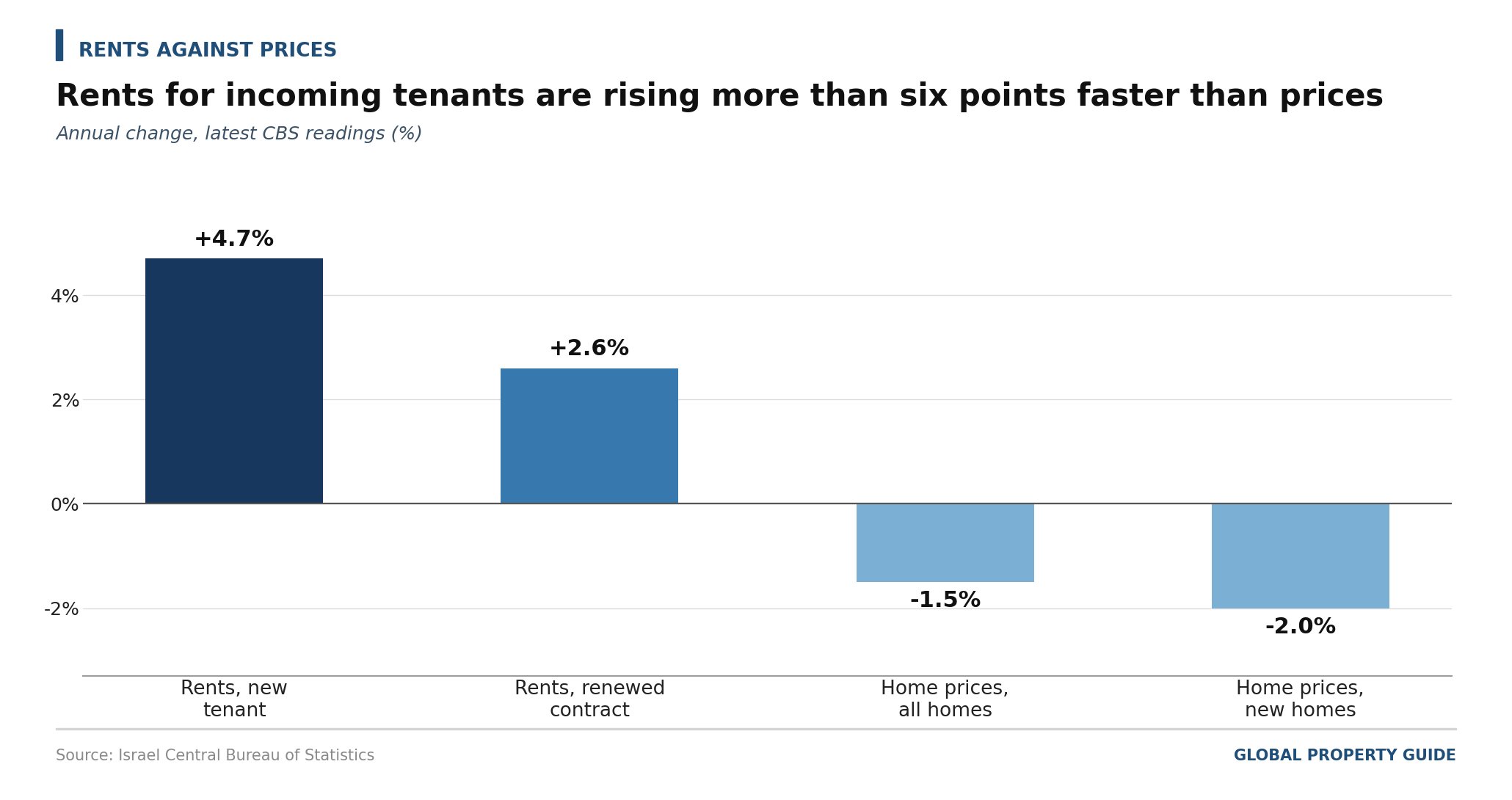
The gap between the two tenant categories is itself revealing. The 2.1 percentage point spread between new and renewed contracts indicates that landlords are repricing sharply at turnover while holding sitting tenants closer to inflation. Earlier in the year, the spread was wider still: in the May index, renewing contracts rose 2.5% while change-of-tenant contracts accelerated to 6.8%, with the housing component of the consumer price index up 4% on the year.
Economists at Bank Hapoalim have attributed the rise to a lagged reaction to the earlier period of high interest rates, which dampened investor purchasing while pushing more households into the rental market, and have suggested the trend may cool as the surplus of new housing is absorbed.
The national average rent reached about ILS 5,027 (US$1,687) per month in the first quarter of 2026, an increase of roughly 3.5% on a year earlier.
Rental yields are poor and getting slightly poorer
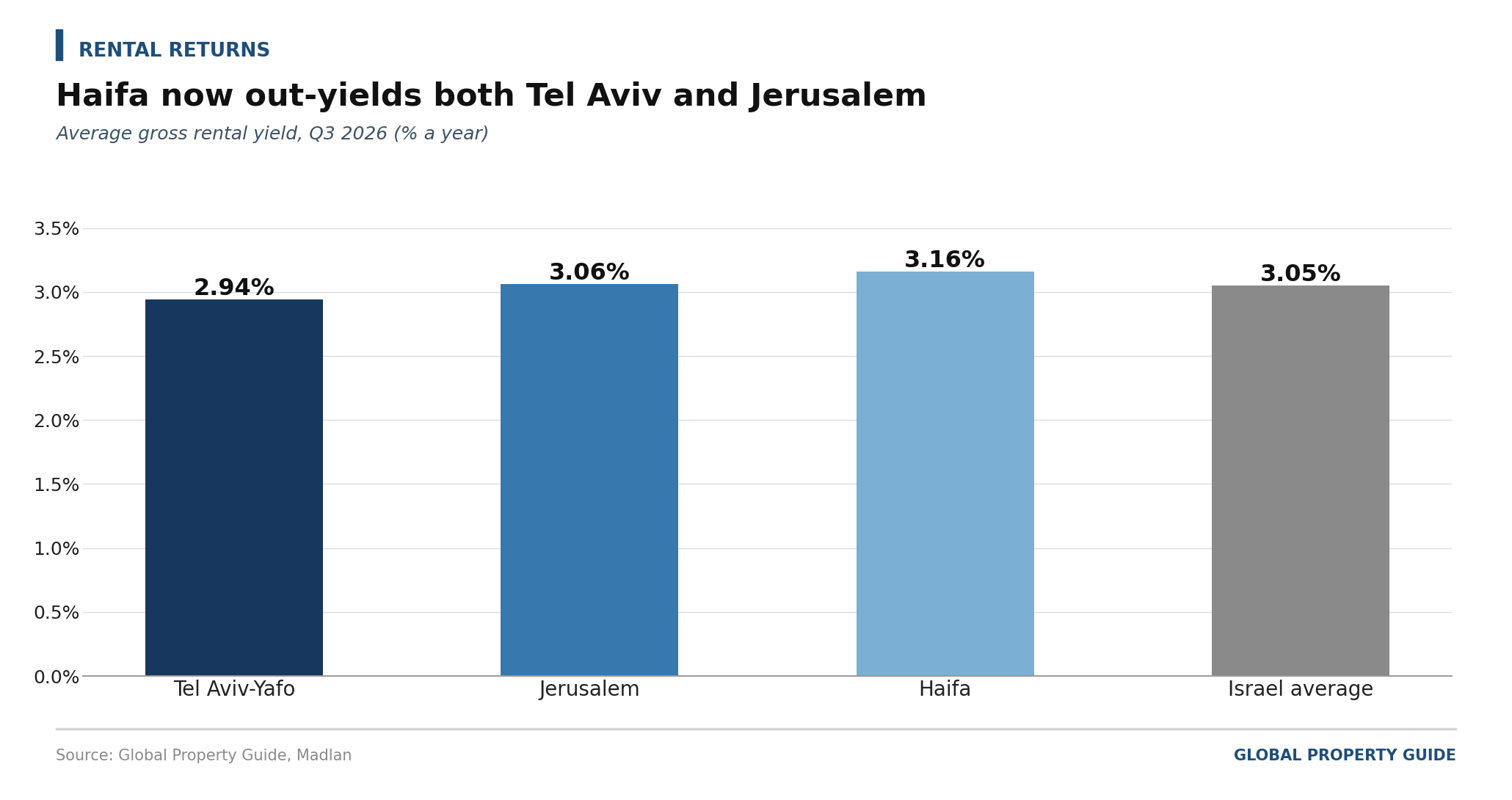
Gross rental yields, meaning the rental return on a property if fully rented out before all expenses, remain low in Israel by international standards. Gross yields for apartments averaged 3.05% in the third quarter of 2026, down from 3.15% in the first quarter of 2026 and 3.16% in the third quarter of 2025, according to research conducted by the Global Property Guide.
The direction of travel is notable. Rents have been rising and prices falling, a combination that should push yields up. That yields have instead edged down by 11 basis points over the past year suggests the asking prices at which apartments are listed have not adjusted as far as transaction prices have.
The ranking of Israel's major cities has also reversed. Haifa now offers the highest average yields of the three cities surveyed at 3.16%, ahead of Jerusalem at 3.06% and Tel Aviv-Yafo at 2.94%. In the previous edition of this report, Jerusalem led and Haifa sat between the two. Tel Aviv has now fallen below 3%.
By apartment type:
- In Tel Aviv-Yafo, yields range from 2.46% for a two-bedroom apartment in the centre to 3.59% for a studio across all locations. A one-bedroom apartment in the centre costs about US$1,051,300 to buy and lets for around US$2,700 a month, a gross yield of 3.08%.
- In Jerusalem, yields run from 2.85% for four-bedroom apartments to 3.29% for three-bedroom units. A three-bedroom apartment costs about US$1,024,800 and lets for approximately US$2,810 a month.
- In Haifa, yields range from 2.84% for studios to 3.5% for three-bedroom apartments. A three-bedroom unit costs about US$545,500 and lets for around US$1,590 a month.
Net yields, after taxes, repair costs, ground rents, agents' fees, and other outgoings, are typically 1.5 to 2 percentage points below these gross figures.
Homeownership stood at about 68% in 2024, the most recent year for which CBS has published the figure. That is up sharply from the record low of 62.7% recorded in 2021, but still below the 68.8% seen in 2008 and the 73% recorded in 1995.
Mortgage Market and Interest Rates
Lending stayed strong through the downturn
Israeli households borrowed approximately ILS 106 billion (US$35.57 billion) in new mortgages from banks during 2025, a higher figure than in most previous years, according to the Bank of Israel's Statistical Bulletin. That is an average of about ILS 8.83 billion a month, sustained through a year in which transactions fell by nearly 12%.
Israel's mortgage loan interest rates:
December 2025 produced a record single month of ILS 11.17 billion, some 26.5% above the year's monthly average. Borrowing has since settled: monthly volumes ran at roughly ILS 9.5 billion in seasonally adjusted terms in both April and May 2026, still about 7.5% above the 2025 average.
Total household debt, covering both housing and non-housing borrowing, grew by about ILS 57 billion, or 6.7%, during 2025 to reach approximately ILS 903 billion. Housing debt continues to make up the majority of the total at around 72%, implying a mortgage stock of roughly ILS 650 billion (US$218 billion).
Debt in the real estate and construction industries reached ILS 534 billion as of September 2025, accounting for 36% of all non-financial business sector debt in Israel. That concentration is the channel through which an unsold inventory of 86,090 apartments becomes a question about the banking system rather than only about developers.
Rate cuts are not reaching borrowers
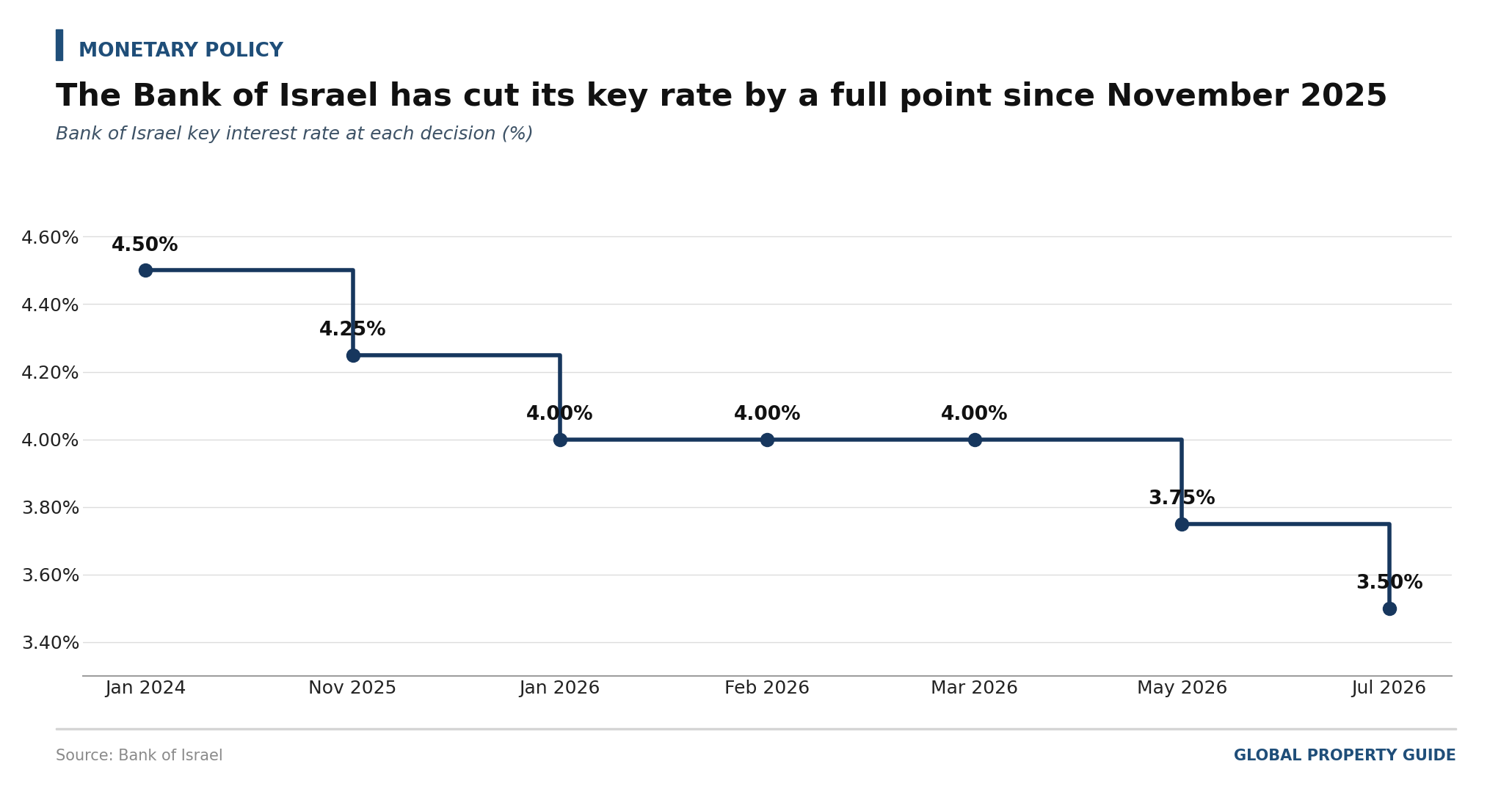
The BOI has eased steadily since late 2025. After holding at 4.5% from January 2024, the Monetary Committee cut to 4.25% on November 24, 2025, to 4% on January 5, 2026, held at that level in February and March, then cut to 3.75% on May 25, 2026, and to 3.5% on July 6, 2026. The prime rate, fixed at the policy rate plus a spread of 1.5 percentage points, accordingly stands at 5%.
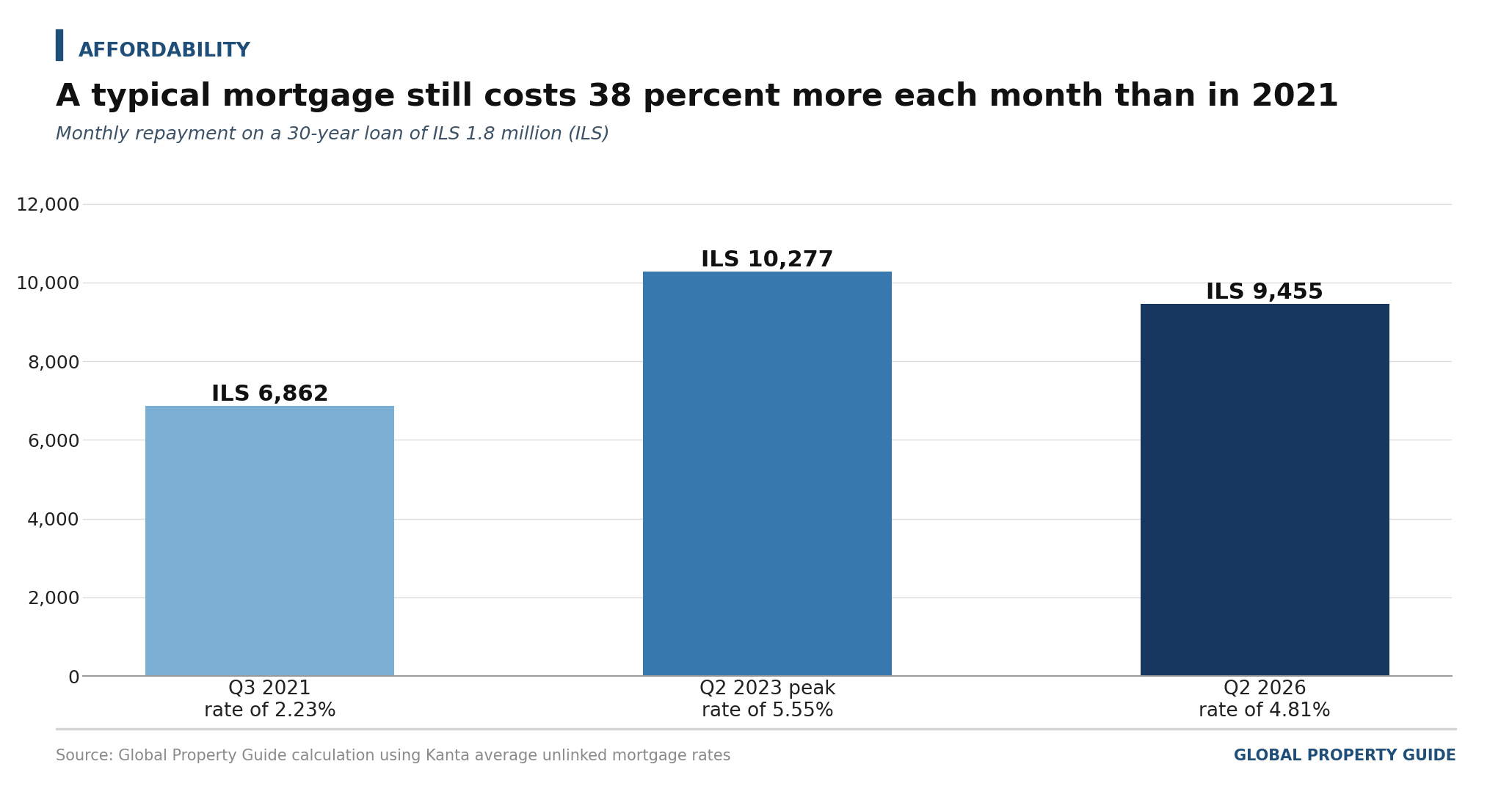
Very little of this has reached borrowers. The average unlinked mortgage interest rate stood at 4.81% in the second quarter of 2026, down from 4.89% in the fourth quarter of 2025. That is a fall of just 8 basis points against roughly 52 basis points of policy easing over the same window, a pass-through of about 15%. Measured over a full year, from the second quarter of 2025 to the second quarter of 2026, mortgage rates fell 23 basis points against 75 basis points of policy easing.
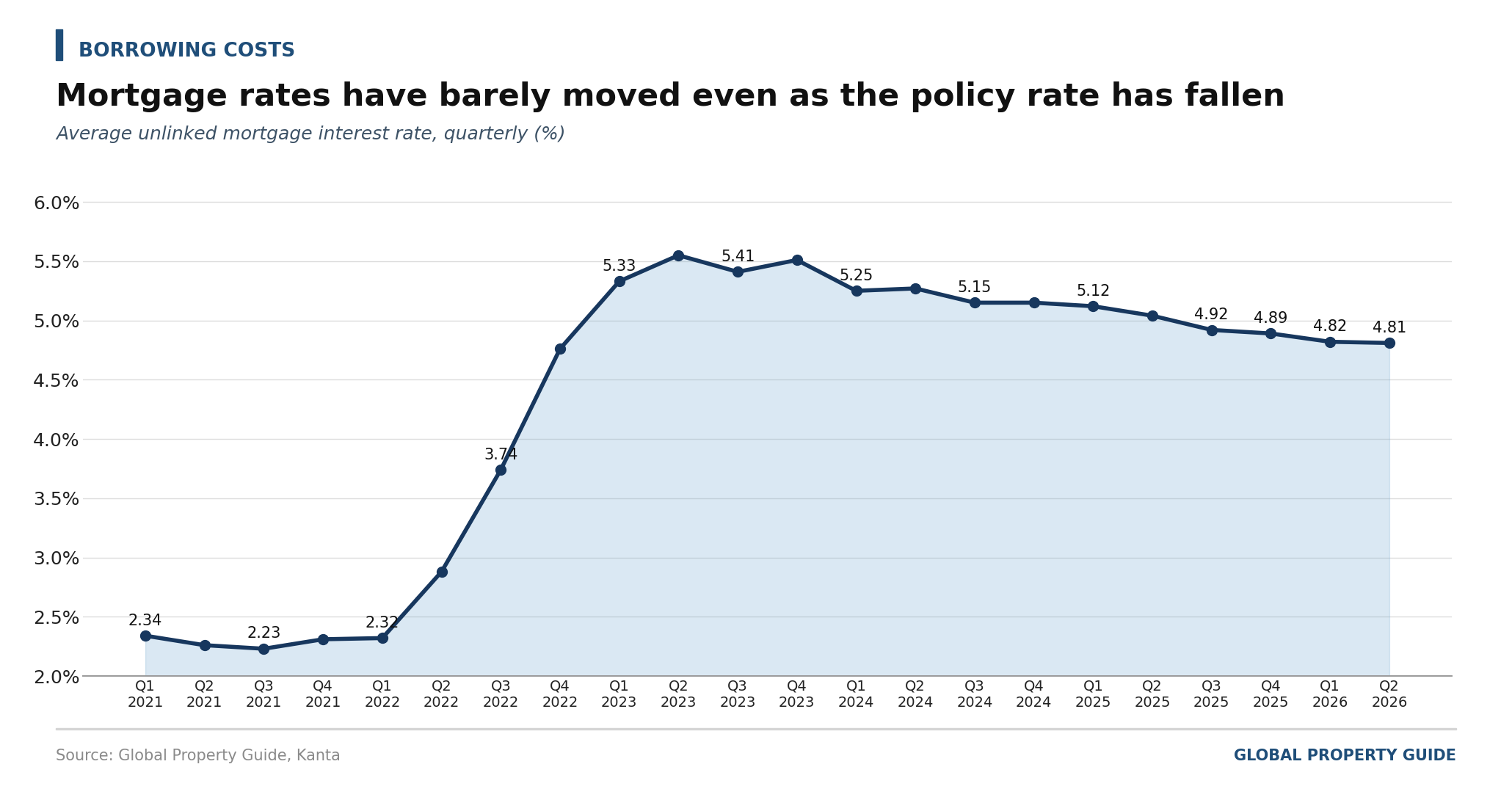
Israeli banks have been reported to have widened their margins on new mortgages, which would account for the gap. The consequence for households is that borrowing costs remain close to the levels of the tightening cycle. At 4.81%, the average unlinked rate is 74 basis points below its second-quarter 2023 peak of 5.55% but a full 2.58 percentage points above the 2.23% trough of the third quarter of 2021.
In cash terms, a 30-year mortgage of ILS 1.8 million costs about ILS 9,455 a month at current rates. The same loan cost approximately ILS 6,862 at the 2021 trough and ILS 10,277 at the 2023 peak. Borrowers are therefore paying about 37.8% more each month than they would have in 2021, and only 8% less than at the worst point of the cycle.
The supervisory framework has tightened at the margin
On December 16, 2025, the Supervisor of Banks introduced three measures in the housing credit market, prompted by an observed increase in additional housing credit being taken on, particularly close to the date of a first mortgage:
- The payment-to-income calculation for an additional housing loan secured against the same property must now examine the monthly payment on the total credit secured by that property, not the new loan alone.
- The maximum property value that may be used in calculating the loan-to-value limit on a reduced-price housing loan, set under Proper Conduct of Banking Business Directive no. 329, will be updated in line with the consumer price index.
- A relief granted temporarily in December 2023 has been made permanent, allowing an all-purpose housing loan with a loan-to-value ratio above 70%, provided the portion above 50% does not exceed ILS 200,000.
The underlying macroprudential limits are unchanged from those imposed in October 2012. First-time buyers may borrow up to 75% of a property's value, buyers replacing an existing home up to 70%, and investors and, by default, non-residents up to 50%. Total monthly repayments may not exceed 40% of net income. Restrictions introduced in March 2025 on aggressive developer financing structures, the so-called 10-90 and 20-80 schemes, remain in force through December 31, 2026.
Purchase tax continues to weigh on investors
The higher purchase tax schedule applying to investors, owners of an additional home, and most non-resident buyers charges 8% on value up to ILS 6,055,070 and 10% above that, applied from the first shekel with no zero-rated band. The temporary order establishing these rates runs through December 31, 2026.
The brackets themselves have been frozen without consumer price indexation from January 16, 2025 to January 15, 2028, so inflation gradually pushes more transactions into higher bands. New immigrants continue to benefit from a reduced track. For Israeli residents replacing a home, the window in which the previous property must be sold was extended from 18 months to 24 months for purchases made from June 1, 2025.
Historic Perspective
Three decades of near-uninterrupted appreciation
Israel experienced dramatic house price rises over the past two decades, despite domestic political uncertainty, security threats, and the global financial crisis. Cumulative nominal house price growth between 2008 and 2025 came to approximately 225.6%, or about 135.8% after adjusting for inflation.
The main reason for the long surge was a supply shortage caused by low construction volumes. Other factors included the central bank's expansionary monetary policy for much of the period and a shortage of alternative investment options.
Since the summer of 2011, when thousands of Israelis set up protest camps over worsening housing affordability, home prices have been high on the government's agenda:
- The government, which controls most of Israel's land, raised dwelling starts to about 59,800 annually between 2015 and 2024, the highest since 1996.
- The Finance Ministry increased purchase taxes and introduced an additional levy on owners of three or more apartments. Investment transactions fell from 40% of the total in early 2015 to about 15%.
- Since 2015, the government has sold land at discounted prices to contractors required to sell the resulting apartments below market prices.
- Israelis who do not own a home may enter a lottery for discounted apartments. Since the scheme began in late 2015, around 75,000 households have won, but only about a third have exercised the right to purchase.
- In July 2017, the government approved a plan to strengthen the long-term rental market, including tax breaks to encourage construction of rental units.
- In October 2021, the government moved against unauthorised vacation rental apartments and restored the purchase tax on additional apartments to 8%.
- From April 2022 to May 2023, the central bank raised its key rate ten times from a record low of 0.1% to 4.75%, then cut to 4.5% in January 2024 and held there until November 2025.
The current downturn is the deepest in real terms since 2018
The table below sets out annual changes in house prices, which compares the latest quarter of each year with the same quarter a year earlier. Readers comparing against earlier editions of this report should note that this basis differs from the annual-average basis used previously and produces different figures for the same years.
| HOUSE PRICES IN ISRAEL, ANNUAL CHANGE (%) | ||
| Year | Nominal | Inflation-adjusted |
| 2008 | 10.58 | 6.33 |
| 2009 | 19.87 | 15.43 |
| 2010 | 14.08 | 11.06 |
| 2011 | 3.98 | 1.78 |
| 2012 | 8.70 | 7.06 |
| 2013 | 7.33 | 5.26 |
| 2014 | 4.26 | 4.50 |
| 2015 | 7.91 | 8.91 |
| 2016 | 5.70 | 5.95 |
| 2017 | 1.42 | 1.07 |
| 2018 | -0.76 | -1.55 |
| 2019 | 4.18 | 3.59 |
| 2020 | 3.96 | 4.67 |
| 2021 | 13.14 | 10.01 |
| 2022 | 14.68 | 8.89 |
| 2023 | -1.00 | -3.84 |
| 2024 | 7.67 | 4.36 |
| 2025 | -0.99 | -3.57 |
| Basis: Latest quarter of each year against the same quarter a year earlier. | ||
| Data Sources: Israel Central Bureau of Statistics, Global Property Guide. | ||
Only three years since 2008 have seen house prices fall in real terms: 2018, 2023, and 2025. Two of those have occurred in the last three years. Taken together, the three years from 2023 to 2025 delivered a cumulative real decline of 3.2%, wiping out a small part of the extraordinary gains of the preceding boom.
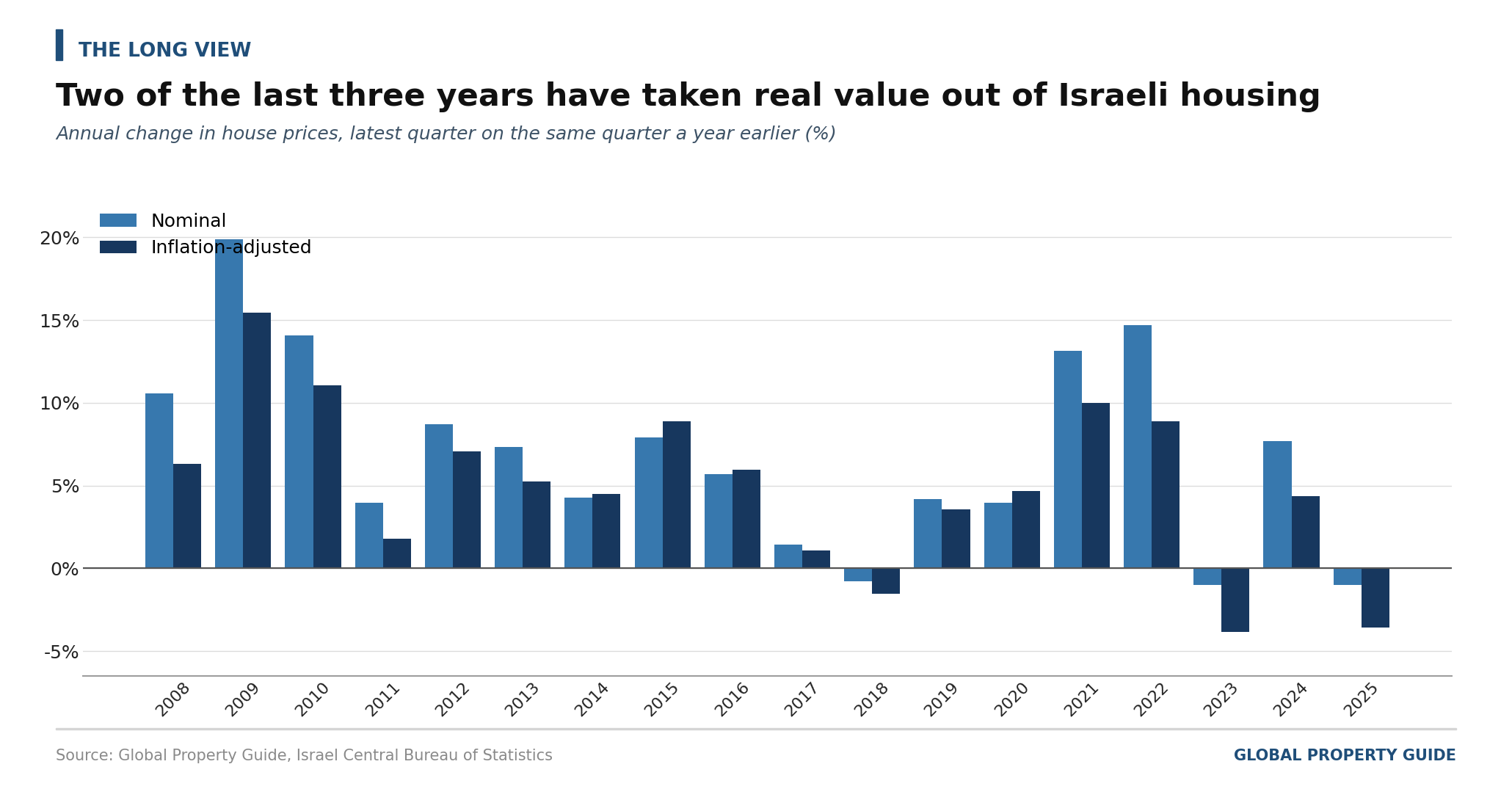
That boom was concentrated in a very short window. Prices rose 13.14% in nominal terms in 2021 and 14.68% in 2022, a cumulative nominal gain of 29.7% and a real gain of 19.8% across just two years. It is against this base that the current correction should be read: prices remain far above their pre-pandemic level even after three difficult years.
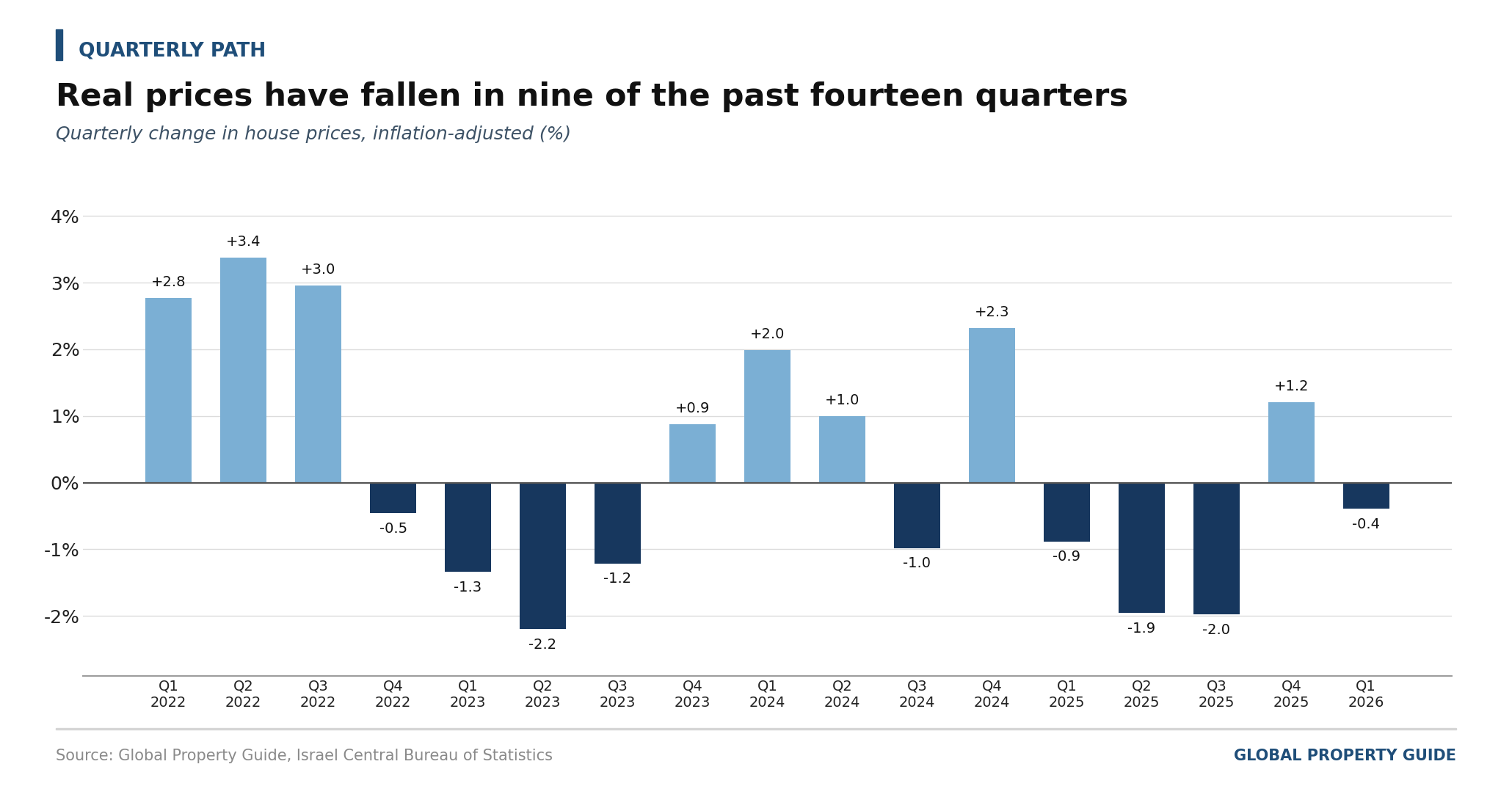
On a quarterly basis, real prices have fallen in nine of the past fourteen quarters. The pattern since the beginning of 2023 has been one of persistent quarterly declines interrupted by occasional rebounds, most recently a 1.21% real gain in the fourth quarter of 2025 followed by a renewed fall of 0.39% in the first quarter of 2026.
How Israel's housing market has behaved through past shocks
The table below records cumulative changes in average dwelling prices through a series of defined historical episodes, from the Second Intifada through to the economic slowdown of 2024 and the first half of 2025.
The pattern is instructive. Israeli house prices proved remarkably resilient to security shocks. Nationwide prices rose 24.2% between the first quarter of 2008 and the fourth quarter of 2009, at the height of the global financial crisis, and Tel Aviv gained 41.27% over the same period. The market was largely unaffected by the Syrian civil war.
What has actually moved Israeli house prices downward, historically, is policy and supply. Prices fell 11.6% during the 2006 conflict with Hezbollah but recovered quickly. The sharpest sustained falls came in 2018 and 2019, after the government intensified its market-cooling measures, when prices dropped 20.2% in Jerusalem and 17.4% in Tel Aviv even as the national figure rose 7% on the strength of other districts.
That history is the clearest guide to the present. The current downturn is not principally a war effect. It is a supply effect, produced by a decade of policy aimed squarely at raising construction volumes finally arriving in the market at the same moment as high financing costs.
Economic and Social Factors
Headline growth is strong, domestic growth is not
Israel's economy rebounded sharply in the second quarter of 2026, with gross domestic product expanding at an annualised rate of 15.4%, equivalent to 3.6% growth on a quarterly basis, according to national accounts data published by the CBS on August 16. Business sector output grew even faster, at an annualised 16.6%.
The figure needs careful handling. It follows a first quarter disrupted by the confrontation with Iran, and a significant portion of the second quarter's activity was work postponed during the fighting. The CBS itself recommends comparing the first half of 2026 with the second half of 2025 to strip out the distortion. On that basis, GDP grew by 3.2%, and business sector output by 4.7%.
Even that figure conceals a weaker domestic picture. A substantial share of the growth reflects production carried out abroad by Israeli-owned companies, which is recorded in the national accounts as Israeli output even though the goods never cross Israel's borders. Excluding it, growth in the first half of 2026 was only about 1%, meaning roughly 69% of measured growth came from production located outside the country.
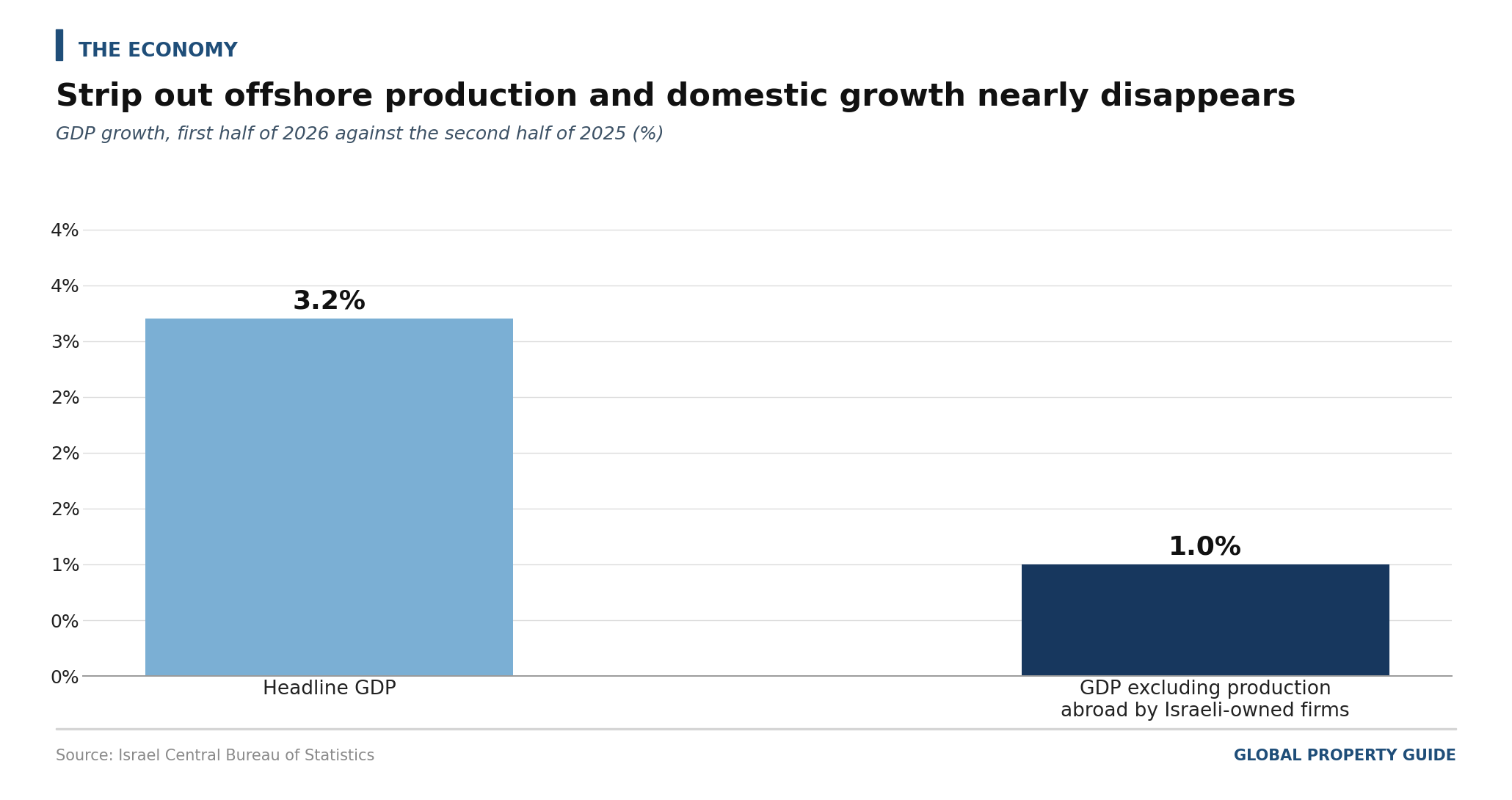
The scale of this component has grown remarkably. Israeli production abroad rose from ILS 5.3 billion in the first quarter of 2023 to about ILS 25.4 billion (US$8.5 billion) in the second quarter of 2026, nearly five times its earlier level, taking its share of the economy from about 1.3% to 5.7%. Industry estimates attribute most of the increase to a single American chip company operating through an Israeli subsidiary.
For the housing market, the implication is direct. Production located abroad generates far less domestic employment, wage income, and consumption than production in Israel, and it therefore supports housing demand far less than the headline GDP figure would suggest.
The composition of second-quarter growth reinforces the caution. The largest contribution came from public consumption, up 19.5% on an annualised basis, partly because the state budget was approved only at the end of the first quarter. Private consumption rose 14.7% annualised and exports 25.2%, while fixed investment increased a more modest 6.3%. On the half-year comparison, private consumption actually fell by 0.4%, though fixed investment was up 10.6%.
Both the BOI and the Ministry of Finance forecast 4% growth for 2026 as a whole. The first-half pace of 3.2% falls 0.8 percentage points short of that.
Inflation has fallen well inside the target range
Consumer prices rose 0.3% in July 2026 against June, bringing annual inflation to 1.5%, comfortably within the BOI's target range of 1% to 3% and below its 2% midpoint. That is a fall of 1.6 percentage points from the 3.1% recorded a year earlier, and it is the principal reason the central bank has been able to cut rates.
Transport prices rose 1.4% in the month and culture and entertainment 1.1%, reflecting seasonal summer demand, while clothing and footwear fell 4.6% and fresh fruit and vegetables 3.5%.
The BOI's Research Department expects inflation of 1.8% in both 2026 and 2027, and the Governor has indicated that this outlook leaves room for further policy easing.
The labour market remains tight
Employment conditions have held up through the war and its aftermath. The broad unemployment rate among the prime working ages of 25 to 64 fell to 3% in May 2026, and the seasonally adjusted headline rate stood at 2.7% in February 2026. The job vacancy rate was 4.2% in May, still below its level before the confrontation with Iran and before October 2023.
Among those aged 25 to 64, the employment rate stood at 78.8% and the participation rate at 80.9% in May. The rate of absentees due to reserve mobilisation had fallen to 0.5%.
Wages are rising rapidly. Earnings increased 6.8% in March to May 2026 against the same period a year earlier, which represents real growth of about 5.2% against inflation of 1.5%. Part of the increase reflects rises in the minimum wage and in public sector pay. The BOI expects the broad unemployment rate to average 4.6% across 2026, distorted by the sharp spike during the fighting, and to stabilise at 3% in the second half of the year.
Public finances are improving from a difficult base
The cumulative government budget deficit over the twelve months to May 2026 was 3.8% of GDP, held down partly by low government expenditure during the first quarter, when an interim budget was in force. Spending is expected to rise over the remainder of the year.
The BOI's Research Department projects a deficit of 4.9% of GDP in 2026 and 4.2% in 2027, on the assumption that the defence budget is not increased beyond the reserves allocated in the state budget. The debt to GDP ratio is expected to be about 69% at the end of both 2026 and 2027, an improvement of two percentage points on the 71% projected for 2026 in last year's forecast.
The central bank has been explicit that considerable uncertainty attaches to these projections, particularly regarding the final size of the defence budget, and that a further increase could push the deficit above target and raise inflation. A national election campaign is under way, which adds a further layer of uncertainty to the fiscal outlook.
Sources:
- Price Changes in the Dwellings Market (Central Bureau of Statistics): https://www.cbs.gov.il/
- Consumer Prices Index, July 2026 (Central Bureau of Statistics): https://www.cbs.gov.il/
- Construction Begun and Completed in October 2024 to September 2025 (Central Bureau of Statistics): https://www.cbs.gov.il/
- Index of Prices of Dwellings (Central Bureau of Statistics): https://www.cbs.gov.il/
- The Monetary Committee decides on July 6, 2026 to lower the interest rate to 3.5 percent (Bank of Israel): https://www.boi.org.il/
- The Banking Supervision Department takes several steps in the housing credit market (Bank of Israel): https://www.boi.org.il/
- The Bank of Israel Publishes the Statistical Bulletin for 2025 (Bank of Israel): https://www.boi.org.il/
- Monetary Policy (Bank of Israel): https://www.boi.org.il/
- Gross rental yields in Israel: Tel Aviv and 2 other cities (Global Property Guide): https://www.globalpropertyguide.com/
- Israel House Price Index (Global Property Guide): https://www.globalpropertyguide.com/
- Israel: Average Unlinked mortgage interest rate (Global Property Guide): https://www.globalpropertyguide.com/
- Summer demand pushes prices up 0.3%, including rent, transportation costs (The Jerusalem Post): https://www.jpost.com/
- Housing snapshot August 2026: Home prices fall 1%, largest drop in eight years (The Times of Israel): https://www.timesofisrael.com/
- Housing snapshot July 2026: In shadow of Iran war, home prices fall 0.3% in March-April (The Times of Israel): https://www.timesofisrael.com/
- Housing snapshot May 2026: Despite Iran war, home prices rise 0.3% in February-March (The Times of Israel): https://www.timesofisrael.com/
- Israel's GDP is booming. Its domestic economy is telling a different story (CTech): https://www.calcalistech.com/
- Israel's economy grew at 15.4% in Q2 (Globes): https://en.globes.co.il/
- Bank of Israel cuts interest rate again (Globes): https://en.globes.co.il/
- Israel Real Estate 2025: CBS Data Analysis (The Tel Avivi): https://thetelavivi.com/
- Israel Home Prices Rise Again in 2026 (Buyitinisrael): https://www.buyitinisrael.com/
- Israel Housing Starts Hit Record as Demand Falls (Buyitinisrael): https://www.buyitinisrael.com/
- Israel approves 80% more homes than planned in 2025 (Ynet News): https://www.ynetnews.com/
- Israel Home Ownership Rate (Trading Economics): https://tradingeconomics.com/
- Israel Interest Rate (Trading Economics): https://tradingeconomics.com/