Israel Residential Real Estate Market Analysis 2025
Israel’s housing market is now losing steam, as demand softens and the combined pressures of economic slowdown and ongoing domestic conflicts push house prices into decline.
This extended overview from Global Property Guide covers key aspects of the Israeli housing market and takes a closer look at its most recent developments and long-term trends.
Table of Contents
- Housing Market Snapshot
- Demand Highlights
- Supply Highlights
- Rental Market
- Mortgage Market
- Historic Perspective
- Socio-Economic Context
Housing Market Snapshot
Following a huge 44% growth last year, the total number of dwellings sold in Israel fell by 12.6% to 44,554 units in the first half of 2025 as compared to the same period last year, according to figures released by the Central Bureau of Statistics (CBS). Over the same period, new dwelling sales plummeted by 27.4% y-o-y to 16,604 units, while existing dwelling sales were more or less steady at 27,950 units.
As a result, the average price of owner-occupied dwellings in Israel fell by 2.48% to ILS 2,272,300 (US$672,358) in Q2 2025 from a year earlier, in stark contrast to the year-on-year increase of 4.42% in the previous quarter and a strong growth of 17.66% a year earlier. Prior to the decline, prices had been climbing steadily for nineteen straight quarters.
When adjusted for inflation, dwelling prices were down by 5.63% y-o-y in Q2 2025, its worst showing since Q1 2007.
Quarter-on-quarter, nationwide dwelling prices declined by 3.34% in Q2 2025 (-4.6% inflation-adjusted).
Israel's house price annual change:
"The mix of war-related uncertainty and tighter credit rules is weighing more heavily than normal cyclical trends. Without easing of conditions or a stabilization in security, no rebound is expected soon. The Ministry of Finance warns sales could stay depressed through end-2025," said an article published by International Investment.
However, house price movements vary considerably across the country's local markets.
Among Israel's major cities, Tel Aviv saw the highest house price growth during the year to Q2 2025, with prices increasing by 5.08%. Other Israeli cities with modest to minimal house price increases during the period included Beer Sheva (3.62%), Rehovot (2.46%), Haifa (2.11%), Jerusalem (1.84%), Netanya (1.2%), and Petah Tikva (0.24%).
In contrast, Herzliya registered the biggest year-on-year decline in house prices in Q2 2025, at 8.3%, followed by Ashdod (-7.97%) and Rishon Lezion (-7.33%).
Other weak local housing markets in Israel included Kfar Saba, with house prices falling by 3.55% in Q2 2025 from a year earlier, Ashkelon (-1.66%), and Holon (-1.6%). Minimal house price decline was recorded in Bnei Brak (-0.81%), Hadera (-0.46%), Beit Shemesh (-0.42%), Ramat Gan (-0.26%), and Bat Yam (-0.04%).
The country's most expensive residential area is Tel Aviv, where the average price of owner-occupied dwellings was ILS 4,369,100 (US$1,292,786) in Q2 2025. It was followed by Herzliya with house prices at an average of ILS3,691,600 (US$1,092,318), Ramat Gan at ILS3,134,600 (US$927,506), Kfar Saba at ILS3,068,700 (US$908,007), and Jerusalem at ILS3,015,600 (US$892,295).
Beer Sheva had the cheapest housing in Israel, with an average price of ILS1,270,200 (US$375,843).
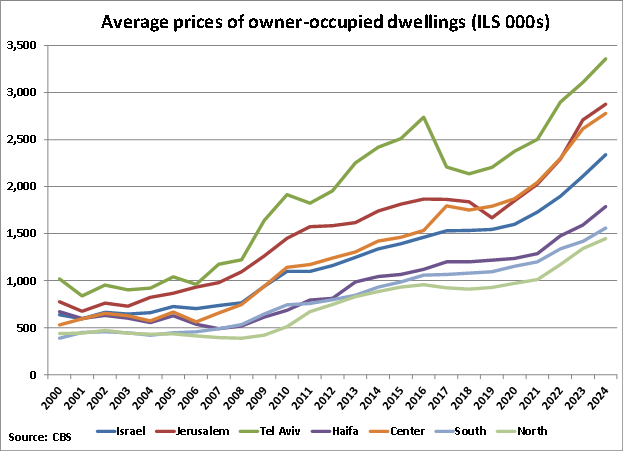
Prior to the ongoing downturn, Israel had experienced dramatic house price rises in the past decade (2011 excepted), despite domestic political uncertainty, security threats, and the global financial meltdown. Israel's house prices have risen by 118% (82% in real terms) from 2006 to 2017.
The main reason for the surge in house prices until 2017 was a supply shortage, due to low construction volumes. Other factors fueling the house price boom included the central bank's expansionary monetary policies and the lack of alternative investment options.
"Real estate accounts for 19% of gross domestic product directly and another 13% indirectly," says Elli Kraizberg, a professor at Bar-Ilan University. "Real estate accounts for not less than 40% of the public's total wealth."
However, since the summer of 2011, when thousands of Israelis set up protest camps over worsening housing affordability, home prices have been top of the government's agenda.
- The government, which controls most of Israel's land, boosted dwelling starts to about 59,800 annually from 2015 to 2024 - the highest since 1996 - to address the supply shortage.
- The Finance Ministry increased purchase taxes and introduced an additional levy on owners of three or more apartments. As a result, investment transactions dropped sharply from 40% of total transactions in early 2015 to 15% recently.
- Since 2015, the government has intensified its sale of land at discounted prices to contractors, who must then sell apartments at below-market prices.
- Israelis who do not own a home may vie for apartments through a lottery system. Since its inception in late 2015, about 75,000 households have won the lottery, but only around one-third have actually exercised their right to purchase an apartment at a reduced price.
- In July 2017, the government approved a plan to strengthen the country's long-term rental market, including the introduction of tax breaks to encourage the construction of rental units.
- In October 2021, the government unveiled its plan to crack down on unauthorized vacation rental apartments and bring back the purchase tax on apartments to 8%, as part of its comprehensive plan to cool the housing market.
- From April 2022 to May 2023, the country's central bank raised its key interest rates ten times from a record-low of 0.1% to 4.75% to rein in inflationary pressures. This effectively increased the borrowing costs for homebuyers. Yet the central bank reversed its monetary policy in January 2024 by cutting the key rate by 25 basis points to 4.50% and keeping it unchanged since.
As a result, house prices fell by 0.9% (-1.9% inflation-adjusted) in 2018 and increased by just a minimal 1.6% (1.2% inflation-adjusted) in 2019. However, the housing market strengthened again in 2020-21 despite the Covid-19 pandemic, with prices rising by a cumulative 14.4% (12.4% inflation-adjusted). Between 2022 and 2024, house prices rose further by more than 33% (18.4% inflation-adjusted).
| HOUSE PRICES IN ISRAEL, ANNUAL CHANGE (%) | ||
| Year | Nominal | Inflation-adjusted |
| 2008 | 4.10 | -0.48 |
| 2009 | 22.35 | 18.14 |
| 2010 | 17.04 | 14.22 |
| 2011 | 0.04 | -2.40 |
| 2012 | 5.82 | 4.12 |
| 2013 | 7.38 | 5.40 |
| 2014 | 7.21 | 7.42 |
| 2015 | 5.99 | 6.88 |
| 2016 | 4.97 | 5.26 |
| 2017 | 3.04 | 2.73 |
| 2018 | -0.88 | -1.94 |
| 2019 | 1.62 | 1.18 |
| 2020 | 5.50 | 6.24 |
| 2021 | 8.44 | 5.79 |
| 2022 | 10.43 | 4.96 |
| 2023 | 11.07 | 7.48 |
| 2024 | 8.49 | 4.92 |
| Sources: Israel Central Bureau of Statistics, Global Property Guide | ||
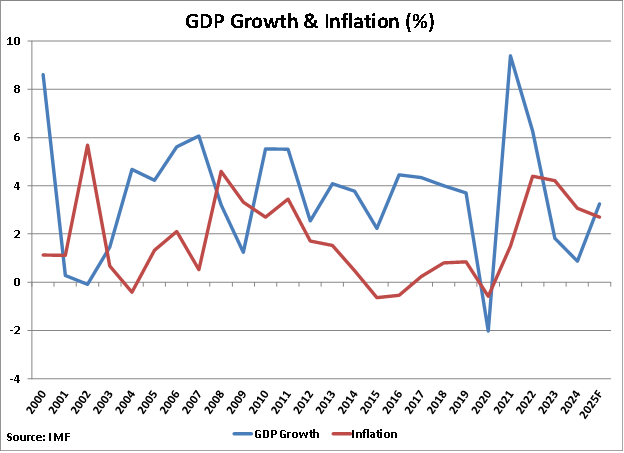
The country continues to face economic headwinds. During 2024, the Israeli economy grew by a meager 0.9%, a sharp slowdown from annual expansions of 1.8% in 2023, 6.3% in 2022, and 9.4% in 2021, amidst heightened global economic uncertainty and domestic conflicts.
In Q2 2025, the country's real GDP contracted by 3.5% from the same period last year, in contrast to the year-on-year growth of 3.4% recorded in Q1 2025, 1.9% in Q4 2024, 5.7% in Q3 2024, 0.1% in Q2 2024, and 16.1% in Q1 2024. The contraction was influenced in large part by the 12-day hostilities between Israel and Iran in mid-June, which weighed heavily on economic activity. All major components of GDP declined during the latest quarter.
Because of this, the Bank of Israel (BOI) revised in July its 2025 GDP growth forecast downward to 3.3%, from 3.5% in its April projection. It is in line with the IMF's forecast of a 3.25% growth for Israel this year.
Demand Highlights:
After surging last year, residential property sales weakening again
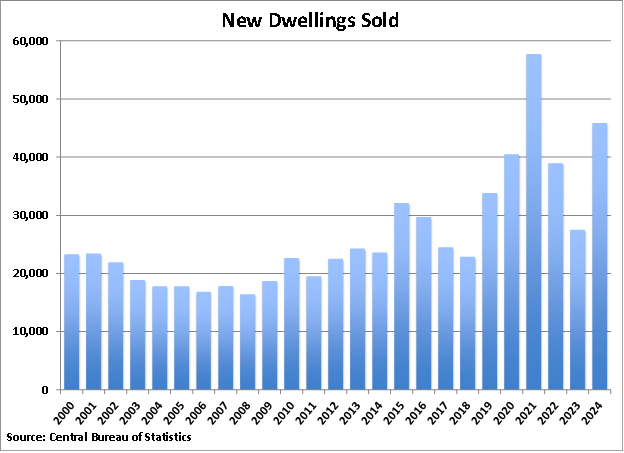
During 2024, the total number of dwelling transactions in Israel increased by a whopping 44% to 103,097 units from a year earlier, based on CBS figures. This is in contrast to the contraction of over 34% recorded in the preceding year.
By market:
- Existing dwellings sold were up by a huge 29.7% y-o-y to 57,195 units last year, in contrast to the annual fall of 36.1% registered in 2023.
- New dwellings sold soared by 66.8% y-o-y to 45,902 units in 2024, in stark contrast to the decline of 29.3% seen in 2023.
However, demand seems to be weakening again this year, amidst the ongoing domestic conflicts. In the first half of 2025, the total number of dwellings sold in Israel fell by 12.6% to 44,554 units compared to the same period last year. Over the same period, new dwelling sales plummeted by 27.4% y-o-y to 16,604 units, while existing dwelling sales were more or less steady at 27,950 units.
By region:
- In Tel Aviv, new housing transactions were down by a huge 33.6% y-o-y to 2,909 units in the first half of 2025. Likewise, existing housing sales fell slightly by 0.6% to 4,161 units over the same period.
- In the Centre, new housing transactions dropped by 24.9% y-o-y to 4,733 units in H1 2025, and existing housing sales were down by 4.1% to 6,457 units.
- In Haifa, new home sales plunged by 43.4% y-o-y to 1,557 units in the first half of 2025, while existing home sales dropped 6.7% to 4,744 units over the same period.
- In the Northern District, new home sales were down by 29.4% y-o-y to 1,762 units in H1 2025. On the other hand, existing home sales increased by 5.8% y-o-y to 3,354 units.
- In Jerusalem, new home sales fell sharply by 26.6% y-o-y to 1,380 units, while existing home transactions increased by 3.3% to 2,616 units.
- In the Southern District, new home transactions declined by 16.5% y-o-y to 4,030 units in H1 2025. In contrast, existing home sales rose by a modest 3.1% to 5,670 units.
- In Judea and Samaria, new home sales declined by 6.8% y-o-y to 220 units in H1 2025, while existing home sales increased by 5.6% to 949 units.
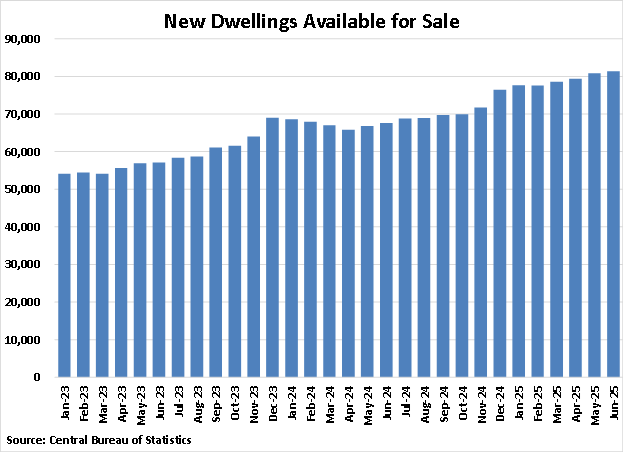
As of June 2025, there were a total of 81,364 new dwellings available for sale in the market, up by 20.3% from a year earlier. At the current sales rate, this implies that the stock of new dwellings is equivalent to about 35 months' supply, far higher than the 17.6 months' supply in the prior year.
Supply Highlights:
Residential construction activity showed mixed signals
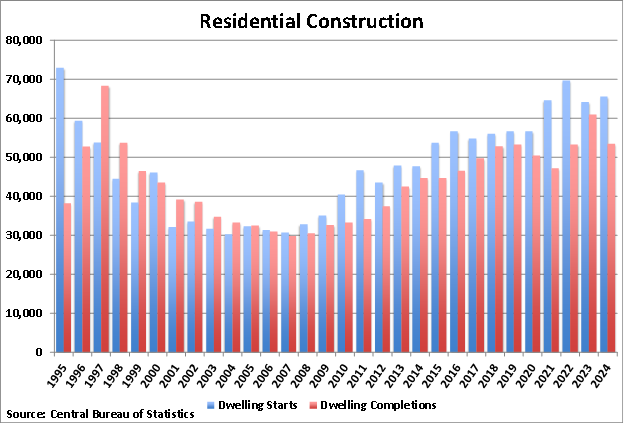
During 2024, the total number of dwelling starts in Israel rose by 2.3% y-o-y to 65,527 units, following an annual decline of 7.9% in 2023 and increases of 7.8% in 2022, 14.1% in 2021, 0.1% in 2020 and 1.1% in 2019, based on figures from the CBS. It was the second highest level recorded since 1995.
Though dwelling starts in the district showed wide variations:
- In Tel Aviv, the number of dwellings started to increase by 10.8% y-o-y to 13,794 units in 2024, following annual declines of 12.8% in 2023 and 6.2% in 2022.
- In the Central district, dwelling starts dropped 2.5% y-o-y to 15,303 units last year, after falling by 6.2% in 2023 and increasing by 16.4% in 2022.
- In Haifa, dwelling starts were up strongly by 40.5% y-o-y to 7,496 units in 2024, following a meager growth of 0.3% in 2023 and a contraction of 26.5% two years prior.
- In the Northern District, dwelling starts fell by 5.3% y-o-y to 9,431 units in 2024, following annual growth of 10.5% in 2023 and 24.1% in 2022.
- In Jerusalem, the number of dwellings started to drop by a huge 20% y-o-y to 6,621 units in 2024, following a modest decline of 2.4% in 2023 and a strong growth of 41.8% in 2022.
- In the Southern District, dwelling starts surged by 27% y-o-y to 13,043 units last year, after a decline of 21,4% in 2023 and an increase of 13.6% in 2022.
- In the Judea and Samaria area, dwelling starts plunged by 51.1% y-o-y to 1,092 units in 2024 from a year earlier, following contractions of 18% in 2023 and 8.8% in 2022.
On the other hand, dwelling completions nationwide fell by 12.3% to 53,418 units in 2024 as compared to a year ago, following y-o-y growth of 14.4% in 2023 and 13% in 2022 and annual declines of 6.5% in 2021 and 5.4% in 2020.
Jerusalem recorded the strongest growth in dwelling completions in 2024, rising by 49.5% year-on-year. The only other district to post an increase was Judea and Samaria, though at a miniscule 0.8%. In contrast, Tel Aviv registered the sharpest decline, with completions falling by 37.7%. Significant decreases were also seen in Haifa (-23.4%), the Central district (-14.4%), the Southern district (-3.4%), and the Northern district (-1.8%).
Residential construction activity continued to show mixed results in early 2025. Dwellings with construction permits were up by 14.2% y-o-y to 17,004 units in Q1 2025, and dwelling starts increased by 6.5% to 17,318 units over the same period, based on CBS figures. In contrast, dwelling completions dropped 8.8% y-o-y to 12,017 units in Q1 2025.
There were 188,811 dwellings under construction in Q1 2025, up by 8.6% from the same period last year.
Rental Market:
Poor rental yields; expensive rental apartments
Over the past three decades, the country's homeownership rate has not increased, and more households are renting, due to the shortage of affordable housing. During 2024, the homeownership rate was about 68%, sharply up from a record-low of 62.7% in 2021, but still lower than the 68.8% in 2008 and 73% in 1995.
Israel's rent price index:
Gross rental yields, i.e., the rental return on a property if fully rented out, before all expenses, are poor in Israel, almost at Monaco-like levels. Gross rental yields for apartments in the country averaged 3.38% in Q3 2025, from 2.53% in Q2 2024 and 2.92% in Q3 2023, according to recent research conducted by the Global Property Guide.
This tends to support the popular view that property is somewhat overpriced in Israel.
By major city:
- In Tel Aviv, the gross rental yields ranged from 3.01% to 3.62% in Q3 2025, with a city average of 3.14%.
- In Jerusalem, apartments generally offer rental yields between 3.11% and 4.2%, with a city average of 3.54%.
- In Haifa, rental yields ranged from 3.19% to 3.85% in Q3 2025, with a city average of 3.45%.
Tel Aviv is a more expensive city to rent property in, generally, than Jerusalem. In Tel Aviv, renting a one-bedroom apartment would cost around US$2,400 per month in Q3 2025, and a two-bedroom apartment would be offered for about US$3,300 per month. On the other hand, renting in Jerusalem for a similar property is likely to cost you average monthly rents of approximately US$1,700 and 2,100, respectively.
Mortgage Market:
Mortgage market continues to grow
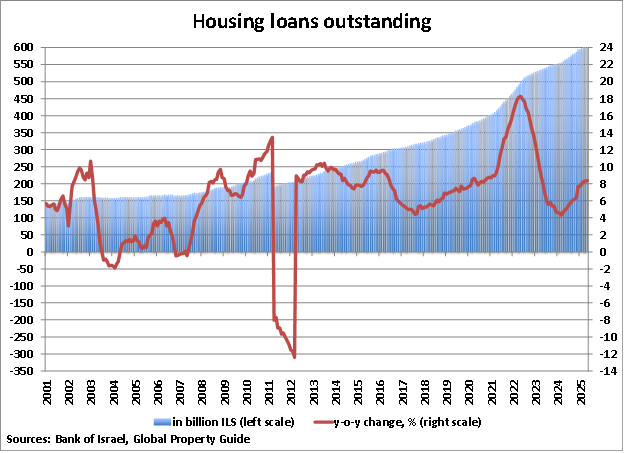
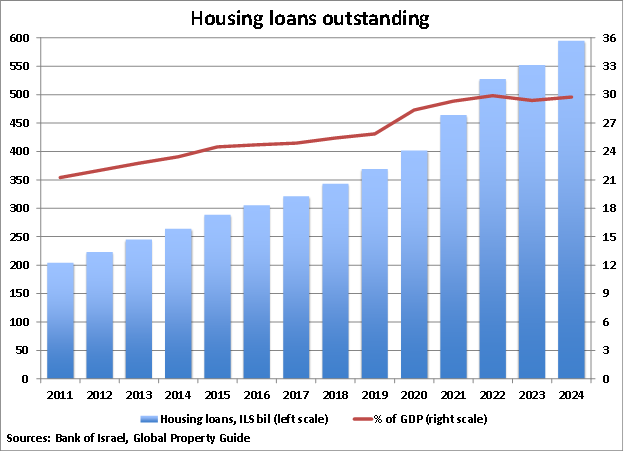
Israel's mortgage market has expanded to approximately 30% of GDP in 2024, broadly stable in the past four years, but up from about 25.8% of GDP in 2019 and 24.5% in 2015. However, this is still considered a modest level of borrowing in a developed country.
Israel's mortgage loan interest rates:
As of May 2025, total housing loans outstanding increased by 8.36% y-o-y to ILS 611.8 billion (US$181.92 billion), following annual growth of 7.7% in 2024, 4.7% in 2023, 13.7% in 2022, 15.5% in 2021, 8.8% in 2020, and 7.5% in 2019. This was slightly below the annual average growth rate of 8.6% recorded between 2012 and 2024.
By loan amount, in May 2025:
- Up to 300k: ILS 29.01 billion (US$8.63 billion), down by 2.5% from a year earlier
- Over 300k up to 600k: ILS 83.09 billion (US$24.71 billion), down slightly by 1.1% from the same period last year
- Over 600k up to 1,200k: ILS 243.49 billion (US$72.4 billion), up by 3.6% from the previous year
- Over 1,200k up to 2,000k: ILS 158.4 billion (US$47.1 billion), up strongly by 14.8% from a year earlier
- Over 2,000k up to 4,000k: ILS 76.25 billion (US$22.67 billion), up by a huge 20.3% from a year earlier
In the first seven months of 2025, the total volume of new housing loans to households rose by 5.2% y-o-y to ILS 50.12 billion (US$14.9 billion), based on figures from the BOI.
Household debt risks rise, but financial stability holds firm
Despite high interest rates and rising household indebtedness, Israel's mortgage market remains fundamentally stable. While risk indicators have increased sharply in recent years, they remain relatively low compared with other advanced economies.
According to the BOI: "the downward trend in the household debt-to-GDP ratio continued, even as household debt grew in the first half of 2024, driven by an increase in mortgage debt while other components remained stable." This indicates that although borrowing has expanded, the overall debt burden relative to the economy has not worsened.
The BOI also emphasized the impact of the conflict on household finances and the disproportionate strain borne by low-income households.
"Since the outbreak of the war, average household debt has increased, both in mortgages and non-housing debt," said the BOI in its Financial Stability Report published last year. "Among households in cities with low socioeconomic ranking, the increase in the average mortgage debt was double that among households from cities with a high socioeconomic ranking."
The BOI report noted that private-sector credit, including household borrowing, has expanded significantly. However, despite this growth, overall financial stability remains intact.
"Since the outbreak of the Swords of Iron War, credit to the private nonfinancial sector (businesses and households) has grown by NIS 51 billion. This growth is primarily attributed to credit extended to the business sector and housing loans. While the credit growth rate was high in the first quarter of 2024, it slowed significantly in the second half of the year. The share of bank loans in arrears remains low from a historical perspective," noted the BOI.
Overall, Israel's household debt-to-GDP ratio is still relatively low by international standards. Moreover, housing credit, though comprising a large share of total household credit, is considered conservative, as it is typically secured by collateral - the home.
Nevertheless, the BOI has cautioned that vigilance is needed given the sharp rise in credit risks in recent months. Mortgages have reached record levels, and the share of high-risk loans has climbed significantly since late 2021.
These concerns are echoed by the International Monetary Fund (IMF), which warned that persistent housing price increases have strained affordability, leaving lower-income borrowers particularly exposed.
"Average household indebtedness in Israel-about 44 percent of GDP-is low compared to the rest of Europe, but lower-income households and those that purchased in overvalued areas or at the maximum of their budget are particularly vulnerable to price shocks, rising interest rates, and tightening financial conditions, with potential spillovers to the real economy," said the IMF.
BOI's key rate kept unchanged, housing loan rates remain high
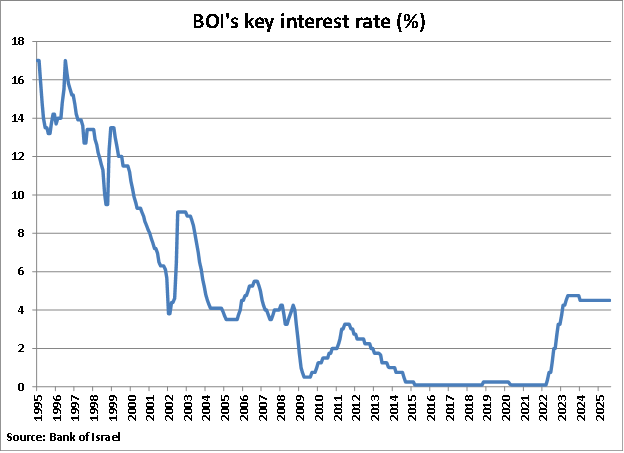
In August 2025, the Bank of Israel (BOI) kept its key interest rate unchanged for the thirteenth straight meeting at 4.50%, as economic activity gradually recovers following a marked decline during the military operation against Iran. Despite this, the central bank noted that there remains a high level of geopolitical uncertainty.
"Economic activity is recovering following a marked decline during the military operation against Iran in June, alongside continued high geopolitical uncertainty," said the BOI. "Annual inflation is slightly above the target range. During the reviewed period, Israel's risk premium stabilized at a level that is lower than it was prior to the Iran operation, but remains higher than it was before the Swords of Iron War."
Prior to this, the BOI raised its key interest rate by ten consecutive times with a cumulative rate hike of 465 basis points from 0.10% in March 2022 to 4.75% in May 2023, in an effort to rein in heightened inflationary pressures. The central bank cut the key rate by 25 basis points in January 2024 to 4.50% where it stayed since.
Despite the BOI's monetary policy shift since last year, the key rate remains at its second-highest level since December 2006.
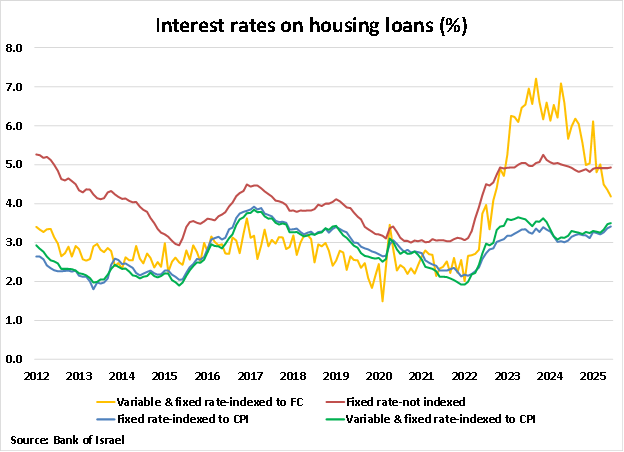
As such, interest rates for housing loans remain exceptionally high. In June 2025, the average interest rate of CPI-indexed housing loans (fixed, variable, and zero coupons) to households rose to 3.50%, up from 3.17% in the previous year but slightly down from 3.59% two years ago, according to figures published by the BOI.
For other housing loan interest rates, in June 2025:
- Fixed-rate, indexed to CPI: 3.41%, higher than the 3.05% in the previous year and 3.34% two years ago
- Fixed-rate, not indexed: 4.93%, slightly lower than the 4.95% a year earlier and 5.04% two years ago
- Variable and fixed rate, indexed to foreign currency: 4.18%, down from 5.66% in June 2024 and 6.54% in June 2023
Historic Perspective:
A brief history of Israel's housing cycle
During the global economic crisis, Israel enjoyed amazing double-digit house price rises. In Tel Aviv, housing prices rose by a whopping 41% between Q1 2008 and Q4 2009. Only the Northern district registered a single-digit house price growth of 4.7%. Israel's average home price rose by 24.2% over the same period.
Despite Bank of Israel rate hikes until the key rate reached 3.25% in June 2011, average house prices in Israel rose by almost 13% from Q1 2010 to Q2 2011.
One result was a social protest movement, which began in July 2011 with a Facebook group protesting Israel's rising cost of living (specifically housing costs) as well as the worsening condition of public services.
| CHANGES IN AVERAGE PRICE OF DWELLINGS (%) | |||||||
| Israel | Tel Aviv | Center | South | Jerusalem | North | Haifa | |
| Second Intifada (Q3 00-Q2 03) |
-6.47 | -16.60 | 6.77 | 11.96 | -3.86 | 1.57 | -10.34 |
| Economic recovery (Q2 03-Q1 06) |
28.09 | 25.50 | 10.21 | -0.78 | 36.77 | 0.07 | -0.68 |
| Israel-Hezbollah War (Q1-Q4 06) |
-11.60 | -12.60 | -12.12 | 8.93 | -6.05 | -8.00 | -10.26 |
| (Q4 06-Q4 07) | 4.90 | 22.37 | 16.22 | 6.84 | 5.05 | -4.40 | -8.47 |
| Global economic crisis (Q1 08-Q4 09) |
24.20 | 41.27 | 34.61 | 29.10 | 20.13 | 4.66 | 29.85 |
| (Q1 10-Q2 11) | 12.99 | 8.26 | 20.34 | 15.26 | 14.23 | 51.46 | 23.54 |
| Israeli social justice protests (Q3 11-Q1 12) |
0.53 | -3.06 | 0.21 | 2.77 | -1.22 | 5.13 | 9.82 |
| (Q2 12-Q4 17) | 31.60 | 40.70 | 34.20 | 33.90 | 29.70 | 31.50 | 35.50 |
| Govt cooling measures (Q4 17-Q4 19) |
7.00 | -17.40 | 14.40 | 6.20 | -20.20 | -0.80 | 6.80 |
| Covid-19 pandemic (Q1 20-Q4 21) |
8.96 | 10.98 | 9.56 | 10.70 | 12.05 | 8.17 | 8.89 |
| Economic recovery (Q1 22-Q4 23) |
20.28 | 14.76 | 19.97 | 9.92 | 37.16 | 24.61 | 12.90 |
| Economic slowdown (Q1 24-Q2 25) |
0.93 | 0.14 | -2.52 | 1.33 | 7.07 | 9.75 | 8.87 |
| Sources: Israel Central Bureau of Statistics, Global Property Guide | |||||||
Nationwide house prices rose by a meager 0.53% from Q3 2011 to Q1 2012, with Tel Aviv and Jerusalem house prices falling by 3.06% and 1.22%, respectively.
House prices in the country then rose 31.6% from Q2 2012 to Q4 2017, with all districts registering double-digit increases over the period. Israel's housing market has been unscathed by the Syrian civil war.
However, Israel's housing market started to slow by the end of 2017, after the government intensified its market-cooling measures. In 2018-19, house prices fell sharply in Jerusalem (-20.2%) and Tel Aviv (-17.4%). Yet nationwide house prices continued to rise by 7%, as the sharp price decline in the two major cities was offset by the continued rise in house prices in other districts.
House prices have been continuously increasing since, despite the Covid-19 pandemic. During the onset of the health crisis from Q1 2020 to Q4 2021, nationwide house prices rose by 8.96%. Jerusalem saw a house price growth of 12.05% while Tel Aviv prices increased 10.98%. Then from Q1 2022 to Q4 2023 when the economy gradually returned to pre-pandemic levels, house price growth in Israel accelerated to 20.28%, despite a sharp decline in property demand.
Since last year, the Israeli economy has slowed sharply due to domestic unrest and global economic uncertainty. In line with this, nationwide house price growth decelerated rapidly to just 0.93% from Q1 2024 to Q2 2025. In fact, house prices fell by 2.52% in the center and rose by a meager 0.14% in Tel Aviv over the past six quarters.
Socio-Economic Context:
Israel's economy weighed down by domestic conflict and global economic uncertainty
The Israeli economy grew by a meager 0.9% during 2024, a sharp slowdown from annual expansions of 1.8% in 2023, 6.3% in 2022, and 9.4% in 2021, amidst heightened global economic uncertainty and domestic conflict.
In Q2 2025, the country's real GDP contracted by 3.5% from the same period last year, in contrast to the year-on-year growth of 3.4% recorded in Q1 2025, 1.9% in Q4 2024, 5.7% in Q3 2024, 0.1% in Q2 2024, and 16.1% in Q1 2024. The contraction was influenced in large part by the 12-day hostilities between Israel and Iran in mid-June, which weighed heavily on economic activity.
All major components of GDP declined during the latest quarter:
- Private consumption dropped 4.1% y-o-y in Q2 2025, following a 6% contraction in the previous quarter.
- Government spending fell by 1% in Q2 2025 from the prior year, in contrast to the year-on-year growth of 1.9% in Q1.
- Fixed capital formation fell by a huge 12.3% over the same period, signaling weakening investor confidence. This was in contrast to the year-over-year increase of 6.4% recorded in the previous quarter.
- Exports of goods and services slid by 6.9% in Q2 2025 from a year earlier, following a 2.2% decline in the prior quarter. Imports, on the other hand, increased by a miniscule 0.6% y-o-y in Q2 2025, a slowdown from the previous quarter's 5.3% growth.
Because of this, the Bank of Israel (BOI) revised in July its 2025 GDP growth forecast downward to 3.3%, from 3.5% in its April projection. It is in line with the IMF's forecast of a 3.25% growth for Israel this year.
"The Bank of Israel Research Department revised its macroeconomic staff forecast. With regard to the fighting in Gaza, the forecast was formulated under the assumption that the ceasefire agreement currently being discussed will lead to a situation in which, during the forecast horizon, beginning in July 2025, the fighting in Gaza will not be intense. The forecast also assumes that the ceasefire with Iran will be maintained. Compared to the April forecast, the current forecast includes some moderation of the impact of the tariffs announced by the United States in April," said the BOI in its July 2025 Monetary Policy report.
"According to the Research Department's assessment, GDP is expected to grow by 3.3 percent in 2025 and by 4.6 percent in 2026."
Israel posted an average economic growth of 4.2% annually from 2010 to 2019, before contracting by 2% in 2020 due to the adverse effects of the Covid-19 pandemic.
The country registered a budget deficit equivalent to approximately 6.9% of GDP in 2024, up from 4.2% in 2023 and 1.9% in 2022. In fact, it was the highest level in the past four years, largely due to increased spending on military conflicts.
The BOI expects the government budget deficit to be around 4.9% of GDP this year, and to decline to 4.2% of GDP in 2026. But the central bank cautioned that this projection is subject to a high degree of uncertainty, with notable risks in either direction.
"Geopolitical uncertainty is high, and there is a wide variety of possible security developments. As noted in the Research Department's forecast in July 2025, if the war becomes more intense and more drawn out, there are risks that the supply restrictions may continue to weigh upon the recovery of economic activity, growth may be more moderate, and the budget deficit and inflation may be higher," said the central bank.
Israel's public debt-to-GDP ratio increased sharply to 69% in 2024, compared to 61.3% the year before, marking its highest level since 2020, as military operations against Hamas in Gaza and Hezbollah in Lebanon weighed heavily on public finances.
The central bank projects the country's debt-to-GDP ratio to be around 70% this year and about 71% in 2026.
Inflationary pressures are easing. In July 2025, the nationwide inflation rate stood at 3.1%, down from 3.3% in the previous month and 3.2% in the same period last year, according to figures from the CBS. Despite this, it remains within the upper band of the central bank's inflation target range of 1% to 3%.
From an annual average of just 0.5% from 2012 to 2021, inflation soared to 4.4% in 2022 and to 4.2% in 2023. Inflation moderated to an average of 3.1% last year.
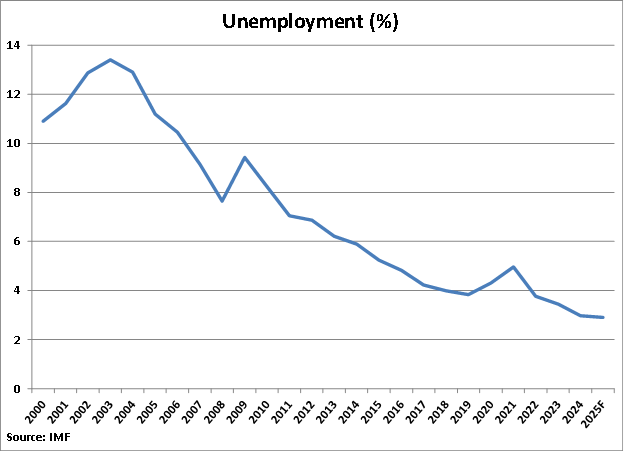
The labor market remains robust. In July 2025, the nationwide unemployment rate was 3%, up from 2.7% in the previous year, according to CBS Labour Force Survey Data for July 2025. The country's jobless rate fell to an annual average of 4.2% from 2015 to 2024, from an average of 9.6% in 2000 to 2014.
"The labor market remains tight, and has returned close to the state it was in prior to the Iran operation. The broad unemployment rate among those aged 15 and higher was 3.5 percent in July, similar to its level prior to the Iran operation. The job vacancy rate increased in July, returning to its level from before the Iran operation," noted the central bank.
Sources:
- Average Housing Indices and Prices - July 2025 (Central Bureau of Statistics): https://www.cbs.gov.il/
- Israel's Housing Market Crashes to a 20-Year Low (International Investment): https://internationalinvestment.biz/
- Real Estate Transactions - Dwellings in April-June 2025 (Central Bureau of Statistics): https://www.cbs.gov.il/
- Construction Begun and Completed in April 2024-March 2025 (Central Bureau of Statistics): https://www.cbs.gov.il/
- Construction Begun and Completed in 2024 (Central Bureau of Statistics): https://www.cbs.gov.il/
- Israel Home Ownership Rate (Trading Economics): https://tradingeconomics.com/
- Gross rental yields in Israel: Tel Aviv and 2 other cities (Global Property Guide): https://www.globalpropertyguide.com/
- Financial Stability Report for the second half of 2024 (Bank of Israel): https://www.boi.org.il/
- Israel: 2023 Article IV Consultation-Press Release; Staff Report; and Statement by the Executive Director for Israel (International Monetary Fund): https://www.elibrary.imf.org/
- Israeli economy contracts by 3.5 pct in Q2 (Xinhuanet): https://english.news.cn/
- Iran war shocks drag Israel's economy into sharp Q2 slump (Ynet News): https://www.ynetnews.com/
- Israel GDP Growth Annualized (Trading Economics): https://tradingeconomics.com/
- Israel: GDP records first contraction since Q4 2023 in the second quarter (Focus Economics): https://www.focus-economics.com/
- The Monetary Committee decides on August 20, 2025 to leave the interest rate unchanged at 4.5 percent (Bank of Israel): https://www.boi.org.il/
- The Monetary Committee decides on July 7, 2025 to leave the interest rate unchanged at 4.5 percent (Bank of Israel): https://www.boi.org.il/
- Israel (International Monetary Fund): https://www.imf.org/
- Israel Government Budget (Trading Economics): https://tradingeconomics.com/
- Israel Government Debt to GDP (Trading Economics): https://tradingeconomics.com/
- Consumer Prices Index - July 2025 (Central Bureau of Statistics): https://www.cbs.gov.il/
- Labour Force Survey Data, July 2025 (Main Data) (Central Bureau of Statistics): https://www.cbs.gov.il/