Uruguay's Residential Property Market Analysis 2025
Uruguay’s housing market continues to demonstrate solid fundamentals, driven by steady domestic demand, renewed foreign investor interest, and improving macroeconomic conditions.
Table of Contents
- Housing Market Snapshot
- Demand Highlights
- Rental Market
- Mortgage Market
- Historic Perspective
- Socio-Economic Context
Housing Market Snapshot
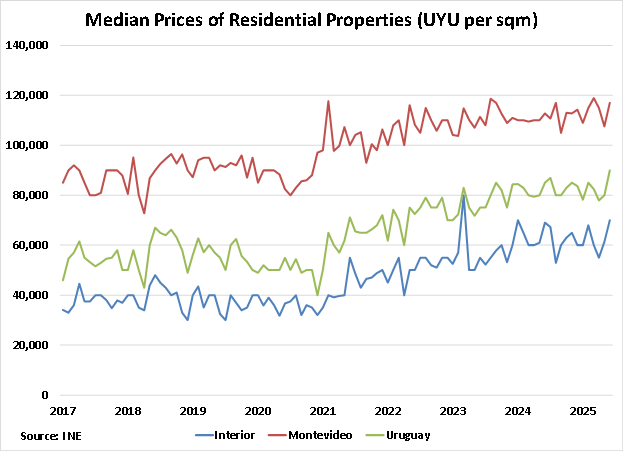
In the second quarter of 2025, the average price of newly built houses in Uruguay rose by 5.88% to UYU 90,000 (US$2,244) per square meter (sqm) as compared to a year earlier, according to the National Institute of Statistics (INE). When adjusted for inflation, nationwide house prices were up slightly by 1.44% over the same period.
Quarter-on-quarter, house prices in the country increased strongly by 9.09% (8.72% inflation-adjusted) in Q2 2025.
House price growth is more muted in the country's capital city. In Montevideo, the average price of newly built houses was up by a modest 3.77% y-o-y to UYU 117,000 (US$2,918) per sqm in Q2 2025. But when adjusted for inflation, real house prices actually dropped 1.01% over the same period.
Quarter-on-quarter, new house prices in the capital city were down by 1.59% in Q2 2025 (-1.94% inflation-adjusted).
Uruguay's house price annual change:
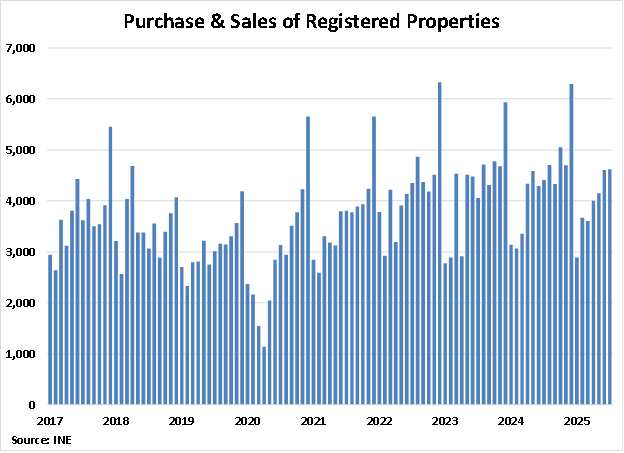
Demand remains robust. During 2024, the total number of real estate purchase transactions increased by 3.3% y-o-y to 52,246 units, following a slight decline of 0.4% in 2023, based on figures from INE. In fact, last year's figures were actually the highest number of transactions recorded in recent years.
Then in the first seven months of 2025, real estate purchase transactions were up slightly by 1.3% to 27,533 units as compared to the same period last year.
Demand from foreign buyers is also increasing. The real estate market in Uruguay, and particularly in its beach resorts, relies heavily on foreign buyers, around 75% of whom have traditionally been Argentines, followed by Brazilians (with about 20% share) while the remaining 5% were buyers from other countries. Some European retirees are also drawn to Montevideo, especially writers and artists.
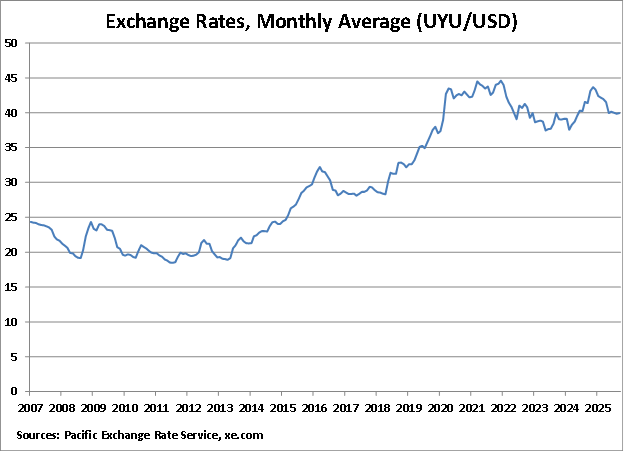
This is mainly attributed to improving economic conditions and the stabilization of the Uruguayan peso, which have made local real estate investments increasingly attractive to foreign buyers. The Uruguayan peso (UYU) was more or less steady against the US dollar in the past two years, reaching an average monthly exchange rate of UYU 39.97 = USD 1 in September 2025.
Real estate transactions in Uruguay are typically quoted in dollars because of a history of fluctuations in the value of the Uruguayan peso.
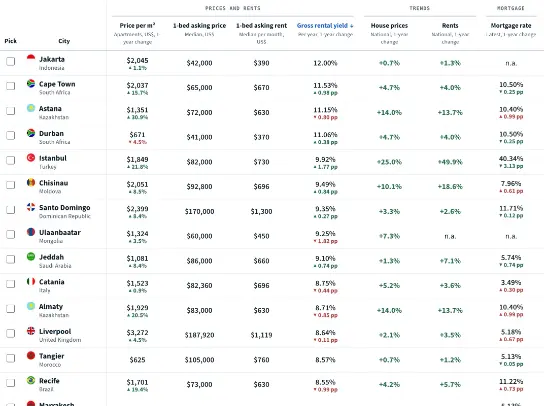
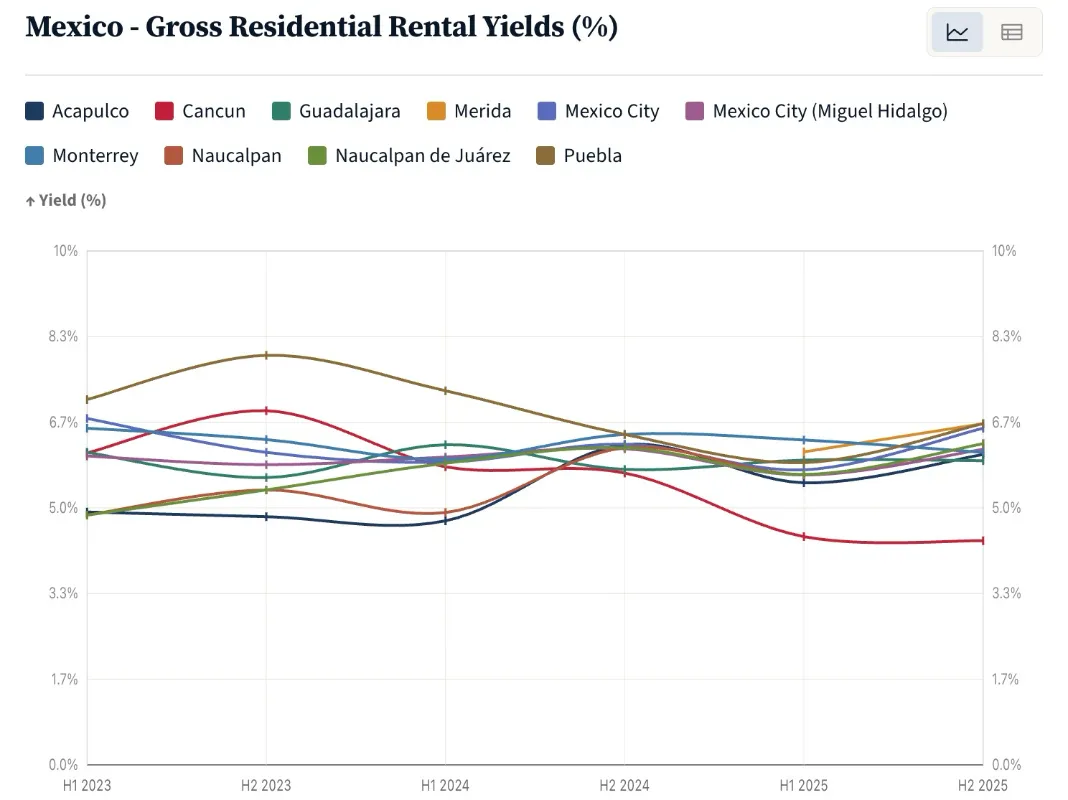
In addition, the country also offers decent rental yields to potential property investors. The average gross rental yield in Montevideo, the return earned on the purchase price of a rental property, before taxation, vacancy costs, and other costs, stood at 4.97% in Q2 2025, according to a recent research conducted by the Global Property Guide.
Uruguay's economy expanded by a modest 3.1% in 2024 from a year earlier, following annual expansions of 0.7% in 2023, 4.5% in 2022, and 5.8% in 2021, mainly driven by the growth in exports and a rebound in agricultural production following a severe drought in the preceding year.
Then in Q2 2025, the economy grew further by 2.1% from a year earlier, following year-on-year expansions of 3.4% in Q1 2025, 3.5% in Q4 2024, 4.4% in Q3 2024, 4% in Q2 2024, and 0.4% in Q1 2024. The latest upturn was mainly driven by strong performance in agriculture, fishing, and mining, which grew by 10.6% year-on-year, supported by a robust soybean and corn harvest. Manufacturing also posted solid gains, rising 7.6%, largely due to increased oil refining activity.
With this, the International Monetary Fund (IMF) expects Uruguay's economy to continue expanding modestly in the medium term, with a projected real GDP growth rate of 2.5% this year and another 2.4% next year.
Demand Highlights:
Property demand continues to improve
During 2024, the total number of real estate purchase transactions increased by 3.3% y-o-y to 52,246 units, following a slight decline of 0.4% in 2023, based on figures from INE.
With this, last year's figures were actually the highest number of transactions recorded in recent years. Transactions dropped by 5.9% in 2018, 11.9% in 2019, and another 4.4% in the pandemic year of 2020 before rebounding by 24.8% in 2021 and 15% in 2022.
Demand remains more or less steady this year. In the first seven months of 2025, real estate purchase transactions were up slightly by 1.3% to 27,533 units as compared to the same period last year.
Montevideo accounted for the biggest share of about 34.4% of all property transactions in the country from January to July 2025, followed by Maldonado (17.9%), Canelones (13.2%), Rocha (5.9%), Colonia (5.2%), and San José (2.5%).
Based on a recent article published by El Observador, the total value of purchases and sales of real estate in Uruguay reached at least US$1.17 billion in the first half of 2025, up from about US$1 billion in the same period last year. Said figures were calculated based on the collection of the Property Transfer Tax (ITP), which is equivalent to 2% for the buyer and another 2% for the seller of the property's value.
Punta del Este: from an idyllic vacation spot to a year-round retreat
The fashionable beach resort of Punta del Este is currently transforming from an idyllic vacation spot to a year-round destination for the rich. Sometimes called the "Monaco of South America", it became a pandemic refuge for thousands of wealthy investors in recent years, according to an article published by Bloomberg.
Post-pandemic, Punta del Este has evolved into a prime destination for beachfront real estate investment.
"Several factors make Punta del Este, Uruguay, a prime destination for beachfront real estate. Firstly, its unparalleled natural beauty and temperate climate make it an ideal location for those seeking a seaside retreat," said a recent article published by B Magazine. "Secondly, Punta del Este's modern infrastructure, upscale amenities, and cosmopolitan atmosphere set it apart from other beachfront destinations."
This is supported by other real estate analysts. "Punta del Este, known as the 'Saint-Tropez of South America,' has for years been a prime destination for luxury property buyers. This Uruguayan resort not only attracts tourists from around the world but has also established itself as a hotbed of real estate investment. The steady demand for real estate in this region has been increasing, and future projections point to a dynamic and constantly evolving real estate landscape," noted a 2025 article published by luxury real estate agency Luxury Punta.
Likewise, according to The Latin Investor, "Punta del Este's property market is experiencing robust growth with prices increasing by 10% over the past year. Foreign buyers are driving strong demand, particularly in luxury beachfront segments, which saw appreciation exceeding 12% annually. The market shows continued strength with projected price increases of 3-7% for the remainder of 2025, supported by Uruguay's stable economy and ongoing infrastructure improvements."
Punta del Este and its neighboring provincial capital, Maldonado, together are home to around 170,000 people, with about 15,000 new residents settling in the area since the onset of the Covid-19 pandemic. In fact, just outside Punta del Este, the resort of La Barra, a former fishing village, is also becoming a popular second-home market for international buyers.
A five-acre mixed-use real estate project named Atlántico, situated at the northwest edge of the city, broke ground in 2021. Developed by Altius Group, the first phase of the project, comprising a shopping center, an 18-floor apartment block, and a 14-story office tower, was completed last year. The whole project has an estimated cost of US$130 million.
Another US$42 million 25-story World Trade Center-branded office tower on the city's historic peninsula district is also currently being built. The building is expected to house at least 1,200 people when it opens by the end of 2025.
Punta del Este's luxury property market is dominated by foreign buyers, particularly from Argentina and Brazil, as well as from the United States.
Luxury homes in Punta del Este typically cost from US$2 million to US$6 million. Beachfront luxury homes command even higher prices, ranging from US$7 million to as high as US$20 million.
Some of the most expensive residences in Punta del Este can be found in the "Mouette" building and Trump Tower apartments, with prices ranging from US$7,000 per sqm to US$10,000 per sqm. The cheapest new apartments in the area range from US$2,500 to below US$7,000.
More modest homes are available farther from the beach, starting at around US$200,000 for a small two-bedroom house, said Sandra Sofio, Engel & Völkers Punta del Este.
House price variations in Montevideo
The neighborhood of Carrasco has the most expensive housing in Montevideo, with an average price of US$4,266 per sqm in mid-2025, according to a recent report published by El Observador.
Carrasco is considered Montevideo's most exclusive suburb. Many are attracted to Punta Carretas for its magnificent Rambla (seaside avenue), Villa Biarritz for its strategic location, and Punta Gorda for its beautifully restored historic spots.
It was followed by Punta Carretas and Punta Gorda, with the average sales price also breaching the US$4,000 per sqm mark.
Other posh neighborhoods in the capital city included Pocitos, Malvín, and Parque Rodó, with house prices ranging from around US$3,500 to US$3,800 per sqm.
La Blanqueada, Cordón, and Tres Cruces registered average house prices ranging from US$2,900 to US$3,250 per sqm. El Centro and Aguada have average prices of around US$2,500 to US$2,800 per sqm.
In the coastal area and surrounding areas, including Parque Battle and Villa Dolores, house prices remain above US$3,000 per sqm.
In the periphery areas and lower-cost neighborhoods, including New Paris, Punta Rieles, Las Acacias, and Peñarol/Lavalleja, house prices range from US$750 to US$1,100 per sqm.
Rental Market:
Rental yields declining gradually
The average gross rental yield in Montevideo, the return earned on the purchase price of a rental property, before taxation, vacancy costs, and other costs, is moderately good at 4.97% in Q2 2025, down from 5.37% in Q2 2024 and 5.53% in Q3 2023, according to a recent research conducted by the Global Property Guide. Though these yields are gross, i.e., before costs and taxes, and so realistically, net rental returns would normally be a couple of percentage points lower.
Uruguay's rent price index:
Gross rental yields are an important consideration even for those who do not intend to become landlords because a high rental yield indicates that the property market is reasonably priced.
In Q2 2025:
- In Pocitos, gross rental yields for apartments ranged from 4.44% to 6%, at par with the previous year's 4.26% to 6.03%.
- In Cordón, apartments offer returns ranging from 4.99% to 5.66%, slightly down from the prior year's 5.1% to 5.97%.
- In Centro, rental yields ranged from 4.91% to 5.86%, slightly higher than the 4.83% to 5.67% in the previous year.
- In Malvin, rental yields are higher, ranging from 5.81% to 6.68%. This is compared to the yields between 5.41% and 8.04% in the previous year.
- In Punta Carretas, apartments offer rental returns from 4.24% to 6.7%, higher than the prior year's 4.16% to 5.76%.
- In Tres Cruces, gross rental yields for apartments are far lower than the city average, ranging from 2.2% to 4.78%. This is compared to the prior year's 2.85% to 4.75%.
- In La Blanqueada, rental yields ranged from 5.58% to 6.62% in Q2 2025, from 5.78% to 6.2% in Q2 2024.
- In Pocitos Nuevo, rental yields ranged from 5% to 5.55%, from the prior year's 4.46% to 6.07%.
Round-trip transaction costs are high in Uruguay (i.e., the total costs of buying and selling a property). See our residential transaction costs analysis for Uruguay.
Rents and rental contracts continue to increase
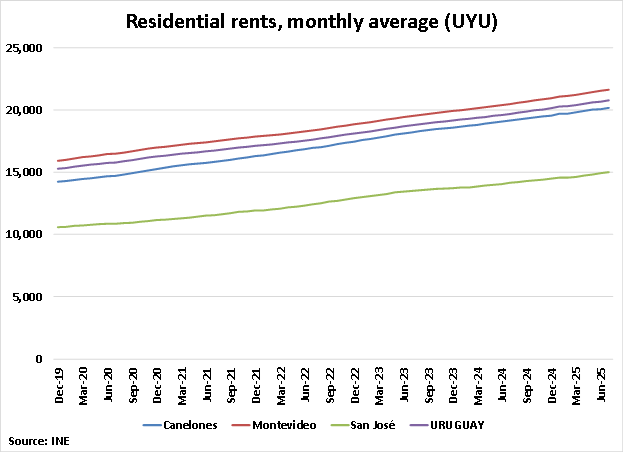
Residential rents continue to increase. In July 2025, rents rose by 5.5% to a monthly average of UYU 20,772 (US$520) as compared to a year earlier, according to INE. This followed year-on-year growth of 5.1% in 2024, 5.79% in 2023, 5.8% in 2022, 5.26% in 2021, and 6.47% in 2020.
By major department:
- In Montevideo, residential rents were up by 5.63% to reach a monthly average of UYU 21,626 (US$542) in July 2025, following annual increases of 5.17% in 2024 and 5.67% in 2023.
- In Canelones, the average monthly rent of residential properties stood at UYU 20,169 (US$505) in July 2025, up by 5.31% from the previous year. This followed rent growths of 5.15% in 2024 and 6.44% in 2023.
- In San José, residential rents increased by 5.93% y-o-y to an average of UYU 15,001 (US$376) per month in July 2025, at par with annual growth of 5.56% in 2024 and 6.02% in 2023.
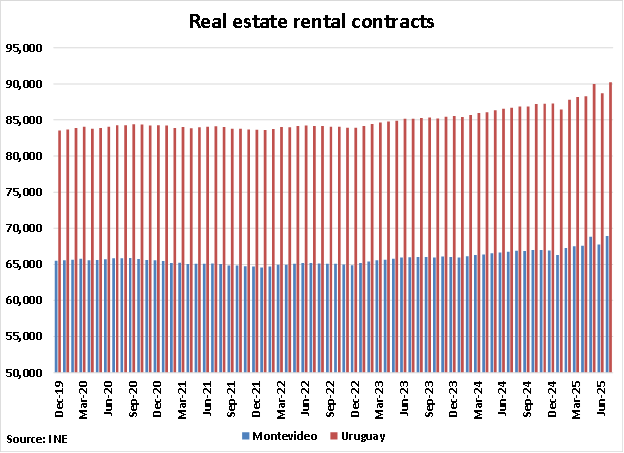
As of July 2025, there are 90,246 current rental contracts in Uruguay, up by 4.11% from the previous year, based on figures from INE.
Of these, about 76.38% were in the city of Montevideo, 11.67% in Canelones, 2.11% in San José, 1.67% in Maldonado, 1.36% in Paysandú, and 1.28% in Colonia.
Mortgage Market:
Stabilizing interest rates, robust housing loan growth
In October 2025, the Banco Central del Uruguay (BCU) reduced its benchmark policy rate by 50 basis points to 8.25%, "moderating the contractionary bias and gradually moving towards the neutral instance of monetary policy." It was its third consecutive rate cut in the past four months, with a cumulative decline of 100 basis points.
"In September, the reduction of business inflation expectations to 5.5% was highlighted, entering the tolerance range for the first time. Added to this are analysts, who lowered their expectations to 4.6%, practically at the target, and financial markets, which fell to 4.75%. In this way, the general average stood at 4.95%, showing a sustained reduction since February and reaching its historical low," said the BCU in its monetary policy statement.
"Based on this, the Board unanimously decided to reduce the MPR by 50 basis points, placing it at 8.25%, which moderates the contractionary bias of monetary policy. To the extent that this scenario continues to evolve in line with expectations, the BCU will continue the cycle of reducing the interest rate towards a neutral policy instance," added the central bank.
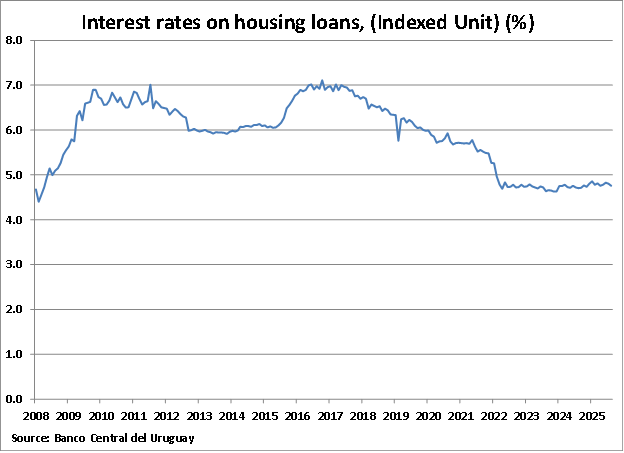
In line with the central bank's policy decisions, the BCU housing lending rate for indexed units (UI) remained more or less steady. In August 2025, the housing lending rate stood at 4.8%, slightly up from 4.7% a year earlier but at par with two years ago.
The Indexed Unit, or Unidad Indexada (UI) in Uruguay, created in 2002, is like Chile's Unidad de Formento, which is adjusted with the CPI, and replaced the previous Unidad Reajustable (UR), which was adjusted according to a wage index. The index is calculated by INE and is subject to daily changes to reflect changes in the CPI. The indexing to the price level does not incur inflation risk since the real value of payments remains constant.
Uruguay's mortgage market is highly concentrated and is dominated by Banco Hipotecario del Uruguay (BHU), which accounts for about 80% of all housing mortgage credits.
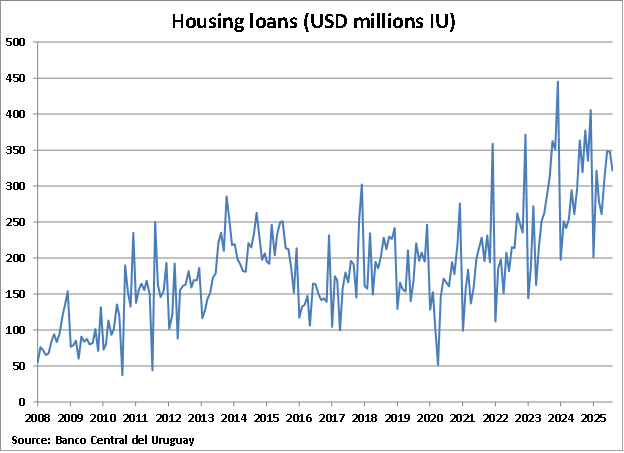
In August 2025, housing loans in local currency fell by 11.5% to 322 million UI from a year earlier, despite stabilizing interest rates, according to figures from BCU. This was in stark contrast to the strong growth of 26.6% recorded in August 2024.
However, in the first eight months of 2025, UYU-denominated housing loans actually increased by 10.7% y-o-y to an accumulated 2,390 billion UI, following a year-on-year growth of 21.2% over the same period last year.
Historic Perspective:
The story of Uruguay's housing boom and bust
Montevideo saw a spectacular housing boom from 1995 to 2005, with prices of newly built houses surging by 198.6%, according to the INE.
House prices continued to rise in the following years, registering an annual average growth of 11.9% from 2006 to 2015 (an average of 2.5% annual growth when adjusted for inflation).
The housing market started to slow by end-2015 due to Uruguay's economic slowdown and Argentina's economic crisis. Uruguay's economy grew by a meager 0.4% in 2015, 1.7% in 2016, 1.6% in 2017, 0.2% in 2018, and 0.9% in 2019 - a sharp deceleration from annual average growth of 5.4% from 2004 to 2014.
House prices have been almost unchanged from 2016 to 2018 when adjusted for inflation. Then in 2019, nominal house prices in Uruguay increased by 2.04% but actually declined by 6.2% in inflation-adjusted terms. In Montevideo, house prices rose by 5.56% but fell by 2.83% in real terms.
The Covid-19 pandemic worsened housing market conditions. During 2020, nationwide house prices plummeted by a huge 20% (-26.9% inflation-adjusted), as both demand and supply fell sharply. Montevideo proved to be more resilient, with house prices still rising by a modest 2.11% (but fell by 6.64% when adjusted for inflation).
The housing market started to show some improvements in 2021, as economic activity returned to pre-pandemic levels amidst the removal of Covid-related restrictions. Nationwide house prices surged by 80% (66.73% inflation-adjusted) in 2021. Montevideo recorded a more moderate house price growth of 9.66% (1.55% inflation-adjusted) over the same year.
After slowing again in 2022, nationwide house prices surged again by 20.59% (14.73% inflation-adjusted) in 2023. Yet Montevideo's house prices were more or less steady (and actually dropped 4.46% inflation-adjusted).
The housing market lost steam once more in 2024, with nationwide house prices falling slightly by 0.91% (-6.06% inflation-adjusted). In Montevideo, nominal prices were up by 2.9% last year but declined by 2.73% in real terms.
Socio-Economic Context:
Modest economic growth, improved international trade
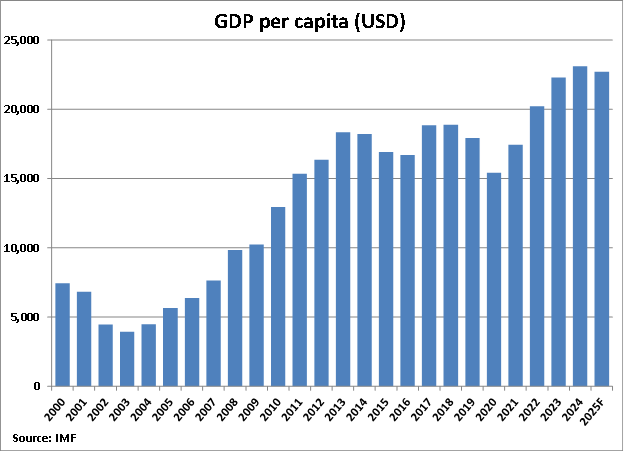
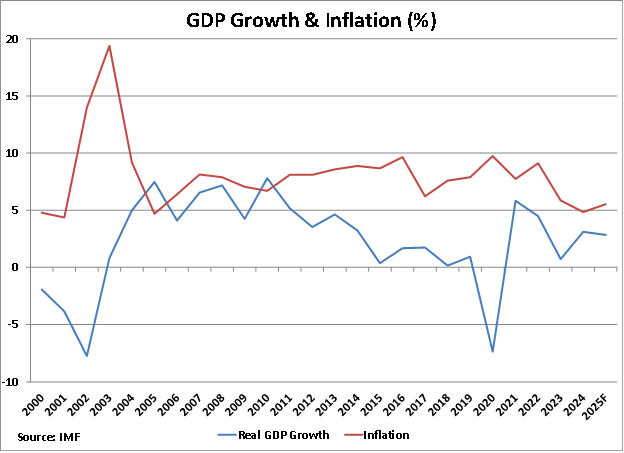
Uruguay's economy expanded by a modest 3.1% in 2024 from a year earlier, following annual expansions of 0.7% in 2023, 4.5% in 2022, and 5.8% in 2021, mainly driven by the growth in exports and a rebound in agricultural production following a severe drought in the preceding year.
"Following a severe drought in 2023, agricultural production expanded significantly in 2024, sustaining growth around potential and contributing to narrowing the current account deficit to -1 percent of GDP," said the International Monetary Fund (IMF).
This is supported by the World Bank, which noted that: "In 2024, the economy rebounded, expanding by 3.1 percent, driven by exports and private consumption, supported by improvements in the labor market and inflation remaining within the Central Bank of Uruguay's target range."
Foreign trade registered an increase in both exports and imports last year. Total exports of goods rose by 13% y-o-y to US$12.85 billion in 2024, in sharp contrast to an annual decline of more than 13% in the prior year, according to the country's trade promotion agency, Uruguay XXI. It was the second-highest export value recorded in the past decade, following 2022's US$13.36 billion total exports.
In 2024, the country's leading export products were cellulose, beef, soybeans, dairy products, and beverage concentrates. Among these, soybeans and cellulose contributed the most to the overall growth in exports, while canola, carinata, rice, and malt registered negative impacts during the year.
In 2024, China was Uruguay's top export destination, accounting for 24% of total exports. Brazil followed with 18%, while the European Union ranked third with 14%. The United States and Argentina made up 9% and 5%, respectively.
Likewise, the import of goods, excluding oil, byproducts, and energy, increased by 2.1% y-o-y to US$10.88 billion in 2024, following a contraction of 2% in 2023. This growth was largely driven by higher imports of consumer goods.
In Q2 2025, Uruguay's economy grew by 2.1% from a year earlier, following year-on-year expansions of 3.4% in Q1 2025, 3.5% in Q4 2024, 4.4% in Q3 2024, 4% in Q2 2024, and 0.4% in Q1 2024. The latest upturn was mainly driven by strong performance in agriculture, fishing, and mining, which grew by 10.6% year-on-year, supported by a robust soybean and corn harvest. Manufacturing also posted solid gains, rising 7.6%, largely due to increased oil refining activity.
With this, the IMF expects Uruguay's economy to continue expanding modestly in the medium term, with a projected real GDP growth rate of 2.5% this year and another 2.4% next year.
"Growth is expected to moderate in 2025. Growth is projected at 2.5 percent in 2025 and 2.4 percent in 2026, fueled by the post-pandemic recovery of real wages and reduction in domestic uncertainty," said the IMF.
The country registered strong economic growth averaging 5.3% annually from 2004 to 2014, before slowing sharply to just 0.4% in 2015, as commodity prices slumped and Uruguay's trade partners slowed. The country's economic growth remained sluggish in the succeeding years, expanding by an average annual growth of only 1.1% from 2016 to 2019. Economic conditions worsened tremendously in 2020 due to the Covid-19 pandemic, with real GDP contracting by a huge 7.4% - the country's worst performance since 2002.
The government's budget deficit stood at around 3.2% of the country's GDP in 2024, at par with the prior year. Public debt was equivalent to 70.3% of GDP last year, a slight increase from the preceding year's 69.2%.
"The fiscal deficit of the central government, including social security (CG-BPS), increased in 2024 to 3.2 percent of GDP, necessitating the activation of the fiscal rule's escape clause. International reserves are ample and reached a level equivalent to 11½ months of imports at the end of August 2025," said the IMF.
Recently, the government raised its deficit projections for 2025 to approximately 4.1% of GDP, from the initial forecast of 3%, to reflect timing adjustments and a weaker structural balance. The shortfall is expected to remain at this level, as revenues continue to grow strongly, outpacing nominal GDP, but spending has also increased due to structural pressures and one-off payments for delayed expenditures.
In September 2025, nationwide inflation averaged 4.25%, slightly up from 4.2% in the previous month but still lower than the 5.32% recorded in the same period last year, according to figures from INE. In fact, recent inflation figures were actually far lower than their long-term historical averages. Inflation averaged 8.2% from 2010 to 2022, before decelerating to 5.9% in 2023 and to 4.9% in 2024.
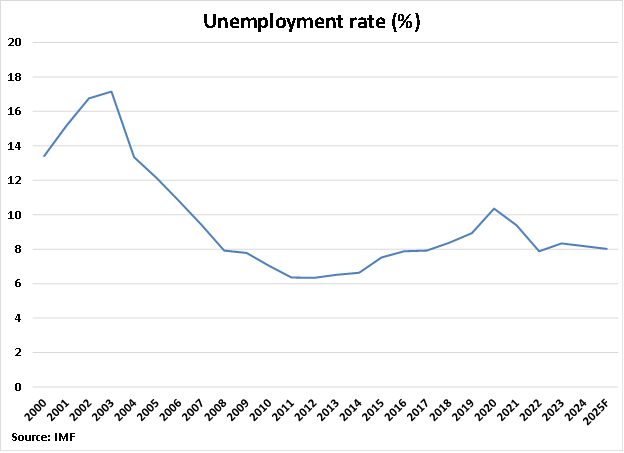
The labor market continues to improve. In August 2025, Uruguay's unemployment rate stood at 7%, far lower than the prior year's 8.4%. During 2024, the nationwide jobless rate was 8.2%, lower than the annual average of 8.9% in 2018-2023 but higher than the 7.4% in 2007-2017.
Uruguay's credit ratings affirmed
In August 2025, credit rating agency Moody's retained Uruguay's credit rating at Baa1, following an upgrade from Baa2 in March 2024. The stable outlook also remains unchanged.
"Uruguay's Baa1 rating is supported by strong institutions that reinforce political and social stability, solid growth performance, and steady flow of foreign direct investment (FDI)," said Moody's. "Comparatively large fiscal reserves and external buffers, and very strong asset-liability management practices, also support creditworthiness. These credit strengths are balanced against a moderate level of public debt, structural rigidities in the government's expenditure, and a relatively high, although declining, share of foreign-currency government debt."
Then in September 2025, credit rating agency Fitch Ratings affirmed the country's long-term foreign currency issuer default rating at 'BBB' with a stable outlook, after raising it by one notch two years ago. Earlier, in November 2024, Standard and Poor's also affirmed its 'BBB+' long-term and 'A-2' short-term foreign and local currency sovereign credit ratings on Uruguay, with a stable outlook.
With an economic freedom score of 70.2, Uruguay is tagged as "mostly free" and the world's 29th freest economy in The Heritage Foundation's 2025 Index of Economic Freedom. The country's economic freedom score improved from the prior year's 69.8, but its world ranking declined by two notches. It ranks 4th out of the 32 South and Central American countries, and its overall score is significantly above the world and regional averages.
"The relative openness of Uruguay's economy is supported by a strong commitment to the rule of law. Uruguay is regarded as Latin America's least corrupt country. Its modern entrepreneurial environment encourages the development of a more robust private sector," said The Heritage Foundation. "Recent reforms have enhanced regulatory efficiency, and the cost of completing licensing requirements has been reduced. Budget deficits and public debt have remained around 3 percent and 60 percent of GDP, respectively, in recent years. Monetary stability has been maintained despite relatively high inflation."
Sources:
- Series históricas Indicadores de Actividad Inmobiliaria (IAI) Compra-Venta (Instituto Nacional de Estadística): https://www.gub.uy/
- Compraventa de inmuebles por más de US$ 1.100 millones en primer semestre de 2025 (El Observador): https://www.elobservador.com.uy/
- Desde US$ 90 mil a más de US$ 300 mil: cuánto cuesta comprar una propiedad en los barrios más demandados de Montevideo (El Observador): https://www.elobservador.com.uy/
- South America's Resort for the Rich Seeks Year-Round Vibe (Bloomberg): https://www.bloomberg.com/
- Punta del Este in Uruguay: A Prime Destination for Beachfront Real Estate (B Magazine): https://www.benoitproperties.com/
- Future of the real estate market in Punta del Este (Luxury Punta): https://luxurypunta.com/
- How is the property market forecast in Punta Del Este? (The Latin Investor): https://thelatinvestor.com/
- Interest rates (Banco Central Del Uruguay): https://www.bcu.gub.uy/
- Credits (Banco Central Del Uruguay): https://www.bcu.gub.uy/
- USD/UYU - US Dollar Uruguayan Peso (investing.com): https://ph.investing.com/
- Boletín Técnico Indicadores de Actividad Inmobiliaria (IAI) Mercado de Alquileres Julio 2025 (Instituto Nacional de Estadística): https://www5.ine.gub.uy/
- The Central Bank reduces the interest rate by 50 basis points, to 8.25% (Banco Central Del Uruguay): https://www.bcu.gub.uy/
- Uruguay: Staff Concluding Statement of the 2025 Article IV Mission (International Monetary Fund): https://www.imf.org/
- IMF mission praises Uruguay's economy (MercoPress): https://en.mercopress.com/
- Uruguay (World Bank): https://www.worldbank.org/
- Foreign Trade Annual Report - 2024 (Uruguay XXI): https://www.uruguayxxi.gub.uy/
- Announcement of Periodic Review: Moody's Ratings announces completion of a periodic review of ratings of Uruguay (Moody's Ratings): https://deuda.mef.gub.uy/
- Fitch Affirms Uruguay at 'BBB'; Outlook Stable (Fitch Ratings): https://www.fitchratings.com/
- Uruguay 'BBB+/A-2' Ratings Affirmed; Outlook Remains Stable (Standard and Poor's): https://www.spglobal.com/
- 2025 Index of Economic Freedom (The Heritage Foundation): https://www.heritage.org/
- Economic Freedom Country Profile: Uruguay (The Heritage Foundation): https://www.heritage.org/
- Índice de Precios del Consumo (IPC) Setiembre 2025 (Instituto Nacional de Estadística): https://www.gub.uy/
- Uruguay Government Debt to GDP (Trading Economics): https://tradingeconomics.com/
- Uruguay Government Budget (Trading Economics): https://tradingeconomics.com/
- Uruguay GDP Growth Slows in Q2 2025 (Trading Economics): https://tradingeconomics.com/