Italy's Residential Property Market Analysis 2026
Supported by firm urban demand and constrained supply, nominal price growth in the Italian housing market remains resilient, although it is becoming more selective, indicating a widening gap between key metro areas and more affordability-sensitive secondary locations.
This extended overview from the Global Property Guide covers key aspects of the Italian housing market and takes a closer look at its most recent developments and long-term trends.
Table of Contents
- Property Prices and Price Index
- Property Demand Trends
- Property Supply Trends
- Rental Market: Rents and Rental Yields
- Mortgage Market and Interest Rates
- Economic and Social Factors
Property Prices and Price Index
Italy’s house price growth strengthened in late 2025, supported mainly by the existing-home segment, firm urban demand, narrow negotiation margins, and constrained available supply. According to provisional figures from the Italian National Statistical Institute (Istat) House Price Index, residential prices rose by 4.05% year-on-year in Q4 2025, or 2.86% in real terms. In quarter-on-quarter terms, the index increased by 0.94% nominally, equivalent to 1.46% inflation-adjusted.
Price growth was entirely driven by existing dwellings, whose prices rose by 5.15% year-on-year (3.95% inflation-adjusted). By contrast, prices for new dwellings declined by 1.16% year-on-year, or 2.29% in real terms, turning negative on an annual basis for the first time in eight years.
Italy's house price annual change:
Regionally, house price growth remained positive across all major areas, but with clear differences in intensity. The strongest annual increase was recorded in the Northeast (+4.74%), followed by the Northwest (+4.41%), while growth was more moderate in Central Italy (+3.68%) and the South and Islands (+3.00%). In all regions, existing dwellings outperformed new dwellings, with the divergence particularly visible in Central Italy and the South and Islands, where new-home prices declined sharply on an annual basis in Q4 2025. Among the major municipalities tracked by Istat, Milan remained the strongest performer, with prices up 6.29% year-on-year, followed by Rome (+5.00%) and Turin (+3.55%).
More timely asking-price data points to continued upward pressure in early 2026. According to Immobiliare.it, one of Italy’s leading real estate portals, the average asking price for residential properties across Italy reached EUR 2,188 (USD 2,561) per square meter in April 2026, up 4.24% year-on-year. Among selected large municipalities, Milan remained the most expensive market, followed by Florence, Bologna, and Rome.
Average asking price by municipality:
| Average Asking Price, EUR/sqm, Apr 2026 |
Average Asking Price, USD/sqm, Apr 2026 |
YoY, % | |
| Rome | EUR 3,779 | USD 4,424 | 6.06% |
| Milan | EUR 5,653 | USD 6,617 | 3.14% |
| Turin | EUR 2,223 | USD 2,602 | 8.12% |
| Genoa | EUR 1,797 | USD 2,104 | 5.33% |
| Naples | EUR 3,010 | USD 3,524 | 2.66% |
| Palermo | EUR 1,547 | USD 1,811 | 3.20% |
| Bologna | EUR 3,818 | USD 4,469 | 6.20% |
| Florence | EUR 4,737 | USD 5,545 | 5.43% |
| Italy | EUR 2,188 | USD 2,561 | 4.24% |
| Note: Exchange rate as of April 2026, USD 1 = EUR 0.8543. | |||
| Data Source: Immobiliare.it. | |||
Market sentiment indicators also support the view that pricing conditions remain relatively tight. The Bank of Italy’s Q4 2025 Housing Market Survey reported that agents’ assessments of selling prices strengthened further across most of the country, while average discounts on asking prices remained extremely small and time on market very short by historical standards. The same survey pointed to recovering demand, particularly in urban areas, alongside a further decline in new sale listings.
The outlook, however, is more moderate. The economic research and consulting firm Nomisma forecasts residential prices to increase by 0.9% in 2026, 0.5% in 2027, and 0.4% in 2028, implying weak or slightly negative real price growth. Its cautious view reflects a market that remains supported by Italy’s strong preference for homeownership, but is becoming more selective as higher purchase prices, mortgage-rate uncertainty, and limited household spending capacity weigh on affordability.
Scenari Immobiliari consultancy presents a more optimistic view, forecasting average residential price growth of 4.2% in 2026, with stronger increases in the largest urban markets, led by Milan (+7.3%) and Rome (+6.8%). Other reported city-level expectations are more moderate, with Florence and Naples at around +2.5% to +3.0%, and Turin and Bologna at around +1.5% to +2.0%. Overall, this points to continued nominal price resilience, but also to a widening gap between the strongest metropolitan markets and more affordability-sensitive secondary locations.
Property Demand Trends
Sales Recovery Continues, Shaped by Credit Access, Affordability, and Quality Stock
Italy’s housing demand strengthened further in 2025, although momentum moderated toward the end of the year. According to the Observatory of the Real Estate Market (OMI) of the Italian Revenue Agency, residential sales reached 766,756 normalised transactions (NTN), up 6.4% year-on-year, confirming the recovery that began in 2024 and marking the second-highest annual level of the past decade. Colliers attributed the improvement to more stable interest-rate conditions, better access to credit, and the gradual recovery of household purchasing power.
Full-year growth, however, overstated the strength of year-end momentum. OMI’s Q4 2025 data showed only a modest 0.4% year-on-year rise in residential transactions, with growth concentrated in non-capital municipalities, while provincial capitals recorded a decline. This was consistent with Gabetti Group’s assessment that the residential market had entered a more mature phase, where consolidated growth was accompanied by early signs of slowing and a widening gap between asking prices and households’ effective purchasing capacity.
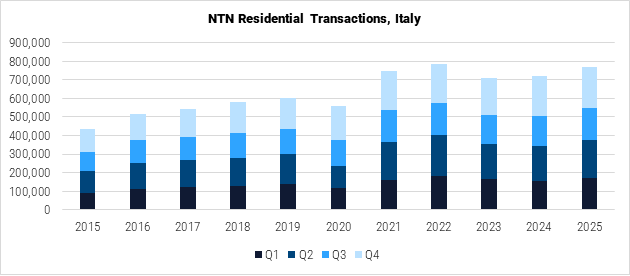
Note: NTN refers to the number of dwellings sold, normalised by the ownership share transferred, and is the standard OMI measure for transaction volumes.
Data Source: OMI.
The main urban markets continued to support national demand, although performance remained uneven. The eight largest cities recorded 113,793 residential transactions in 2025, up 5.4% year-on-year, slightly below the national increase. Rome and Milan remained the two largest markets, together accounting for more than half of transactions recorded across the main cities. However, the underlying demand profile differed: Milan continued to stand out as Italy’s deepest and most liquid residential market, with activity supported by demand for high-quality product and a relatively larger new-build component, while Rome’s growth was more closely linked to replacement demand and interest in better-quality housing, against the backdrop of an ageing residential stock and a growing need for renovation.
Number of normalised residential transactions recorded in the major cities:
| NTN Residential Transactions, 2025 |
YoY, % | |
| Rome | 37,293 | 6.2% |
| Milan | 25,173 | 4.9% |
| Turin | 16,151 | 6.8% |
| Genoa | 9,273 | 5.5% |
| Naples | 8,031 | 3.0% |
| Palermo | 7,140 | 9.4% |
| Bologna | 6,089 | 5.2% |
| Florence | 4,643 | -3.8% |
| Total main cities | 113,793 | 5.4% |
| Data Source: OMI. | ||
Foreign-citizen buyer activity also improved, although it remained far below its pre-global financial crisis peak. According to Scenari Immobiliari, purchases by foreign citizens reached an estimated 39,000 homes in 2025, equal to 5.1% of total residential transactions, compared with 135,000 homes, or around 17% of the market, in 2007. This indicator should be interpreted mainly as foreign-citizen / immigrant homebuyer demand, rather than as a direct proxy for high-end international second-home demand. While the segment has been recovering from the pandemic trough, Scenari Immobiliari notes that activity remains constrained by financial barriers, high upfront costs, and access-to-credit issues. Purchases also remained concentrated outside central urban locations, with only 3.6% of homes bought in city centers in 2025, and continued to be dominated by buyers from Eastern Europe, followed by the Indian subcontinent and China.
Italy also continues to attract a distinct international prime and lifestyle-buyer segment, which is only partly reflected in the foreign-citizen / immigrant homebuyer data. Knight Frank describes Italy as “Europe’s tax-led magnet,” with the flat-tax regime continuing to attract internationally mobile wealth and demand extending from Milan to Rome, Tuscany, and Lake Como as prime stock tightened. Engel & Völkers also points to a sizeable international component in Italy’s upper-end residential market, particularly in established prime destinations such as Lake Como and the Northern Lakes, the Tuscan Hills and Chianti, Liguria’s coastal markets, Monte Argentario, Salento, Taormina and the Aeolian Islands, and Costa Smeralda, where demand is focused on high-quality second homes, renovated villas, privacy, outdoor space, lake or sea views, and rental-income potential.
At the national level, forecasts point to continued residential demand growth in 2026, but at a slower pace than in 2025. Scenari Immobiliari expects the market to reach around 800,000 home sales in 2026, supported by resilient demand and continued interest from families and investors. Nomisma presents a more cautious outlook, forecasting residential transactions to increase by about 1.8% in 2026 to around 780,000–783,000 units, before broadly stabilising in 2027–2028. Overall, housing demand is expected to remain expansionary in 2026, but more selective. Activity should continue to benefit from the structural preference for homeownership and improved credit conditions, while remaining sensitive to affordability constraints, mortgage-rate developments, and the availability of suitable housing stock.
Property Supply Trends
Structurally Thin New-Build Pipeline and Tight Existing-Stock Availability
Italy’s residential supply remains structurally constrained, reflecting both long-term and cyclical factors. New development has never fully recovered from the post-2008 construction downturn, while the current pipeline continues to be held back by high construction costs, lengthy planning and approval procedures, limited land availability in major cities, and the growing reliance on redevelopment and regeneration rather than large-scale greenfield construction. At the same time, housing need has not disappeared despite weak population growth. Smaller household sizes, population ageing, internal migration, and the concentration of demand in major urban areas continue to support the need for additional, modern, and better-quality housing.
This shortage is increasingly reflected in policy and industry discussions. Real estate trade association Confindustria Assoimmobiliare estimates that Italy will need around 635,000 housing units over the next five years, delivered through both new construction and the redevelopment of obsolete and inefficient buildings, particularly in the main metropolitan areas. The association also notes that newly built homes account for only a minority of the overall housing offer, while Italy remains below several large European markets in terms of authorised residential floor area per inhabitant.
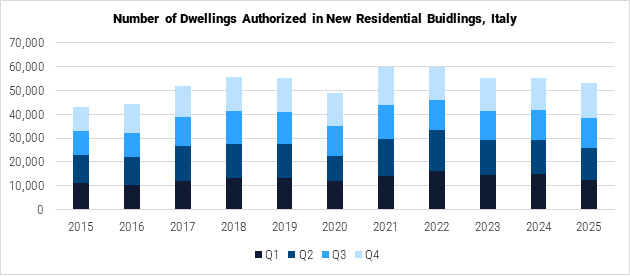
Official permit data confirms the limited scale of the current pipeline. According to Istat, the number of dwellings authorised in new residential buildings fell by 4.0% year-on-year to 53,024 units in 2025, following 55,256 units in 2024. The figure remained broadly in line with the low volumes recorded over the past decade and far below the scale of the pre-2008 construction cycle, confirming that new development continues to play only a limited role in replenishing Italy’s housing stock.
Data Source: Istat.
The limited new-build pipeline is being compounded by a reduced flow of existing homes coming to the market. According to the Bank of Italy’s Q4 2025 survey of real estate agents, the supply of homes available for sale continued to decline, with agents reporting a further fall in both outstanding sale mandates and new instructions from sellers. This suggests that supply constraints are not limited to low construction volumes but are also visible in the existing stock, as fewer owners are bringing properties to the market.
Supply pressures are also evident in the rental market. The same Bank of Italy survey found that rent growth in Q4 2025 remained mainly driven by the reduced availability of homes for rent, particularly in Central Italy. Short-term rentals appear to be intensifying this pressure in selected urban and tourist-oriented markets by diverting part of the housing stock away from long-term residential use. Around 55% of real estate agencies considered short-term rentals relevant in their local areas, and among these agencies, more than eight out of ten reported upward effects on long-term rents. The survey also noted that the impact on the sales market is mainly supply-related, as short-term rentals can reduce the number of homes offered for sale.
Overall, Italy’s housing supply issue is broader than weak new construction alone. The market is affected by a thin new-build pipeline, a limited flow of existing homes for sale, and shortages in the long-term rental segment. These constraints are likely to remain most visible in large urban and tourist-oriented markets, where demand is stronger, land is scarcer, and regulatory complexity makes new delivery difficult.
Rental Market: Rents and Rental Yields
Continued Albeit Moderating Growth in Asking Rents
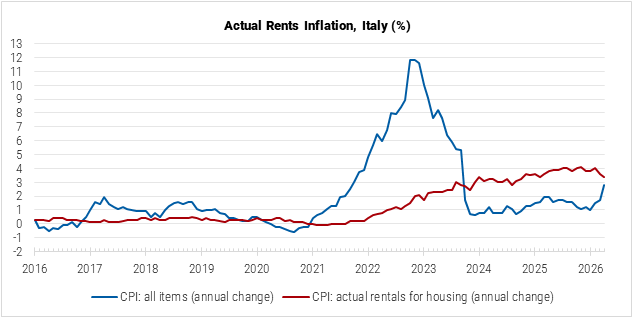
In the rental segment of the Italian housing market, rental inflation for existing contracts (as measured by the annual change in actual rentals for the housing component of the consumer price index) remained elevated in the second half of 2025 and early 2026, still trending above the overall price growth in the country. In Q4 2025, based on OECD preliminary figures, the rental sub-index posted a 3.98% year-on-year growth, compared to a 1.15% increase registered in the all-item CPI over the same period.
Italy's rent price index:
Data from property platforms also shows a consistent, albeit moderating, upward trend for listed rates across the country. Immobiliare.it reported a 3.4% annual increase in nationwide average rents in April 2026, compared to 7.4% in April 2025 and 13.3% in April 2024. Similarly, Idealista observed a 3.0% year-on-year increase in asking rents in April, a slowdown from 7.8% and 13.1% annual increases previously recorded during the same period in 2025 and 2024, respectively.
“Today, we observe a context in which demand, while returning to more sustainable levels, continues to exert pressure on supply, which remains limited, especially in large centers and the most attractive areas,” commented Vincenzo De Tommaso, Head of Research at Idealista. “At the same time, the increase — albeit significant — is part of a broader normalisation process: rent growth continues, but with less extreme dynamics than in the previous two years, outlining a more mature, widespread, and progressively more balanced market.”
Data Source: Istat.
In nominal terms, according to Immobiliare.it, the average asking rent in April 2026 reached EUR 14.45 (USD 16.92) per square meter nationwide. Among major cities, Milan (EUR 22.25 / USD 26.05), Florence (EUR 20.91 / USD 24.48), and Rome (EUR 18.48 / USD 21.63) traditionally stood out with rent levels substantially above the national average, while Palermo (EUR 9.55 / USD 11.18), Genoa (EUR 10.45 / USD 12.23), and Turin (EUR 12.63 / USD 14.78) remained relatively more affordable.
Reflecting slower growth in rents and uneven regional patterns, research conducted by Global Property Guide in January 2026 found gross rental yields for housing in Italy at an average level of 7.23%, down from 7.50% previously reported in January 2025. The highest potential performance among the surveyed submarkets was estimated for rental properties in Catania (9.17%) and Palermo (8.25%), while the lowest yields were reported in Florence (5.88%) and Milan (5.26%).
Average asking rents in selected submarkets:
| Municipality | April 2026, EUR/sqm |
April 2026, USD/sqm |
YoY,% April 2026 vs April 2025 |
| Rome | 18.48 | 21.63 | 4.5% |
| Milan | 22.25 | 26.05 | -1.5% |
| Turin | 12.63 | 14.78 | 2.4% |
| Genoa | 10.45 | 12.23 | 7.0% |
| Naples | 14.93 | 17.48 | 1.0% |
| Palermo | 9.55 | 11.18 | 5.6% |
| Bologna | 16.61 | 19.44 | -2.1% |
| Florence | 20.91 | 24.48 | -2.1% |
| Italy | 14.45 | 16.92 | 3.4% |
| Note: Exchange rate as of April 2026, EUR 1 = USD 1,1706. | |||
| Data Source: Immobiliare.it. | |||
Overall, based on the 2025 figures from Istat, 17.4% of Italian households nationwide rent rather than own their residence, with the share of tenants reaching 25.0% in metro areas. At the same time, as outlined in the analysis from the research center of the Italian Federation of Professional Real Estate Agents (FIAIP) prepared in collaboration with the National Agency for New Technologies, Energy and Sustainable Economic Development (ENEA), the rental segment of the Italian housing market is undergoing a structural transformation, with short-term and temporary rentals, student contracts, and subsidised schemes growing more actively than traditional long-term rentals.
Mortgage Market and Interest Rates
Demand in Fragile Recovery, Cost of New Loans Edging Up
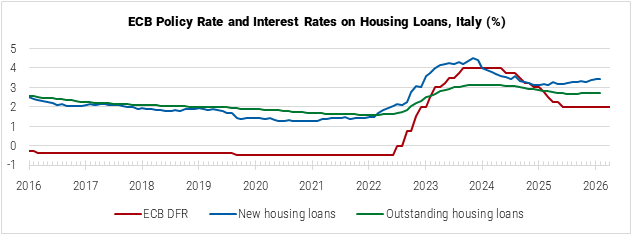
After a series of cuts through 2024 and early 2025, the European Central Bank (ECB) has kept its key rates unchanged since last June, making no further moves at the latest meeting of the monetary policy committee at the end of April 2026. At the same time, in a post-decision press statement, the regulator noted that upside risks to inflation and downside risks to growth have intensified, as the war in the Middle East has led to a sharp increase in energy prices, pushing up inflation and weighing on economic sentiment.
Italy's mortgage loan interest rates:
In light of recent developments, most economists polled by Reuters earlier in April stated the ECB is now likely to raise its key rates in June, although the path after that is highly uncertain and will depend on the intensity and duration of the energy price shock and the scale of its effects on the euro area economy.
In this environment, mortgage interest rates in Italy previously eased from their late-2023 peak levels, although a mild upward pressure appears to persist. In recent months, reflecting the increase in longer-term market yields, the average interest rate on new loans to households for house purchase edged up, reaching 3.44% in February 2026 (up 0.26 points since the same period last year). For outstanding loans, the indicator stood at 2.72% in February 2026, also registering a marginal upward movement since August.
Looking ahead, the Bank of Italy anticipates a potential further increase in market rates due to the impact of global uncertainty. “The increase in market yields observed since the outbreak of the conflict in the Middle East could, were it to persist, generate upward pressures on the cost of bank funding and of lending to firms and households,” said the central bank’s latest economic bulletin.
Data Source: ECB.
Average interest rates on loans to households for house purchase:
| Feb 2026 | YoY | Feb 2025 | YoY | Feb 2024 | |
| New housing loans | 3.44% | ↑ | 3.18% | ↓ | 3.89% |
| - Floating rate and IRF up to 1 year | 3.08% | ↓ | 3.82% | ↓ | 4.97% |
| - IRF of over 1 and up to 5 years | 3.53% | ↑ | 3.08% | ↓ | 4.37% |
| - IRF of over 5 and up to 10 years | 3.68% | ↑ | 3.62% | ↓ | 4.31% |
| - IRF of over 10 years | 3.51% | ↑ | 3.12% | ↓ | 3.64% |
| Outstanding housing loans | 2.72% | ↓ | 2.82% | ↓ | 3.13% |
| - Original maturity up to 1 year | 3.88% | ↓ | 6.23% | ↓ | 6.51% |
| - Original maturity over 1 and up to 5 years | 3.86% | ↓ | 4.17% | ↓ | 4.87% |
| - Original maturity of over 5 years | 2.72% | ↓ | 2.82% | ↓ | 3.13% |
| Data Source: ECB. | |||||
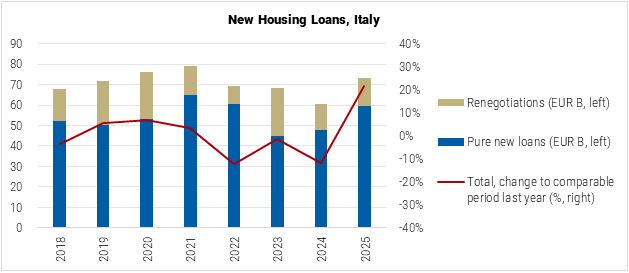
Greater household demand and easier supply conditions on the part of banks supported growth in mortgage lending in Italy throughout 2025, with the total value of new housing loans (including pure new loans and renegotiations) issued between January and December reaching EUR 73.3 billion (USD 82.9 billion), a 21.4% increase compared to 2024. At the same time, it is not yet clear whether the recovery will continue this year, considering the already elevated (relative to EU peers and compared to pre-2022 levels) cost of borrowing, interest rate projections, and overall uncertainty over the macroeconomic environment. In the first two months of 2026, the value of pure new housing loans issued in Italy remained 1.9% below the comparable period last year.
Another factor that could negatively impact lending activity this year is the Italian government’s budgetary measures, including higher taxes on banks, as liquidity risks could prompt individual lenders to cut their credit supply to households and businesses. In a formal opinion issued prior to the Italian government’s 2026-2028 budget approval, the ECB warned that “caution must be taken in particular to ensure that increased tax pressure on credit institutions does not lead to abrupt adjustments to their lending to the real economy, especially given the already moderate levels of bank lending in Italy.”
Data Source: ECB.
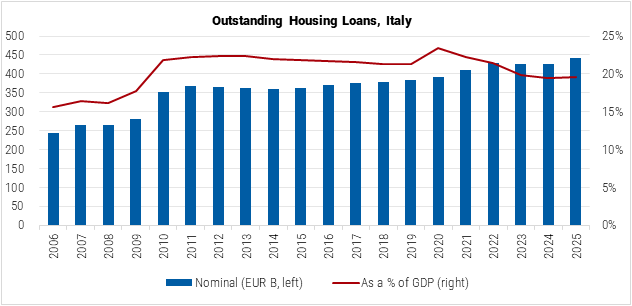
Overall, based on the latest EUROSTAT figures, 17.3% of Italians currently live in owner-occupied residences with an outstanding mortgage or housing loan. The total value of outstanding housing loans in the country, as reported by the ECB, increased by 3.4% in 2025 and reached EUR 444.2 billion (USD 513.4 billion) as of March 2026. The relative size of the market, measured as the loan-to-GDP ratio, remains relatively stable, estimated at 19.5% in 2025.
Data Source: ECB.
Economic and Social Factors
Modest Growth to Continue Amid Global Challenges
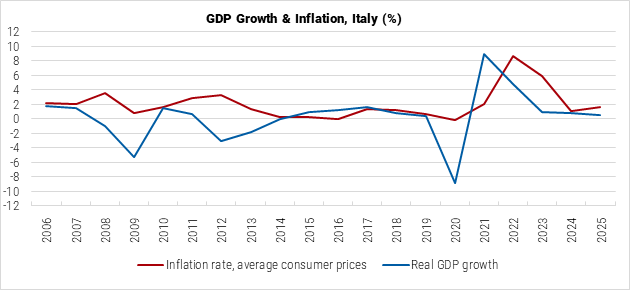
Italy's economic performance has improved over the past decade, following the crises of the early 2010s, and demonstrated resilience to the shocks of recent years. Real GDP growth has remained modest, however, estimated at 0.5% in 2025 (down from 0.8% in 2024 and 0.9% in 2023), and the International Monetary Fund (IMF) forecasts that the economy will maintain this pace of expansion over the next two years. Accounting for global headwinds, the Bank of Italy recently revised its projections downwards, now also expecting 0.5% growth in 2026 and 2027 (compared to respective 0.6% and 0.8% previously projected in December 2025).
“The outbreak of the [Middle East] conflict and the spike in energy prices will have a negative impact on the short-term outlook, squeezing domestic demand in the current quarter and in the two quarters ahead,” the central bank summarised in its April 2026 macroeconomic projections. “Economic activity is assumed to regain strength in early 2027, as inflationary pressures ease.”
At the same time, consumer price index (CPI) inflation in the country accelerated from the average annual level of 1.1% in 2024 to 1.6% in 2025 and was most provisionally reported by Istat at 2.8% in April 2026. According to the Bank of Italy, as a result of the surge in commodity prices, inflation is set to reach the annual level of 2.6% this year, before returning to just below 2.0% in 2027 and 2028. The IMF forecast is somewhat more conservative, also projecting inflation at 2.6% for 2026, but expecting a more gradual easing over the following years, the 2.0% target only reached in 2029.
Data Source: IMF.
As outlined in the 2026 Foundations for Growth and Competitiveness report from the Organisation for Economic Co-operation and Development (OECD), the country’s medium-term growth potential remains constrained by population decline and rapid ageing, with the working-age population projected to drop by more than one-third by 2050 in Istat’s median scenario. The impact of these wider demographic trends is amplified by structural labor market challenges, such as lower labor force participation of women and young people compared to many European peers, as well as significant skills gaps. “A substantial share of young Italians is not in work or training or emigrate,” noted the 2026 OECD economic survey of Italy.
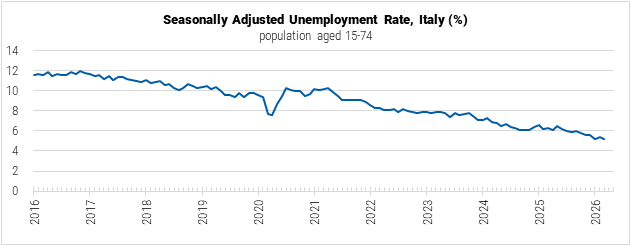
In this environment, despite recent growth in employment and consistently declining unemployment rate (which fell to historical lows and was most recently reported by Istat at 5.2% in March 2026), employment rates in Italy remain lower than in most OECD countries. Looking ahead, the Bank of Italy expects employment to continue growing, albeit at a slower pace, while the unemployment rate is expected to edge up over the next three years.
Data Source: Istat.
Overall, Italy’s economy is large, diversified, and high-value-added. Its medium-term growth prospects, however, remained weighed down by high debt (general government gross debt reached 137.1% of GDP in 2025), demographic factors, and elevated uncertainty linked to global trade policy, geopolitical tensions, and stronger international competition.
In March 2026, Fitch Ratings affirmed Italy’s 'BBB+' standing with a stable outlook.
Sources:
- Italian National Statistical Institute (Istat)
- House Prices (Provisional) – Q4 2025: https://www.istat.it/
- Building Permits Indicators, Fourth Quarter 2025: https://www.istat.it/
- Employment and Unemployment, Provisional Data, March 2026: https://www.istat.it/
- Population and Household Projections, Base 1/1/2024: https://www.istat.it/
- Bank of Italy
- Italian Housing Market Survey. Short-term Outlook - 2025 Q4: https://www.bancaditalia.it/
- Economic Bulletin No. 2, 2026: https://www.bancaditalia.it/
- Macroeconomic Projections for the Italian Economy, April 2026: https://www.bancaditalia.it/
- Ministry of Economy and Finance
- Main Measures of the 2026 Budget Law: https://www.mef.gov.it/
- European Central Bank (ECB)
- ECB Data Portal: https://data.ecb.europa.eu/
- Key ECB Interest Rates: https://www.ecb.europa.eu/
- Monetary Policy Decisions, 30 April 2026: https://www.ecb.europa.eu/
- Opinion of the European Central Bank of 12 December 2025 on the Taxation of Financial Institutions (Con/2025/41): https://eur-lex.europa.eu/
- European Commission
- Economic Forecast for Italy: https://economy-finance.ec.europa.eu/
- Distribution of Population by Tenure Status, Type of Household, and Income group: https://ec.europa.eu/
- International Monetary Fund (IMF)
- Country Overview: Italy: https://www.imf.org/
- Organisation for Economic Co-operation and Development (OECD)
- OECD Economic Surveys: Italy 2026: https://www.oecd.org/
- Foundations for Growth and Competitiveness, 2026: https://www.oecd.org/
- OECD Economic Outlook, Volume 2025 Issue 2, Italy: https://www.oecd.org/
- OECD Italy's Rent Price Index: https://data-explorer.oecd.org/
- Observatory of the Real Estate Market (OMI)
- Residential Market Observatory, Q4 2025 (IT): https://www.agenziaentrate.gov.it/
- National Agency for New Technologies, Energy and Sustainable Economic Development (ENEA)
- FIAIP, ENEA, and I-Com Report Presented to the Senate… (IT): https://www.media.enea.it/
- Scenari Immobiliari
- 2026: A Boom Year for Real Estate After a Bold 2025 (IT): https://www.scenari-immobiliari.it/
- Statistical Dossier on Immigration (IT): https://unipd-centrodirittiumani.it/
- Confindustria Assoimmobiliare
- Call for evidence "European Affordable Housing Plan": https://www.assoimmobiliare.it/
- Idealista
- Nomisma: Real Estate Forecasts Through 2028 (IT): https://www.idealista.it/
- Rent Growth Continues…(IT): https://www.idealista.it/
- Price Evolution of Housing for Rent in Italy: https://www.idealista.com/
- Immobiliare.it
- Property Price Data in Italy: https://www.immobiliare.it/
- Gabetti Group
- G-Market Pulse – Q4 2025 (IT): https://www.gabettigroup.com/
- Nomisma
- Nomisma's 1st Real Estate Market Report 2026 Presented (IT): https://www.nomisma.it/
- Colliers
- Recovering Credit and Rising Investments Boost the Italian Housing Market: https://www.colliers.com/
- Knight Frank
- The Wealth Report 2026: https://www.knightfrank.com/
- Engel & Völkers
- Market Report, Italy 2026 (IT): https://issuu.com/
- Fitch Ratings
- Fitch Affirms Italy at 'BBB+'; Outlook Stable: https://www.fitchratings.com/
- Reuters
- ECB to Raise Rates in June on War-Driven Inflation but Path Beyond Unclear: Reuters Poll: https://www.reuters.com/
- ECB Policymakers See First of Several Rate Hikes in June, Sources Say: https://www.reuters.com/
- ECB Criticises Italy Over Budget Measures Affecting Banks: https://www.reuters.com/