Iceland's Residential Property Market Analysis 2026
While structural demand for housing in Iceland remains supported by demographic trends, market activity has cooled from the extraordinary conditions seen a year earlier, with more moderate price increases now observed in sales and rental segments.
This extended overview from the Global Property Guide covers key aspects of Iceland's housing market and takes a closer look at its most recent developments and long-term trends.
Table of Contents
- Property Prices and Price Index
- Property Demand Trends
- Property Supply Trends
- Rental Market: Rents and Rental Yields
- Mortgage Market and Interest Rates
- Economic and Social Factors
Property Prices and Price Index
House prices in Iceland continue to rise, although the pace of growth has clearly moderated. According to Statistics Iceland’s Residential Property Market Price Index, the nationwide index rose by 3.71% year-on-year in February 2026, down from 11.89% at its most recent peak in September 2024. Within the Capital Region, detached house prices increased by 5.35% year-on-year, while apartment prices rose by a somewhat more moderate 4.38%, indicating that lower-density housing has remained relatively firmer even as overall market momentum has softened.
Iceland's house price annual change:
Supplementary transaction data from the Housing and Construction Authority (HMS) also points to a widening divergence between housing types in the capital area. As of January 2026, the three-month median purchase price in the Capital Region reached ISK 72,662,461 (USD 582,146) for apartments, down by 2.70% year-on-year, and ISK 148,029,890 (USD 1,185,964) for detached houses, up by 1.67% year-on-year.
In its March 2026 market report, HMS commented that “one likely explanation for the growing price gap between apartment buildings and detached homes in the capital area is an imbalance in supply, as new housing development in recent years has focused almost exclusively on apartment buildings”. The authority added that this suggests new supply is not fully aligned with demand, which could continue to support detached-home prices. Outside the Capital Region, by contrast, the price gap between the two housing types has been more stable, which HMS linked to a relatively greater supply of newly built detached homes in those areas.
Average purchase price of residential properties, by region and property type:
| Detached Houses, ISK Jan 2026 |
Detached Houses, USD Jan 2026 |
YoY | Apartments, ISK Jan 2026 |
Apartments, USD Jan 2026 |
YoY | |
| Capital Region | ISK 148,029,890 | USD 1,185,964 | 1.67% | ISK 72,662,461 | USD 582,146 | -2.70% |
| Vicinity of the Capital Region | ISK 81,540,287 | USD 653,273 | 0.99% | ISK 54,836,621 | USD 439,332 | -0.29% |
| Other rural areas | ISK 57,261,232 | USD 458,757 | -8.53% | ISK 48,375,356 | USD 387,567 | 1.40% |
| Note: Exchange rate as of January 2026: USD 1 = ISK 124.8182. | ||||||
| Data Source: HMS. | ||||||
The broader market backdrop likewise points to weaker seller pricing power than in earlier phases of the cycle. In the March 2026 HMS survey, nine out of ten estate agents said the market was a buyer’s market, while 64% reported that prices were often or always reduced during the sales process. At the same time, only 6.6% of homes sold above asking price in January, the lowest share recorded since 2019. This softer tone has coincided with a sharp increase in for-sale inventory, with the number of homes listed nationally rising from around 5,100 at the beginning of January to just over 6,000 by early March, an increase of nearly 18% since the turn of the year.
Looking ahead, Iceland’s housing market appears set for a period of softer price growth rather than outright correction. Íslandsbanki forecasts nominal house price growth of 3.8% in 2026, followed by a pickup to 6.4% in 2027 and 7.2% in 2028, implying a much calmer near-term pricing environment than in recent years before somewhat stronger momentum returns later in the forecast horizon.
At the same time, Landsbankinn points out that house prices have recently been rising more slowly than consumer prices, meaning that real house prices have been declining even as nominal values continue to edge upward. This suggests that the near-term adjustment is likely to take place mainly through subdued nominal appreciation and continued real-price compression, rather than through a sharp fall in headline prices. Even so, persistent supply mismatches in parts of the market, especially in the detached-home segment in the Capital Region, may continue to support firmer pricing in selected submarkets.
Property Demand Trends
Activity Softens, Though Structural Housing Need Persists
Housing demand in Iceland remained supported by demographic growth in 2025, but market activity cooled noticeably from the extraordinary conditions seen a year earlier. Statistics Iceland reported a population of 394,530 at the end of Q4 2025, of whom 252,080, or 64%, lived in the Capital Region. Net migration remained positive throughout the year and totaled 3,390 people, continuing to support underlying housing need, particularly in and around Reykjavík, where demand is most concentrated.
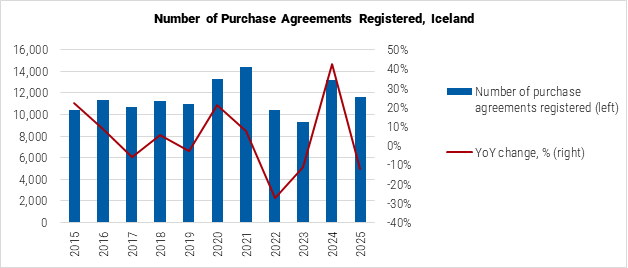
According to data from HMS, 11,657 residential property purchase agreements were registered nationwide in 2025, representing an 11.91% year-on-year decline. This drop should be viewed partly as a normalization from an unusually high 2024 base, when transaction volumes were temporarily lifted by the activities of Þórkatla, the state-owned real estate company established in response to the housing disruption in Grindavík following heightened volcanic activity.
Compared with 2023 and 2022, transaction volumes in 2025 remained 25.60% and 11.79% higher, respectively, while still staying close to the ten-year average. This suggests that demand did not disappear, but rather settled back toward more normal levels after an exceptional prior year. As Íslandsbanki observed, the market was “reasonably well balanced rather than frozen.”
Data Source: HMS.
Geographically, the Capital Region remained the main hub of housing market activity, accounting for 7,657 purchase agreements, or 66% of total transactions nationwide. The sharpest year-on-year decline, at 58.20%, was recorded in the Southern Peninsula, reflecting the reversal of the unusually strong Þórkatla-related activity seen there in 2024.
Number of registered purchase agreements for residential properties, by region:
| Number of Registered Residential Purchase Agreements, 2025 |
YoY | |
| Eastern Region | 275 | 16.53% |
| Capital Region | 7,657 | -2.16% |
| Northeastern Region | 1,013 | -3.89% |
| Northwestern Region | 102 | -25.00% |
| Southern Region | 1,076 | -12.09% |
| Southern Peninsula | 866 | -58.20% |
| Westfjords | 177 | 12.03% |
| Western Region | 491 | -6.83% |
| Iceland Total | 11,657 | -11.91% |
| Data Source: HMS. | ||
Demand continued to soften at the start of 2026. HMS recorded 1,391 residential purchase agreements in January and February, down 17.15% from the corresponding period of 2025. The weaker start to the year reflects not only the fading of the extraordinary Grindavík-related effects, but also continued caution among buyers amid still-tight financing conditions. Landsbankinn noted that the Supreme Court rulings on interest rates “temporarily increased uncertainty and constrained credit supply”, adding to the softer tone in market activity.
Looking ahead, Íslandsbanki expects the housing market to be “fairly tranquil” in 2026, with high interest rates, tight borrowing conditions, and limited access to credit still keeping demand in check. At the same time, the bank stresses that “underlying demand for housing remains,” citing demographic factors, including the age distribution of the population and the need for first-time buyers to enter the market. Landsbankinn similarly says demand “may increase again” once the recent period of uncertainty has passed and as interest rates decline over the coming quarters. Overall, this points to a subdued near-term demand environment, with any more meaningful pickup likely to emerge only gradually.
Property Supply Trends
Slower Completions Reflect Cautious Delivery and Rising Unsold Stock
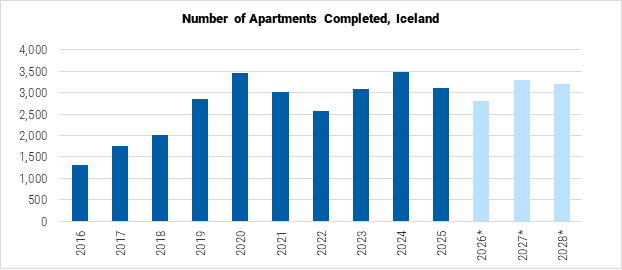
New-build supply in Iceland weakened in terms of completed output in 2025 and at the start of 2026, but the broader picture remains more mixed than the completions data alone suggest. HMS reports that 3,103 new dwellings were completed in 2025, down 10.99% year-on-year. This downward trend continued into early 2026, with 264 dwellings completed in January and February, marking a 54.87% drop compared to the corresponding period of 2025. The authority, however, notes that the decline in completed dwellings may reflect not only slower building activity, but also more cautious delivery behavior by developers under current market conditions.
Note: *HMS Forecast. Chart data indicates the medium bracket of the HMS forecast.
Data Source: HMS.
A key feature of the current supply cycle is the build-up of completed but unoccupied stock. According to HMS, there are “indications that developers are postponing final finishing of dwellings,” a development that “may be explained by abundant supply and weak sales of new dwellings in the market.” This is visible in the sharp rise in completed dwellings that have not yet been taken into use, which reached 1,409 units in March 2026, up from 707 a year earlier. In other words, the supply-side adjustment is not only about fewer completions; it is also about a growing volume of finished homes that are being released or absorbed more slowly than before.
A further supply-side constraint is that development conditions remain more challenging than during the earlier upswing. In its March 2026 monthly report, HMS notes that return on equity in construction declined for a third consecutive year in 2024 and says the weaker profitability likely reflects a higher interest-rate environment, cost pressures, and more difficult operating conditions in the sector. This helps explain why the current market is characterized not only by slower sell-through of new units but also by greater caution around project completion and, potentially, the timing of new project launches.
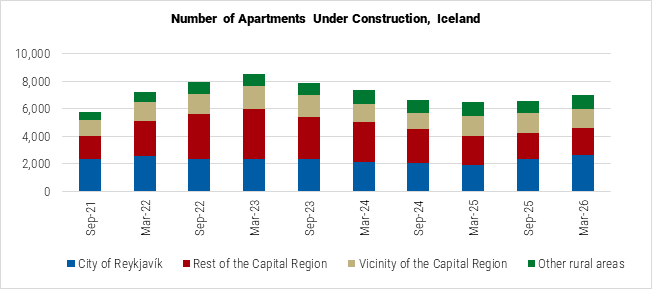
At the same time, the development pipeline remains substantial. According to the biannual construction census from HMS, as of March 2026, 6,988 dwellings were under construction at various stages of development nationwide, marking a 7.94% increase compared with the previous year. The strongest increase was recorded in Reykjavík, where the number of dwellings under construction rose by 36.64% year-on-year. By contrast, the rest of the capital area recorded a 7.44% decline, while the municipalities around the capital area and other rural areas saw modest decreases of 1.82% and 1.50%, respectively.
Data Source: HMS.
Looking ahead, HMS expects 2,500-3,000 dwellings to be completed in 2026, followed by 2,800-3,700 in both 2027 and 2028, while also cautioning that construction timelines and uncertainty over whether projects proceed as currently recorded may affect the outcome. The most likely near-term scenario is therefore one of softer completions in 2026, followed by only a gradual recovery, as the market works through elevated finished inventory and developers remain selective about bringing projects fully to completion. Over the medium term, however, the still-substantial construction pipeline and the recent rebound in new starts suggest that supply capacity remains in place. If financing conditions continue to improve, the market should gradually move toward a better balance, with unsold completed stock being absorbed first and a firmer pace of project delivery more likely thereafter.
Rental Market: Rents and Rental Yields
Signs of Market Cooling Balanced by Increased Inflationary Pressures
The Icelandic rental market began to exhibit signs of cooling in the second half of 2025, with slowing real price increases and smaller nominal price increases.
Iceland's rent price index:
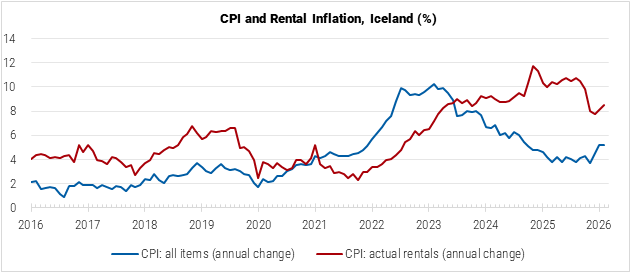
At the same time, as general price dynamic in the country continues to directly affect rents in the majority of existing rental contracts (with rates in about 70% of valid leases linked to the CPI and typically updated monthly), rental inflation in the country re-accelerated somewhat in recent months along with the rise in overall inflation at the end of 2025 and early 2026. In February, the actual rentals for the housing component of the consumer price index (CPI) reported by Statistics Iceland recorded an 8.5% annual change (up from 8.1% in January and 7.7% in December), while the overall price growth reached 5.2% during the same period (up from 3.7% in November and 4.5% in December).
The movement of the HMS rental price index based on newly registered leases in the capital region, which had been slowing in late 2025, appears to have picked up pace as well, demonstrating a 1.2% month-on-month and 5.2% year-on-year growth in February 2026, up from the respective -1.4% and 5.0% reported in December. The latest overview from HMS, however, highlights that the annual increase in the rental index was equal to annual inflation in February, suggesting that “rental prices have remained stable in real terms” over twelve months.
Looking ahead, the January 2026 macroeconomic forecast from Íslandsbanki, one of the country's largest banks, expects the slowdown in the rental segment to continue, projecting 5% growth in rents this year, slightly above its house price forecast. Over the course of the next two years, lower interest rates are expected to boost activity in the housing market and moderate rental growth further to 3.9% in 2028, in line with the general price level.
Data Source: Statistics Iceland.
In nominal terms, the average market rent in newly registered contracts in Iceland reached ISK 268,926 (USD 2,197) per unit in February 2026, according to HMS. 1-room units were rented for ISK 190,843 (USD 1,559) per month, 2-room units for ISK 252,006 (USD 2,059) per month, and 3-room units for ISK 294,344 (USD 2,405) per month, on average.
On a per square meter basis, the national average for newly registered market contracts reached ISK 4,178 (USD 33.28) in Reykjavik, ISK 4,047 (USD 32.18) in the Capital Region, and ISK 3,777 (USD 30.07) nationwide.
As for gross rental yields for residential properties in Iceland, according to Global Property Guide research, the indicator averaged 5.34% nationwide in October 2025, up from 5.20% previously reported in April 2025. For Reykjavik, the average yield was slightly lower at 5.05%.
Average market rent in newly registered contracts by submarket:
| Avg Rent, ISK/sqm Feb 2026 |
Avg Rent, USD/sqm Feb 2026 |
YoY Feb 2026 vs Feb 2025 |
|
| Iceland | ISK 3,777 | USD 30.07 | 2.6% |
| Capital Region | ISK 4,047 | USD 32.18 | 2.7% |
| Reykjavík | ISK 4,178 | USD 33.28 | 2.6% |
| Kópavogur | ISK 3,679 | USD 30.02 | 0.1% |
| Hafnarfjörður | ISK 3,796 | USD 30.82 | 0.6% |
| Akureyri | ISK 3,341 | USD 24.75 | 10.3% |
| Reykjanesbær | ISK 3,931 | USD 29.91 | 7.4% |
| Note: Exchange rate as of February 2026: USD 1 = ISK 122.4. | |||
| Data Source: HMS. | |||
In general, the rental market in Iceland has grown in importance over the past decades, leading to an increased share of rental properties in the overall dwelling stock, persistent rental inflation, and active development of institutional landlords. “Rapid population growth due to immigration and rising housing prices outpacing rents has increased demand for rental housing. In this environment, large for-profit rental companies have emerged while the government has also supported the development of non-profit rental companies,” HMS analysis noted earlier last year.
According to the authority’s surveys on housing patterns, around 16% of adults in Iceland were in the rental market as of 2024, an increase from 13% in 2020, which is generally consistent with the earlier household tenure status estimates from Statistics Iceland. At the same time, HMS believes that the available data held by public bodies in the country is insufficient to assess the true size of the market and suggests that around 37 thousand adults (primarily foreigners) might be undercounted in the surveys, which would bring the actual share of tenants in Iceland to 29% of the adult population. Íslandsbanki recently estimated the size of the rental market at 20-25% of households in the country.
According to the 2025 HMS rental market survey, 41% of tenants in Iceland rent from individual private landlords, 15% from friends and relatives, 12% from private rental companies, and about 9% from municipalities. The remaining tenants are split between non-profit rental companies, specialized student housing, and housing associations.
Mortgage Market and Interest Rates
Policy Shift Interrupts Interest Rate Easing, Lending Activity Subdued After Court Ruling
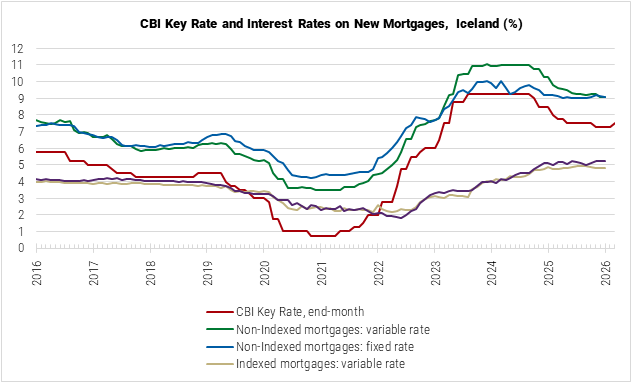
In March 2026, the Central Bank of Iceland (CBI) decided to raise its key rate for the first time since 2023, bringing it up 25 bps to 7.5%. Commenting on the decision, the regulator noted that although most economic indicators suggest that economic activity in Iceland has slowed, underlying inflation has risen again and reached its highest point in over a year. Inflation expectations have also begun to rise, driven, in part, by heightened concerns over energy prices.
“Steep increases in the price of oil and other commodities following the escalation of the conflict in the Persian Gulf have already led to further rises in inflation expectations in the bond market. If the conflict drags on, there is the risk that price increases will become more widespread, especially when inflation expectations are as high as they are at present,” said the CBI Monetary Policy Committee in a statement.
This move implies the policy easing cycle, which was previously expected to continue from spring 2026 through mid-2027, eventually bringing the rate down to 5.5%-6.0%, will be delayed, as rates are likely to remain restrictive through most of this year. According to a recent assessment from Íslandsbanki, “another rate hike is likely in May, and monetary easing will probably have to wait until Q4 2026”.
Data Source: CBI.
While the latest policy shift is not yet reflected in the officially reported weighted average interest rates on new mortgages to households based on data from the domestic systemically important banks, the previously expected declines in rates on mortgages are now also delayed into late 2026 or beyond. The latest available CBI figures from January 2026 show the average variable rate for mortgages not indexed to inflation at 9.07% (down from 10.28% in January 2025) and the average fixed rate at 9.05% (down from 9.22% in January 2025). For inflation-indexed mortgages, the average variable rate in January 2026 stood at 4.83% (down from 4.87% in January 2025), and the average fixed rate was recorded at 5.23% (up from 5.10% in in January 2025).
At the time of this research in late March 2026, Iceland’s largest commercial banks had already started revising their interest rates. The best fixed-rate offers ranged 8.10%-8.25% for non-indexed mortgages and 4.50%-4.74% for indexed mortgages. Variable-rate non-indexed loans were offered by two out of three major lenders at 8.94%-9.94%.
Overall, due to a history of persistent inflation and high interest rates, Iceland’s mortgage system is largely based on so-called indexed loans, which offer lower nominal rates and initial payments in combination with inflation-based indexation of the loan principal. While indexed loans continue to represent the majority of the Icelandic mortgage market (65.5% of the stock, based on HMS data), the traditional non-indexed mortgages previously gained popularity during the period of historically low interest rates in 2020-2021, and, according to HMS, demand for this type of loans increased last year in parallel with the reduction in prime rates.
Data Source: HMS.
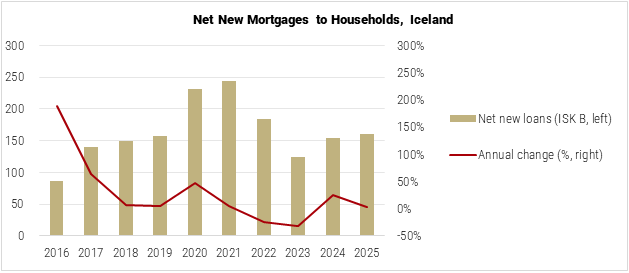
Based on the latest HMS data, net new housing loans to households from financial institutions in Iceland (including banks, pension funds, and government funds) totaled ISK 159.7 billion (USD 1.2 billion) in 2025, demonstrating a moderate 3.7% year-on-year increase. At the same time HMS analysis points out that while bank lending has begun to increase again in recent months after a halt following the Supreme Court's ruling in a case on variable interest transparency in mid-October 2025 (which led to most credit institutions suspending processing of various types of mortgages, especially loans with variable interest rates), “loan supply of the three largest commercial banks is less now than before the interest rate ruling”.
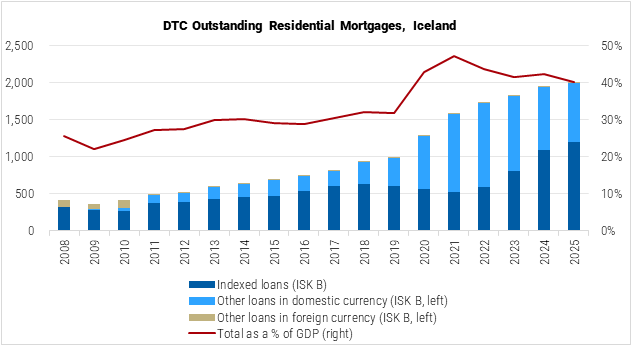
The total value of outstanding residential mortgages maintained by the deposit-taking corporations (DTC) in Iceland also continued to expand (2.5% annual growth in 2025, following 7.1% in 2024 and 5.1% in 2023), reaching ISK 2.0 trillion (USD 16.0 billion) in January 2026. Represented as a percentage of GDP, DTC mortgages went down from the peak level of 47.1% in 2021 to an estimated 40.1% in 2025. Combined with outstanding loans from government funds and the largest pension funds, the stock equaled an estimated 58.5% of GDP in 2025 and stood at ISK 2.93 trillion (USD 23.4 billion) as of January 2026, according to preliminary ICB figures.
Statistics Iceland estimates that as of 2022, more than half of households in the country (52.3%) were homeowners with a mortgage.
Data Sources: CBI, Statistics Iceland.
Economic and Social Factors
Slower Growth and Above-Target Inflation, Referendum on EU Talks Ahead
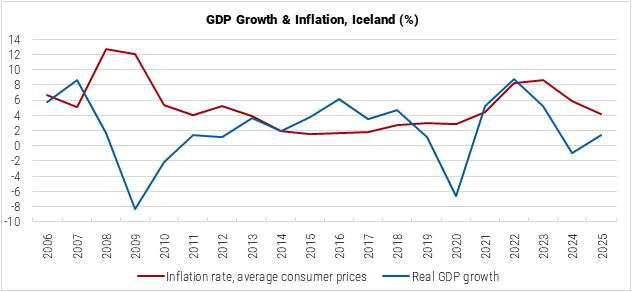
Following a contraction in 2024, Iceland’s economy began recovering in 2025, although growth remained sluggish, held back by export weakness and modest private consumption reflecting the impact of tight macroeconomic policies. According to Statistics Iceland, real GDP growth for the year reached 1.3%, and while earlier assessments expected a gradual pick-up over the next two years (CBI growth forecast of 2.0% in 2026 and 2.2% in 2027 and corresponding International Monetary Fund (IMF) projections of 2.3% and 2.4%), the re-tightening of the monetary stance initiated by the central bank in March could further curtail economic activity.
Despite slower economic activity, the consumer price index (CPI) inflation in the country remains above the 2.5% target, re-accelerating from 3.7% in November and 4.5% in December 2025 to 5.2% in February 2026, as reported by Statistics Iceland. The latest CBI forecast raised the projected average annual inflation level to 4.3% for 2026 and 2.7% for 2027.
Data Source: IMF.
In Iceland’s labor market, based on labor force register data published by Statistics Iceland, the share of foreign workers in the employed population continues to rise, reaching 24.6% in 2025 (up from 12.0% in 2015 and only 6.9% in 2005). At the same time, strong labor importation, which had previously eased workforce constraints, has eased, with weaker labor demand now accommodated by lower migration inflows, as noted by the European Commission forecast.
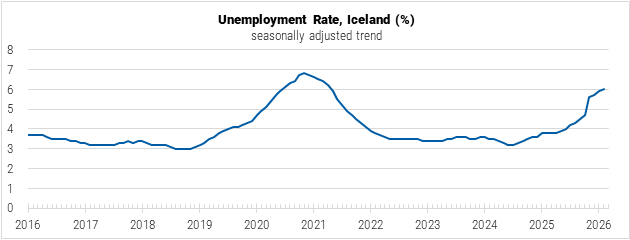
Although the labor market remains tight overall, the unemployment rate has started to rise, the seasonally adjusted trend most recently reported at 6.0% in February 2026, up from 3.8% a year ago. It is expected, however, to peak this year and stabilize close to the 4% neutral rate over the forecast period. The macroeconomic forecast from Íslandsbanki also expects moderate real wage gains to continue over the forecast horizon despite slower growth in nominal wages.
Data Source: Statistics Iceland.
Overall, the IMF sees medium-term prospects for Iceland’s economy as favorable, with continued diversification of the economy toward higher value-added export-oriented sectors anticipated to bolster productivity growth, while inflows of foreign labor are expected to support a modest increase in employment.
Reflecting the potential for Iceland’s budgetary performance to strengthen over the next two years (leading to a further decline in general government debt), S&P revised its outlook on the country’s 'A+/A-1' sovereign ratings from stable to positive in early March 2026. Prior to withdrawing ratings (for commercial reasons), Fitch upgraded Iceland to ‘A+’ in February 2026, also citing the country’s strengthened public finances and projected path of declining debt, underpinned by a strong political commitment to fiscal prudence.
At the same time, as highlighted by the European Commission’s forecast, risks to Iceland’s economic outlook are tilted to the downside, stemming from the effect of tight fiscal policy, persistent high interest rates on domestic demand, and the impact of the uncertain global environment on export recovery.
In light of heightened geopolitical tensions, trade concerns, and debates over national currency stability, Iceland’s government has reconsidered the possibility of joining the EU, previously abandoned more than a decade ago. The referendum on EU negotiations is now scheduled for August 2026.
Sources:
- Statistics Iceland
- National Accounts: https://www.statice.is/
- Labor Force Survey: https://www.statice.is/
- Labor Force Register Data: https://www.statice.is/
- Consumer Price Index: https://www.statice.is/
- Housing: https://www.statice.is/
- Residential Property Market Price Index: https://px.hagstofa.is/
- Iceland’s Population, Q4 2025 (press release): https://www.statice.is/
- Economic Forecast, November 2025: https://www.statice.is/
- Central Bank of Iceland (CBI)
- Key Interest Rate: https://www.cb.is/
- Statement of the Monetary Policy Committee 18 March 2026: https://cb.is/
- Publications: https://www.cb.is/
- Monetary Statistics: https://cb.is/
- Icelandic Parliament (The Althingi)
- Rent Act No. 36/1994 (IS): https://www.althingi.is/
- Housing and Construction Authority (HMS)
- Housing Market Report, March 2026 (IS): https://hms.is/
- Housing Market Report, February 2026 (IS): https://hms.is/
- Dashboard of Completed Apartments (IS): https://hms.is/
- Turnover and Number of Purchase Agreements (IS): https://hms.is/
- Apartments Under Construction, March 2026 (IS): https://hms.is/
- Interest Rate Table (IS): https://hms.is/
- Housing and Rental Price Indices (IS): https://hms.is/
- Key Figures from the HMS 2025 Rental Market Survey (IS): https://hms.is/
- Rental Market Roadmap 2025 (IS): https://hms.is/
- European Commission
- Autumn 2025 Economic Forecast for EFTA Countries: https://economy-finance.ec.europa.eu/
- International Monetary Fund (IMF)
- Country Overview: Iceland: https://www.imf.org/
- 2025 Article IV Staff Report: https://www.imf.org/
- Organization for Economic Co-operation and Development (OECD)
- OECD Economic Outlook, Volume 2025 Issue 2, Iceland: https://www.oecd.org/
- S&P Global
- Research Update: Iceland Outlook Revised To Positive On Strengthening Fiscal Position; 'A+/A-1' Ratings Affirmed: https://www.spglobal.com/
- Fitch Ratings
- Fitch Upgrades Iceland to 'A+'; Outlook Stable; Withdraws Ratings: https://www.fitchratings.com/
- Islandsbanki
- Macroeconomic Forecast: Under Unsettled Skies: https://cdn.islandsbanki.is/
- Policy Rate Hike Coupled With Significantly Sterner Tone: https://www.islandsbanki.is/
- Interest Table: https://cdn.islandsbanki.is/
- Arion Bank
- Interest Rate Table (IS): https://www.arionbanki.is/
- Landsbankinn
- Monthly Newsletter, March 2026: https://www.landsbankinn.is/
- Monthly Newsletter, February 2026: https://www.landsbankinn.is/
- Monthly Newsletter, January 2026: https://www.landsbankinn.is/
- Interest Rate Table: https://www.landsbankinn.is/
- Reuters
- Iceland Plans Now or Never Referendum on EU Negotiations: https://www.reuters.com/
- RÚV
- Thousands of Loans to be Reviewed after Supreme Court Interest Rate Ruling: https://www.ruv.is/