Puerto Rico's Residential Real Estate Market Analysis 2026
Puerto Rico’s housing market is on a recovery path, marked by rising residential property prices driven by increasing demand, a buoyant tourism sector, and improving construction activity. Yet the overall economy remains volatile.
This extended overview from the Global Property Guide provides a comprehensive analysis of Puerto Rico’s housing market, detailing recent developments, price and rental trends, supply-demand dynamics, and regional variations.
Table of Contents
- Property Prices and Price Index
- Property Demand Trends
- Property Supply Trends
- Rental Market: Rents and Rental Yields
- Mortgage Market and Interest Rates
- Historic Perspective
- Economic and Social Factors
Property Prices and Price Index
In the fourth quarter of 2025, the seasonally-adjusted purchase-only house price index in Puerto Rico rose strongly by 14.95% from a year earlier, following year-on-year growth of 2.55% in Q3 2025, 12.98% in Q2 2025, 14.78% in Q1 2025, and 17.27% in Q4 2024, according to the Federal Housing Finance Agency (FHFA). It marked the third biggest year-on-year increase recorded since Q1 2021.
When adjusted for inflation, house prices across the island were up by 12.78% during the same period, its seventh consecutive quarter of year-on-year growth.
Quarter-on-quarter, house prices increased strongly by 13.41% (13.29% inflation-adjusted) in Q4 2025 – its biggest quarterly growth in eleven years.
Puerto Rico's house price annual change:
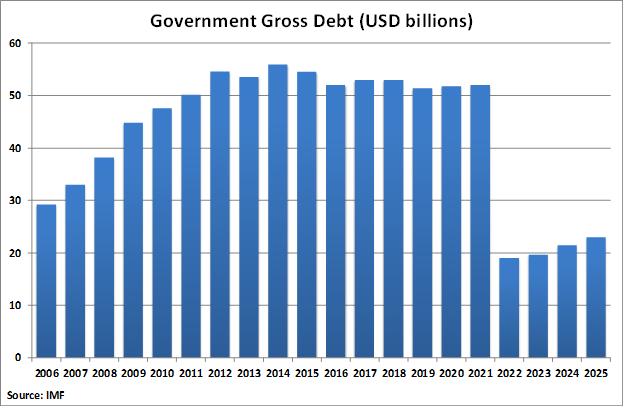
The Puerto Rican housing market has suffered tremendously for most of the decade. The island has experienced a prolonged economic crisis, massive debt, high unemployment, and continuing population loss. With US$70 billion in debt and US$50 billion in pension liabilities, Puerto Rico’s bankruptcy filing in May 2017 was the biggest in the history of the United States.
In recent years, the housing market has shown signs of recovery, despite the adverse effects of the COVID-19 pandemic and global economic slowdown. This momentum, however, faces growing risks from global uncertainties such as geopolitical conflicts, inflationary pressures, and tightening financial conditions.
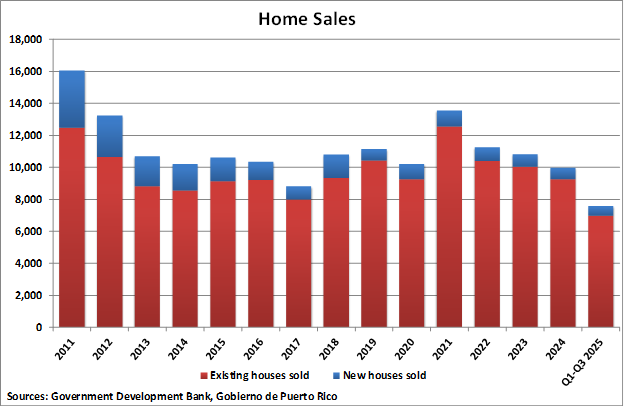
Property demand indicators are showing some improvements, with both the total number and value of home sales now increasing. In the first nine months of 2025, the total number of houses sold in Puerto Rico rose by a modest 2.8% to 7,601 units as compared to the same period last year, following annual declines of 7.5% in 2024, 4% in 2023, and 17% in 2022, based on figures from the Office of the Commissioner of Financial Institutions (OCIF).
In terms of value, total home sales rose strongly by 11.4% y-o-y to US$1.83 billion in the first nine months of 2025, following an annual growth of 6.8% in 2024 and declines of 2.4% in 2023 and 12.1% in 2022.
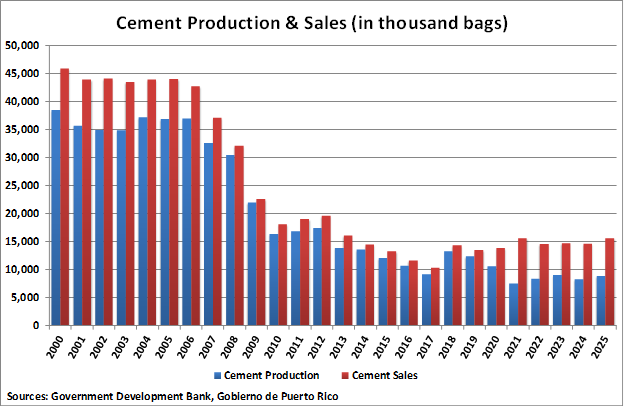
Cement production and sales, key indicators of the current condition of the construction industry, are picking up again. During 2025, cement production rose by 8.2% y-o-y to 8.87 million bags, and cement sales were up by 6.6% y-o-y to 15.56 million bags.
After suffering a pandemic-induced contraction of 4.2% in 2020, the Puerto Rican economy grew by a meager 0.4% in 2021, 3.6% in 2022, and another 0.6% in 2023. Then in 2024, the island recorded a modest economic growth of 2.1%, primarily driven by robust domestic consumption, as well as increased exports, according to the Statistical Institute of Puerto Rico.
The Puerto Rican economy showed mixed but generally more resilient performance in 2025, with growth supported by continued federal reconstruction spending and steady labor market conditions. While earlier projections from the International Monetary Fund (IMF) pointed to a possible contraction, more recent estimates from the Puerto Rican government indicate that the economy likely posted a real GDP growth rate of around 2.2% in 2025, driven in part by sustained disbursements of federal recovery funds, including Community Development Block Grant (CDBG) allocations.
However, energy continues to pose a significant challenge in Puerto Rico, where electricity costs remain persistently high. Global energy market volatility, primarily driven by the ongoing war in the Middle East, is adding upward pressure on costs.
Puerto Rico’s economy is projected to remain subdued this year, with the IMF forecasting a slight contraction of 0.1%.
Property Demand Trends
Housing demand improving
Property demand indicators are showing some improvements, with both the total number and value of home sales now increasing.
In the first nine months of 2025, the total number of houses sold in Puerto Rico rose by a modest 2.8% to 7,601 units as compared to the same period last year, following annual declines of 7.5% in 2024, 4% in 2023, and 17% in 2022, based on figures from the Office of the Commissioner of Financial Institutions.
In January-September 2025:
- For existing houses, which accounted for 91.9% of total transactions, sales increased by 1.7% y-o-y to 6,982 units, after falling by 7.7% in 2024, 3.7% in 2023, and 17% in 2022.
- For newly built houses, sales were up strongly by 16.8% y-o-y to 619 units, following annual declines of 5.3% in 2024, 7.9% in 2023, and 16.3% in 2022.
Total home sales averaged 10,050 units annually in the past decade (2014-2024).
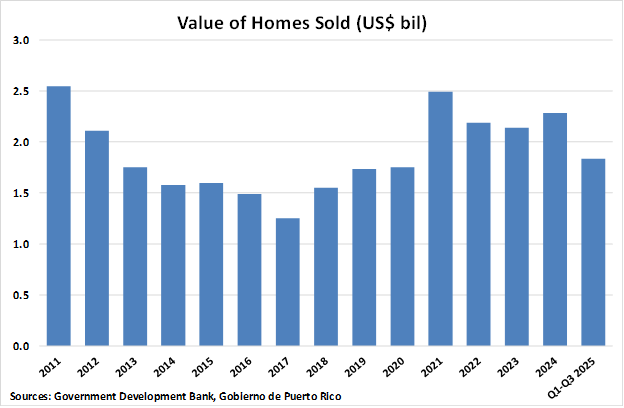
In terms of value, total home sales rose strongly by 11.4% y-o-y to US$1.83 billion in the first nine months of 2025, following an annual growth of 6.8% in 2024 and declines of 2.4% in 2023 and 12.1% in 2022, according to figures from OCIF.
Over the same period:
- For existing houses, sales value rose by 7.4% y-o-y to US$1.56 billion, following an annual growth of 5% in 2024 and contractions of 4% in 2023 and 12% in 2022.
- For newly built houses, sales value skyrocketed by 41.3% y-o-y to US$271.74 million, following annual increases of 20.7% in 2024 and 12.2% in 2023 and a drop of 12.8% in 2022.
U.S. mainlanders account for a substantial share of property demand in Puerto Rico. Foreigners can freely buy property on the islands. It is important to hire a real estate agent, as knowledge of Spanish is essential. A foreigner can alternatively buy through a corporation (US$300 for Corporate Resolution). Registering a property by a corporation can be completed in around 15 days.
Property Supply Trends
Residential construction activity recovering
Cement production and sales, a key indicator of the construction sector’s health, are showing renewed signs of improvement.
During 2025:
- Cement production increased by 8.2% y-o-y to 8.87 million bags in 2025, following an annual decline of 9% in 2024 and increases of 8.6% in 2023 and 11.6% in 2022, according to the Office of the Commissioner of Financial Institutions (OCIF).
- Cement sales were up by 6.6% to approximately 15.56 million bags as compared to a year earlier, after a slight contraction of 0.8% in 2024, a meager growth of 1.3% in 2023, and a decline of 6.8% in 2022.
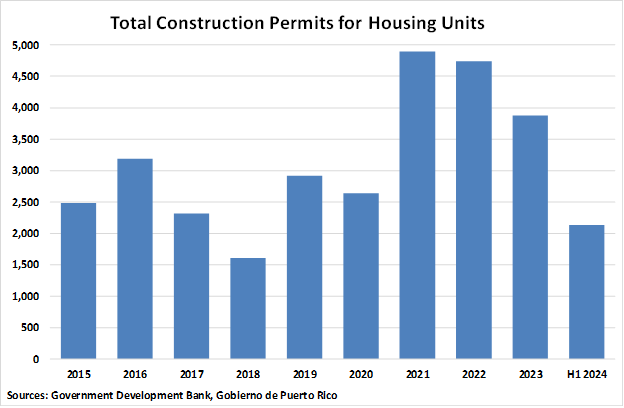
In 2025, the total number of construction permits issued for housing units in Puerto Rico showed modest improvement, with activity stabilizing after the stagnation observed in 2024, when permits stood at 2,133 in the first half of the year. This marks a gradual recovery from earlier contractions of 18.2% in 2023 and 3.2% in 2022, supported by ongoing reconstruction efforts and resilient housing demand.
Looking ahead to 2026, permit activity is expected to increase slightly but remain below pre-pandemic levels, as high construction costs, labor constraints, and permitting bottlenecks continue to weigh on the pace of new housing supply.
Rental Market: Rents and Rental Yields
Rental yields are good, rental market remains volatile
Rental yields in Puerto Rico are good, averaging 7.09% in Q1 2026, up from 5.26% in the previous year but still down from 8.42% two years ago, according to research conducted by the Global Property Guide.
But rental yields vary considerably by city:
- In San Juan, apartments offer gross rental yields ranging from 3.49% to 5.2% in Q1 2026, with a city average of 4.18%.
- In Isla Verde, rental yields for apartments range from 6.74% to 8% in Q1 2026, with a city average of 7.21%.
Puerto Rico’s rental market remains volatile, with a vacancy rate of about 12.3%, up from 10% in 2010 and 7.4% in 2000, mainly due to continued population loss, according to the U.S. Department of Housing and Urban Development (HUD). More recent assessments indicate that vacancy rates have remained at roughly similar elevated levels, at around 12% to 13% in 2025, suggesting that structural weaknesses in the rental market persist despite localized increases in demand.
“Continued population loss in Puerto Rico has led to increasingly soft rental market conditions and rising vacancy rates,” said HUD.
In San Juan, the average monthly rent for one-bedroom apartments stood at US$1,900 in Q1 2026, while it was US$2,400 for two-bedroom apartments. Over the same period, rents for larger three-bedroom (or more) apartments start at US$2,600 per month.
Round-trip transaction costs, i.e., the costs of buying and selling a property, are very low in Puerto Rico.
Mortgage Market and Interest Rates
Residential mortgage loans continue to increase
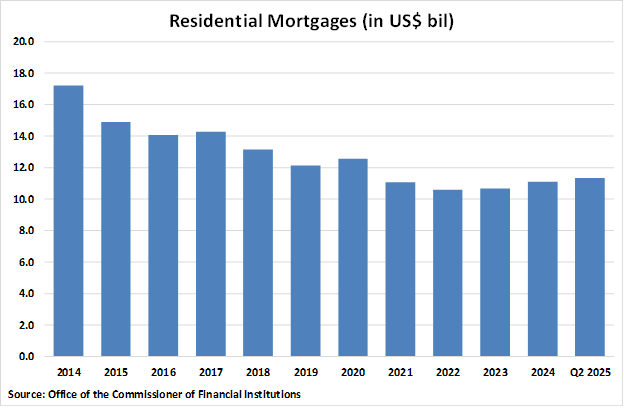
By the end of the first half of 2025, the total amount of residential mortgage loans in all of the island’s financial institutions rose by a modest 4.8% to US$11.35 billion as compared to the same period in the preceding year, according to OCIF. Yet it remains far below the US$17.22 billion in residential mortgage loans recorded in 2014.
Prior to this, residential mortgage loans saw annual growth of 3.9% in 2024 and 0.8% in 2023 and declines of 4.4% in 2022 and 11.8% in 2021.
Though as a percent of GDP, the size of the residential mortgage market in Puerto Rico remained at about 9.3% in 2025, nearly unchanged in the past four years.
Residential foreclosures falling sharply, delinquent mortgages also declining
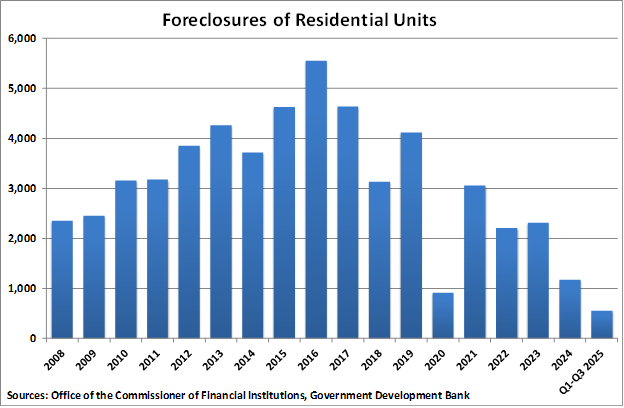
In the first three quarters of 2025, residential foreclosures in Puerto Rico fell sharply by 40% to 555 units as compared to the same period in the prior year, according to data released by OCIF. The decline suggests easing financial distress among homeowners and a more stable housing market environment.
Similarly, delinquent mortgages continue to fall. As of June 2025, there were a total of 342,589 delinquent mortgages recorded in Puerto Rico, down by 1.2% from 342,589 in the same period in the preceding year. This was equivalent to about US$31.2 billion.
During the onset of the Covid-19 pandemic, residential foreclosures dropped sharply due to the imposition of moratoriums to help struggling homeowners. As a result, the number of foreclosures in Puerto Rico plunged by almost 78% y-o-y to just 911 units in 2020, in contrast to the 31.3% rise in 2019 and the lowest level recorded in recent memory. However, in 2021, when the moratoriums were lifted, foreclosures surged again by a whopping 235.5% y-o-y to 3,056 units.
Foreclosures fell again by 27.7% to 2,210 units in 2022 but increased by 4.8% to 2,315 units in 2023. Then in 2024, foreclosures declined sharply by 49.4% y-o-y to just 1,171 units.
The pre-pandemic level of residential foreclosures averaged 3,800 from 2008 to 2019.
Historic Perspective:
Economic crisis, natural disasters, and the housing market
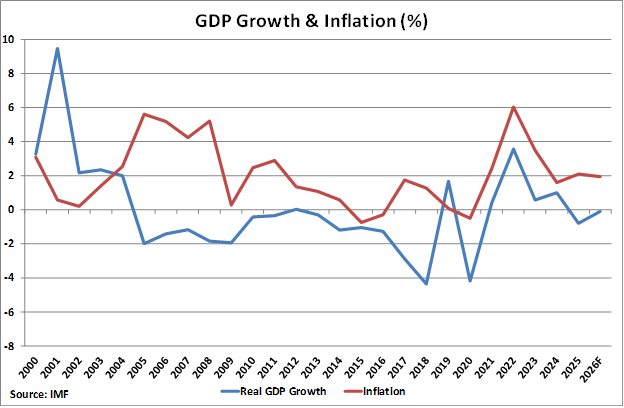
Puerto Rico’s recession began in the fourth quarter of 2006. GDP has grown very little or declined over the past decade, contracting every year from 2005 to 2018, with the exception of 2012 when the economy grew by a meager 0.03%.
After huge annual house price increases in the early 2000s, the housing market came crashing down in 2008. The market remained depressed in the following years, with house prices falling by more than 31% (41.3% inflation-adjusted) from Q2 2007 to Q3 2018.
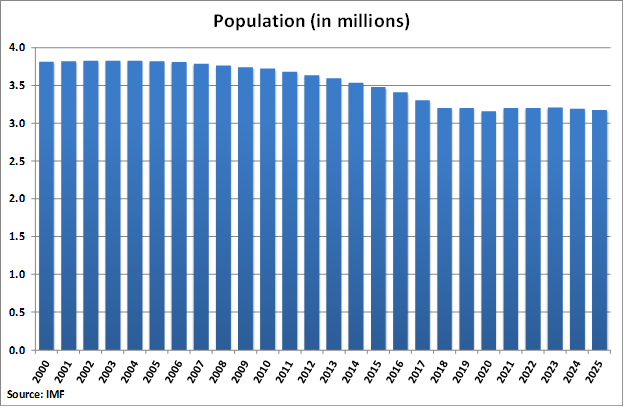
There’s been high unemployment, massive emigration, a near-catastrophic national debt crisis, and credit rating downgrades. Puerto Rico has lost about 20% of its jobs since 2007. The population shrank by more than 17% over the past two decades (2004-2025). Nearly half of Puerto Rico’s population lives in poverty, and household income is about US$18,000 annually - less than half that of Mississippi, the poorest U.S. state. And public health and retirement systems were insolvent.
The loss of net worth among Puerto Ricans associated with the collapse of real estate prices in the past several years has been close to US$ 30 billion, according to economic consulting firm Estudios Tecnicos’s CEO, Jose Villamil.
Puerto Rico’s economic collapse was accompanied by a banking crisis, with non-performing loans at elevated levels. Most of the problem was in the housing market, which represented about two-thirds of total loans, according to Scotia Bank. In 2006, before the crisis, the prime interest rate stood at 7.26%. It dropped to 3.25% in 2009 and has remained very low since, but despite this, about 80,000 families have been unable to refinance their loans and risk losing their homes.
Puerto Rico filed for the equivalent of bankruptcy protection in May 2017, unable to pay its massive debt or provide its citizens with effective services. With US$70 billion in debt and US$50 billion in pension liabilities, Puerto Rico’s bankruptcy filing was the biggest in the history of the United States, dwarfing Detroit’s US$18 billion bankruptcy filing in 2013.
As if Puerto Rico’s economic woes were not enough, Hurricane Maria struck the island in September 2017, killing an estimated 2,975 people, severely damaging the island’s infrastructure, adversely affecting thousands of small businesses, and destroying nearly all agricultural production. The category 4 storm caused an estimated US$90 billion in damage. A total of 357,492 homes in Puerto Rico were damaged, according to the Federal Emergency Management Agency (FEMA). Overall, about 23% of the island’s housing stock was affected, with around a third of them located in the San Juan metropolitan area and other coastal counties.
In response to Hurricane Maria, the US Department of Housing and Urban Development (HUD) approved US$1.5 billion for the Community Development Block Grant-Disaster Recovery (CDBG-DR) Action Plan in July 2018 to assist in rebuilding. The grant included US$1 billion for housing projects, US$100 million for infrastructure, and US$10 million for rental assistance to vulnerable households and the elderly.
Then, in March 2019, HUD allocated another US$8.2 billion in funds to the program - the largest funding approved by HUD for the recovery after a disaster. Of which USD2.85 billion is allocated for housing.
In 2021, former US President Joe Biden approved another US$10 billion relief recovery funding for Puerto Rico for housing and infrastructure reconstruction, among other social programs.
In 2022, more than US$947 million in U.S. Bipartisan Infrastructure Law funding has been announced to be allocated to Puerto Rico. About US$566 million of which has been used to invest in roads, bridges, public transit, ports, and airports, and over US$78 million for clean water.
The Community Development Block Grant-Disaster Recovery (CDBG-DR) plan for Puerto Rico’s reconstruction also presents a huge opportunity for the construction industry, particularly for new housing construction.
At least twenty more hurricanes struck the islands from 2018 to 2024, but the damage was trivial when compared to Hurricane Maria.
The economy improved in 2019, registering a growth of 1.7%. However, it was immediately cut short by the pandemic, dragging the economy back to recession with a 4.2% decline in 2020.
The economy started to bounce back in 2021, registering a meager real GDP growth rate of 0.4%, according to the International Monetary Fund (IMF), followed by an expansion of 3.6% in 2022.
Puerto Rico’s economy weakened again in 2023, with its real GDP growing by a minuscule 0.6%.
The domestic economy has been growing modestly since, registering a real GDP growth rate of 2.1% in 2024 and another 2.2% in 2025, primarily driven by strong private consumption, expansionary fiscal spending on infrastructure, and a steady rebound in the services sector, particularly tourism and trade, based on data released by the Statistical Institute of Puerto Rico.
The Housing Stimulus Act
To rescue the island’s plunging housing market, former Governor Luis Fortuño implemented the stimulus program “Impulso a la Vivienda” (Act 152) in 2010. The initiative aimed to reduce the large inventory of unsold homes while revitalizing demand and encouraging new residential construction.
Even before the ratification of Act 152, a “combo program” allowed people to buy second homes at a reduced rate, through a US$25,000 incentive, plus a US$10,000 voucher covering closing costs.
Act 152 further strengthened these efforts by providing a comprehensive package of incentives, including:
- Loan-to-value mortgage ratios of up to 105%, allowing buyers to finance more than the property’s appraised value.
- A 100% exemption from net rental income tax for a 10-year period.
- Temporary full tax exemptions during a defined window period, including: 100% exemption from capital gains tax upon resale of qualifying properties, and 100% exemption from transaction-related costs such as fees, stamps, and vouchers.
- Property tax relief, including: Full temporary exemption from property taxes, and an additional five-year exemption following the initial relief period.
Acts 20 & 22: Contested impact of Puerto Rico’s flagship tax incentives
Two landmark incentive laws introduced in 2012 significantly reshaped Puerto Rico’s investment landscape by offering generous tax benefits to foreign individuals and export-oriented businesses:
- The Export Services Act 20 (now Chapter 3 of the Puerto Rico Incentives Code 60) offers tax incentives to export services.
- The Individual Investors Act 22 now Chapter 2 of Code 60) provides a total exemption from Puerto Rican income taxes on all passive income realized or accrued after becoming a bona fide resident of Puerto Rico. Aside from this, other benefits offered to residents include tax exemption on gains from sales of property acquired after becoming a resident. However, the tax exemptions will apply only if the individual is a bona fide resident of Puerto Rico and if they start the process of becoming one before January 1, 2035.
Then, in December 2014, the government expanded the coverage of both Acts 20 and 22, expanding the period of tax exemption. On July 11, 2017, Act 45 further expanded Acts 20 and 22, adding “medical tourism services” and “telemedicine facilities” as eligible services under Act 20; abolishing the minimum number of employees required for most Act 20 businesses. In 2020, the two laws were consolidated into Act 60.
Recently, the government introduced a new “Test” in Act 60. According to the new Act 60 program, an individual with a tax exemption decree must purchase real estate property within two years of obtaining it. This property must also be the individual's primary residence throughout the term of the decree.
However, more than a decade since their introduction, some claim that these two laws have not generated the expected investments and job creation in Puerto Rico, causing them to lobby for their repeal.
Though the Economic Development Department (DDEC) remains supportive of the said laws. “Studies have shown that these laws have been positive for the economy of Puerto Rico,” said Carlos Fontán of DDEC. “They provide economic activity that we may not otherwise receive. Repealing these laws would give the false impression that Puerto Rico is not open for business.”
Based on a study conducted by Econometrika Corp. and commissioned by DDEC, Acts 20 and 22 created about 33,000 new jobs between 2012 and 2017. In the said five years, Act 22 attracted 1,332 individuals and their families to live in Puerto Rico, while Act 20 approved another 781. This helped Puerto Rico to increase its employment rate by 3% and total production by 2%.
The number of decree holders plunged in 2020 due to the pandemic, but in the succeeding year, 579 additional decrees were approved under Act 22 and 710 under Act 20.
Since Act 20 was enacted in 2012, approximately 3,900 export service tax exemption decrees have been approved (covering Act 20 and its continuation under Act 60 through 2024), according to publicly compiled government and oversight data from the Puerto Rico incentive system and related federal reporting. In addition, about 5,800 to 6,000 resident investor tax exemption decrees (Act 22 and its successor under Act 60) have been granted from 2012 through 2024, based on official figures from the U.S. Government Accountability Office (GAO).
Moreover, Puerto Rico’s government has also reformed the business permits system to attract more investment.
Major reforms include the following:
- Effective June 7, 2019, new and existing businesses on the island can obtain a single permit, consolidating all licenses, authorizations, and certifications.
- A Unified Information System for the filing and processing of permits, authorizations, licenses, and certifications for land uses and the operation of businesses.
- Time limits for the issuance of permits. Getting building permits now takes only 20 days, on average, a significant improvement from the previous 98-day timeline.
However, from 2025 onward, the policy environment has begun to shift. While the core structure of Act 60 remains in place, the government has introduced adjustments aimed at improving fiscal balance and tightening compliance. One of the most significant changes affecting new applicants is the introduction of a 4% tax on passive investment income beginning in 2026. This applies to dividends, interest, and capital gains for individuals who obtain their decree after the cutoff period, while existing beneficiaries who secured approval earlier remain grandfathered under the original zero percent regime. This has effectively created a two-tier system that differentiates between earlier and newer participants.
In addition, there is a strong policy signal encouraging applications before December 31, 2025, as those approved within this period are expected to retain the more favorable legacy tax treatment. This has contributed to increased urgency among prospective investors considering relocation to Puerto Rico.
Despite these adjustments, the incentive framework has been extended long-term, with Act 60 provisions now projected to remain in force until 2055. This extension reflects the government’s continued reliance on tax incentives as a core economic development strategy, particularly in attracting external capital and high-income earners.
At the same time, regulatory enforcement has intensified. In 2025 and early 2026, both Puerto Rican authorities and U.S. federal agencies have increased scrutiny on residency compliance, particularly ensuring that beneficiaries meet bona fide residency requirements. This includes stricter documentation standards, closer audits, and heightened attention to physical presence tests and tax domicile declarations. These measures aim to address longstanding concerns that some beneficiaries may be benefiting from incentives without fully relocating or contributing to the local economy.
Complementary tax adjustments have also been introduced, including refinements in deductions and administrative improvements to streamline the incentives system. These changes reflect a broader effort to modernize tax governance while maintaining Puerto Rico’s competitiveness as a relocation and investment destination.
Overall, while Act 60 continues to provide significant tax advantages and remains attractive for investors and businesses, the recent updates signal a clear policy transition: from broad, highly favorable tax exemptions toward a more controlled, partially taxed, and closely monitored incentive regime. The long-term viability of the program is no longer in question, but its structure is gradually evolving toward tighter regulation and reduced generosity for future applicants.
Economic and Social Factors
Puerto Rico’s economy remains fragile, inflation gradually increasing
The Puerto Rican economy showed mixed but generally more resilient performance in 2025, with growth supported by continued federal reconstruction spending and steady labor market conditions.
While earlier projections from the International Monetary Fund (IMF) pointed to a possible contraction, more recent estimates from the Puerto Rican government indicate that the economy likely posted a real GDP growth rate of around 2.2% in 2025, driven in part by sustained disbursements of federal recovery funds, including Community Development Block Grant (CDBG) allocations.
However, energy continues to pose a significant challenge in Puerto Rico, where electricity costs remain persistently high. Global energy market volatility, primarily driven by the ongoing war in the Middle East, is adding upward pressure on costs.
Inflationary pressures are beginning to build up once again. In February 2026, the overall inflation increased to 2.3%, up from 2% in the previous month and 1.4% from the same period last year, based on figures from the Statistical Institute of Puerto Rico.
From 2012 to 2020, inflation in Puerto Rico was very low, averaging just 0.5% annually. However, it began to climb in 2021, reaching 2.4%, and surged to 6% in 2022. This sharp rise was driven by soaring energy prices, global supply chain disruptions, and the economic fallout from natural disasters. Inflation remained elevated at 3.5% in 2023 before easing to an average of 1.6% in 2024 and 1.5% in 2025, signaling a return to more stable price conditions.
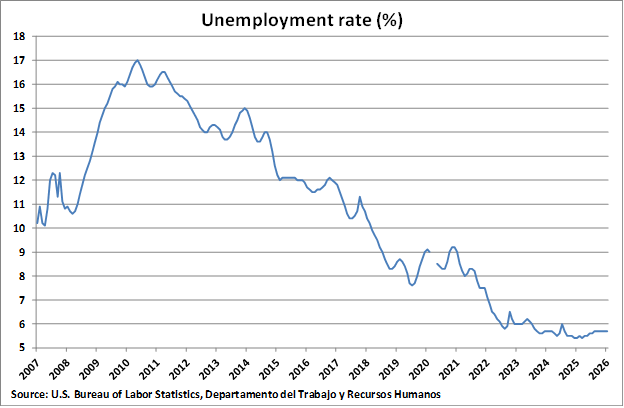
The labor market is stable. The unemployment rate stood at 5.7% in January 2026, unchanged from the previous month but up from 5.4% a year earlier, according to Departamento del Trabajo y Recursos Humanos, Puerto Rico. It remains above the U.S. unemployment rate of just 4.2% over the same period.
The jobless rate in the islands dropped to an annual average of 7.6% in 2017-2025, from 16.4% in 2010 and 15.9% in 2011. Many of the new jobs are in rebuilding, which has created many construction jobs, and much of the improvement is in fact due to the emigration of labor. And we should remember that these additional jobs in construction are mostly temporary.
Tourism continues to grow rapidly
Puerto Rico’s tourism sector continues to expand strongly, welcoming a record-breaking 6.8 million passengers at the Luis Muñoz Marin International Airport in 2025. This represents about 3% growth from the preceding year and marked the country’s fifth consecutive record-breaking year.
The figure does not yet include the visitors arriving from the island’s two cruise ports, which welcome over 500 ships annually.
“This is the fifth consecutive year that Puerto Rico has achieved new tourism records, reflecting sustained growth and a clear international positioning strategy. This momentum will continue to strengthen in 2026 through events and promotions that consolidate the Island as a global-caliber destination. Puerto Rico is not defined by regional comparisons; it is a destination with a unique and competitive offering for visitors from around the world,” said Jorge L. Pérez, Chief Executive Officer of Discover Puerto Rico.
Over 1.6 million cruise passengers arrived at Puerto Rico’s ports in 2025, up by nearly 8% from the preceding year.
About 55% to 65% of visitor arrivals in Puerto Rico in the past five years came from the United States.
Other indicators also point to the strong growth of the tourism sector in 2025:
- Lodging Demand: Nearly 7.9 million hotel nights booked in 2025, representing an 8% y-o-y increase, according to STR and AirDNA.
- Lodging Revenue: Hotels and short-term rentals generated approximately US$1.99 billion, up by 3% from 2024.
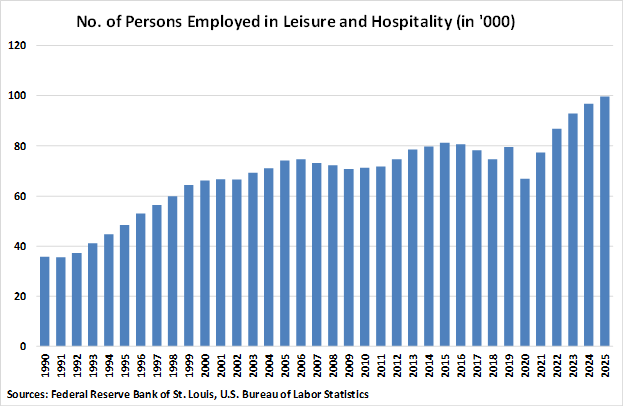
- Employment: Puerto Rico reached a record 102,300 jobs in the recreation and lodging sector by November 2025, up by 4% from the previous year.
- Events and Conventions: There were 262,779 hotel nights booked in 2025, up by 18% from a year ago, contributing over US$207 million to Puerto Rico’s economy.
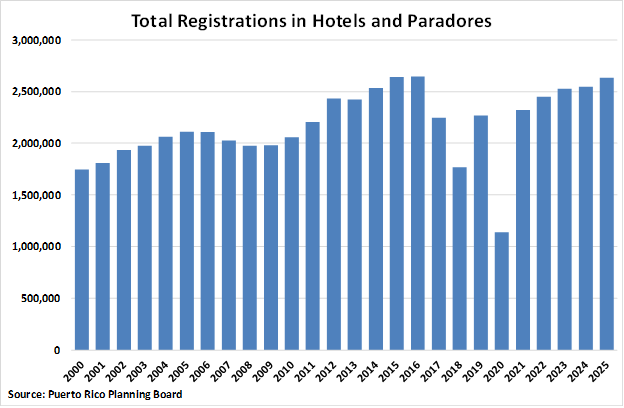
- Registrations in hotels and paradores: Total registrations increased by 3.4% y-o-y to 2.63 million in 2025, following annual growth of 0.8% in 2024, 3.2% in 2023, 5.5% in 2022, and 103.7% in 2021, based on figures released by the Puerto Rico Planning Board.
Throughout 2025, Puerto Rico strengthened its position in destination marketing through strategic partnerships and culturally driven campaigns that expanded the island’s global reach. A notable initiative was its collaboration with Calm in May 2025, which introduced immersive wellness-focused audio experiences in English and Spanish, promoting Puerto Rico as a mental health and wellness destination.
Puerto Rico also advanced its “Return the Love” platform, encouraging responsible tourism through storytelling campaigns featuring figures such as Amaury Nolasco and Kiké Hernández.
In addition, Puerto Rico expanded its cultural outreach through events like Puerto Rico’s Day at the Ballpark, a multi-city celebration showcasing the island’s rich baseball heritage and reaching millions of fans across major league venues.
Tourism remains a key economic driver, contributing about 7% to Puerto Rico’s GDP.
Sources:
- FHFA House Price Index Datasets (Federal Housing Finance Agency): https://estadisticas.pr/
- Gross rental yields in Puerto Rico: San Juan and Isla Verde (Global Property Guide): https://www.globalpropertyguide.com/
- Comprehensive Housing Market Analysis Puerto Rico (U.S. Department of Housing and Urban Development): https://www.huduser.gov/
- HUD Approves Amended Action Plan with $8.2 billion in CDBG-DR for Puerto Rico (McConnell Valdés) https://www.mcvpr.com/
- Relief Funds Accelerate into Puerto Rico (Coatings World): https://www.coatingsworld.com/
- ACT-60 - Puerto Rico Tax Incentives (Sotheby’s International Realty): https://www.sothebysrealty.com/
- Puerto Rico Act 20 and Act 22 (Alpen Partners): https://alpenpartners.com/
- Puerto Rico Tax Incentives: The Ultimate Guide to Act 20 and Act 22 (PRelocate): https://relocatepuertorico.com/
- Puerto Rico: IRS Should Improve Oversight of Taxpayers Claiming Exemption from Federal Taxes (United States Government Accountability Office): https://www.gao.gov/
- DDEC Supports Acts 20/22 (W Journal): https://www.wjournalpr.com/
- Do Puerto Rico tax breaks displace locals to benefit the wealthy? Here are 5 things to know (NBC News): https://www.nbcnews.com/
- Puerto Rico Act 60 Reform 2025: Key Updates Explained (Christian Kleiner Luxury Real Estate): https://christiankleinerluxuryrealestate.com/
- Puerto Rico’s 2025 Act 60 Update: What Luxury Buyers Need to Know Now (Investate Puerto Rico): https://investatepr.com/
- IRS Crackdown and Puerto Rico Law Changes Take Aim at U.S. Citizens (Windham Brannon): https://windhambrannon.com/
- Puerto Rico’s Act 60, Income Sourcing and IRS Scrutiny in the Age of Cryptocurrency (Holland & Knight): https://www.hklaw.com/
- Puerto Rico Governor Recently Signed into Law Four New Tax-Related Measures (Ferraiuoli): https://ferraiuoli.com/
- Puerto Rico Consumer Price Index (CPI) (Trading Economics): https://tradingeconomics.com/
- Puerto Rico GDP Annual Growth Rate (Trading Economics): https://tradingeconomics.com/
- Puerto Rico Economy at a Glance (U.S. Bureau of Labor Statistics): https://www.bls.gov/
- Puerto Rico (International Monetary Fund): https://www.imf.org/
- Puerto Rico Inflation Rate (Trading Economics): https://tradingeconomics.com/
- Puerto Rico Tourism Breaks Records in 2025, Sets the Stage for 2026 (Discover Puerto Rico): https://www.discoverpuertorico.com/
- Puerto Rico Posts Fifth Consecutive Year of Visitor Arrivals Growth (Travel Pulse): https://www.travelpulse.com/