South Korea’s house price growth accelerates strongly
South Korea’s housing market continues to grow stronger, buoyed by declines in interest rates. The nationwide housing purchase price composite index surged 7.26% during the year to November 2020, its biggest y-o-y increase since October 2007, according to Kookmin Bank. When adjusted for inflation, house prices rose by 6.6%.
Figures from the Bank of Korea, the country’s central bank, are more modest, with house prices rising by 4.78% y-o-y in November 2020 (4.15% inflation-adjusted). But this is the best performance in almost nine years.
Foreigners have been buying more properties in South Korea in recent years, though the country has a reputation of not being easy to navigate. The housing market is unusual, with huge key money deposits (the Chonsei system), and significant government intervention.
Yet judging by results this is a well-run market. It has been stable since the 2007 crisis.
Early this year, in a typical intervention, the authorities decided to put a brake on the market once again. According to a directive released by the Financial Service Commission (FSC), beginning March 2, 2020, the current loan-to-value (LTV) ratio of 60% will be lowered to 50% when buying homes valued up to KRW 900 million (US$823,340) in the newly designated “speculative areas”. For properties valued above KRW900 million, a 30% LTV ratio will be applied. Moreover, homeowners with one house in speculative areas are eligible to apply for mortgage loans to buy another home but with an agreement that they will sell the current property within two years. The new rule also compels them to move into the newly purchased home. These new rules followed other anti-speculative measures introduced in the past years to curb house prices in so-called “overheated speculative zones”, including Seoul, Gwacheon and Sejong City.
The results of all this caution have been good: unsold houses on the market have gone down from 2009’s peak figure of 123,297 housing units, to 47,797 units in 2019. The banking system is in good health, with the delinquency rate of loans to households falling to a mere 0.3% in 2019, from 0.5% in 2009 and 1.8% in 2003.
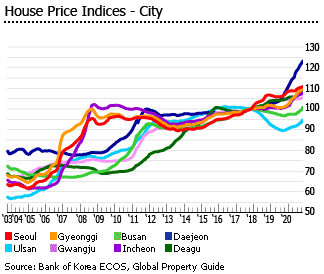
Seoul’s house price index was up strongly by 10.1% y-o-y (9.45% inflation-adjusted) in November 2020, according to Kookmin Bank. Aside from Seoul, all of the country’s seven largest metropolitan cities saw continued house price rises.
- Daejeonregistered the biggest y-o-y price increase of 12.18% y-o-y in November 2020 (11.51% inflation-adjusted), sharply up from last year’s 3.7% growth and its best showing since January 2012.
- In Daegu, house prices soared 7.12% (6.48% inflation-adjusted), a sharp improvement from the previous year’s 1.4% increase and its biggest y-o-y rise in more than four years.
- In Incheon, house prices rose 6.15% (5.52% inflation-adjusted), sharply up from the previous year’s 0.3% y-o-y increase and its highest growth in more than a decade.
- In Busan, house prices rose by 5.02% (4.39% inflation-adjusted), in contrast to a 1.3% y-o-y decline in November 2019. It was its best showing in almost five years.
- In Ulsan, prices rose by 5.01% (4.39% inflation-adjusted), a sharp turnaround from last year’s 4.6% y-o-y fall.
- In Gwangju, house prices rose by a modest 2.6% (1.99% inflation-adjusted), a slight improvement from a 1.7% growth last year.
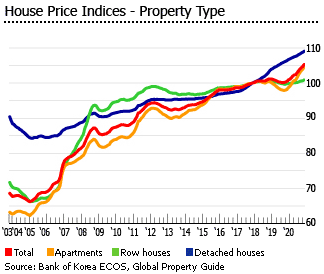
By property type, apartments recorded the biggest y-o-y increase in prices in November 2020, at 6.72% (6.08% inflation-adjusted), based on figures from the BOK. Detached houses and row houses saw more modest price rises of 2.54% and 1.1%, respectively.
Foreign demand is rising strongly, despite the pandemic. In the first five months of 2020, foreigners bought about 3,500 units, up 27% from a year earlier, according to Park Won-gap of KB Kookmin Bank.
“From 2017 to May this year, foreigners bought some 23,000 apartment units in South Korea. The amount is valued at 7.6 trillion won, which is about 6.4 billion US dollars. The number of home purchases by foreigners has continued to increase year after year to reach 5,300 in 2017, 6,900 in 2018 and 7,300 in 2019,” said Park Won-gap. “As of May this year, the figure stood at 3,500, up 27 percent from the same period of last year. In brief, foreigners are increasingly buying apartments in South Korea.”
Upon conclusion, a property sale contract must be recorded by the foreigner to the head of the Shi/Kun/Ku (city/county/ward). If the property is located in military installation protection areas, designated cultural properties, and ecosystem conservation areas, foreigners shall obtain permission from the head of Shi/Kun/Ku before the conclusion of the contract.
Korean house prices are strongly steered by the government
The peak of South Korea’s previous house price boom was reached in 2006, when Seoul prices rose almost 20%. Then the government applied the brakes, imposing controls on housing loans, and hiking capital gains taxes on “speculative areas”.
These cooling measures caused a slight slowdown in 2007 and 2008. In 2009, the Lehman shock, and government curbs led to a sharp slowdown, followed by a house price drop in 2010. The government began reviving the housing market in 2009 by purchasing KRW 2 trillion (US$ 1.83 billion) worth of unsold newly built housing, and KRW 3 trillion (US$ 2.74 billion) of land from construction firms wishing to repay their debts. This was followed by a more intensive expansion measures in 2010 and 2011.
HOUSE PRICES, ANNUAL CHANGE (%) |
||||
| South Korea | Seoul | |||
| Year | Nominal | Inflation-adjusted | Nominal | Inflation-adjusted |
| 2007 | 5.72 | 2.04 | 9.78 | 5.96 |
| 2008 | 5.90 | 1.70 | 9.61 | 5.26 |
| 2009 | 1.51 | -1.26 | 2.78 | -0.02 |
| 2010 | 1.49 | -1.50 | -1.14 | -4.06 |
| 2011 | 6.09 | 1.85 | 0.74 | -3.29 |
| 2012 | -1.38 | -2.77 | -4.81 | -6.14 |
| 2013 | 0.22 | -0.92 | -1.43 | -2.54 |
| 2014 | 1.72 | 0.88 | 1.22 | 0.39 |
| 2015 | 3.59 | 2.43 | 4.51 | 3.34 |
| 2016 | 0.71 | -0.61 | 2.21 | 0.86 |
| 2017 | 1.42 | 0.01 | 3.60 | 2.17 |
| 2018 | 1.10 | -0.22 | 6.16 | 4.78 |
| 2019 | -0.30 | -1.03 | 1.31 | 0.57 |
| Nov 2020 | 4.78 | 4.15 | 3.26 | 2.65 |
| Source: Bank of Korea (BOK) | ||||
However these measures were not enough. There were house price declines from 2012 to 2013, especially in Seoul. Further measures were taken such as introduction of tax breaks to induce more demand, as well as other supply control measures for the improvement of prices. The effects of these measures were seen after a year, and were also reflected on the gradual improvement of prices from 2014 to 2015. House prices started to slowdown again towards the end of 2016, as the government started another set of tightening measures, in combination with the rising house supply.
The government recently introduced new set of anti-speculative rules, as house price growth accelerates again.
Housing construction falling
Residential construction activity has been continuously falling in recent years, mainly due to stricter regulations on home rebuilding projects. During 2019, housing construction permits in Korea fell by almost 12% to 487,975 from a year earlier, following y-o-y declines of 15.2% in 2018, 10% in 2017 and 5.1% in 2016.
In Seoul, permits also dropped 5.3% y-o-y to 62,272 last year.
Chungbuk registered the biggest fall in construction permits last year, at 58.9%. It was followed by Gyeongbuk (-53.9%), Ulsan (-53.6%), Busan (-49.8%), Gyeongnam (-30.4%), Gangwon (-26.4%), Jeju (-22.4%), Daegu (-21.8%), Jeonbuk (-20.5%), and Gyeonggi (-5.5%).
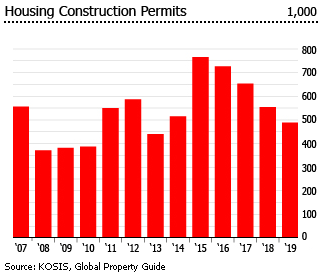
In contrast, Daejeon and Sejong saw the highest y-o-y increase in housing construction permits last year at 168.8% and 156.9%, respectively. Permits also increased in Gwangju (27.8%), Jeonnam (20.8%), Incheon (13.1%), and Chungnam (3.1%).
Gyeonggi accounted for a third of all housing construction permits issued last year.
Borrowing rates at record low; gov’t plans on transitioning mortgage borrowing to fixed-rate
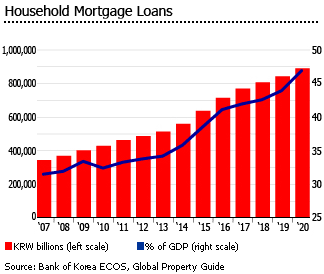
Interest rates in Korea are quite low. The average interest rate on newly drawn housing loans was around 2.47% in October 2020, slightly down from 2.5% in October 2019, and significantly lower than the 7.58% peak recorded in October 2008, according to the Bank of Korea (BOK). For outstanding housing loans, the average interest rate dropped to a record low of 2.72% in October 2020.
The Korea market has historically been very sensitive to interest rate changes, as traditionally around 80% to 95% of housing loans have been floating rate. The Korean government has promoted fixed rate loans to reduce default risks since the second half 2011. In February 2014, South Korea’s Financial Services Commission (FSC) stated that by 2017 banks would be obliged to hold a minimum of 40% of the banks’ mortgage portfolios in fixed-rate and amortising home loans, with targets of 20% for 2014, 25% in 2015 and 30% in 2016.
In 2016, the government raised the target for fixed-rate loans issued by banks to 45% in 2017. The fixed-rate loan target was also raised to 47.5% by the end of 2018.
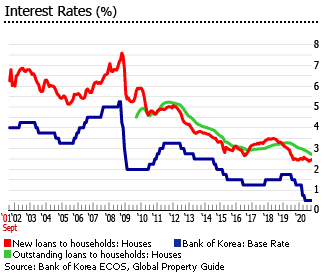
However, it seems that new borrowers still prefer floating rate loans. As of October 2020, only about 31.5% of total new homes were financed by fixed-rate loans, with the rest floating rate, according to BOK figures.
Mortgage lending continues to rise
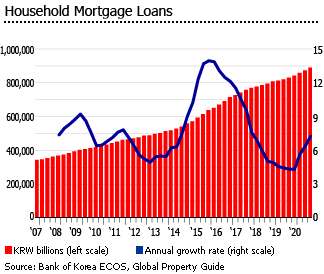
Korea’s mortgage market continues to expand, fuelled by very low interest rates. In Q3 2020, total mortgage credit to households by the private sector rose by 7.2% y-o-y to KRW 890.4 trillion (US$814.5 billion), according to the BOK. Over the same period:
- By commercial and specialized banks: KRW566.5 trillion (US$518.3 billion), up 8.3% a year ago
- Non-bank depository corporations: KRW 95 trillion (US$86.9 billion), down 7% a year ago
- Other financial corporations: KRW 228.9 trillion (US$209.4 billion), up 11.7% a year earlier
Established in 2004, Korea Housing Finance Corporation (HF) has a mandate to serve the housing needs of people regardless of their income and advance the nation’s housing finance market. As of Q3 2020, HF holds about KRW176.7 trillion (US$161.7 billion) of mortgage loans to households, up 14% from a year earlier and almost four times a decade ago.
Anti-speculative measures
Early this year, the Financial Service Commission (FSC) unveiled tighter housing loan rules to curb speculative demand in the housing market.
- Homeowners whose property is valued at over KRW900 million (US$823,340) can no longer obtain jeonseloan guarantees from the Seoul Guarantee Insurance Company (SGI).
- For individuals who receive jeonse loan guarantees from public guarantee institutions such as Korea Housing Finance Corporation (KHFC), Korea Housing & Urban Guarantee Corporation (HUG) or SGI and purchase a high-priced home or become a multiple homeowner thereafter, the said jeonse loan will be collected.
Beginning March 2, 2020, new mortgage regulations were in place:
- The current loan-to-value (LTV) ratio was lowered to 50% from 60% when buying homes valued up to KRW 900 million (US$823,340) in the newly designated “speculative zones”. For properties valued above KRW900 million, a 30% LTV ratio applies.
- Homeowners with one house in a speculative area can apply for mortgage loans to buy another home, but must sell their current property within two years, and move into the newly purchased home.
These measures follow earlier anti-speculative efforts by the government, such as the ‘debt service ratio’ (DSR) system for bank assessments under which lenders must look at the borrower’s overall debt-to-income ratio, including interest payments, not just the borrower’s mortgage and interest payments.
The Financial Services Commission (FSC) also released new detailed mortgage regulations in September 2018:
- Multiple home owners are banned from taking out mortgages when purchasing new homes in "speculative zones", and even single home owners can get loans only in "exceptional circumstances" such as job-relocation.
- Mortgages only allowed for houses worth more than KRW 900 million (US$ 801,139) when intended for residential purposes.
- Multiple home owners, and those with annual household income worth KRW 100 million (US$ 89,015), not allowed public guarantees for jeonse rental deposits.
- An LTV ratio of 40% applied to the mortgages of housing rental business providers, when buying housing for rent in "speculative zones".
- Housing rental business providers prohibited from taking out a mortgage when buying a "high-priced house".
Rents are steady
Korea’s residential rental market has been more or less steady. The national monthly rent index rose slightly by 0.82% in November 2020 from a year earlier, according to the BOK. In Seoul, rents increased 0.91% y-o-y in November 2020.
Sejong saw the biggest y-o-y rent increase in November 2020 at 9.3%, followed by Ulsan (3.5%), Daejeon (1.7%), and Gyeonggi(1.32%). Minimal rent increases were recorded in Incheon (0.81%), Daegu (0.8%), Gangwon (0.62%), Chungbuk (0.52%), Chungnam (0.51%), and Jeonnam (0.4%). Rents were steady in Gyeongnam, Busan, Gwangju, and Gyeongbuk.
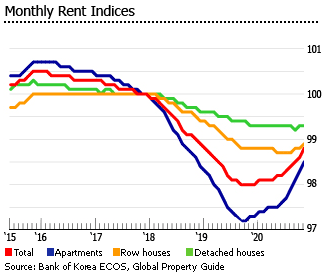
Only Jeju and Jeonbuk registered rent declines, of 1.45% and 0.2%, respectively.
By property type, apartments saw rent increases of 1.83% during the year to November 2020. Monthly rents were almost unchanged for detached houses and row houses.
Unique rental system hits young people
Monthly rents for residential properties were almost stable mainly due to Korea’s unique chonsei (or jeongsei) rental system. The tenant deposits a lump-sum amount to the owner for the use of the property, with no additional requirement for periodic rent payments. The deposit is fully refunded at the end of contract period with no interest.
The Chonsei system eliminates the likelihood of tenant’s default on monthly rent. However, the lump-sum deposit, equivalent to 70% to 80% of the property value, imposes a huge burden on younger renters and new households.
According to Population and Housing Census Report 2000, 54% of households live in owner-occupied houses, while 28% are under chonsei contracts. The remaining 18% are under a monthly rental system called wolse.
Korea’s economy remains more or less stable
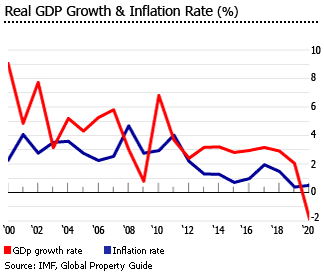
South Korea’s trade-reliant economy returned to modest growth in Q3 2020, as exports started to recover following the gradual easing of coronavirus-related travel and health safety restrictions worldwide. GDP grew by 1.9% in Q3 from the previous quarter, after contracting by 3.2% in Q2 and 1.3% in Q1, according to the Bank of Korea (BOK). It was the fastest quarterly expansion since Q1 2010. Compared with a year ago, however, the economy shrank 1.3% in Q3 2020, following an annual decline of 2.7% in Q2.
As a result, the BOK recently revised upwards its 2020 economic forecast to a contraction of 1.1%, a slight improvement from its earlier projection of a 1.3% fall. The economy grew by more than 3% annually from 2009 to 2019.
In November 2020, overall inflation stood at 0.6% y-o-y, well below the BOK’s 2% annual target. The BOK expects headline inflation to average 0.5% this year before accelerating to 1% in 2021.
Unemployment jumped to 4.2% in October 2020, an increase from 3.5% in the same month last year, according to the Korean Statistical Information Service (KOSIS). Korea’s unemployment rate averaged 3.6% from 2009 to 2019, based on IMF figures.
Korea’s consolidated fiscal deficit climbed to KRW 70.9 trillion (US$64.85 billion) in August 2020, more than triple the KRW 22.3 trillion (US$20.4 billion) shortfall recorded a year earlier, according to the Ministry of Economy and Finance.
The deficit is projected to increase to about 4.4% of GDP this year, according to Fitch Solutions, up from shortfalls of 2.6% in 2019, 0.6% in 2018 and 1% in 2017.
The national debt is expected to increase further to KRW 846.9 trillion (US$774.6 billion) this year – about 44% of the country’s GDP – following the passage of a fourth fiscal stimulus in September.
Moon revives the “Sunshine Policy”
After being sworn into office in May 2017, South Korean President Moon Jae-in revived the “Sunshine Policy” to improve South Korea’s relationship with North Korea. President Moon’s efforts led to three inter-Korean summits in 2018, two in Panmunjom (held in April 2018 and in May 2018) and one in Pyongyang (September 2018). The improved relationship is evidenced events that involved both countries:
- The reopening of the Seoul-Pyongyang hotline;
- North Korea sent a delegation to the 2018 Winter Olympics, headed by Kim Jong-un’s sister, Kim Yo-jong;
- South Korean K-pop stars performed a concert in Pyongyang;
- Both countries pledged to remove nuclear weapons from the Korean Peninsula;
- North and South Korea combined teams in some events during the 2018 Asian Games;
- Military leaders from both countries signed an "Agreement on Reconciliation, Non-Aggression, Exchanges and Cooperation" (or "the Basic Agreement"), which aids in easing military tension between both countries.
However in September 2020, a maritime incident that resulted in the killing of a South Korean fisheries official by North Korean soldiers sparked outrage in the South barely a day after President Moon called for a formal end to the Korean War and the need for the two countries to sign a peace treaty.
“This act by the North Korean military amounts to pouring cold water over our consistent patience and efforts for inter-Korean reconciliation and peace and runs directly counter to the yearning of our people,” said a South Korean Unification Ministry official.
The recent incident threatens to weaken the already eroding public support for Moon’s policy for reconciliation.
Sources:
- Monthly KB housing price trend (Kookmin Bank): https://onland.kbstar.com/quics?page=C059744
- Housing Purchase Price Index (Bank of Korea): http://ecos.bok.or.kr/flex/ClassSearch_e.jsp?langGubun=E&topCode=000Y008
- Housing Monthy Rent Index (Bank of Korea): http://ecos.bok.or.kr/flex/ClassSearch_e.jsp?langGubun=E&topCode=000Y008
- Real Estate Purchases by Foreigners Soaring (KBS World): https://world.kbs.co.kr/service/contents_view.htm?lang=e&menu_cate=business&id=&board_seq=389026
- Housing construction permits by region (Korean Statistical Information Service):https://kosis.kr/eng/statisticsList/statisticsListIndex.do?menuId=M_01_01&vwcd=MT_ETITLE&parmTabId=M_01_01&statId=2002017&themaId=#SelectStatsBoxDiv
- South Korea grants fewer home construction permits in 2019 (PropertyGuru): https://www.asiapropertyawards.com/en/south-korea-grants-fewer-home-construction-permits-in-2019/
- World Economic Outlook Database, October 2020 (International Monetary Fund): https://www.imf.org/en/Publications/WEO/weo-database/2020/October
- S.Korea’s central bank revises up 2020 GDP forecast (Xinhuanet): http://www.xinhuanet.com/english/2020-11/26/c_139544626.htm
- Is Moon Jae-in’s North Korea Peace Plan Dead? (The National Interest): https://nationalinterest.org/blog/korea-watch/moon-jae-%E2%80%99s-north-korea-peace-plan-dead-169537
- Fiscal Deficits Here To Stay In South Korea (Fitch Solutions): https://www.fitchsolutions.com/country-risk-sovereigns/fiscal-deficits-here-stay-south-korea-02-10-2020
- S. Korea’s fiscal deficit more than triples as of August on year (Pulse): https://pulsenews.co.kr/view.php?year=2020&no=1047323
- Household debt risks are new focus of government (Korea JoongAng Daily): https://koreajoongangdaily.joins.com/news/article/article.aspx?aid=3047032
- FSC Tightens Housing Loan Rules (Financial Services Commission): https://www.fsc.go.kr/eng/new_press/releases.jsp?menu=01&bbsid=BBS0048&selYear=&sch1=&sword=&nxPage=28
- Administrative Guidance on Mortgage Loan Regulations in Speculative Areas (Financial Services Commission): https://www.fsc.go.kr/eng/wn/list_qu.jsp?menu=01&bbsid=BBS0048&selQuarter=01&selYear=2020&nxPage=5