Malaysia's Residential Property Market Analysis 2026
Malaysia's residential property market has become a market of two speeds: house prices are still rising, and the wider economy is expanding faster than the government forecast, yet fewer homes are changing hands, unsold stock has climbed for six consecutive quarters, and developers cannot get their buyers financed.
This extended Global Property Guide overview examines recent house price trends, demand and supply dynamics, and the longer-term outlook for Malaysia's housing sector, with particular attention to the financing bottleneck that now defines the market.
Note on currency: ringgit figures are converted at approximately MYR 4.13 = USD 1, the prevailing rate in late July 2026. Conversions in older sources may assume materially different rates.
Table of Contents
- Property Prices and Price Index
- House Price Variations
- Property Demand Trends
- Property Supply Trends
- Rental Market: Rents and Rental Yields
- Mortgage Market and Interest Rates
- Historic Perspective
- Economic and Social Factors
Property Prices and Price Index
In the first quarter of 2026, Malaysia's nationwide house price index stood at 235.2 points, rising by 1.7% from a year earlier, according to figures released by the Valuation and Property Services Department (JPPH) through the National Property Information Centre. That marked a clear recovery from the near standstill of mid-2025, when annual growth slowed to just 0.1% in the third quarter, but it remains modest by the standards of the past decade.
With consumer prices rising by 1.6% over the same quarter, based on figures from the Department of Statistics Malaysia, nationwide house prices were essentially flat in real terms, gaining about 0.1% once inflation is stripped out.
Malaysia's average house price stood at MYR 507,533 (US$122,890) in Q1 2026, up from MYR 494,384 (US$119,706) in Q3 2025.
Malaysia's house price annual change:
For the whole of 2025, the index averaged 233.1 points, an increase of 2.6% with an average house price of MYR 502,922 (US$121,773), according to the Property Market Report 2025. Terraced houses led the way that year with growth of 3.3%, followed by semi-detached homes at 2.8%.
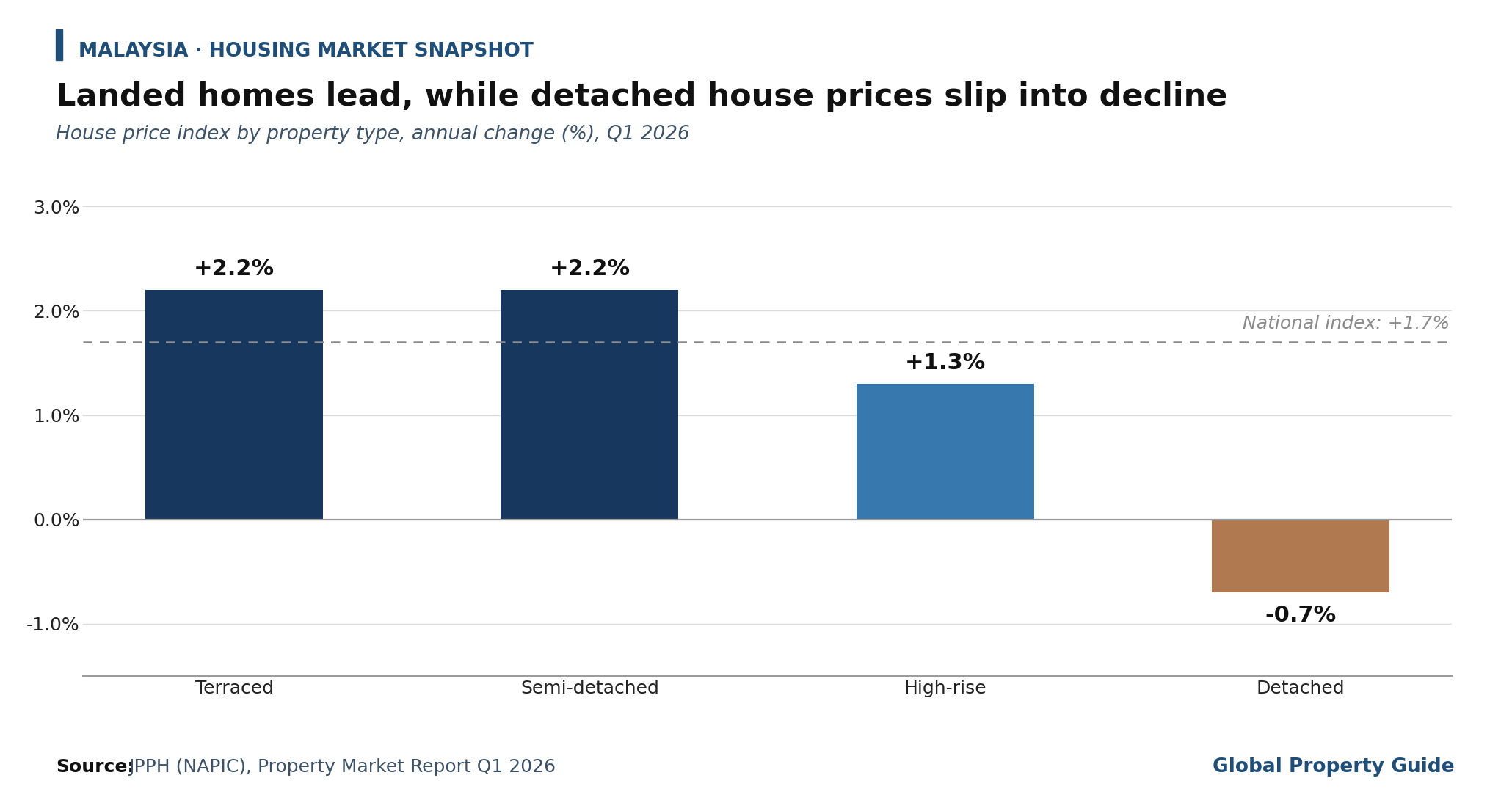
By property type in Q1 2026:
- Terraced house prices rose by 2.2% y-o-y, the joint strongest of any category.
- Semi-detached house prices also rose by 2.2% y-o-y.
- High-rise residential prices increased by 1.3% y-o-y, continuing to lag landed formats.
- Detached house prices fell by 0.7% y-o-y, the only category in outright decline.
Demand, however, has thinned noticeably. Total property transactions across all sub-sectors fell by 8% y-o-y to 89,966 units in Q1 2026, while transaction value slipped by a marginal 0.6% to MYR 51.09 billion (US$12.37 billion), based on figures released by the JPPH. The residential sub-sector remained the market's anchor, accounting for 58.8% of all transactions with 52,936 deals worth MYR 22.60 billion (US$5.47 billion).
The gap between those two numbers matters. A sharp fall in volume paired with a barely changed value means the average completed deal held its price. Fewer buyers and sellers reached the closing table, but those who did were not forced into discounts.
"This resilient market activity reflects the industry's confidence in Malaysia's ongoing economic restructuring under the Madani Economy framework, amid the West Asian conflict and global economic uncertainties," said JPPH director general Abdul Razak Yusak at the launch of the Q1 2026 Property Market Report.
Residential construction activity has split into two directions. Completed housing units surged by more than 30% y-o-y to 12,905 units in Q1 2026 from 9,329 units a year earlier, while housing starts collapsed to 8,243 units from 28,344 units, a fall of 70.9%. Planned new supply, by contrast, rose by more than 50% to 12,852 units, indicating that developers are keeping projects in the pipeline while declining to break ground.
The unsold housing stock keeps growing. In Q1 2026, the total residential supply overhang rose to 32,801 units worth MYR 16.37 billion (US$3.96 billion), up 7.6% in volume from the previous quarter and up 39.5% from the 23,515 units recorded a year earlier. It was the sixth consecutive quarterly increase. Add 19,263 unsold completed serviced apartments worth MYR 16.52 billion (US$4.00 billion), and Malaysia is now holding more than 52,000 finished homes that nobody has bought.
New residential launches moderated to 9,112 units in Q1 2026 from 12,498 units a year earlier, with only 1,052 units sold for a take-up rate of 11.5%.
In the first quarter of 2026, Malaysia's economy grew by 5.4% from a year earlier, beating both the advance estimate and the Bloomberg consensus of 5.3%, though moderating from an exceptional 6.2% in Q4 2025. Growth then accelerated again to 5.8% in the second quarter, according to advance estimates from the Department of Statistics Malaysia, lifting first-half expansion to 5.6% against 4.5% in the same period of 2025.
House Price Variations
Local house price variations
Almost every state recorded positive house price growth in Q1 2026, with increases ranging between 0.3% and 7.2%, according to the JPPH. The exceptions were Negeri Sembilan, where prices edged down by 0.2%, and Sabah, where they fell by 2.3%. Perak held steady.
The secondary market tells a sharper story than the national index. The average subsale house price rose by 4.8% y-o-y to MYR 545,059 (US$131,976) in Q1 2026, nearly three times the pace of the headline index, based on an IQI residential subsale analysis of more than 230,000 transactions recorded since 2018.
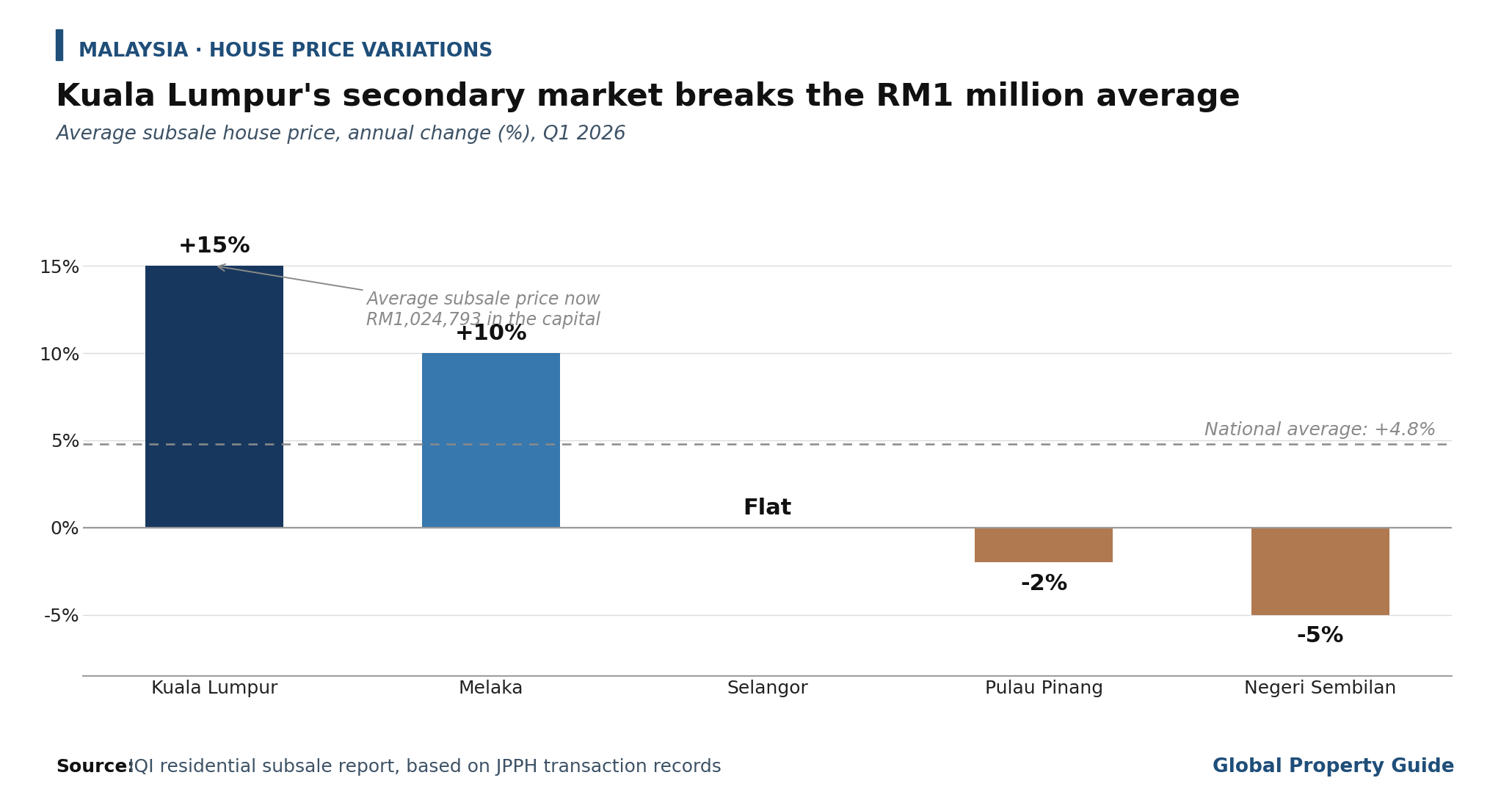
Kuala Lumpur crossed a symbolic threshold, with its average subsale price reaching MYR 1,024,793 (US$248,134), a rise of 15% from a year earlier. That makes Malaysia's capital the first million-ringgit housing market on this measure.
Melaka recorded the second strongest gain, up 10% to an average of MYR 358,964 (US$86,916).
Selangor, the country's largest subsale market by transaction volume, was broadly stable at an average of MYR 559,935 (US$135,577).
Pulau Pinang saw average subsale prices decline by 2%, while Negeri Sembilan fell by 5% to MYR 340,207 (US$82,375), making it the most affordable of the major markets tracked.
The distribution of activity has barely moved. Roughly seven in ten subsale purchases involved homes priced below MYR 500,000 (US$121,065), and nearly a quarter involved homes at MYR 250,000 (US$60,533) or below. Properties above MYR 1 million accounted for just 8% of transactions.
"Affordable homes remain the engine of transaction volume," said IQI Group chief executive Kashif Ansari.
The same pattern holds in the primary market. Housing priced at MYR 300,000 (US$72,639) and below was the most active price band in Q1 2026, with 27,209 transactions, more than half of all residential deals in the quarter.
Property Demand Trends
Prices hold while volumes thin
Residential demand is no longer uniformly healthy. The residential sub-sector recorded 52,936 transactions worth MYR 22.60 billion (US$5.47 billion) in Q1 2026, accounting for 58.8% of total market activity, but overall transaction volume across all property types was down 8% y-o-y.
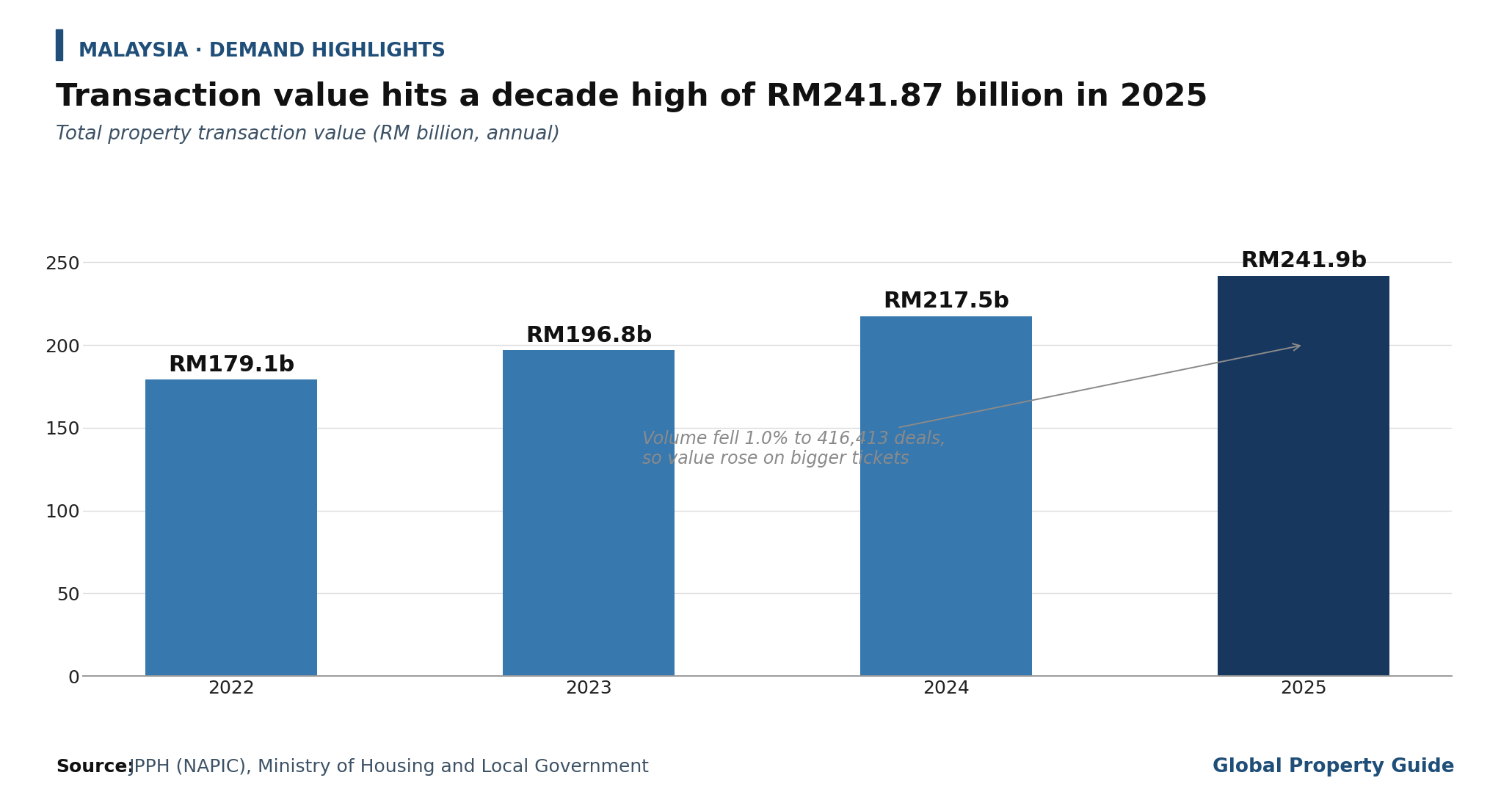
That follows a strong year. Malaysia's total property transaction value reached MYR 241.87 billion (US$58.56 billion) in 2025, a rise of 4.1% and the highest figure in a decade, even though the number of transactions dipped by 1% to 416,413, according to the Property Market Report 2025 released in February 2026.
New residential launches fell by 14.9% to 64,487 units in 2025, with a sales performance rate of 35.5%.
The picture in the second half of that year was considerably weaker than the annual average suggests. A Property Industry Survey by the Real Estate and Housing Developers' Association (REHDA) covering 166 developers across Peninsular Malaysia found that 17,971 residential units were launched in H2 2025 and only 3,784 were sold, a take-up rate of 21% against 38% in the first half. Asked why, 72% of developers pointed to financing rather than price or a shortage of interest.
That diagnosis is now the central fact of the Malaysian housing market. Buyers want the homes and can find them; what they cannot reliably obtain is the end-financing to complete the purchase.
Government support broadens under Budget 2026
Tabled in October 2025, Budget 2026 responded to the affordability and financing squeeze with a substantially larger package than the previous year:
- MYR 672 million (US$162.7 million) allocated to the Residensi Rakyat (PRR) and Rumah Mesra Rakyat (RMR) programmes, expected to benefit more than 33,000 residents, with projects including PRR Ayer Lanas in Jeli, Kelantan, and PRR Masai in Johor.
- The Housing Credit Guarantee Scheme (SJKP) doubled from MYR 10 billion to MYR 20 billion (US$4.84 billion), targeting 80,000 first-time buyers and explicitly extended to gig workers and the self-employed who struggle to satisfy conventional bank criteria.
- Full stamp duty exemption on both the instrument of transfer and the loan agreement for first-time buyers of homes priced up to MYR 500,000 (US$121,065), extended to 31 December 2027.
- The LPPSA financing ceiling for civil servants was raised from MYR 600,000 to MYR 1 million (US$242,131), assisting around 48,000 younger public sector employees, alongside a Step-Up Financing programme for buyers aged 21 to 35.
- MYR 500 million (US$121 million) to rebuild or repair more than 3,300 dilapidated homes, including 380 houses for fishermen.
- MYR 143 million (US$34.6 million) for the maintenance of low and medium-cost strata housing, including lift replacement.
- A special tax deduction worth 10% of eligible expenses, capped at MYR 10 million (US$2.42 million), for renovating or converting commercial buildings into residential premises.
- Encouragement for financial institutions to support rent-to-own and build-then-sell schemes, in line with the 13th Malaysia Plan.
The Ministry of Housing and Local Government received MYR 6.09 billion (US$1.47 billion) in total. Looking further out, the 13th Malaysia Plan (2026 to 2035) sets a target of one million affordable homes over the decade.
Foreign buyers hit with a doubled stamp duty
The single most consequential change for overseas investors took effect on 1 January 2026. Under the Finance Act 2025, non-citizen individuals and foreign-incorporated or foreign-owned companies now pay a flat 8% stamp duty on the instrument of transfer for residential property, double the flat 4% rate that had applied since 2024. Malaysian permanent residents are excluded and continue to pay the tiered citizen rates of 1% to 4%.
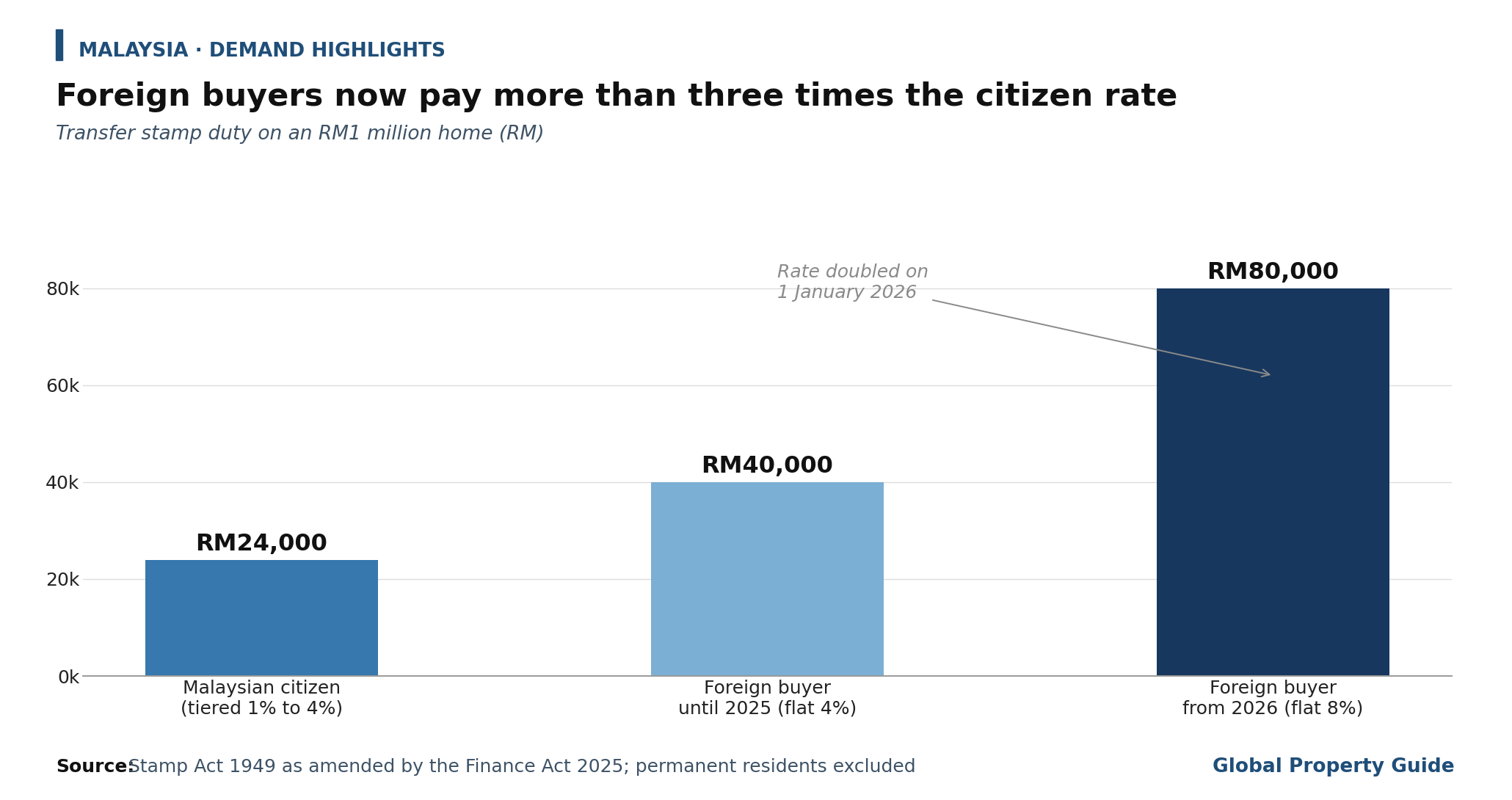
The arithmetic is stark. On a MYR 1 million (US$242,131) home, a Malaysian citizen pays roughly MYR 24,000 (US$5,811) in transfer duty on the tiered scale, while a foreign buyer now pays MYR 80,000 (US$19,370). Commercial and industrial property remain on the standard rates. MM2H participants are treated as foreign buyers for this purpose.
The government framed the measure as a way to keep the housing market competitive and to restrain price escalation. In regional terms, the increase still leaves Malaysia comparatively open: Singapore's additional buyer's stamp duty for foreigners runs to 60%, and Hong Kong has historically applied a 15% buyer's stamp duty.
Malaysia has also moved to a stamp duty self-assessment system through e-Duti Setem, shifting responsibility for calculating the correct amount onto the taxpayer, with the Inland Revenue Board announcing that no penalties would be imposed for computational errors during the first year of implementation.
MM2H rebounds under the three-tier framework
The Malaysia My Second Home (MM2H) scheme has recovered strongly since the tiered structure replaced the punitive 2021 rules.
MM2H approved 3,172 applications in 2025, generating an estimated MYR 3.875 billion (US$938 million) in economic value, Tourism, Arts and Culture Minister Tiong King Sing announced in March 2026. Those approvals translated into 9,038 participants, including dependents. Fixed deposits placed with Malaysian banks accounted for MYR 2.35 billion (US$569 million), residential property purchases for MYR 1.51 billion (US$366 million), and participation fees for MYR 13.86 million (US$3.36 million).
For context, the whole of the 2021 to 2023 period produced only about 1,900 approvals, when the rules demanded a MYR 1 million fixed deposit from every applicant, MYR 40,000 in monthly offshore income, and a minimum age of 35. A single year under the revised terms has now exceeded that three-year total by roughly two-thirds.
Of the 3,172 approvals in 2025, 2,650 or 83.5% fell under the entry-level Silver category, with a further 322 entering through the Special Economic and Financial Zone category tied to Forest City.
On the property side, 744 MM2H participants had purchased residential property in Malaysia as of 31 December 2025, with another 2,637 in the process of buying, Tiong told the Dewan Rakyat in February 2026. China led with 304 purchases, followed by Taiwan (91), Singapore (63), the United States (41), the United Kingdom (40), Hong Kong (34), and Australia (29). Buyers came from more than 90 countries in total.
"The programme is open to applicants worldwide. Don't politicise this. Applicants from Arab countries are also accepted, and some have made purchases, although the numbers are not large," Tiong said, adding that promotional efforts in those markets would be intensified.
The minister also used the session to correct a persistent misconception: MM2H has never conferred permanent residency or citizenship. It is a renewable long-term social visit pass with multiple-entry facilities.
Several structural features of the programme have hardened in 2026:
- Property purchase is mandatory rather than optional, with the minimum value set by tier and by state, and the acquired property is subject to a ten-year holding period.
- Fixed deposits range from roughly US$150,000 for Silver to US$1 million for Platinum, with pass durations of 5, 15, and 20 years, respectively. Up to 50% of the deposit may be withdrawn after one year, restricted to approved purposes such as property, medical treatment, or education.
- Principal applicants under 50 must satisfy an annual residency test, which may be fulfilled collectively by the principal and approved dependents. Applicants aged 50 and above are exempt.
- All applications must be channelled through MOTAC-licensed agents; direct submission is no longer permitted.
- Separate pathways exist alongside the federal programme, including a Sarawak scheme (S-MM2H) with its own 30-day in-state residency requirement, and a Johor tier linked to the special financial zone.
Foreign property ownership rules vary per state
The states continue to set their own criteria and investment thresholds for foreign property ownership, and these sit on top of the new 8% federal stamp duty.
In Selangor, Malaysia's most populous state and its largest by GDP, foreigners may purchase property with a minimum value of MYR 2 million (US$484,262). Foreign buyers are restricted to landed properties with landed strata titles, cannot buy at auction, and cannot own agricultural land.
In Kuala Lumpur, as well as in Perak, Kelantan, Putrajaya, Labuan, Pahang, and Terengganu, the minimum investment requirement is MYR 1 million (US$242,131), while in Perlis it is MYR 500,000 (US$121,065).
Current minimum purchase prices by state are shown below:
| State | Minimum Price | MM2H Price |
| Johor | MYR 2 million (US$484,262) for landed property in designated international zones; MYR 1 million (US$242,131) for high-rise or strata title property within non-international zones, except for Medini | According to MM2H tier |
| Kedah | MYR 600,000 (US$145,278) in Kedah; MYR 1 million (US$242,131) in Langkawi | According to MM2H tier |
| Melaka | MYR 1 million (US$242,131) for landed title; MYR 500,000 (US$121,065) otherwise | According to MM2H tier |
| Negeri Sembilan | MYR 1 million (US$242,131) for overhang landed property; MYR 600,000 (US$145,278) for overhang high-rise or strata title property | According to MM2H tier |
| Pulau Pinang | MYR 1.8 million (US$435,835) for overhang landed property on the island; MYR 750,000 (US$181,598) for overhang landed property on the mainland; MYR 800,000 (US$193,705) for overhang strata or high-rise on the island; MYR 400,000 (US$96,852) for overhang strata or high-rise on the mainland | According to MM2H tier |
| Pahang, Terengganu, Putrajaya, Kuala Lumpur, Labuan, Kelantan, Perak | MYR 1 million (US$242,131) | According to MM2H tier |
| Perlis | MYR 500,000 (US$121,065) | According to MM2H tier |
| Sarawak | MYR 600,000 (US$145,278) in Kuching; MYR 500,000 (US$121,065) in other areas | According to MM2H tier |
| Sabah | MYR 1 million (US$242,131) for landed property; MYR 600,000 (US$145,278) for high-rise property | According to MM2H tier |
| Selangor | MYR 2 million (US$484,262). Foreign buyers are limited to landed properties with landed strata titles; they cannot buy at auction or own agricultural land | According to MM2H tier |
| Data Source: PropertyGuru. | ||
Johor emerges as the market's structural story
Johor has moved from an oversupply cautionary tale to the country's most closely watched growth market, driven by two catalysts.
The Rapid Transit System (RTS) Link, a four-kilometre cross-border shuttle connecting Bukit Chagar in Johor Bahru to Woodlands North in Singapore, is targeted for completion around the end of 2026, with operations expected from early 2027. Designed to move up to 10,000 passengers per hour in each direction, it would cut a crossing that can take one to three hours by road at peak times down to roughly five minutes.
The Johor-Singapore Special Economic Zone, agreed in a framework signed in January 2025, designates areas of Johor for preferential tax treatment, streamlined regulation, and joint development with Singapore, attracting data centres, manufacturing, and technology investment.
Johor recorded the highest number of new residential launches of any state in Q1 2026, at 2,693 units, ahead of Selangor with 1,904 units and Negeri Sembilan with 1,512 units. It also carries the heaviest serviced apartment overhang in the country at 9,972 unsold completed units, a reminder that the state's supply pipeline still runs ahead of absorption in parts of the market.
Property Supply Trends
Developers stop breaking ground
Residential construction activity has diverged sharply between what is being finished and what is being started.
In Q1 2026, housing completions rose by more than 30% y-o-y to 12,905 units from 9,329 units, according to JPPH data. Housing starts, by contrast, fell to 8,243 units from 28,344 units a year earlier, a decline of 70.9%.
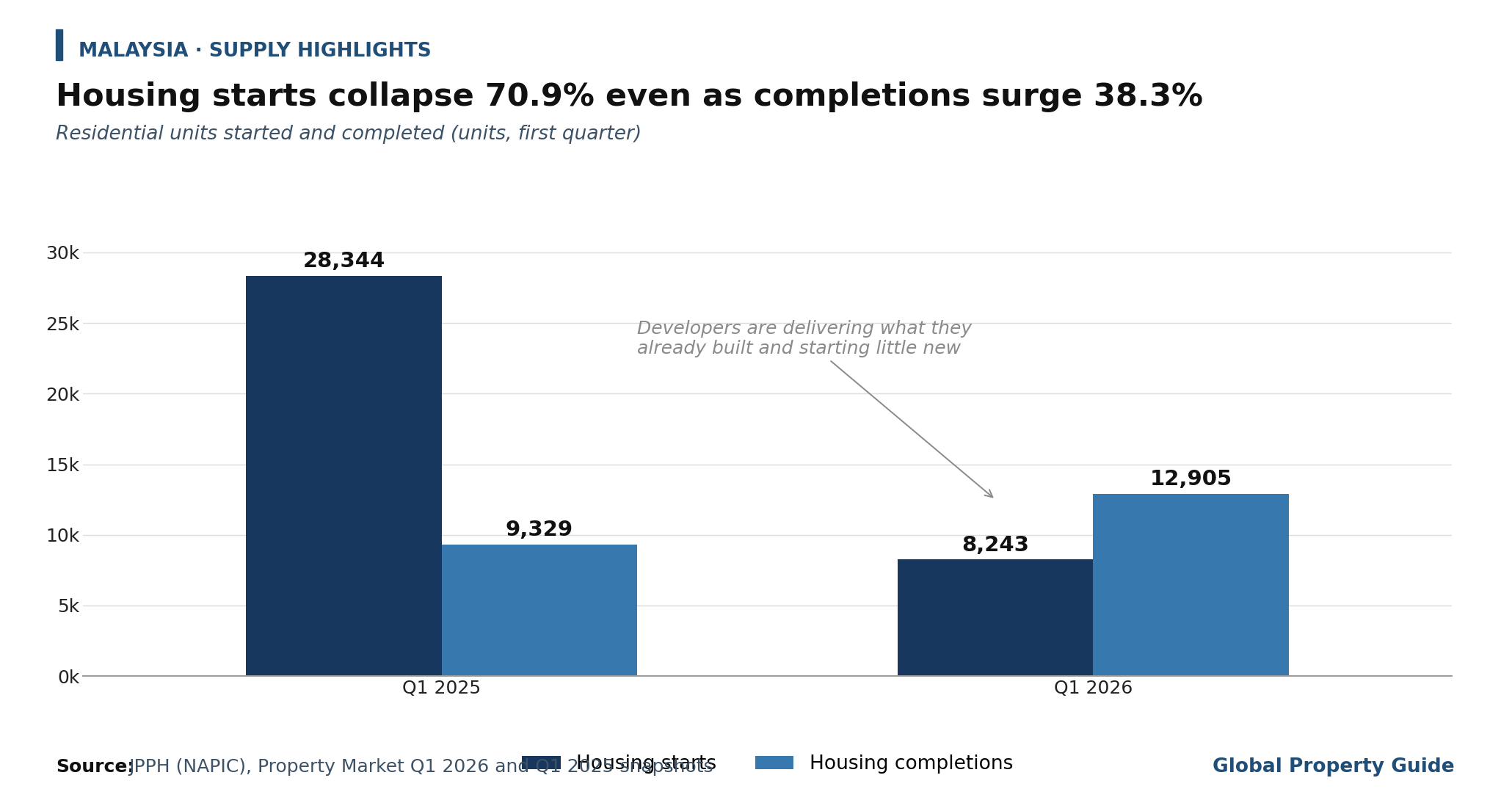
The two movements are related. Developers are delivering projects already under construction while sharply curtailing new commitments, a pattern consistent with caution over demand, financing conditions and future project costs.
For the whole of 2025, based on the quarterly Property Market snapshots published by NAPIC, residential completions totalled 99,877 units, housing starts came to 82,097 units, and planned new supply amounted to 75,370 units.
Planned new supply is the one indicator moving the other way. It rose by more than 50% to 12,852 units in Q1 2026 from 8,342 units a year earlier, while planned new supply for serviced apartments climbed to 6,961 units from 4,024 units. Developers are keeping the pipeline stocked even as they defer the start of construction.
CIMB Securities senior analyst Kenny Mak Hoy Ken has warned that tender costs for upcoming projects could rise by 5% to 15%, with launches liable to slip into the second half of 2026.
Completed serviced apartments delivered during the quarter fell by more than 40% to 1,888 units.
In recent years, residential construction in Malaysia has been constrained by the government's decision to freeze approvals for high-end property developments. Effective November 2017, the restriction covered properties costing over MYR 1 million. That was compounded by pandemic-related restrictions in 2020 and 2021. Starts fell by an average of 6% annually from 2018 to 2023, while completions declined by an average of 3.6% over the same period. Activity only began improving in 2024, and the Q1 2026 reading suggests that recovery has stalled.
Overhang rises for a sixth straight quarter
The unsold housing stock is the clearest evidence that supply is not clearing.
In Q1 2026, the total residential supply overhang reached 32,801 units valued at MYR 16.37 billion (US$3.96 billion), rising 7.6% in volume from 30,471 units in Q4 2025 and up 39.5% from 23,515 units in Q1 2025, based on the Property Market Status Report released by NAPIC. It was the sixth consecutive quarterly increase.
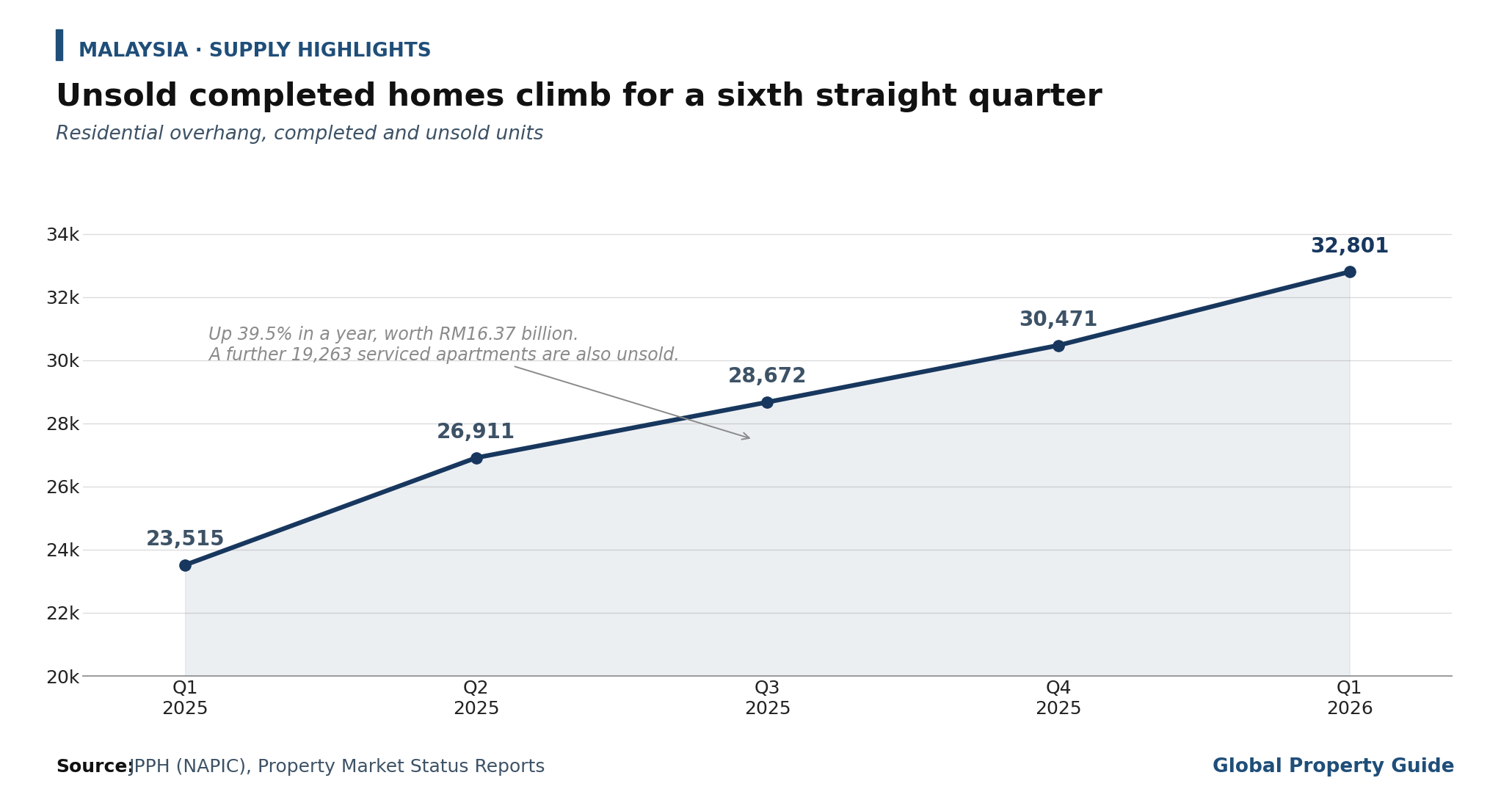
One detail deserves attention. The number of unsold units rose 7.6% quarter-on-quarter while their total value fell 7.7%. The overhang is accumulating in cheaper stock, and developers are trimming prices on paper to shift it.
By state, Perak recorded the largest residential overhang at 4,063 units, followed by Johor (3,852 units), Selangor (3,745 units), Kuala Lumpur (3,733 units), and Pulau Pinang (3,165 units). Kuala Lumpur saw the biggest single-quarter jump, adding 1,678 units. Penang's total was 16% higher than the 2,729 units recorded in the corresponding quarter of 2025.
The serviced apartment segment carries a separate and larger problem in value terms. Unsold completed serviced apartments rose to 19,263 units worth MYR 16.52 billion (US$4.00 billion) in Q1 2026, from 18,752 units worth MYR 15.42 billion in Q4 2025. Johor accounted for 9,972 of those units, Kuala Lumpur for 4,181, and Selangor for 2,407. A substantial 58.5% of this stock sits in the MYR 500,001 to MYR 1 million price band, above the level at which most Malaysian buyers transact and above the ceiling for first-time buyer stamp duty relief.
Combined, residential and serviced apartment overhang now exceeds 52,000 completed units.
The concentration matters more than the headline. The slowdown and the overhang are heavily weighted toward the segments that federal and state affordable housing programmes have prioritised most. The MYR 300,000 and below band recorded both the highest buyer activity in Q1 2026, with 27,209 transactions, and a substantial share of unsold stock. Malaysia's most active buyers are clustered in its most oversupplied segment, and the transactions are not clearing at the rate either the pipeline or the demand signal would imply.
Rental Market: Rents and Rental Yields
Yields edge higher as prices stall
Gross rental yields from apartments in Malaysia averaged 5.27% in Q1 2026, up from 5.19% in Q3 2025, 5.10% in Q1 2025, 5.24% in Q3 2024 and 5.16% in Q1 2024, according to research conducted by the Global Property Guide. The gross rental yield is the rent the landlord will earn, before taxation, vacancy costs, and other costs, compared to the property's purchase price. Net yields are typically 1.5 to 2 percentage points lower.
Yields have been drifting up for two years, but the mechanism is worth naming. With capital values close to flat in real terms and rents still climbing in well-connected urban locations, the improvement reflects a stalled denominator as much as genuine rental strength.
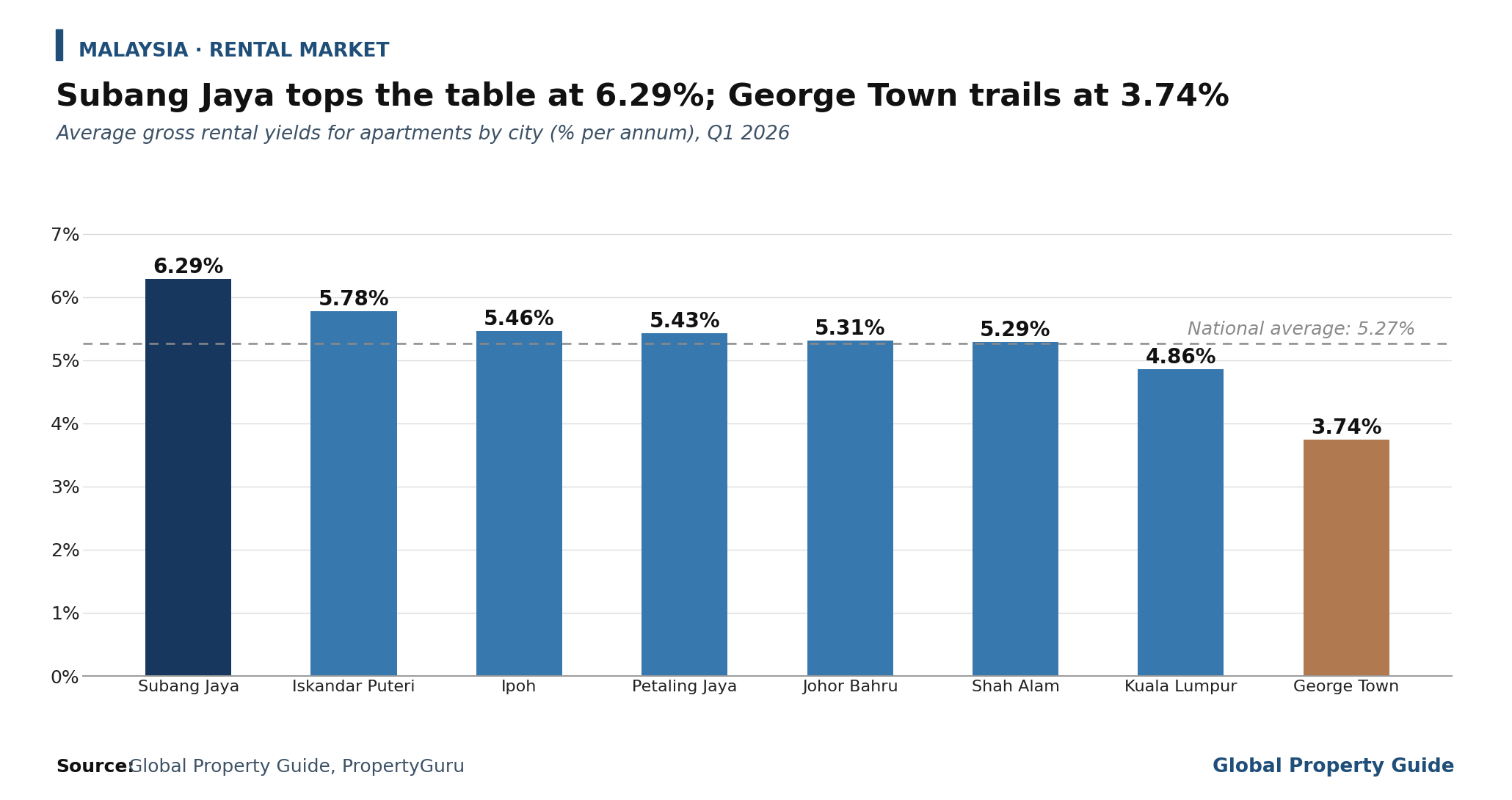
Gross rental yields by city in Q1 2026 were as follows:
- Subang Jaya leads the country with a city average of 6.29%, with three-bedroom apartments returning as much as 7.01%.
- Iskandar Puteri follows at 5.78%, with yields ranging from 4.80% to 6.44% across unit sizes.
- Ipoh averages 5.46%, in a narrow band of 5.23% to 5.59%.
- Petaling Jaya averages 5.43%, ranging from 4.16% to 6.63%.
- Johor Bahru averages 5.31%, with wide dispersion by district: two-bedroom units in Skudai show yields above 10% on very low entry prices, while premium locations return closer to 4.4%.
- Shah Alam averages 5.29%, ranging from 4.86% to 5.53%.
- Kuala Lumpur averages 4.86%, below the national figure. Yields range from 2.28% for three-bedroom units in KLCC to 7.53% for larger units around Jalan Kuching, a spread that reflects how much location and unit type matter within the capital.
- George Town is the weakest major market at 3.74%, ranging from 2.78% to 4.33%.
Rents continue to climb in the urban core
Malaysia's residential rental market continues to expand, with sustained demand supporting higher rents in key urban centres, particularly near LRT and MRT stations, close to major universities, and in locations with strong transport connectivity.
Kuala Lumpur's average rent reached MYR 2,901 (US$702) per month, an increase of 6.1% year-on-year, well above the national average of MYR 2,020 (US$489), based on IQI market data.
"The residential rental market was generally stable in major states with terraced houses and high-rise units experiencing rental growth in selected locations," said JPPH in its Property Market Report.
The RTS Link is beginning to reshape rental economics in the south. A Singaporean earning in Singapore dollars who rents near Bukit Chagar for roughly MYR 2,500 per month saves a substantial sum against comparable Singapore rents, even after the rail fare and commuting time, according to market analysis. This creates a genuinely new tenant class and supports demand for well-located mid-range rental stock in the Johor Bahru core.
Malaysia's rental market nonetheless remains structurally small. Only about 6% of the housing stock sits in the private rental sector, roughly 85% is owner-occupied, and government-provided housing accounts for about 7%.
Mortgage Market and Interest Rates
Key interest rate unchanged for a full year
At its meeting on 9 July 2026, Bank Negara Malaysia's Monetary Policy Committee maintained the Overnight Policy Rate (OPR) at 2.75% for a sixth consecutive meeting. The rate has been at this level since July 2025, when the central bank delivered a 25 basis point cut, its first reduction in five years.
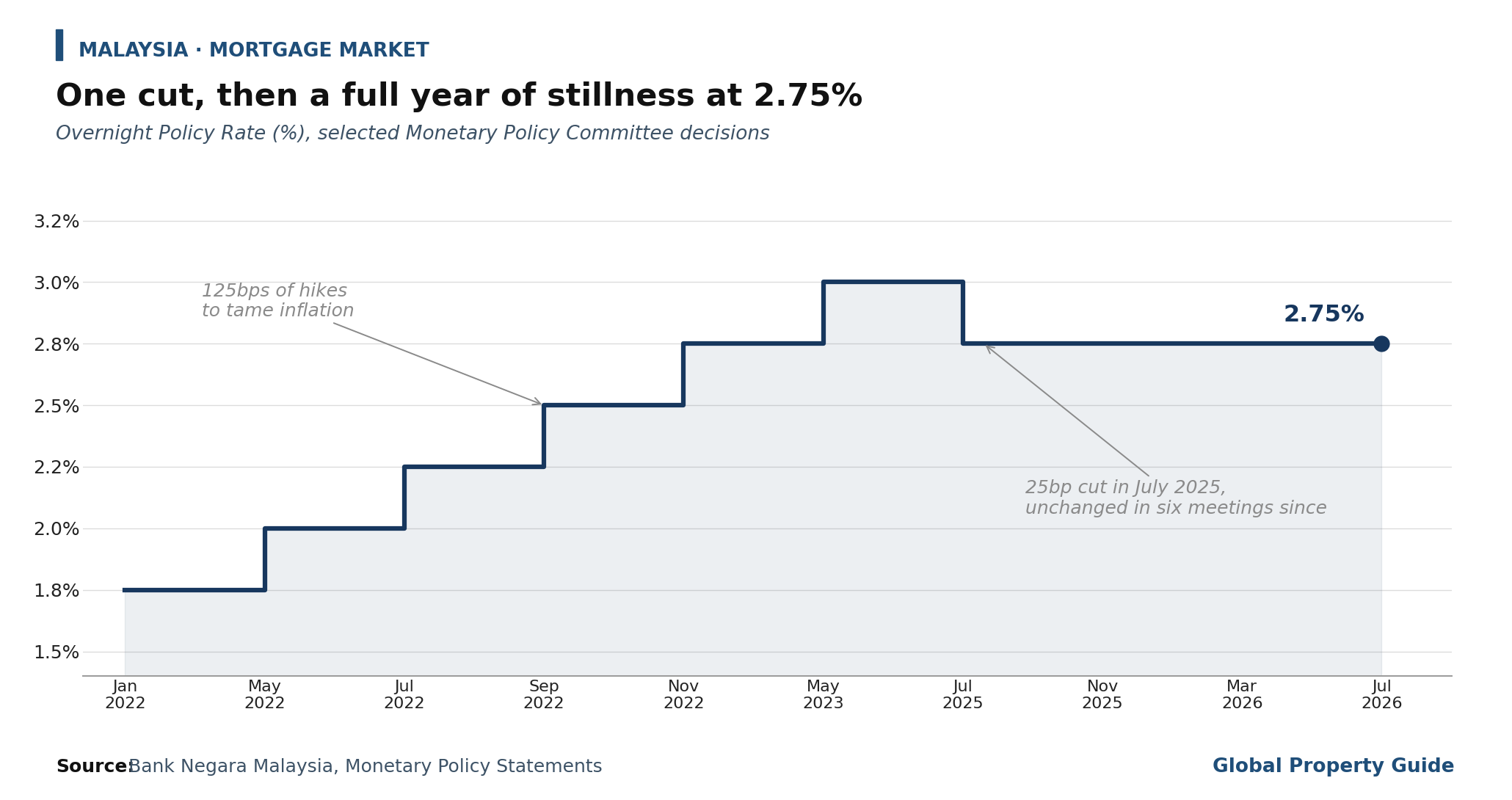
To tame inflation, the central bank had raised the key rate five times between May 2022 and May 2023, a cumulative increase of 125 basis points that took the OPR from 1.75% to 3.00%. It then held that level until the July 2025 cut.
"At the current OPR level, the MPC considers the monetary policy stance to be appropriate and consistent with the outlook of continued price stability and sustainable economic growth. The MPC will remain vigilant to ongoing developments and assess the balance of risks surrounding the outlook for domestic inflation and growth," said BNM in its July 2026 statement.
The central bank noted that the latest developments pointed to resilient growth in the second quarter, driven by sustained domestic demand and stronger-than-expected export performance, while flagging that uncertainties surrounding the Middle East conflict could affect the outlook for both inflation and growth.
Economists surveyed after the decision broadly expect the OPR to stay at 2.75% for the remainder of 2026, with gradual normalisation only in 2027. BNM projects the economy to expand by 4% to 5% in 2026 with headline inflation averaging 1.5% to 2.5%.
Most Malaysian home loans are floating-rate facilities tied to the Standardised Base Rate framework introduced in 2022, with banks adding a margin based on credit assessment. Effective housing loan rates across 2025 and 2026 have commonly ranged from about 3.8% to 5.6% per annum, depending on borrower profile.
Financing, not pricing, is the binding constraint
Cheap money has not translated into approved loans, and this is the market's defining problem.
The housing loan approval rate fell to 39.2% during the first four months of 2026, compared with 41% in 2025 and 42% in 2024, according to Bank Negara Malaysia data. Fewer than four in ten applications now succeed.
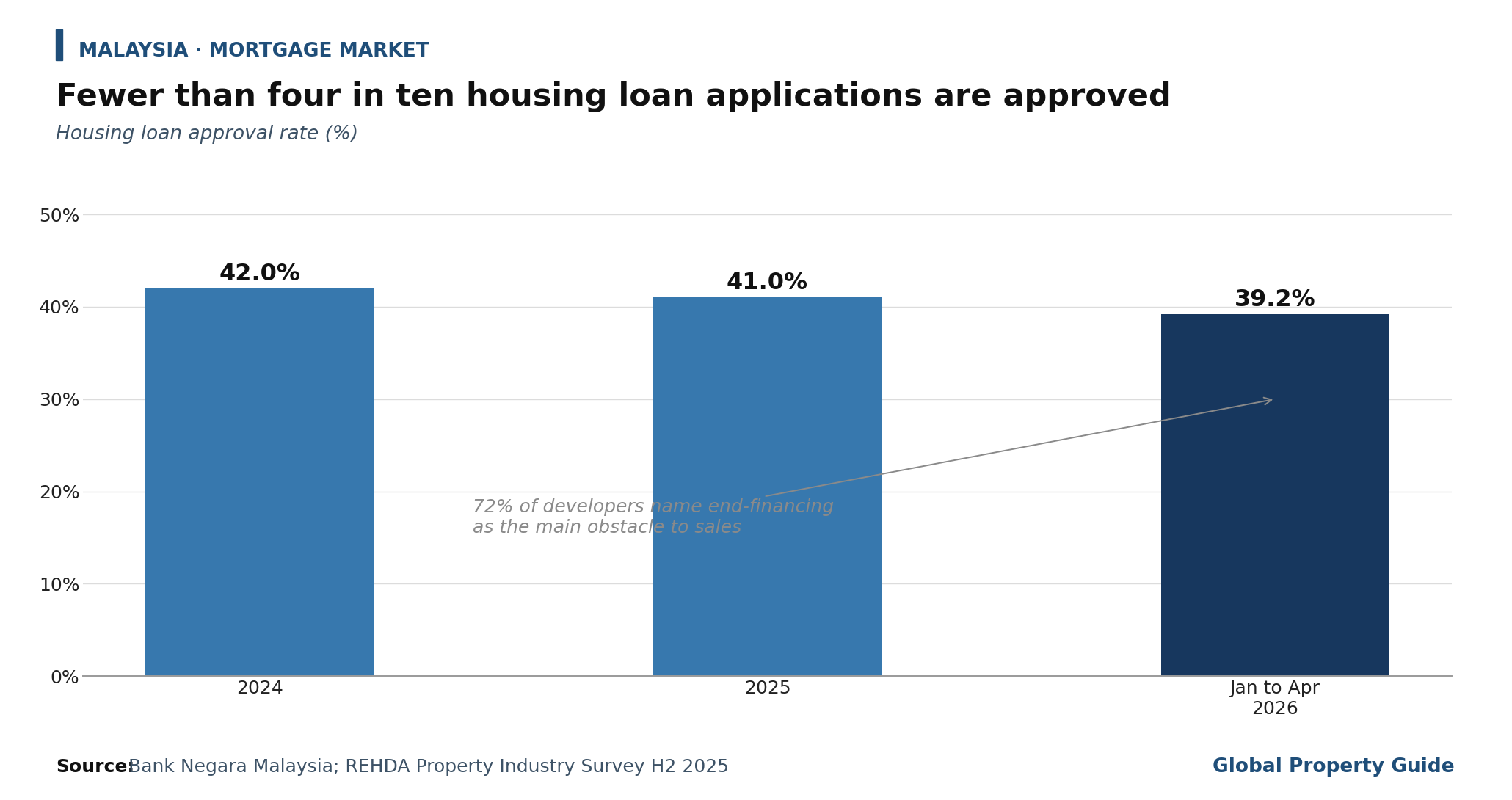
This is not a story about the cost of borrowing. The OPR has been at 2.75% for a year and headline inflation ran at just 1.6% in Q1 2026. Rejections are driven instead by debt service ratios, credit records and income documentation. Banks assess CCRIS and CTOS records closely, and a growing number of applicants carry commitments from buy-now-pay-later facilities and multiple digital financing platforms that count against their capacity.
The consequence appears directly in the developer results. REHDA's survey found that 72% of developers identified financing as the reason unsold units did not clear in H2 2025, when take-up fell to 21%. Deals are dying at end-financing, not at the point of interest.
The government's principal response is the expansion of the Housing Credit Guarantee Scheme to MYR 20 billion (US$4.84 billion) under Budget 2026, designed to cover 80,000 first-time buyers and specifically extended to gig workers, freelancers, and the self-employed who cannot document a fixed income. Whether a guarantee scheme can offset a debt service ratio problem is the open question for the second half of 2026.
Household debt remains elevated but serviceable
Total household debt stood at 84.4% of GDP, or more than MYR 1.7 trillion (US$412 billion), as at end-March 2026, slightly lower than the 84.7% recorded at end-December 2025. Loans for the purchase of residential property make up roughly 61% of that total, the single largest component, followed by vehicle loans and personal financing.
Household loan impairment held steady at 1%, unchanged from end-December, and the median debt service ratio on outstanding loans sits at roughly one-third of income. Malaysia's household debt-to-GDP ratio remains among the highest in Southeast Asia, second only to Thailand, but the servicing metrics do not currently indicate systemic stress.
Household loan growth was 5.2% y-o-y in May 2026, with system-wide loan growth steady at 5.7%, based on BNM banking statistics. Real estate lending to businesses grew 8.3%.
By way of a longer perspective, the value of housing loans rose by an annual average of 8% from 2016 to 2024, down from an annual average growth of 13.1% in 2007 to 2015 and 19.3% in 2000 to 2006. Outstanding loans for house purchase stood at MYR 869.54 billion at the end of August 2025, up 6.3% y-o-y, equivalent to roughly 43% of GDP on the banking system measure.
Historic Perspective
House prices are still below Asian crisis levels
Remarkably, house prices in Malaysia remain below their pre-Asian Crisis 1997 levels in inflation-adjusted terms, despite the housing booms of the intervening decades.
Since the Asian crisis, Kuala Lumpur's house prices have significantly outperformed the rest of the country. After the downturn of 2008 and 2009, the property market was revitalised with the help of the Greater Kuala Lumpur Plan, which included the MRT project. From 2005 to 2015, Kuala Lumpur house prices surged by almost 122%, or 73% inflation-adjusted.
National price rises were more muted. From 2005 to 2015, Malaysia's house prices rose by 96.1%, or 52.4% inflation-adjusted. From 2016 to 2018, nationwide house prices rose by an annual average of 5.2%, or 3.3% inflation-adjusted.
The market then slowed markedly as cooling measures took effect and the pandemic struck. Nationwide house prices increased by a meagre 1.79% (0.79% inflation-adjusted) in 2019, 1.21% (2.63% inflation-adjusted) in 2020, and 1.89% (a 1.3% decline inflation-adjusted) in 2021.
Growth then recovered, rising 3.9% (0.12% inflation-adjusted) in 2022, 3.85% (2.27% inflation-adjusted) in 2023, and 4.43% (2.71% inflation-adjusted) in 2024, before decelerating to 2.6% (roughly 1.2% inflation-adjusted) in 2025 and 1.7% (about 0.1% inflation-adjusted) in Q1 2026.
Overall, national house prices increased by a cumulative 23.4%, or approximately 8.7% inflation-adjusted, from 2019 to Q1 2026. On the affordability measure that matters most to Malaysian households, the average house price sits at roughly five times median annual household income on 2024 income data, well above the internationally recognised threshold of three times.
Economic and Social Factors
The economy outruns its own forecasts
Malaysia's economy has consistently beaten official projections. Real GDP grew by 5.2% in 2025, above the government's forecast range of 4% to 4.8% and up from 5.1% in 2024, capped by a three-year-high 6.2% expansion in the fourth quarter.
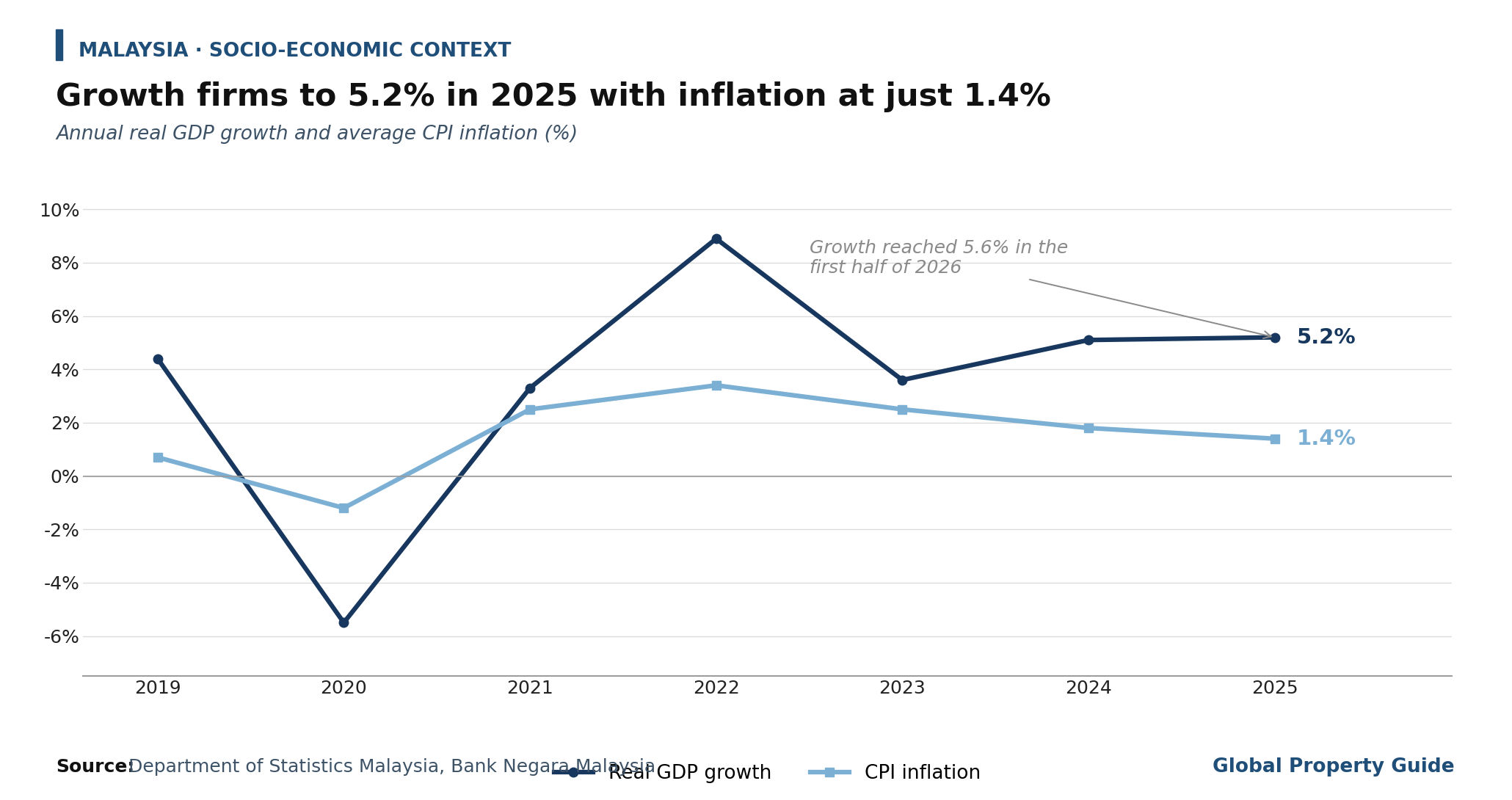
Momentum carried into 2026. The economy expanded by 5.4% in Q1 2026, then by 5.8% in Q2 according to advance estimates, taking first-half growth to 5.6% against 4.5% a year earlier. At constant 2015 prices, Q1 2026 GDP reached MYR 437.7 billion, up from MYR 415.4 billion a year earlier.
Domestic demand expanded by 5.2% in Q1 2026, supported by household spending amid a buoyant labour market and higher disposable income following the second phase of the Public Service Remuneration System, special financial assistance for civil servants, and continued Sumbangan Asas Rahmah transfers. Private consumption rose 4.7% and private investment 7.8%, while net exports surged 13.5%.
By major sector in Q1 2026, services grew 5.6%, manufacturing 5.9% on stronger electrical and electronics output tied to artificial intelligence and data centre demand, and construction posted the strongest reading of any sector at around 7.7%. Agriculture slowed to 2.6% as palm oil production normalised, while mining and quarrying contracted 2.1% on weaker crude oil and gas output.
"We project that the economy will grow between 4% and 5% in 2026 despite ongoing geopolitical and trade disruptions," said BNM Governor Abdul Rasheed Ghaffour, noting that the outlook remained subject to both upside and downside risks.
The International Monetary Fund projected growth of 4.6% for 2026 in its February 2026 Article IV assessment, while the World Bank forecast 4.4%.
Trade hits a record as semiconductors surge
Malaysia's external sector delivered its strongest half-year on record. Total trade grew by 22.4% y-o-y to MYR 1.796 trillion (US$435 billion) in the first half of 2026, with exports up 27.5% to MYR 971.59 billion (US$235.2 billion) and imports up 16.9% to MYR 824.44 billion (US$199.6 billion), producing a trade surplus of MYR 147.15 billion (US$35.6 billion), according to the Ministry of Investment, Trade and Industry.
Electrical and electronics exports rose 42.5% to a record MYR 467.9 billion (US$113.3 billion), close to half of all Malaysian exports. June marked the 74th consecutive month of trade surplus since May 2020.
Malaysia also climbed eight places to 15th in the IMD World Competitiveness Ranking 2026.
Economists caution that replicating these gains will be harder as favourable base effects fade, and that the export mix is becoming increasingly concentrated in downstream semiconductor assembly, which generates limited spillover into domestic value creation and employment.
On tariffs, a proposed 24% levy on Malaysian exports formed part of the United States global import measures announced in April 2025. Following implementation delays and a reciprocal trade agreement concluded around the ASEAN Summit in October 2025, Malaysia now faces an effective tariff of about 19% on most exports, supported by extensive exemptions.
Inflation manageable despite the energy shock
Inflation remains contained. Headline inflation averaged 1.6% in Q1 2026, up from 1.3% in Q4 2025, while core inflation moderated to 2.1% from 2.3%. The rate then rose to 2.0% in May 2026, the highest since July 2024, before easing to 1.9% in June. For the first five months of the year, headline inflation averaged 1.7% and core 2.1%.
Nationwide inflation averaged 1.4% in 2025, from 1.8% in 2024, 2.5% in 2023, 3.4% in 2022, and 2.5% in 2021.
The main upward pressure has come from transport costs, reflecting the pass-through of higher global fuel prices caused by the Middle East conflict. Targeted subsidies under the BUDI MADANI RON95 and BUDI Diesel schemes have absorbed much of the shock at the pump, at considerable fiscal cost.
Labour market at a decade high
The labour market continues to strengthen. Malaysia's unemployment rate stood at 2.9% in Q1 2026, unchanged from the preceding quarters, with the number of unemployed persons edging down to 506,500 from 508,300, according to the Department of Statistics Malaysia.
For the whole of 2025, the unemployment rate fell to 3.0%, its lowest level in a decade and below the pre-pandemic 3.3% recorded in 2019. The number of unemployed declined 5.0% to 507,200 from 534,100 in 2024. The labour force expanded 1.1% to 17.09 million, and the labour force participation rate reached 70.8%, the highest ever recorded. Employment rose 1.3% to 16.58 million.
The jobless rate had averaged 3.2% annually from 2009 to 2019 before rising to 4.5% in 2020 and 4.7% in 2021 during the pandemic, then declining to 3.8% in 2022, 3.6% in 2023, and 3.5% in 2024.
By state in Q1 2026, Putrajaya recorded the lowest unemployment rate at 1.3%, followed by Pahang at 1.9% and Selangor and Melaka at 2.0%. Putrajaya also led on participation at 79.2%, ahead of Selangor at 78.0% and Kuala Lumpur at 76.0%.
Public finances improving, but the energy bill bites
Malaysia's fiscal deficit narrowed to 3.7% of GDP in 2025, the fifth consecutive year of consolidation from 6.4% in 2021, with a target of 3.5% for 2026, according to the Ministry of Finance. New annual borrowings have fallen steadily from MYR 100 billion in 2021 to MYR 75.6 billion (US$18.3 billion) in 2025.
Federal government debt fell to 63.1% of GDP as of the end of Q1 2026, down from 65.2% in 2025, keeping statutory borrowings just below the 65% ceiling set under the Public Finance and Fiscal Responsibility Act. The government aims to reduce the medium-term deficit below 3% and cap debt under 60% of GDP.
That trajectory faces a real test in 2026. Higher global energy prices linked to the Middle East conflict have pushed subsidy expenditure well above budget, and independent analysts have flagged that the full-year deficit is likely to exceed the 3.5% target. Debt service charges are projected to consume around 17% of revenue in 2026, up from roughly 10% in the early 2010s. The Ministry of Finance has said a revised fiscal projection for 2026 will be announced at Budget 2027.
"Malaysia's commitment to prudent fiscal management has been demonstrated by the passage of the landmark Public Finance and Fiscal Responsibility Act in 2023 and a steady reduction in the fiscal deficit since 2022," said the IMF in its 2026 Article IV assessment, while noting that Malaysia's fiscal space remains at risk given sizeable financial guarantees.
Ringgit strength stalls in mid-2026
The Malaysian ringgit extended its recovery into early 2026 before the Middle East conflict interrupted it.
After averaging MYR 4.28 to the US dollar across 2025 and closing that year at MYR 4.06, the currency strengthened through the first quarter to reach roughly MYR 3.89 in late February 2026, its firmest level since June 2018, supported by Malaysia's role in the artificial intelligence supply chain and the strong Q4 2025 GDP print.
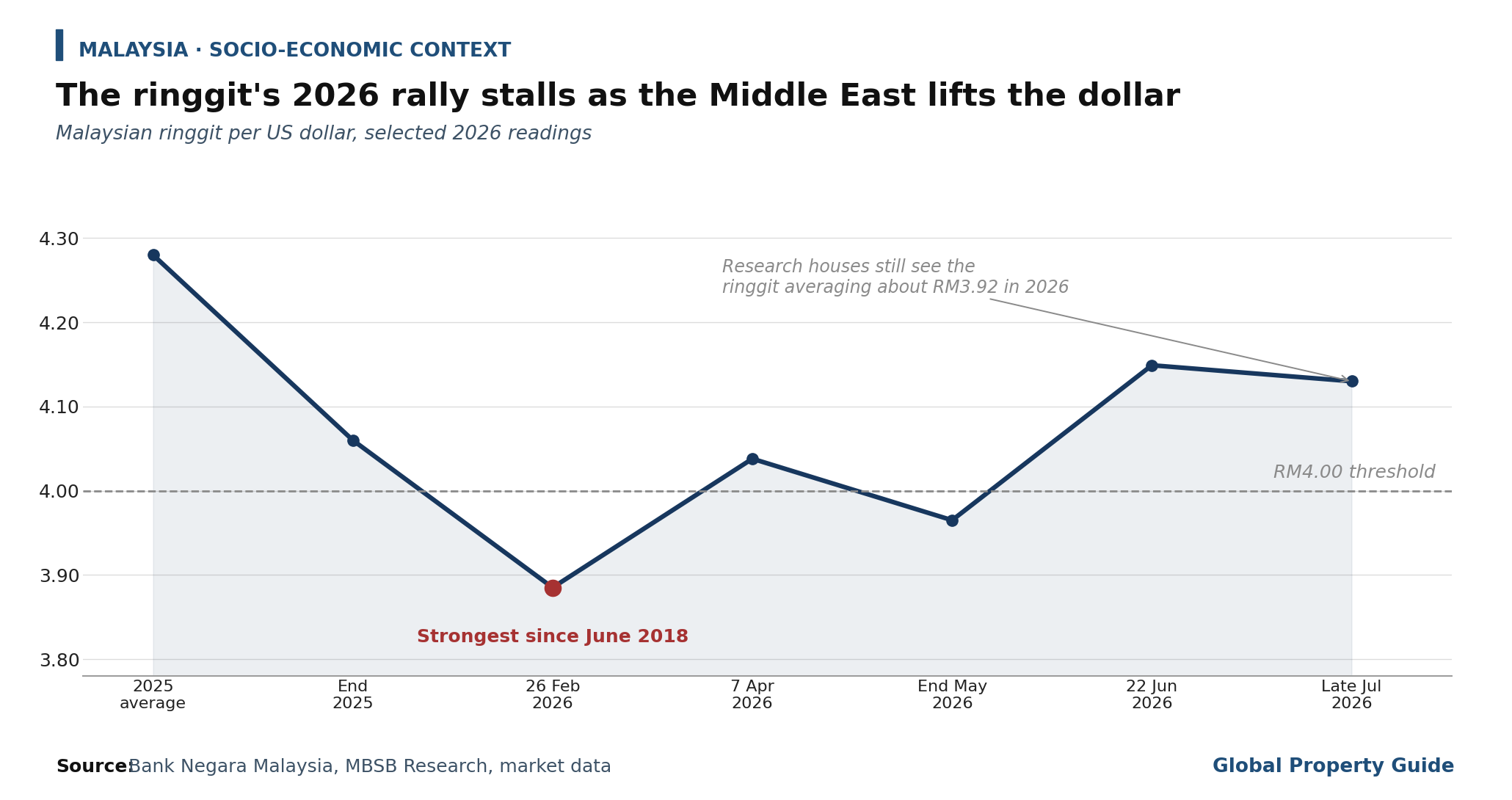
The rally then faded. Renewed dollar demand tied to tensions around the Strait of Hormuz pushed the pair back above MYR 4.00, with the ringgit reaching about MYR 4.15 in late June before settling near MYR 4.13 in late July.
Research houses remain constructive. MBSB Research maintains a 2026 average forecast of around MYR 3.92 with a year-end target near MYR 3.85, underpinned by a narrowing differential between the OPR and the US federal funds rate. Juwai IQI global chief economist Shan Saeed expects the currency to trade within a MYR 3.90 to MYR 4.20 range through the second half of 2026.
For foreign buyers, the currency picture cuts both ways. A firmer ringgit raises the dollar cost of Malaysian property just as the 8% stamp duty takes effect, compounding the increase in entry costs.
Malaysia has recorded current account surpluses for nearly three decades, and Fitch Ratings expects that to continue in the medium term, projecting a surplus of around 1% to 2% of GDP supported by a diversified export base and competitive manufacturing sector.
Politics turns against the governing coalition
The most significant development of 2026 for Malaysia's medium-term policy outlook is electoral.
Two southern states went to the polls in quick succession. In the Johor state election on 11 July 2026, Barisan Nasional won 48 of 56 seats, a two-thirds supermajority, and an increase on the 40 seats it held in the outgoing assembly. Prime Minister Anwar Ibrahim's Pakatan Harapan was left as a diminished opposition in the state, holding 32.64% of the popular vote but losing four urban seats previously held by the Democratic Action Party. Negeri Sembilan, held by Pakatan Harapan since 2018, votes on 1 August 2026.
Two factors drove the result. Multi-cornered contests diluted the opposition-leaning vote, with Bersama, the new party formed by former economy minister Rafizi Ramli and former environment minister Nik Nazmi Nik Ahmad after they resigned from government in May 2025, acting as a spoiler in urban seats. And the coalition partners campaigned against one another, with the Democratic Action Party and the United Malays National Organisation distancing themselves to offset the cost of governing together federally.
The Johor result follows a near wipeout for Pakatan Harapan in the Sabah state election in November 2025. A federal general election is due by February 2027, and Melaka is expected to hold state polls before the end of this year.
For the housing market, the implications run through policy continuity rather than any immediate mechanism. The Madani framework has underpinned the affordable housing agenda, the expanded credit guarantee scheme, and the 13th Malaysia Plan's target of one million affordable homes. A federal coalition in which the United Malays National Organisation holds substantially greater leverage, facing an election within eighteen months, is a different environment for fiscal consolidation and for the targeted subsidy reforms that consolidation depends on.
Malaysia's underlying position is nonetheless strong. Growth is outpacing forecasts, inflation is the lowest in ASEAN, the labour market is at a decade high, and the export engine is running at record levels. The housing market's problem is narrower and more tractable than the political noise suggests: a financing channel that is turning willing buyers away from homes that are already built.
Sources:
- Property Price and Rental Index (Valuation and Property Services Department): https://napic.jpph.gov.my/
- Malaysian House Price Index (Valuation and Property Services Department): https://napic.jpph.gov.my/
- Property Market (Valuation and Property Services Department): https://napic.jpph.gov.my/
- Property Market Q1 2026 Snapshots (National Property Information Centre): https://napic.jpph.gov.my/
- Malaysia's property market stays stable in 1Q2026 with transactions near 90,000 units worth RM51.9b, says JPPH (EdgeProp): https://www.edgeprop.my/
- Report: Malaysia's property sector posts record RM241.9b in 2025 (Malay Mail): https://www.malaymail.com/
- NAPIC Q1 2026: What Malaysia's Property Data Means for Buyers (IQI Global): https://iqiglobal.com/
- Penang ranked 5th for residential property overhang in Q1 2026 (Penang Property Talk): https://www.penangpropertytalk.com/
- Malaysia's property market posts moderate Q3 growth despite cautious sentiment (Malay Mail): https://malaymail.com/
- Why So Many Malaysians Can't Get a Home Loan in 2026 (MyRumahBaru, citing REHDA Property Industry Survey): https://www.myrumahbaru.com/
- Malaysia's housing problem isn't supply but financing (Focus Malaysia): https://focusmalaysia.my/
- Govt budgets RM672m for affordable housing, first-time homebuyers get stamp duty waivers extended to 2027 (Malay Mail): https://www.malaymail.com/
- Budget 2026: Stability as the Catalyst for Malaysia's Next Property Growth Phase (PropertyGuru Malaysia): https://www.propertyguru.com.my/
- Stamp Duty Malaysia 2026: Complete Guide (KC Group): https://kcgroup.biz/
- Malaysia My Second Home (MM2H) (Immigration Department of Malaysia): https://www.imi.gov.my/
- Malaysia MM2H Posts 3,172 Approvals in 2025, Generating Nearly US$1 Billion (IMI Daily): https://www.imidaily.com/
- China, Taiwan, and Singapore top MM2H property buyers, says Tiong (The Star): https://www.thestar.com.my/
- Malaysia MM2H 2026: New Tiered Rules and Requirements (Sovereign Residence): https://sovereignresidence.com/
- Johor Bahru Property Guide 2026: Prices, Rent, RTS Link and the Honest Risks (iHome.my): https://ihome.my/
- Johor Bahru Property Prices 2026 (PropCashflow): https://propcashflow.my/
- Gross rental yields in Malaysia: Kuala Lumpur and 7 other areas (Global Property Guide): https://www.globalpropertyguide.com/
- Malaysia Property Market Insights 2026: Prices, Trends and Yields (IQI Global): https://iqiglobal.com/
- Bank Negara holds OPR at 2.75%, maintains 4%-5% growth forecast (The Star): https://www.thestar.com.my/
- Economists see BNM holding OPR through 2026, with gradual rate normalisation next year (The Edge Malaysia): https://theedgemalaysia.com/
- What the Banking Sector's Loan Growth Indicate (Business Today): https://www.businesstoday.com.my/
- Masked household debt hardships (The Star): https://www.thestar.com.my/
- Malaysia's economy grows 5.4% in Q1 2026, outpacing expectations amid global uncertainty (Ministry of Finance Malaysia): https://www.mof.gov.my/
- Malaysia's GDP up 5.4% in Q1 2026 (Free Malaysia Today): https://www.freemalaysiatoday.com/
- Malaysia's GDP unexpectedly grows 5.8% on exports as inflation cools (Free Malaysia Today): https://www.freemalaysiatoday.com/
- Advance Gross Domestic Product Estimates, Q1 2026 (Department of Statistics Malaysia): https://www.dosm.gov.my/
- Labour Force Survey Report, First Quarter 2026 (Department of Statistics Malaysia): https://www.dosm.gov.my/
- Labour Force Survey 2025 (Department of Statistics Malaysia): https://www.dosm.gov.my/
- Malaysia's trade surges 22.4% to record RM1.796 trillion in 1H26 (The Star): https://www.thestar.com.my/
- Trade momentum to slow after record 1H26 (The Star): https://www.thestar.com.my/
- Malaysia's federal debt drops to 63.1% of GDP in Q1 2026 (The Star): https://www.thestar.com.my/
- Malaysia's Fiscal Reforms (ISEAS Yusof Ishak Institute): https://www.iseas.edu.sg/
- Malaysia: 2025 Article IV Consultation (International Monetary Fund): https://www.elibrary.imf.org/
- Malaysia (International Monetary Fund): https://www.imf.org/
- Malaysia Economic Monitor (World Bank): https://thedocs.worldbank.org/
- Malaysian Ringgit Remains Resilient, June 2026 (MBSB Research): https://www.midf.com.my/
- Ringgit expected to trade within 3.90-4.20 against US$ through 2H26 (The Star): https://www.thestar.com.my/
- Fitch Affirms Malaysia, Outlook Stable (Fitch Ratings): https://www.fitchratings.com/
- Assessment and Early Analysis of the 2026 Johor State Election Results (RSIS): https://rsis.edu.sg/
- Johor and Negeri Sembilan state elections are double trouble for Anwar (East Asia Forum): https://eastasiaforum.org/
- Biggest winners and losers in the Johor polls (Free Malaysia Today): https://www.freemalaysiatoday.com/
- Affordable Housing or Affordable Debt? (Khazanah Research Institute): https://www.krinstitute.org/