Is Australia a Good Country to Buy Property?
Australia is recognized as one of the world’s most stable and transparent property markets, supported by strong institutions, steady population growth, and resilient demand in major cities. The country offers diverse opportunities, from global hubs like Sydney and Melbourne to rapidly growing markets such as Brisbane and Perth, though entry prices are often higher than in other regions. Foreign buyers may purchase property but must obtain approval from the Foreign Investment Review Board and are generally restricted to new developments or land for construction, in line with Australia’s policy to channel foreign investment into expanding housing supply.
Although subject to occasional slowdowns, Australia’s housing market has demonstrated consistent long-term growth, with prices reaching record highs before stabilizing. Rental yields are generally moderate, with some cities offering stronger returns. The legal framework for landlords and tenants is structured and state-based, providing clarity for investors. Lower interest rates are encouraging renewed lending, and a stable economic outlook positions Australia as a mature, well-regulated market that supports long-term capital preservation and steady appreciation rather than rapid speculative gains.
Table of Contents
- Can Foreigners Buy Property in Australia
- Best Cities and Regions to Invest
- Median Asking Prices
- Rental Yields and Rents
- Market Performance (Past and Present)
- Landlord and Tenant Laws
- Property Related Taxes
- Buying (and Selling) Costs
- Mortgage and Financing Options
1) Can Foreigners Buy Property in Australia?
Yes, but with a few things to consider. Foreign investors must obtain approval from Australia’s Foreign Investment Review Board before purchasing property. The Board regulates foreign real estate transactions to ensure compliance with national policy. Typically, foreign buyers may purchase only new dwellings or vacant land for development, while established properties are limited to redevelopment purposes. Approval is required before purchase, unless buying jointly with an Australian citizen, permanent resident, or New Zealand citizen. This framework directs foreign investment toward new housing supply and helps preserve existing homes for local residents.
2) Best Regions and Cities to Invest
Sydney
As Australia's largest city and a global financial hub, Sydney is a prime destination for real estate investment. Suburbs like Bondi, Manly, and Darlinghurst are highly popular for their proximity to the beach, vibrant lifestyle, and world-class amenities. The city offers a range of property options, from luxury apartments with iconic views of Sydney Harbour to family homes in quieter neighborhoods, making it an attractive location for both residential and commercial investments.
Melbourne
Known for its rich cultural scene and diverse architecture, Melbourne is a top choice for real estate investors. Areas such as Southbank, Docklands, and Fitzroy offer excellent opportunities for investment in high-rise apartments and mixed-use developments. The city's status as a hub for arts, education, and tech sectors makes it appealing for both investors and renters, with a stable demand for residential and commercial properties.
Gold Coast
With its stunning beaches, sunny climate, and tourist-driven economy, the Gold Coast is a highly desirable location for real estate investment, particularly in luxury vacation homes and resort-style living. Popular areas like Surfers Paradise, Broadbeach, and Burleigh Heads offer strong returns on short-term rental properties, appealing to both investors and those seeking holiday homes.
Birsbane
Brisbane, the capital of Queensland, offers a more affordable alternative to Sydney and Melbourne but is rapidly growing in popularity among investors. Suburbs like New Farm, Kangaroo Point, and South Brisbane provide attractive investment opportunities in residential properties, particularly with the city's ongoing infrastructure developments and population growth driving demand.
Perth
Located on Australia’s west coast, Perth is known for its relaxed lifestyle, booming mining industry, and relatively lower property prices compared to other major Australian cities. Areas like Cottesloe, Fremantle, and Subiaco are popular for their beachside living, offering a mix of luxury homes and investment properties. The city's growing economy and strategic location make it a key market for long-term investment opportunities.
Adelaide
Adelaide is known for its affordability, peaceful lifestyle, and cultural charm. Real estate investors are drawn to its suburban areas like Glenelg and North Adelaide, which offer strong growth potential in residential markets. With a focus on innovation and technology sectors, Adelaide is becoming increasingly attractive to investors seeking lower entry points with steady growth.
Tasmania
Tasmania is gaining traction as an emerging real estate market due to its stunning landscapes and lifestyle appeal. Cities like Hobart and Launceston have seen a surge in interest from both local and overseas buyers. Tasmania's unique blend of natural beauty, affordability, and a growing tourism sector makes it an appealing choice for investors seeking vacation rentals and lifestyle properties.
3) Median Asking Prices
Australia has a significantly higher median asking price than New Zealand. As of August 2025, one-bedroom apartments ranged from $194,000 to $428,000.
As of August 2025, square meter prices were as follows in Australia:
- Sydney - $428,000
- Gold Coast - $389,000
- Brisbane - $363,000
- Perth - $292,000
- Adelaide - $277,000
- Canberra - $266,000
- Melbourne - $252,000
- Darwin - $194,000
Note: Prices are shown in US Dollars.
4) Rental Yields and Rents
Australia’s rental yields are just below average, with an overall rating of 4.92%.
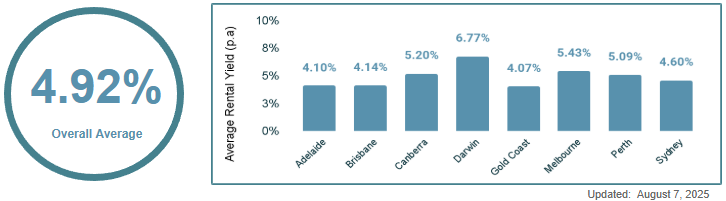
As of January 2026, average yields for one-bedroom apartments across Australia are as follows:
- Darwin - 6.77%
- Melbourne - 5.43%
- Canberra - 5.20%
- Perth - 5.09%
- Sydney - 4.60%
- Brisbane - 4.14%
- Adelaide - 4.10
- Gold Coast - 4.07%
Australia's rent price index:
Data Source: OECD.
5) Market Performance (Past and Present)
Australia’s housing market has experienced sustained long-term growth, characterized by cycles of acceleration and moderation. National dwelling prices have increased significantly, driven by limited supply, strong demand, and solid economic fundamentals. Sydney and Melbourne have consistently led this growth. Annual price changes have fluctuated, with rapid increases in the early 2010s and around 2021, followed by corrections, especially in 2022 when higher interest rates slowed momentum. By 2024, prices continued to rise year-on-year, though at a more moderate pace, with nominal gains often exceeding those adjusted for inflation.
In recent quarters, the Australian market has remained resilient, with continued price appreciation and record levels across several indicators. However, growth has slowed due to affordability challenges and broader economic pressures. As housing values approached new highs in 2025, annual gains moderated compared to previous years, indicating a shift toward a more balanced market. Despite these trends, national prices remain high relative to historical levels, highlighting the market’s long-term upward trajectory despite regional and short-term fluctuations.
Australia's house price annual change:
Data Source: Australian Bureau of Statistics.
6) Landlord and Tenant Laws
Australia’s landlord-tenant framework is considered balanced. Most residential tenancies are governed by state and territory laws rather than a single national law. Rent levels and increases are negotiable at the start of a lease, but many jurisdictions limit how often and by how much rent can be raised. Security deposits are regulated, and landlords must follow formal notice and legal procedures to terminate leases or evict tenants, usually requiring valid reasons such as non-payment or property damage. Recent reforms in several regions have strengthened tenant rights, improved dispute resolution, and clarified landlord responsibilities, making the system more structured and protective, particularly for long-term renters.
7) Property Related Taxes
Australia’s property tax and cost structure impacts buyers, owners, and investors in several ways. Purchase costs include stamp duties and land transfer taxes, which vary by state and can be substantial. Foreign buyers may face additional surcharges. Ongoing land tax is charged annually on investment or non-primary residences, based on assessed value. Rental income is taxed at standard Australian income tax rates, typically around 32.5% for many non-residents, with allowable expenses deductible from taxable income. Capital gains tax may apply when selling investment properties. Local councils impose annual rates, and real estate agent fees and other transaction charges contribute to the total cost of buying and selling property in Australia.
8) Buying (and Selling) Costs
In Australia, property transactions are formalized through a legally binding Contract of Sale that outlines the terms agreed upon by the buyer and seller, including the price, deposit, payment conditions, and property details. After signing, the buyer usually pays a 10 percent deposit to secure the agreement. Buyers should conduct thorough due diligence, including inspections and the review of disclosures, and engage a qualified solicitor or conveyancer to review the contract, ensure legal compliance, address potential issues, and guide them through settlement.
Here's a full breakdown:
| Transaction Costs | ||
| Who Pays? | ||
| Property Transfer Tax | 1.00% - 6.50% | buyer |
| Legal Fees | 0.50% - 1.00% | buyer |
| Notary Fees | 0.10% - 0.50% | buyer |
| Real Estate Agent Fee | 2.00% - 2.50% | seller |
| Costs Paid by Buyer | 2.00% - 8.00% | |
| Costs Paid by Seller | 2.00% - 2.50% | |
| Round-trip Transaction Costs | 4.00% - 10.50% | |
| Source: Global Property Guide, PWC | ||
10) Mortgage and Financing Options
Australia’s mortgage market has regained momentum following the Reserve Bank of Australia’s policy easing in 2025. Three rate cuts totaling 75 basis points reduced the cash rate to 3.60% by August. While average interest rates on new housing loans have fallen, they remain above pre-2022 levels, at approximately 5.75% for owner-occupiers and 5.94% for investors as of mid-2025. Lower borrowing costs have driven a rebound in lending, with new housing loan commitments rising by more than 10% year on year in the first half of 2025. Investor lending has outpaced owner-occupied borrowing, and most new loans continue to finance existing dwellings. Outstanding housing debt reached AUD 2.45 trillion in mid-2025, about 88% of GDP, though still below pandemic-era peaks.
The broader economic backdrop remains supportive. The broader economic environment remains supportive but cautious. GDP growth has slowed in recent years but is expected to improve modestly through 2025 and 2026, supported by fiscal stimulus and monetary easing. Inflation is declining toward the RBA’s target, though some sectors still face underlying price pressures. The labor market remains resilient, with unemployment near historic lows despite some softening. Authorities and international observers expect a soft landing, with inflation returning to target and unemployment remaining stable, though risks persist from global trade tensions, geopolitical uncertainty, and variable household spending.
Australia's mortgage loan interest rates:
Data Source: The Reserve Bank of Australia.
Need Help?
Buying property in a foreign country can feel overwhelming, but we're here to help.
At Global Property Guide, we offer:
- Data-backed insights on property prices, rental yields, and taxes
- Country-specific legal and tax guidance through our partner network
- Pre-screened investment properties, including income-generating Airbnb units
- 1-on-1 consultations with real estate experts focused on international buyers
- Step-by-step buyer support, from due diligence to closing
Whether you're looking for your first investment in Australia or expanding your international portfolio, we can help you make smart, secure decisions.
Contact our team or book a free consultation to get started.