Dominican Republic's Residential Property Market Analysis 2026
The Dominican Republic's housing market is still rising, but the pace has cooled for a second consecutive year, and an unexpected surge in the peso has quietly made Dominican property considerably more expensive for the foreign buyers who drive its coastal segment.
This extended overview from the Global Property Guide presents a comprehensive analysis of the Dominican housing market, covering its overall structure, price movements, demand and supply dynamics, and regulatory environment, while placing particular emphasis on recent developments and long-term trends shaping the sector.
Table of Contents
- Property Prices and Price Index
- House Price Variations
- Property Demand Trends
- Property Supply Trends
- Rental Market: Rents and Rental Yields
- Mortgage Market and Interest Rates
- Historic Perspective
- Economic and Social Factors
Property Prices and Price Index
Dominican house prices rose by 7.74% in the year to the first quarter of 2026, according to the Properstar apartment price index, which is compiled from asking prices published on the listing portal Properstar. That is the third annual reading in a row to come in below the one before it, following growth of 10.25% in 2025 and 12.48% in 2024.
Adjusted for consumer price inflation, the deceleration is sharper still. Real house prices were up by just 2.97% over the same period, against 5.05% a year earlier and 8.84% in 2024. In the space of two years, the inflation-adjusted gain has shrunk by roughly two-thirds.
Dominican Republic's house price annual change:
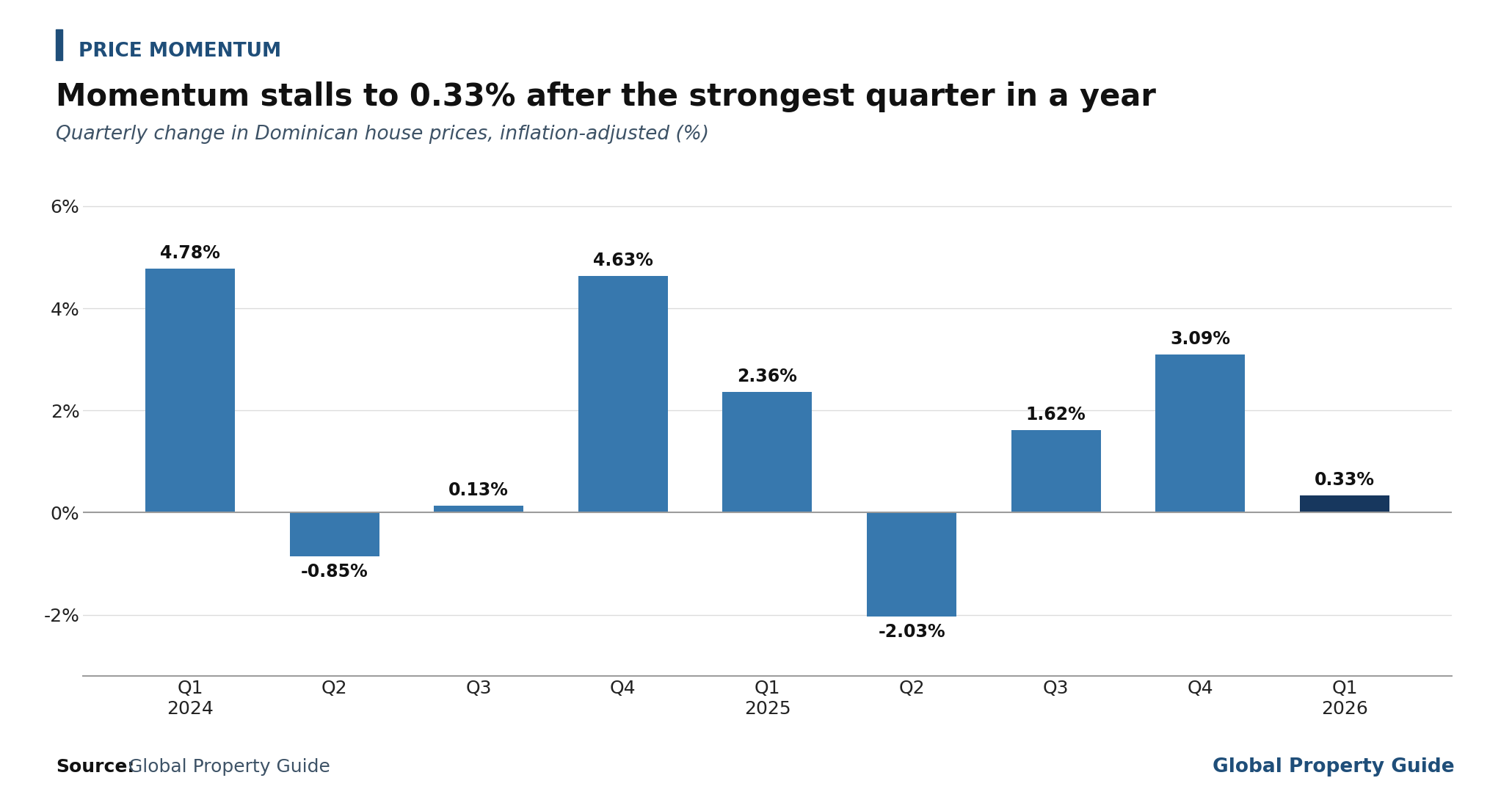
The quarterly series shows where the momentum went. Inflation-adjusted prices edged up by only 0.33% in Q1 2026, a marked cooling after the 3.09% rise recorded in Q4 2025 and the weakest first quarter in the recent series. The market has also grown notably choppier since 2022, with real prices falling outright in the second quarter of 2023, 2024, and 2025 before recovering in the second half of each year.
Listing data puts current price levels in context. As of June 2026, Properstar reported a median asking price of DOP 12,918 per square foot for apartments, equivalent to about DOP 139,000 per square metre (US$2,373), and DOP 10,059 per square foot for houses, or roughly DOP 108,300 per square metre (US$1,848). Currency conversions in this report use an exchange rate of DOP 58.60 to the US dollar, the average bank selling rate quoted in late July 2026.
The peso rewrote the arithmetic for foreign buyers
The headline growth figures understate what has happened to dollar-denominated buyers. The Dominican peso, which forecasters expected to weaken through 2026, instead strengthened sharply. The average bank selling rate moved from DOP 63.50 to the dollar in January to about DOP 58.61 in late July, an appreciation of close to 8% in seven months.
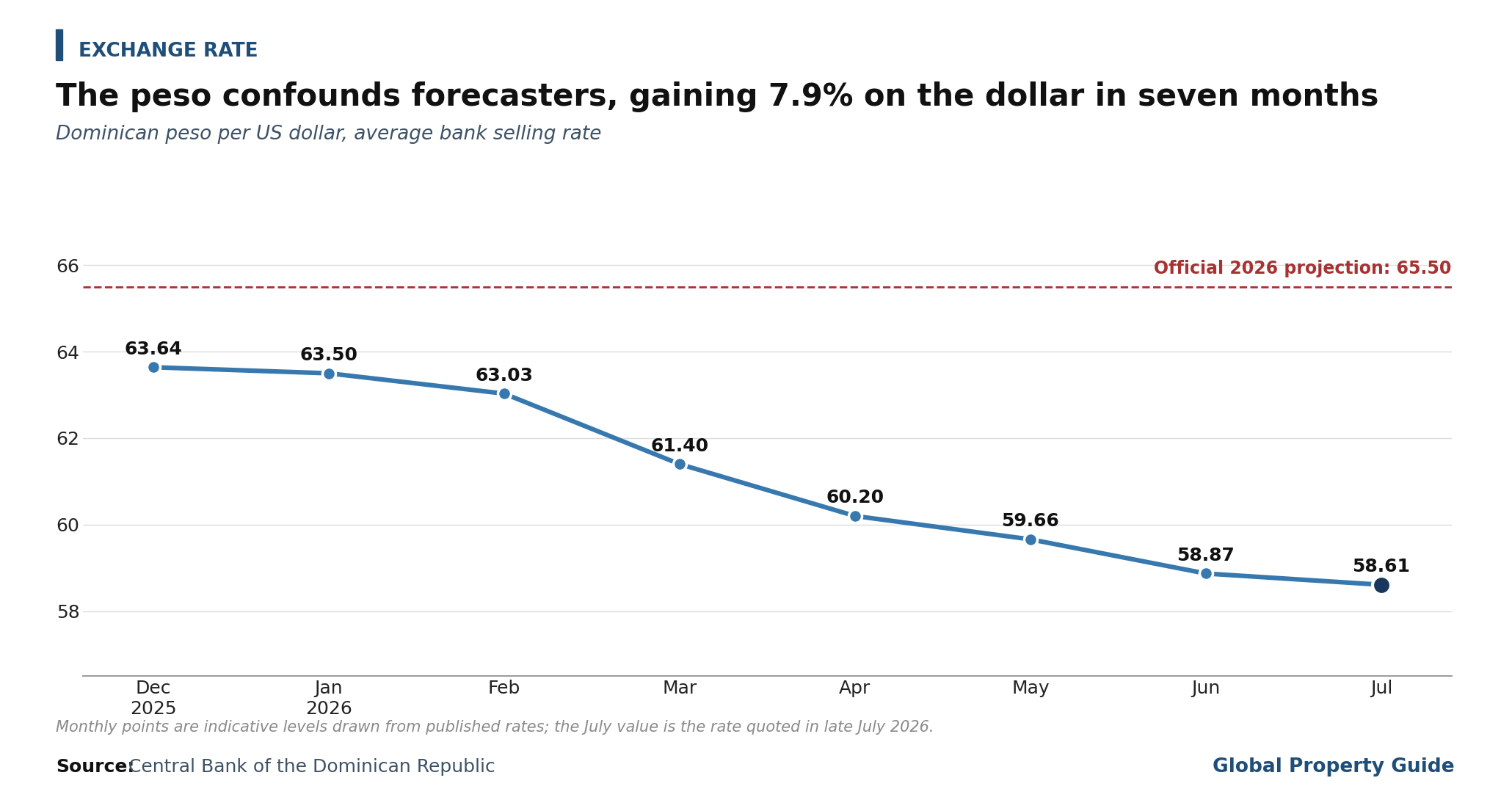
That reversal broke the government's own assumptions. The Panorama Macroeconomico 2025-2029 had projected an average rate of DOP 65.50 for the year, implying a depreciation of about 5.6%. The central bank reported that as of 8 July 2026, the peso had gained 7.2% against the dollar over twelve months.
Analysts have offered three explanations, and the most detailed assessment published so far weighs all three: a globally weaker dollar, an unusually heavy inflow of foreign currency from remittances, tourism, exports, and investment, and deliberate central bank management of the exchange rate as an anti-inflation anchor. Former IMF official Wayne Camard, quoted by Diario Libre, argued that with inflation pressing against the top of the target band, strengthening the peso was the most direct instrument available to the monetary authorities.
For a market in which most high-end listings are quoted in dollars, the practical effect cuts both ways. Peso-priced homes in Santo Domingo have become measurably more expensive in dollar terms, even where local prices barely moved, while dollar-priced coastal stock has become cheaper in peso terms for domestic buyers. Whether the appreciation holds is the open question. The same analysis notes that tourism and remittance flows are the dominant explanatory variables, so a reversal in either could unwind the move with equal speed.
House Price Variations
Location, rather than property type, is the dominant determinant of value in the Dominican Republic. The Oficina Nacional de Estadistica (ONE) captures this through its twice-yearly Registro de Oferta de Edificaciones (ROE), a census of buildings on offer in the Greater Santo Domingo metropolitan region, home to about 3.7 million people.
At the close of 2025, the average asking price across the metropolitan region stood at DOP 109,381 per square metre (US$1,867), according to the ROE. Inside that single average sits a spread of more than five to one.
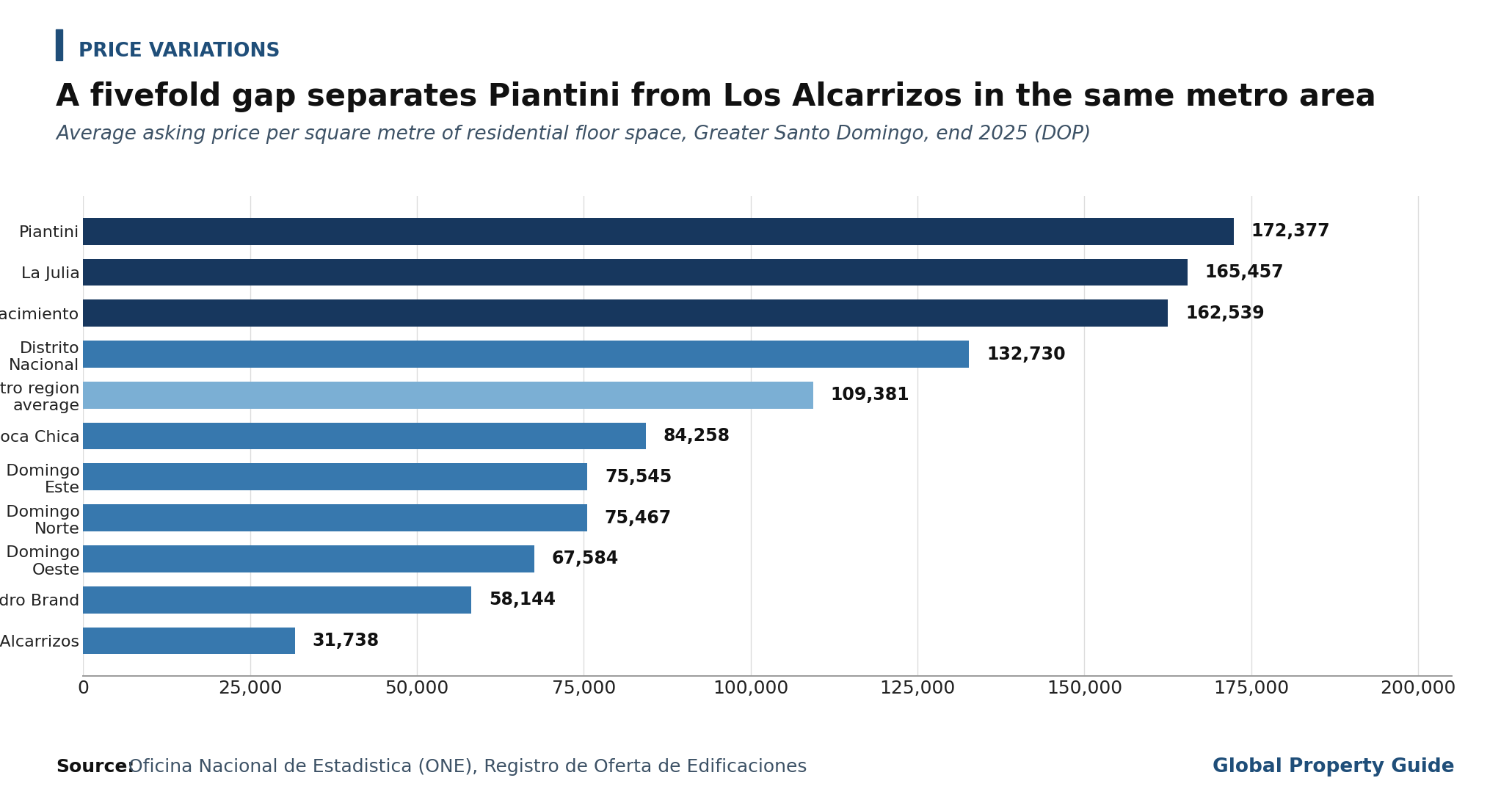
By neighbourhood, Piantini is the most expensive address in the country at DOP 172,377 per square metre (US$2,942), followed by La Julia at DOP 165,457 (US$2,824) and Renacimiento at DOP 162,539 (US$2,774). All three sit inside the Distrito Nacional's central polygon.
By municipality, the Distrito Nacional averaged DOP 132,730 per square metre (US$2,265). At the other end of the scale, Los Alcarrizos recorded the cheapest square metre in the metropolitan region at DOP 31,738 (US$542), less than a fifth of the Piantini figure. Between them lie Boca Chica at DOP 84,258 (US$1,438), Santo Domingo Este at DOP 75,545 (US$1,289), Santo Domingo Norte at DOP 75,467 (US$1,288), Santo Domingo Oeste at DOP 67,584 (US$1,153), and Pedro Brand at DOP 58,144 (US$992).
The periphery is where prices moved most violently in 2025. Comparing the second half of the year with the first, ONE recorded a 67.1% jump in Pedro Brand, a 32.5% rise in Santo Domingo Oeste, and a 27.1% increase in Boca Chica, while Santo Domingo Norte fell by 9.2%. Swings of this magnitude reflect thin formal supply in outlying municipalities, where a handful of new projects can reset the average.
That volatility carries a social edge. An earlier edition of the same register, ROE 2025-1, was read by industry analysts as evidence of a polarising market, with genuinely affordable homes disappearing from formal supply while prices in the capital's most exclusive districts set successive records. Families priced out of the centre are being pushed towards Santo Domingo Norte, Oeste, Los Alcarrizos, and Pantoja, where the infrastructure is thinner. Analysis of the following edition found that only about 7% of new formal supply in Greater Santo Domingo was priced at DOP 3 million or less.
Outside the capital, the geography inverts. Coastal resort property in Cap Cana, Casa de Campo, and Punta Cana trades at a substantial premium to urban Santo Domingo despite offering none of the city's infrastructure, because pricing there is set by international rather than local demand. Santiago, the second city, sits roughly 25% to 30% below comparable Santo Domingo neighbourhoods.
Property Demand Trends
Tourism sets another record
Tourism remains the engine of foreign demand for Dominican property, and 2025 was the strongest year the sector has recorded. The country received 11.68 million visitors, an increase of 4.3% on 2024 and an all-time high, the Ministry of Tourism reported.
Air arrivals reached 8,861,169, up by 3.8% on 2024 and 10% on 2023. Cruise passengers numbered 2,815,732, a gain of 6% on the previous year and more than double the 2022 figure, according to the same release. December alone brought close to 960,000 air arrivals, the busiest single month in Dominican tourism history, against a pre-pandemic monthly average of roughly 667,000.
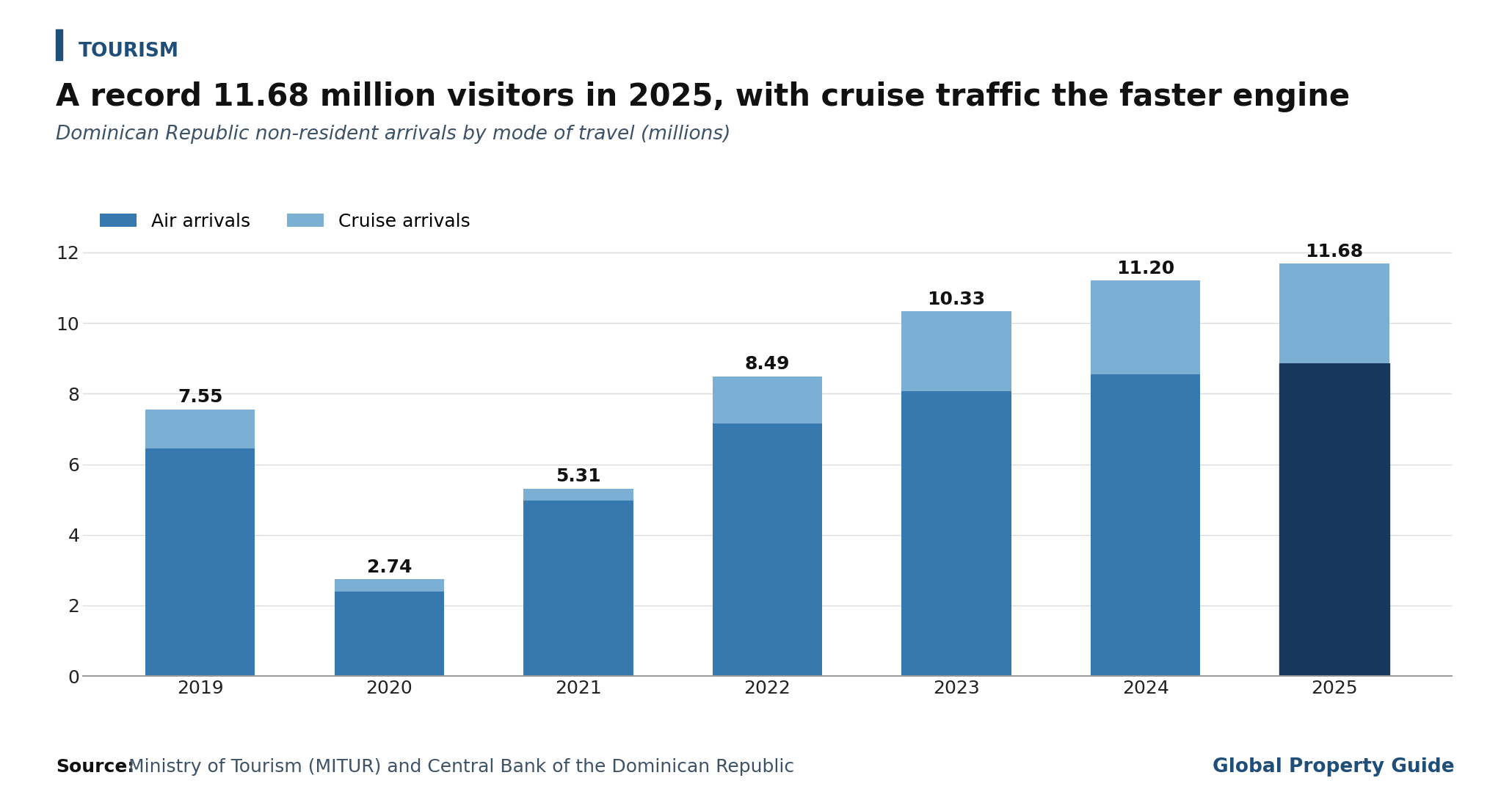
The run has continued into 2026. The country welcomed 6.6 million visitors in the first half of the year, comprising 4.96 million by air and 1.65 million by sea, another record for the period. March was the first month in which more than 900,000 air passengers arrived. In June, air arrivals of 816,517 and cruise arrivals of 158,495 were up by 6% and 6.3% respectively on the same month of 2025.
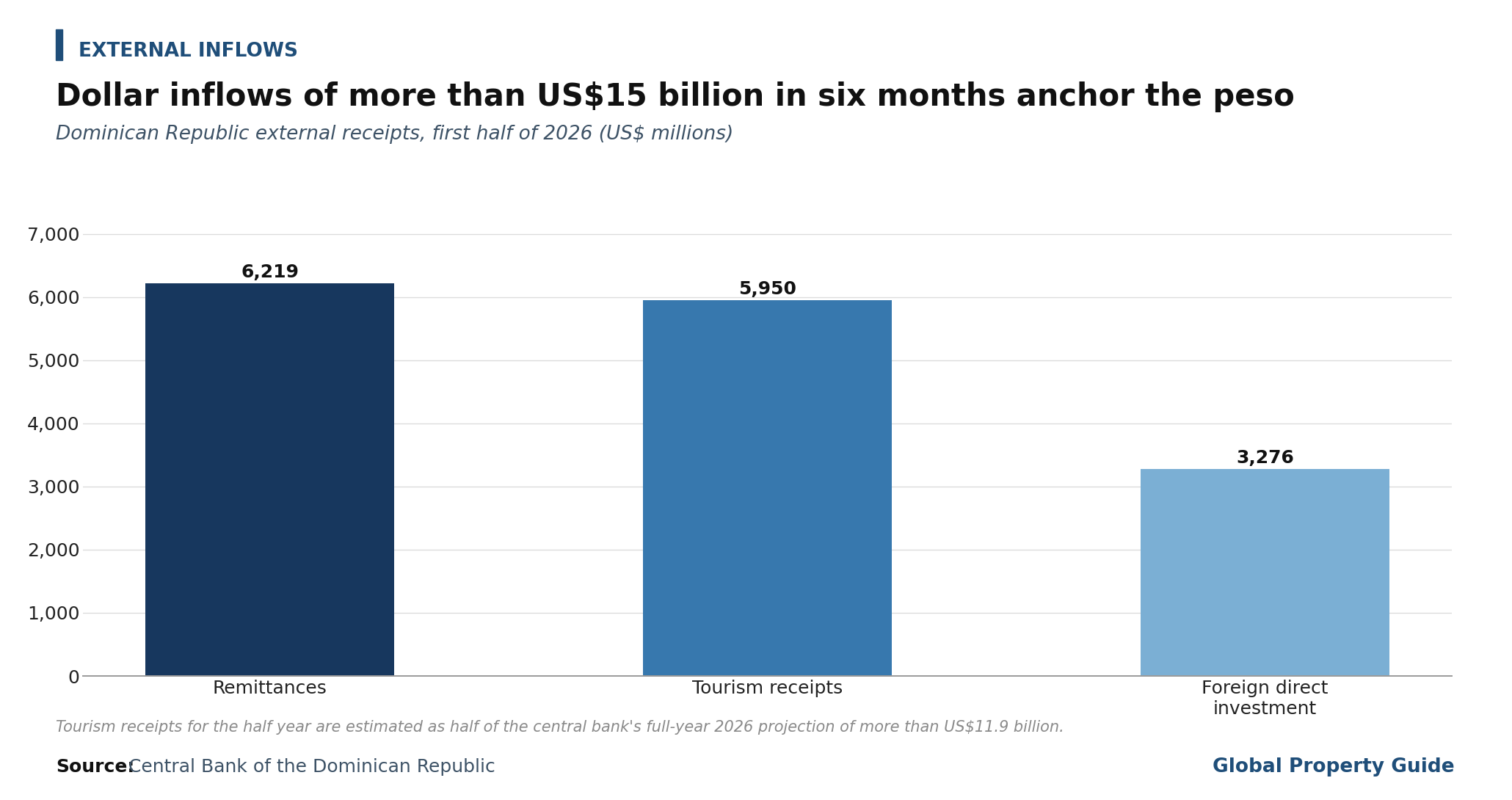
Punta Cana continues to dominate the map, handling 53% of air arrivals in the first half of 2026. The Central Bank projects tourism receipts of more than US$11.9 billion for the full year.
Foreign ownership remains unrestricted
There are no restrictions on foreigners buying property in the Dominican Republic. Non-residents hold the same ownership rights as citizens, need no special permit or local partner, and face no cap on the number of properties they may own.
Incentives reinforce the openness. Under Law 158-01 on Tourism Incentive, better known as CONFOTUR, qualifying projects in designated tourism zones receive exemption from the 3% property transfer tax and from annual property tax for up to fifteen years, with developers relieved of national and municipal taxes for a decade. Law 171-07 on Special Incentives for Pensioners and Persons of Independent Means grants tax-free receipt of foreign pension income together with a 50% exemption from property tax, a 50% exemption from taxes on mortgages held with regulated financial institutions, and an exemption from taxes on dividends, interest, and property transfers.
Buyers are also drawn by relative value. Dominican coastal property continues to price well below comparable Caribbean markets, and entry-level condominiums in the eastern resort corridor remain available from roughly US$150,000.
Foreign capital keeps arriving
Foreign direct investment reached US$3,276.5 million in the first six months of 2026, the Central Bank announced in late July. That follows a record US$4,523 million for the whole of 2024. Real estate and tourism are consistently among the largest recipients.
Remittances add a second and larger stream. Transfers from the diaspora totalled US$6,219.3 million in the first half of 2026, an increase of 6.7% year on year, with June alone bringing US$1,049.3 million. The Central Bank expects the full-year figure to exceed US$12.2 billion. The Distrito Nacional received 51% of June's remittances, with Santiago and Santo Domingo provinces accounting for a further 16.4%.
Diaspora money matters directly to housing. It funds a meaningful share of purchases in the affordable and mid-market segments, and returning Dominicans are an explicit target of the government's housing programmes. At the Boca Residence handover under the Familia Feliz plan, more than 34% of beneficiaries were members of the diaspora.
Property Supply Trends
Construction emerges from its longest slump in more than a decade
The supply story of the past two years is a construction sector that stalled and has only just restarted. The industry contracted in five consecutive quarters from the final quarter of 2024, ending 2025 down by 1.8% for the year as a whole. It was the longest negative run since 2011 to 2013, and worse than the pandemic year of 2020, when the sector at least avoided four consecutive quarterly falls.
Industry representatives attribute the slump to a combination of high borrowing costs, permit bureaucracy, rising input prices, and a shortage of skilled labour.
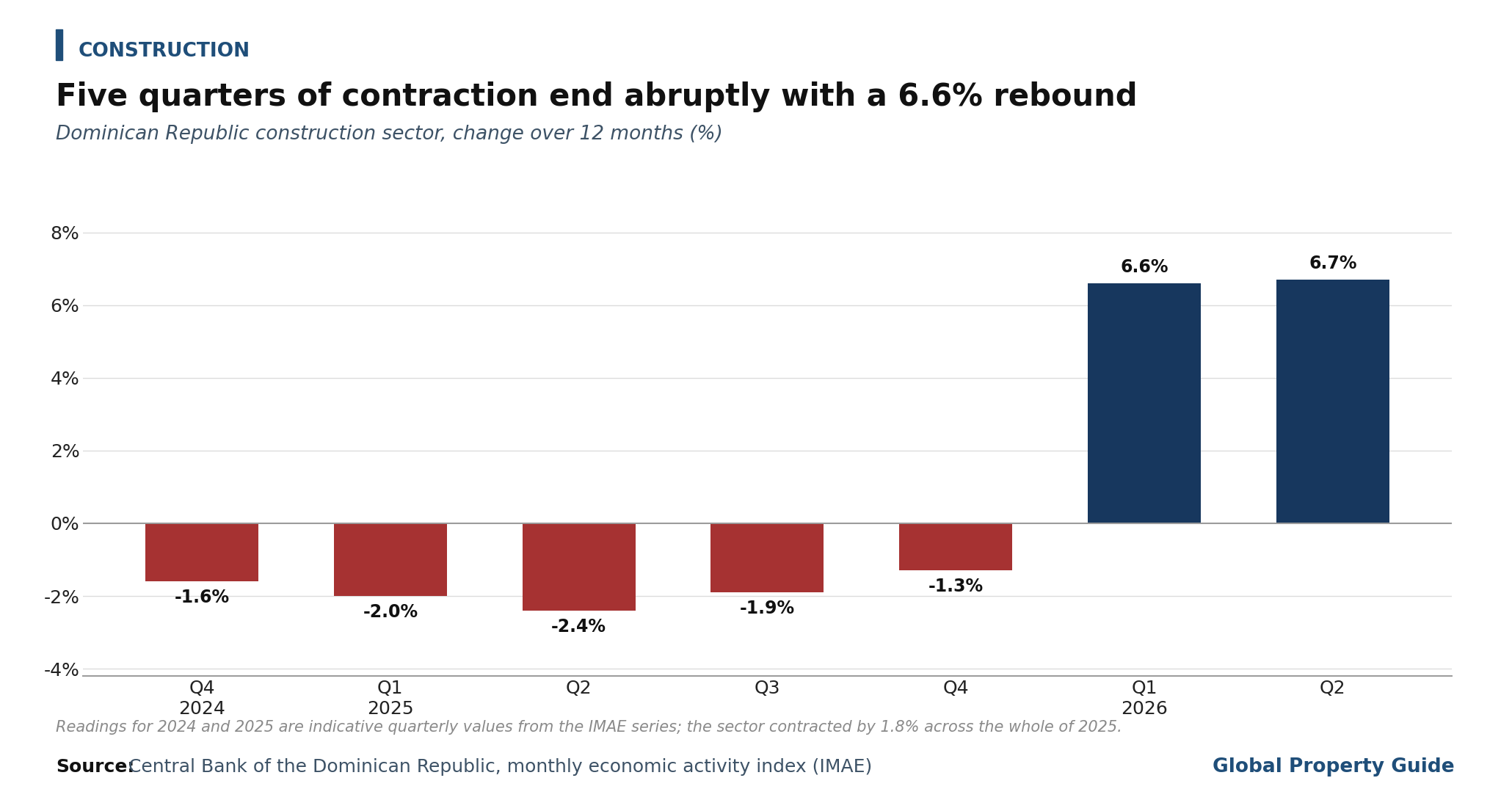
The turnaround in 2026 has been abrupt. Construction grew by 6.6% in the first quarter, breaking the five-quarter losing streak, then by 6.7% in the second. In June alone, the sector expanded by 14.9% year on year and contributed close to 30% of the increase in the Central Bank's monthly activity index. Credit to construction grew by 26.1% in the year to April and by 22.6% in the year to June, the latter equivalent to more than DOP 34 billion of additional lending.
The recovery is not yet uniform. April recorded a monthly contraction of 1.8% even as the four-month average stayed positive at 4.6%, and public capital spending, though improving, remains historically low at 1.9% of GDP in the first half of 2026.
Construction cost inflation has halved
Cost pressure, one of the constraints developers cited during the downturn, has eased considerably. The Indice de Costos Directos de la Construccion de Viviendas (ICDV), compiled by ONE for the National District and Santo Domingo province, closed 2025 at 236.17 points, up by 3.74% over the year.
By dwelling type, the December 2025 increases were:
- Detached houses (one level): costs rose by 4.36% to 242.41 points
- Single-family houses (two levels): costs rose by 3.57% to 238.18 points
- Multi-family buildings (four levels): costs rose by 3.49% to 232.30 points
- Multi-family buildings (eight levels or more): costs rose by 3.45% to 231.99 points
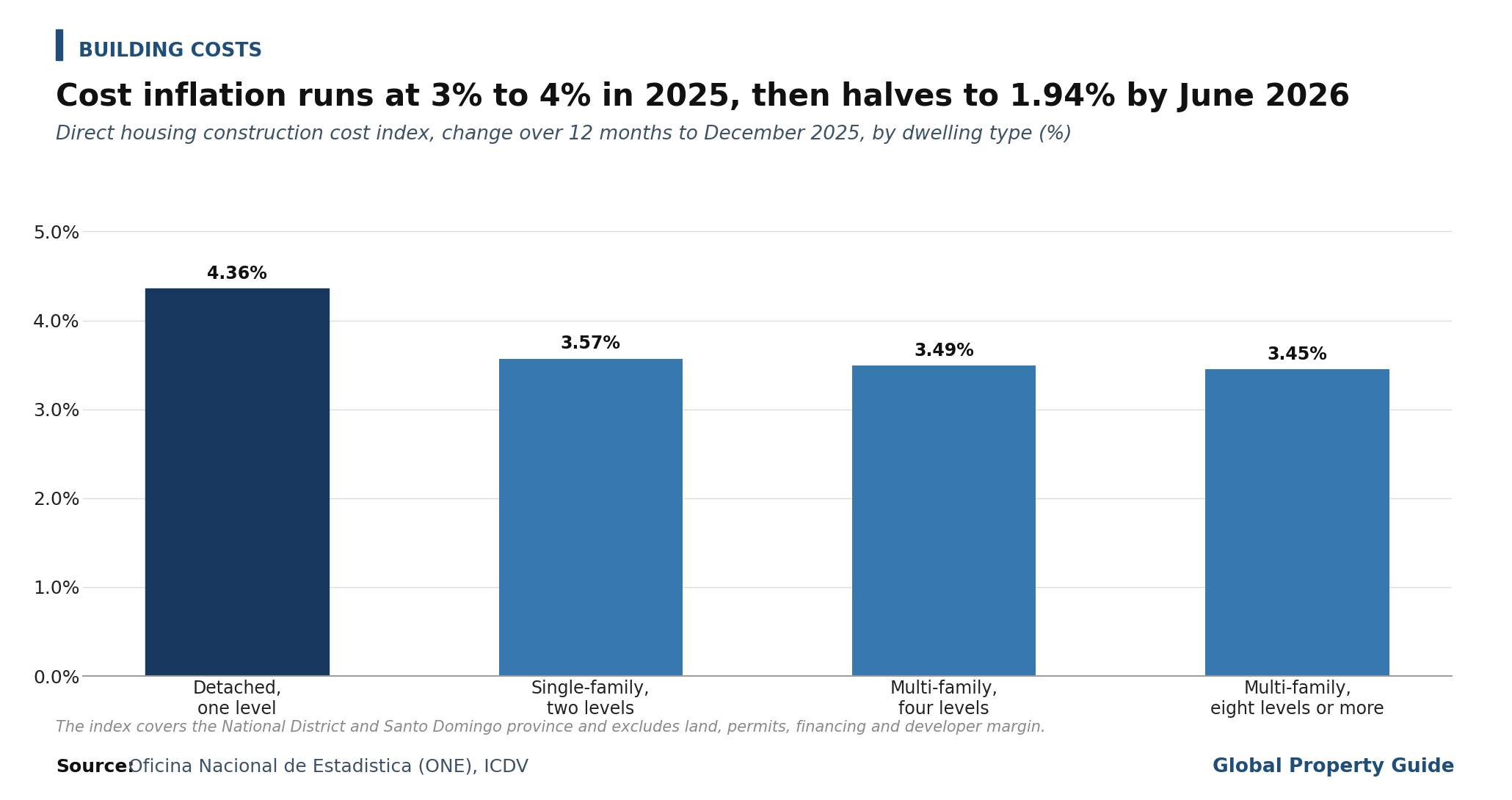
Through 2026, the index has flattened markedly. It reached 240.16 points in April, up by 1.65% year on year, and 240.31 points in June, up by 1.94% and actually 0.30 points below May. Cumulative growth between December 2025 and June 2026 was 1.75%. In June, subcontracts were the only component to rise materially, at 0.18%, while labour was flat and materials, machinery, and tools all edged down.
A labour force the sector cannot easily replace
The most significant structural risk on the supply side is the migration policy. Research published in June 2026 by the Instituto Nacional de Migracion, drawn from its Encuesta Sectorial Construcción, found that Haitian nationals make up 68.3% of the construction workforce against 31.1% Dominicans. In the early "obra gris" phase of a project, when structures are being founded, and the work is heaviest, Haitian participation commonly exceeds 70% and can reach 90%.
The government's deportation drive, stepped up from April 2025, therefore lands squarely on the sector. Developers report project delays, partial stoppages, and higher logistics costs, and the Asociacion Dominicana de Constructores y Promotores de Viviendas has asked the authorities to regularise at least 87,000 workers. Views on the severity differ: some industry figures argue that with activity so weak in 2025, labour demand fell far enough to mask the effect. With construction now expanding at close to 7%, that cushion is disappearing.
Permits lag construction by a wide margin
Formal approvals continue to trail actual building. ONE statistics drawn from the Ministry of Housing records show that 1,362 permits were issued for private construction in 2025, while 4,163 buildings were registered, a gap of 2,801 projects. The imbalance is starkest in La Altagracia, the province containing Punta Cana, which accounted for around 40% of all national construction with 1,642 buildings, but received only 264 permits. Santo Domingo led on approvals with 290 permits against 827 buildings.
A unified national building code, socialised with the industry from 2025, took legal effect in 2026, setting common standards for design, construction, and supervision. That the country operated without one for so long helps explain the informality and inconsistent approval criteria that developers have long complained about.
The affordable housing deficit
Most formal residential construction remains aimed at the middle and upper market, leaving a large unmet need at the bottom. The CAF Development Bank of Latin America puts the Dominican housing deficit at approximately 1.4 million units, equivalent to 39.3% of all households, of which roughly 393,000 dwellings have critical deficiencies in access to water, sanitation, or electricity.
Government policy runs through the Plan Nacional de Viviendas Familia Feliz and the Mi Vivienda programme, both administered by the Ministerio de Vivienda, Habitat y Edificaciones (MIVHED) through Fonvivienda. In the first half of 2026, the ministry delivered 890 apartments across the two programmes, housing more than 2,600 people, and has said it intends to accelerate deliveries in the second half.
Financing is supported by a set of state subsidies known as the Bono Inicial, Bono Tasa, Bono Primera Vivienda, and Bono Mujer. The demographic profile of recipients is distinctive: 58.62% of units were titled to women, and 53.01% of titleholders were aged between 18 and 35.
Set against a deficit measured in seven figures and estimated to grow by 50,000 to 60,000 homes a year, the delivery run rate remains modest.
Rental Market: Rents and Rental Yields
Yields are high and still climbing
The Dominican Republic offers some of the strongest gross rental returns in Latin America, and they have improved for a third consecutive reading. The average gross rental yield stood at 8.53% in the first quarter of 2026, up from 7.78% in Q3 2025, 7.12% in Q1 2025, and 6.74% in Q2 2024, according to Global Property Guide research.
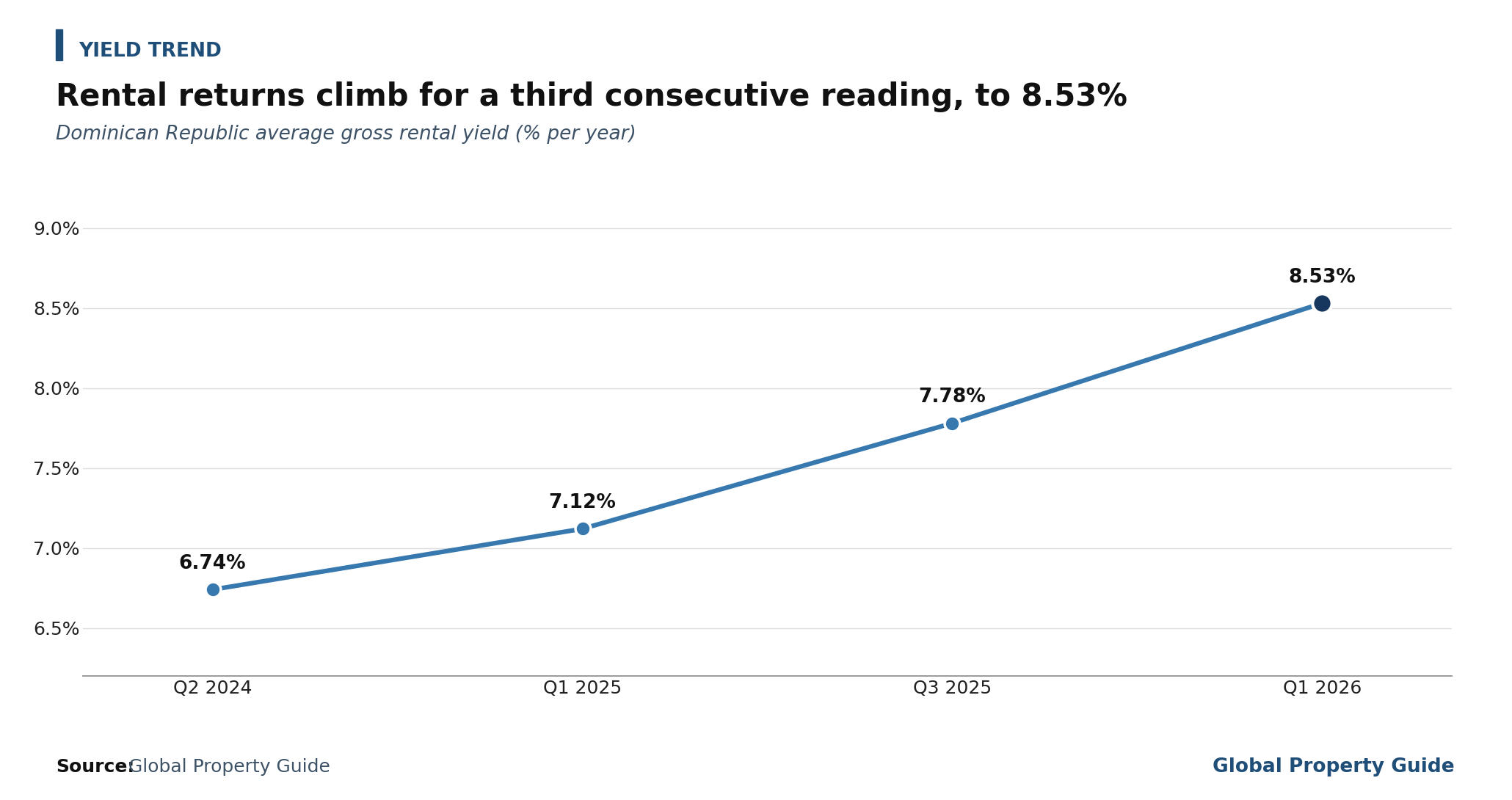
Rising yields alongside decelerating capital growth is the signature of rents outpacing prices, which is what the arithmetic implies here. For income investors, the trade is attractive; for those relying on capital appreciation, it is a warning that the price engine has slowed.
By city and apartment size:
- In Santo Domingo, gross yields average 9.09%. Two-bedroom apartments lead at 9.87%, with three-bedroom units at 9.74% and one-bedroom units at 8.98%. Larger four-bedroom-plus homes return 7.76%.
- In Punta Cana and Bavaro, gross yields average 7.98%, ranging from 7.74% on one-bedroom units to 8.20% on two-bedroom apartments, with three-bedroom units at 8.00%.
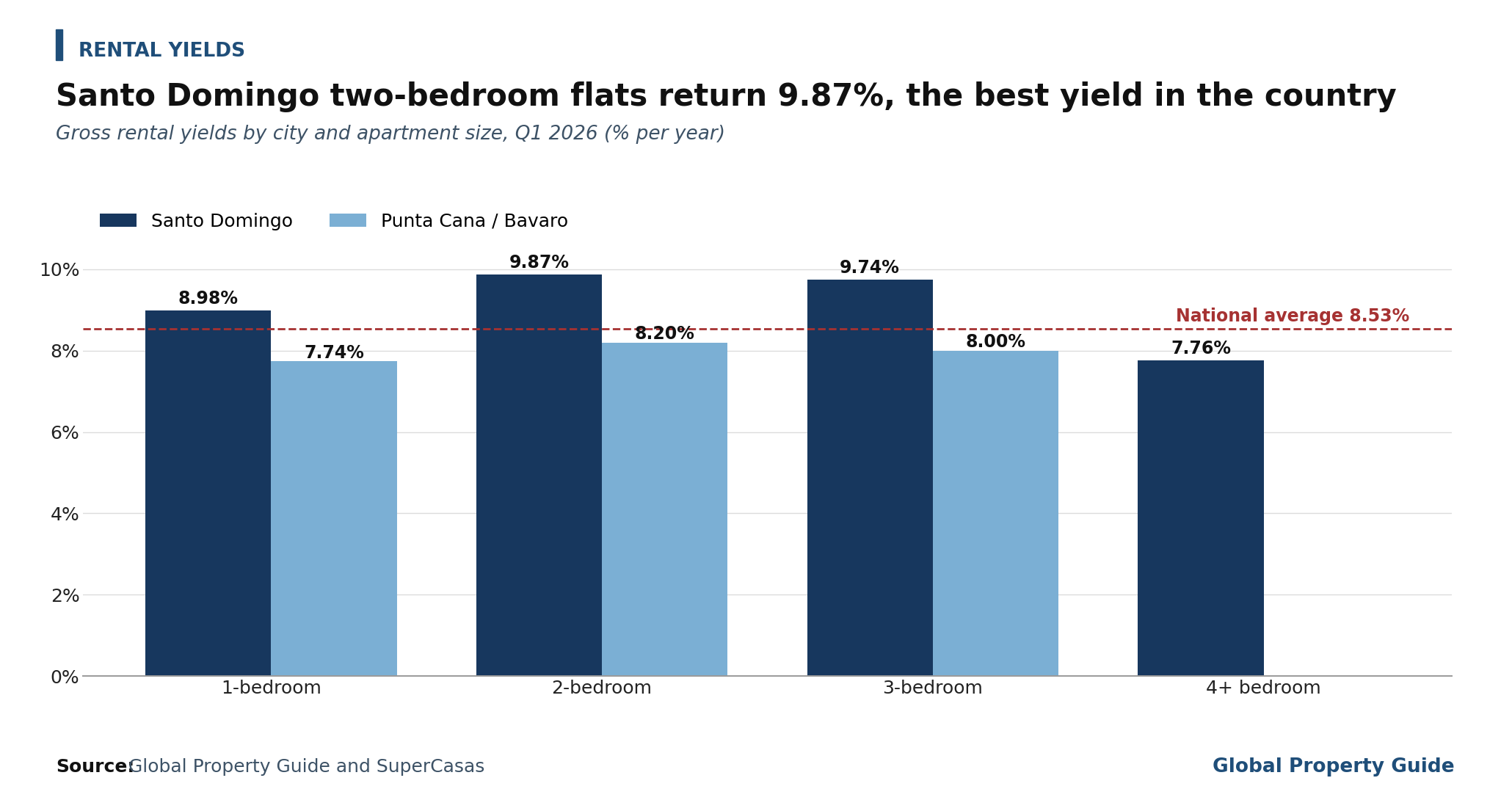
In price terms, a two-bedroom apartment in Santo Domingo costs around US$225,000 to buy and rents for about US$1,850 a month. The equivalent unit in Punta Cana costs roughly US$205,000 and rents for about US$1,400. The capital's higher yield reflects a deeper year-round tenant base, while the resort corridor depends more heavily on seasonal and short-let demand.
All figures are gross, before taxes, maintenance, vacancy, and agents' fees. Net yields typically run 1.5 to 2 percentage points lower.
Mortgage Market and Interest Rates
Mortgages are the one loan that has not got cheaper
The Central Bank has been easing. The monetary policy rate was reduced to 5.25% during the second half of 2025 and has been held there through 2026, including at the June meeting. The overnight repo rate remains at 5.75% and the remunerated deposit rate at 4.50%.
Transmission has worked almost everywhere except housing. Data from the Superintendencia de Bancos show the average mortgage rate at 11.47% in May 2026, marginally above the 11.40% recorded a year earlier. Over the same twelve months, the commercial lending rate fell from 12.32% to 11.55%, and the weighted average rate across the whole loan book dropped from 16.27% to 15.52%.
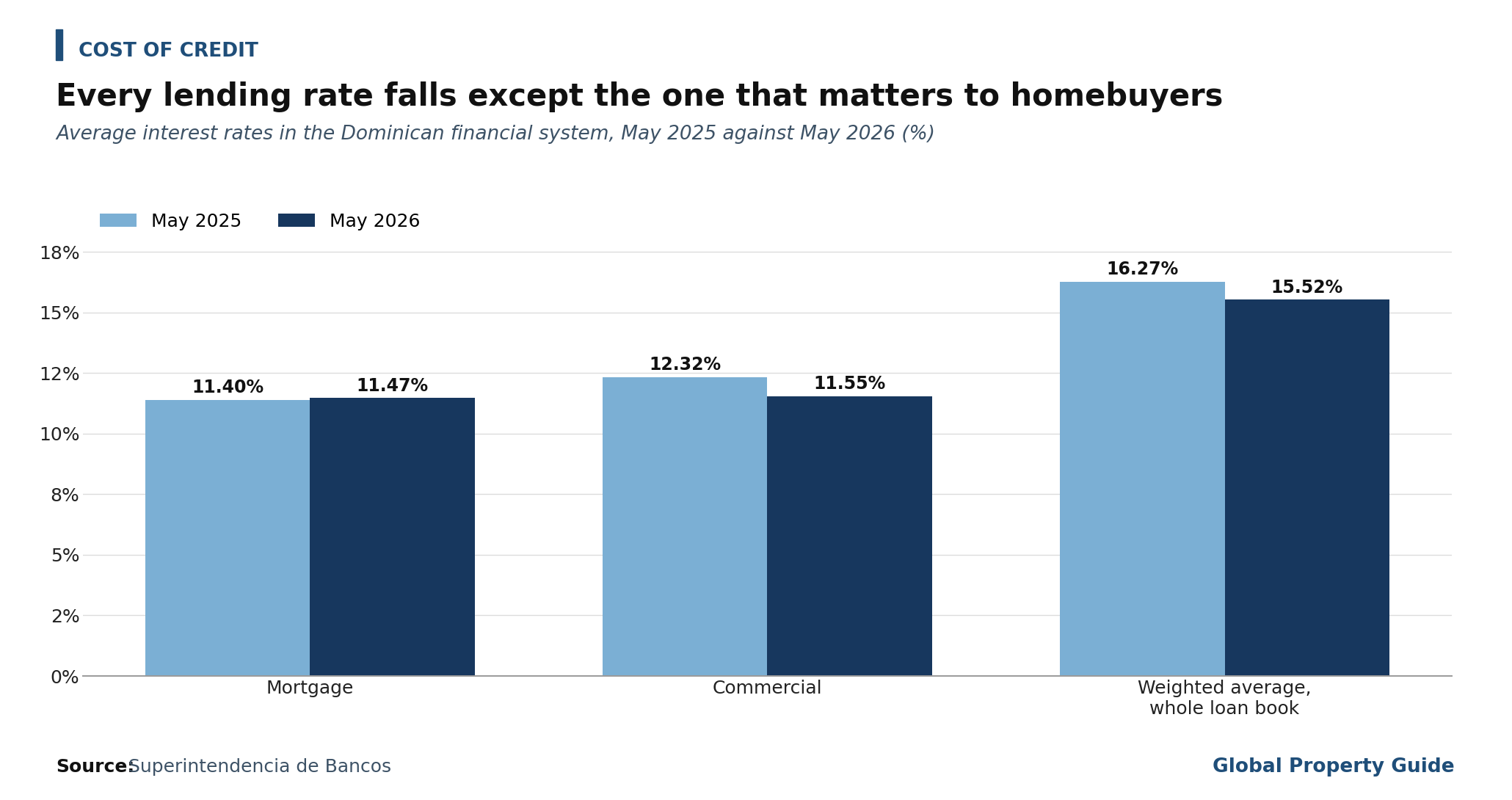
The broader easing is real. The weighted average lending rate at multiple banks fell from 14.99% to 13.59% between May 2025 and January 2026, the Central Bank reported, and stood at 13.28% by March 2026. Mortgages have simply not followed.
Lending volumes are growing regardless
Borrowers appear to be looking past the rate. The mortgage portfolio grew by 11.4% year on year in the first quarter of 2026, outpacing every other lending segment, against 9.4% for commercial loans and 8% for the loan book as a whole, which reached DOP 2.42 trillion at the end of March. Total financial system assets stood at DOP 4.28 trillion, up by 9.2%.
Within multiple banks specifically, lending for home purchase rose by DOP 3,848.5 million during the first quarter, while credit to the construction sector added DOP 8,594.9 million, the largest single increase of any destination.
A fast-growing but still shallow market
For all that growth, the Dominican mortgage market remains small relative to the economy, at roughly 5.5% of GDP as of 2024, and most property transactions are still settled in cash. The last confirmed absolute figure for outstanding home purchase loans was DOP 427.11 billion in May 2025, published by the Central Bank, around 39 times the level of 2000.
The legal groundwork dates to the 2012 Law on Mortgage Market Development and Trusts, which introduced tax incentives and established the trust as a legal instrument. Loan-to-value ratios of up to 70% of appraised value are standard.
Historic Perspective
The modern Dominican housing cycle has run through three distinct phases.
From the mid-2000s, the market expanded alongside one of the fastest-growing economies in the region, with tourism infrastructure, international hotel brands, and steady foreign buying driving coastal development. Growth averaged close to 6% a year between 2005 and 2019.
The pandemic interrupted rather than ended that expansion. The economy contracted by 7.9% in 2020, its worst showing in modern history, and tourist arrivals collapsed by 63%. The rebound was violent: GDP grew by 12.3% in 2021, and house prices rose by 15.77% in nominal terms in the year to Q1 2022.
The third phase, from 2023, has been one of normalisation punctuated by shocks. Nominal prices fell by 1.64% in the year to Q1 2023, and by 5.03% in real terms, as double-digit input cost inflation and higher interest rates bit. Prices then recovered strongly in 2024 before decelerating through 2025 and into 2026.
Over the five years to Q1 2026, the cumulative record is one of solid nominal gains substantially eroded by inflation. Compounding the annual figures, nominal prices rose by roughly 50% while the inflation-adjusted gain was closer to 20%.
Construction cost data tells a parallel story. Housing construction costs rose by an annual average of 8.5% between 2017 and 2022, with peaks above 15% in 2021, before moderating to 3.74% in 2025 and under 2% in mid-2026.
Economic and Social Factors
A sharp slowdown, then a sharp recovery
The Dominican economy grew by just 2.1% in 2025, the Central Bank confirmed in January 2026. That undershot the authorities' own October estimate of 2.5%, which had itself been revised down from 3.5% at mid-year, and marked the weakest performance since the pandemic. Growth had reached 5.0% in 2024.
The Central Bank attributed the weakness to global uncertainty and tight liquidity conditions, which held back private investment, compounded by public capital spending running below its historical average. In some months, the economy grew by as little as 0.2%.
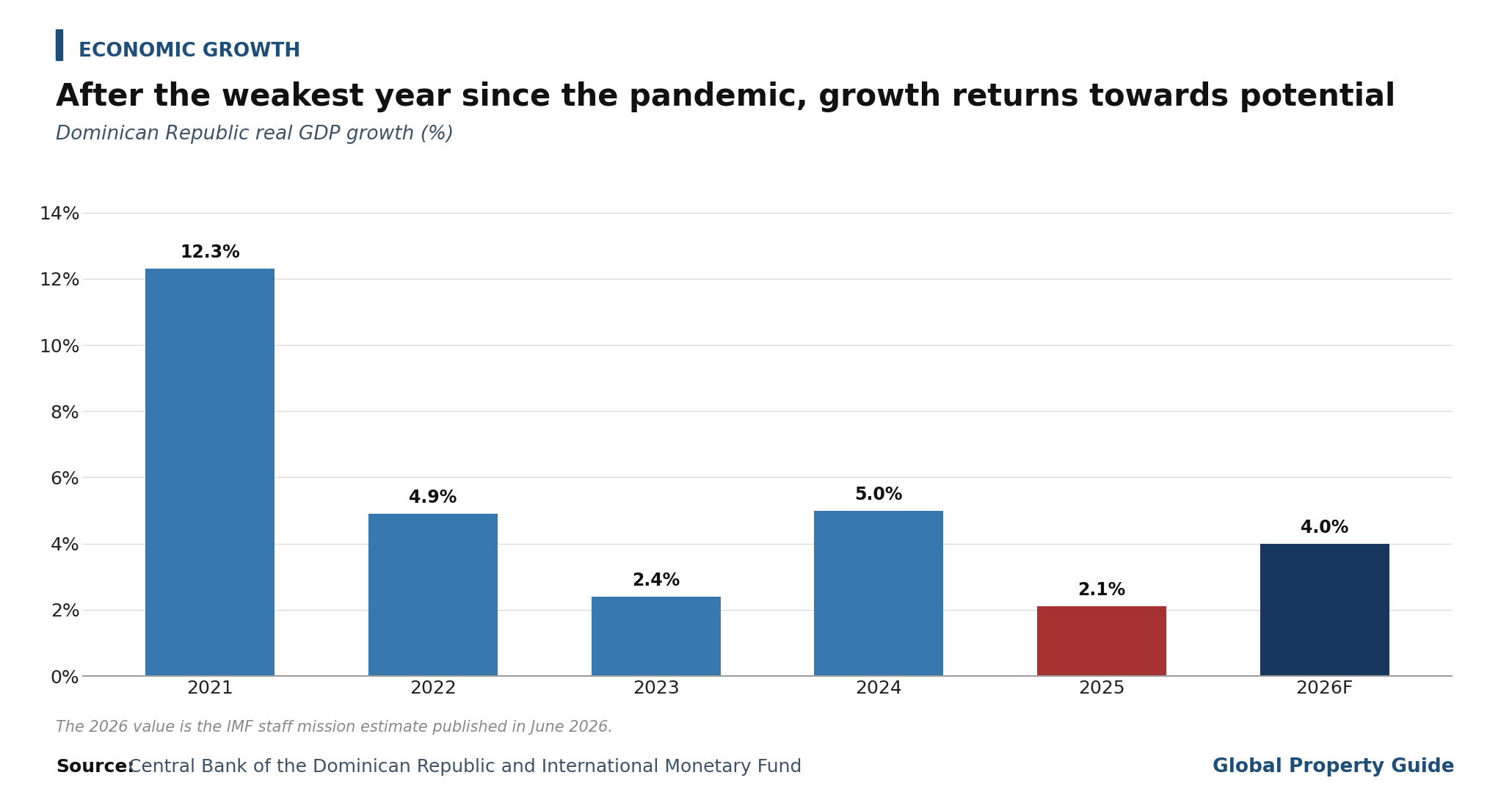
Recovery arrived quickly. The monthly activity index rose by an average of 4.0% between January and April 2026, against 2.7% in the same period of 2025, and by 6.4% in June. Mining led at 10.7% over the first four months, followed by construction at 4.6%, free-zone manufacturing at 3.7%, and services at 4.4%.
An IMF mission that visited in June 2026 projected growth of around 4% for the full year with inflation inside the target band, and the Fund's regional outlook puts 2027 growth at 4.4%.
Inflation has drifted above target
Consumer price inflation reached 5.35% in May 2026, pushed up by fuel costs after the Middle East conflict raised oil prices, the Central Bank reported. That is above the upper bound of the 4% plus or minus 1% target range, although core inflation remained inside it at 4.86%. The rate had been 4.63% in March.
The oil shock has since partially reversed. West Texas Intermediate crude fell from about US$90 to US$70 a barrel following the agreement to reopen the Strait of Hormuz, easing the pressure on Dominican fuel subsidies and on the headline index.
Inflation averaged 4.8% in 2023 and 3.3% in 2024, and had sat within the target band for a run of more than two years before the recent drift.
Labour market and public finances remain steady
Open unemployment stood at 5.0% in the first quarter of 2026, in line with the 2025 average, according to the Central Bank's labour force survey. Total employment reached 5,236,178, an increase of 118,631 from the year earlier.
International reserves stood at US$15,821.6 million at the end of June 2026, equivalent to 11.3% of GDP and 5.7 months of imports, comfortably above IMF thresholds. Consolidated public debt has held around 57% to 58% of GDP, with the non-financial public sector deficit close to 3.2%.
Trade and commerce, which employs about 20% of the workforce, expanded by only 2.2% in the first half of 2026, a reminder that the recovery has been led by capital-intensive sectors rather than by broad-based consumption.
Structural challenges persist
The country's long-run record is genuinely strong. Per capita GDP has risen several times over since the early 2000s, and the World Bank has noted that two decades of growth well above the regional average lifted close to three million people out of poverty and produced a middle class that now outnumbers the poor.
Those gains sit alongside persistent inequality, low revenue mobilisation, and high exposure to natural disasters. Economic damage from hurricanes and flooding costs the country an estimated US$420 million a year. The migration relationship with Haiti, which supplies most of the construction labour force, remains both economically essential and politically contested, and is the single variable most likely to determine whether the current building recovery can be sustained.
Sources:
- Dominican Republic House Price Index (Global Property Guide): https://www.globalpropertyguide.com/
- Gross rental yields in Dominican Republic: Santo Domingo and Punta Cana (Global Property Guide): https://www.globalpropertyguide.com/
- Dominican Republic: housing price and price per square foot (Properstar): https://www.properstar.com/
- Índice de Costos Directos de la Construcción de Viviendas (ICDV) (Oficina Nacional de Estadística): https://www.one.gob.do/
- Registro de Oferta de Edificaciones (Oficina Nacional de Estadística): https://www.one.gob.do/
- Los Alcarrizos registra el metro cuadrado más barato y Piantini el más caro en el Gran Santo Domingo (Acento): https://acento.com.do/
- Así sube el precio del metro cuadrado en el Gran Santo Domingo (Acento): https://acento.com.do/
- El ROE 2025-1 confirma el colapso del mercado asequible (El Inmobiliario): https://inmobiliario.do/
- República Dominicana marca hito histórico: 11.6 millones de visitantes en 2025 (Ministry of Tourism): https://noticias.mitur.gob.do/
- El turismo en República Dominicana marca un récord con 6,6 millones de visitantes en el primer semestre de 2026 (Infobae): https://www.infobae.com/
- Remesas suben 6.7% en el primer semestre (Infobae, citing the Central Bank): https://www.infobae.com/
- Banco Central de la República Dominicana (Central Bank of the Dominican Republic): https://www.bancentral.gov.do/
- Sector Monetario y Financiero (Central Bank of the Dominican Republic): https://www.bancentral.gov.do/
- Créditos hipotecarios se encarecen a mayo de 2026 (elDinero, citing the Superintendencia de Bancos): https://eldinero.com.do/
- Las hipotecas crecieron 11.4% (El Inmobiliario, citing the Superintendencia de Bancos): https://inmobiliario.do/
- La banca múltiple presenta fortalezas en sus indicadores financieros al primer trimestre del 2026 (Asociación de Bancos Múltiples): https://aba.org.do/
- La construcción sufre su segunda caída más prolongada en casi 15 años (Diario Libre): https://www.diariolibre.com/
- Sector construcción retoma liderazgo económico en el país (elCaribe): https://www.elcaribe.com.do/
- Mano de obra haitiana concentra más del 68% de la construcción dominicana (DiarioDigitalRD, citing the Instituto Nacional de Migración): https://diariodigitalrd.com/
- En RD se construyeron en 2025 tres veces más proyectos de los que tenían permisos (N Digital, citing ONE and MIVHED): https://n.com.do/
- Permisos de construcción en RD (Acento): https://acento.com.do/
- Más de 2,600 dominicanos acceden a un hogar propio con entregas del MIVHED (Presidencia de la República Dominicana): https://presidencia.gob.do/
- Plan Nacional de Viviendas Familia Feliz (Government of the Dominican Republic): https://familiafeliz.gob.do/
- Cuánto creció la economía dominicana en el 2025 (Diario Libre, citing the Central Bank): https://www.diariolibre.com/
- Misión del FMI estima un crecimiento en torno al 4% para 2026 (Ministerio de Hacienda y Economía): https://www.hacienda.gob.do/
- La apreciación que nadie pronosticó (El Dinero): https://eldinero.com.do/
- Peso dominicano acumula una apreciación de un 4.7% este año (Diario Libre): https://www.diariolibre.com/
- Dominican Republic (International Monetary Fund): https://www.imf.org/
- The World Bank in the Dominican Republic (World Bank): https://www.worldbank.org/