United Arab Emirates' Residential Property Market Analysis 2026
Amid heightened geopolitical uncertainty affecting consumer sentiment, strong fundamentals still support positive, albeit more measured, growth in the sales and rental segments of the UAE’s housing market, with Abu Dhabi maintaining a stronger momentum than Dubai.
This extended overview from Global Property Guide covers key aspects of the housing market in the United Arab Emirates and takes a closer look at its most recent developments and long-term trends.
Table of Contents
- Property Prices and Price Index
- Property Demand Trends
- Property Supply Trends
- Rental Market: Rents and Rental Yields
- Mortgage Market and Interest Rates
- Economic and Social Factors
Property Prices and Price Index
The UAE’s two main residential markets remained on different pricing paths in early 2026. Dubai continued to post positive annual price growth, but the market was increasingly characterized by moderation and greater selectivity, while Abu Dhabi remained in a stronger growth phase, supported by limited availability in key locations, selective high-quality launches, and a more constrained handover environment.
In Dubai, residential sales price growth remained positive in annual terms, although the latest REIDIN data shows a softer short-term pricing trend. As of April 2026, the Dubai Residential Market Sales Price Index declined by 1.76% month-on-month but remained 6.09% higher year-on-year. Apartments recorded annual growth of 5.49%, while villas continued to outperform, rising by 9.86% year-on-year. On a monthly basis, both segments softened, with apartment prices down 1.87% and villa prices down 1.08%.
United Arab Emirates' house price annual change:
Professional commentary broadly supports the view that Dubai is moving into a more mature and selective pricing phase. Cushman & Wakefield noted that the market is showing signs of a maturing cycle, with prime villa communities continuing to outperform while apartment-led areas show more measured growth. Knight Frank similarly described Dubai as an increasingly “two-speed market”, where prime locations posted stronger annual gains while wider price growth normalizes. CBRE also noted that price growth is moderating, with expected new deliveries later in 2026 encouraging a more cautious approach among some investors.
In Abu Dhabi, annual price growth remained considerably stronger than in Dubai, although April also showed a small monthly adjustment. According to REIDIN, the Abu Dhabi Residential Market Sales Price Index declined by 0.32% month-on-month in April 2026 but increased by 27.76% year-on-year. Apartment prices rose by 31.46% annually, while villa prices increased by 7.84%. On a monthly basis, apartment prices declined by 0.23%, while villa prices were down by 0.80%.
Agency commentary suggests that Abu Dhabi remains in a stronger growth phase, although future gains are likely to become more measured after the sharp increases recorded over the past year. Cushman & Wakefield attributed the emirate’s strong pricing performance to sustained end-user demand, limited prime availability, and selective new launches. Savills also linked pricing growth to strong demand and quality launches, while noting a more cautious and measured approach among market participants, including selective renegotiations in parts of the secondary market. CBRE likewise described Abu Dhabi price growth as robust, while noting early signs of normalization after rapid expansion.
In nominal terms, ValuStrat data shows that Dubai’s citywide average transacted price for off-plan homes stood at AED 2,030 per sq ft (USD 553) in Q1 2026, up 12.22% year-on-year. In the ready homes segment, the average transacted price rose by 5.62% year-on-year to AED 1,691 per sq ft (USD 460). For Abu Dhabi, the average transacted price for off-plan properties reached AED 2,191 per sq ft (USD 597), up 17.99% year-on-year, while ready homes increased by 25.06% year-on-year to AED 1,507 per sq ft (USD 410).
Weighted-average residential values:
| Dubai Off-Plan Homes, Q1 2026 |
Dubai Ready Homes, Q1 2026 |
Abu Dhabi Off-Plan Homes, Q1 2026 |
Abu Dhabi Ready Homes, Q1 2026 |
|
| AED/ sq ft | AED 2,030 | AED 1,691 | AED 2,191 | AED 1,507 |
| USD/ sq ft | USD 553 | USD 460 | USD 597 | USD 410 |
| YoY change, % | 12.22% | 5.62% | 17.99% | 25.06% |
| Note: Exchange rate USD 1 = AED 3.6725. | ||||
| Data Source: ValuStrat. | ||||
The outlook for Dubai points to continued price growth, but at a slower and more selective pace than in the previous phase of the cycle. ValuStrat forecasts citywide residential capital values to rise by 10% in 2026, with villas expected to continue outperforming apartments and appreciate by 17.7%. This is broadly consistent with the agency's view that Dubai’s market is moving from broad-based post-pandemic growth toward a more fundamentals-led phase, where performance is likely to vary more clearly by location, asset quality, unit type, and exposure to new supply.
For Abu Dhabi, the outlook remains stronger, although agencies also point to a more measured near-term environment after the sharp gains recorded in early 2026. ValuStrat forecasts residential capital values to rise by 16% in 2026, with apartments expected to outperform villas in terms of capital appreciation. Savills expects supply constraints, limited handovers, and continued economic growth to sustain demand, while noting that the market is entering a wait-and-see phase. Overall, Abu Dhabi is likely to remain in a stronger pricing phase than Dubai in the near term, but growth should become more selective as the market absorbs recent gains.
Property Demand Trends
Strong Fundamentals Persist as Geopolitical Risk Tests Buyer Sentiment
The UAE residential market entered 2026 from a position of strength, but Q1 brought the first clear test of buyer sentiment after a prolonged period of rapid expansion. Escalation of regional conflict reflected in market activity, with Savills linking weaker March performance in both Dubai and Abu Dhabi to regional geopolitical tensions, alongside the Ramadan and Eid al-Fitr period, which typically influences working patterns, travel, and transaction timing across the region.
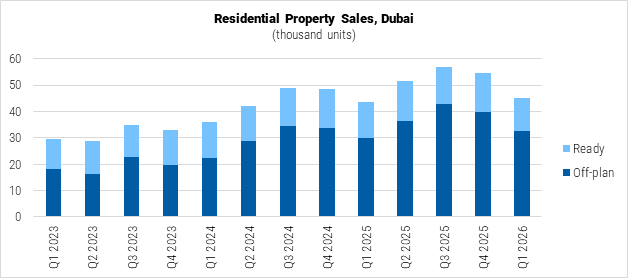
In Dubai, residential sales activity remained strong by historical standards, despite a quarterly slowdown. According to data from the Dubai Land Department (DLD), compiled by Savills, the emirate recorded approximately 45.2 thousand residential transactions in Q1 2026, up 3.9% year-on-year, but down 17.1% quarter-on-quarter. The quarterly decline, however, should be viewed against an exceptionally high comparison base, as transaction volumes exceeded 50,000 in each of the previous three quarters of 2025.
Data Sources: DLD, Savills.
The off-plan segment remained the main driver of Dubai’s demand profile. Savills reported that off-plan properties accounted for 72% of all residential transactions in Q1 2026, leaving the ready market with around 28% of activity. This dominance was reinforced by the segment’s continued year-on-year growth: off-plan sales increased by 9.4%, while ready-market transactions declined by 8.0% over the same period. The divergence points to continued demand for new launches, supported by flexible payment structures, developer incentives, and investor participation, while the ready market was more exposed to price sensitivity, financing considerations, and weaker sentiment in March. This reading is broadly consistent with Cavendish Maxwell, which also noted that ready-market activity came under pressure as Ramadan seasonality and geopolitical uncertainty converged.
The near-term demand outlook for Dubai remains positive but more moderate. Savills expects off-plan transaction volumes to ease in Q2 2026, as new launches were concentrated in January and February before pausing in March, and notes that the full impact of recent market moderation has not yet been reflected in the data. Cavendish Maxwell also projects the coming months to provide a clearer indication of underlying demand once seasonal and timing effects normalize, while noting that the market remains sensitive to investor sentiment and launch activity.
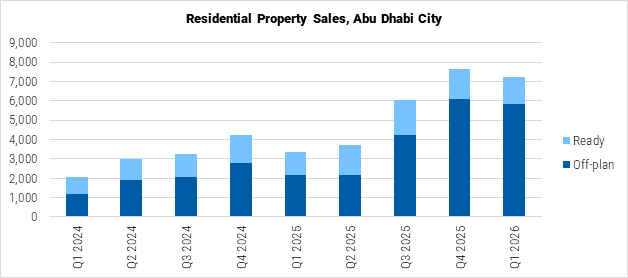
In Abu Dhabi, demand remained exceptionally strong in year-on-year terms, although activity also moderated slightly from the previous quarter’s peak. According to Abu Dhabi Real Estate Centre (ADREC) data compiled by Savills, residential transaction volumes within Abu Dhabi City reached over 7,200 in Q1 2026, making it the second strongest quarterly performance on record and only marginally behind the Q4 2025 peak of over 7,600 transactions. Volumes more than doubled year-on-year, but were 5.6% lower quarter-on-quarter.
Data Sources: ADREC, Savills.
The off-plan segment was again the main source of activity in Abu Dhabi, while apartments remained the dominant product type. Savills reported that off-plan properties accounted for 81% of total residential transactions in Q1 2026, while apartments represented 73% of all transactions, with over 5,200 apartment sales recorded during the quarter. Colliers also noted continued demand across Abu Dhabi’s major investment areas, including Yas Island, Saadiyat Island, Al Raha Beach, and Al Reem Island. Together, these trends point to a market still supported by strong project-level demand, particularly in established lifestyle and investment-led locations.
The outlook for Abu Dhabi remains favorable, although activity is likely to become more measured after the exceptionally strong start to the year. Demand is expected to remain supported by continued economic growth, international interest, and the appeal of Abu Dhabi’s major investment and lifestyle-led locations, while limited handovers should help maintain relatively tight market conditions. Near-term activity, however, may remain more cautious as buyers and sellers assess geopolitical risks and recent price gains.
Property Supply Trends
Delivery Pipeline Expands, With Diverging Supply Dynamics in Dubai and Abu Dhabi
The UAE’s main residential markets are entering a more supply-sensitive phase, although the scale and timing of new deliveries differ materially between Dubai and Abu Dhabi. Dubai faces a larger and more visible delivery pipeline, while Abu Dhabi’s supply cycle remains comparatively more measured, with handover delays likely to remain an important moderating factor.
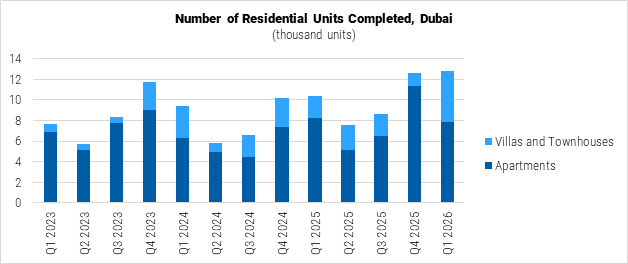
According to Property Monitor data compiled by Cavendish Maxwell, approximately 12,900 residential units were completed in Dubai in Q1 2026, up 23.1% year-on-year and marking the highest quarterly delivery volume in three years. However, actual completions remained well below the initially projected volume of around 30,300 units, highlighting the continued role of construction delays and phased handovers in moderating the pace of new supply.
Data Sources: Property Monitor, Cavendish Maxwell.
For the full year 2026, around 77,500 residential units are projected for delivery in Dubai, although actual handovers are likely to remain below scheduled volumes. Cavendish Maxwell expects Q2 2026 completions to range between 9,000 and 15,000 units, compared with a scheduled pipeline of around 29,600 units, as some projects are deferred into later quarters. The largest contributions are expected from Business Bay, Jumeirah Village Circle, Dubai South, Dubai Science Park, and Dubai Hills Estate, which together account for more than one-third of the projected 2026 deliveries.
The medium-term pipeline remains substantial, with around 146,400 units anticipated in 2027 and a further 120,100 units in 2028. While delivery slippage is likely to continue smoothing the pace of completions, the overall pipeline remains large and increasingly committed. As a result, Dubai is gradually moving into a more delivery-sensitive phase, where absorption capacity will become a key determinant of future performance.
The implications of this supply cycle will depend primarily on the pace of completions and the market’s ability to absorb incoming inventory, supported by end-user demand, investor appetite, rental performance, mortgage conditions, and broader economic sentiment. CBRE notes that moderating price and rental growth, together with the anticipated influx of new deliveries, is already encouraging a more cautious approach among some investors. JLL similarly highlights that the large future stock pipeline increases the importance of supply-demand balance, especially if demand softens, and notes that some developers are using cash discounts, bulk purchase deals, and value-added promotions to maintain sales momentum in selected segments.
In Abu Dhabi, the supply outlook remains more measured but is also strengthening. According to Cavendish Maxwell, approximately 7,400 residential units were completed in 2025, bringing the total residential stock to around 315,000 units, a 2.4% increase compared to 2024. Around 15,900 units are projected for completion in 2026, followed by 18,600 units in 2027 and 22,300 units in 2028, which would lift total stock to approximately 371,800 units by the end of 2028. However, recent handover trends suggest that actual deliveries in 2026 may be lower, in the range of 6,500 to 9,000 units.
Other consultancy commentary also points to a supply cycle that remains relatively controlled in the near term. Savills notes that supply constraints and limited handovers are expected to remain important features of Abu Dhabi’s residential market in the coming years, while also highlighting that some parts of the pipeline may face delays. The key issue is therefore not immediate oversupply, but the speed at which the larger 2026–28 pipeline materializes.
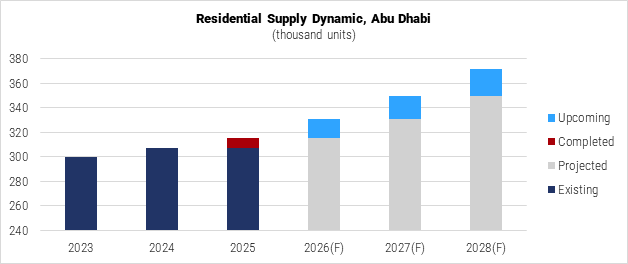
Note: Years marked (F) include the forecast period. The project supply is based on the information available at the time of the research
Data Sources: Cavendish Maxwell, MEED Projects.
Rental Market: Rents and Rental Yields
Rental Growth Moderates in Key Submarkets
Throughout early 2026, the REIDIN Residential Market Rent Price Index has been on a clearly decelerating trajectory in both Dubai and Abu Dhabi, although the latter is still posting much more pronounced rental growth. According to REIDIN, annual rental growth for all residential properties in Dubai eased from 6.2% in December 2025 to 1.5% in April 2026. In Abu Dhabi, the indicator moderated from 21.8% in December 2025 to 12.0% in April 2026. In both submarkets, apartment rents increased more substantially than villa rents (2.1% vs -1.5% in Dubai and 12.9% vs 7.7% in Abu Dhabi).
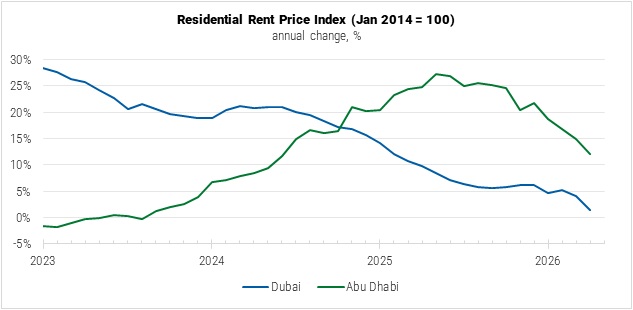
Data Source: REIDIN.
The continued moderation in rental growth in Dubai can be attributed to the regulatory impact of the Smart Rental Index (used to determine fair market rent and whether a landlord is legally entitled to increase rent at tenancy renewal), as well as increased new supply delivered over the recent quarters. “This expansion in stock provided tenants with greater choice and negotiating power, contributing to a slower pace of rental growth, particularly in areas with concentrated new completions,” real estate advisory firm Cavendish Maxwell observed in their Q1 2026 report.
The real estate agency Betterhomes also noted an increased competition in the Dubai rental market, with more selective tenant behavior slowing leasing deal conversions. “At a pricing level, new-let apartment prices across prime communities have come under pressure, declining between 10% and 20% year-on-year, while renewals remain largely anchored by the [regulatory] index,” said the agency’s Q1 2026 report. “This has created a widening gap between what existing tenants are paying and what new tenants are negotiating, with tenants taking advantage of greater choice and negotiating more actively.”
At the same time, while still performing strongly, with upward pressure on rents driven by a growing population due to consistent inflow of skilled professionals drawn to the emirate by employment opportunities and business creation, the Abu Dhabi market appears to be moving from an overheated rental cycle toward a more sustainable pace. In June 2026, to address affordability concerns and rapid rent growth in recent years, ADREC introduced a temporary freeze on rent increases for residential, commercial, and industrial properties in Abu Dhabi, preventing upward rent adjustments until further notice.
In nominal terms, ValuStrat reported average asking rents at AED 146,452 (USD 39,878) per year in Dubai and AED 163,000 (USD 44,383) per year in Abu Dhabi City as of Q1 2026.
Average asking annual rents by property type and submarket:
| Unit type | Dubai | Abu Dhabi City | ||
| Q1 2026 (AED) |
Q1 2026 (USD) |
Q1 2026 (AED) |
Q1 2026 (USD) |
|
| Apartments | AED 98,600 | USD 26,848 | AED 121,500 | USD 33,084 |
| Villas | AED 440,400 | USD 119,918 | AED 260,000 | USD 70,796 |
| Total | AED 146,452 | USD 39,878 | AED 163,000 | USD 44,384 |
| Note: Exchange rate USD 1 = AED 3.6725. | ||||
| Data Source: ValuStrat. | ||||
As for rental yields, the REIDIN April 2026 report offered a positive assessment of potential investment performance in key submarkets, estimating the residential market rental yields at 6.57% in Dubai and 6.08% in Abu Dhabi, with apartment yields reaching as high as 7.08% in Dubai and 6.50% in Abu Dhabi, while villas averaged at 4.54% in Dubai and 4.75% in Abu Dhabi.
Across a wider geography, research conducted by Global Property Guide in May 2026 found gross rental yields for residential properties in the UAE at an average level of 4.94%, marginally up from 4.87% previously reported in May 2025. The highest potential performance among the surveyed submarkets was estimated for rental properties in Dubai (6.31%), while the lowest yields were observed in Ras al Khaimah (2.72%).
Mortgage Market and Interest Rates
Benchmark Interest Rates Stable, Outlook for Lending Activity Uncertain
With the Dirham pegged to the US dollar, benchmark rates published by the Central Bank of the United Arab Emirates (CBUAE) closely follow the trajectory set by the US Federal Reserve. In line with the American regulator’s decisions, the CBUAE previously reduced its base rate applicable to the overnight deposit facility by 75 bps in the second half of 2025, bringing it to 3.65% by the end of the year and holding this level since. In parallel, the 3-month Emirates Interbank Offered Rate (EIBOR), often used as a reference in individual variable and hybrid mortgage products, has also remained relatively stable in recent months, standing at 3.69% as of the end of May 2026.
Domestic and international banks in the UAE have a variety of home loan programs for citizens and foreign residents, typically based on a floating rate set as a combination of EIBOR and a fixed margin or a fixed rate during an introductory period of 1 to 5 years, after which the rate reverts to EIBOR plus the bank’s margin. While no consolidated figures on mortgage interest rates across the country are publicly available, individual lenders have likely already adjusted their pricing, as the central bank’s earlier base rate cuts have filtered through the financial system.
At the time of research in June 2026, First Abu Dhabi Bank, one of the country’s largest lenders, offered home loans for residences and investments at fixed rates between 3.99% and 4.44% during the introductory period. Another prominent lender, Emirates NBD, posted indicative home loan rates ranging from 2.14% to 6.00%.
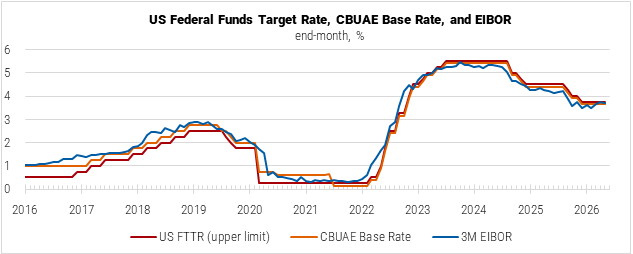
Data Sources: FRED, CBUAE.
It remains to be seen how the recent escalation in the Middle East will impact lending activity in the UAE, but as of late 2025 and early 2026, stronger household incomes and improving creditworthiness of borrowers, as well as lower interest rates and overall favorable economic conditions, continued to support demand for personal credit, and home credit in particular, across the Emirates. “Housing-investment loans grew at their strongest rate since the inception of the survey, while other housing loans (owner-occupier, refinancing, and renovations) were also strong, tracking near record highs,” said the Q4 2025 Credit Sentiment Survey from the CBUAE.
Illustrating this trend, Dubai continued to show year-on-year growth in residential mortgage transactions, based on data published by the UAE-based real estate advisory firm Cavendish Maxwell. About 10,800 such transactions were registered in Q1 2026, a 16.1% increase compared to the same period in 2025. In monetary terms, the value of these transactions reached AED 23.1 billion (USD 6.3 billion), also demonstrating a solid 13.2% year-on-year growth. The most pronounced year-on-year increase in transaction volume (20.0%) was observed in the villas segment, while townhouses posted the strongest increase in the total transaction value (15.6%).
In Abu Dhabi, ADREC reported about 5,000 residential mortgage transactions in Q1 2026, totaling AED 10.05 billion (USD 2.7 billion), a substantial 42.1% increase compared to the same period a year prior.
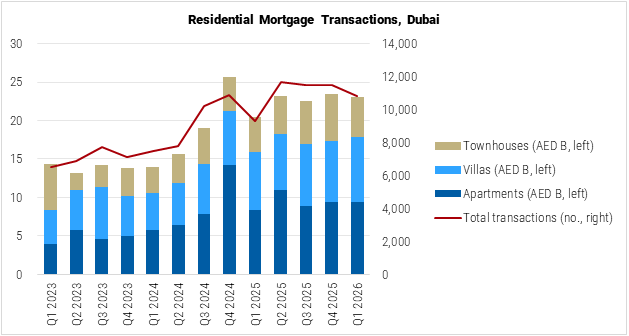
Data Sources: Property Monitor, Cavendish Maxwell.
Looking ahead, however, local experts agree that the market’s trajectory through the remainder of this year and beyond will depend on how long the conflict in the region lasts and how quickly economic conditions stabilize afterwards, how effectively the supply pipeline is absorbed, and whether demand from end-users and investors holds firm.
“Towards the end of [Q1 2026], more buyers began using financing strategically, not because of affordability pressure, but to preserve liquidity and flexibility during a period of increased uncertainty,” pointed out the real estate agency Betterhomes in their latest report on Dubai’s residential market.
“While Dubai has demonstrated resilience through previous external shocks and its structural strengths remain intact, these dynamics will collectively shape market performance over the months ahead,” summarized Cavendish Maxwell.
Overall, despite increased mortgage activity in previous quarters (driven in part by long-time tenants shifting to homeownership as the gap between renting and borrowing costs narrowed), cash buyers continue to dominate in the UAE’s real estate market. For Dubai, Knight Frank estimated the share of cash sales at 86% of total transaction volume in the first three quarters of 2025. In Abu Dhabi, ADREC reporting indicates that about 87% of transactions in 2025 were conducted in cash.
Economic and Social Factors
Economy Resilient, Uncertainty Over the Regional Conflict Weighs on Outlook
Prior to the escalation in the Middle East, the UAE economy outperformed regional and global averages, with real GDP growth supported by robust non-hydrocarbon activity and improving oil production accelerating from 4.0% in 2024 to 5.8% in 2025. More recently, however, the country has been severely affected by the regional conflict, with large spillovers to hydrocarbons, tourism, aviation, trade, and logistics. Against this background, the International Monetary Fund (IMF) currently projects growth to moderate to 3.1% in 2026, then pick up to 5.3% in 2027. The April 2026 outlook from the World Bank offers an even more conservative scenario, with growth reaching 2.4% and 4.1% over the next two years, respectively.
Driven by lower food prices and reduced transportation costs, which offset increases in housing-related costs, the country’s consumer price index (CPI) inflation remained below 2% over the last three years, averaging 1.3% in 2025. Considering recent airspace disruptions and higher shipping costs impacting import prices, inflation is projected to rise moderately this year (2.5% forecasts by both the IMF and the World Bank) before stabilizing at moderate levels from 2027.
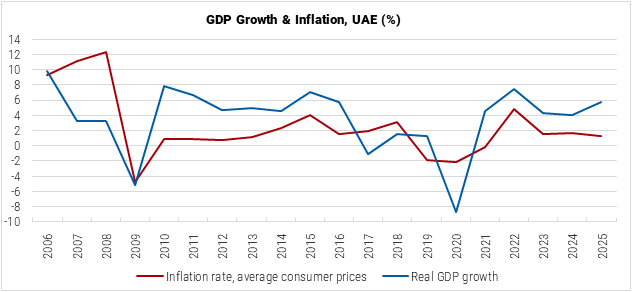
Data Source: IMF.
In May 2026, Fitch Ratings affirmed the country’s ‘AA-’ sovereign rating with a stable outlook, noting that the country’s strengths, such as low consolidated government debt, strong net external asset position, and high GDP per capita, are currently balanced by high geopolitical risk, high dependence on hydrocarbon income, and weak governance indicators relative to rating peers.
At the same time, while the outlook for the UAE is currently tethered to development of the Middle East conflict and related global energy shocks, the economy is generally seen as resilient. Although hydrocarbons remain the nation’s main source of revenue, the UAE continues to pursue economic diversification to mitigate fiscal vulnerabilities. Targeted public investments in AI and digital infrastructure are accelerating innovation-driven growth and expanding the knowledge economy.
Contributing to the country’s diversification efforts, Dubai’s tourism sector sustained its strong performance in 2025, according to the CBUAE economic review. The city attracted 19.6 million international overnight visitors throughout the year (5% increase from 2024) and posted a hotel occupancy rate of 80.7%, up from 78.2% a year earlier. “These developments reaffirm tourism’s important contribution to non-oil economic growth,” the central bank commented.
Amid the pivot from oil dependency to non-oil sectors such as tech, renewable energy, healthcare, tourism, and finance, the overall unemployment rate in the UAE’s labor market is relatively low, previously reported by the Federal Competitiveness and Statistics Center (FCSC) at 1.9% in 2024. Unemployment levels, however, are notably higher (5.5% in 2024) for women and the young population. The recent World Bank outlook also notes the continued growth in expatriate employment and the dominant share of non-Emirati workers in the UAE labor force. In this environment, labor-intensive sectors such as hospitality, retail, and construction (where expat workers are concentrated) could be particularly affected if regional instability persists.
Sources:
- Federal Competitiveness and Statistics Center (FCSC)
- Prices - CPI: https://fcsc.gov.ae/
- Labor Force: https://fcsc.gov.ae/
- Central Bank of the United Arab Emirates (CBUAE)
- Quarterly Economic Review, March 2026: https://www.centralbank.ae/
- Credit Sentiment Survey Q4 2025: https://www.centralbank.ae/
- CBUAE Lowers the Base Rate by 25 Basis Points: https://www.centralbank.ae/
- EIBOR Rates: https://www.centralbank.ae/
- Dubai Department of Land (DLD)
- Real Estate Data: https://dubailand.gov.ae/
- Abu Dhabi Real Estate Centre (ADREC)
- Abu Dhabi’s Real Estate Market Data: https://adrec.gov.ae/
- Temporary Update to Annual Rental Cap Increase in Abu Dhabi: https://adrec.gov.ae/
- International Monetary Fund (IMF)
- Country Overview: United Arab Emirates: https://www.imf.org/
- 2025 Article IV Staff Report: https://www.imf.org/
- United Arab Emirates: Selected Issues: https://www.imf.org/
- World Bank
- United Arab Emirates MPO, April 2026: https://thedocs.worldbank.org/
- REIDIN
- United Arab Emirates Residential Property Price Report: April 2026: https://reidin.com/
- ValuStrat
- Dubai – Real Estate Review Q1 2026: https://valustrat.com/
- Abu Dhabi – Real Estate Review Q1 2026: https://valustrat.com/
- Dubai – Real Estate Market Outlook 2026: https://valustrat.com/
- Abu Dhabi – Real Estate Market Outlook 2026: https://valustrat.com/
- Cavendish Maxwell
- Dubai Residential Market Performance Q1 2026: https://cavendishmaxwell.com/
- Abu Dhabi Residential Market Performance 2025: https://cavendishmaxwell.com/
- Engel & Völkers
- Smart Rental Index by DLD: Understanding its Impact on Tenants & Landlords: https://www.engelvoelkers.com/
- Betterhomes
- Q1 2026 Dubai Residential Real Estate Market Report: https://www.bhomes.com/
- Knight Frank
- Growth Gap Between Luxury and Mainstream Markets Widens…: https://www.knightfrank.ae/
- Dubai Residential Market Review – Q1 2026: https://www.knightfrank.ae/
- Dubai Residential Market Review – Q3 2025: https://www.knightfrank.ae/
- JLL
- UAE Living Market Dynamics, Q1 2026: https://www.jll.com/
- CBRE
- UAE Real Estate Market Review Q1 2026: https://www.cbre.ae/
- Cushman & Wakefield
- Market Beat – Residential Q1 2026, Dubai, UAE: https://www.cushwake.ae/
- Market Beat – Residential Q1 2026, Abu Dhabi, UAE: https://www.cushwake.ae/
- Savills
- Abu Dhabi Residential Market Report - Q1 2026: https://www.savills.com/
- Dubai Residential Market Report - Q1 2026: https://www.savills.com/
- Colliers
- UAE Real Estate Report | Q1 2026: https://www.colliers.com/
- Emirates NBD
- Home Loans: https://www.emiratesnbd.com/en/loans/home-loans
- First Abu Dhabi Bank (FAB)
- Home Loan for Residences and Investments in the UAE: https://www.bankfab.com/
- Fitch Ratings
- Fitch Affirms the United Arab Emirates at 'AA-'; Outlook Stable: https://www.fitchratings.com/