Jordan's housing market still struggling
All is not well in Jordan. High interest rates are impeding demand, and economic growth is weak - and there is socio-political unrest. The government is seen as weak and incompetent, regional worries have hit exports, and local red tape is discouraging investment.
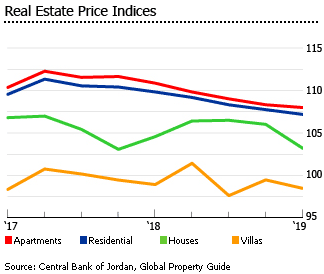
The nationwide residential real estate price index fell by 2.4% during the year to Q1 2019 (-2.43% inflation-adjusted), following y-o-y declines of 2.4% in Q4 2018, 2% in Q3 and 1.9% in Q2, and an annual increase of just 0.3% in Q1, according to the Central Bank of Jordan. Quarter-on-quarter, residential property prices fell 0.52% in Q1 2019 (up 0.47% when adjusted for inflation).
Apartments saw the biggest price decline of 2.59% during the year to Q1 2019 (-2.61% inflation-adjusted). House and villa prices fell by 1.3% and 0.45%, respectively. In contrast, residential land prices rose by 2.16% y-o-y in Q1 2019, based on the central bank figures.
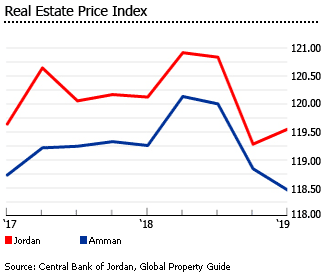
In Amman, Jordan’s capital city, the real estate price index fell slightly by 0.7% during 2018, after y-o-y decline of 0.4% in Q4 2018 and miniscule growth of 0.6% in Q3, 0.8% in Q2 and 0.4% in Q1.
The UAE-based property management firm Asteco produces figures based on observed sales prices. It saw Amman’s apartment sales prices unchanged during 2018, noting that "it is unknown whether these improvements are based on actual transactions".
In Amman’s major districts:
- In Abdoun, the capital city’s most affluent area, apartment prices were almost steady, ranging from JOD 1,250 (US$1,763) to JOD 1,600 (US$2,257) per square metre (sq. m.), according to Asteco.
- In 4th Circle, apartment prices range from JOD 1,150 (US$1,622) to JOD 1,550 (US$2,186) per sq. m.
- In Sweifieh, apartment prices range from JOD 1,100 (US$1,551) to JOD 1,300 (US$1,834) per sq. m.
- In Um-Othainah, apartment prices range from JOD 1,150 (US$1,622) to JOD 1,350 (US$1,904) per sq. m.
- In Al-Rabiah, apartment prices were stable at an average of JOD 1,100 (US$1,551) per sq. m.
- In Der Ghabar, the average apartment price was also unchanged at JOD 1,200 (US$1,693) per sq. m.
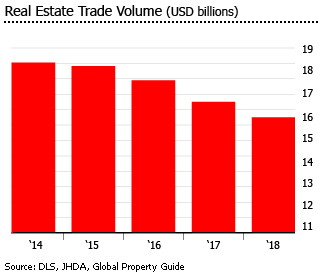
Demand continues to fall. In the first two months of 2019, real estate transaction volume dropped almost 24% y-o-y to JOD695 million (US$980.3 million), following annual declines of 13% in 2018, 14% in 2017, 9% in 2016 and 2% in 2015, according to the Department of Land and Survey (DLS).
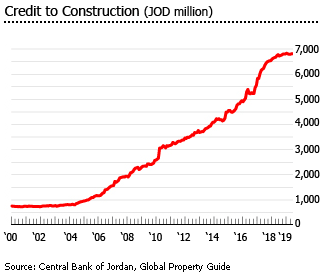
One factor that limits Jordanians buying homes is high mortgage rates. Arab Bank, Jordan’s largest regional bank, charges lending rates ranging from 7.2% to 8.9% per annum. Unsurprisingly, loans to the construction industry have been slowing. In May 2019, the total amount of credit to construction rose by a meager 0.6% to JOD 6.82 billion (US$ 9.61 billion) over the same period last year, a sharp slowdown from the prior year’s 8.8% growth and the lowest y-o-y increase in 16 years, based on the figures from the Central Bank of Jordan.
In hopes of stimulating capital inflows in the country, Jordan approved an investment program that grants citizenship or permanent residency of non-Jordanians in February 2018. This program includes permanent residency for non-Jordanians who purchase properties worth a minimum of JOD 200,000 (US$ 282,100) and hold the properties for 10 years. Grants of Jordanian citizenship or residency are limited only to 500 applicants per year, according to State Minister for Media Affairs and Government Spokesperson Mohammad Momani.
Foreigners are allowed to buy property in Jordan, provided Jordan and the buyer’s country of residence have a reciprocal relationship, and that the approval of the Cabinet (Council of Ministers) is obtained. Foreigners can only sell the property five years after acquisition. Most properties for rent and for sale can be found in Amman, Jordan’s capital city.
Property transactions falling
In 2018, the total value of real estate transactions in Jordan fell by about 13% to US$7.4 billion from a year earlier, after annual declines of 14% in 2017, 9% in 2016 and 2% in 2015.
Then in the first two months of 2019, volumes dropped almost 24% to JOD695 million (US$980.3 million) compared to the same period last year, according to the Department of Land and Survey (DLS).
“The sector has been steadily collapsing and I am afraid it is going to hit rock bottom in 2019,” said JHDA President Zuhair Omari.
Northern Amman registered the highest sales of JOD 122 million (US$172 million) in the first two months of this year, followed by Amman with JOD102 million (US$144 million) and Southern Amman with JOD68 million (US$96 million). Overall, Amman offices and the DLS headquarters accounted for 68% share of the total trade volume.
Most foreign buyers are Iraqis, followed by the Saudis, Syrians and Yemenis.
Residential construction continues to fall
In the first quarter of 2019, the total number of licenses for new residential buildings in Jordan fell by 6.4% y-o-y to 1,140, according to the Department of Statistics. Likewise, existing residential building licenses plummeted by 42.6% to 3,721 over the same period. In Greater Amman, new and existing residential building licenses fell by 48.7% and 6%, respectively.
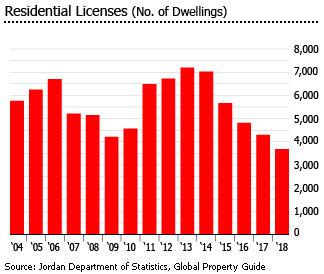
The number of dwelling licenses in the country also dropped 36.2% to just 593 in Q1 2019 from a year earlier, following y-o-y declines of 14.3% in 2018, 10.9% in 2017, 14.9% in 2016, 19.3% in 2015 and 2.4% in 2014. Over the same period:
- The total area of dwelling licenses fell by 4% y-o-y to 1.22 million sq. m.
- The cost of dwelling licenses plunged 38% y-o-y to JOD 92.53 million (US$130.51 million)
Rental yields are good; increasing rents in Amman
In Amman, Jordan’s capital, gross rental yields of apartments are good, ranging from 6.5% to 9%, based on a research conducted by Global Property Guide. Smaller-sized apartments have higher yields than their larger counterparts.
Apartment rents in Amman rose by a modest 2% during 2018, according to Asteco. On a quarterly basis, apartment rents in the capital increased 1% in Q4 2018.
Sweifieh saw the highest rent price increase of 7% in 2018 from a year earlier, followed by Abdoun with a 5% rent hike. Modest rent increases were registered in 4th Circle (2%) and Der Ghabar (1%). Rents were unchanged in Al-Rabiah while they fell by 1% in Um-Othainah.
The increase in rents was mainly due to the shortage of larger unit types (2 BR and 3 BR), according to Asteco.
Rental rates in Amman are rather high, mainly due to the large number of refugees who have poured into the country.
Abdoun, Amman’s most affluent district, has the most expensive housing, with one-bedroom apartments offered for an average rent of JOD5,500 (US$7,757) per year in 2018; two-bedroom apartments for JOD11,750 (US$16,573); and three-bedroom apartments for JOD22,750 (US$32,088).
APARTMENT RENTS IN AMMAN, 2018 |
|||||
| District | Average rent per annum (JOD) | Q-O-Q change | Y-O-Y change | ||
| 1-BR | 2-BR | 3-BR | |||
| Abdoun | 5,500 | 11,750 | 22,250 | 3% | 5% |
| Sweifieh | 4,250 | 9,250 | 16,500 | 6% | 7% |
| Um-Othainah | 5,000 | 9,000 | 13,250 | -1% | -1% |
| Al-Rabiah | 3,500 | 7,500 | 10,750 | 0% | 0% |
| Der Ghabar | 5,250 | 10,000 | 16,500 | 0% | 1% |
| 4th Circle | 5,000 | 11,000 | 18,000 | -2% | 2% |
| Source: Asteco | |||||
Refugee population boosts local property market
The conflict in neighboring Syria has meant an influx of as many as 1.5 million Syrian refugees since 2011, compounded by large Palestinian and Iraqi refugee populations present even before the Syrian civil war. About 83% of the refugees live in cities and towns, while the remainder reside mainly in two refugee camps, Zaatari and Azraq, based on a report by European Commission. Zaatari has evolved into Mafraq Governorate’s largest city and the world’s second largest refugee camp with close to 80,000 residents.
TOTAL POPULATION |
||
| Population | % of Total | |
| Ajloun | 176,080 | 2% |
| Amman | 4,000,000 | 42% |
| Aqaba | 188,160 | 2% |
| Balqa | 491,709 | 5% |
| Irbid | 1,364,000 | 14% |
| Jerash | 237,059 | 2% |
| Karak | 316,629 | 3% |
| Maan | 144,083 | 2% |
| Madaba | 189,192 | 2% |
| Mafraq | 549,948 | 6% |
| Tafileh | 96,291 | 1% |
| Zarqa | 1,364,000 | 14% |
| TOTAL | 9,500,000 | 96% |
| Source: Census Data | ||
When registered refugees are added to the number of Syrian nationals residing in Jordan, the proportion could be as high as 21% of the population, according to Deputy Prime Minister Nasser Judeh. According to a recent report by REACH Resource Centre, prices of rented accommodation have jumped 200% to 300% versus pre-crisis levels in some areas.
An additional 86,000 housing units were needed to meet immediate demand, compared to 32,000 units under more normal circumstances, according to REACH.
Dire need for affordable housing stymied by bureaucracy
Refugees and native Jordanians cite housing as their area of greatest concern, as well as their largest monthly expenditure. Royal efforts have failed in the past. In 2005, King Abdallah II kicked off the “Decent Housing for a Decent Life” campaign, which aimed to provide 120,000 affordable homes for low-income Jordanians over five years. The campaign was later abandoned, as most dwellings ended up being built in rural areas, far from job opportunities.
From 2004-2011, some 28,600 housing units per year were built, against an increase in demand of about 32,000 per year, but they were concentrated in the mid to upper end of the real estate market, exacerbating the shortage of affordable housing.
“The crisis has deep social consequences. Young people cancel engagements and postpone marriage because they cannot afford to make a home together,” noted a report by The Economist.
Large parts of Amman are zoned for high-end units, even though there is huge demand for cheaper units. The government has also set the minimum size for new apartments at 110 sq. m., bigger than most people can afford, exacerbating the shortage of affordable housing.
“It is much easier to find a luxurious and big flat in Amman than to find an affordable one that is less than 110 square metres… Because of the recently endorsed building bylaw, we are not allowed to build small apartments that are in need in the market,” said Jordan Housing Developers Association President Zuhair Omari.
“Prices in Jordan are high as the prices of land plots are expensive and we pay large amount in fees and taxes,” Omari added.
Recently, the government passed a new property law, the 13th Real Estate Ownership Law for 2019, that aims to consolidate 13 laws governing property ownership, and addresses issues such as zoning, and the facilitation of ownership and leases for foreign investors. The new law is set to become effective on September 16, 2019.
Presently, the Housing and Urban Development Corporation (HUDC), a government body responsible for the kingdom’s general housing policy, in cooperation with UNHCR and several NGOs, focuses on four forms of intervention: cash-for-rent grants, construction of new units, winterization and upgrading of existing homes, and housing and property rights legal education.
The UNHCR and the International Catholic Migration Commission and Caritas are the primary distributors of cash for rent aid. Shelter upgrading is central to the plans of the Norwegian Refugee Council, the Jordan Health Aid Society, Medair, the Lutheran World Federation and Première Urgence-Aid Médicale Internationale (PU-AMI).
Excessive bureaucracy, red tape thwart housing market growth
Excessive bureaucracy and irrational regulations keep Amman under-housed - and the poor, the middle class, and the refugees suffer.
The Greater Amman Municipality (GAM), which oversees private and public construction, is rife with red tape. GAM imposes strict restrictions and procedures significantly limiting investments in the capital. These included time-consuming paperwork and long delays in connecting new buildings to utilities, such as water, electricity and sewage.
Based on the 2019 Ease of Doing Business published by World Bank, Jordan was ranked 139th out of 190 countries for the ease of obtaining construction permits – significantly worse than Egypt (ranked 68th) and Turkey (ranked 59th). Securing a construction permit in Jordan requires 20 procedures and takes 66 days, on average.
Apart from drawn-out procedures, GAM also restricts the number of flats in each building. “Developers want to construct buildings with 15 smaller apartments but GAM forces them to build only ten,” says former Jordanian Housing Developers Association (JHDA) president Kamal Awamleh. This has resulted in larger and less affordable apartments that are basically inaccessible to the majority of Jordanians.
Furthermore, GAM also imposes height restrictions on construction, capping residential buildings at four stories and, in some areas, at two floors plus a roof above street level.
Since 2015, housing investors have been moving their investments from Jordan to other countries, according to current JHDA president Zuheir Omari. In 2018, about only 2,000 out of 3,400 investors have renewed their membership in the JHDA. The reduced number of members, however, "does not mean that 1,400 investors have moved but surely indicates a reluctance to continue doing businesses in the Kingdom," Omari noted.
Investor Numaan Hamshari, who relocated his investments to Turkey, said that investors distanced themselves from Jordan due to "fees, ‘high’ taxes, too strict regulations and complicated procedures". Another investor, Haidar Tamimi, also transferred investments to Cyprus and Kyrgystan, noting that the "lack of clear procedures for investing in Jordan and temperamental treatment of some public employees have compelled me to look for a new location of my investments".
Omari called on the government to trim down the owner transfer fees from 9% to 5%, or to maintain the registration fees exemption on the first 150 sq. m. given to first-time buyers who bought from registered developers.
GAM countered the criticisms by saying that any delays are due to disputes or failures to meet the official standards. Procedures should only take 12 days maximum if the building license transaction meets terms and conditions. Normally, around 80-85% of transactions are approved.
A new GAM regulation was implemented on January 1, 2018, mandating all requests for renovating establishments’ licenses to be presented in an electronic format. "Our aim is to bring transparency and eliminate bureaucracy for our citizens’ convenience," said Amman Mayor Yousef Shawarbeh. "We want to build confidence between the employers and the inspectors; we have received many complaints of bad behaviours from the inspectors and we apologise for that."
Weak economic growth; record-high unemployment
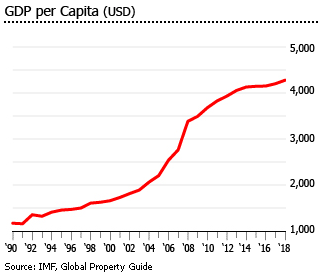
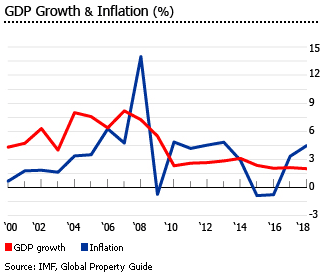
Jordan’s economy expanded by 2% in 2018, the lowest level in more than two decades, amidst political and social unrest in the region brought about by the continuing chaos in Syria and Iraq, which severely effected Jordan’s exports, tourism, and overall economic performance.
During the first quarter of 2019, Jordan’s real GDP increased by 2% y-o-y, marginally up from 1.9% growth in the same quarter last year, according to Finance Minister Ezzeddine Kanakrieh.
The economy is expected to have a modest expansion of 2.2% in 2019 and by 2.4% in 2020, according to the IMF.
To jumpstart the economy, His Majesty King Abdullah unveiled an ambitious economic stimulus plan (2018-2022) that include reforms in various sectors, projects worth JOD6.9 billion (US$9.7 billion) and private sector investment opportunities amounting to JOD9.5 billion (US$13.4 billion).
High unemployment is another major concern. Jordan’s jobless rate rose to a record 19% in Q1 2019, up from 18.4% in the same period last year, according to the Department of Statistics. In 2018, the unemployment rate stood at 18.3%, up from 18.1% in 2017, 15.3% in 2016, 13.1% in 2015, 11.9% in 2014, and 12.6% in 2013.
In June 2019, inflation slowed to just 0.5%, sharply down from 5.1% a year earlier.
Social unrest persists amidst massive debt burden
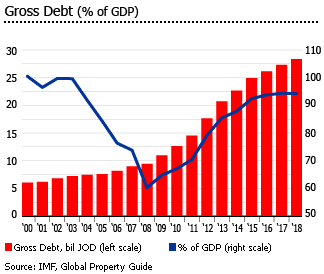
In August 2016, Jordan accepted a US$723 million loan from the IMF’s Extended Fund Facility (EFF) on condition that the government reduces public debt as a percentage of GDP from almost 95% currently to 80% by 2021 through fiscal reforms and austerity measures.
However in June 2018, there were massive protests against price hikes as well as against a new income tax draft law, which aimed to raise employees’ income taxes by at least 5% and on companies by around 20% to 40%. The protests caused the resignation of former Prime Minister Hani Mulki. His replacement Omar al-Razzaz pledged to withdraw the income tax law, but his alternative measures also aroused widespread unrest. In May 2019 he reshuffled his cabinet for the third time in less than a year - widely seen as a way of deflecting public frustration amidst declining living standards.
Jordan´s public deficit rose in 2018 to 4% of GDP, up from 2.9% in 2017 and 3.8% in 2016, according to the IMF, and during the first five months of 2019, the public budget deficit after grants rose by 11% y-o-y to JOD483.5 million (US$682 million), according to the Finance Ministry.
Nevertheless in 2018, the country’s public debt was down to 94.23% of GDP, slightly down from 95.9% of GDP in 2017 and 95.1% of GDP in 2016, according to the Central Bank of Jordan.
Sources:
- Jordan Real Estate Price Index (Central Bank of Jordan): http://www.cbj.gov.jo/Pages/viewpage.aspx?pageID=212
- Jordan Real Estate Report Q4 2018 (Asteco): https://www.asteco.com/application/files/2815/4857/4898/20181111_astrep866_2018q4_jordan.pdf
- Real estate trade volume drops 24% in first two months of 2019 (The Jordan Times): http://www.jordantimes.com/news/local/real-estate-trade-volume-drops-24-first-two-months-2019
- World Economic Outlook Database (International Monetary Fund): https://www.imf.org/external/pubs/ft/weo/2019/01/weodata/index.aspx
- Credit Facilities According to Economic Activity (Central Bank of Jordan): http://statisticaldb.cbj.gov.jo/index?action=level4&page_no=0#
- Jordan: gross rental yields good at 6.5% to 9% (Global Property Guide): https://www.globalpropertyguide.com/Middle-East/Jordan/Rental-Yields
- Tables of price indices (Department of Statistics): http://dosweb.dos.gov.jo/economic/price-indices/table-price-indices/
- Building Licenses (Department of Statistics): http://dosweb.dos.gov.jo/industry/building-licenses/
- Jordan (European Commission): https://ec.europa.eu/echo/where/middle-east/jordan_en
- ´Kingdom suffers from lack of affordable housing, excess in luxurious homes´ (The Jordan Times): http://jordantimes.com/news/local/kingdom-suffers-lack-affordable-housing-excess-luxurious-homes
- Housing crisis brewing (The Jordan Times): http://jordantimes.com/opinion/editorial/housing-crisis-brewing
- Jordan´s PM says new real estate law to address many challenges facing sector (Zawya): https://www.zawya.com/mena/en/legal/story/Jordans_PM_says_new_real_estate_law_to_address_many_challenges_facing_sector-SNG_148121571/
- Jordan sees 2% GDP growth in Q1 — Kanakrieh (MENAFN): https://menafn.com/1098734061/Jordan-sees-2-GDP-growth-in-Q1Kanakrieh
- Jordan Unemployment Rate (Trading Economics): https://tradingeconomics.com/jordan/unemployment-rate
- Jordan approves third cabinet reshuffle in less than a year (The Arab Weekly): https://thearabweekly.com/jordan-approves-third-cabinet-reshuffle-less-year
- Jordan caught between a rock and a hard place (Daily Sabah): https://www.dailysabah.com/op-ed/2019/07/11/jordan-caught-between-a-rock-and-a-hard-place
- Jordan Seeks to Reduce Public Deficit to 2.5% in 2019 (Asharq Al-Awsat): https://aawsat.com/english/home/article/1583116/jordan-seeks-reduce-public-deficit-25-2019
- Budget deficit up to around JD484 m in first 5 months (The Jordan Times): http://jordantimes.com/news/local/budget-deficit-around-jd484-m-first-5-months
- Jordan Government Debt to GDP (Trading Economics): https://tradingeconomics.com/jordan/government-debt-to-gdp
- Housing sector witnesses ‘investor drain, due to bureaucracy, taxes’ (The Jordan Times): http://www.jordantimes.com/news/local/housing-sector-witnesses-investor-drain-due-bureaucracy-taxes%E2%80%99
- Doing Business 2019 Jordan (World Bank): https://www.doingbusiness.org/content/dam/doingBusiness/country/j/jordan/JOR.pdf