Peru's Residential Property Market Analysis 2026
Peru’s housing market has proven resilient, with prices continuing to rise amidst increasing demand. This strength persists despite the ongoing political crisis in the country.
This detailed Global Property Guide overview evaluates Peru’s recent housing market performance, key demand and supply factors, and the medium- to long-term outlook for the sector.
Table of Contents
- Property Prices and Price Index
- Property Demand Trends
- Property Supply Trends
- Rental Market: Rents and Rental Yields
- Mortgage Market and Interest Rates
- Economic and Social Factors
Property Prices and Price Index
During the year to Q3 2025, the nationwide hedonic property price index rose by 4.06%, an improvement from year-on-year increases of 2.24% in Q2 2025 and 0.74% in Q1 2025 and a decline of 1.46% in Q4 2024, according to figures from the Central Reserve Bank of Peru (BCRP). In fact, it marked the highest annual price growth since Q2 2019.
When adjusted for inflation, property prices were up by an average of 2.67% in Q3 2025 from a year earlier.
Quarterly, property prices increased by 1.59% (1.64% in real terms) in Q3 2025, following q-o-q growth of 1.66% in Q2 and 0.57% in Q1.
Peru's house price annual change:
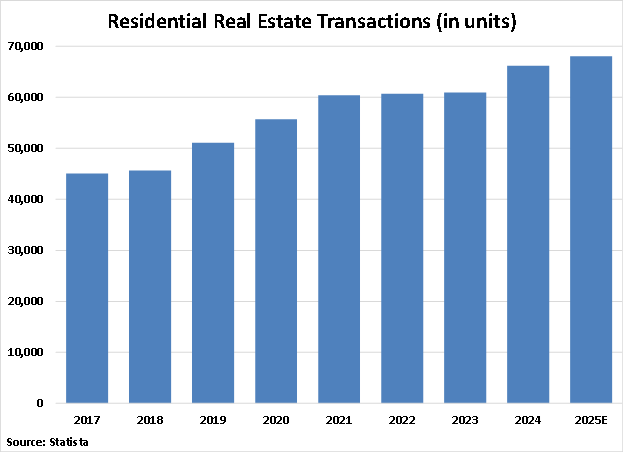
Demand remains strong. During 2025, residential real estate transactions in Peru rose by a modest 2.8% y-o-y to approximately 68,030 units, following annual increases of 8.6% in 2024, 0.4% in 2023, 0.5% in 2022, and 8.4% in 2021, based on figures from Statista. Lima remained the primary driver of the market, accounting for around 37% of the total units sold last year.
Peru’s housing market experienced a remarkable boom between 2007 and the first half of 2014, with house prices soaring by 197.5% (141.2% when adjusted for inflation), fueled by strong demand and robust economic growth. However, this rapid growth began to taper off in the second half of 2014, as the economy slowed due to falling copper prices.
Economic growth in Peru decelerated to 2.4% in 2014 and moderated to 3.3% in 2015. It briefly rebounded to 4% in 2016, but slowed again to 2.5% in 2017, reflecting the broader economic challenges. Correspondingly, house price growth weakened, with prices either rising modestly or declining.
The Covid-19 pandemic dealt a further blow to the housing market. In 2021, house prices fell by 3% (-8.9% inflation-adjusted) compared to the previous year. The housing market remained fragile in the following years. In 2022, nominal prices rose slightly by 1.6% but fell by 6.3% in real terms. In 2023, house prices increased by 2.9%, yet after adjusting for inflation, they still edged down by 0.4%. The downward trend continued into 2024, with prices declining 1.5% (-3.4% inflation-adjusted), before showing some signs of improvement last year.
| NOMINAL & INFLATION-ADJUSTED HOUSE PRICE CHANGES (Y-O-Y) IN PERU | ||
| Year | Nominal | Inflation-adjusted |
| 2008 | 34.83% | 26.42% |
| 2009 | 7.09% | 6.83% |
| 2010 | 20.00% | 17.56% |
| 2011 | 20.47% | 15.02% |
| 2012 | 19.62% | 16.53% |
| 2013 | 9.52% | 6.48% |
| 2014 | 3.96% | 0.71% |
| 2015 | -3.82% | -7.88% |
| 2016 | 2.17% | -1.03% |
| 2017 | 0.21% | -1.14% |
| 2018 | 1.54% | -0.64% |
| 2019 | -0.67% | -2.52% |
| 2020 | 3.88% | 1.87% |
| 2021 | -3.01% | -8.87% |
| 2022 | 1.60% | -6.33% |
| 2023 | 2.87% | -0.36% |
| 2024 | -1.46% | -3.36% |
| Q3 2025 | 4.06% | 2.67% |
| Data Sources: Central Reserve Bank of Peru (BCRP), Global Property Guide | ||
Despite signs of improvement in recent months, the housing market outlook remains fragile, as investor confidence continues to be weighed down by the country’s political instability. However, easing inflation and a recovering economy are helping to restore purchasing power among prospective homebuyers, offering some support to demand.
Peru’s broader economy expanded modestly in 2025, with the International Monetary Fund (IMF) reporting a real GDP growth of around 2.9%, while the Ministry of Economy and Finance (MEF) suggested growth could have reached 3.5%. This followed a period of uneven expansion in recent years, as the country recovered from the pandemic-induced slowdown and navigated challenges such as fluctuating commodity prices and external economic shocks.
The IMF forecasts that Peru’s economy will continue its steady expansion, growing by 2.9% in 2026 and 2.7% in 2027. The BCRP is slightly more optimistic, recently revising its 2026 growth projection upward from 2.9% to 3%.
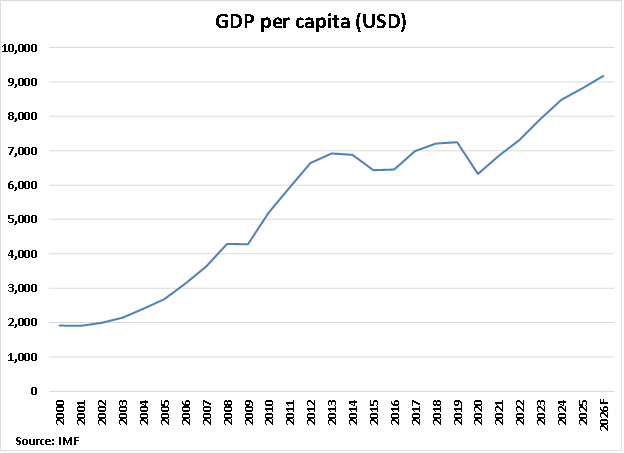
Peru’s GDP per capita reached around US$8,800 last year, up by nearly 37% from a decade ago, based on IMF figures. The country’s GDP per capita has followed an uneven but broadly upward trajectory since the early 2000s, buoyed by growth in mining, services, and exports.
Property Demand Trends
Residential property sales continue to increase
During 2025, residential real estate transactions in Peru rose by a modest 2.8% y-o-y to approximately 68,030 units, following annual increases of 8.6% in 2024, 0.4% in 2023, 0.5% in 2022, and 8.4% in 2021, based on figures from Statista. Lima remained the primary driver of the market, accounting for nearly 25,000 units sold last year.
Market trends indicate that total units sold nationwide in 2026 are likely to match or modestly exceed 2025 levels, with Lima expected to continue leading residential activity due to sustained demand and ongoing urban housing developments.
Following two years of subdued performance, Peru’s residential property market began to improve in 2024, with demand continuing to strengthen in 2025, supported by improved economic activity, easing inflation, and gradually stabilizing financial conditions. The rebound has been particularly visible in Lima, which remains the country’s primary housing market and accounts for a substantial share of total transactions.
However, market dynamics vary significantly by segment. While overall demand has improved, the high-end residential market in Lima has remained relatively soft in recent years. Political uncertainty and periods of economic volatility have made many affluent Peruvians cautious about committing capital to domestic property investments. Some high-net-worth buyers have instead redirected funds abroad, particularly to markets such as Miami, seeking greater stability and asset security.
On the other hand, the middle- and lower-income segments remain resilient and continue to underpin overall market activity. Middle-income households, supported by access to mortgage financing and government-backed housing programs, have sustained transaction volumes. Many buyers continue to purchase their first homes or upgrade to better housing despite political concerns in recent years. While uncertainty may temper sentiment among wealthier investors, end-user demand among middle-income Peruvians has proven comparatively stable and confidence-driven.
In recent years, there has also been growing interest in coastal areas and districts outside central Lima, driven by limited buildable land in prime urban locations, rising land prices, and lifestyle considerations. Coastal communities benefit from a favorable climate and, in some cases, comparatively better value, making them increasingly attractive to both end-users and investors.
Overall, Peru’s housing market recovery has been broad-based but uneven, with mass market demand strengthening while the luxury segment continues to adjust amid political and economic uncertainty.
Foreign residents and nonresidents alike may buy Peruvian property. Investment in Peruvian property does not require government approval, except if such property is close to Peru’s frontiers.
Most foreign homebuyers in Peru are retirees from North America, Spain, and Britain. Expatriate Peruvians account for a significant portion of the high-end market, said Alen Becerra of Lima-based Becerra Group/Leading Real Estate Companies in the world.
In the past several years, the New Peruvian Sol has fallen by nearly 37% from US$1=PEN 2.55 in January 2013 to US$1=PEN 4.05 in December 2021, largely due to copper price weakness. This reduces costs for foreign buyers.
The domestic currency appreciated against the US dollar by 20.5% since. In January 2026, the average monthly exchange rate stood at US$ 1 = PEN 3.36.
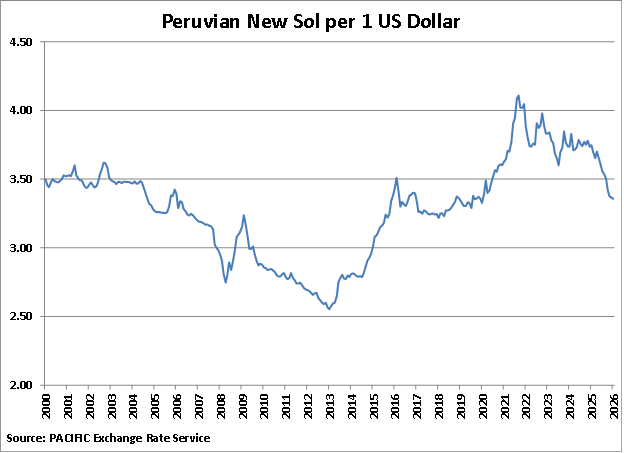
Many property transactions in Peru take place in U.S. dollars.
Property Supply Trends
Addressing Peru’s social housing deficit
Peru’s housing deficit currently stands at around 1.9 million units, according to recent official estimates. Of this total, roughly 587,000 units represent a quantitative deficit (homes that do not exist), while about 1.3 million units correspond to a qualitative deficit, referring to dwellings that are structurally inadequate or lacking basic services. The shortfall continues to widen, increasing by approximately 142,000 units annually, while only about 90,000 formal housing units are constructed each year, according to Housing Minister Hania Pérez de Cuéllar.
Peru’s housing shortage has long been a structural challenge, persisting for several decades. In 2014, the deficit was estimated at around 1.86 million units, according to Scotiabank. More localized data from consultancy HGP Group indicated that Metropolitan Lima alone had a housing deficit of approximately 612,464 units in 2016, with San Juan de Lurigancho accounting for about 15.6% of the capital’s total deficit at the time.
The steady expansion of the deficit underscores the structural imbalance between rapid household formation, sustained urbanization, and the limited capacity of the formal housing sector to supply affordable units, particularly in the low- and middle-income segments.
To meaningfully narrow the gap, Habitat for Humanity estimates that Peru would need to allocate approximately US$2 billion annually toward housing subsidies and related support programs.
In response to the persistent shortfall, the government has implemented a range of financial assistance and direct subsidy programs aimed at improving affordability and expanding homeownership. These include Fondo MiVivienda, Techo Propio, as well as initiatives such as Micasa Más, Mi Construcción, and Mi Terreno. These programs provide subsidized financing, grants for home purchases or construction, and support for serviced land acquisition, primarily targeting first-time buyers and lower-income families
MiVivienda, established in 1999, provides housing loans for the middle and upper-class levels (A, B, and C). MiVivienda is the largest provider of affordable housing financing in the country, accounting for about 30% of the residential mortgages financed in Peru. As of 2025, the MiVivienda program continues to support access to formal housing in Peru. Under the Nuevo Crédito MiVivienda, households can finance homes valued between approximately PEN 68,800 (US$20,508) and PEN 488,800 (US$145,703), covering both completed and under-construction properties. The Bono del Buen Pagador (BBP) provides subsidies of up to PEN 27,400 (US$8,167) for homes priced up to PEN 362,100 (US$107,936), helping reduce down payment costs for eligible buyers. While the program remains a key tool to address the housing deficit, budget reductions in 2026 may limit the number of households able to benefit from these subsidies.
Techo Propio is a program launched in 2002, directed at family groups who do not have their own houses and have never received State support to build or buy one. As of 2025, households earning up to PEN 3,715 (US$1,107) for home purchases or PEN 2,706 (US$807) for construction or improvement are eligible. The program provides the Bono Familiar Habitacional (BFH) subsidy up to PEN 32,100 (US$9,568) for home construction, with regional variations, and higher amounts for home purchases depending on the property value.
Micasa Mas is a credit program that is intended for families who already own a home (including homes that are under mortgage) that could be put on sale, in order to buy a new or used house that matches their family's current financial and family situation. Loans that could be requested in this program range from PEN 45,000 (US$13,414) to PEN 270,000 (US$80,482), with a minimum down payment of 20% of the home’s value.
Mi Construcción enables beneficiaries to build, expand, or improve their homes on land they already own. Under the current program parameters, eligible borrowers can access loans of up to PEN 100,000 (US$29,808) with repayment terms of up to 12 years.
MiTerreno helps low-income families purchase urban land (private or public) that will be used for housing purposes. The maximum amount of funds is around PEN 50,000 (US$14,904), with a maximum financing period of 8 years.
Rental Market: Rents and Rental Yields
Moderately good rental yields, increasing apartments rents
While gross rental yields on prime residential property in Peru remain moderately good, they have been on a declining trend over the past few years. From an amazing 13% in 2009, yields continuously fallen to around 6% to 7% recently.
The average gross rental yield in Peru stood at 5.94% in Q4 2025, slightly down from 5.97% in Q2 2025 and 6.13% in Q4 2024, based on recent research conducted by the Global Property Guide. In Lima, apartments have rental yields ranging from 4.98% to 8.55% in Q4 2025, with a city average of 6.29%.
In Arequipa, the seat of the Constitutional Court of Peru and often dubbed the country’s legal capital, the gross rental yields for apartments ranged from 4.94% to 6.26% in Q4 2025, with a city average of 5.6%.
Residential rents continued their upward trend in 2025, with average rents rising by approximately 6% to 20%, depending on property type and location. In Lima, monthly rents for two-bedroom apartments currently range from around PEN 1,711 (US$510) to PEN 3,623 (US$1,080).
In Lima’s major areas, in Q4 2025:
- In Barranco, one of the city’s hippest neighborhoods, monthly rents range from PEN2,181 (US$650) for studio-type to PEN 4,363 (US$1,300) for three-bedroom apartments.
- In Miraflores, an upscale residential and shopping district south of downtown Lima, monthly rents range from PEN 2,685 (US$800) for studio apartments to PEN 10,740 (US$3,200) for apartments with four or more rooms.
- In San Isidro, one of Lima's most expensive areas, which is home to most of the country’s embassies, monthly rents range from PEN 2,685 (US$800) for studio apartments to PEN 13,089 (US$3,900) for four-bedroom apartments or larger.
- Rents are relatively cheaper in the districts of La Molina, Chorillos, San Borja, and Surquillo, ranging from PEN 1,712 (US$510) for studio apartments to PEN 4,027 (US$1,200) for three-bedroom apartments.
Lima’s rental prices are usually set in US dollars. From 2013 to 2021, the Peruvian Nuevo Sol (PEN) depreciated sharply, which could have pushed (the already declining) rental prices even lower. However, the value of the domestic currency has been stabilizing in recent years.
Mortgage Market and Interest Rates
Mortgage interest rates remain elevated, despite successive benchmark rate cuts
In February 2026, the Central Reserve Bank of Peru (BCRP) kept its reference rate unchanged at 4.25%, marking the third consecutive meeting without an adjustment. This followed a prolonged easing cycle, during which the central bank reduced its key policy rate thirteen straight times from October 2023 to September 2025, aiming to support its robust economic activity amid moderating inflationary pressures.
Peru's mortgage loan interest rates:
“One-year-ahead inflation expectations decreased from 2.1 percent in December to 2.0 percent in January, at the midpoint of the inflation target range,” said the BCRP in its February 2026 Monetary Policy report. “Year-on-year inflation is expected to approach the midpoint of the target range in the coming months. Likewise, core inflation is expected to remain around 2 percent in the projection horizon.”
“Economic activity remains around its potential level, and the leading indicators for January show sound performance. Additionally, almost all current situation and expectations indicators remained in the optimistic territory,” added the central bank.
Prior to shifting to an expansionary monetary stance, the central bank had successively raised its key policy rate from a record low of 0.25% in July 2021 to a 22-year high of 7.75% in January 2023, in an effort to battle the stubbornly high inflation during the period.
The Peruvian economy has strengthened over the past two years, while nationwide inflation has remained well-contained. In January 2026, inflation stood at 1.7%, up slightly from 1.51% in the previous month but lower than 1.85% recorded a year earlier. Importantly, inflation continues to remain within the central bank’s target range of 1% to 3%.
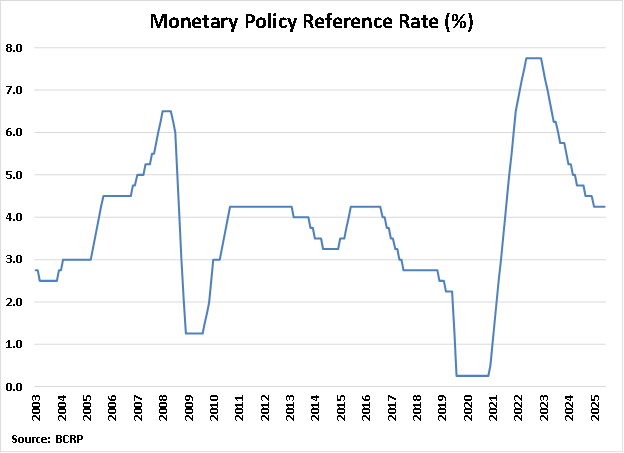
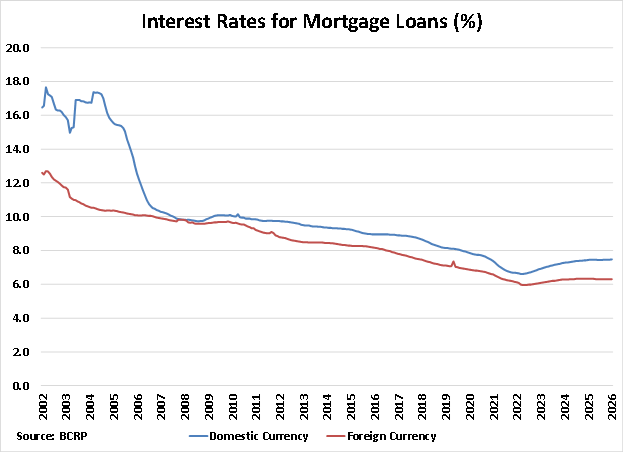
Notwithstanding the central bank’s sustained monetary easing over the past two years, mortgage interest rates continue to rise.
- For Peruvian New Sol (PEN)-denominated mortgage loans, the average interest rate stood at 7.47% in January 2026, slightly up from 7.43% in the previous year and from7.27% two years ago.
- For foreign currency-denominated mortgage loans, the average interest rate was 6.29% in January 2026, at par with the 6.32% in the same period last year and 6.28% two years earlier.
Mortgage loan rates significantly fell from the second half of 2017 to the first half of 2018. The average rate for mortgages denominated in PEN dropped by more than one percentage point from 8.53% in June 2017 to 7.30% a year later, according to the Superintendency of Banking and Insurance (SBS). Much of the decline was attributed to the strong competition in the mortgage market, according to the Ministry of Housing, Construction, and Sanitation (MVCS) Deputy Minister of Housing Jorge Arévalo. Mortgage rates generally trended downward in the succeeding years. However, beginning in 2022, borrowing costs started to rise gradually and have remained elevated in recent months.
Mortgage market still underdeveloped
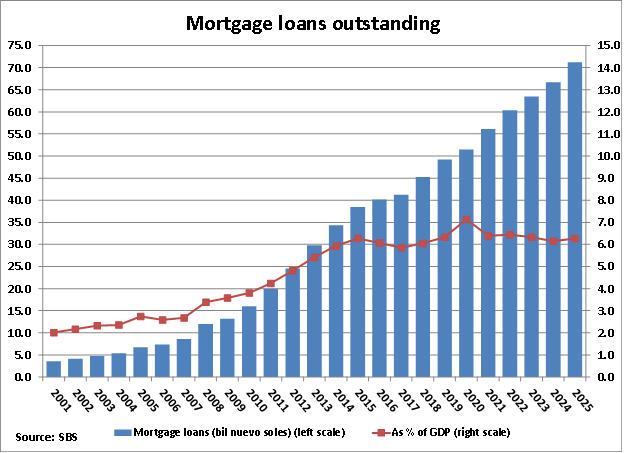
Peru’s mortgage market is still relatively small, at around 6.3% of GDP in 2025. This is despite the continued growth in mortgage loans.
In December 2025, the value of outstanding mortgage loans rose by 6.7% from a year earlier, to reach PEN 71.17 billion (US$21.22 billion), according to figures published by the Superintendency of Banking and Insurance (SBS). This followed annual growth of 5.1% in 2024, 5.2% in 2023, 7.6% in 2022, 8.9% in 2021, 4.6% in 2020, 8.8% in 2019, and 9.7% in 2018.
Homebuyers are shifting to PEN-denominated mortgage loans. In December 2025:
- PEN-denominated mortgage loans increased by 8.5% y-o-y to PEN 67.15 billion (US$20.02 billion), up from an annual growth of 5.9% in the prior year.
- Foreign currency-denominated mortgage loans were down sharply by 16.1% y-o-y to PEN 4.03 billion (US$1.2 billion), following an annual decline of 4.4% in 2024.
The total number of mortgage loans also increased modestly by 4.9% to 279,330 loans in December 2025 from 266,326 loans in the same period in the prior year.
Economic and Social Factors
Economic conditions improving, inflation manageable
Peru’s economy expanded moderately in 2025, with the International Monetary Fund (IMF) reporting a real GDP growth of around 2.9%, while the Ministry of Economy and Finance (MEF) suggested growth could have reached 3.5%. This followed a period of uneven expansion in recent years, as the country recovered from the pandemic-induced slowdown and navigated challenges such as fluctuating commodity prices and external economic shocks.
Last year’s growth was supported by a strong mining sector, especially copper production, as well as private investment, domestic consumption, and contributions from services, manufacturing, and construction. Government initiatives to boost infrastructure and improve the investment climate further stimulated economic activity, helping Peru maintain steady expansion despite slower growth than during the early 2010s boom years.
The IMF forecasts that Peru’s economy will continue its steady expansion, growing by 2.9% in 2026 and 2.7% in 2027. The BCRP is slightly more optimistic, recently revising its 2026 growth projection upward from 2.9% to 3%.
“The growth forecast for 2026 has also been revised upward compared to the previous report, from 2.9 to 3.0 percent,” said the central bank in its December 2025 Inflation Report. “This revision is mainly due to the updated forecast for private spending, whose dynamism would drive activity in the construction, trade, and services sectors. Likewise, a recovery is expected in the hydrocarbons and fishing sectors, the latter favored by a lower basis of comparison in 2025 and normal weather conditions.”
Peru experienced an uninterrupted economic growth from 1999 to 2019, expanding by an average of 4.6% annually. However, the Covid-19 pandemic dragged the economy into a deep recession, with the country registering a huge contraction of nearly 11% in 2020 - its worst showing since 1989.
The economy rebounded strongly in 2021, posting a remarkable 13.4% growth, before moderating to 2.7% in 2022. In 2023, Peru slipped back into recession with a slight 0.4% contraction, but returned to growth in 2024, achieving a 3.3% expansion. Since then, the country’s economy has been growing steadily, albeit at a more modest pace.
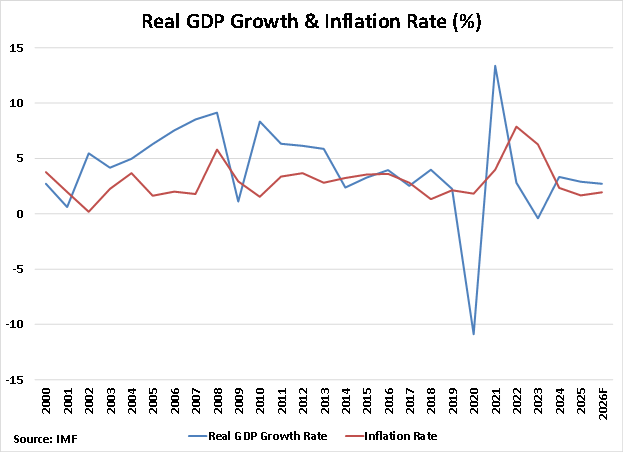
Inflation remains well within manageable levels. In January 2026, the overall inflation rate in Lima was 1.7%, slightly up from 1.51% in the previous month but lower than the prior year’s 1.85%. It also remains within the central bank’s target rate of 1% to 3%.
Inflation averaged just 2.9% from 2011 to 2021 before accelerating to 7.9% in 2022. Inflation remained high at an average of 6.3% in 2023 before gradually falling to 2.4% in 2024 and to 1.7% in 2025.
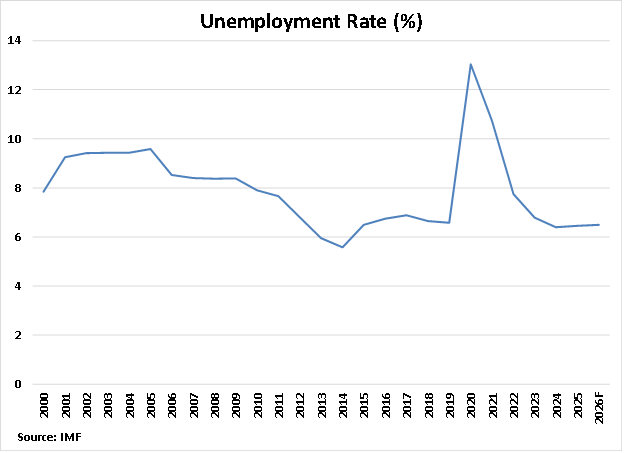
The labor market remains stable. The nationwide unemployment rate stood at 6.3% in January 2026, up from 5.9% in the previous month and slightly higher than the 6.2% recorded in the same period last year.
Unemployment averaged 6.9% in 2010-2019, before surging to 13% in 2020 due to the Covid-19 pandemic. The jobless rate fell to 10.7% in 2021, to 7.8% in 2022, and further to 6.8% in 2023, according to the IMF. The unemployment rate eased to an annual average of 6.4% in the past two years, signaling a gradual improvement in labor market conditions.
Peru’s political crisis deepens
Peru’s prolonged political turmoil, which flared in late 2022, has continued unabated through 2025 and into early 2026.
The crisis began after leftist leader Pedro Castillo was arrested and removed from office in December 2022 for attempting to dissolve Congress and rule by decree, a move critics called an unconstitutional power grab. His ouster ended a turbulent 17-month presidency marked by frequent cabinet reshuffles and multiple investigations.
Vice President Dina Boluarte succeeded Castillo as Peru’s first female president, but faced widespread nationwide protests demanding early elections, the dissolution of Congress, and constitutional reform. Boluarte called for a political truce after months of political unrest and protests, which saw dozens of people killed.
However, political tensions persist. Boluarte’s administration has faced widespread anti-government demonstrations since she was sworn in. Castillo’s supporters initially took to the streets to protest Boluarte’s removal, but the demonstrations have since grown, driven by public discontent with the government as a whole. Protesters, who have blocked highways and shuttered airports and rail stations, have also called for the dissolution of Congress and the drafting of a new constitution.
Boluarte, on the other hand, has been criticized for the government’s harsh crackdown on demonstrations, with at least 49 people killed from December 2022 to February 2023 in clashes between protesters and security forces. After an eleven-month investigation, the Attorney-General filed a constitutional complaint against Boluarte for the said deaths. Then, in June 2024, two human rights groups filed a complaint with the International Criminal Court (ICC), accusing Boluarte and her government of crimes against humanity linked to the deaths of the protesters.
In early 2024, Boluarte became embroiled in the so-called “Rolexgate” scandal, following allegations that she possessed a collection of Rolex watches and luxury jewelry, sparking a corruption investigation and placing her at the center of yet another controversy. In March 2024, Boluarte’s home was raided as part of the ongoing corruption investigation. The inquiry began following a report by the local news outlet La Encerrona, which revealed that she had worn several Rolex watches during official events.
Boluarte was removed from office in October 2025 after Congress voted to impeach her, marking another dramatic turn in Peru’s prolonged political crisis. Her ouster paved the way for then-Congress head José Jerí to assume the presidency, but his tenure proved equally short-lived.
On February 17, 2026, Peru’s Congress voted overwhelmingly (75–24) to impeach and remove Jerí from office amid a corruption probe linked to undisclosed meetings with Chinese businessmen and alleged misconduct, a move that deepened the nation’s institutional crisis just months before the April 2026 general election.
In the wake of Jerí’s ouster, lawmakers elected José María Balcázar as interim president on February 19, 2026, making him the eighth Peruvian leader in less than a decade - a stark indication of the country’s chronic political volatility. Balcázar’s government faces the immediate task of overseeing elections scheduled for April 12, 2026, and managing public demands for stability and democratic integrity amid persistent polarization and governance challenges.
Sources:
- Índice de precios de inmuebles - Índice de precios hedónicos de inmuebles (Banco Central de Reserva del Perú): https://estadisticas.bcrp.gob.pe/
- Residential Real Estate Transactions - Peru (Statista): https://www.statista.com/
- House Hunting in Peru: A Modern Mountain Perch Above Lima (The New York Times): https://www.nytimes.com/2022/04/20/realestate/peru-house-hunting.html
- Gross rental yields in Peru: Lima and Arequipa (Global Property Guide): https://www.globalpropertyguide.com/
- Monetary Policy Statement January 2026 BCRP maintained the reference rate at 4.25% (Banco Central de Reserva Del Perú): https://www.bcrp.gob.pe/
- Monetary Policy Statement February 2026 BCRP maintained the reference rate at 4.25% (Banco Central de Reserva Del Perú): https://www.bcrp.gob.pe/
- MN Mortgage (Instituto Nacional de Estadística e Informática):https://estadisticas.bcrp.gob.pe/
- ME Mortgage (Instituto Nacional de Estadística e Informática):https://estadisticas.bcrp.gob.pe/
- MVCS: tasas de interés podrían bajar para créditos hipotecarios (El Comercio): https://elcomercio.pe/
- Sistema Financiero (Superintendencia de Banca, Seguros y AFP): http://www.sbs.gob.pe/
- Outlook of the real estate market (Scotiabank): https://cdn.aglty.io/
- Déficit habitacional de Lima llega a 612.464 viviendas (El Comercio): https://elcomercio.pe/
- Solving Peru’s affordable housing market gap through innovation (Habitat for Humanity): https://www.habitat.org/
- Fondo Mivivienda S.A. - Update (Fitch Ratings): https://www.fitchratings.com/
- Housing and basic needs: the core of social backwardness (La Republica): https://larepublica.pe/
- Mivivienda offers bonuses of up to S/ 27,400 so that more Peruvians can buy their own home (Infobae): https://www.infobae.com/
- Mivivienda Credit: The Ministry of Housing increases the Good Payer Bonus to S/ 27,400 (The Peruvian State): https://www.gob.pe/
- Programa Techo Propio (The Peruvian State): https://www.gob.pe/
- Peruvians who apply to access the Techo Propio housing bonds in 2025 must earn this amount at most per month (La Republica): https://larepublica.pe/
- Peru (International Monetary Fund): https://www.imf.org/
- Peru country profile (BBC News): https://www.bbc.com/
- Peru is experiencing an “economic miracle amidst political chaos (Neofeed): https://neofeed.com.br/
- Growth in the Peruvian economy will consolidate between 2026 and 2029 with average rates above 3% (The Peruvian State): https://www.gob.pe/
- Inflation Report December 2025 Recent trends and macroeconomic forecasts 2025-2027 (Banco Central de Reserva Del Perú): https://www.bcrp.gob.pe/
- Peru Inflation Rate (Trading Economics): https://tradingeconomics.com/
- Peru’s Congress votes to impeach President Jose Jeri in government shake-up (Al Jazeera): https://www.aljazeera.com/
- Peru heads to April election under legally embattled interim president (Intellinews): https://www.intellinews.com/
- Peru Congress removes interim president over corruption allegations (Jurist News): https://www.jurist.org/
- New Peruvian president sworn in, predecessor Castillo arrested (CNBC): https://www.cnbc.com/
- Peru's president removed from office and charged with ‘rebellion’ after alleged coup attempt (The Guardian): https://www.theguardian.com/
- Human rights groups accuse Peru’s president of crimes against humanity in submission to ICC (CNN): https://edition.cnn.com/
- Peru president Dina Boluarte under pressure amid ‘Rolexgate’ scandal (The Guardian): https://www.theguardian.com/
- Peru President Dina Boluarte’s home raided in luxury watch investigation (Al Jazeera): https://www.aljazeera.com/
- Peru’s Congress votes to remove President Boluarte as crime grips nation (Al Jazeera): https://www.aljazeera.com/
- Peru names eighth president in a decade after incumbent’s ouster (BBC): https://www.bbc.com/