Finland's Residential Property Market Analysis 2026
Despite the historically subdued supply cycle and gradually improving buyer activity, pricing in the Finnish housing market remains constrained by excess inventory already listed, with only modest nominal growth expected in the near term.
This extended overview from Global Property Guide covers key aspects of Finland's housing market and takes a closer look at its most recent developments and long-term trends.
Table of Contents
- Property Prices and Price Index
- Historic Perspective
- Property Demand Trends
- Property Supply Trends
- Rental Market: Rents and Rental Yields
- Mortgage Market and Interest Rates
- Economic and Social Factors
Property Prices and Price Index
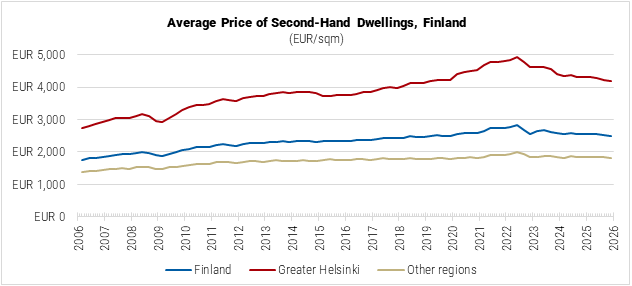
Despite an uptick in buyer activity and still subdued new supply, Finland’s home prices remained soft through 2025, as the market continued to work through elevated listings and buyers retained strong negotiating leverage. According to Statistics Finland, the average sales price for second-hand dwellings in Q4 2025 stood at EUR 2,487 (USD 2,893) per square meter, reflecting a year-on-year decline of 2.85%. Meanwhile, new dwellings recorded an average sales price of EUR 5,093 (USD 5,925) per square meter, marking a 2.81% annual increase.
Finland's house price annual change:
Although the new development activity is still weak, the secondary market has faced an unusually large pool of homes for sale, extending selling times and widening negotiation margins as transactions recover. Nordea summarizes the dynamic as: “Abundant supply keeps sales times long and prices falling.” S-Bank makes a similar point on the lag between volumes and pricing: “Despite the pick-up in transactions, the price upturn is still taking its time,” and notes that abundant for-sale supply is unlikely to clear quickly, keeping price development muted in the near term.
Macroeconomic “brakes” also help explain why improving activity has not yet translated into clear pricing power. The Bank of Finland (BOF) analysis points to a slow recovery backdrop where “confidence <…> is weak and unemployment still rising,” which restrains households’ willingness to pay up even as interest rates have eased from their peak. Danske Bank likewise links the near-term price response to cautious sentiment, describing a “two-sided” market where activity improves but pricing remains constrained, while also noting that excess inventory has weighed on prices, particularly in growth centers.
Regional dispersion remained pronounced. Greater Helsinki continued to command a clear premium over other regions, but it also showed sharper sensitivity to the sheer volume of listings: S-Bank notes that the number of homes for sale in the capital region has been high, which has contributed to a slower and more uneven price turn. By unit type, year-on-year changes were generally negative for second-hand homes across the country, while new apartments were comparatively resilient, partly reflecting the smaller, developer-reported sample for new-build transactions and the greater mix sensitivity of new-dwelling averages in Finland’s official series.
Housing price dynamics by region and property type:
| Greater Helsinki | Other Regions | Finland Total | ||||
| Average price per sqm, Q4 2025 |
YoY, % | Average price per sqm, Q4 2025 |
YoY, % | Average price per sqm, Q4 2025 |
YoY, % | |
| Second-hand dwellings | ||||||
| Terraced Houses | EUR 3,497 (USD 4,068) |
-1.69% | EUR 1,699 (USD 1,977) |
-1.34% | EUR 2,061 (USD 2,398) |
-1.67% |
| Block of flats | EUR 4,434 (USD 5,159) |
-3.21% | EUR 1,882 (USD 2,190) |
-2.94% | EUR 2,729 (USD 3,175) |
-3.36% |
| New dwellings | ||||||
| Terraced Houses | EUR 5,382 (USD 6,261) |
- | EUR 3,423 (USD 3,982) |
2.55% | EUR 4,055 (USD 4,718) |
16.69% |
| Block of flats | EUR 6,514 (USD 7,578) |
-0.84% | EUR 4,743 (USD 5,518) |
4.93% | EUR 5,560 (USD 6,469) |
2.53% |
| Note: Year-on-year change in prices for terraced houses in the Greater Helsinki region is not available due to a small number of transactions recorded in Q4 2024. Exchange rate as of Q4 2025, USD 1 = EUR 0.8595. | ||||||
| Data Source: Statistics Finland. | ||||||
Looking ahead, most bank forecasters expect Finland’s housing prices to shift from decline toward low single-digit nominal growth, but with meaningful dispersion by region and segment and a gradual recovery profile while listings remain elevated. Nordea’s latest housing-market review expects prices to turn to around +1.5% in 2026 and +2.5% in 2027, while stressing forecast uncertainty and the continued importance of local supply-demand balance. S-Bank forecasts +1.5% for 2026 and +2.5% for 2027, reiterating that the “price upturn is still taking its time” while abundant listings cap near-term upside. Danske Bank is more conservative on the first step of the recovery, projecting roughly +0.8% in 2026 and +2.5% in 2027 and emphasizing that weak confidence and labor-market uncertainty keep the near-term rebound measured.
Historic Perspective:
The Evolution of Housing Market Dynamics in Times of Boom and Bust
Since the early 2000s, Finland’s housing market has been shaped by a long period of generally rising prices, interrupted mainly by brief, cyclical pauses rather than prolonged downturns. After the post-1990s recovery, the early-2000s slowdown and the global financial crisis temporarily cooled market momentum, but the broader trend remained supported by mortgage credit availability and, increasingly, by falling borrowing costs. The post-2008 period brought tighter underwriting and higher borrower equity expectations, yet the lengthy era of very low interest rates helped keep ownership attainable and underpinned price resilience through the 2010s.
The euro-area crisis and the early phase of the pandemic primarily affected sentiment and turnover rather than fundamentally resetting the price trend, as financing conditions remained supportive. The clear inflection point came in 2022–2023, when rapid monetary tightening collided with high inflation and weaker confidence, pushing up debt-servicing costs and triggering a sharp fall in transactions and a visible price correction, most pronounced in the largest urban markets.
By 2024, conditions began to stabilise: activity stopped deteriorating, buyer interest gradually returned, and the pace of price declines eased from the earlier slump, even though the market remained cautious and selective. In 2025, the recovery became more evident in market functioning and buyer activity, but pricing power stayed limited. Households and investors remained price-sensitive after the rate shock, and abundant choice in the resale market, together with lingering uncertainty around the labour market, kept negotiations wide. Improving demand was increasingly absorbed through higher turnover and longer decision windows rather than through a swift, broad-based re-acceleration in prices.
House price dynamics (second-hand dwellings):
Data Source: Statistics Finland.
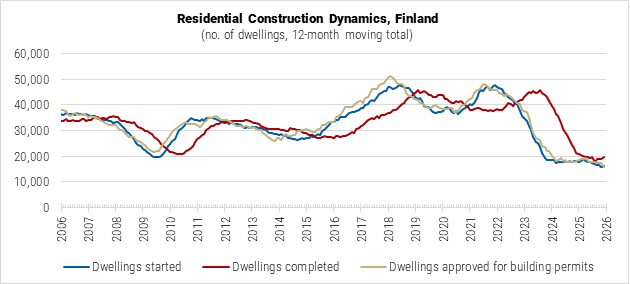
Construction activity dynamic (12-month moving total):
Data Source: Statistics Finland.
Property Demand Trends
Recovery Broadens as Liquidity Improves, Led by Resale Activity
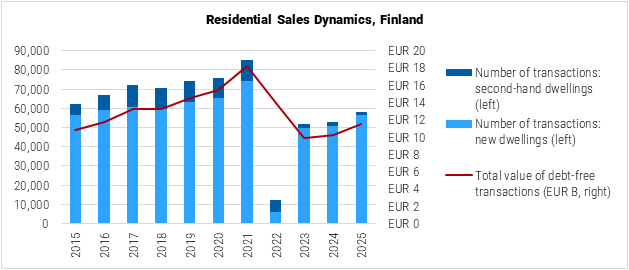
Sales activity in Finland’s housing market continued to recover in 2025, extending the gradual normalization that began after the 2022–2023 downturn. According to the Federation of Finnish Real Estate Agencies (KVKL), 58,282 residential property transactions were recorded nationwide over the year, demonstrating a 10.66% year-on-year increase. Even so, turnover remains below pre-pandemic norms, with volumes still around 19% below 2019, which is widely used as a proxy for a “normal” market before the pandemic-era shift in preferences and the subsequent 2021 peak.
Improving demand conditions have been underpinned by easing interest-rate pressure and better affordability in real terms, but the recovery has remained uneven across buyer segments. The real estate brokerage Huoneistokeskus notes that households hold “a record amount of cash, but wealth is unevenly distributed across age groups,” and links a broader strengthening in activity to improved confidence and stronger first-time buyer purchasing power.
The rebound has been overwhelmingly concentrated in the secondary market. Used homes accounted for roughly 97% of total transactions, with 56,597 deals recorded in 2025, up 11.81% year-on-year. By contrast, sales of newly built homes fell by 17.88% to 1,685 units. This divergence is consistent with a recovery phase where demand returns first to existing stock, where buyers have wider choice, greater flexibility on pricing and timing, and faster “market clearing”, while the primary market remains constrained by the feasibility and pricing of new projects, as well as more selective buyer and lender behavior at higher ticket sizes.
Data Source: KVKL.
Regionally, the upturn remained growth-center led. KVKL identified Oulu and the Helsinki Metropolitan Area as clear growth areas in 2025, while Jyväskylä was the only major city where sales volumes declined compared with 2024.
Residential sales dynamics in the largest cities:
| City | Number of Residential Transactions, 2025 |
YoY, % |
| Espoo | 3,536 | 16.35% |
| Helsinki | 7,961 | 12.95% |
| Jyväskylä | 1,666 | -5.13% |
| Kuopio | 1,563 | 1.43% |
| Lahti | 1,597 | 13.58% |
| Oulu | 3,088 | 16.66% |
| Tampere | 3,752 | 9.13% |
| Turku | 2,556 | 5.93% |
| Vantaa | 2,261 | 13.96% |
| Finland | 58,282 | 10.66% |
| Data Source: KVKL. | ||
For 2026, market experts broadly expect liquidity to improve further, with activity normalizing rather than snapping back to peak-cycle intensity. KVKL projects nationwide transaction volumes to exceed 60,000 deals (around 5,000 per month) and anticipates that selling times will begin to shorten from spring as participation broadens. At the same time, KVKL’s year-end review underlines that “improving the situation of first-time home buyers further is really important,” reflecting the view that a sustained recovery requires stronger entry-level demand to unlock wider market mobility.
Consistent with this, Huoneistokeskus, citing S-Bank’s outlook, expects brokered activity to return toward 2016–2018 levels (around 60,000 transactions annually), while noting that the pace and breadth of the upturn will depend on first-time buyers’ ability to rebuild down payments and enable onward purchasing across the market.
Property Supply Trends
Historically Weak New-Build Cycle Keeps Delivery Tight
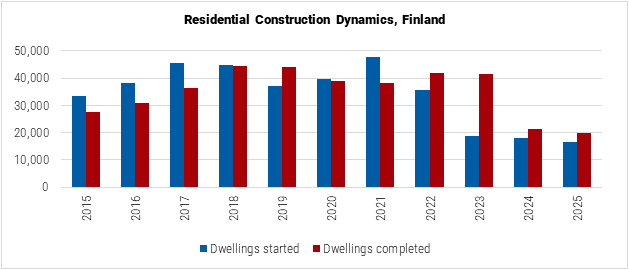
Construction-side indicators continue to point to a historically subdued supply cycle in Finland, with the delivery pipeline still constrained even as financing conditions have started to ease. Data from Statistics Finland indicates a drop in housing starts, with a 9.34% year-on-year decline to 16,370 dwellings throughout 2025. Reflecting weak starts in recent years, completions have also fallen, totaling 19,721 dwellings — a 7.49% decrease compared to the previous year.
Official commentary reinforces that the downturn remains unusually deep, particularly in the market-financed segment, and that the restart is likely to be gradual. The BOF notes that “the difficulties experienced in the housing construction sector have been of historical proportions in recent years, and the production of non-subsidized housing has plummeted to a fraction of what it was a few years ago. At present, housing construction largely rests on publicly subsidized construction.”
Data Source: Statistics Finland.
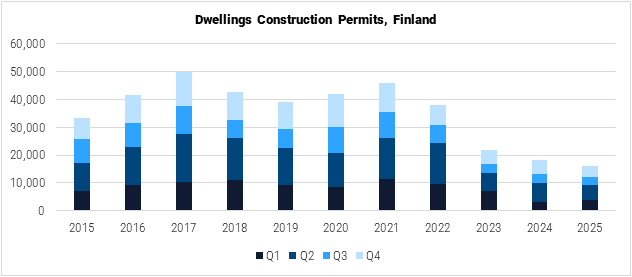
Forward-looking indicators also remain soft. The issuance of building permits, a key leading signal for future construction volumes, continued to decline, falling by 15.91% year-on-year to 15,942 units in 2025, with no clear signs of an imminent rebound. In line with this, market commentary from the association of professional property owners, real estate investors, corporate real estate managers, and construction clients Rakli stresses that residential construction has yet to return to growth momentum and that a near-term inflection is not evident: “residential construction has not returned to growth, and no turnaround is visible in the first months of 2026.”
Data Source: Statistics Finland.
Looking ahead, the BOF’s January 2026 forecast expects housing construction to “slowly start to grow in 2026,” but emphasizes that the recovery will remain subdued and far below the peaks of 2021–2022, as new-build activity is still constrained by a weak new-home market and difficulty finding buyers. The central bank further notes that “the number of unsold new homes is continuously declining” because new-build volumes were very low in 2025 and remain weak into 2026; it expects improving household incomes and stronger consumer confidence to support a more meaningful improvement in new-home sales and construction, “particularly in 2027 and 2028.”
In parallel, industry commentary highlights a medium-term risk that prolonged underbuilding could translate into tighter incremental supply once market liquidity normalizes: the professional association Construction Industry RT cites VTT research suggesting Finland would need 31,000–36,000 new homes per year to keep pace with population growth in growth centers, while 2026 is expected to be the fourth consecutive year with starts below 20,000 homes.
Rental Market: Rents and Rental Yields
Rental Inflation Continues to Ease, Non-Subsidized Rents in Decline in Key Submarkets
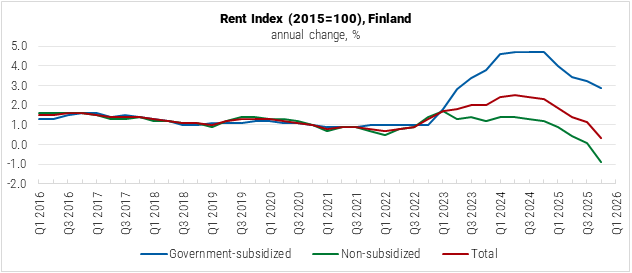
The rapid acceleration of rental inflation previously observed across Finland in 2022-2023 reversed in 2024, with the year-on-year change in the country-wide rent index reported by Statistics Finland now demonstrating a slowing trend for six consecutive quarters. In Q4 2025, it reached 0.4%, down from 1.9% in Q1 and its peak level of 2.5% in Q2 2024.
Finland's rent price index:
Despite the overall slowing trend, rental growth remained slightly more pronounced in the government-subsidized sector at 2.9% year-on-year in Q4 2025, compared to a 0.9% decline registered in the non-subsidized sector. In the Greater Helsinki region, subsidized rents grew by 3.4%, and non-subsidized rents declined by 1.3% during this period.
At the same time, recent commentary from local experts indicates that a gradual market recovery might already be underway, with rental housing occupancy rates rising for several consecutive quarters in the Helsinki metro area and other major cities.
“The oversupply in the rental market is slowly melting away,” said the fall 2025 market review from Nordea, noting that the gradual release of oversupply is being driven by continued population growth in urban centers and a significantly reduced housing production.
“The first phase of the rental housing market recovery is visible in improving occupancy rates. According to the OP’s estimate, the oversupply of rental apartments will ease in 2026–2027 as a result of migration and the halt in new construction. This would bring the market closer to the situation seen in 2019, when conditions were relatively balanced, and rent increases were easier to implement. At the moment, the biggest challenge is that rents have not yet risen in line with costs, so investors have been focusing on strengthening occupancy rates. Gradually improving occupancy will enable rent increases, but upward pressure on rents will take more time to materialize, especially in the Helsinki metropolitan area,” said Anton Takkavuori, real estate analyst at Retta Management.
Data Source: Statistics Finland.
In nominal terms, in Q4 2025, the weighted average rents per square meter reached EUR 15.51 (USD 18.04) for all dwellings, EUR 13.40 (USD 15.59) for subsidized dwellings, and EUR 16.48 (USD 19.17) for non-subsidized dwellings. The average rents for new tenancy agreements in the non-subsidized sector stood slightly higher at EUR 17.31 (USD 20.14).
Among Finland’s five largest metro areas, the highest average rents per sqm in both segments were observed in Helsinki at EUR 15.19 (USD 17.67) for subsidized dwellings and EUR 21.42 (USD 24.92) for non-subsidized dwellings, followed by Tampere at EUR 13.74 (USD 15.99) for subsidized and EUR 16.60 (USD 19.31). Notably, non-subsidized rents demonstrated a year-on-year decline in all key submarkets.
Against this background, gross rental yields for apartments in Finland averaged 5.53%, according to research by Global Property Guide conducted in November 2025, with the strongest potential performance among the monitored regional submarkets observed in Jyväskylä (7.54%), while in the capital city of Helsinki, the average yield was notably lower at 4.41%.
Weighted average rents per submarket:
| Metro area | Average rent per sqm, subsidized sector, Q4 2025 |
Annual change, Q4 2025 vs Q4 2024 |
Average rent per sqm, non-subsidized sector, Q4 2025 |
Annual change, Q4 2025 vs Q4 2024 |
| Helsinki | EUR 15.19 (USD 17.67) |
2.5% | EUR 21.42 (USD 24.92) |
-4.3% |
| Tampere | EUR 13.74 (USD 15.99) |
-0.3% | EUR 16.60 (USD 19.31) |
-2.4% |
| Turku | EUR 13.30 (USD 15.47) |
2.9% | EUR 15.97 (USD 18.58) |
-3.6% |
| Oulu | EUR 12.24 (USD 14.24) |
0.2% | EUR 14.30 (USD 16.64) |
-3.8% |
| Jyväskylä | EUR 12.99 (USD 15.11) |
0.4% | EUR 14.91 (USD 17.35) |
-3.7% |
| Data Source: Exchange rate as of Q4 2025, USD 1 = EUR 0.8595. | ||||
| Data Source: Statistics Finland. | ||||
The overall size of Finland's rental market continues to gradually expand. Over the past decade, the share of households living in rented housing increased from 31.5% in 2014 to 36.0% in 2024. Based on figures from Statistics Finland, 10.0% of households are tenants in government-subsidized dwellings and 26.0% in other types of rental properties.
Mortgage Market and Interest Rates
Stabilizing Interest Rates and Modest Recovery in Pure New Loans
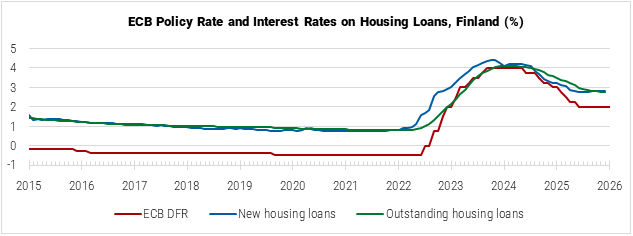
As the majority of housing loans in Finland are variable-rate, for both new and existing credit categories, interest rates have been stabilizing along with the trajectory of the monetary policy benchmarks set by the European Central Bank (ECB). The regulator’s latest easing cycle is now over after eight consecutive cuts, with key rates on hold since June 2025 (the deposit facility rate at 2.00%, the main refinancing operations rate at 2.15%, and the marginal lending facility rate at 2.40%) and no further moves announced at the February meeting of the Governing Council.
Finland's mortgage loan interest rates:
The ECB data shows that the average interest rates on loans to households for house purchase in Finland previously reached their peak in late 2023 — early 2024, when they exceeded 4%, and have declined notably since. The average interest rate was most recently reported at 2.82% for new housing loans and 2.77% for outstanding housing loans in December 2025, with further gradual decreases expected in the next several months.
“The effects of changes in monetary policy on interest expenses are yet to be fully realized,” Juho Kostiainen, Chief Analyst at Nordea, wrote in September 2025. “Barring any surprises, the average mortgage interest rate will fall further by approximately 0.5 percentage points by next April because the most common reference rate on Finnish mortgages is the 12-month Euribor, which reached its current level of about 2% in April this year.”
Data Source: ECB.
Average interest rates on loans to households for house purchase:
| Dec 2025 | YoY | Dec 2024 | YoY | Dec 2023 | |
| New housing loans | 2.82% | ↓ | 3.21% | ↓ | 4.28% |
| - Floating rate and IRF up to 1 year | 2.81% | ↓ | 3.22% | ↓ | 4.29% |
| - IRF of over 1 and up to 5 years | 3.24% | ↑ | 3.04% | ↓ | 3.67% |
| - IRF of over 5 and up to 10 years | 3.41% | ↑ | 2.73% | ↓ | 3.24% |
| - IRF of over 10 years | 3.17% | ↑ | 3.01% | ↓ | 3.53% |
| Outstanding housing loans | 2.77% | ↓ | 3.56% | ↓ | 4.08% |
| - Original maturity up to 1 year | 2.80% | ↓ | 3.66% | ↓ | 4.56% |
| - Original maturity over 1 and up to 5 years | 2.83% | ↓ | 3.67% | ↓ | 4.30% |
| - Original maturity of over 5 years | 2.77% | ↓ | 3.56% | ↓ | 4.07% |
| Data Source: ECB. | |||||
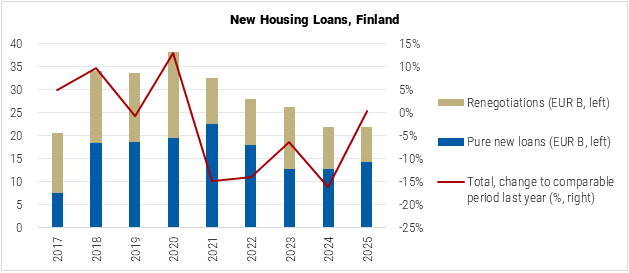
Lower borrowing costs have not yet fully translated into solid gains in lending activity in Finland. Based on the ECB data, the total value of new housing loans (including pure new loans and renegotiations) issued between January and December 2025 reached EUR 22.0 billion (USD 24.8 billion), only a 0.3% increase compared to 2024, and still far from approaching disbursement levels observed in 2018-2021.
“Wage earners’ purchasing power is still recovering, interest rates are still higher than in past years despite the drop that has occurred, and the purchasing power of households with mortgages is still 4% lower on average than in 2019,” Juho Kostiainen from Nordea commented on the dynamic. “In the current uncertain labor market, households have continued to focus on repaying their debt even though interest rates peaked [in 2024].”
However, a closer look at the newly issued credit breakdown reveals early signs of recovery, with pure new loans demonstrating an 11.1% year-on-year increase in 2025, while renegotiations dropped by 14.9% during the same period.
Data Source: ECB.
Apart from elevated borrowing costs, the overall slowdown in residential lending in Finland in recent years was tied to the cancellation of tax deductions for housing loans that came into effect in 2023. “The right to deduct interest on homeowner loans would naturally have mitigated the blow to households’ purchasing power caused by rising interest rates. In all other Nordic countries, the right to deduct interest on homeowner loans is still in use. It is hardly surprising that the housing market in all other Nordic countries began to recover more strongly during 2024 than in Finland,” Tuomas Viljamaa, CEO of the Federation of Finnish Real Estate Agencies, previously noted in an annual overview of the market.
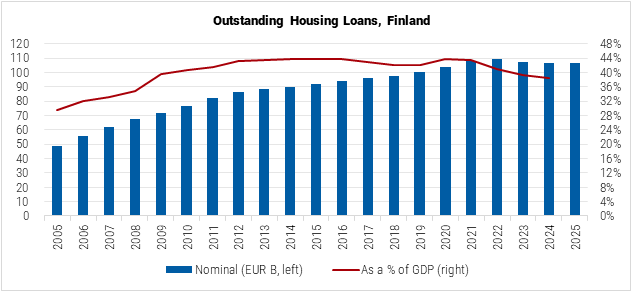
In this environment, the total value of outstanding housing loans in Finland dropped by 1.7% in 2023, a further 1.2% in 2024, and demonstrated virtually no change in 2025, standing at EUR 106.3 billion (USD 120.1 billion) at the end of the year. The relative size of the market has declined in recent years from an estimated 43.8% of GDP at current prices in 2020 to an estimated 38.5% in 2024.
Data Sources: ECB, Statistics Finland.
Economic and Social Factors
Slow Recovery from Recession and Labor Market Among the Weakest in Europe
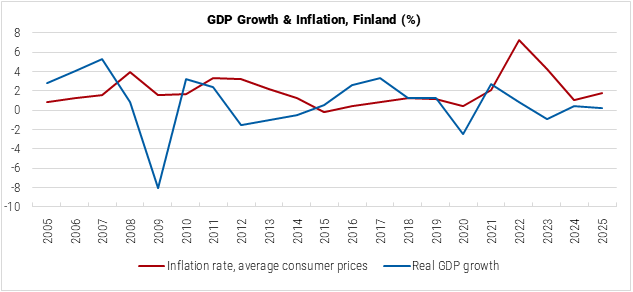
Since the 2023 downturn, Finland’s economic recovery has been slow as consumption has remained weak and construction investment has fallen. The country’s real GDP growth reached just 0.4% in 2024 and is estimated 0.2% in 2025, with the autumn economic forecast from the European Commission anticipating only modest acceleration to approximately 1% growth rate in 2026 and 2027.
“The economy is set to regain momentum in 2026 as private demand recovers, but risks are tilted to the downside, primarily from trade tensions and geoeconomic uncertainty,” noted the 2026 Article IV staff report from the International Monetary Fund (IMF).
A similar view is expressed in the latest forecast from the BOF, which points out that Finland’s economy is “emerging from a phase of extremely low growth”, but “there is no strong expansionary phase in sight in the immediate years ahead”.
Based on the IMF figures, consumer price index (CPI) inflation in Finland re-accelerated somewhat from the average annual level of 1.0% in 2024 to 1.8% in 2025, but is projected by the European Commission to remain relatively stable in the next two years, reaching 1.6% in 2026 and 2.0% in 2027.
Data Source: IMF.
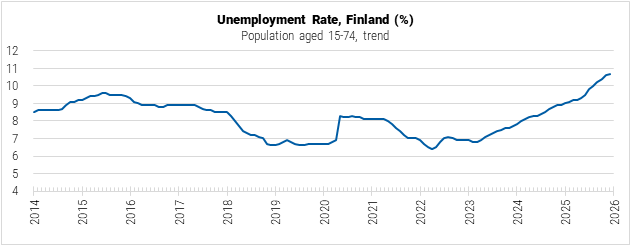
In Finland’s labor market, weaker economic activity in recent years, combined with expanding labor supply (supported by immigration and reforms that strengthened job-search incentives), led to a sharp increase in the unemployment rate, which climbed up from 6.8% in early 2023 to 10.7% most recently reported by Statistics Finland in December 2025 - among the highest levels in Europe.
However, as the economy continues to recover, the European Commission expects employment in the country to increase gradually and unemployment to decrease to 9.3% in 2026 and 9.0% in 2027.
In parallel, the significant wage increases agreed for 2025-2027 (totaling approximately 8%) set against the normalized inflation levels are expected to support growth in real disposable incomes over the next few years.
Data Source: Statistics Finland.
Despite the projected strengthening of overall economic conditions, Finland’s public finances are set to remain in deficit. The country’s general government deficit remained steady at 4.5% of GDP in 2025 and is forecast to improve only slightly in the upcoming periods, reaching 4.0% in 2026 and 3.9% in 2027. At the same time, due to persistent deficits and weak growth, Finland’s public debt relative to GDP has grown over the past decade to record highs, reaching 82.5% in 2024 and forecast to increase further to 88.1% in 2025, 90.9% in 2026, and 92.3% in 2027.
Considering these developments in Finland’s economy, Fitch Ratings downgraded the country to an ‘AA’ standing with a stable outlook earlier in 2025, pointing out high and rising government debt (with sufficient fiscal consolidation to stabilize it not anticipated over the medium term), sustained fiscal deficits, and growth underperformance in recent years among key drivers behind the rating action.
Overall, the economic outlook for Finland in the immediate years ahead remains surrounded by many uncertainties, including longstanding domestic structural challenges, unpredictability of the US administration regarding trade policy impacting Finland’s exports, and geopolitical tensions in Ukraine and the Middle East.
Sources:
- Statistics Finland
- Annual National Accounts: https://stat.fi/
- Prices and Consumption: https://stat.fi/
- Labor Force Survey: https://stat.fi/
- Building and Dwelling Production Statistics: https://stat.fi/
- Number of Household-Dwelling Units Living in Rented Dwellings Increased Slightly in 2024: https://stat.fi/
- Rents of Dwellings: https://stat.fi/
- Prices of Old Dwellings in Housing Companies in 2025 (Press Release): https://stat.fi/
- Bank of Finland (BOF)
- Household Bank Loans Almost Unchanged Year-on-Year in December 2025: https://www.suomenpankki.fi/
- Mortgage Borrowers Have Proved Resilient Against the Interest Rate Risk of Their Loans: https://www.bofbulletin.fi/
- Finland’s Labor Market Weaker Than That of the Euro Area: https://www.bofbulletin.fi/
- Finland’s Economy Heading Out of Recession: https://www.bofbulletin.fi/
- Forecast for the Finnish Economy – December 2025: https://www.bofbulletin.fi/
- Finland’s Economy Will Pick Up Gradually: https://www.bofbulletin.fi/
- European Commission
- Economic Forecast for Finland: https://economy-finance.ec.europa.eu/
- European Central Bank (ECB)
- ECB Data Portal: https://data.ecb.europa.eu/
- Key ECB Interest Rates: https://www.ecb.europa.eu/
- Monetary Policy Decisions, 5 February 2025: https://www.ecb.europa.eu/
- International Monetary Fund (IMF)
- Country Overview: Finland: https://www.imf.org/
- 2026 Article IV Staff Report: https://www.imf.org/
- Federation of Finnish Real Estate Agencies (KVKL)
- Housing Market Review 2025 (FI): https://kiinteistonvalitysala.fi/
- Annual Review 2024: Housing Transaction Volumes Pushed Into The Positive Territory, Driven By A Strong End Of The Year (FI): https://kiinteistonvalitysala.fi/
- Nordea
- Monetary Stimulus Comes With a Delay in Finland: https://www.nordea.com/
- Finland's Economic Forecast: Growth Opportunities (FI): https://www.nordea.com/
- Housing Market Review Autumn 2025 (FI): https://corporate.nordea.com/
- Finland's Economic Forecast: Growth Opportunities (FI): https://www.nordea.com/
- S-Bank
- S-Bank’s Housing Market Forecast… (FI): https://www.s-pankki.fi/
- Danske Bank
- Is Now a Good Time to Buy a Home, and What Will Housing Prices Look Like in 2026?… (FI): https://danskebank.fi/
- Forecast: Housing Prices Will Rise Moderately Next Year (FI): https://danskebank.com/
- Huoneistokeskus
- Housing Market Overview (FI): https://huoneistokeskus.fi/
- Retta Management
- Finnish Residential Rental Market Q3 2025: Strong Results as Expected: https://rettamanagement.fi/
- Fitch Ratings
- Fitch Downgrades Finland to 'AA'; Outlook Stable: https://www.fitchratings.com/
- Rakli
- The Housing Market is Showing Signs of Recovery… (FI): https://www.rakli.fi/
- The Helsinki Times
- Saarikko’s Idea to Reinstate Deduction for Mortgage Interests Rejected by Experts: https://www.helsinkitimes.fi/
- Construction Industry RT
- The Construction Industry is Rushing to Take Steps…: https://rt.fi/