Denmark's Residential Property Market Analysis 2026
Denmark’s housing market entered 2026 with strong price momentum, supported by resilient buyer demand and constrained new supply, although softer sales activity and rising interest rates may moderate growth later in the year.
This extended overview from Global Property Guide covers key aspects of the Danish housing market and takes a closer look at its most recent developments and long-term trends.
Table of Contents
- Property Prices and Price Index
- Historic Perspective
- Property Demand Trends
- Property Supply Trends
- Rental Market: Rents and Rental Yields
- Mortgage Market and Interest Rates
- Economic and Social Factors
Property Prices and Price Index
Denmark’s housing market entered 2026 with strong price momentum, supported by rising household incomes, the earlier easing in borrowing costs, and constrained housing supply. According to Statistics Denmark, the nationwide House Price Index rose by 8.32% year-on-year in Q1 2026, accelerating from 7.56% in Q4 2025.
Denmark's house price annual change:
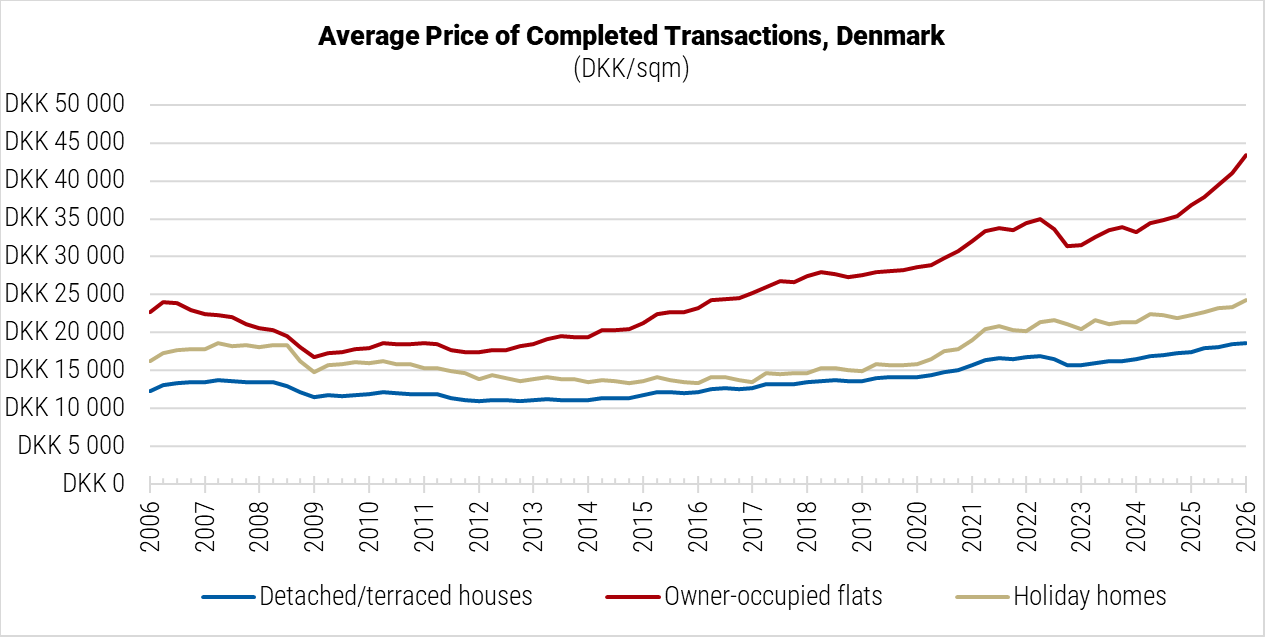
Transaction-based data from the Association of Danish Mortgage Banks (Finans Danmark), which reflects prices achieved in completed sales, confirmed growth across all residential segments. The average price of owner-occupied apartments increased by 18.14% year-on-year to DKK 43,421 (USD 6,758) per square meter in Q1 2026. Prices for detached and terraced houses increased by 6.77% to DKK 18,626 (USD 2,899) per square meter, while holiday-home prices rose by 8.79% to DKK 24,247 (USD 3,774) per square meter.
Data Source: Finans Danmark.
The Capital Region remained Denmark’s most expensive housing market, recording the highest average prices across all three property categories. The particularly strong growth in the apartment segment was largely driven by Copenhagen, where demand continues to outpace the limited availability of owner-occupied housing. Nordea notes that owner-occupied properties represent only around 22% of Copenhagen’s housing stock, leaving prices highly sensitive to population growth and sustained buyer demand.
Average per sqm price of dwellings sold by region:
| Region | Detached/terraced houses, Q1 2026 |
YoY, % | Owner-occupied flats, Q1 2026 |
YoY, % | Holiday Homes, Q1 2026 |
YoY, % |
| Capital Region | DKK 39,130 (USD 6,090) |
9.64% | DKK 60,817 (USD 9,465) |
24.26% | DKK 30,692 (USD 4,777) |
3.40% |
| Zealand | DKK 16,033 (USD 2,495) |
6.52% | DKK 24,250 (USD 3,774) |
14.61% | DKK 25,106 (USD 3,907) |
16.37% |
| Southern Denmark | DKK 12,104 (USD 1,884) |
4.01% | DKK 19,585 (USD 3,048) |
-1.25% | DKK 24,804 (USD 3,860) |
7.23% |
| Central Denmark | DKK 14,820 (USD 2,306) |
4.09% | DKK 28,105 (USD 4,374) |
4.86% | DKK 22,535 (USD 3,507) |
12.06% |
| North Jutland | DKK 10,656 (USD 1,658) |
5.06% | DKK 17,386 (USD 2,706) |
-7.40% | DKK 17,243 (USD 2,684) |
-1.22% |
| All Denmark | DKK 18,626 (USD 2,899) |
6.77% | DKK 43,421 (USD 6,758) |
18.14% | DKK 24,247 (USD 3,774) |
8.79% |
| Note: Exchange rate as of Q1 2026, 1 USD = 6.4255 DKK. | ||||||
| Data Source: Finans Danmark. | ||||||
The outlook remains positive, although growth is expected to moderate following the strong increase at the beginning of 2026. Danmarks Nationalbank forecasts nationwide house-price growth of 6.0% in 2026, slowing to 2.5% in 2027 and 3.0% in 2028. The expected moderation reflects gradually improving housing supply, slightly higher mortgage rates, and the adjustment of property taxes to earlier price increases, while continued income growth should support further appreciation. Nordea projects house-price increases of 4.0% in 2026 and 3.5% in 2027, while apartment prices are forecast to rise by 4.9% and 4.2%, respectively, reflecting the more persistent supply constraints in Denmark’s largest cities.
Historic Perspective
Housing Cycles in Line with Global Patterns
Denmark’s housing market experienced a major upswing during the early 2000s, supported by low interest rates, economic growth, and favorable credit conditions. Annual nominal price growth remained exceptionally strong in 2006, at 14.77%, before stagnating in 2007. The global financial crisis subsequently triggered a prolonged correction, with prices falling by 10.96% in 2008 and 4.93% in 2009. After a brief rebound in 2010, the market weakened again in 2011.
A more sustained recovery began in 2013, supported by low financing costs and improving economic conditions. Nominal house prices increased every year between 2013 and 2021, with growth accelerating to 9.45% in 2015. The pandemic provided another significant boost: changing housing preferences and historically low interest rates pushed price growth to 7.15% in 2020 and 11.17% in 2021.
The cycle turned again in 2022 as higher inflation and interest rates reduced affordability. Nominal growth slowed to 0.76%, while prices declined by 7.76% in inflation-adjusted terms. A modest nominal correction followed in 2023, before easing inflation and lower interest rates supported a recovery in 2024.
Price growth strengthened considerably during 2025, with the House Price Index rising by 7.56% year-on-year in Q4—the fastest end-of-year increase since 2021. In inflation-adjusted terms, prices increased by 5.40%. The recovery was supported by improving household purchasing power and constrained housing supply following the earlier downturn in residential construction.
20-year annual house price change (based on end-of-year house price index and consumer price index):
| Year | Nominal house prices (%) |
Inflation-adjusted house prices (%) |
Year | Nominal house prices (%) |
Inflation-adjusted house prices (%) |
|
| 2006 | 14.77% | 12.85% | 2016 | 4.32% | 3.90% | |
| 2007 | 0.00% | -2.13% | 2017 | 4.14% | 2.84% | |
| 2008 | -10.96% | -13.49% | 2018 | 2.88% | 2.07% | |
| 2009 | -4.93% | -6.10% | 2019 | 2.40% | 1.70% | |
| 2010 | 2.59% | 0.00% | 2020 | 7.15% | 6.67% | |
| 2011 | -5.56% | -7.94% | 2021 | 11.17% | 7.77% | |
| 2012 | 1.25% | -0.98% | 2022 | 0.76% | -7.76% | |
| 2013 | 3.70% | 3.03% | 2023 | -0.54% | -0.99% | |
| 2014 | 4.24% | 3.76% | 2024 | 3.81% | 2.07% | |
| 2015 | 9.45% | 9.08% | 2025 | 7.56% | 5.40% | |
| Data Source: Statistics Denmark. | ||||||
Property Demand Trends
Sales Activity Moderates Amid Regional Divergence
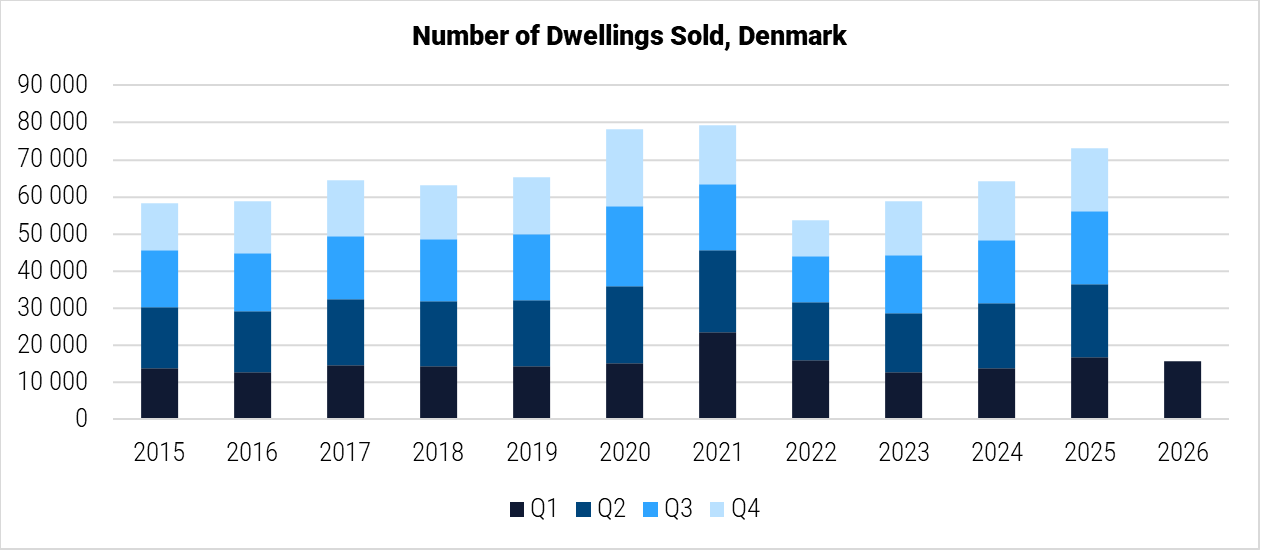
After three consecutive years of growth, residential sales activity in Denmark started to moderate in early 2026. According to Finans Danmark, 15,763 residential properties were sold during Q1 2026, down 5.9% from the corresponding period of 2025. The contraction was most pronounced in the owner-occupied apartment segment, where sales fell by 11.5% year-on-year, while transactions involving detached and terraced houses declined by 5.6%. Holiday homes were the only major segment to record growth, with sales rising by 5.7% year-on-year.
At the regional level, the Capital Region experienced the sharpest reduction in activity, including double-digit declines in both apartment and house sales. By contrast, overall transaction volumes in Central Denmark and North Denmark remained broadly stable.
Data Source: Finans Danmark.
Number of dwellings sold by region:
| Region | Detached/ terraced houses, Q1 2026 |
YoY, % | Owner-occupied flats, Q1 2026 |
YoY, % | Holiday homes, Q1 2026 |
YoY, % |
| Capital Region | 2,148 | -11.46% | 2,119 | -17.68% | 286 | 0.35% |
| Zealand | 1,938 | -9.01% | 289 | -1.37% | 480 | 9.84% |
| Southern Denmark | 2,528 | -5.42% | 328 | 11.19% | 272 | 4.21% |
| Central Denmark | 2,643 | 1.50% | 598 | -6.42% | 407 | 2.26% |
| North Jutland | 1208 | -2.58% | 225 | -0.44% | 295 | 10.90% |
| Data Source: Finans Danmark. | ||||||
Despite the year-on-year decline, demand remained relatively resilient, with Boligsiden describing the slowdown as a moderation from the particularly active market of 2025 rather than a broad deterioration. According to Birgit Daetz, Communications Director and Housing Economist at Boligsiden, activity had “slowed somewhat around Copenhagen,” while sales were still moving “at full speed in Aarhus and the surrounding areas.”
Within the Capital Region, elevated prices appear to be encouraging some apartment buyers to consider more affordable districts and neighbouring municipalities. Boligsiden observed stronger activity in several areas adjoining Copenhagen and linked this pattern to buyers increasingly seeking lower-priced alternatives within commuting distance of the capital.
Looking ahead, sales activity is expected to remain relatively firm during the remainder of 2026, although annual transaction volumes may stay below the robust levels recorded in 2025. Elevated prices are likely to continue constraining activity in Copenhagen and redirecting some demand towards neighbouring municipalities, while the market should remain firmer in Aarhus and other regional urban centres. The holiday-home segment is also seen to stay comparatively resilient.
Property Supply Trends
Improving Permits Yet Weak Housing Delivery
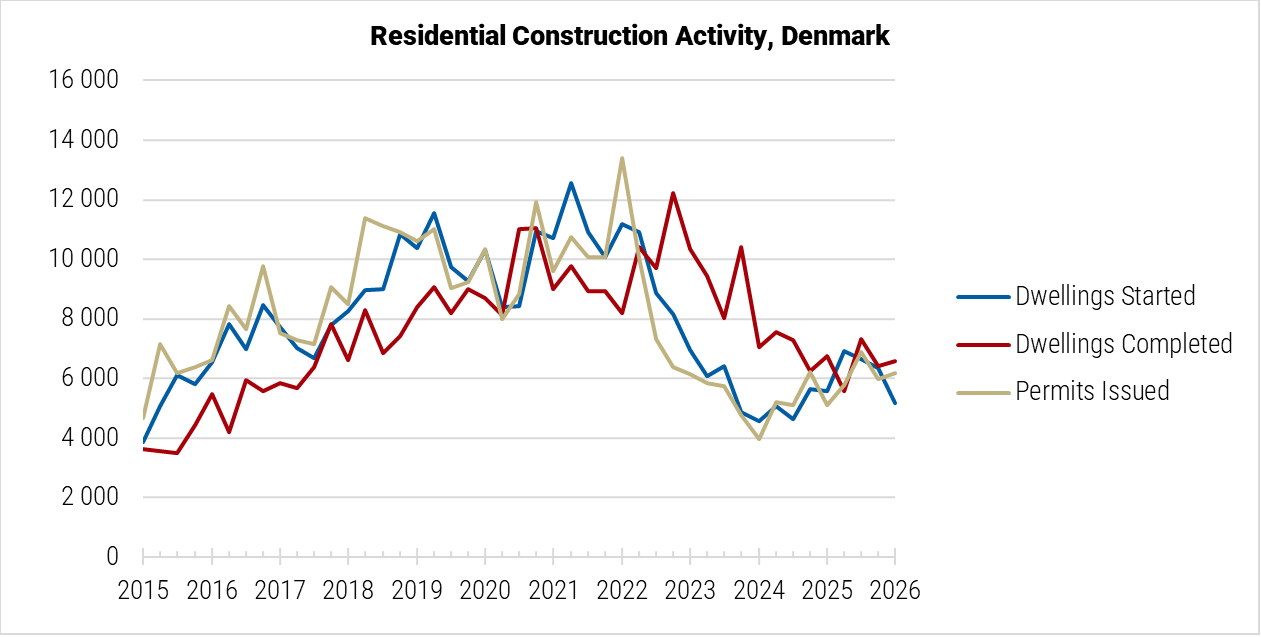
Denmark’s residential construction sector remained subdued in 2025, although forward-looking indicators improved from their earlier lows. According to Statistics Denmark’s estimated and seasonally adjusted figures, 26,038 dwellings were completed during the year, down 7.5% from 28,150 in 2024. By contrast, housing starts rose by 28.1% to 25,492 units, while the number of permitted dwellings increased by 15.8% to 23,727. The improvement followed several years of weak development activity after higher interest rates and construction costs significantly reduced the viability of new projects.
The recovery remained uneven at the beginning of 2026. A total of 6,594 dwellings were completed in Q1, down 2.1% from the same period a year earlier. Housing starts declined by 7.2% year-on-year to 5,173 units, whereas permits increased by 21.4% to 6,192 units, suggesting that developers remain cautious about moving projects from planning into construction despite the improvement in permissions.
Note: Figures are estimated to account for delayed registrations and are seasonally adjusted. Recent observations remain subject to revision.
Data Source: Statistics Denmark.
According to Morten Granzau, deputy director at Dansk Industri, rising material prices, higher financing costs, and geopolitical uncertainty continue to weigh on new development. He noted that new residential construction is expected to lose momentum in the coming years, with activity increasingly shifting towards renovation.
The constrained supply outlook remains particularly relevant in Copenhagen, where housing delivery is struggling to keep pace with projected household growth. EjendomDanmark estimates that the city will require around 75,000 additional dwellings by 2060, against an expected population increase of approximately 110,000. Around 35,000 of these homes will be required for single-person households, highlighting the growing need for smaller dwellings. Peter Stenholm, CEO of EjendomDanmark, warned that sufficient housing must be delivered to avoid an outright shortage, while arguing that existing planning rules make it difficult to build the smaller units increasingly demanded by the city’s changing household structure.
The near-term outlook is therefore mixed. Higher permit numbers and the rebound in starts during 2025 point to some improvement in the development pipeline, supported by stronger housing demand and rising prices. However, the renewed fall in starts in Q1 2026 suggests that the recovery will remain gradual and vulnerable to construction and financing costs. New supply is consequently unlikely to increase rapidly enough to ease pressure in the country’s strongest urban markets over the short term.
Rental Market: Rents and Rental Yields
Market Rents to Keep Growing in Largest Cities
Highlighting the relevance of the rental segment in the Danish housing market, the share of tenants in the country’s population reached 41.6% in 2025, up from 37.3% a decade ago and 33.4% two decades ago. An analysis by Finans Danmark outlines the financial considerations behind this trend, revealing that in many municipalities the cost of living in an average owner-occupied home exceeds that of renting a comparable property. “The development in housing prices and interest rates on mortgages in recent years has meant that the number of municipalities where it is cheapest to own a home has decreased,” explained Ane Arnth Jensen, Deputy Managing Director of Finans Danmark. “In larger cities and many areas of Zealand, renting is typically more affordable than owning a home.”
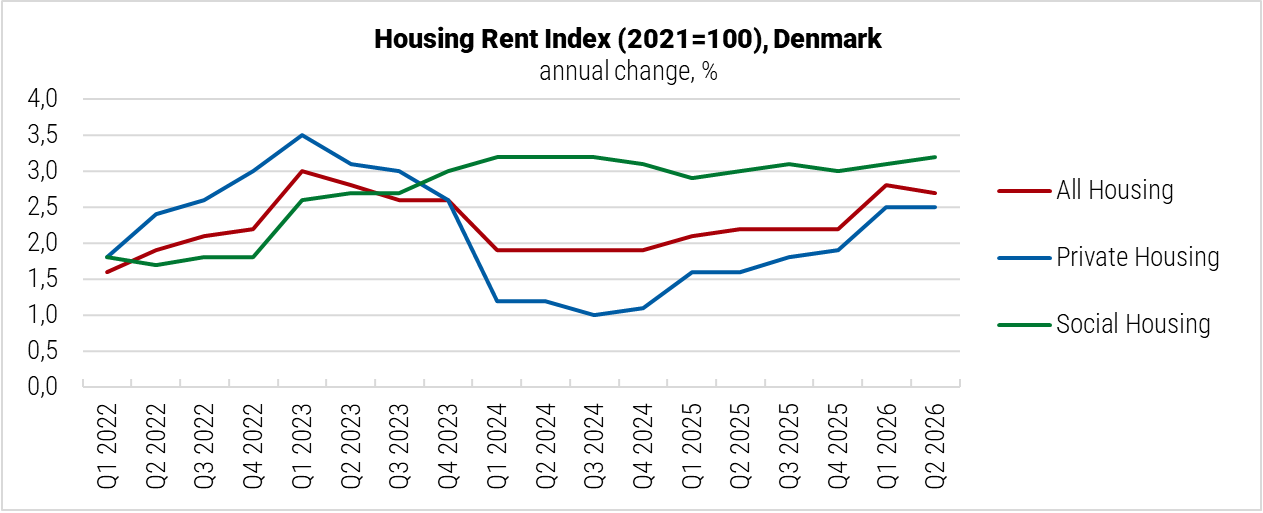
Denmark's rent price index:
This highly relevant market segment is strictly regulated under Danish law, which has helped contain growth in the Housing Rent Index even during periods of general inflation spikes. In Q2 2026, for all housing types combined, Statistics Denmark reported a 2.7% increase in rents compared to the same period in 2025, with social housing demonstrating somewhat more pronounced growth (3.2%) than private housing (2.5%).
At the same time, advertised rents for newly listed properties are typically more dynamic, especially in major urban centers (where the gap between the housing burden for tenants and owners is most pronounced and where rents are still considered affordable due to high real wage growth). According to Cushman & Wakefield | RED, in 2025, offering rates for residential leases increased by 10% in Copenhagen, 7% in Aarhus, and 4% in other parts of the country.
“Residential rental properties have been characterized by a high tenant demand for several years, which was also reflected in rising rent levels and decreasing vacancy rates across the country in the past year,” said the advisory’s Danish investment atlas. “For 2026, we expect demand to remain high, particularly in the country’s largest cities.”
Data Source: Statistics Denmark.
In nominal terms, Cushman & Wakefield | RED data shows average offering rates for residential leases in 2025 ranging from DKK 1,136 (USD 172) per square meter per year in Jutland (outside of Aarhus) & Funen to DKK 2,247 (USD 339) per square meter per year in Copenhagen, which remained the most expensive rental submarket.
In this environment, research by Global Property Guide in June 2026 found gross rental yields for residential properties in Denmark at a 4.11% average, slightly down from 4.26% reported a year ago in June 2025. Among the monitored submarkets, the highest yields were estimated in Aalborg (5.16%), followed by Aarhus (4.31%), while Copenhagen (2.87%) traditionally showed lower results.
Offering rate for residential leases by submarket:
| Offering rent, DKK/sqm/year, 2025 |
Offering rent, USD/sqm/year, 2025 |
YoY, % | |
| Copenhagen | DKK 2,247 | USD 339 | 10% |
| Greater Copenhagen | DKK 1,880 | USD 284 | 4% |
| Other Zealand | DKK 1,560 | USD 236 | 4% |
| Aarhus | DKK 1,642 | USD 248 | 7% |
| Other Jutland & Funen | DKK 1,136 | USD 172 | 4% |
| Note: Exchange rate as of 2025, USD 1 = DKK 6.62018. | |||
| Data Source: Cushman & Wakefield | RED. | |||
Looking ahead, due to continued undersupply of rental housing and limited development opportunities in the high-demand capital region, market rents in Copenhagen are expected to keep growing; however, the experts warn that the pace of growth is likely to moderate, as “there is a natural limit to how much of their income tenants can and will pay in rent”.
At the same time, Denmark’s second-largest city of Aarhus, which previously went through a period of oversupply and relatively high vacancy levels constraining rental rates, has now returned to growth, as high construction costs put the brake on new development and continued demographic shift towards larger cities contributed to a “better balance between supply and demand”.
In contrast to Copenhagen and Aarhus, the majority of investors recently surveyed by Cushman & Wakefield | RED expect rent to remain stable in the provinces throughout 2026.
Mortgage Market and Interest Rates
Higher Interest Rates and Slower Growth in New Lending
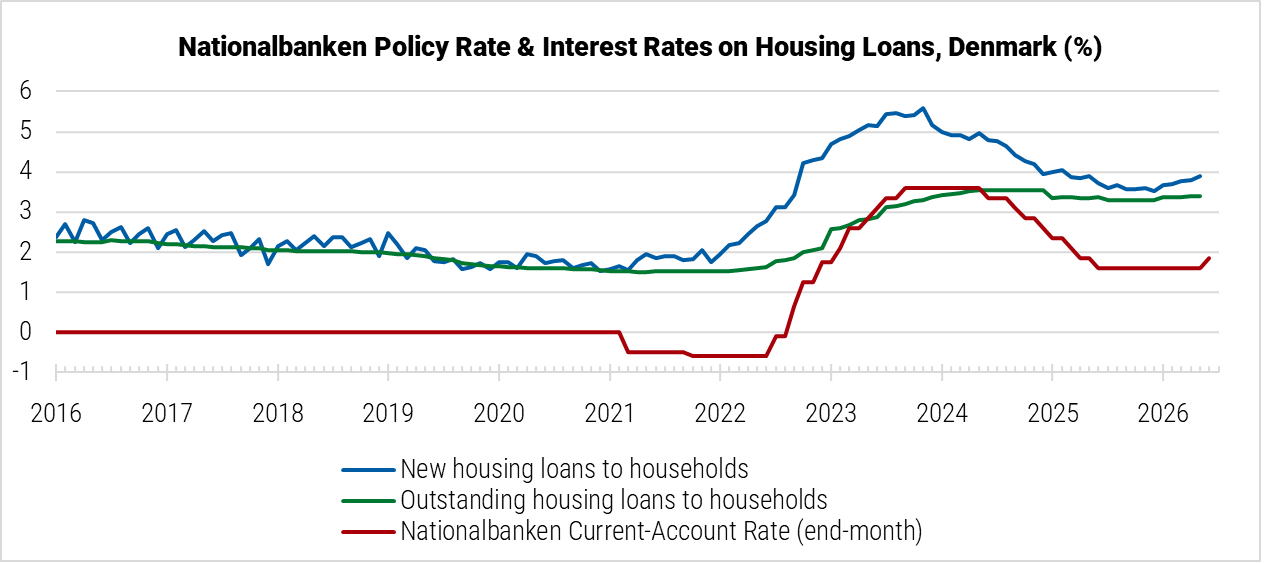
In June 2026, in line with the European Central Bank’s (ECB) decision, Denmark’s Nationalbanken announced a first hike in its key interest rates in three years, raising current-account, certificates of deposit, and discount rates from 1.60% to 1.85%, and lending rate from 1.75% to 2.00%.
Denmark's mortgage loan interest rates:
Based on global and domestic developments, experts from Nordea, one of the country’s leading financial services providers, now expect the Danish regulator to follow the ECB's footsteps and raise the policy rates three more times this year by a total of 75 bps. According to Nordea, the current interest rate spread to the ECB is likely to be maintained; however, a continued weak Danish krone environment also creates a risk of an independent interest rate hike from Nationalbanken.
Data Source: Nationalbanken.
Anticipated monetary policy tightening, higher inflation expectations, and uncertainty surrounding global geopolitical developments have pushed long-term bond yields higher, leading to higher rates on new mortgages in Denmark.
In May 2026, the average interest rate on new loans to households for house purchase from the country’s monetary financial institutions reached 3.88%, up from the recent low of 3.52% in December 2025. Specialized lenders (mortgage banks), which provide credit under the Danish mortgage model, offered slightly higher average rates (3.96%) compared to commercial banks issuing traditional loans for house purchase (3.64%).
For outstanding loans, the indicator reached 3.47% for the MFI sector as a whole, 3.40% for mortgage banks, and 3.92% for commercial banks during the same period.
Interest rates on mortgage loans to households (mortgage banks):
| May 2026 | YoY | May 2025 | YoY | May 2024 | |
| New loans | 3.96% | ↑ | 3.89% | ↓ | 4.83% |
| - IRF up to 1 year | 3.14% | ↓ | 3.45% | ↓ | 4.88% |
| - IRF of over 1 and up to 5 years | 3.73% | ↑ | 3.26% | ↓ | 4.21% |
| - IRF of over 5 and up to 10 years | 3.79% | ↑ | 3.63% | ↓ | 4.04% |
| - IRF of over 10 years | 4.70% | ↓ | 4.81% | ↓ | 5.07% |
| Outstanding loans | 3.40% | ↑ | 3.35% | ↓ | 3.53% |
| Data Source: Nationalbanken. | |||||
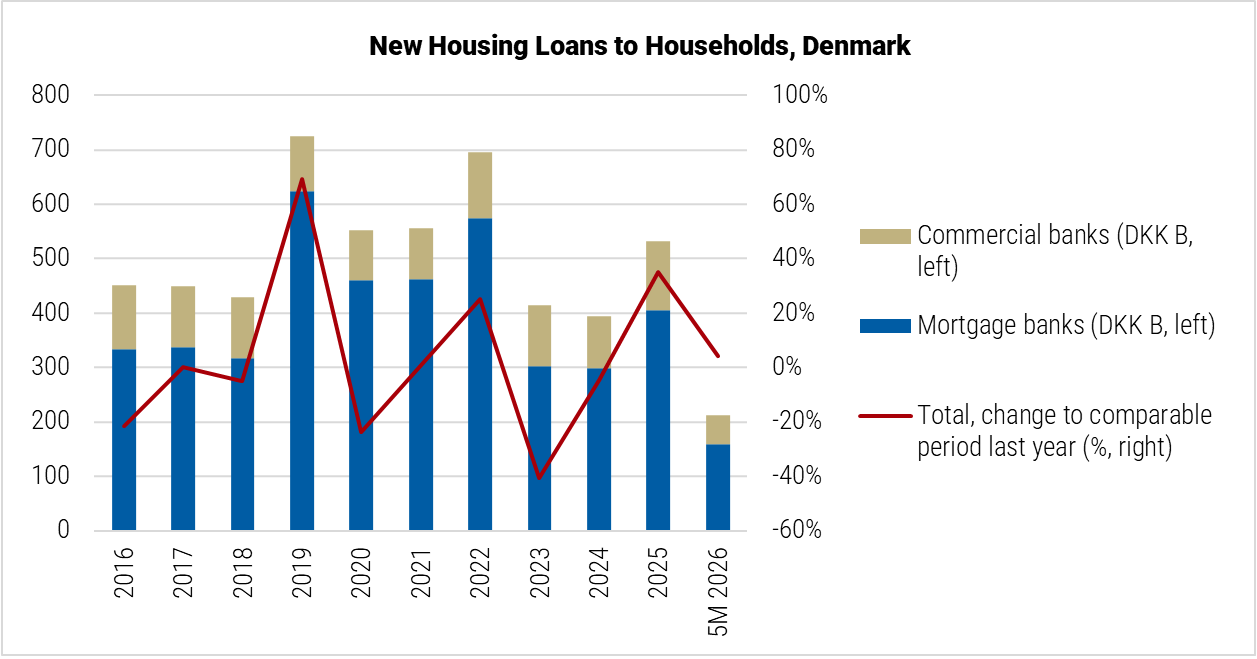
With interest rates trending upward again, the recovery in lending activity has also slowed in early 2026 after a notable rebound observed last year. Following two years of subdued performance, the combined value of new mortgages from specialized lenders and loans for house purchase from commercial banks issued to households in Denmark increased 34.9% year-on-year in 2025, with strong growth recorded in both segments. In the first five months of 2026, however, Nationalbanken reported DKK 211.9 billion (USD 33.1 billion) of new business in the combined MFI sector, which was only 4.2% above the comparable period in 2025. Of this amount, loans from mortgage banks comprised 75%, with the remaining 25% made up by loans from commercial banks.
“In most places in the country, more loan offers have been made for home purchases than a year ago. But it is worth noting that the increases are somewhat lower than previously”, noted Peter Jayaswal, Deputy Director of Mortgage Credit and Property Financing at Finans Danmark, commenting on the latest developments in July. “This shows that there is still momentum in the market and an interest in home purchases, but that it is generally happening at a calmer pace.”
Note: Based on new domestic mortgage loans from mortgage banks to households and new domestic loans from banks to households for house purchase.
Data Source: Nationalbanken.
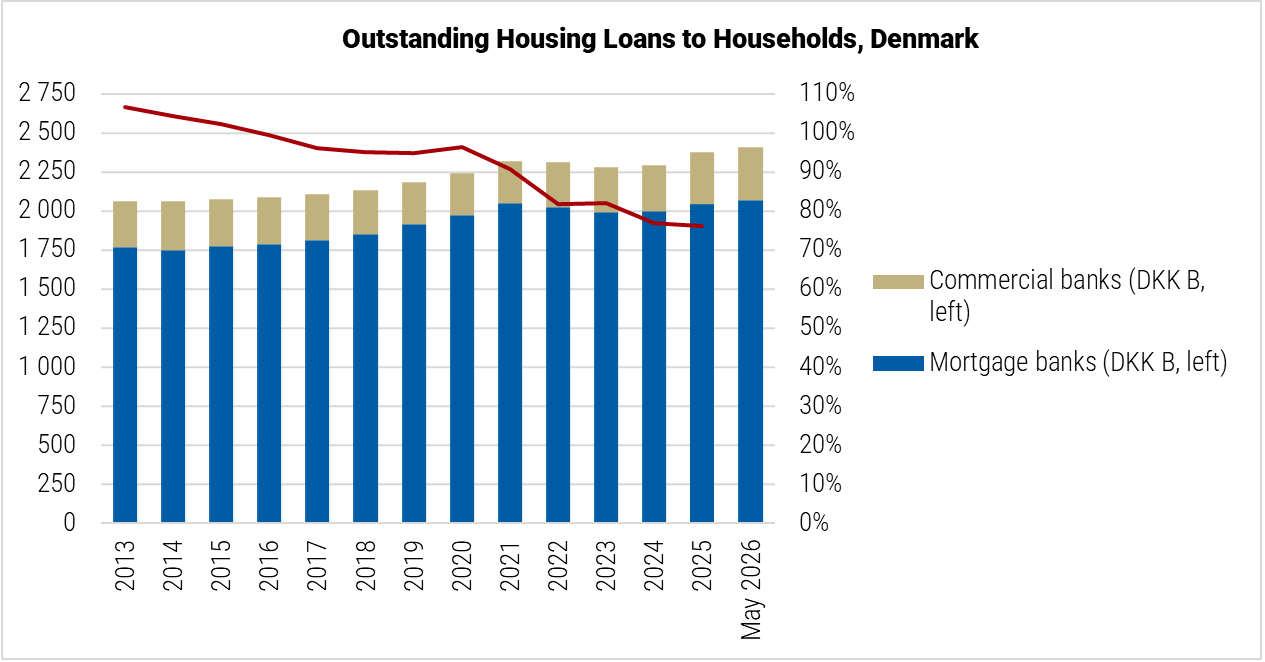
Overall, according to the most recent Eurostat figures, 39.2% of Denmark’s population resides in an owned property with an outstanding mortgage or housing loan. The total value of outstanding mortgage loans from mortgage banks and housing loans to households from commercial banks returned to growth, expanding by 0.7% in 2024 and 3.4% in 2025. As of May 2026, the nominal value of the combined stock stood at DKK 2.4 trillion (USD 375.8 billion), with nearly 86% of those being loans from mortgage banks. At the same time, the relative size of the market, as measured by the loan-to-GDP ratio, continued to decline, falling from 102.2% in 2015 to an estimated 76.1% in 2025.
Note: Based on domestic mortgage loans from mortgage banks to households (all types of properties) and domestic loans from banks to households for house purchase.
Data Sources: Nationalbanken, Statistics Denmark.
Economic and Social Factors
Economy Resilient, But Heading Into a Period of More Subdued Growth
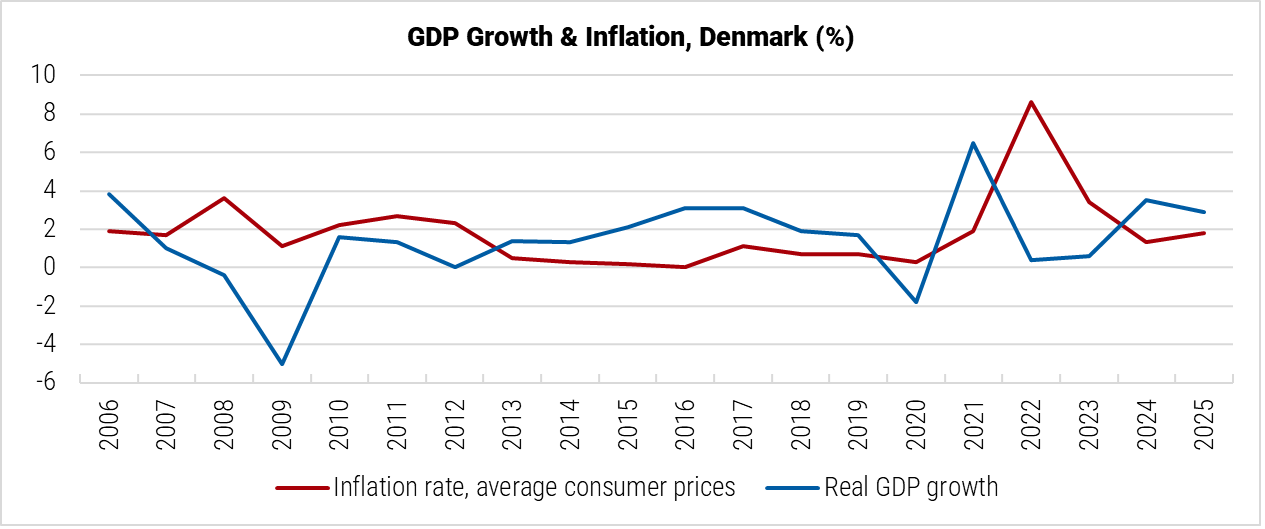
After a period of solid growth mainly driven by export activity (3.5% in 2024 and 2.9% in 2025), the Danish economy is forecast to slow down over the next two years, with real GDP growth projected by the European Commission to moderate to 1.9% in 2026 and 1.8% in 2027. Private and public consumption and investment are expected to become the main drivers of economic growth, replacing net exports.
“The war in the Middle East is now putting small cracks in the foundation of the Danish economy,” Nordea’s experts wrote, commenting on their latest economic forecast. “Despite the economy’s strong public finances, a large surplus on the balance of payments, historically high employment, and a long tradition of political stability and a willingness to undertake economic reforms, the conflict in the Middle East is now leaving its mark in the form of lower economic growth and higher inflation.”
Consumer price index (CPI) inflation in Denmark previously reached an average annual level of 1.8% in 2025 and has been most recently reported by Statistics Denmark at 1.9% in June 2026, up from just 0.8% in January and 0.7% in February of this year. Despite sharply higher oil and gas prices, the European Commission expects headline inflation to remain below 2% over the forecast period, partly due to a temporary lowering of electricity taxes to the EU’s minimum rate.
Data Source: IMF.
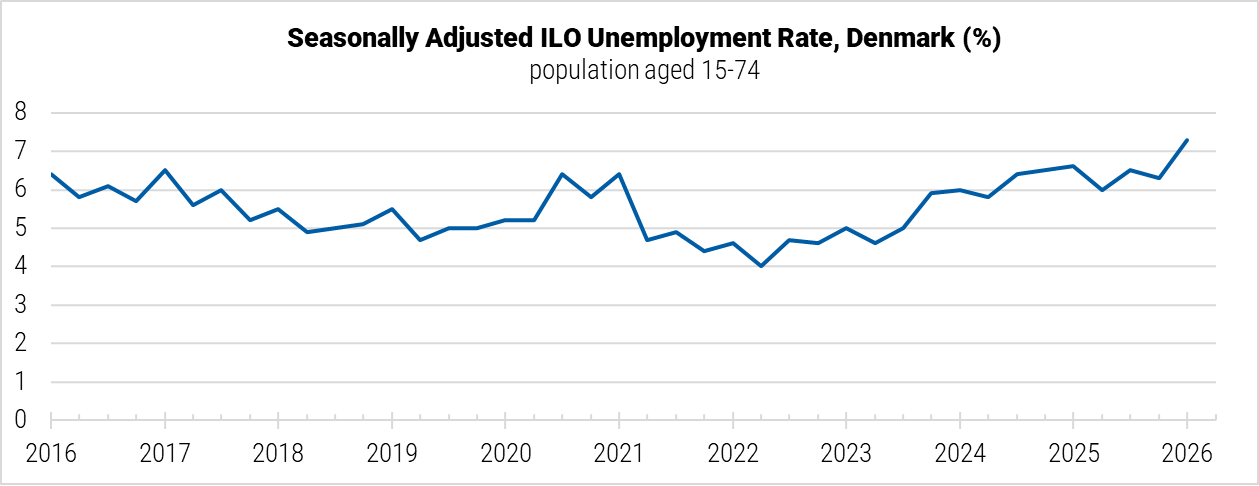
The country’s labor market remains broadly stable, while a slowdown is underway, with slower employment growth and slightly higher unemployment expected over the forecast horizon against the background of higher participation of older workers and international labor in the labor force. The seasonally adjusted ILO unemployment rate has been trending upwards since 2022, most recently reported by Statistics Denmark at 7.3% in Q1 2026, up from 6.6% a year ago and 6.0% two years ago. Register-based unemployment was reported at 3.1% in May 2026, up from 2.9% a year ago and two years ago. Despite recent inflationary pressures, the European Commission expects real wages in the country to continue growing over the next two years, supporting a pickup in private consumption.
Data Source: Statistics Denmark.
Contributing to its reputation as a wealthy and high-value-added economy, Denmark continues to maintain sound public finances. The country has recorded budget surpluses for several consecutive years, although the surplus narrowed from 4.5% of GDP in 2024 to 2.9% in 2025 and, according to the European Commission, is set to decline further to 0.9% in 2026 and 0.5% in 2027, mainly due to higher government consumption and investment, particularly in defence. Denmark has also kept its gross debt ratio below the European Union’s target threshold of 60% of GDP for over 20 years now. In 2025, gross public debt sat at 27.9% of GDP and is forecast to continue declining.
Overall, the Danish economy has proved resilient to geopolitical and trade uncertainties, and although this resilience is now being further challenged by the escalation in the Middle East, the foundation for continued growth is quite solid. During the first half of 2026, all three major rating agencies affirmed Denmark’s ‘AAA’ standing with a stable outlook.
Sources:
- Statistics Denmark
- Consumer Price Index: https://www.dst.dk/
- Key Figures for the National Accounts (GDP): https://www.dst.dk/
- EMU Debt and EMU Balance: https://www.dst.dk/
- Labor Force Survey (LFS): https://www.dst.dk/
- Unemployed Persons: https://www.dst.dk/
- Rent Indices: https://www.dst.dk/
- Construction Activity: https://www.dst.dk/
- Danmarks Nationalbank (Nationalbanken)
- Official Interest Rates: https://www.nationalbanken.dk/
- Lending: https://www.nationalbanken.dk/
- Robust Danish Economy in an Uncertain Global Landscape (DK): https://www.nationalbanken.dk/
- European Commission
- Economic Forecast for Denmark: https://economy-finance.ec.europa.eu/
- Distribution of Population by Tenure Status, Type of Household, and Income group: https://ec.europa.eu/
- International Monetary Fund
- Country Overview: Denmark: https://www.imf.org/
- Organization for Economic Co-operation and Development (OECD)
- OECD Economic Surveys: Denmark 2026: https://www.oecd.org/
- Association of Danish Mortgage Banks (Finans Danmark)
- Housing Statistics: https://finansdanmark.dk/
- Loan Offers for Home Purchases are Increasing More Slowly Than Previously (DK): https://finansdanmark.dk/
- New Mortgage Loans for Owner-Occupied Homes and Holiday Homes are Increasing (DK): https://finansdanmark.dk/
- In More and More Municipalities, It Has Become More Expensive to Own Than to Rent a Home (DK): https://finansdanmark.dk/
- Boligsiden
- See the Speed of the Housing Market Where You Live (DK): https://www.boligsiden.dk/
- Slightly Fewer Apartments Sold in Copenhagen’s Districts in the First Quarter… (DK): https://www.boligsiden.dk/
- Apartment Sales Slow Down in Copenhagen (DK): https://www.boligsiden.dk/
- Nordea
- Danish Economy Stands on Solid Foundation: https://www.nordea.com/
- Danish Economy is Now Being Hit by Conflict in the Middle East (DK): https://www.nordea.com/
- First Interest Rate Hike From the Danish Central Bank Since 2023: https://corporate.nordea.com/
- New House Price Forecast: Prices Are Expected to Increase Further in 2026 and 2027 (DK): https://www.nordea.com/
- Dagens Bygger
- DI: No Prospect of a New Construction Boom in the Coming Years (DK): https://dagensbyggeri.dk/
- Colliers
- Colliers Denmark Market Report 2026: https://www.colliers.com/
- Cushman & Wakefield | RED
- RED Danish Investment Atlas 2026: https://issuu.com/
- EjendomDanmark
- New Analysis Predicts Housing Shortage in Copenhagen… (DK): https://ejd.dk/
- Fitch Ratings
- Fitch Affirms Denmark at 'AAA'; Outlook Stable: https://www.fitchratings.com/
- S&P
- Denmark 'AAA/A-1+' Ratings Affirmed; Outlook Stable: https://www.spglobal.com/
- Moody’s
- Moody's Affirms the Aaa Ratings of Denmark: https://ratings.moodys.com/